
Asia-Pacific Toluene Diisocyanate Market Outlook to 2030
Region:Asia
Author(s):Paribhasha Tiwari
Product Code:KROD8583
November 2024
100
About the Report
Asia-Pacific Toluene Diisocyanate Market Overview
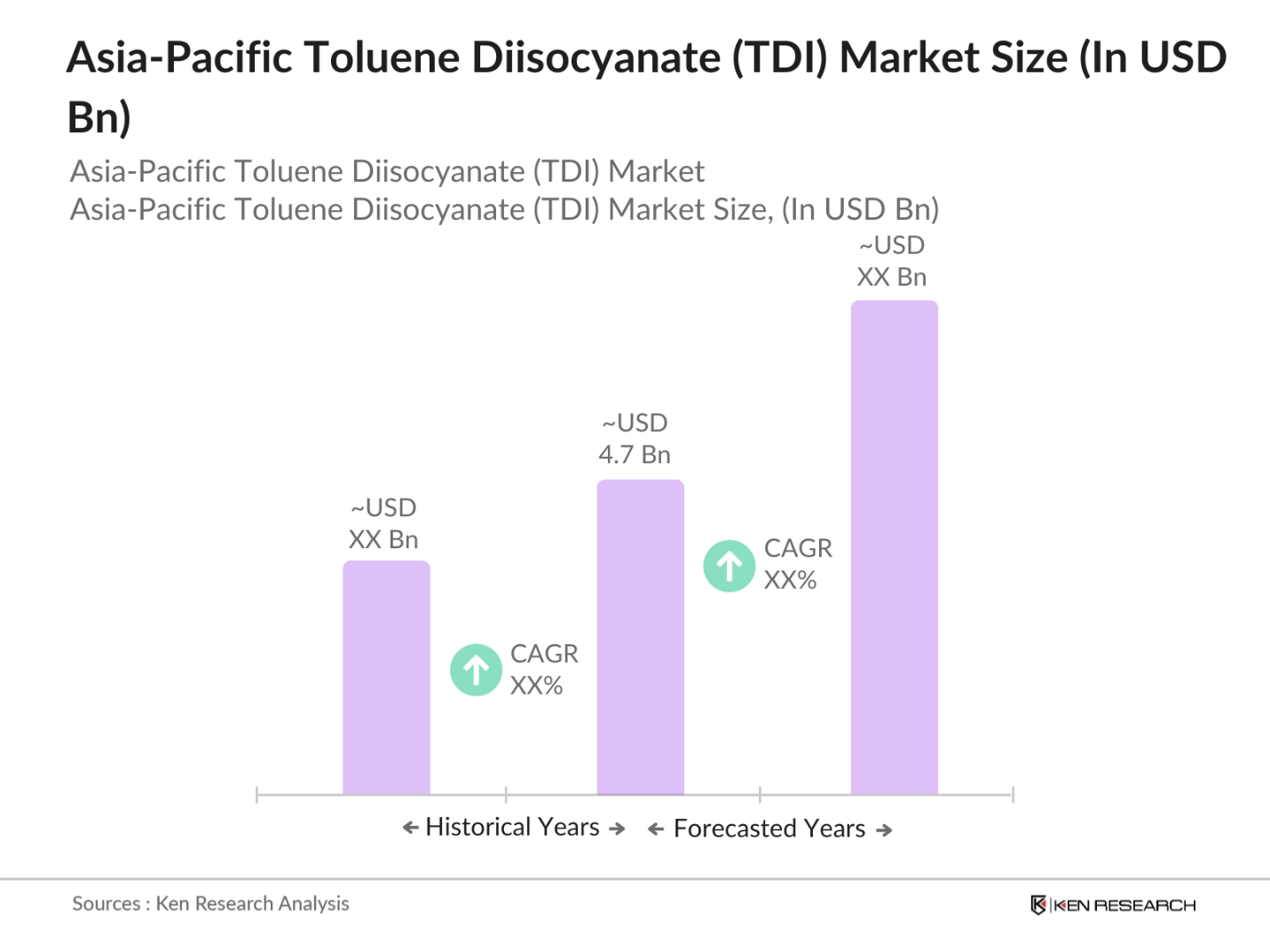
- The Asia-Pacific Toluene Diisocyanate (TDI) market, valued at USD 4.7 billion in 2023, is driven by significant demand from the polyurethane industry, especially for flexible foams used in furniture, automotive, and construction sectors. The consistent rise in construction activities and infrastructure development across key APAC regions, coupled with the booming automotive industry, is bolstering the demand for TDI. Regulatory frameworks encouraging sustainable manufacturing practices are also influencing the growth trajectory of the TDI market in the region.
- Countries like China, India, and Japan dominate the Asia-Pacific TDI market due to their extensive industrial base and high consumption in downstream sectors. China, being the largest producer and consumer of polyurethane products globally, benefits from its strong manufacturing capabilities, well-established chemical industry, and government initiatives supporting industrial growth. Similarly, Japans advanced chemical sector and Indias rapid industrialization further boost the demand for TDI in these countries.
- Under the 14th Five-Year Plan, China allocated $200 billion for the chemical industry between 2022 and 2027, with a focus on expanding production capacities and reducing reliance on imported chemicals. TDI production facilities benefited from this initiative, with new plants and expansions planned in major industrial hubs like Tianjin and Shanghai, reinforcing Chinas position as a key player in the TDI market.
Asia-Pacific Toluene Diisocyanate Market Segmentation
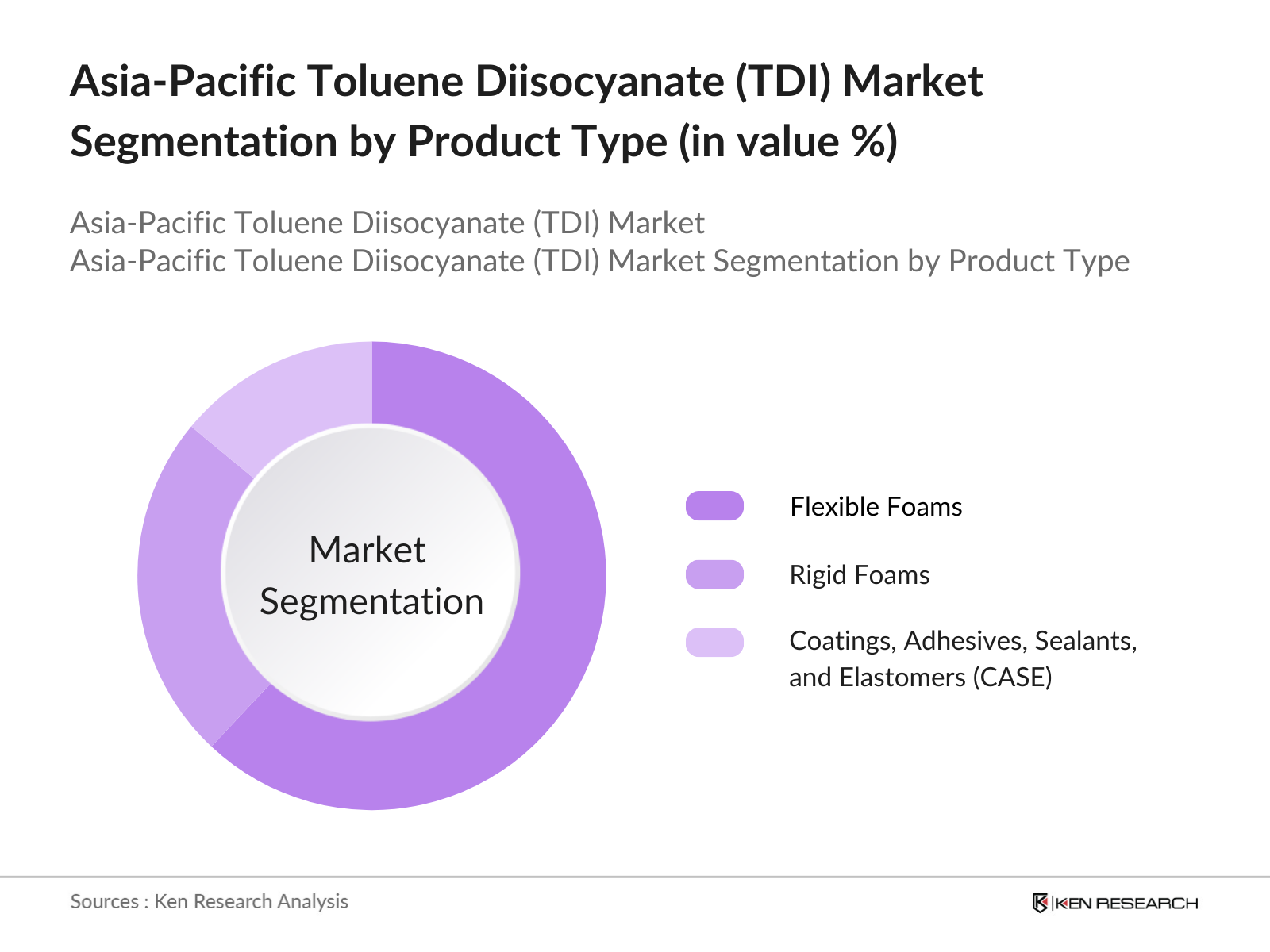
- By Product Type: The Asia-Pacific Toluene Diisocyanate market is segmented by product type into Flexible Foams, Rigid Foams, and Coatings, Adhesives, Sealants, and Elastomers (CASE). Recently, Flexible Foams have dominated the market share under this segmentation. The flexibility and versatility of flexible foams make them ideal for use in furniture, bedding, and automotive seat cushions. The surge in the demand for consumer comfort, as well as the growth in the automotive and furniture industries, have contributed to the rising use of flexible foams in the region.
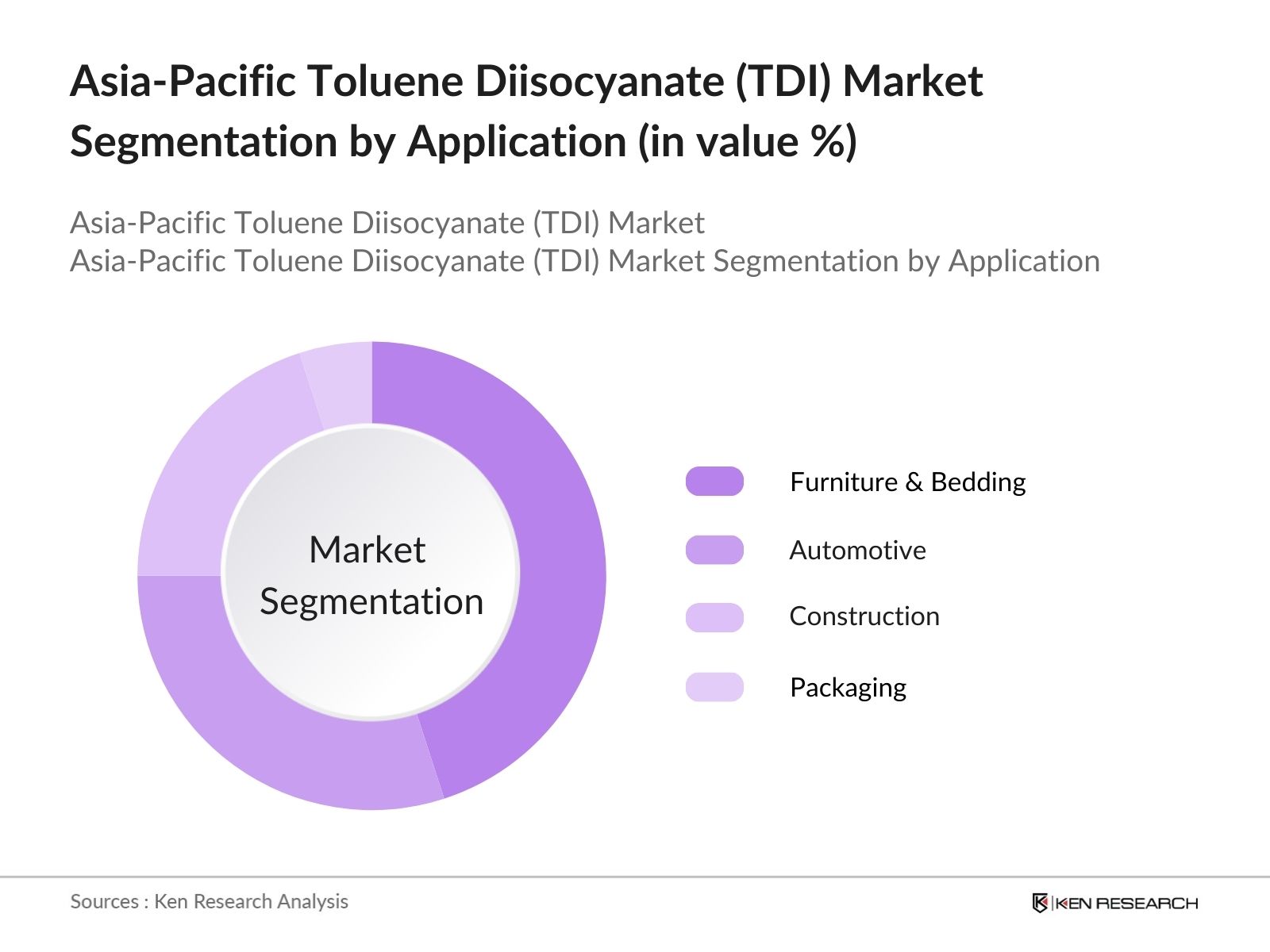
- By Application: The Asia-Pacific Toluene Diisocyanate market is also segmented by application into Furniture & Bedding, Automotive, Construction, and Packaging. Furniture & Bedding hold a dominant position in the market, as TDI-based flexible foams are essential components in furniture cushions and mattresses. With rising urbanization and growing demand for household furniture in emerging economies like China and India, this segment continues to witness substantial growth.
Asia-Pacific Toluene Diisocyanate Market Competitive Landscape
The Asia-Pacific TDI market is dominated by key global and regional players, with significant consolidation of market shares among a few major companies. These companies leverage their advanced R&D capabilities, strategic partnerships, and large-scale production capacities to maintain a competitive edge. Additionally, technological advancements in chemical manufacturing processes and the emphasis on sustainability initiatives have reshaped the competitive landscape.
|
Company |
Year of Establishment |
Headquarters |
Production Capacity |
R&D Investments |
Global Reach |
Sustainability Initiatives |
Strategic Partnerships |
Technological Expertise |
|
BASF SE |
1865 |
Ludwigshafen, Germany |
- | - | - | - | - | - |
|
Covestro AG |
2015 |
Leverkusen, Germany |
- | - | - | - | - | - |
|
Wanhua Chemical Group Co. Ltd. |
1978 |
Yantai, China |
- | - | - | - | - | - |
|
Huntsman Corporation |
1970 |
Texas, USA |
- | - | - | - | - | - |
|
Mitsui Chemicals, Inc. |
1997 |
Tokyo, Japan |
- | - | - | - | - | - |
Asia-Pacific Toluene Diisocyanate (TDI) Market Analysis
Market Growth Drivers
- Increasing Demand for Polyurethane Products: The TDI market in the Asia-Pacific region is experiencing growth due to the increasing demand for polyurethane-based products, such as foams, coatings, and elastomers. In 2023, the production of polyurethane products in China surpassed 1.15 million metric tons, driven by applications in furniture, insulation, and packaging. This surge in demand for flexible and rigid polyurethane foams is supported by robust industrial activity, particularly in the construction and consumer goods sectors, bolstering the demand for TDI as a key raw material.
- Expanding Automotive Industry: The automotive sector is a major consumer of TDI, especially for producing seat cushions, interior trims, and other flexible foam components. As of 2024, China alone manufactured over 26 million vehicles annually, and India crossed the 5 million marks in vehicle production, with increasing focus on lightweight materials for fuel efficiency. TDI is crucial for manufacturing polyurethane foams that provide comfort and weight reduction, making the automotive industry's growth a critical driver of the TDI market.
- Government Regulations Favoring Industrial Growth: Regulatory frameworks in key APAC countries are designed to support industrial expansion, including the production of chemicals like TDI. In 2022, China's 14th Five-Year Plan promoted investments in the chemical sector, allocating substantial funds towards expanding chemical manufacturing capacities, which benefited the TDI market. Similarly, India has implemented Production-Linked Incentive (PLI) schemes, providing incentives for domestic chemical production, directly influencing TDI production and consumption.
Market Challenges
-
Price Volatility of Raw Materials The price of TDI is highly sensitive to fluctuations in the prices of raw materials such as toluene. In 2023, the average price of toluene in APAC exceeded $950 per ton, influenced by global crude oil price swings and supply chain disruptions. This volatility in raw material costs directly impacts the production costs of TDI, making it challenging for manufacturers to maintain stable pricing in the market.
- Stringent Environmental Regulations Environmental concerns are imposing challenges on the TDI market due to strict emissions and waste disposal regulations in major producing countries. For example, China's environmental policy in 2023 included stricter air and water pollution standards for chemical plants, which increased the compliance costs for TDI manufacturers. In Japan, the government-imposed limitations on volatile organic compounds (VOCs), further complicating the production process for TDI.
Asia-Pacific Toluene Diisocyanate Market Future Outlook
Over the next five years, the Asia-Pacific Toluene Diisocyanate market is expected to experience steady growth driven by increasing demand for polyurethane products across key end-use industries like automotive, construction, and consumer goods. Continuous investments in sustainable chemical manufacturing, advancements in bio-based TDI alternatives, and government initiatives to regulate environmental impacts will further propel market development. The focus on technological innovations and green manufacturing practices will also drive the adoption of TDI in eco-friendly applications, contributing to the market's expansion.
Market Opportunities
- Growth in Bio-Based and Sustainable TDI Alternatives The shift towards sustainability in the chemical industry is creating opportunities for the development of bio-based TDI. In 2024, several governments in APAC, such as Japan and South Korea, announced incentives for green chemical technologies, leading to investments in bio-based isocyanates production facilities. The adoption of bio-TDI is gaining momentum as companies seek to reduce their carbon footprints and comply with stringent environmental regulations.
- Expansion in Emerging Economies Countries like Vietnam, Indonesia, and the Philippines are emerging as key markets for TDI, fueled by rapid industrialization and increasing demand for automotive and construction products. By 2023, Vietnams automotive manufacturing sector had grown by $10 billion in value, creating significant demand for polyurethane foams used in vehicle production. Similarly, infrastructure investments in Southeast Asia are providing a fertile ground for TDI applications in insulation and coatings.
Scope of the Report
|
By Product Type |
Flexible Foams Rigid Foams Coatings Adhesives Sealants Elastomers (CASE) |
|
By Application |
Furniture & Bedding Automotive Construction Packaging |
|
By Technology |
Phosgene-Based Process Non-Phosgene-Based Process |
|
By Raw Material |
Toluene Nitric Acid Sulfuric Acid Chlorine |
|
By Region |
China Japan India Australia South Korea |
Products
Key Target Audience
Polyurethane Product Manufacturers
Automotive Industry Players
Furniture and Bedding Manufacturers
Government and Regulatory Bodies (e.g., Ministry of Environment, Forestry and Climate Change, India)
Chemical Industry Investors
Venture Capital Firms
Raw Material Suppliers
Construction Companies
Companies
Players Mentioned in the Report:
BASF SE
Covestro AG
Wanhua Chemical Group Co. Ltd.
Huntsman Corporation
Mitsui Chemicals, Inc.
The Dow Chemical Company
Evonik Industries AG
Perstorp Group
Vencorex Chemicals
Hanwha Solutions
Table of Contents
1. Asia-Pacific Toluene Diisocyanate (TDI) Market Overview
1.1. Definition and Scope
1.2. Market Taxonomy
1.3. Market Growth Rate
1.4. Market Segmentation Overview
2. Asia-Pacific Toluene Diisocyanate (TDI) Market Size (In USD Bn)
2.1. Historical Market Size
2.2. Year-On-Year Growth Analysis
2.3. Key Market Developments and Milestones
3. Asia-Pacific Toluene Diisocyanate (TDI) Market Analysis
3.1. Growth Drivers (Market-Specific Parameters: Chemical Industry Growth, Demand from Polyurethane Sector, Automotive Industry Demand, Regulatory Environment)
3.1.1. Increasing Demand for Polyurethane Products
3.1.2. Expanding Automotive Industry
3.1.3. Urbanization and Infrastructure Development
3.1.4. Government Regulations Favoring Industrial Growth
3.2. Market Challenges (Market-Specific Parameters: Raw Material Volatility, Environmental Concerns, Supply Chain Bottlenecks, Regulatory Restrictions)
3.2.1. Price Volatility of Raw Materials
3.2.2. Stringent Environmental Regulations
3.2.3. Supply Chain Disruptions in APAC Region
3.2.4. Competition from Alternative Chemicals
3.3. Opportunities (Market-Specific Parameters: Innovation in Bio-Based TDI, M&A Activity, Investment in R&D, Technological Advancements)
3.3.1. Growth in Bio-Based and Sustainable TDI Alternatives
3.3.2. Expansion in Emerging Economies
3.3.3. Collaborative Research & Innovation
3.3.4. Strategic Partnerships with Automotive Giants
3.4. Trends (Market-Specific Parameters: R&D in Eco-Friendly TDI, Integration with Circular Economy, Digitalization in Chemical Manufacturing, Supply Chain Transparency)
3.4.1. Increased Focus on Sustainable and Green Chemicals
3.4.2. Circular Economy Adoption in TDI Manufacturing
3.4.3. Digital Solutions for Efficient Manufacturing
3.4.4. Supply Chain Transparency Initiatives
3.5. Government Regulations (Market-Specific Parameters: Emission Standards, Safety Regulations, Environmental Permits, Trade Policies)
3.5.1. National Chemical Safety Standards
3.5.2. Environmental Permitting for Manufacturing Plants
3.5.3. APAC Regional Emission Standards
3.5.4. Import-Export Trade Policies on Chemical Products
3.6. SWOT Analysis (Market-Specific Parameters: Strengths in Raw Material Availability, Weaknesses in Compliance, Opportunities in Emerging Economies, Threats from Regulations)
3.7. Stakeholder Ecosystem (Market-Specific Parameters: Suppliers, Manufacturers, Distributors, End-Users)
3.8. Porters Five Forces Analysis (Market-Specific Parameters: Supplier Bargaining Power, Buyer Bargaining Power, Industry Rivalry, Threat of Substitutes, Threat of New Entrants)
3.9. Competition Ecosystem (Market-Specific Parameters: Market Fragmentation, Key Players, Innovation Intensity, Strategic Alliances)
4. Asia-Pacific Toluene Diisocyanate (TDI) Market Segmentation
4.1. By Product Type (In Value %)
4.1.1. Flexible Foams
4.1.2. Rigid Foams
4.1.3. Coatings, Adhesives, Sealants, and Elastomers (CASE)
4.2. By Application (In Value %)
4.2.1. Furniture and Bedding
4.2.2. Automotive
4.2.3. Construction
4.2.4. Packaging
4.3. By Technology (In Value %)
4.3.1. Phosgene-Based Process
4.3.2. Non-Phosgene-Based Process
4.4. By Raw Material (In Value %)
4.4.1. Toluene
4.4.2. Nitric Acid
4.4.3. Sulfuric Acid
4.4.4. Chlorine
4.5. By Region (In Value %)
4.5.1. China
4.5.2. Japan
4.5.3. India
4.5.4. Australia
4.5.5. South Korea
5. Asia-Pacific Toluene Diisocyanate (TDI) Market Competitive Analysis
5.1 Detailed Profiles of Major Companies
5.1.1. BASF SE
5.1.2. Covestro AG
5.1.3. Wanhua Chemical Group Co. Ltd
5.1.4. Huntsman Corporation
5.1.5. Mitsui Chemicals, Inc.
5.1.6. The Dow Chemical Company
5.1.7. Evonik Industries AG
5.1.8. Perstorp Group
5.1.9. Vencorex Chemicals
5.1.10. Hanwha Solutions
5.1.11. UBE Industries, Ltd.
5.1.12. Korea Kumho Petrochemical Co. Ltd.
5.1.13. Sadara Chemical Company
5.1.14. Tosoh Corporation
5.1.15. Cangzhou Dahua Group Co., Ltd.
5.2 Cross Comparison Parameters (No. of Employees, Headquarters, Inception Year, Revenue, Production Capacity, Distribution Channels, R&D Investments, Sustainability Initiatives)
5.3 Market Share Analysis
5.4 Strategic Initiatives
5.5 Mergers and Acquisitions
5.6 Investment Analysis
5.7 Venture Capital Funding
5.8 Government Grants
5.9 Private Equity Investments
6. Asia-Pacific Toluene Diisocyanate (TDI) Market Regulatory Framework
6.1 Environmental Standards
6.2 Compliance Requirements
6.3 Certification Processes
7. Asia-Pacific Toluene Diisocyanate (TDI) Future Market Size (In USD Bn)
7.1 Future Market Size Projections
7.2 Key Factors Driving Future Market Growth
8. Asia-Pacific Toluene Diisocyanate (TDI) Future Market Segmentation
8.1 By Product Type (In Value %)
8.2 By Application (In Value %)
8.3 By Technology (In Value %)
8.4 By Raw Material (In Value %)
8.5 By Region (In Value %)
9. Asia-Pacific Toluene Diisocyanate (TDI) Market Analysts Recommendations
9.1 TAM/SAM/SOM Analysis
9.2 Customer Cohort Analysis
9.3 Marketing Initiatives
9.4 White Space Opportunity Analysis
Research Methodology
Step 1: Identification of Key Variables
In this phase, we conducted a thorough analysis of the Asia-Pacific Toluene Diisocyanate market's ecosystem. Through extensive secondary research, we identified key stakeholders, such as TDI manufacturers, distributors, and end-users, as well as the critical variables affecting market dynamics, such as production capacity, environmental regulations, and technological innovations.
Step 2: Market Analysis and Construction
The next step involved analyzing historical data on the Asia-Pacific Toluene Diisocyanate market, including sales trends, production output, and the distribution network across various sectors. This analysis provided insights into the revenue-generating capacities of different market segments and their growth potential.
Step 3: Hypothesis Validation and Expert Consultation
Industry experts, including chemical engineers and market analysts, were consulted to validate key market hypotheses. These consultations offered real-time insights into market trends, technological advancements, and the challenges faced by manufacturers in meeting the growing demand for TDI.
Step 4: Research Synthesis and Final Output
In this final step, we synthesized the research findings, using both top-down and bottom-up approaches to triangulate the data. A comprehensive analysis was produced, supported by industry insights, market data, and stakeholder input, to ensure the accuracy and reliability of the market estimates.
Frequently Asked Questions
01. How big is the Asia-Pacific Toluene Diisocyanate market?
The Asia-Pacific Toluene Diisocyanate market is valued at USD 4.7 billion in 2023, driven by the increasing demand for polyurethane products across industries like automotive, construction, and consumer goods.
02. What are the key growth drivers of the Asia-Pacific Toluene Diisocyanate market?
Key drivers include the growing demand for flexible foams in furniture and automotive industries, increasing urbanization leading to higher construction activities, and government support for industrial development across APAC countries.
03. Who are the major players in the Asia-Pacific Toluene Diisocyanate market?
Major players include BASF SE, Covestro AG, Wanhua Chemical Group Co. Ltd., Huntsman Corporation, and Mitsui Chemicals, Inc., dominating the market with their large-scale production capacities and innovative product portfolios.
04. What challenges are faced by the Asia-Pacific Toluene Diisocyanate market?
The market faces challenges such as raw material price volatility, stringent environmental regulations regarding chemical manufacturing, and competition from bio-based alternatives.
Why Buy From Us?

What makes us stand out is that our consultants follows Robust, Refine and Result (RRR) methodology. i.e. Robust for clear definitions, approaches and sanity checking, Refine for differentiating respondents facts and opinions and Result for presenting data with story

We have set a benchmark in the industry by offering our clients with syndicated and customized market research reports featuring coverage of entire market as well as meticulous research and analyst insights.

While we don't replace traditional research, we flip the method upside down. Our dual approach of Top Bottom & Bottom Top ensures quality deliverable by not just verifying company fundamentals but also looking at the sector and macroeconomic factors.

With one step in the future, our research team constantly tries to show you the bigger picture. We help with some of the tough questions you may encounter along the way: How is the industry positioned? Best marketing channel? KPI's of competitors? By aligning every element, we help maximize success.

Our report gives you instant access to the answers and sources that other companies might choose to hide. We elaborate each steps of research methodology we have used and showcase you the sample size to earn your trust.

If you need any support, we are here! We pride ourselves on universe strength, data quality, and quick, friendly, and professional service.