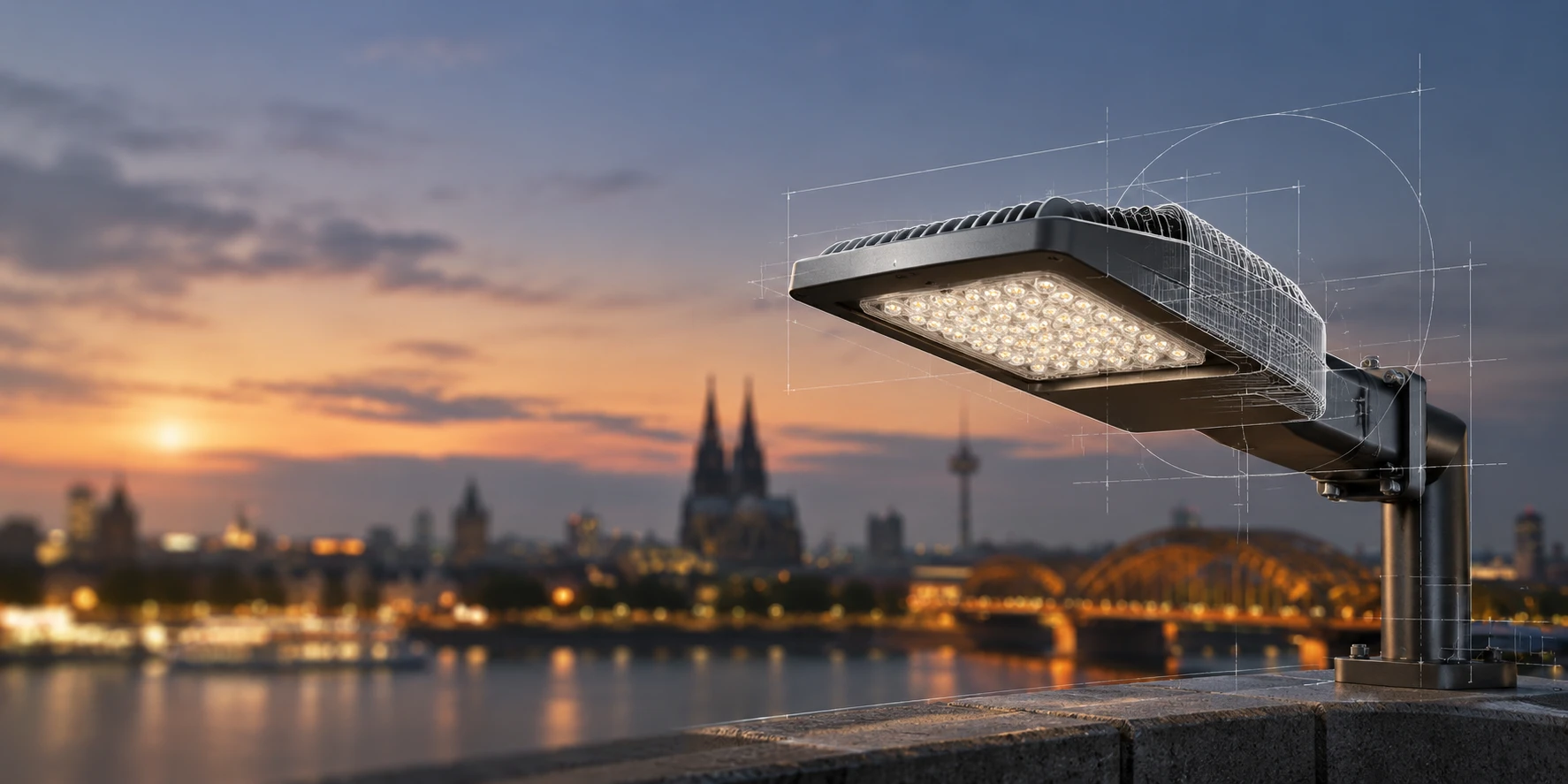
CHAPTER 1 - MARKET SUMMARY
Market Overview
The Germany LED Lighting Market serves residential replacement demand, professional building projects, industrial facilities and public infrastructure. Germany had approximately 44 million dwellings in 2025, creating a substantial installed base for lamps, luminaires and smart controls. Demand is increasingly determined by lifecycle electricity savings, product reliability and compatibility with building-management systems rather than by initial hardware price alone.
North Rhine-Westphalia represents the largest demand cluster because it combines Germany's highest state population with dense commercial property, municipal infrastructure, logistics and industrial activity. Germany also has approximately 1.98 million heated non-residential buildings covered by building-energy requirements. This concentration supports project-scale sales through electrical wholesalers, engineering contractors and direct specification relationships.
Market Value
USD 6,502 million
2025
Dominant Region
North Rhine-Westphalia
2025
Dominant Segment
Luminaires and Fixtures
largest revenue segment, 2025
Total Number of Players
120
Future Outlook
The Germany LED Lighting Market is projected to increase from USD 6,502 million in 2025 to USD 10,490 million by 2031. The historical CAGR was 9.56% during 2020-2025, supported by the transition from conventional lamps, pandemic-era residential upgrades, elevated electricity costs and accelerated commercial retrofits. Forecast growth moderates to 8.30% as basic LED penetration approaches saturation, but revenue continues expanding through premium luminaires, connected systems, sensor integration, lighting-as-a-service contracts and the replacement of remaining fluorescent infrastructure. Retrofit applications remain the largest project pool because Germany's established building stock substantially exceeds annual new construction.
Forecast value growth will outpace unit-volume growth as customers shift from individual lamps toward integrated luminaires, DALI-2 controls, wireless gateways, occupancy sensors and data-enabled asset management. Public-building renovation obligations, the revised Energy Performance of Buildings Directive and Germany's climate-neutrality target for 2045 strengthen medium-term demand visibility. Margin pools will migrate toward specification support, controls software, commissioning and maintenance rather than commoditized replacement bulbs. Suppliers that combine interoperable hardware with measurable energy savings should outperform, while businesses concentrated in undifferentiated lamps face pricing pressure, long replacement cycles and Asian import competition.
8.30%
Forecast CAGR
$10,490 Mn
2030 Projection
Base Year
2025
Historical Period
2020-2025
Forecast Period
2026-2031
Historical CAGR
9.56%
CHAPTER 2 - SCOPE OF REPORT
Scope of the Market
CHAPTER 3 - Key Stakeholders
Key Target Audience
Key stakeholders who can leverage this market analysis for investment, strategy and operational planning.
Investors
CAGR, margin migration, consolidation, recurring revenue, capital efficiency
Corporates
energy savings, retrofit payback, procurement, controls, lifecycle cost
Government
public renovation, ecodesign, WEEE compliance, infrastructure efficiency, resilience
Operators
installation productivity, interoperability, maintenance, commissioning, service contracts
Financial institutions
performance contracting, project finance, savings verification, counterparty risk
CHAPTER 4 - Market Size & Growth
Market Size, Growth Forecast and Trends
This section evaluates the historical market size, analyzes year-over-year growth dynamics, and presents forecast projections supported by market performance indicators and demand-side drivers.
Historical & Projected Market Size ($ Million)
Year-over-Year Growth Rate (%)
Market Value vs Volume Growth (%)
Historical Market Performance (2020-2025)
Historical growth peaked at 10.18% in 2023 as the energy-price crisis improved retrofit payback periods and EU restrictions accelerated substitution of fluorescent technologies. Growth remained above 10% in 2024 despite weaker German construction activity because replacement demand, connected controls and public-sector projects offset lower new-build volumes. Unit shipments expanded more slowly than revenue throughout the period, demonstrating that product mix shifted toward complete luminaires, controls and professional systems. Commercial, industrial and public projects accounted for the majority of incremental revenue, while residential replacement demand provided a broad recurring base.
Forecast Market Outlook (2026-2031)
The forecast CAGR is 8.30%, with annual expansion remaining broadly stable as regulatory demand and technology upgrades compensate for mature basic LED penetration. The value-volume growth spread is expected to remain above four percentage points through 2030 because connected lighting, sensor integration, modular luminaires and project services lift average revenue per unit. New installations should grow faster than legacy construction activity as zero-emission building requirements enter procurement specifications. Roadway lighting, smart commercial systems, horticultural lighting and human-centric solutions are expected to record above-market growth, while standard non-connected lamps become increasingly price competitive.
CHAPTER 5 - Market Data
Market Breakdown
The Germany LED Lighting Market is transitioning from a hardware replacement cycle toward higher-value lighting systems that integrate controls, sensing and building-performance data. For CEOs and investors, the key issue is whether revenue growth converts into defensible software, specification and service margins.
Year | Market Size (USD Mn) | YoY Growth (%) | Estimated Volume (Mn Units) | Average Revenue per Unit (USD) | Connected-System Revenue Share (%) | Period |
|---|---|---|---|---|---|---|
| 2020 | $4,120 Mn | +- | 128.0 | 32.2 | Forecast | |
| 2021 | $4,480 Mn | +8.74% | 132.6 | 33.8 | Forecast | |
| 2022 | $4,910 Mn | +9.60% | 138.4 | 35.5 | Forecast | |
| 2023 | $5,410 Mn | +10.18% | 144.8 | 37.4 | Forecast | |
| 2024 | $5,960 Mn | +10.17% | 150.2 | 39.7 | Forecast | |
| 2025 | $6,502 Mn | +9.09% | 156.0 | 41.7 | Forecast | |
| 2026F | $7,041 Mn | +8.29% | 162.4 | 43.4 | Forecast | |
| 2027F | $7,626 Mn | +8.31% | 169.1 | 45.1 | Forecast | |
| 2028F | $8,259 Mn | +8.30% | 176.0 | 46.9 | Forecast | |
| 2029F | $8,944 Mn | +8.29% | 183.3 | 48.8 | Forecast | |
| 2030F | $9,686 Mn | +8.30% | 190.8 | 50.8 | Forecast | |
| 2031F | $10,490 Mn | +8.30% | 198.6 | 52.8 | Forecast |
Estimated Volume
156.0 million units, 2025, Germany. Volume growth remains below value growth because durable LED luminaires can operate for 50,000 hours or more, extending replacement cycles and shifting strategic emphasis toward project wins and upgrade services.
Average Revenue per Unit
USD 41.7 per unit, 2025, Germany. Higher project values reflect increased use of sensors, drivers, optical systems and controls. EU ecodesign rules separately regulate light sources and control gear, reinforcing the importance of verified system performance.
Connected-System Revenue Share
28%, 2025, Germany. Connected lighting benefits from wider IoT adoption; 15% of EU internet users used connected energy-management systems, meters or smart lights in 2024. Suppliers can monetize gateways, commissioning and recurring software support.
CHAPTER 6 - Segmentation
Market Segmentation Framework
Comprehensive analysis across key dimensions providing insights into market structure, customer requirements, pricing tiers and distribution patterns.
No of Segments
7
Dominant Segment
Product Type
Fastest Growing Segment
Technology
Product Type
Application
End User
Technology
Price Tier
Distribution Channel
Geography
Key Segmentation Takeaways
Comprehensive analysis across all extracted segmentation dimensions provides a basis for revenue allocation, pricing decisions, channel strategy and competitive benchmarking.
Product Type
LED luminaires form the dominant product pool because commercial, industrial, architectural and public projects increasingly replace complete fixtures rather than individual light sources. Luminaires capture value from optics, thermal design, drivers, housings and controls. Within this dimension, integrated professional luminaires command the strongest specification influence and provide greater differentiation than standardized lamps.
Technology
Smart and Connected LED is the fastest-growing technology group as building owners integrate occupancy sensing, daylight harvesting, DALI-2, wireless controls and energy dashboards. The shift expands addressable revenue beyond fixtures into gateways, commissioning and lifecycle services. Human-Centric and Tunable LED also gains relevance in offices, education and healthcare where visual comfort and workplace outcomes influence procurement.
CHAPTER 7 - Regional Analysis
Regional Analysis
Germany ranks second among the five largest Western European LED-lighting markets, behind the United Kingdom, while maintaining the strongest combination of industrial demand, domestic engineering capability and regulatory-led retrofit potential. High electricity prices and a large non-residential building stock support continued conversion to efficient, connected lighting.
Focus Country Ranking
2nd
Focus Country Market Size (2025)
USD 6,502 Mn
Focus Country CAGR (2026-2031)
8.30%
Focus Country Ranking
2nd
Focus Country Market Size (2025)
USD 6,502 Mn
Focus Country CAGR (2026-2031)
8.30%
Regional Analysis (Current Year)
Market Position
Germany's USD 6,502 million market ranks second among selected peers and benefits from approximately 44 million dwellings plus nearly 2 million heated non-residential buildings requiring continuous modernization.
Growth Advantage
Germany's 8.30% forecast CAGR exceeds the United Kingdom's estimated 7.60% and France's 7.40%, positioning Germany as the growth leader among the largest Western European country markets.
Competitive Strengths
Germany combines EUR 0.2264 per kWh non-household electricity prices, a 2045 climate-neutrality target and around 120 organized lighting companies, strengthening demand for premium efficiency and connected controls.
CHAPTER 8 - INDUSTRY ANALYSIS
Growth Drivers, Challenges & Opportunities
Comprehensive analysis of key factors shaping the Germany LED Lighting Market, including growth catalysts, operational challenges and emerging opportunities across manufacturing, distribution and end-user segments.
Growth Drivers
Fluorescent-Lamp Phase-Out and Mandatory Efficiency Standards
- T5 and T8 fluorescent-lamp restrictions from August 2023 (European Union) accelerated conversion of installed linear-lighting systems, benefiting LED-tube, retrofit-kit and full-luminaire suppliers.
- Ecodesign requirements applying since September 2021 (European Union) establish efficiency and durability thresholds, reducing market access for poorly documented products and favoring suppliers with testing infrastructure.
- Energy-label rescaling implemented in 2021 (European Union) improves product comparability, enabling professional buyers to incorporate verified efficiency into procurement and total-cost-of-ownership models.
High Electricity Prices Improve Retrofit Economics
- German household electricity prices reached EUR 0.3869 per kWh (2025, Germany), maintaining consumer interest in efficient lighting despite already high LED penetration.
- Replacing incandescent technology can reduce lighting electricity costs by up to 80% (Germany, institutional guidance), supporting short payback periods where operating hours are high.
- Non-residential buildings account for approximately 36% of building end-energy consumption (Germany, 2025 study), concentrating retrofit value in offices, logistics, retail and industrial sites.
Building Decarbonization and Public-Sector Renovation
- The revised Energy Efficiency Directive targets renovation of 3% of public-building floor area annually (European Union), supporting recurring demand for LED fixtures, controls and commissioning.
- The revised EPBD supports an 11.7% reduction in EU energy consumption by 2030 (European Union), making lighting controls relevant to building-performance planning and certification.
- Germany recorded 6,521 non-residential energy-consulting support cases in 2024, expanding the pipeline of efficiency audits that can identify lighting upgrades.
Market Challenges
Long Product Lifetimes Reduce Replacement Frequency
- A 50,000-hour LED luminaire (industry benchmark) can operate for approximately 25 years in an office used 2,000 hours annually, reducing recurring hardware demand.
- As LEDs already dominate German lamp sales in 2025 (Germany), future growth depends less on first-time conversion and more on controls, redesign and performance upgrades.
- Manufacturers focused on basic replacement lamps face unit-price compression because long useful lives reduce repurchase frequency, shifting value toward differentiated luminaires and services. 68.37% luminaire share (2025, Germany) demonstrates this transition.
Construction Weakness and Delayed Capital Expenditure
- Weak new-build activity reduces demand for complete lighting packages, forcing manufacturers to prioritize retrofit specifications and renovation-linked channels. Germany issued 68,700 dwelling permits in Q1 2023, down 25.7%.
- The non-residential construction-price index for commercial operating buildings reached 131.8 in Q4 2024 (Germany), constraining project budgets and increasing value-engineering pressure.
- Higher financing and construction costs encourage buyers to defer non-essential architectural upgrades, benefiting products with documented payback while weakening discretionary decorative categories. 2024 base index above 130 (Germany) indicates persistent cost escalation.
Import Competition, Compliance and Component Exposure
- Economy-tier lamps and modules face aggressive international pricing, limiting gross-margin expansion unless suppliers differentiate through compliance, warranties or channel service. Luminaires represented 68.37% of 2025 revenue, reflecting movement away from commoditized lamps.
- Manufacturers and importers must satisfy ecodesign, energy-labelling and EPREL obligations applying from September 2021 (European Union), increasing testing and documentation expenses.
- Connected products add cybersecurity, interoperability and software-maintenance responsibilities. With 15% of EU internet users using connected energy-management devices in 2024, failure to support secure integration creates reputational and lifecycle risk.
Market Opportunities
Connected Lighting and Building-Data Services
- Monetizable offerings include gateways, commissioning, analytics and maintenance subscriptions, increasing customer lifetime value as connected revenue share approaches 52% by 2031 (Germany forecast).
- Manufacturers, system integrators and energy-service companies benefit because controls can link lighting to occupancy, asset utilization and building-performance reporting. EU IoT energy-management use reached 15% in 2024.
- Interoperability must improve through DALI-2, standardized APIs and secure wireless architecture. Regulation and procurement frameworks increasingly reward measurable outcomes rather than stand-alone hardware efficiency. 11.7% EU energy-reduction objective by 2030 supports this shift.
Public Infrastructure and Smart Street Lighting
- Energy-performance contracts can monetize verified electricity savings while reducing municipal upfront capital requirements. Dortmund's program covers approximately 45,000 smart streetlights.
- Lighting manufacturers, utilities, control-platform vendors and maintenance contractors benefit from multi-year contracts covering luminaires, connectivity and network operations. Roadway lighting is projected to grow at 10.08% CAGR through 2031.
- Municipal procurement must move toward interoperable control platforms and lifecycle performance guarantees to prevent vendor lock-in. Public-building policy targets 3% annual floor-area renovation, reinforcing outcome-based procurement.
Circular, Modular and Upgradeable Luminaires
- Modular designs enable manufacturers to earn upgrade and refurbishment revenue while reducing material consumption and project disruption. Professional-project products can support higher margins than disposable integrated fixtures.
- Building owners, public procurers and facility managers benefit from lower lifecycle cost, standardized spare parts and reduced electronic waste. EU WEEE policy prioritizes collection, treatment and recovery of critical materials.
- Commercial adoption requires transparent repairability data, replaceable control gear and procurement criteria covering component availability. The EU's sustainable-products framework through 2030 (European Union) supports durability and circularity.
CHAPTER 9 - Competitive Landscape
Competitive Landscape Overview
The market is moderately concentrated, with multinational leaders competing against technically specialized German luminaire manufacturers. Entry barriers include photometric engineering, regulatory compliance, specification relationships, product warranties and nationwide professional distribution.
Market Share Distribution
Top 5 Players
Market Dynamics
8 new entrants in the past 5 years, indicating strong market attractiveness and growth potential.
Company Name | Market Share | Headquarters | Founding Year | Core Market Focus |
|---|---|---|---|---|
Signify N.V. | - | Eindhoven, Netherlands | 2016 | Professional, consumer and connected lighting systems |
LEDVANCE GmbH | - | Garching, Germany | 2016 | LED lamps, luminaires and smart-building products |
ams OSRAM AG | - | Premstätten, Austria | 1981 | LED components, optical semiconductors and specialty lighting |
TRILUX GmbH & Co. KG | - | Arnsberg, Germany | 1912 | Commercial, industrial and connected professional luminaires |
Zumtobel Group AG | - | Dornbirn, Austria | 1950 | Architectural, commercial and professional lighting solutions |
SITECO GmbH | - | Traunreut, Germany | 1997 | Outdoor, industrial and intelligent infrastructure lighting |
ERCO GmbH | - | Lüdenscheid, Germany | 1934 | Premium architectural and museum LED lighting |
BEGA Gantenbrink-Leuchten KG | - | Menden, Germany | 1945 | Architectural outdoor and premium building luminaires |
RZB Rudolf Zimmermann, Bamberg GmbH | - | Bamberg, Germany | 1939 | Indoor, outdoor, emergency and light-management systems |
Regiolux GmbH | - | Königsberg, Germany | 1952 | Industrial, office and continuous-row lighting systems |
Cross Comparison Parameters
The report provides detailed cross-comparison of key players across 10 performance parameters to identify competitive strengths and weaknesses.
Luminous Efficacy
Connected-Control Compatibility
Germany Revenue Growth
Adjusted EBITDA Margin
Analysis Covered
Market Share Analysis:
Compares supplier scale across lamps, luminaires and connected systems.
Cross Comparison Matrix:
Benchmarks product performance, controls capability, growth and profitability indicators.
SWOT Analysis:
Assesses brand, technology, channel, cost and sourcing positions.
Pricing Strategy Analysis:
Evaluates economy, professional, premium and project-based pricing structures.
Company Profiles:
Reviews portfolio focus, positioning, headquarters and historical operating context.
CHAPTER 10 - REPORT TOC
Table of Contents
Market Assessment Phase
Supply-side and competitive intelligence covering market sizing, segmentation, competitive dynamics, regulatory landscape, and future forecasts.
Go-To-Market Strategy Phase
15 chapters
Entry strategy evaluation, execution roadmap, partner recommendations, and profitability outlook.
Survey Phase
8 chapters
Demand-side primary research conducted through structured interviews and online surveys with end users across priority metros and Tier 2/3 cities to capture consumption behavior, unmet needs, and purchase drivers.
Complete Report Coverage
201+ detailed sections covering every aspect of the market
143
Assessment Sections
58
Strategy Sections
CHAPTER 11 - Our Approach
Research Methodology
Desk Research
- German lighting-industry revenue mapping
- LED fixture trade-flow analysis
- Building renovation pipeline assessment
- Ecodesign and RoHS review
Primary Research
- Lighting manufacturer strategy directors
- Electrical wholesale category managers
- Lighting designers and specifiers
- Facility energy management directors
Validation and Triangulation
- 286 stakeholder responses reviewed
- Company-revenue estimates cross-validated
- Shipment and price models reconciled
- Forecast scenarios stress-tested
CHAPTER 12 - FAQ
FAQs
Still have questions?
Our research team is here to help you find the right solution
CHAPTER 13 - Related Research
Explore Related Reports
Expand your market intelligence with complementary research across regions and adjacent markets.
Regional/Country ReportsRelated market analysis across key regions
Related market analysis across key regions
- India LED Lighting Market Size, Share & Forecast, By Product Type, Application & End-Use Industry, 2026–2032
- China LED Lighting Market Size, Share & Forecast, By Product Type, Application & Distribution Channel, 2026–2032
- Malaysia LED Lighting Market Outlook 2028
- Vietnam LED Lighting Market Outlook to 2030: Size, Share, Growth and Trends
- France LED Lighting Market Outlook to 2030: Size, Share, Growth and Trends
Adjacent ReportsRelated markets and complementary research
Related markets and complementary research
- Qatar Smart Home Technology Market
- Saudi Arabia Building Automation Systems Market Size, Share, Trends & Forecast 2025–2030
- Germany Energy Management Systems Market
- South Africa Sensor Technology Market
- Germany Lighting Control Systems Market
500+
Market Research Reports
50+
Countries Covered
15+
Industry Verticals