
Global 3D Printing Market Outlook to 2030
Region:Global
Author(s):Abhinav kumar
Product Code:KROD2056
December 2024
90
About the Report
Global 3D Printing Market Overview
- The Global 3D Printing Market was valued at USD 16.6 billion in 2023, driven by its growing applications across various industries such as aerospace, automotive, healthcare, and manufacturing. The market is evolving with increasing adoption of metal 3D printing, bioprinting, and on-demand production, which significantly reduce production time and costs while offering enhanced design flexibility. This, combined with advancements in materials and the scalability of 3D printing technology, has fostered strong growth over recent years.
- The major players in the global 3D printing market include Stratasys, 3D Systems, GE Additive, Materialise NV, and HP Inc. These companies are at the forefront of developing advanced 3D printing technologies, expanding their portfolios with materials, hardware, and software solutions to cater to industrial needs, including lightweight parts for aerospace and customized implants in healthcare.
- In 2023, GE Additive expanded its collaboration with Airbus, increasing the use of metal 3D printing to produce lightweight aircraft components. This development underscores the significant role 3D printing plays in reducing production costs and improving efficiency in high-demand sectors like aerospace.
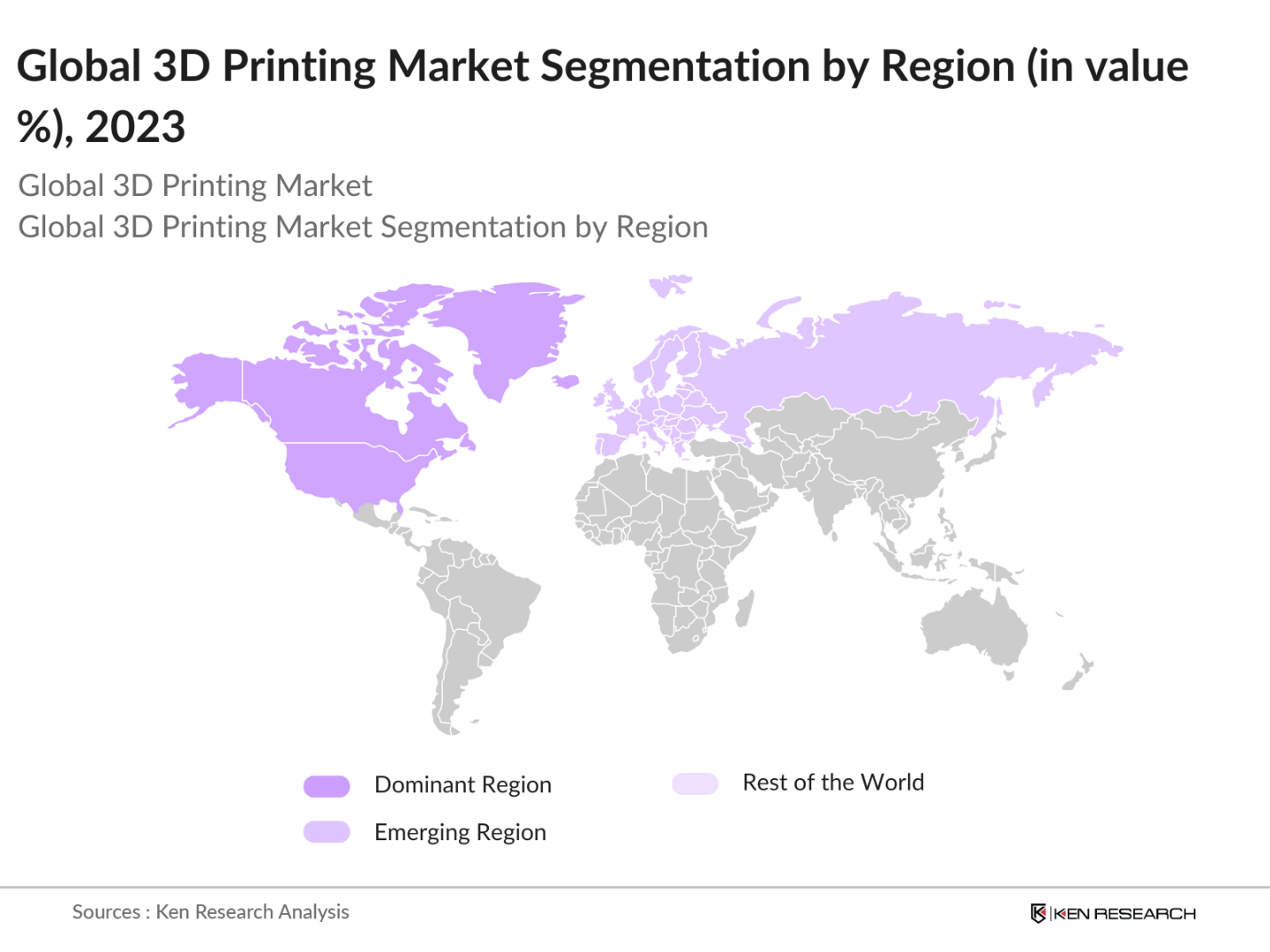
- North America dominated the global 3D printing market in 2023, due to its advanced manufacturing infrastructure, substantial R&D investment, and the presence of key market players. The U.S. governments investment in additive manufacturing for defense and healthcare has further solidified the regions dominance.
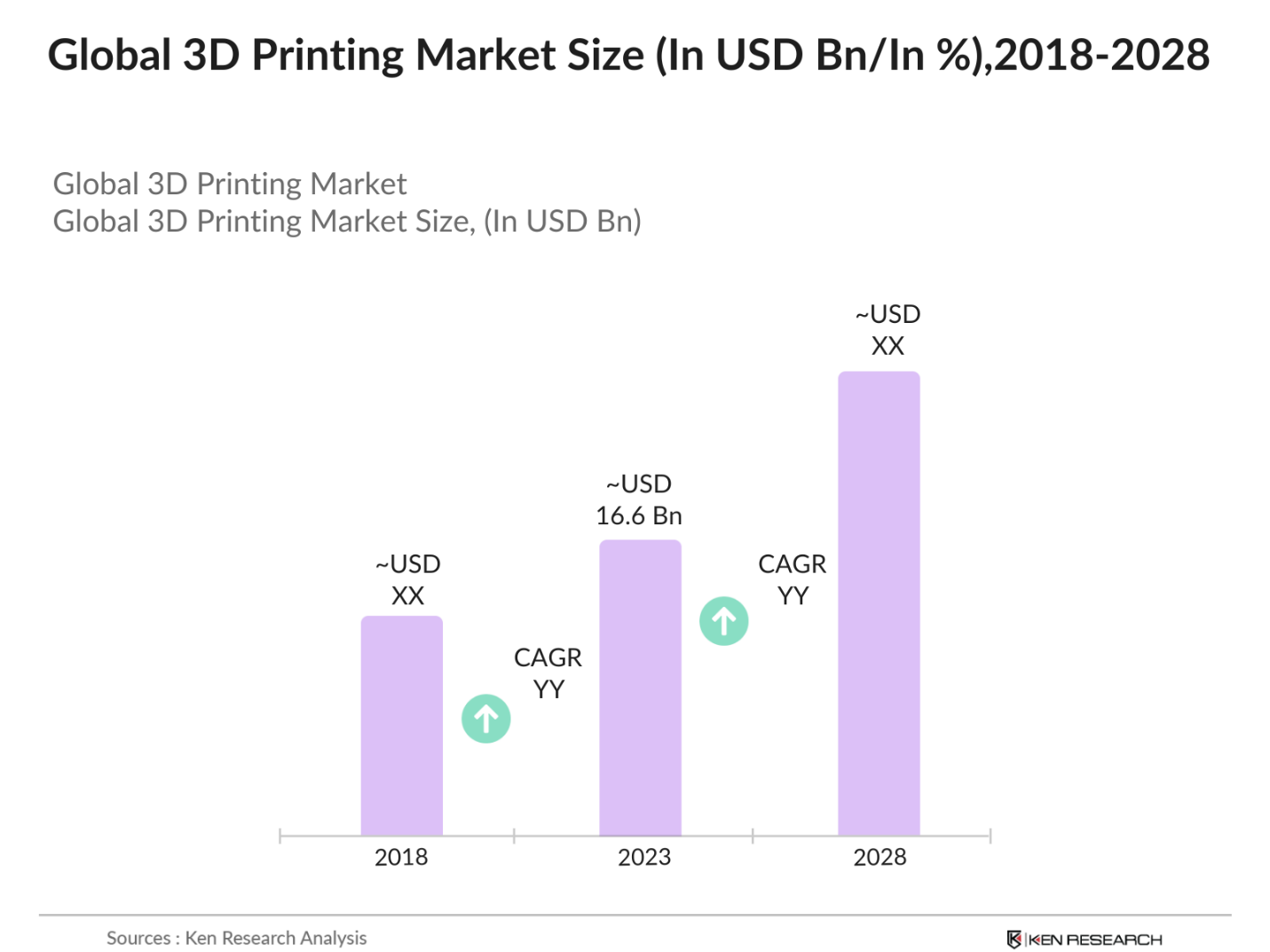
Global 3D Printing Market Segmentation
The global 3D printing market is segmented by component, technology, application, end-user industry, and region.
By Region: The market is segmented into North America, Europe, Asia-Pacific (APAC), Latin America, and Middle East & Africa (MEA). In 2023, North America held the largest market share due to its established R&D infrastructure and the presence of leading 3D printing companies. The U.S. Department of Defense has been a major investor in 3D printing, further solidifying the regions dominance.
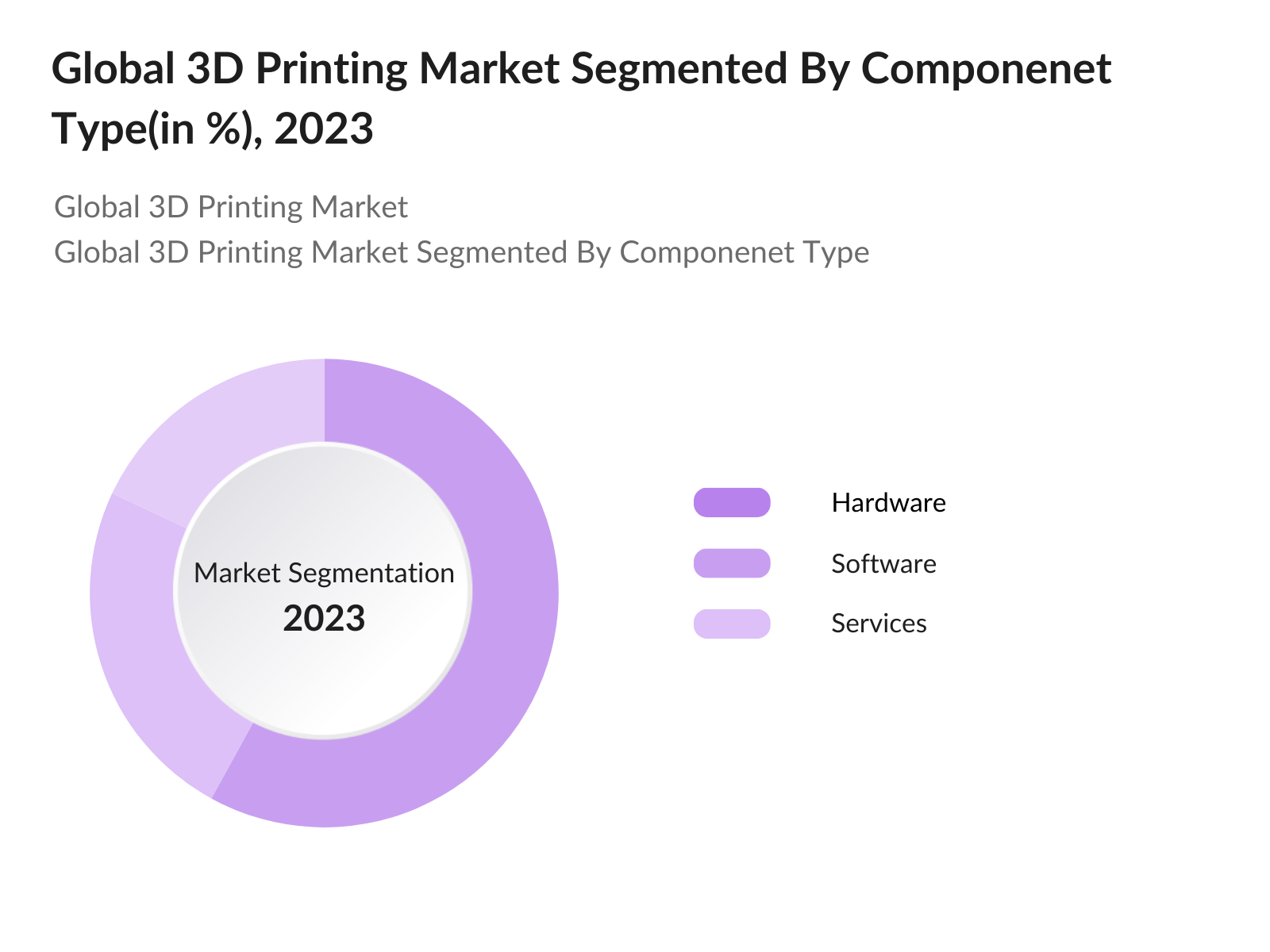
By Component: The market is segmented into hardware, software, and services. In 2023, hardware held the largest market share, driven by the rising demand for high-performance 3D printers capable of producing complex metal and polymer components. Major companies such as HP Inc. and Stratasys are at the forefront of hardware innovations, which are critical to expanding the market's industrial applications.
By Technology: The market is segmented into stereolithography (SLA), fused deposition modeling (FDM), selective laser sintering (SLS), and metal 3D printing. In 2023, SLA led the market, driven by its application in producing highly detailed, complex parts for the healthcare and automotive industries. SLAs ability to provide intricate designs with high accuracy is a key factor in its dominance.
Global 3D Printing Market Competitive Landscape
|
Company Name |
Year Established |
Headquarters |
|
Stratasys |
1989 |
Eden Prairie, Minnesota, USA |
|
3D Systems |
1986 |
Rock Hill, South Carolina, USA |
|
GE Additive |
2016 |
Cincinnati, Ohio, USA |
|
HP Inc. |
1939 |
Palo Alto, California, USA |
|
Materialise NV |
1990 |
Leuven, Belgium |
- HP Inc.: In 2023, at the RAPID + TCT event, HP unveiled new automation solutions designed to scale 3D printed parts production. These solutions include a closed-loop material processing system and an automation accessory for high-volume production. HP's innovations are part of a broader strategy to enhance production efficiency and meet the increasing demand for 3D printing across various industries, including automotive and healthcare.
- Materialise NV.: In 2023, Materialise NV signed a five-year partnership agreement with Japan Medical Dynamic Marketing, Inc. This collaboration aims to enhance the availability of Materialise's 3D printing technology for Total Hip Replacement surgeries in Japan, allowing surgeons to utilize 3D-printed patient-specific guides for better surgical planning.
Global 3D Printing Market Analysis
Global 3D Printing Market Growth Drivers:
- Expansion of Bioprinting in Healthcare: By 2023, bioprinting had gained traction, particularly in the healthcare sector. Hospitals are using 3D-printed tissues and implants, which are tailor-made to meet patient-specific needs. For instance, bioprinting was used in surgeries for organ and tissue replacement in the U.S. during 2023. This capability is set to expand the market for medical-grade 3D printing.
- Rising Demand for Sustainable Manufacturing Solutions: In 2023, the demand for sustainable manufacturing technologies, such as 3D printing, grew significantly. Manufacturers reduced waste by up to 30% using additive manufacturing compared to traditional subtractive methods. The automotive and aerospace industries were key contributors to this growth, where companies like Boeing adopted 3D printing to improve fuel efficiency and reduce material waste.
- Adoption in Aerospace and Defense: The aerospace sector remains one of the largest consumers of 3D printing technology. In 2023, Airbus and Boeing expanded their use of 3D-printed metal components to reduce aircraft weight, improve fuel efficiency, and lower production costs. This trend is expected to continue through 2028, with more aircraft components being manufactured using 3D printing technologies.
Global 3D Printing Market Challenges:
- Regulatory Issues in Medical Applications: Regulatory approval processes for 3D-printed medical devices remain complex and time-consuming. The U.S. FDA requires extensive testing and approval procedures that delay the market introduction of innovative healthcare solutions. This regulatory barrier limits the expansion of 3D printing in critical healthcare applications like organ printing.
- Material Standardization and Process Control: The lack of standardization in 3D printing materials and processes remains a significant challenge. Manufacturers face difficulties in ensuring consistent quality across different batches of materials, particularly in industries like aerospace where precision is critical. This variability affects production timelines and increases costs.
Global 3D Printing Market Government Initiatives:
- U.S. Department of Energys Investment in 3D Printing: In 2023, the U.S. Department of Energy announced an investment in research and development of 3D printing technologies for energy applications. The initiative aims to support the development of 3D-printed parts for energy-efficient devices and infrastructure, such as turbines and renewable energy systems.
- 2. European Unions Horizon 2024 Initiative: In 2024, the European Union launched its Horizon program, providing funding for research and development in sustainable 3D printing technologies. This initiative is focused on reducing the environmental impact of manufacturing through additive processes and is expected to boost growth in the European market.
Global 3D Printing Market Future Outlook to 2028
The Global 3D Printing Market is expected to witness substantial growth through 2028, driven by advancements in metal printing, bioprinting, and AI-driven manufacturing processes. The growing demand for sustainable and customized solutions will further propel the adoption of 3D printing across multiple industries.
Global 3D Printing Market Future Market Trends
- Bioprinting for Tissue and Organ Replacement: By 2028, bioprinting will expand significantly, enabling the production of complex tissues and potentially fully functional organs. Hospitals and research institutions worldwide will increase their investment in stem cell technologies, further driving the demand for 3D bioprinters.
- AI Integration in 3D Printing Processes: The integration of AI into 3D printing will revolutionize the manufacturing process by predicting material usage and optimizing designs before production begins. By 2028, AI-driven 3D printing will reduce waste, improve precision, and further increase adoption across sectors like aerospace and automotive.
Scope of the Report
|
By Component Type |
Hardware Software Services |
|
By Technology |
Stereolithography (SLA) Fused Deposition Modeling (FDM) Selective Laser Sintering (SLS) Metal 3D Printing |
|
By Application |
Prototyping Tooling Production Research & Development |
|
By End-User Industry |
Aerospace Automotive Healthcare Consumer Goods Education & Research |
|
By Region |
North America Europe Asia-Pacific (APAC) Middle East & Africa (MEA) Latin America |
Products
Key Target Audience Organizations and Entities Who Can Benefit by Subscribing to This Report:
Aerospace & Defense Manufacturers
Automotive Manufacturers
Healthcare Companies
Consumer Goods Manufacturers
Energy & Utility Companies
3D Printing Equipment Industries
Venture Capitalists & Investors
Government and regulatory bodies (FDA, EMA)
Time Period Captured in the Report
Historical Period: 2018-2023
Base Year: 2023
Forecast Period: 2023-2028
Companies
Players Mentioned in the Report:
Stratasys
3D Systems
Materialise NV
HP Inc.
GE Additive
EOS GmbH
SLM Solutions
Renishaw Plc
Proto Labs Inc.
ExOne
Table of Contents
1.Global 3D Printing Market Overview
1.1. Definition and Scope
1.2. Market Taxonomy
1.3. Market Growth Rate
1.4. Market Segmentation Overview
2.Global 3D Printing Market Size (in USD Bn), 2018-2023
2.1. Historical Market Size
2.2. Year-on-Year Growth Analysis
2.3. Key Market Developments and Milestones
3.Global 3D Printing Market Analysis
3.1. Growth Drivers
3.1.1. Expansion of Bioprinting in Healthcare
3.1.2. Rising Demand for Sustainable Manufacturing Solutions
3.1.3. Adoption in Aerospace and Defense
3.2. Restraints
3.2.1. High Cost of Industrial-Grade Printers
3.2.2. Regulatory Issues in Medical Applications
3.2.3. Material Standardization and Process Control
3.3. Opportunities
3.3.1. Expansion in Healthcare and Education Sectors
3.3.2. Integration with AI and Machine Learning
3.3.3. On-Demand Manufacturing Services
3.4. Trends
3.4.1. Bioprinting for Organ Replacement
3.4.2. AI Integration in 3D Printing Processes
3.4.3. Growth of Metal 3D Printing for Aerospace
3.5. Government Regulations
3.5.1. U.S. Department of Energys Investment
3.5.2. European Unions Horizon 2024 Initiative
3.5.3. India's Additive Manufacturing Strategy 2024
3.6. SWOT Analysis
3.7. Stakeholder Ecosystem
3.8. Competition Ecosystem
4.Global 3D Printing Market Segmentation, 2023
4.1. By Component Type (in Value %)
4.1.1. Hardware
4.1.2. Software
4.1.3. Services
4.2. By Technology (in Value %)
4.2.1. Stereolithography (SLA)
4.2.2. Fused Deposition Modeling (FDM)
4.2.3. Selective Laser Sintering (SLS)
4.2.4. Metal 3D Printing
4.3. By Application (in Value %)
4.3.1. Prototyping
4.3.2. Tooling
4.3.3. Production
4.3.4. Research & Development
4.4. By End-User Industry (in Value %)
4.4.1. Aerospace
4.4.2. Automotive
4.4.3. Healthcare
4.4.4. Consumer Goods
4.4.5. Education & Research
4.5. By Region (in Value %)
4.5.1. North America
4.5.2. Europe
4.5.3. Asia-Pacific
4.5.4. Middle East & Africa
4.5.5. Latin America
5.Global 3D Printing Market Cross Comparison
5.1. Detailed Profiles of Major Companies
5.1.1. Stratasys
5.1.2. 3D Systems
5.1.3. GE Additive
5.1.4. HP Inc.
5.1.5. Materialise NV
5.1.6. EOS GmbH
5.1.7. SLM Solutions
5.1.8. Renishaw Plc
5.1.9. Proto Labs Inc.
5.1.10. ExOne
5.1.11. Ultimaker
5.1.12. Formlabs
5.1.13. Desktop Metal
5.1.14. Voxeljet
5.1.15. Markforged Inc.
5.2. Cross Comparison Parameters (No. of Employees, Headquarters, Inception Year, Revenue)
6.Global 3D Printing Market Competitive Landscape
6.1. Market Share Analysis
6.2. Strategic Initiatives
6.3. Mergers and Acquisitions
6.4. Investment Analysis
6.4.1. Venture Capital Funding
6.4.2. Government Grants
6.4.3. Private Equity Investments
7.Global 3D Printing Market Regulatory Framework
7.1. Environmental Standards
7.2. Compliance Requirements
7.3. Certification Processes
8.Global 3D Printing Market Future Market Size (in USD Bn), 2023-2028
8.1. Future Market Size Projections
8.2. Key Factors Driving Future Market Growth
9.Global 3D Printing Market Future Market Segmentation, 2028
9.1. By Component Type (in Value %)
9.2. By Technology (in Value %)
9.3. By Application (in Value %)
9.4. By End-User Industry (in Value %)
9.5. By Region (in Value %)
10.Global 3D Printing Market Analysts Recommendations
10.1. TAM/SAM/SOM Analysis
10.2. Customer Cohort Analysis
10.3. Marketing Initiatives
10.4. White Space Opportunity Analysis
Disclaimer
Contact Us
Research Methodology
Step: 1 Identifying Key Variables
Ecosystem creation for all the major entities and referring to multiple secondary and proprietary databases to perform desk research around the Market to collate Market-level information.
Step: 2 Market Building
Collating statistics on the global 3D printing market over the years, and analyzing the penetration of Marketplaces as well as the ratio of service providers to compute the revenue generated for the market. We will also review service quality statistics to understand the revenue generated which can ensure accuracy behind the data points shared.
Step: 3 Validating and Finalizing
Building Market hypotheses and conducting CATIs with Market experts belonging to different companies to validate statistics and seek operational and financial information from company representatives.
Step: 4 Research Output
Our team will approach multiple 3D printing companies to understand the nature of service segments, consumer preferences, and other parameters. This supports validating statistics derived through a bottom-to-top approach from these 3D printing companies, ensuring accuracy and reliability in the report.
Frequently Asked Questions
01 How big is the Global 3D Printing Market?
The global 3D printing market was valued at USD 16.6 billion in 2023, driven by increasing demand from industries like aerospace, healthcare, and automotive for customized solutions, faster prototyping, and cost-effective manufacturing processes.
02 What are the challenges in the Global 3D Printing Market?
Challenges in the global 3D printing market include high initial capital costs for industrial-scale printers, regulatory hurdles in medical applications, and a lack of standardization in materials and processes. These issues hinder broader adoption across smaller industries.
03 Who are the major players in the Global 3D Printing Market?
Key players in the global 3D printing market include Stratasys, 3D Systems, HP Inc., GE Additive, and Materialise NV. These companies lead through extensive R&D, diverse product offerings, and strategic partnerships in high-growth industries.
04 What are the growth drivers of the Global 3D Printing Market?
The market is driven by the increasing demand for mass customization, growing adoption in healthcare for personalized implants and prosthetics, and the need for sustainable manufacturing solutions that reduce material waste and energy consumption.
Why Buy From Us?

What makes us stand out is that our consultants follows Robust, Refine and Result (RRR) methodology. i.e. Robust for clear definitions, approaches and sanity checking, Refine for differentiating respondents facts and opinions and Result for presenting data with story

We have set a benchmark in the industry by offering our clients with syndicated and customized market research reports featuring coverage of entire market as well as meticulous research and analyst insights.

While we don't replace traditional research, we flip the method upside down. Our dual approach of Top Bottom & Bottom Top ensures quality deliverable by not just verifying company fundamentals but also looking at the sector and macroeconomic factors.

With one step in the future, our research team constantly tries to show you the bigger picture. We help with some of the tough questions you may encounter along the way: How is the industry positioned? Best marketing channel? KPI's of competitors? By aligning every element, we help maximize success.

Our report gives you instant access to the answers and sources that other companies might choose to hide. We elaborate each steps of research methodology we have used and showcase you the sample size to earn your trust.

If you need any support, we are here! We pride ourselves on universe strength, data quality, and quick, friendly, and professional service.