















Global Agriculture IoT Market Outlook to 2030
Region:Global
Author(s):Naman Rohilla
Product Code:KROD7123
December 2024
92
About the Report
Global Agriculture IoT Market Overview
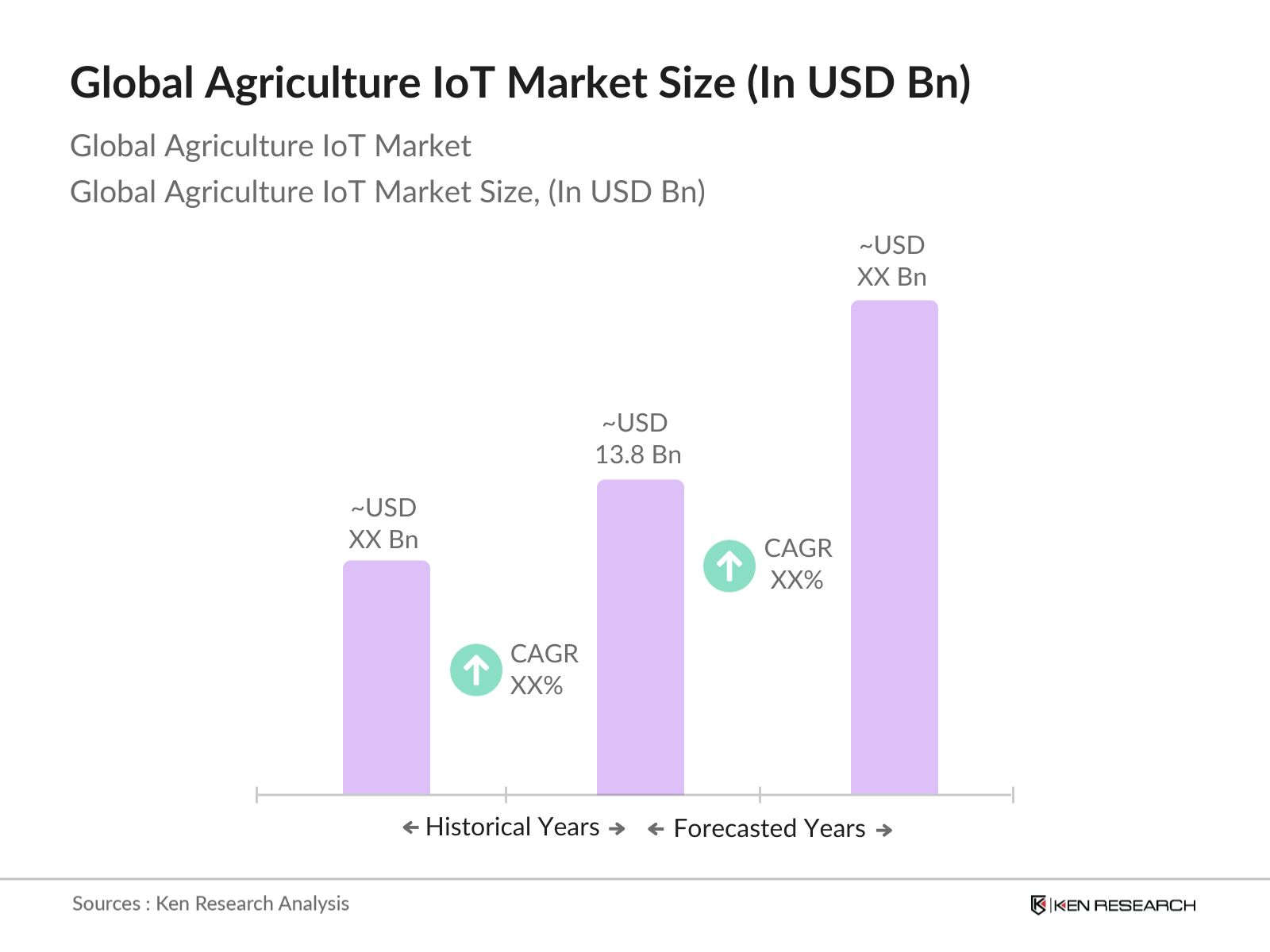
- The global Agriculture IoT market is valued at USD 13.8 billion, supported by the rising adoption of precision agriculture and smart farming solutions. IoT technologies have transformed traditional farming methods, enabling real-time data collection, which enhances operational efficiency and productivity. Driven by the increasing demand for food production efficiency and government incentives for smart farming, the Agriculture IoT market has seen robust growth over the last five years.
- Countries such as the United States and China dominate the Agriculture IoT market due to their advanced technological infrastructure and strong agricultural sectors. The U.S. benefits from substantial investments in IoT technologies in farming, while China has implemented widespread digitization initiatives in its agricultural sector, driven by government-led smart agriculture programs.
- Governments around the world are developing policies to promote the use of IoT in agriculture. In 2023, the Indian government introduced a National IoT Framework aimed at integrating IoT technologies into the countrys agricultural sector. This initiative is expected to increase the use of IoT in Indian agriculture by 20% over the next five years, according to official reports. Such frameworks are crucial for creating a supportive environment for IoT adoption in agriculture.
Global Agriculture IoT Market Segmentation
- By Component: The Agriculture IoT market is segmented by component into hardware, software, connectivity solutions, and platforms. Hardware, comprising sensors, drones, and other IoT devices, holds a dominant market share due to its integral role in gathering essential data for farm operations. The continued innovation in sensor technology and increased affordability of these devices contribute to their wide adoption across farms globally.
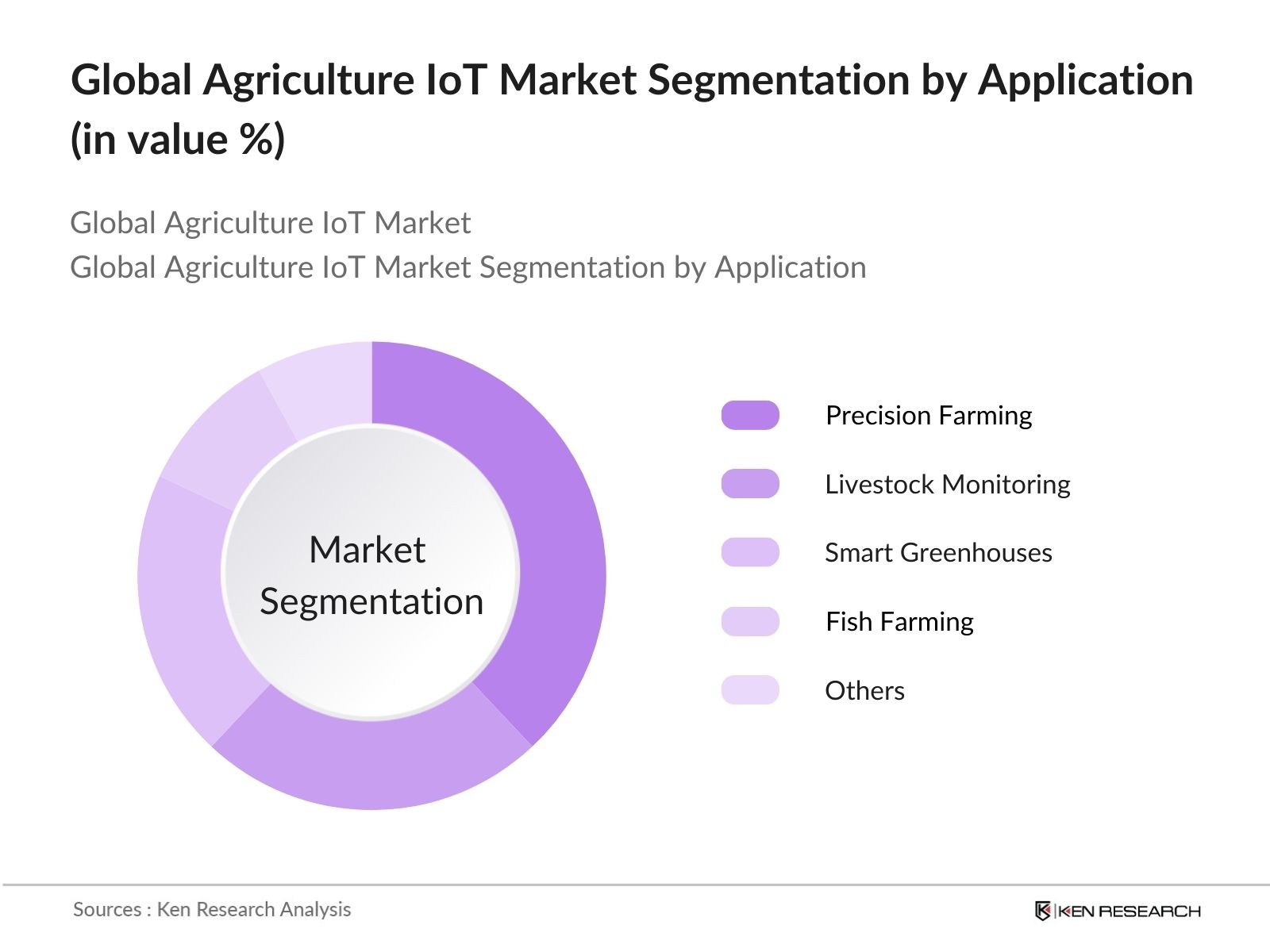
- By Application: The market is further segmented by application into precision farming, livestock monitoring, smart greenhouses, fish farming, and others. Precision farming is the leading segment because of its ability to optimize resource usage and increase yield. The demand for precise data to monitor crop conditions and soil health has made precision farming an essential tool for modern agriculture.
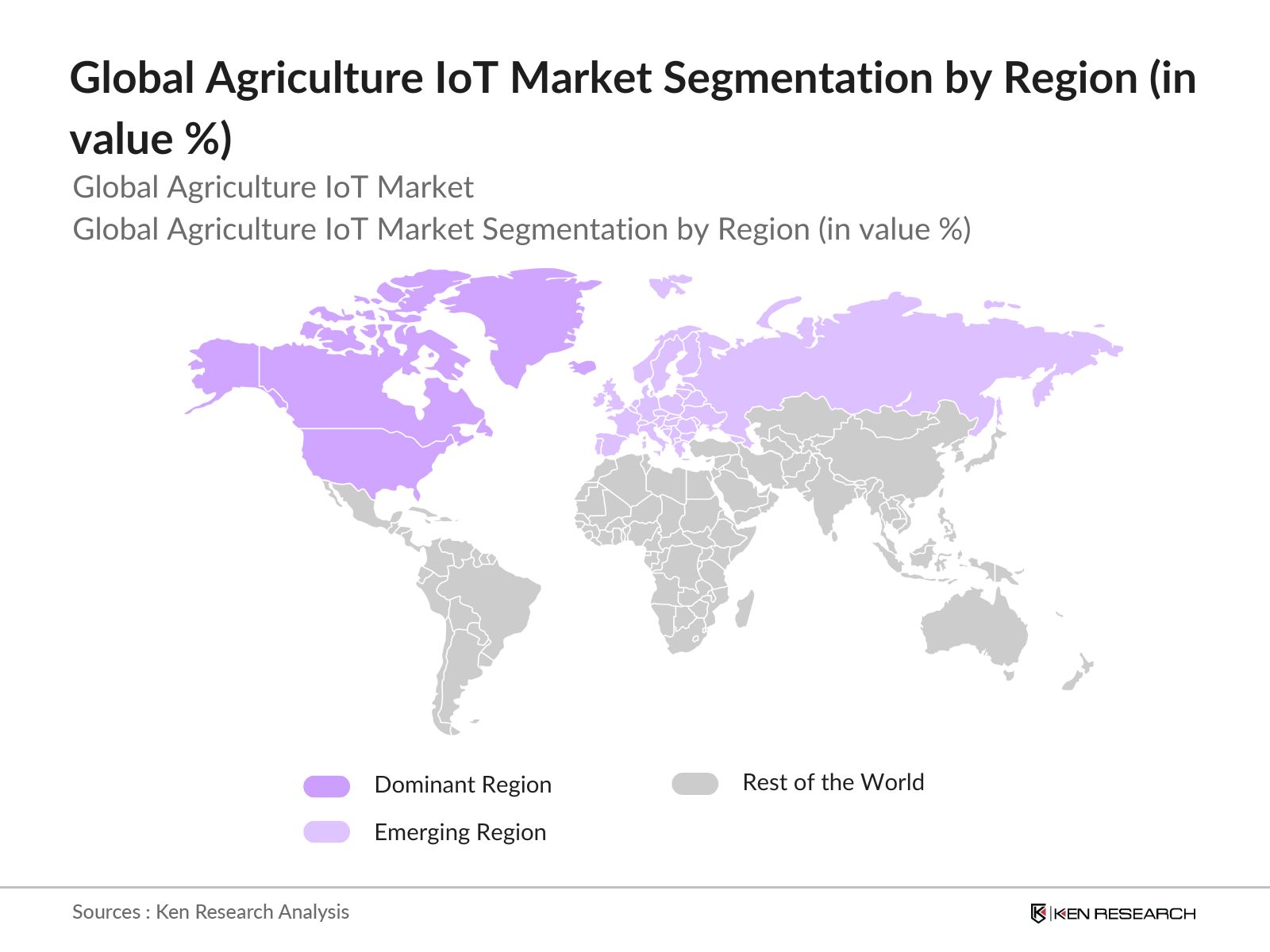
- By Region: The market is divided into North America, Europe, Asia Pacific, Latin America, and the Middle East & Africa. North America leads the market, driven by high adoption rates of advanced IoT solutions in agriculture, supported by government funding and large-scale farms. Additionally, the region's focus on reducing resource waste and optimizing food production contributes to its market leadership.
Global Agriculture IoT Market Competitive Landscape
The global Agriculture IoT market is dominated by major players that have established a strong presence through technological innovation, product diversification, and strategic partnerships. Leading companies in the market invest in research and development to stay ahead of competitors, resulting in the continuous improvement of IoT applications for agriculture.
|
Company |
Year Established |
Headquarters |
Revenue |
Technology Adoption |
Innovation Index |
IoT Solutions Offered |
Farm Size Focus |
Strategic Collaborations |
Global Footprint |
|
Cisco Systems, Inc. |
1984 |
San Jose, USA |
- |
- |
- |
- |
- |
- |
- |
|
John Deere & Company |
1837 |
Moline, USA |
- |
- |
- |
- |
- |
- |
- |
|
IBM Corporation |
1911 |
Armonk, USA |
- |
- |
- |
- |
- |
- |
- |
|
AGCO Corporation |
1990 |
Duluth, USA |
- |
- |
- |
- |
- |
- |
- |
|
Trimble Inc. |
1978 |
Sunnyvale, USA |
- |
- |
- |
- |
- |
- |
- |
Global Agriculture IoT Market Analysis
Global Agriculture IoT Market Growth Drivers
- Adoption of Precision Agriculture: Precision agriculture is increasingly being adopted worldwide as a solution for boosting crop yields and optimizing input usage. According to the Food and Agriculture Organization (FAO), precision farming has the potential to increase crop yields by 20-30% while reducing the use of water, fertilizers, and pesticides by 10-15%. Additionally, the global population is expected to reach 8.5 billion by 2030, driving demand for higher agricultural output. The World Bank emphasizes the role of digital technologies, such as IoT, in addressing these challenges and increasing overall farm efficiency.
- Rising Demand for Farm Automation: Farm automation is becoming essential as global labor shortages and rising wages push farmers to seek alternatives. The U.S. Bureau of Labor Statistics reports that the agricultural workforce is shrinking, with employment in the sector projected to decline by 5% by 2031. Automation technologies, including IoT, are helping to address these challenges. For instance, IoT-enabled robotic systems are now widely used for tasks like seeding, weeding, and harvesting, which can help reduce operational costs by over 20%.
- Enhanced Farm Productivity: IoT technologies are directly contributing to enhanced farm productivity by enabling real-time data collection and precise control over farming activities. Research from the United Nations reports that IoT-based solutions, such as smart irrigation systems, can improve water efficiency by up to 50%. Similarly, data-driven decision-making can help farmers reduce input waste, leading to a 25% improvement in crop productivity in certain regions. These advancements are crucial for addressing the growing global food demand.
Global Agriculture IoT Market Challenges
- High Initial Setup Costs: The adoption of IoT in agriculture comes with upfront costs, particularly for small-scale farmers. According to a report by the International Fund for Agricultural Development (IFAD), the average cost of setting up IoT infrastructure for a mid-sized farm can range from $50,000 to $100,000, depending on the level of automation. These costs include hardware, sensors, and connectivity infrastructure, which are often beyond the reach of farmers in developing countries.
- Data Security Concerns: As IoT devices collect vast amounts of data, the risk of cyberattacks and data breaches has become a concern in the agriculture sector. A report by the World Economic Forum highlighted that in 2023, cyberattacks targeting agriculture-related IoT systems increased by 15%, with estimated damages reaching $10 billion globally. This growing vulnerability is a major challenge, especially as farms become more connected through IoT networks.
Global Agriculture IoT Market Future Outlook
Over the next five years, the Agriculture IoT market is poised for substantial growth, driven by increasing investments in smart farming technologies, the rise of artificial intelligence integration in farming operations, and growing awareness of the benefits of IoT in enhancing agricultural productivity. The market is expected to see new opportunities as IoT solutions become more affordable and accessible to small and medium-sized farms, expanding beyond large-scale operations. Moreover, government policies promoting sustainable farming practices will further boost the adoption of IoT in agriculture.
Global Agriculture IoT Market Opportunities
- Integration with Artificial Intelligence and Machine Learning: The integration of IoT with artificial intelligence (AI) and machine learning (ML) presents a major opportunity for optimizing agricultural practices. AI-driven IoT systems are already being used to predict weather patterns, soil health, and crop disease outbreaks, enabling farmers to make more informed decisions. According to a 2023 report by the World Bank, AI-integrated IoT systems can increase agricultural productivity by 30%, making them a key driver for future growth in smart farming.
- Expansion of IoT-based Irrigation Systems: IoT-based irrigation systems, which use real-time data to manage water distribution efficiently, are gaining popularity as water scarcity becomes a critical issue. The World Resources Institute (WRI) notes that agriculture accounts for 70% of global freshwater use, and IoT irrigation systems can reduce water consumption by 20-25%. This technology is being widely adopted in regions such as North America and Europe, where water conservation is a top priority.
Scope of the Report
|
Component |
Hardware Software Connectivity Solutions Platforms |
|
Application |
Precision Farming Livestock Monitoring Smart Greenhouses Fish Farming Others |
|
Connectivity Technology |
Cellular IoT LPWAN Bluetooth Wi-Fi |
|
Farm Size |
Small Farms Medium Farms Large Farms |
|
Region |
North America Europe Asia Pacific Latin America Middle East & Africa |
Products
Key Target Audience
Investors and Venture Capitalist Firms
Government and Regulatory Bodies (USDA, EU Agriculture Commission)
IoT Solution Providers
Agriculture Equipment Manufacturers
Banks and Financial Institutions
Large-Scale Farm Operators
Livestock Management Companies
Irrigation System Providers
Agricultural Cooperatives
Companies
Players Mentioned in the Report
Cisco Systems, Inc.
John Deere & Company
IBM Corporation
AGCO Corporation
Trimble Inc.
Topcon Corporation
Hexagon Agriculture
Raven Industries, Inc.
Farmers Edge Inc.
TeeJet Technologies
Table of Contents
1. Global Agriculture IoT Market Overview
1.1. Definition and Scope
1.2. Market Taxonomy
1.3. Market Growth Rate
1.4. Market Segmentation Overview
2. Global Agriculture IoT Market Size (In USD Bn)
2.1. Historical Market Size
2.2. Year-On-Year Growth Analysis
2.3. Key Market Developments and Milestones
3. Global Agriculture IoT Market Analysis
3.1. Growth Drivers
3.1.1. Adoption of Precision Agriculture
3.1.2. Rising Demand for Farm Automation
3.1.3. Government Support for IoT in Agriculture
3.1.4. Enhanced Farm Productivity
3.2. Market Challenges
3.2.1. High Initial Setup Costs
3.2.2. Data Security Concerns
3.2.3. Lack of Connectivity in Remote Areas
3.3. Opportunities
3.3.1. Integration with Artificial Intelligence and Machine Learning
3.3.2. Expansion of IoT-based Irrigation Systems
3.3.3. Development of Low-Power Wide-Area Networks (LPWAN)
3.3.4. Collaborations between IoT Providers and Farmers
3.4. Trends
3.4.1. Use of Smart Sensors and Drones
3.4.2. Increasing Adoption of Cloud Computing in Agriculture
3.4.3. Rising Focus on Crop Monitoring
3.5. Government Regulations
3.5.1. Agricultural IoT Policies
3.5.2. Smart Farming Initiatives
3.5.3. Subsidies for IoT Adoption in Agriculture
3.6. SWOT Analysis
3.7. Stakeholder Ecosystem
3.7.1. IoT Solution Providers
3.7.2. Hardware and Software Integrators
3.7.3. Agri-Tech Startups
3.8. Porters Five Forces Analysis
3.9. Competition Ecosystem
4. Global Agriculture IoT Market Segmentation
4.1. By Component (In Value %)
4.1.1. Hardware
4.1.2. Software
4.1.3. Connectivity Solutions
4.1.4. Platforms
4.2. By Application (In Value %)
4.2.1. Precision Farming
4.2.2. Livestock Monitoring
4.2.3. Smart Greenhouses
4.2.4. Fish Farming
4.2.5. Others
4.3. By Connectivity Technology (In Value %)
4.3.1. Cellular IoT
4.3.2. LPWAN
4.3.3. Bluetooth
4.3.4. Wi-Fi
4.4. By Farm Size (In Value %)
4.4.1. Small Farms
4.4.2. Medium Farms
4.4.3. Large Farms
4.5. By Region (In Value %)
4.5.1. North America
4.5.2. Europe
4.5.3. Asia Pacific
4.5.4. Latin America
4.5.5. Middle East and Africa
5. Global Agriculture IoT Market Competitive Analysis
5.1 Detailed Profiles of Major Companies
5.1.1. Cisco Systems, Inc.
5.1.2. John Deere & Company
5.1.3. IBM Corporation
5.1.4. AGCO Corporation
5.1.5. Trimble Inc.
5.1.6. Topcon Corporation
5.1.7. Hexagon Agriculture
5.1.8. Raven Industries, Inc.
5.1.9. Farmers Edge Inc.
5.1.10. TeeJet Technologies
5.1.11. DeLaval Inc.
5.1.12. PrecisionHawk Inc.
5.1.13. The Climate Corporation
5.1.14. Bayer AG (Digital Farming)
5.1.15. Telit Communications PLC
5.2 Cross Comparison Parameters (Revenue, Technology Adoption, IoT Solutions Offered, Farm Size Targeted, Global Footprint, Innovation Capabilities, Strategic Collaborations, Product Portfolio)
5.3. Market Share Analysis
5.4. Strategic Initiatives
5.5. Mergers and Acquisitions
5.6. Investment Analysis
5.7 Venture Capital Funding
6. Global Agriculture IoT Market Regulatory Framework
6.1. IoT Standards for Agriculture
6.2. Data Privacy and Security Compliance
6.3. Licensing and Certification Requirements
7. Global Agriculture IoT Future Market Size (In USD Bn)
7.1. Future Market Size Projections
7.2. Key Factors Driving Future Market Growth
8. Global Agriculture IoT Future Market Segmentation
8.1. By Component (In Value %)
8.2. By Application (In Value %)
8.3. By Connectivity Technology (In Value %)
8.4. By Farm Size (In Value %)
8.5. By Region (In Value %)
9. Global Agriculture IoT Market Analysts Recommendations
9.1. TAM/SAM/SOM Analysis
9.2. Market Penetration Strategy
9.3. Strategic Marketing Initiatives
9.4. White Space Opportunity Analysis
Research Methodology
Step 1: Identification of Key Variables
The first step involved mapping the entire ecosystem of the Agriculture IoT market, identifying critical stakeholders such as IoT solution providers, hardware manufacturers, and regulatory bodies. This was achieved through comprehensive desk research, analyzing a mix of secondary databases and industry reports.
Step 2: Market Analysis and Construction
In this phase, historical data related to market performance was compiled and analyzed. The analysis covered revenue generation, penetration of IoT technologies across different farming types, and the integration of new technologies into farming practices.
Step 3: Hypothesis Validation and Expert Consultation
Market hypotheses were developed based on the initial findings and validated through consultations with industry experts. These included interviews with senior executives from leading Agriculture IoT companies, who provided insights on trends, challenges, and future prospects.
Step 4: Research Synthesis and Final Output
The final phase involved synthesizing the data collected from multiple sources. IoT manufacturers and stakeholders were directly engaged to verify the statistics, ensuring that the final output presents an accurate picture of the market dynamics.
Frequently Asked Questions
01. How big is the Global Agriculture IoT Market?
The global Agriculture IoT market is valued at USD 13.8 billion, driven by advancements in smart farming technologies and the increasing need for real-time data collection and analysis.
02. What are the challenges in the Global Agriculture IoT Market?
Key challenges in the global Agriculture IoT market include high initial setup costs, data security concerns, and limited connectivity in rural areas, which hinder widespread adoption among small and medium-scale farms.
03. Who are the major players in the Global Agriculture IoT Market?
Major players in the global Agriculture IoT market include Cisco Systems, John Deere, IBM Corporation, AGCO Corporation, and Trimble Inc., among others. These companies dominate the market through their technological innovations and strong global presence.
04. What are the growth drivers of the Global Agriculture IoT Market?
The global Agriculture IoT market is driven by factors such as the rising demand for food production efficiency, government incentives for smart farming, and technological advancements in IoT applications for agriculture.
Why Buy From Us?

What makes us stand out is that our consultants follows Robust, Refine and Result (RRR) methodology. i.e. Robust for clear definitions, approaches and sanity checking, Refine for differentiating respondents facts and opinions and Result for presenting data with story

We have set a benchmark in the industry by offering our clients with syndicated and customized market research reports featuring coverage of entire market as well as meticulous research and analyst insights.

While we don't replace traditional research, we flip the method upside down. Our dual approach of Top Bottom & Bottom Top ensures quality deliverable by not just verifying company fundamentals but also looking at the sector and macroeconomic factors.

With one step in the future, our research team constantly tries to show you the bigger picture. We help with some of the tough questions you may encounter along the way: How is the industry positioned? Best marketing channel? KPI's of competitors? By aligning every element, we help maximize success.

Our report gives you instant access to the answers and sources that other companies might choose to hide. We elaborate each steps of research methodology we have used and showcase you the sample size to earn your trust.

If you need any support, we are here! We pride ourselves on universe strength, data quality, and quick, friendly, and professional service.