
Global AI Text Generator Market Outlook 2030
Region:Global
Author(s):Shivani Mehra
Product Code:KROD3982
November 2024
92
About the Report
Global AI Text Generator Market Overview
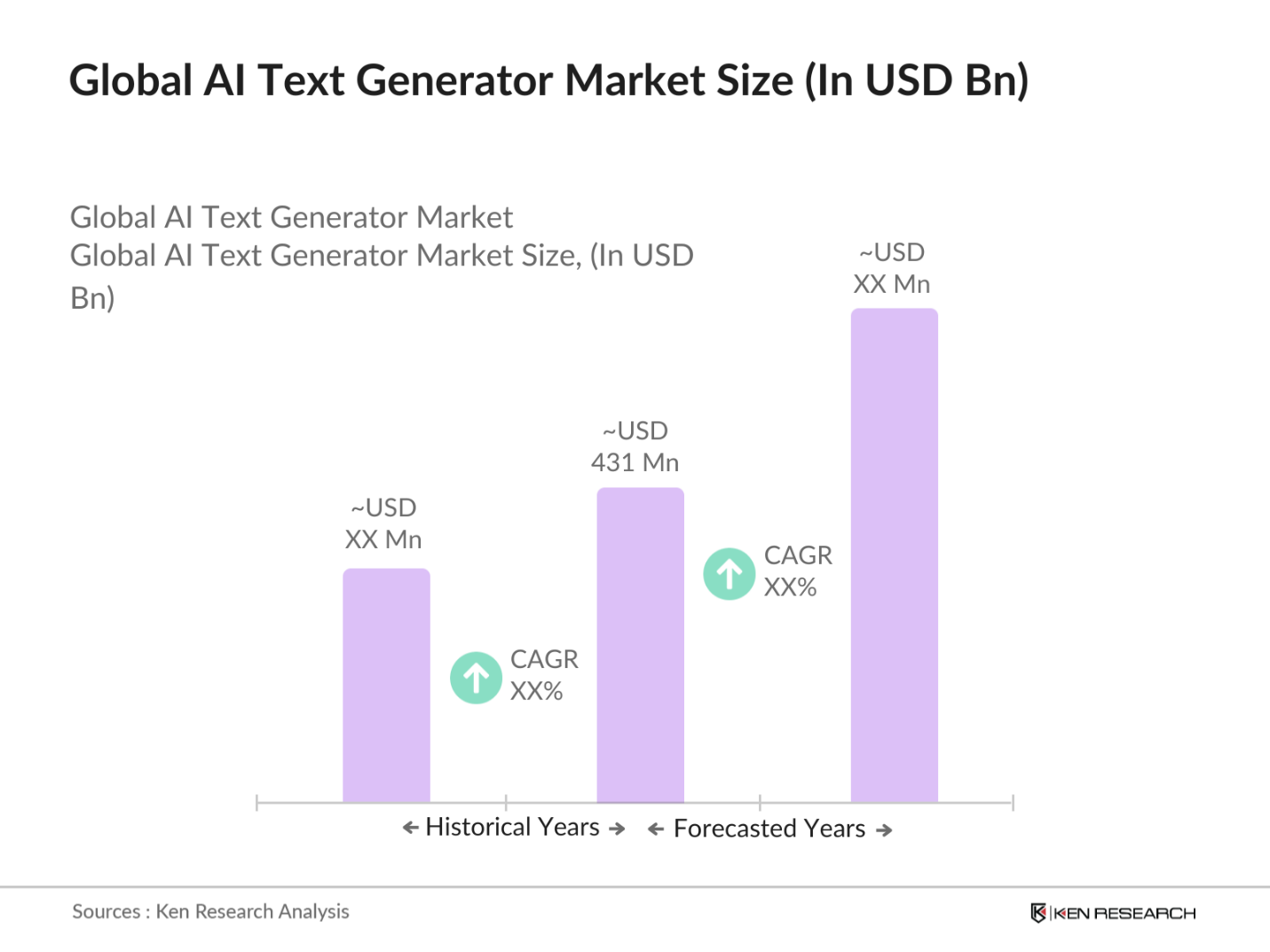
- The Global AI Text Generator market is valued at USD 431 million, driven primarily by advancements in Natural Language Processing (NLP) and machine learning. This market growth is heavily fueled by the increasing demand for automated content generation across industries such as marketing, e-commerce, and customer service.
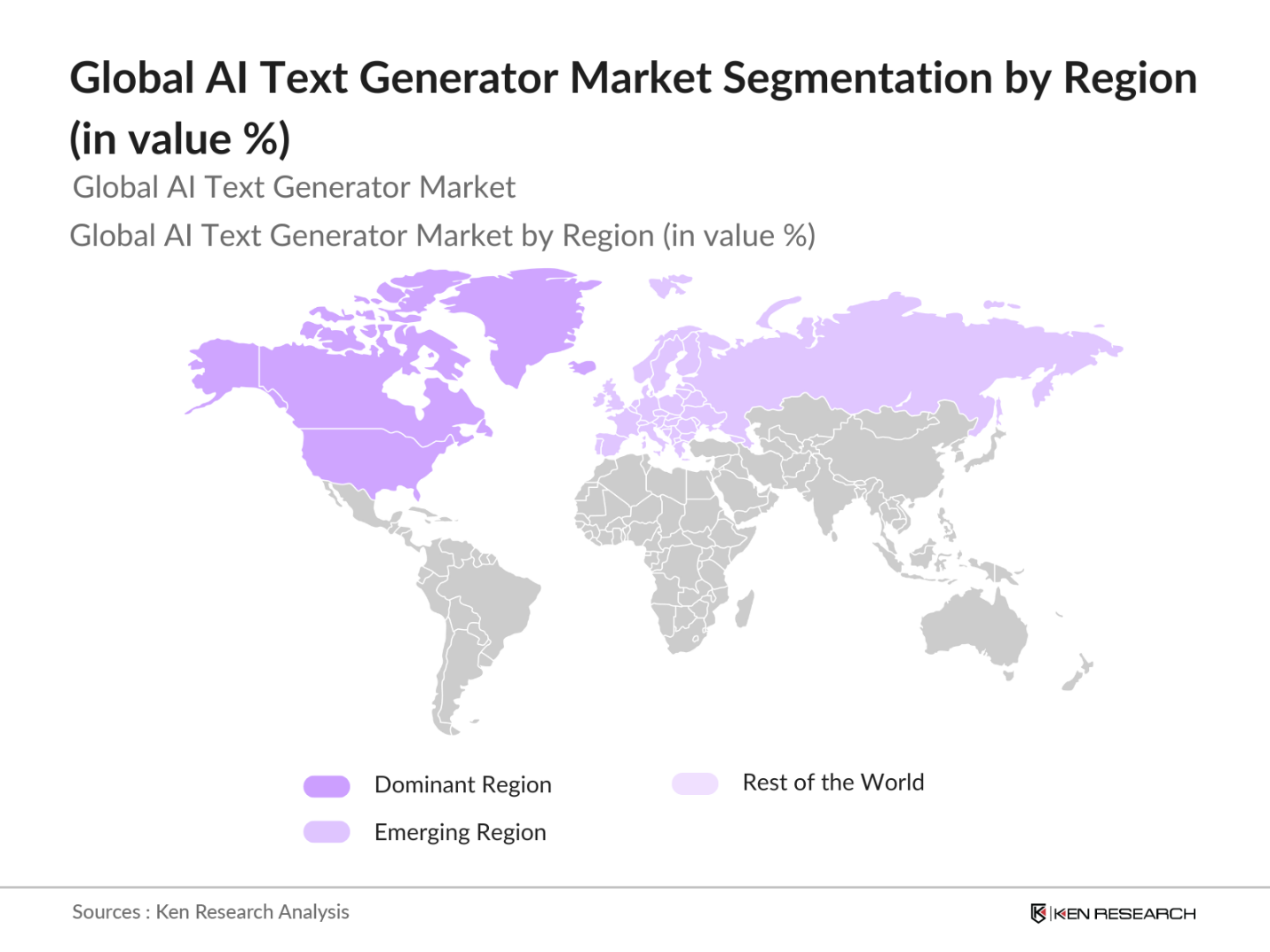
- North America, led by the United States, dominates the AI text generator market. The region's leadership is attributed to the early adoption of AI technologies, a strong presence of key players, and significant investments in AI research and development. Countries like China and Japan are emerging as major competitors due to their investment in AI infrastructure and governmental initiatives aimed at fostering innovation in artificial intelligence.
- Governments are introducing regulatory frameworks to govern the use of AI in creative industries. In 2023, the European Union implemented guidelines to ensure transparency in AI-generated art, focusing on copyright issues and content authenticity. The United States is considering similar regulations, emphasizing the need for creative works produced by AI to adhere to ethical standards. In Asia, countries like Japan are creating AI ethics boards to oversee the development and usage of AI-generated creative content.
Global AI Text Generator Market Segmentation
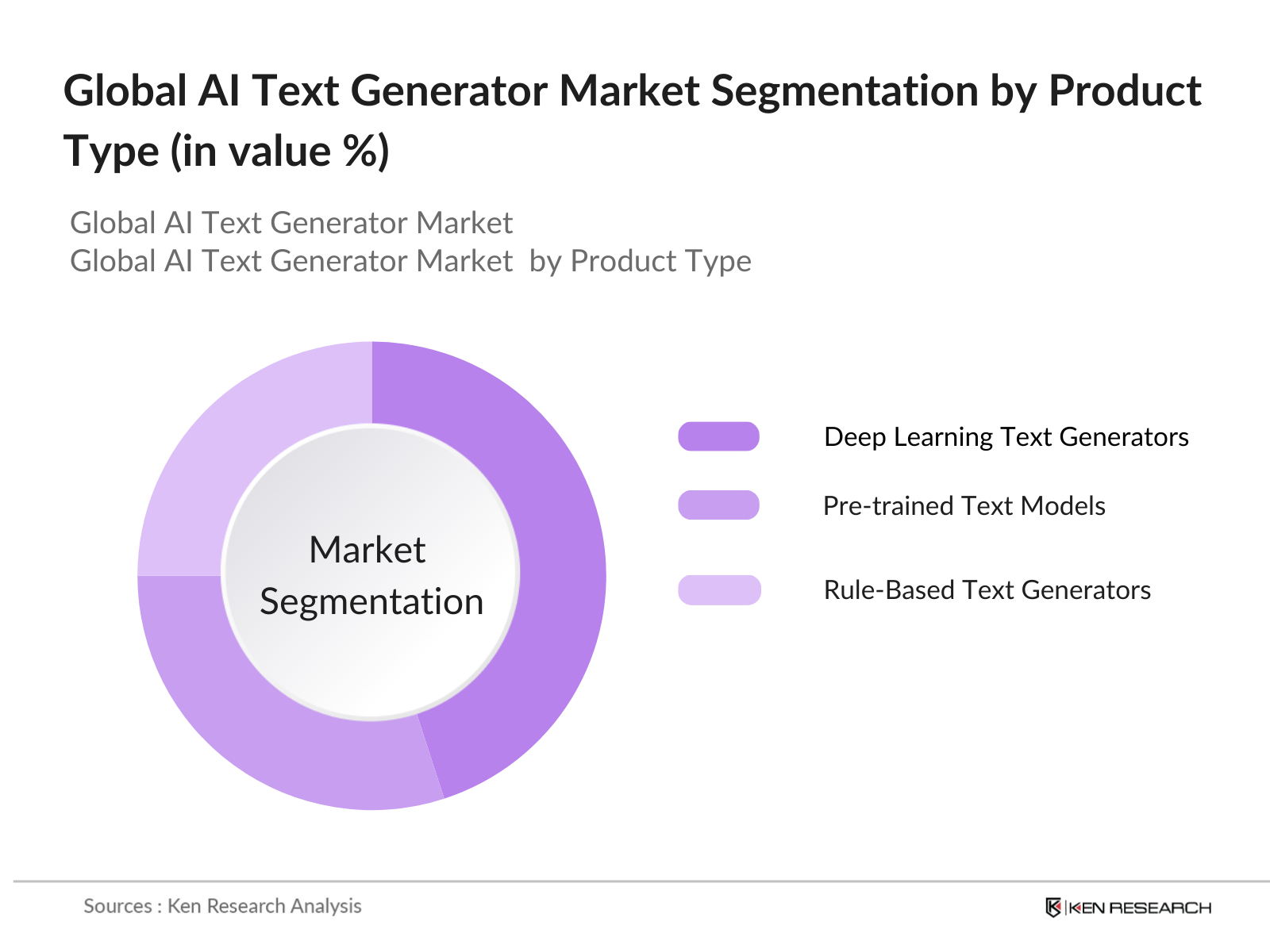
By Product Type: The Global AI Text Generator market is segmented by product type into Rule-Based Text Generators, Deep Learning Text Generators, and Pre-trained Text Models. Rule-based generators have traditionally held a dominant market share due to their simplicity and straightforward implementation. However, Deep Learning Text Generators have recently overtaken them in market share due to their ability to generate more sophisticated and human-like text. The rise in demand for highly contextual and personalized content across industries such as customer service and digital marketing has propelled deep learning models to the forefront of AI-driven content generation.
By Region: The market is segmented by region into North America, Europe, Asia-Pacific, Latin America, and Middle East & Africa. North America continues to lead the market, This dominance is attributed to the concentration of AI pioneers and key market players, coupled with robust infrastructure supporting technological advancements. The Asia-Pacific region is seeing rapid growth, especially in countries like China and Japan, where government-backed initiatives are driving AI adoption in various industries. These nations are also leveraging AI to bolster content generation capabilities across education, media, and communication sectors.
Global AI Text Generator Market Competitive Landscape
The Global AI Text Generator market is competitive, with both established tech giants and innovative startups playing a significant role. Key players include companies specializing in AI research, cloud computing, and machine learning solutions. The market is primarily dominated by a few leading players who have the advantage of extensive data resources, strong R&D capabilities, and established partnerships with industries across various sectors.
|
Company Name |
Established |
Headquarters |
Revenue |
Patents |
API Integrations |
End-User Focus |
Global Reach |
AI Model Type |
|
OpenAI |
2015 |
USA |
$1 Billion |
|||||
|
Google DeepMind |
2010 |
UK |
$1.5 Billion |
|||||
|
Microsoft Azure AI |
2010 |
USA |
$10 Billion |
|||||
|
IBM Watson |
2011 |
USA |
$5 Billion |
|||||
|
Hugging Face |
2016 |
USA |
$500 Million |
Global AI Text Generator Market Analysis
Market Growth Drivers
- Demand for Content Personalization: AI text generators are increasingly employed in content personalization, a key driver for the market. As of 2023, a large number of consumers expect personalized brand interactions, pushing companies to adopt AI tools for content generation. Major economies such as the United States have seen the rise of AI-based personalization solutions with the demand for tailored marketing strategies. In Europe, the adoption of AI in personalized content creation is supported by government-backed innovation projects, such as the EU's Horizon 2020 program, aimed at enhancing AI adoption across industries.
- Increasing Use in Marketing and Customer Engagement: In 2023, companies allocated substantial amounts of their marketing budgets to customer engagement technologies, driven by AI-powered solutions, including text generation platforms. Countries like Japan and South Korea have recorded a rapid rise in AI adoption for marketing purposes, with AI tools contributing to improved customer conversion rates. AI-driven text generation tools are becoming essential in the global retail sector, with large corporations in the United States investing over $9 billion in AI-powered marketing by 2023.
- Integration with Voice Assistants: Voice assistant usage is increasing globally, with a significant number of households in the United States utilizing AI-powered voice assistants in 2023. These devices are integrating AI text generators to enhance user interactions. In China, the number of smart voice assistant users reached 150 million in 2023, contributing to the demand for natural language generation in multiple languages. This trend is heavily supported by AI developers, who are refining text generation models to better assist voice-based systems in enhancing customer service and user interaction.
Market Challenges
- Ethical and Regulatory Concerns (AI-generated content transparency, Data Privacy): The AI text generator market faces regulatory challenges, particularly concerning transparency and data privacy. Governments in the European Union are focusing on ethical AI development, pushing the enforcement of the Artificial Intelligence Act, which will impose stringent regulations on transparency in AI-generated content. In 2023, privacy fines in the EU reached 1.6 billion, highlighting the regulatory environment's focus on safeguarding personal data, especially in AI-driven tools. Moreover, countries like Canada and Japan are also working on updating their data privacy laws to address challenges posed by AI-based content generation.
- High Development and Training Costs (Computational Power, Dataset Acquisition): The high cost of developing AI text generation models poses a barrier to market growth. As of 2023, the global expenditure on computational power for AI model training surged to $30 billion, with large-scale language models requiring extensive hardware resources. Governments are initiating funding schemes to support AI research; for instance, the U.S. government allocated $1 billion for AI innovation in 2022 to address infrastructure and computational cost challenges.
Global AI Text Generator Market Future Outlook
The Global AI Text Generator market is poised for significant growth over the next few years, driven by increased investment in AI technologies, continuous advancements in NLP, and expanding use cases across various industries. The integration of AI with emerging technologies like Augmented Reality (AR) and Virtual Reality (VR) is expected to unlock new applications for text generators, further propelling market growth. In addition, governmental support and strategic partnerships between AI developers and industries will likely fuel innovation and adoption.
Market Opportunities:
- Adoption of Generative Pre-trained Transformer Models (GPT, BERT): The adoption of Generative Pre-trained Transformer (GPT) models has skyrocketed, with GPT-3 models generating over 4.5 billion words daily by 2023. These models are revolutionizing the content generation industry across various sectors. In the United States, GPT-3 models are being integrated into publishing and journalism to automate content creation, and tech giants in China are developing proprietary generative models tailored for local markets. These models' capacity to create human-like text is transforming content automation globally .
- Collaboration between Tech Firms and Educational Institutions: Tech firms are increasingly partnering with educational institutions to explore AI text generation in academic research and content creation. In 2023, the U.S. Department of Education partnered with leading AI developers to integrate AI-driven content creation tools in learning modules, benefiting over 3 million students. Similar initiatives are underway in Europe, where governments are allocating funds for research in AI-enhanced educational platforms. These collaborations are not only driving AI adoption but also improving the quality and accessibility of educational content.
Scope of the Report
|
By Product Type |
Rule-Based Text Generators Deep Learning Text Generators Pre-trained Text Models |
|
By Application |
Marketing and Advertising Customer Service Automation Educational Content Generation Entertainment and Creative Writing |
|
By Technology |
Natural Language Processing (NLP) Neural Networks Machine Learning Deep Learning |
|
By End-User |
Large Enterprises Small and Medium-sized Enterprises (SMEs) Educational Institutions |
|
By Region |
North America Europe Asia-Pacific Latin America Middle East & Africa |
Products
Key Target Audience
AI Developers and Service Providers
Content Marketing Firms
Customer Service and Support Providers
E-commerce Platforms
Media and Entertainment Firms
Investors and Venture Capitalist Firms
Government and Regulatory Bodies (e.g., EU AI Act Regulatory Authorities)
Tech and IT Consultancy Firms
Companies
Players Mention in the Report
OpenAI
Google DeepMind
Microsoft Azure AI
IBM Watson
Hugging Face
Grammarly
Writesonic
Jasper AI
AI Dungeon (Latitude)
Copy.ai
ContentBot.ai
Articoolo
Rytr.me
QuillBot
Kuki AI
Table of Contents
Global AI Text Generator Market Overview
1.1 Definition and Scope
1.2 Market Taxonomy (Natural Language Processing, Deep Learning, Machine Learning)
1.3 Market Growth Rate (AI Adoption Rate, NLP Advancements)
1.4 Market Segmentation Overview
Global AI Text Generator Market Size (In USD Bn)
2.1 Historical Market Size
2.2 Year-On-Year Growth Analysis
2.3 Key Market Developments and Milestones
Global AI Text Generator Market Analysis
3.1 Growth Drivers
3.1.1 Demand for Content Personalization
3.1.2 Increasing Use in Marketing and Customer Engagement
3.1.3 Integration with Voice Assistants
3.1.4 AI-Powered Customer Service Solutions
3.2 Market Challenges
3.2.1 Ethical and Regulatory Concerns (AI-generated content transparency, Data Privacy)
3.2.2 High Development and Training Costs (Computational Power, Dataset Acquisition)
3.2.3 Limited Multilingual Support
3.3 Opportunities
3.3.1 Integration with Augmented Reality and Virtual Reality Platforms
3.3.2 Rising Use in Educational and Training Platforms
3.3.3 Custom AI Model Development for Niche Industries
3.4 Trends
3.4.1 Adoption of Generative Pre-trained Transformer Models (GPT, BERT)
3.4.2 Collaboration between Tech Firms and Educational Institutions
3.4.3 Expansion of AI Models to Creative Industries (AI-generated Art, Literature)
3.5 Government Regulations
3.5.1 Regulatory Framework for AI in Creative Industries
3.5.2 Data Protection Laws Impacting AI Development
3.5.3 Funding Initiatives for AI Innovation (Public-Private Partnerships)
3.6 SWOT Analysis
3.7 Stakeholder Ecosystem (AI Developers, End-users, Third-Party Integrators)
3.8 Porters Five Forces
3.9 Competition Ecosystem
Global AI Text Generator Market Segmentation
4.1 By Product Type (In Value %)
4.1.1 Rule-Based Text Generators
4.1.2 Deep Learning Text Generators
4.1.3 Pre-trained Text Models
4.2 By Application (In Value %)
4.2.1 Marketing and Advertising
4.2.2 Customer Service Automation
4.2.3 Educational Content Generation
4.2.4 Entertainment and Creative Writing
4.3 By Technology (In Value %)
4.3.1 Natural Language Processing (NLP)
4.3.2 Neural Networks
4.3.3 Machine Learning
4.3.4 Deep Learning
4.4 By End-User (In Value %)
4.4.1 Large Enterprises
4.4.2 Small and Medium-sized Enterprises (SMEs)
4.4.3 Educational Institutions
4.5 By Region (In Value %)
4.5.1 North America
4.5.2 Europe
4.5.3 Asia-Pacific
4.5.4 Latin America
4.5.5 Middle East & Africa
Global AI Text Generator Market Competitive Analysis
5.1 Detailed Profiles of Major Companies
5.1.1 OpenAI
5.1.2 Google DeepMind
5.1.3 IBM Watson
5.1.4 Microsoft Azure AI
5.1.5 Hugging Face
5.1.6 Grammarly
5.1.7 Writesonic
5.1.8 Jasper AI
5.1.9 AI Dungeon (Latitude)
5.1.10 Copy.ai
5.1.11 ContentBot.ai
5.1.12 Articoolo
5.1.13 Rytr.me
5.1.14 QuillBot
5.1.15 Kuki AI
5.2 Cross Comparison Parameters (Revenue, AI Model Type, Inception Year, Headquarters, No. of Patents, API Integrations, End-user Focus, Model Customization)
5.3 Market Share Analysis
5.4 Strategic Initiatives
5.5 Mergers and Acquisitions
5.6 Investment Analysis
5.7 Venture Capital Funding
5.8 Government Grants
5.9 Private Equity Investments
Global AI Text Generator Market Regulatory Framework
6.1 Compliance with Global AI Ethics Guidelines
6.2 Data Usage Regulations (GDPR, CCPA)
6.3 IP and Copyright Implications of AI-generated Text
6.4 Certification and Standardization in AI-driven Solutions
Global AI Text Generator Future Market Size (In USD Bn)
7.1 Future Market Size Projections
7.2 Key Factors Driving Future Market Growth
Global AI Text Generator Future Market Segmentation
8.1 By Product Type (In Value %)
8.2 By Application (In Value %)
8.3 By Technology (In Value %)
8.4 By End-User (In Value %)
8.5 By Region (In Value %)
Global AI Text Generator Market Analysts Recommendations
9.1 TAM/SAM/SOM Analysis
9.2 Customer Cohort Analysis
9.3 Marketing Initiatives
9.4 White Space Opportunity Analysis
Research Methodology
Step 1: Identification of Key Variables
The initial stage focuses on mapping the AI Text Generator market ecosystem. We conducted a comprehensive desk study using both secondary and proprietary databases to pinpoint critical variables influencing market dynamics, including key drivers, restraints, and emerging trends.
Step 2: Market Analysis and Construction
In this phase, we analyzed historical market data to assess the market penetration rate and revenue generation. The evaluation also included insights into key AI model types and use cases, ensuring accurate market construction.
Step 3: Hypothesis Validation and Expert Consultation
We validated key market hypotheses through consultations with industry experts using computer-assisted telephone interviews (CATIs). These experts provided real-time insights into market trends, which were integral to refining the research data.
Step 4: Research Synthesis and Final Output
The final synthesis involved gathering detailed feedback from key players in the AI text generation industry to validate the findings. This ensured that the market estimates and segmentation analysis are accurate, comprehensive, and reliable.
Frequently Asked Questions
01. How big is the Global AI Text Generator Market?
The global AI text generator market is valued at USD 431 million, driven by the rising adoption of AI-based solutions in industries like marketing, customer service, and content creation.
02. What are the challenges in the AI Text Generator Market?
Challenges include ethical concerns surrounding AI-generated content, such as transparency and data privacy, as well as the high costs associated with training complex AI models.
03. Who are the major players in the AI Text Generator Market?
Key players in the market include OpenAI, Google DeepMind, Microsoft Azure AI, Hugging Face, and IBM Watson. These companies dominate due to their extensive research, advanced AI models, and robust integration capabilities.
04. What are the growth drivers of the AI Text Generator Market?
Growth is primarily driven by advancements in NLP, increasing demand for automated content creation, and the integration of AI in marketing, customer service, and creative industries.
Why Buy From Us?

What makes us stand out is that our consultants follows Robust, Refine and Result (RRR) methodology. i.e. Robust for clear definitions, approaches and sanity checking, Refine for differentiating respondents facts and opinions and Result for presenting data with story

We have set a benchmark in the industry by offering our clients with syndicated and customized market research reports featuring coverage of entire market as well as meticulous research and analyst insights.

While we don't replace traditional research, we flip the method upside down. Our dual approach of Top Bottom & Bottom Top ensures quality deliverable by not just verifying company fundamentals but also looking at the sector and macroeconomic factors.

With one step in the future, our research team constantly tries to show you the bigger picture. We help with some of the tough questions you may encounter along the way: How is the industry positioned? Best marketing channel? KPI's of competitors? By aligning every element, we help maximize success.

Our report gives you instant access to the answers and sources that other companies might choose to hide. We elaborate each steps of research methodology we have used and showcase you the sample size to earn your trust.

If you need any support, we are here! We pride ourselves on universe strength, data quality, and quick, friendly, and professional service.