
Global Aprotic Solvents Market Outlook 2030
Region:Global
Author(s):Shivani Mehra
Product Code:KROD11343
November 2024
83
About the Report
Global Aprotic Solvents Market Overview
- The global aprotic solvents market is valued at USD 23.03 billion, primarily driven by rising demand in key industries such as pharmaceuticals, electronics, and oil & gas. Aprotic solvents, particularly N-methyl-2-pyrrolidone (NMP), are widely used in various applications, including chemical synthesis, electronics cleaning, and manufacturing processes. The surge in demand for lithium-ion batteries, especially in electric vehicles, is also a significant growth driver, as these batteries rely heavily on aprotic solvents. Furthermore, their critical role in agrochemical formulations and increasing global infrastructure development has contributed to steady market growth.
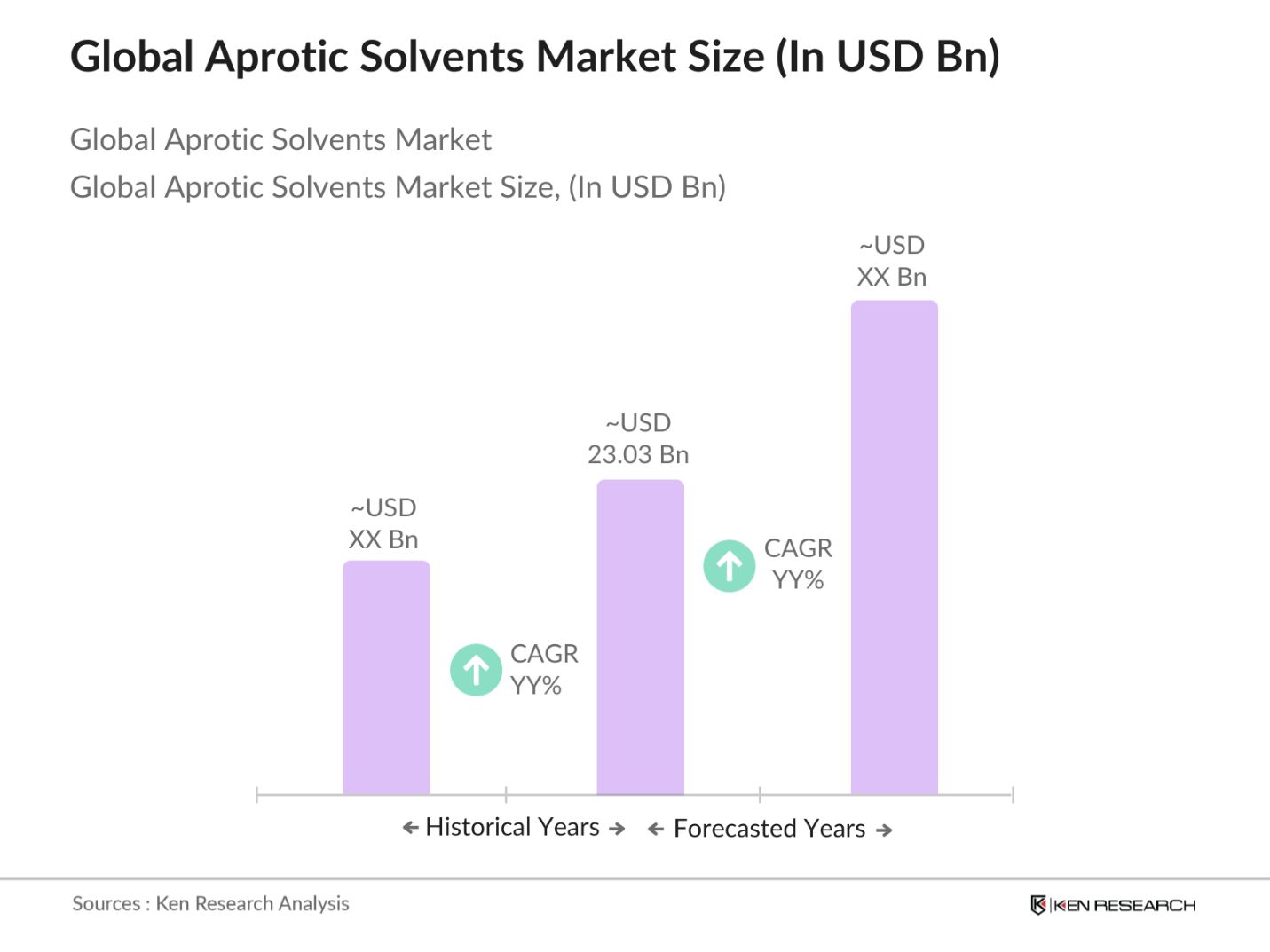
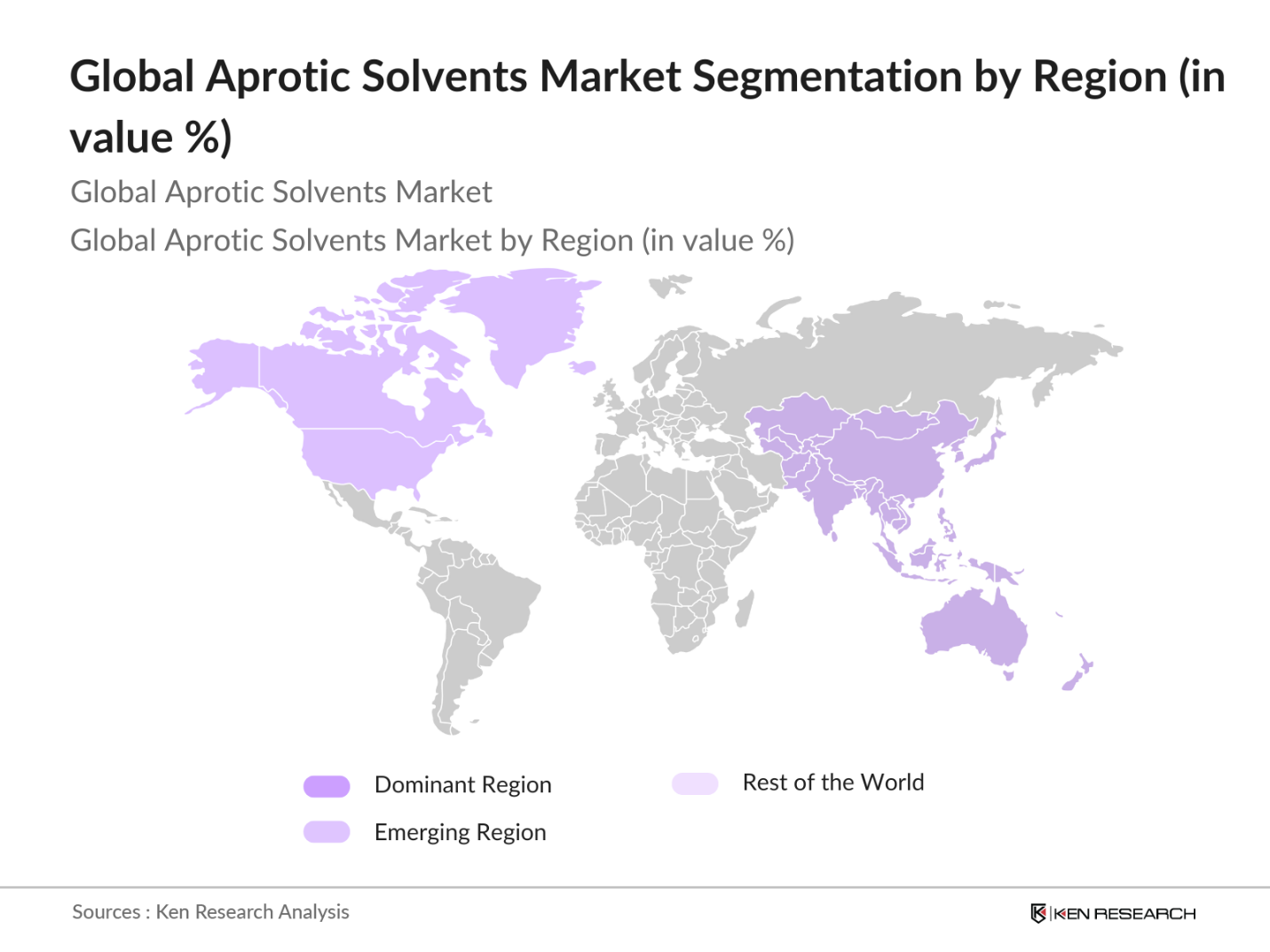
- The dominant regions in the global aprotic solvents market include North America and Asia-Pacific, particularly China, India, and Japan, which hold substantial influence due to their expanding industrial sectors. North America, led by the U.S., sees dominance due to its well-established pharmaceutical and chemical industries, while Asia-Pacific's stronghold is attributed to the booming electronics manufacturing and construction sectors. Countries like China have positioned themselves as global leaders in the aprotic solvents market due to rapid urbanization and the rise of electronics production hubs.
- The European Unions REACH regulations continue to be a significant challenge for aprotic solvent manufacturers, with strict controls on hazardous substances. As of 2024, companies found non-compliant with REACH standards face fines of up to EUR 40,000 per infraction. The regulations target solvents with high VOC emissions, driving the market toward the development of greener alternatives that can meet these stringent requirements.
Global Aprotic Solvents Market Segmentation
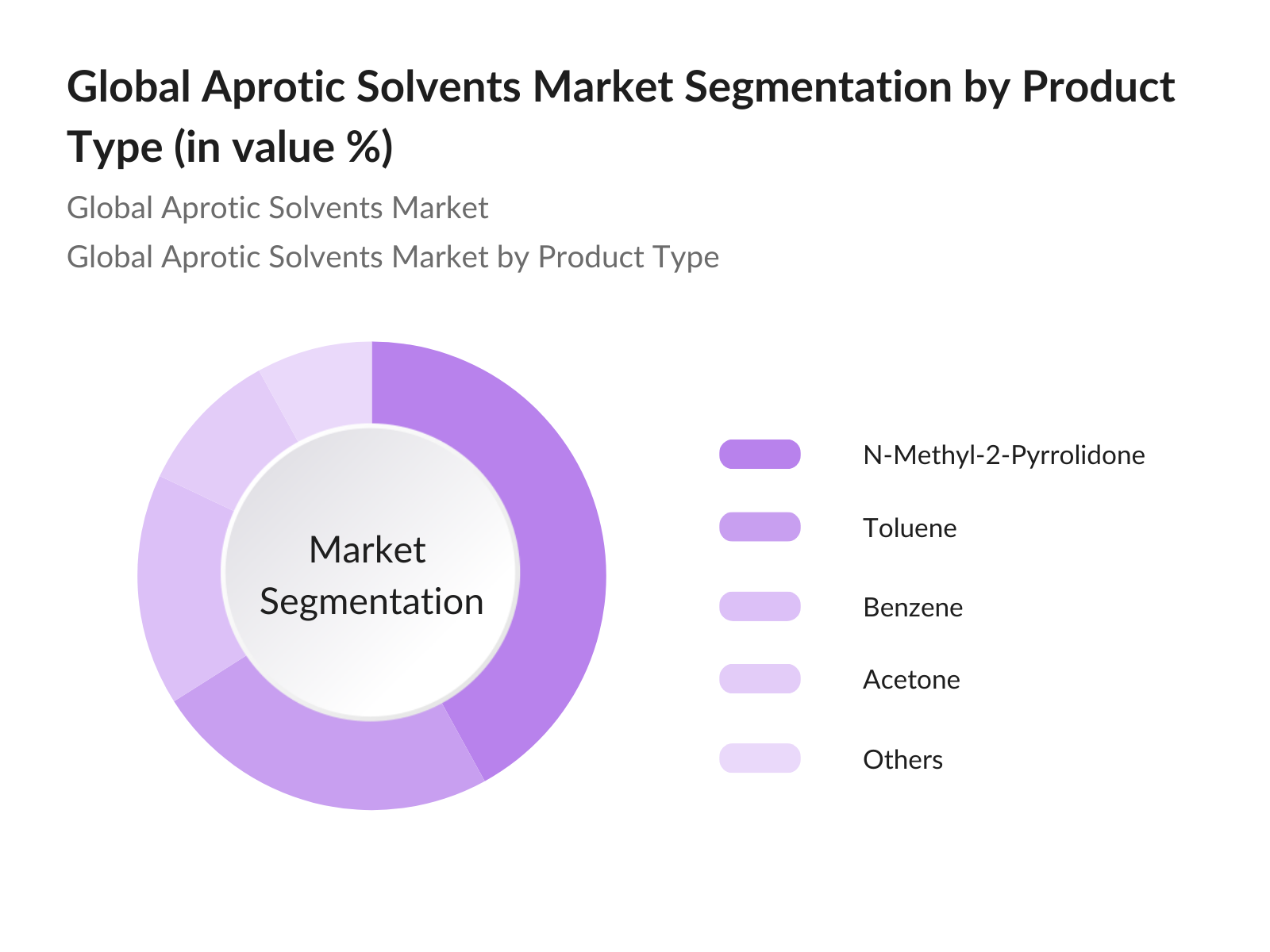
By Product Type: The aprotic solvents market is segmented by product type into N-methyl-2-pyrrolidone (NMP), Toluene, Benzene, Acetone, and Others. NMP holds a dominant share due to its high solvency power and critical use in pharmaceutical drug synthesis and lithium-ion battery production. NMPs low toxicity and efficiency in dissolving a wide range of compounds make it essential in chemical and agrochemical processes, contributing to its leading market position. In contrast, toluene is primarily used in industrial chemical production and coatings, further driving its demand in oil & gas and construction sectors.
By Region: The aprotic solvents market is segmented into North America, Europe, Asia-Pacific, Middle East & Africa, and Latin America. Asia-Pacific leads this segmentation due to its massive electronics and chemical production industries, especially in countries like China, Japan, and South Korea. The demand for aprotic solvents in electronics and industrial applications in these regions has pushed the market forward. Europe follows closely, with a strong focus on green solvent technologies and regulatory standards driving innovation in chemical manufacturing.
Global Aprotic Solvents Market Competitive Landscape
The aprotic solvents market is consolidated with key players focusing on R&D investments, capacity expansion, and technological advancements. Major companies leverage their extensive product portfolios to maintain competitive advantages and market share. The market also sees a mix of regional and global players engaged in various mergers and acquisitions to enhance their product offerings.
|
Company Name |
Establishment Year |
Headquarters |
Revenue (USD Bn) |
R&D Spend (%) |
Production Sites |
Global Reach |
Green Solvent Innovations |
Product Portfolio |
Strategic Acquisitions |
|
BASF SE |
1865 |
Germany |
86 |
- |
- |
- |
- |
- |
- |
|
Eastman Chemical Company |
1920 |
USA |
10.5 |
- |
- |
- |
- |
- |
- |
|
DowDuPont |
1897 |
USA |
43 |
- |
- |
- |
- |
- |
- |
|
INEOS Group Ltd. |
1998 |
UK |
61 |
- |
- |
- |
- |
- |
- |
|
Mitsui Chemicals |
1912 |
Japan |
30.1 |
- |
- |
- |
- |
- |
- |
Global Aprotic Solvents Market Analysis
Market Growth Drivers
- Expanding Pharmaceutical Industry: The pharmaceutical sector is a significant driver for the aprotic solvents market, with global pharmaceutical spending projected to exceed USD 1.8 trillion in 2023, according to the World Bank. Aprotic solvents like N-Methyl-2-pyrrolidone (NMP) and Dimethylformamide (DMF) are used in drug formulation processes due to their high solvency. The U.S., one of the largest pharmaceutical markets, is expected to maintain high drug production levels, with growth driven by increasing demand for advanced medications. Government funding for healthcare and pharmaceuticals has also risen, further boosting the requirement for these solvents.
- Rising Demand for Electronic Components: The rapid expansion of the electronics industry, particularly in countries like China, South Korea, and the U.S., is fueling demand for aprotic solvents. In 2023, global semiconductor sales are expected to reach USD 600 billion, largely driven by increased demand for consumer electronics and electric vehicles. Aprotic solvents are critical in the manufacturing of semiconductors due to their ability to dissolve materials like polymers and resins used in the production of microchips and other components.
- Adoption in Oil & Gas Applications: Aprotic solvents play a key role in the oil & gas industry, particularly in extraction and refining processes. With global oil production expected to stabilize at around 90 million barrels per day in 2023, demand for solvents such as dimethyl sulfoxide (DMSO) for enhancing oil recovery processes is anticipated to grow. These solvents help in reducing viscosity and improving extraction efficiency, thus aiding in the overall productivity of the sector. The oil & gas industry continues to be a crucial application area for aprotic solvents.
Market Challenges:
- Environmental Regulations (Stringent VOC restrictions): Aprotic solvents, such as NMP and DMF, face stringent regulations due to their high Volatile Organic Compound (VOC) emissions. The European Union's REACH regulations have placed significant restrictions on the use of such solvents, with fines for non-compliance reaching EUR 40,000 per violation. The U.S. Environmental Protection Agency (EPA) has also tightened its regulations on solvent emissions, particularly in industrial sectors, leading to reduced adoption in regions with strict environmental oversight.
- Availability of Substitutes: The availability of alternative solvents, such as bio-based and low-VOC solvents, poses a challenge to the aprotic solvent market. In 2023, the global market for bio-based solvents is expected to be valued at USD 8 billion, with increasing adoption in industries like paints and coatings, where environmental regulations are stringent. These substitutes provide lower toxicity and reduced environmental impact, making them more favorable in regions with strict environmental standards.
Global Aprotic Solvents Market Future Outlook
Over the next few years, the aprotic solvents market is expected to witness significant growth. The increasing demand for sustainable solutions in the chemical industry, coupled with the rising adoption of green solvents, will shape the future of the market. Additionally, technological advancements in solvent manufacturing and the booming lithium-ion battery sector will continue to drive demand. Industries such as pharmaceuticals, oil & gas, and electronics are expected to remain key contributors to the global aprotic solvents market growth.
Market Opportunities:
- Innovation in Green Solvents: There is a growing opportunity in the development of green aprotic solvents, driven by increasing environmental concerns and stricter regulations. In 2023, the green chemistry market, which includes green solvents, is projected to grow substantially, with governments in the U.S. and EU committing over USD 3 billion in funding for green chemical research and development. This push for innovation offers significant growth prospects for manufacturers investing in sustainable solvent alternatives.
- Growing Demand for Bio-Based Aprotic Solvents: The demand for bio-based aprotic solvents is growing as industries seek to reduce their environmental footprint. In 2023, the market for bio-based solvents is anticipated to exceed USD 8 billion, fueled by their increasing application in industries such as pharmaceuticals and agrochemicals. These solvents provide a sustainable alternative to traditional petrochemical-based solvents, aligning with the global shift toward greener industrial practices, particularly in regions like the EU and North America.
Scope of the Report
|
By Product Type |
NMP Toluene Benzene Acetone Others |
|
By Application |
Pharmaceuticals Oil & Gas Paints & Coatings Electronics Others |
|
By Source |
Synthetic Bio-Based |
|
By End-Use Industry |
Chemical Healthcare Consumer Goods Infrastructure Others |
|
By Region |
North America Europe APAC Middle East & Africa Latin America |
Products
Key Target Audience
Pharmaceutical Manufacturers
Chemical Manufacturing Companies
Electronics Industry Players
Agrochemical Producers
Lithium-Ion Battery Manufacturers
Government Regulatory Bodies (EPA, REACH)
Investments and Venture Capital Firms
Oil & Gas Companies
Companies
Players Mention in the Report
BASF SE
Eastman Chemical Company
DowDuPont
INEOS Group Ltd.
Mitsui Chemicals
Shell Chemicals
Asahi Kasei
Ashland Global Holdings
AlzChem AG
Solvay
Celanese Corporation
Imperial Chemical Corporation
Mitsubishi Chemical Corporation
Nanjing Jinlong Chemical
CNPC Jilin Chemical Group
Table of Contents
1. Global Aprotic Solvents Market Overview
- 1.1 Definition and Scope
- 1.2 Market Taxonomy
- 1.3 Key Industry Developments
- 1.4 Market Growth Drivers
2. Global Aprotic Solvents Market Size (In USD Mn)
- 2.1 Historical Market Size
- 2.2 Market Growth Rate Analysis
- 2.3 Key Market Developments and Milestones
3. Global Aprotic Solvents Market Analysis
- 3.1 Growth Drivers
- 3.1.1 Expanding Pharmaceutical Industry
- 3.1.2 Rising Demand for Electronic Components
- 3.1.3 Adoption in Oil & Gas Applications
- 3.1.4 Growth in Paints & Coatings Industry
- 3.2 Market Challenges
- 3.2.1 Environmental Regulations (Stringent VOC restrictions)
- 3.2.2 Availability of Substitutes
- 3.2.3 Fluctuations in Raw Material Prices
- 3.3 Opportunities
- 3.3.1 Innovation in Green Solvents
- 3.3.2 Growing Demand for Bio-Based Aprotic Solvents
- 3.3.3 Increasing Application in Lithium-Ion Batteries
- 3.4 Market Trends
- 3.4.1 Technological Advancements in Solvent Manufacturing
- 3.4.2 Shift Toward Sustainable Chemistry Practices
- 3.4.3 Expansion of R&D Activities in APAC Region
- 3.5 Government Regulation
- 3.5.1 EU REACH Regulations
- 3.5.2 US EPA Regulations on Solvent Emissions
- 3.5.3 China Environmental Protection Policies
- 3.6 SWOT Analysis
- 3.7 Stakeholder Ecosystem
- 3.8 Porters Five Forces Analysis
- 3.9 Competitive Landscape
4. Global Aprotic Solvents Market Segmentation
- 4.1 By Product Type (In Value %)
- 4.1.1 N-Methyl-2-Pyrrolidone (NMP)
- 4.1.2 Toluene
- 4.1.3 Benzene
- 4.1.4 Acetone
- 4.1.5 Other Aprotic Solvents
- 4.2 By Application (In Value %)
- 4.2.1 Pharmaceuticals
- 4.2.2 Oil & Gas
- 4.2.3 Paints & Coatings
- 4.2.4 Electronics
- 4.2.5 Other Industries (Personal Care, Agrochemicals)
- 4.3 By Source (In Value %)
- 4.3.1 Synthetic Aprotic Solvents
- 4.3.2 Bio-Based Aprotic Solvents
- 4.4 By End-Use Industry (In Value %)
- 4.4.1 Chemical Industry
- 4.4.2 Healthcare
- 4.4.3 Consumer Goods
- 4.4.4 Construction & Infrastructure
- 4.4.5 Others
- 4.5 By Region (In Value %)
- 4.5.1 North America
- 4.5.2 Europe
- 4.5.3 Asia-Pacific
- 4.5.4 Middle East & Africa
- 4.5.5 Latin America
5. Global Aprotic Solvents Market Competitive Analysis
- 5.1 Detailed Profiles of Major Companies
- 5.1.1 BASF SE
- 5.1.2 Eastman Chemical Company
- 5.1.3 DowDuPont
- 5.1.4 INEOS Group Ltd.
- 5.1.5 Mitsui Chemicals
- 5.1.6 Shell Chemicals
- 5.1.7 Asahi Kasei
- 5.1.8 Ashland Global Holdings Inc.
- 5.1.9 AlzChem Group AG
- 5.1.10 Solvay
- 5.1.11 Celanese Corporation
- 5.1.12 Imperial Chemical Corporation
- 5.1.13 Mitsubishi Chemical Corporation
- 5.1.14 Nanjing Jinlong Chemical
- 5.1.15 CNPC Jilin Chemical Group
- 5.2 Cross-Comparison Parameters (Revenue, Headquarters, R&D Investment, Product Portfolio, Market Share, Production Capacity, Geographic Reach, Sustainability Initiatives)
- 5.3 Market Share Analysis
- 5.4 Strategic Initiatives (Mergers, Acquisitions, Partnerships)
- 5.5 Investment Analysis
6. Global Aprotic Solvents Market Regulatory Framework
- 6.1 Environmental Standards
- 6.2 Compliance Requirements
- 6.3 Certification Processes
7. Global Aprotic Solvents Future Market Size (In USD Mn)
- 7.1 Market Projections
- 7.2 Factors Driving Future Growth
8. Global Aprotic Solvents Future Market Segmentation
- 8.1 By Product Type
- 8.2 By Application
- 8.3 By Source
- 8.4 By Region
9. Global Aprotic Solvents Market Analysts Recommendations
- 9.1 TAM/SAM/SOM Analysis
- 9.2 White Space Opportunities
- 9.3 Competitive Strategy Recommendations
- 9.4 Customer Targeting Strategy
Research Methodology
Step 1: Identification of Key Variables
The first step involves mapping the key stakeholders within the aprotic solvents market. This is carried out through extensive desk research and data collection from primary and secondary databases. Critical variables such as market demand, production trends, and regulatory environments are identified to understand market dynamics.
Step 2: Market Analysis and Construction
Historical market data related to aprotic solvents are analyzed to establish trends and patterns. A combination of top-down and bottom-up approaches is employed to assess production volumes, market penetration, and consumption across different regions and industries.
Step 3: Hypothesis Validation and Expert Consultation
Expert consultations with industry specialists from major companies are conducted to validate hypotheses related to market growth and dynamics. These interviews provide operational insights that further refine the market estimates.
Step 4: Research Synthesis and Final Output
The data collected from various sources is synthesized to provide a comprehensive market analysis. Detailed insights into product segments, industry trends, and regional variations are combined to create the final report on the aprotic solvents market.
Frequently Asked Questions
01. How big is the global aprotic solvents market?
The global aprotic solvents market is valued at USD 23.03 billion, driven by strong demand across industries such as pharmaceuticals, electronics, and oil & gas.
02. What are the major growth drivers in the global aprotic solvents market?
Key drivers include the increasing adoption of aprotic solvents in pharmaceuticals, expanding electronics manufacturing, and growing demand for lithium-ion batteries in electric vehicles.
03. Which regions dominate the global aprotic solvents market?
The Asia-Pacific region dominates due to its thriving industrial base, particularly in China, Japan, and South Korea, where the demand for electronics and chemicals is high.
04. Who are the major players in the global aprotic solvents market?
Major players include BASF SE, Eastman Chemical Company, DowDuPont, INEOS Group Ltd., and Mitsui Chemicals, each of which holds a significant market presence globally.
Why Buy From Us?

What makes us stand out is that our consultants follows Robust, Refine and Result (RRR) methodology. i.e. Robust for clear definitions, approaches and sanity checking, Refine for differentiating respondents facts and opinions and Result for presenting data with story

We have set a benchmark in the industry by offering our clients with syndicated and customized market research reports featuring coverage of entire market as well as meticulous research and analyst insights.

While we don't replace traditional research, we flip the method upside down. Our dual approach of Top Bottom & Bottom Top ensures quality deliverable by not just verifying company fundamentals but also looking at the sector and macroeconomic factors.

With one step in the future, our research team constantly tries to show you the bigger picture. We help with some of the tough questions you may encounter along the way: How is the industry positioned? Best marketing channel? KPI's of competitors? By aligning every element, we help maximize success.

Our report gives you instant access to the answers and sources that other companies might choose to hide. We elaborate each steps of research methodology we have used and showcase you the sample size to earn your trust.

If you need any support, we are here! We pride ourselves on universe strength, data quality, and quick, friendly, and professional service.