
Global Astronauts Space Suits Market Outlook to 2030
Region:Global
Author(s):Paribhasha Tiwari
Product Code:KROD7631
December 2024
93
About the Report
Global Astronauts Space Suits Market Overview
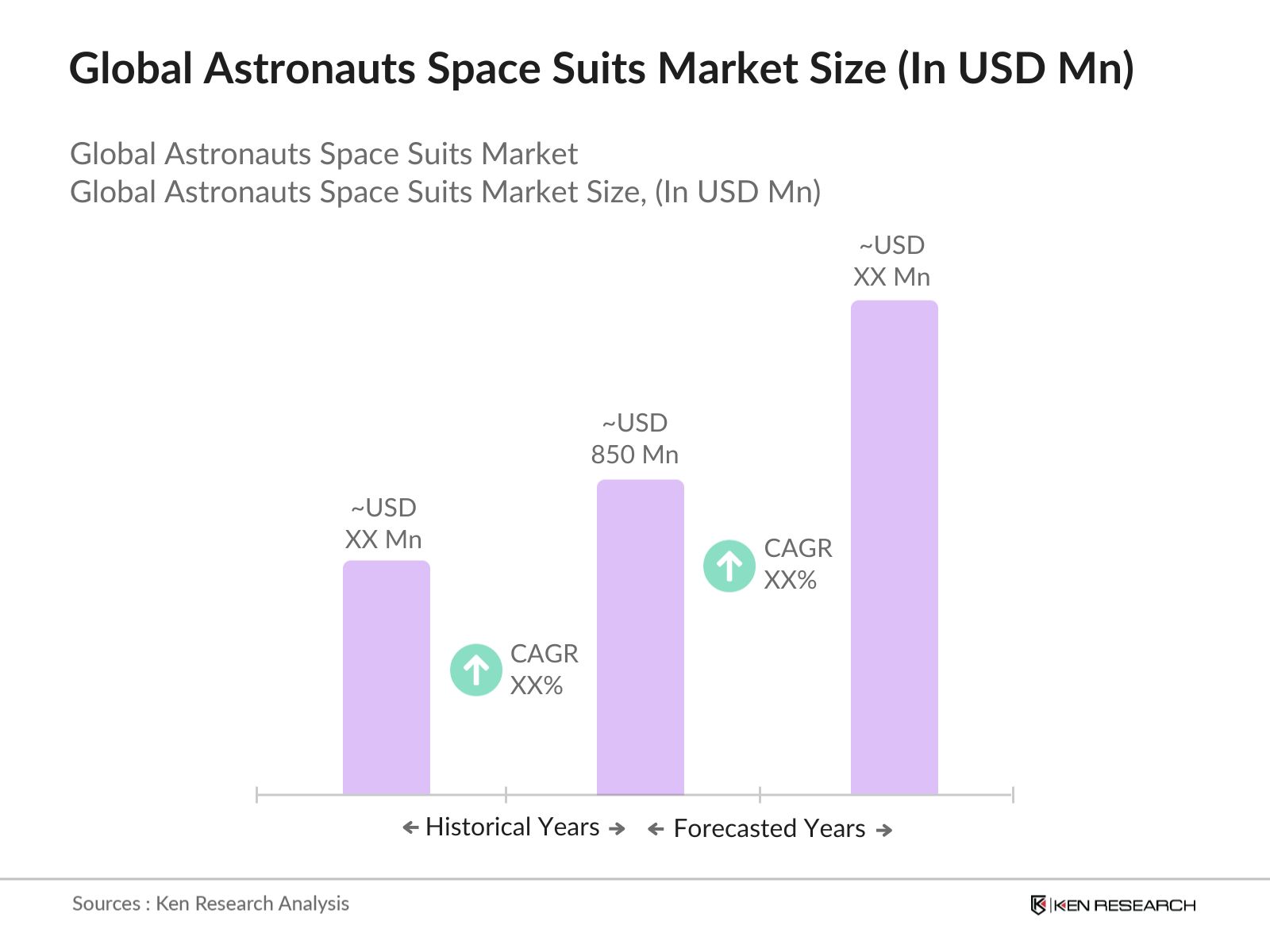
- The global astronauts space suits market is valued at USD 850 million, based on a five-year historical analysis. This market is driven by a combination of rising manned space exploration missions, private space travel growth, and continuous government initiatives. The launch of space programs such as NASAs Artemis and advancements in private space companies like SpaceX are pivotal factors accelerating the market demand. Governments around the globe, particularly in North America and Europe, are investing heavily in space exploration, which fuels the growing need for advanced space suits.
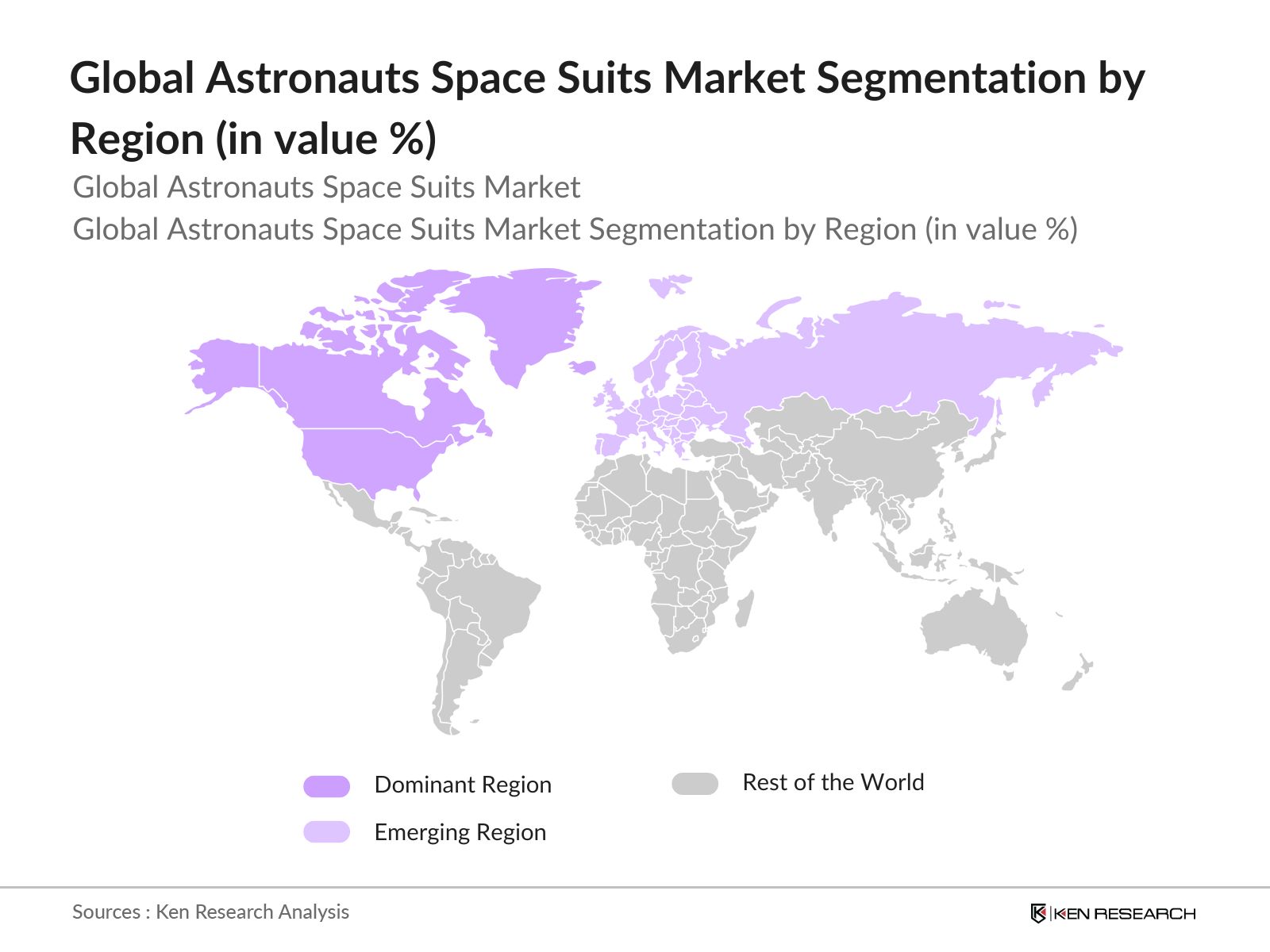
- North America, specifically the United States, dominates the global astronauts space suits market due to its significant investments in space exploration and a well-established space agency, NASA. Additionally, the presence of private players such as SpaceX further reinforces the regions leadership. Europe also plays a major role in the market with the European Space Agencys strong initiatives and collaborations, while countries like Russia and China are emerging as key contenders, with growing investments in space missions and space technology advancements.
- NASAs 2024 budget allocated significant resources toward the development of new space suit technologies. The agency is focusing on next-generation space suits for its Artemis program, which requires enhanced protection and mobility for astronauts. This government funding is set to accelerate innovation in the market and drive the development of suits suitable for long-term space exploration.
Global Astronauts Space Suits Market Segmentation
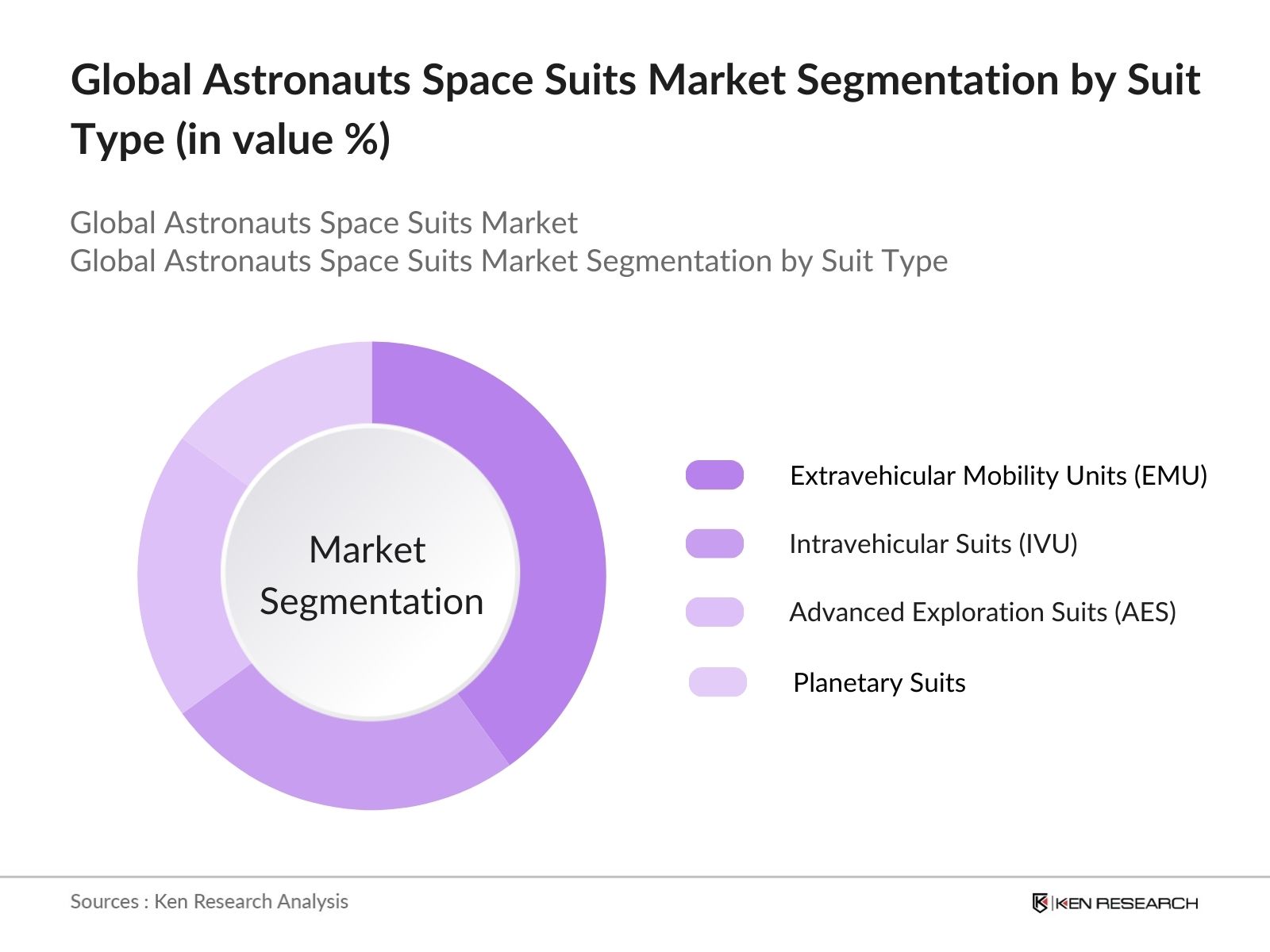
- By Suit Type: The astronauts space suits market is segmented by suit type into Extravehicular Mobility Units (EMU), Intravehicular Suits (IVU), Advanced Exploration Suits (AES), and Planetary Suits. The Extravehicular Mobility Units dominate the market share due to their critical role in spacewalks and extravehicular activities (EVAs) for maintenance, repairs, and exploration in space environments. NASAs EMU suits, used in both the International Space Station (ISS) and future deep-space missions, are the most recognized in this segment, bolstering their demand and prominence in the market.
- By Region: North America holds the largest share of the astronauts space suits market, driven by high investments in space programs and private companies' involvement in space exploration. Europe follows closely due to the European Space Agency's consistent focus on space innovation. Asia-Pacific, led by China and India, is rapidly emerging as a growing region with increasing investments in their space agencies.
- By Application: The astronauts space suits market is segmented by application into manned space missions, space tourism, deep space exploration, and planetary colonization. Manned space missions are the largest sub-segment due to their continuous reliance on space suits for astronaut safety during EVAs and long-duration space missions. These missions are driving the demand for highly durable, multi-functional suits that can withstand the harsh space environment.
Global Astonaut Space Suits Market Competitive Landscape
The global astronauts space suits market is dominated by a few key players, including NASA contractors and private companies like SpaceX. These companies hold substantial influence due to their technological expertise, strategic partnerships with government space agencies, and significant R&D investments.
|
Company Name |
Establishment Year |
Headquarters |
Specialization |
Key Contracts |
Technological Advancements |
Global Presence |
R&D Capabilities |
Key Partnerships |
Innovation Focus |
|---|---|---|---|---|---|---|---|---|---|
|
Collins Aerospace |
1917 |
United States |
- | - | - | - | - | - | - |
|
SpaceX |
2002 |
United States |
- | - | - | - | - | - | - |
|
Boeing |
1916 |
United States |
- | - | - | - | - | - | - |
|
ILC Dover |
1947 |
United States |
- | - | - | - | - | - | - |
|
NPP Zvezda |
1952 |
Russia |
- | - | - | - | - | - | - |
Global Astronaut Space Suits Market Analysis
Market Growth Drivers
- Rise in Space Exploration (Increased Mission Frequency): The global space sector is seeing significant growth in mission frequency, driven by increasing investments from governments and private entities. NASA has planned over 35 manned and unmanned missions for 2024, including those under the Artemis program, aimed at returning humans to the Moon. This surge in space exploration is expected to increase the demand for astronauts' space suits, which are critical for extravehicular activities (EVA). The space suits used in such missions must be reliable, safe, and technologically advanced, prompting further R&D investments in suit development.
- Growth of Private Space Industry (Collaboration with NASA, SpaceX, Blue Origin): Private players like SpaceX and Blue Origin are making significant contributions to the growth of the space industry. In 2024, SpaceX is planning over 60 launches, some of which involve crewed missions in partnership with NASA, necessitating new-generation space suits. The commercial space sector now forms a vital part of space exploration, with more private astronauts expected to require custom-designed suits. This collaboration between private companies and government space agencies has created a dynamic market for advanced space suits.
- Government Initiatives (NASA, ESA, Roscosmos Space Programs): Government agencies are heavily involved in advancing space exploration. NASAs 2024 budget has earmarked over $7 billion for human exploration and space operations, including investments in new spacesuit technologies. Similarly, the European Space Agency (ESA) and Roscosmos have been increasing their collaboration on manned space missions. These programs provide a solid base for the space suits market to flourish, with increased demand for more robust and versatile suits.
Market Challenges
- High Cost of Space Suit Development: The development and production of space suits are highly expensive due to the need for advanced materials and specialized manufacturing processes. The 2024 budget for space exploration programs, including spacesuit R&D, shows that each suit can cost several million dollars, limiting widespread adoption. Companies are facing pressure to reduce these costs while maintaining high safety standards, which remains a challenge for manufacturers and government agencies alike.
- Strict Regulatory Requirements (Safety Standards): Space suits must adhere to stringent safety and regulatory standards imposed by space agencies like NASA and international bodies. In 2024, NASAs updated guidelines require space suits to pass a series of rigorous tests, including thermal, vacuum, and radiation resistance. These regulatory requirements often lead to longer development cycles and increased costs, as non-compliant suits face rejection. Meeting these evolving safety standards remains a significant challenge for manufacturers.
Global Astronaut Space Suits Market Future Outlook
Over the next five years, the astronauts space suits market is projected to witness considerable growth driven by ongoing space exploration initiatives, increasing participation of private companies in space travel, and advancements in space suit technology. Continuous innovations, including lightweight materials and modular designs, are anticipated to redefine space suits functionalities, enhancing their efficiency for long-duration missions. Furthermore, the expansion of commercial space tourism and lunar missions will further contribute to the growth of this market.
Market Opportunities
- Growing Commercial Space Travel (Space Tourism, Private Companies): The commercial space travel sector is witnessing exponential growth, driven by companies like SpaceX and Blue Origin. With over 150 private astronauts expected to participate in missions by 2025, the demand for custom space suits is rising. This surge in private sector involvement offers significant opportunities for manufacturers to develop space suits tailored for space tourism and commercial missions.
- Global Collaboration in Space Missions (International Space Stations): The increasing international collaboration on space missions presents a unique opportunity for the space suits market. By 2024, agencies such as NASA, ESA, and Roscosmos are working together on projects like the International Space Station and the Artemis mission. These collaborative efforts drive the need for standardized space suits that can be used across different missions, opening new markets for suppliers and manufacturers globally.
Scope of the Report
|
By Suit Type |
Extravehicular Mobility Units (EMU) Intravehicular Suits (IVU) Advanced Exploration Suits (AES) Planetary Suits (Lunar & Martian Exploration) |
|
By Application |
Manned Space Missions Space Tourism Deep Space Exploration Planetary Colonization |
|
By Material |
Kevlar-based Materials Gore-Tex Composite Thermal Micrometeoroid Garment (TMG) Pressure Garments (Inner Layer) |
|
By Component |
Helmet Systems Life Support Systems Communications Systems Thermal Regulation Systems |
|
By Region |
North America Europe Asia-Pacific Middle East & Africa Latin America |
Products
Key Target Audience
Space Agencies (NASA, ESA, Roscosmos, ISRO)
Space Equipment Manufacturers
Private Space Companies (SpaceX, Blue Origin)
Government and Regulatory Bodies (NASA, FAA)
Defense Departments (DoD, European Defense Agency)
Aerospace Engineers and Designers
Investors and Venture Capitalist Firms
Suppliers of Raw Materials for Space Suits
Companies
Players Mentioned in the Report:
Collins Aerospace
SpaceX
Boeing
ILC Dover
NPP Zvezda
Honeywell International
David Clark Company
Final Frontier Design
Thales Alenia Space
Lockheed Martin
Table of Contents
1. Global Astronauts Space Suits Market Overview
1.1. Definition and Scope
1.2. Market Taxonomy
1.3. Space Suit Development History
1.4. Market Segmentation Overview
1.5. Technological Advancements in Space Suit Design
1.6. Space Exploration Mission Trends (Manned Missions, Lunar & Mars Programs)
2. Global Astronauts Space Suits Market Size (In USD Bn)
2.1. Historical Market Size
2.2. Year-on-Year Growth Analysis (Manned Missions, Private Space Sector Growth)
2.3. Key Market Developments and Milestones (SpaceX, NASA Artemis, and other missions)
2.4. Impact of Emerging Space Economies
3. Global Astronauts Space Suits Market Analysis
3.1. Growth Drivers
3.1.1. Rise in Space Exploration (Increased Mission Frequency)
3.1.2. Growth of Private Space Industry (Collaboration with NASA, SpaceX, Blue Origin)
3.1.3. Government Initiatives (NASA, ESA, Roscosmos Space Programs)
3.1.4. Technological Innovations (New Materials, Life-Support Systems)
3.2. Market Challenges
3.2.1. High Cost of Space Suit Development
3.2.2. Strict Regulatory Requirements (Safety Standards)
3.2.3. Limited Supplier Ecosystem (Specialized Components)
3.2.4. Long Development Timelines
3.3. Opportunities
3.3.1. Growing Commercial Space Travel (Space Tourism, Private Companies)
3.3.2. Global Collaboration in Space Missions (International Space Stations)
3.3.3. Expansion of Lunar and Mars Exploration (NASA Artemis, China Lunar Missions)
3.3.4. Advanced Space Suit Customization (Adaptation to Different Environments)
3.4. Trends
3.4.1. Integration of Augmented Reality in Space Suits
3.4.2. Modular Space Suit Systems for Long-Duration Missions
3.4.3. Sustainability and Reusability in Space Suit Design
3.4.4. Lightweight Materials and Enhanced Mobility Features
3.5. Government Regulations
3.5.1. NASA Suit Standards (Orion, Artemis Programs)
3.5.2. International Space Agency Guidelines (ESA, Roscosmos)
3.5.3. Compliance with Space Mission Safety Protocols
3.5.4. Public-Private Partnership Regulations (NASA, Private Sector)
4. Global Astronauts Space Suits Market Segmentation
4.1. By Suit Type (In Value %)
4.1.1. Extravehicular Mobility Units (EMU)
4.1.2. Intravehicular Suits (IVU)
4.1.3. Advanced Exploration Suits (AES)
4.1.4. Planetary Suits (Lunar and Martian Exploration)
4.2. By Application (In Value %)
4.2.1. Manned Space Missions
4.2.2. Space Tourism
4.2.3. Deep Space Exploration
4.2.4. Planetary Colonization Efforts
4.3. By Material Type (In Value %)
4.3.1. Kevlar-based Materials
4.3.2. Gore-Tex Composite Materials
4.3.3. Thermal Micrometeoroid Garment (TMG)
4.3.4. Pressure Garments (Inner Layer)
4.4. By Component (In Value %)
4.4.1. Helmet Systems
4.4.2. Life Support Systems
4.4.3. Communications Systems
4.4.4. Thermal Regulation Systems
4.5. By Region (In Value %)
4.5.1. North America
4.5.2. Europe
4.5.3. Asia-Pacific
4.5.4. Middle East & Africa
4.5.5. Latin America
5. Global Astronauts Space Suits Market Competitive Analysis
5.1. Detailed Profiles of Major Companies
5.1.1. Collins Aerospace
5.1.2. SpaceX
5.1.3. Boeing
5.1.4. Oceaneering International
5.1.5. ILC Dover
5.1.6. Final Frontier Design
5.1.7. David Clark Company
5.1.8. NPP Zvezda
5.1.9. Honeywell International
5.1.10. NASA (Contract Partners)
5.1.11. Lockheed Martin
5.1.12. Thales Alenia Space
5.1.13. SpaceX
5.1.14. Airbus Defence and Space
5.1.15. Roscosmos (Subcontractors)
5.2. Cross Comparison Parameters (Technology Expertise, Contracts with Space Agencies, No. of Missions Supported, Suit Customization Capabilities, Market Share, Global Presence, Patents Held, Key Partnerships)
5.3. Market Share Analysis
5.4. Strategic Initiatives (R&D, Partnerships with Space Agencies, Private Sector Collaborations)
5.5. Mergers and Acquisitions
5.6. Investment Analysis (Government Funding, Private Investment)
5.7. Venture Capital Funding in Space Tech
5.8. Space Exploration Contracts and NASA Partnerships
6. Global Astronauts Space Suits Market Regulatory Framework
6.1. International Space Safety Standards
6.2. Suit Certification Processes
6.3. Regulatory Compliance for Extravehicular Activities (EVAs)
6.4. National Space Policies Impacting Suit Design
7. Global Astronauts Space Suits Future Market Size (In USD Bn)
7.1. Market Size Projections
7.2. Key Factors Driving Future Market Growth
8. Global Astronauts Space Suits Future Market Segmentation
8.1. By Suit Type (In Value %)
8.2. By Application (In Value %)
8.3. By Material Type (In Value %)
8.4. By Component (In Value %)
8.5. By Region (In Value %)
9. Global Astronauts Space Suits Market Analysts Recommendations
9.1. Market Entry Strategy (TAM/SAM/SOM Analysis)
9.2. Target Market Identification (Space Agencies, Commercial Spaceflight Operators)
9.3. Partnerships and Collaborative Opportunities (Cross-Industry Collaborations)
9.4. White Space Opportunity Analysis
Disclaimer Contact UsResearch Methodology
Step 1: Identification of Key Variables
The first step in the research involves mapping the entire astronaut space suits ecosystem, including all major stakeholders such as space agencies, private space companies, and equipment manufacturers. Desk research and proprietary databases were utilized to collect comprehensive industry information. Key market dynamics were identified to form the basis for further research.
Step 2: Market Analysis and Construction
Historical data on space exploration missions, private sector involvement, and space suit innovations were gathered and analyzed. Metrics such as the number of space missions and technological advancements in space suits were assessed to gauge the current market trends.
Step 3: Hypothesis Validation and Expert Consultation
A hypothesis based on emerging trends and growth drivers was created. Industry experts from various aerospace companies were consulted through interviews, which provided valuable operational insights into the astronauts space suits market. This process helped validate the findings and refine the data.
Step 4: Research Synthesis and Final Output
Finally, data from space agencies, space equipment manufacturers, and private companies was synthesized to ensure an accurate analysis of the astronauts space suits market. This phase also involved assessing the future growth potential based on expert opinions and industry developments.
Frequently Asked Questions
01. How big is the Global Astronauts Space Suits Market?
The global astronauts space suits market is valued at USD 850 million, driven by increased space exploration missions and growing private sector involvement in space travel.
02. What are the challenges in the Global Astronauts Space Suits Market?
Key challenges in the global astronauts space suits market include the high cost of development, long development cycles, and stringent regulatory requirements that necessitate extensive testing and certification.
03. Who are the major players in the Global Astronauts Space Suits Market?
Major players in the global astronauts space suits market include Collins Aerospace, SpaceX, Boeing, ILC Dover, and NPP Zvezda, which dominate the market due to their expertise in space suits, technological advancements, and strategic partnerships with space agencies.
04. What drives growth in the Global Astronauts Space Suits Market?
The growth of the global astronauts space suits market is driven by ongoing space exploration programs, government investments, advancements in space suit technologies, and the rise of commercial space tourism.
Why Buy From Us?

What makes us stand out is that our consultants follows Robust, Refine and Result (RRR) methodology. i.e. Robust for clear definitions, approaches and sanity checking, Refine for differentiating respondents facts and opinions and Result for presenting data with story

We have set a benchmark in the industry by offering our clients with syndicated and customized market research reports featuring coverage of entire market as well as meticulous research and analyst insights.

While we don't replace traditional research, we flip the method upside down. Our dual approach of Top Bottom & Bottom Top ensures quality deliverable by not just verifying company fundamentals but also looking at the sector and macroeconomic factors.

With one step in the future, our research team constantly tries to show you the bigger picture. We help with some of the tough questions you may encounter along the way: How is the industry positioned? Best marketing channel? KPI's of competitors? By aligning every element, we help maximize success.

Our report gives you instant access to the answers and sources that other companies might choose to hide. We elaborate each steps of research methodology we have used and showcase you the sample size to earn your trust.

If you need any support, we are here! We pride ourselves on universe strength, data quality, and quick, friendly, and professional service.