
Global Biocompatible Coatings Market Outlook to 2030
Region:Global
Author(s):Yogita Sahu
Product Code:KROD1097
October 2024
80
About the Report
Global Biocompatible Coatings Market Overview
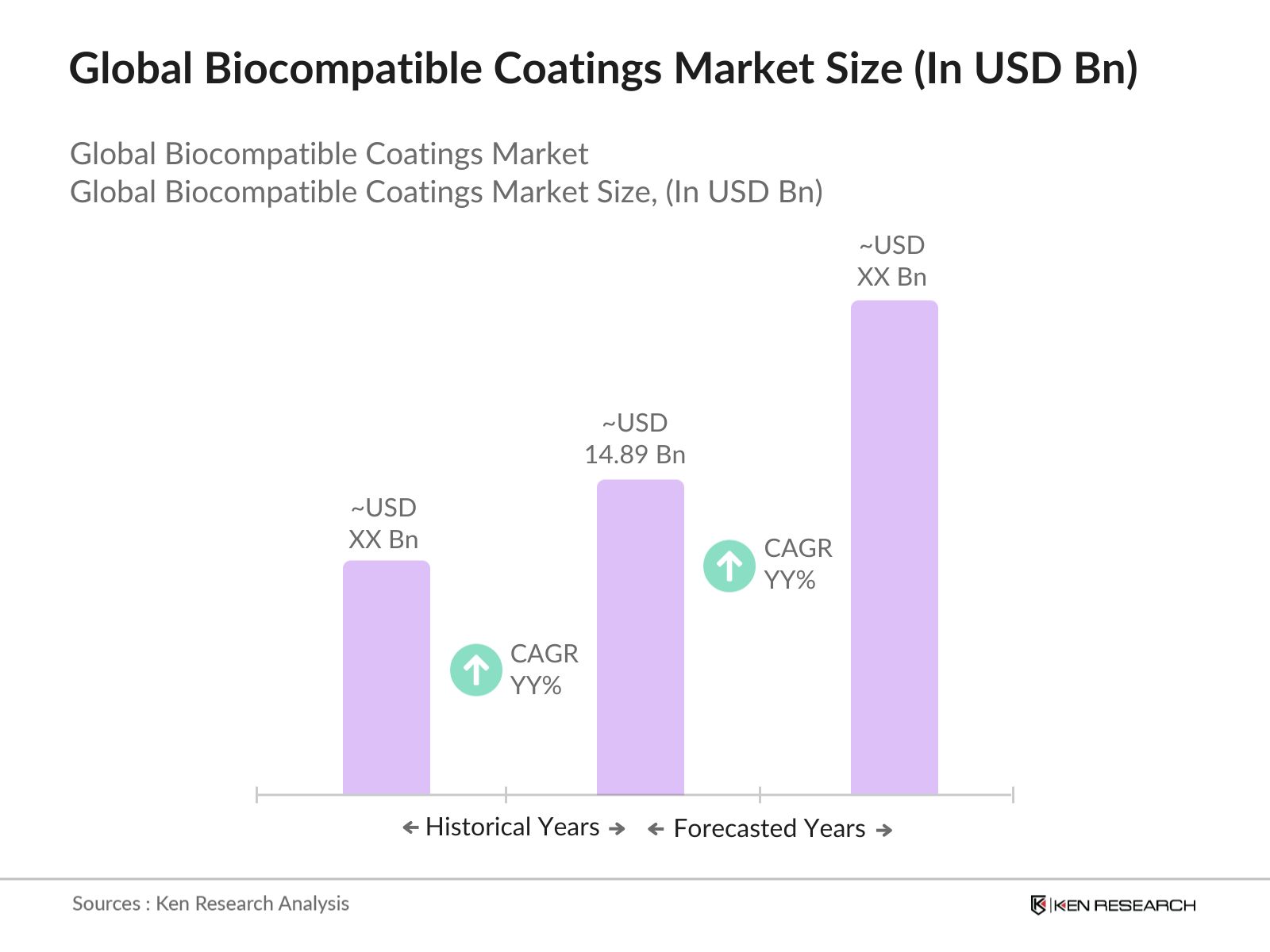
- The Global Biocompatible Coatings Market was valued at USD 14.89 billion in 2023. The market is driven by the increasing demand for advanced medical implants and devices, which require coatings that are compatible with human tissues. The surge in the elderly population and the prevalence of chronic diseases are also significant contributors, fueling the need for biocompatible materials in healthcare.
- Key players in the market are DSM Biomedical, SurModics, Inc., Covalon Technologies Ltd., Biocoat Inc., and Hydromer Inc. These companies have established themselves as leaders through innovation, extensive product portfolios, and strategic partnerships, catering to the growing demand for biocompatible coatings across various applications.
- In 2023, DSM Biomedical introduced a new antimicrobial coating to its biocompatible coating portfolio. This development was aimed at addressing the increasing concerns over infections associated with medical implants, which is a significant issue in the healthcare sector. The introduction of antimicrobial coatings is part of a broader trend in the biocompatible coatings market, which is projected to grow significantly due to the rising demand for safer and more effective medical devices.
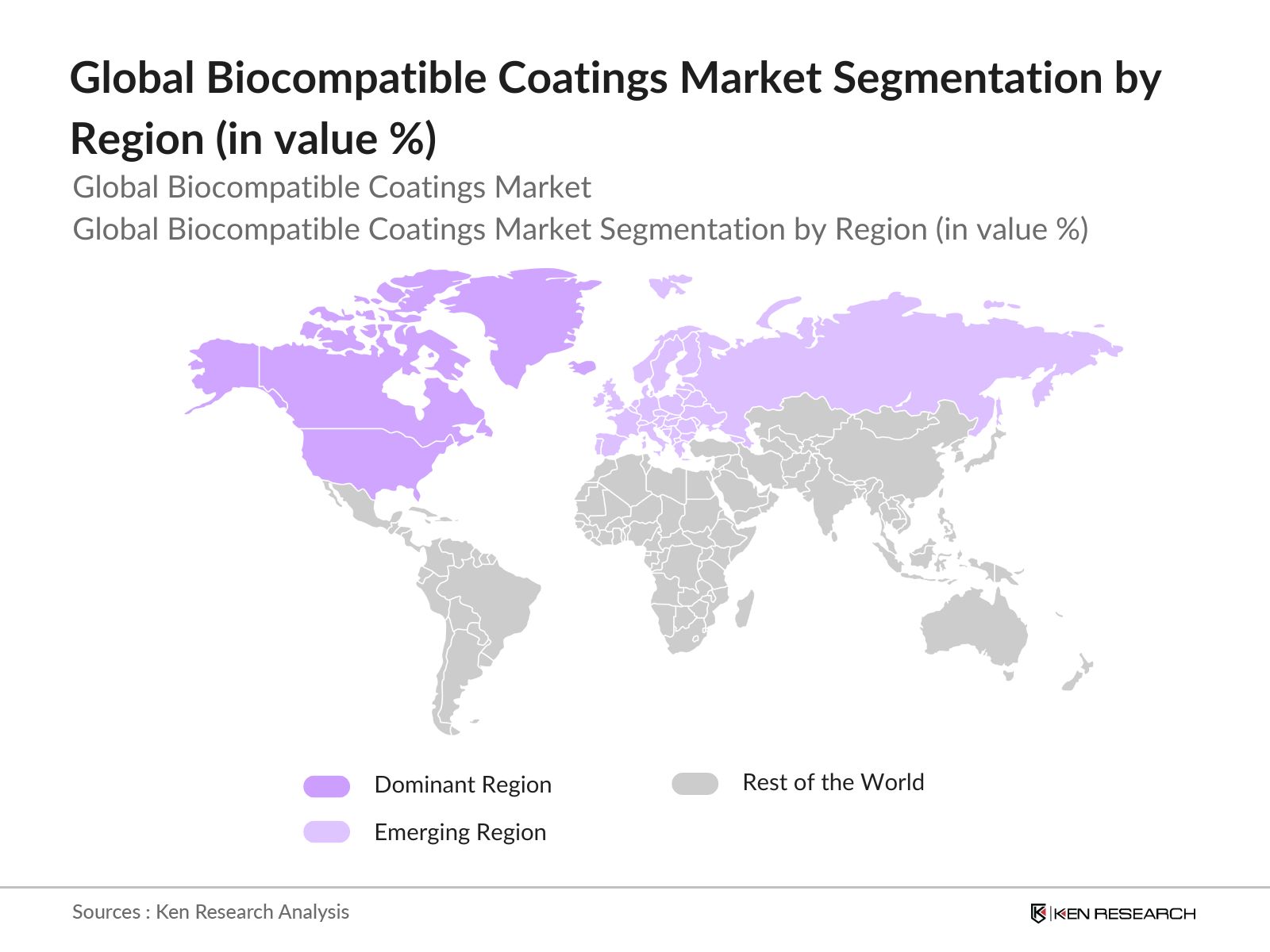
- The USA, dominates the region due to the presence of a large number of medical device manufacturers, advanced healthcare infrastructure, and a high adoption rate of new technologies. The strong focus on research and development, supported by government funding, has positioned the USA as a leader in the biocompatible coating market.
Global Biocompatible Coatings Market Segmentation
The global biocompatible coatings industry is segmented into various factors like product, application, and region.
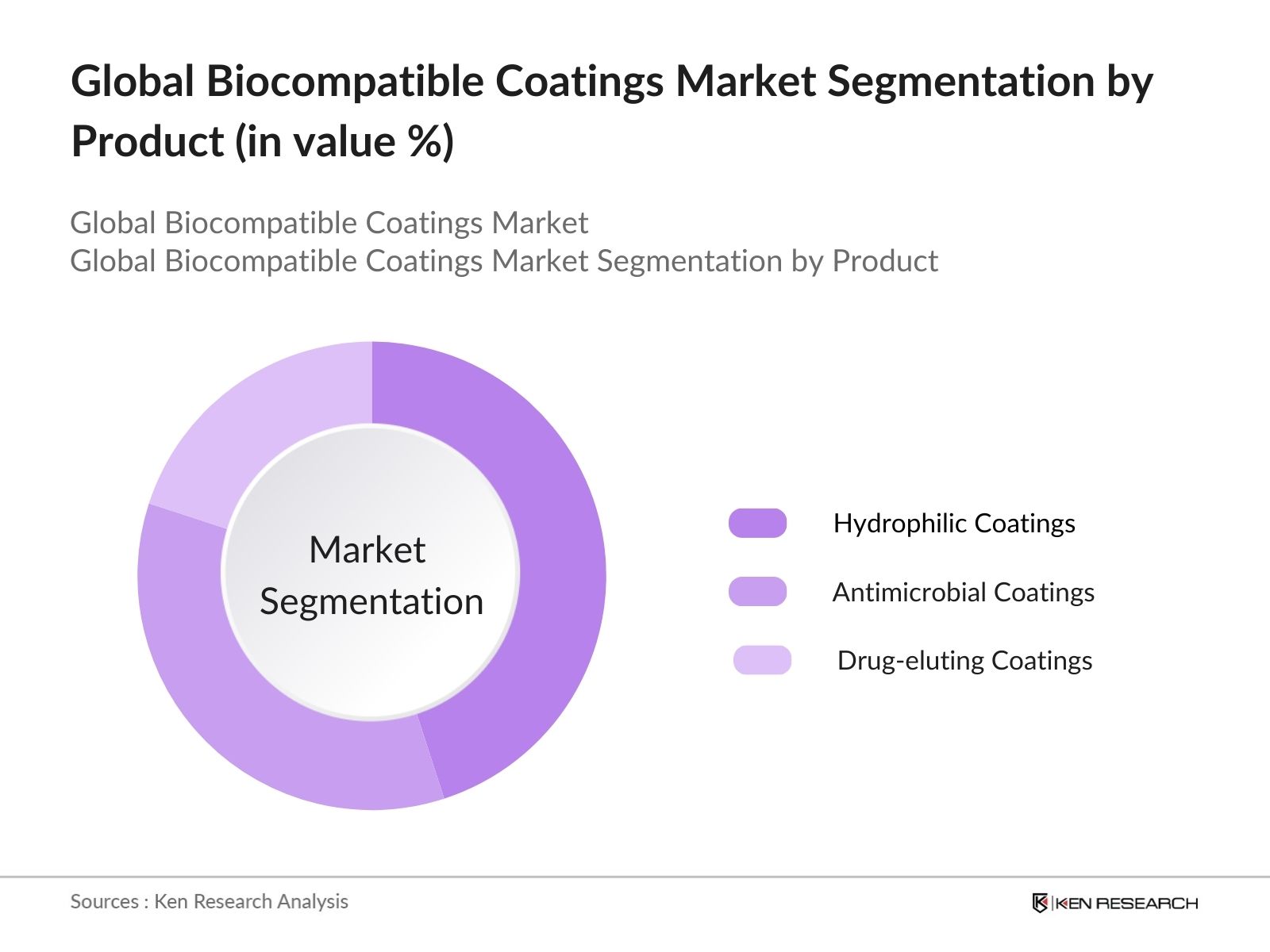
By Product: The market is segmented by product type into hydrophilic coatings, antimicrobial coatings, and drug-eluting coatings. In 2023, Hydrophilic coatings held the largest market share due to their wide application in catheters, guidewires, and other medical devices that require lubricity and moisture retention.
By Region: The market is segmented by region into North America, Europe, Asia-Pacific (APAC), Middle East & Africa (MEA), and Latin America. In 2023, North America held the largest market share with the regions advanced healthcare infrastructure, strong focus on R&D, and high adoption of new technologies contributing to its dominance.
By Application: The market is segmented by cardiovascular, orthopedics, and dental. In 2023, the cardiovascular segment held the largest market share with the increased demand for biocompatible coatings in stents, pacemakers, and other cardiovascular devices. The ongoing development of advanced coatings that reduce the risk of blood clots and infections has further driven the growth of this segment.
Global Biocompatible Coatings Market Competitive Landscape
|
Company Name |
Establishment Year |
Headquarters |
|
DSM Biomedical |
1981 |
Heerlen, Netherlands |
|
SurModics, Inc. |
1979 |
Eden Prairie, USA |
|
Covalon Technologies |
2004 |
Ontario, Canada |
|
Biocoat Inc. |
1991 |
Horsham, USA |
|
Hydromer Inc. |
1980 |
Concord, USA |
- SurModics, Inc.: In March 2024, SurModics, Inc. announced a breakthrough in biocompatible coating technology with the launch of a new polymer-based coating that reduces thrombosis risk. This innovation is expected to impact the cardiovascular device market, where the risk of blood clots is a major concern. SurModics reported an increase in its cardiovascular segment revenue in Q1 2024.
- Covalon Technologies: Covalon Technologies introduced a new biocompatible coating in early 2024 that incorporates antimicrobial and anti-inflammatory properties. This dual-functionality coating is designed for use in wound care and surgical applications, offering enhanced patient outcomes. The company has reported an increase in sales from its wound care segment in the first half of 2024, driven by the adoption of this new coating technology.
Global Biocompatible Coatings Market Analysis
Market Growth Drivers
- Increasing Demand for Advanced Medical Implants: In 2024, the global demand for medical implants is raising, with biocompatible coatings playing a crucial role in enhancing their compatibility with human tissue. This demand is further supported by the growing aging population, which reached 1.2 billion globally in 2024, leading to an increased need for medical devices that require biocompatible coatings to ensure safety and efficacy during long-term use.
- Rise in Chronic Disease Prevalence: Chronic diseases such as cardiovascular diseases, diabetes, and arthritis have seen a rise globally, driving the need for medical devices coated with biocompatible materials. In 2024, the global prevalence of cardiovascular diseases alone was 550 million cases, requiring the use of stents and other implants that incorporate biocompatible coatings to reduce complications.
- Government Regulations Supporting Biocompatibility Standards: Governments worldwide are implementing stringent regulations to ensure the safety and effectiveness of medical devices, including those with biocompatible coatings. In 2024, the European Union's Medical Devices Regulation (MDR) enforced stricter biocompatibility standards, affecting 10,000 medical devices across Europe. This regulatory push has led to increased adoption of high-quality biocompatible coatings, driving market growth as manufacturers strive to meet the new requirements and ensure compliance.
Market Challenges
- Limited Availability of Raw Materials: In 2024, the global supply of key raw materials for biocompatible coatings was disrupted by geopolitical tensions and environmental regulations, affecting over 15,000 tons of material supply. This scarcity has led to increased raw material costs, making it challenging for manufacturers to maintain consistent production levels and meet market demand.
- Environmental Concerns: In 2024, over 1 million tons of medical waste containing biocompatible coatings were generated globally, prompting stricter environmental regulations. Manufacturers face the challenge of developing eco-friendly coatings and implementing sustainable production practices to reduce their environmental impact, which can increase production costs and complicate the manufacturing process.
Government Initiatives
- FDAs Medical Device Innovation Consortium (MDIC) Initiative: In 2024, the FDA requested USD 7.2 billion to advance public health, including USD 11.6 million dedicated to improving the medical device supply chain and addressing shortages. This funding aims to enhance the availability of safe and effective medical devices, including those with biocompatible coatings, ensuring continuous patient access and mitigating supply disruptions.
- European Union's Medical Devices Regulation (MDR) Implementation: The European Union fully implemented the MDR in 2024, which includes stringent requirements for biocompatibility testing and certification of medical devices. This regulation affects 25,000 medical device manufacturers across Europe, requiring them to meet higher biocompatibility standards. The MDR's enforcement is expected to drive demand for advanced biocompatible coatings as manufacturers seek to comply with the new regulations and maintain market access within the European Union.
Global Biocompatible Coatings Market Future Outlook
The future trends in the global biocompatible coatings industry include the increased adoption of personalized medicine, advancements in nanotechnology for medical applications, the expansion of biocompatible coatings in the pharmaceutical sector, and the emergence of smart coatings with sensing capabilities.
Future Market Trends
- Advancements in Nanotechnology for Medical Applications: Nanotechnology will play a pivotal role in the future of biocompatible coatings, with ongoing research leading to the development of nanocoatings that offer superior performance and functionality. By 2028, nanocoatings are expected to account for 30% of all biocompatible coatings used in medical devices, driven by their ability to improve drug delivery, reduce infection risks, and enhance tissue integration.
- Emergence of Smart Coatings with Sensing Capabilities: The next five years will witness the emergence of smart biocompatible coatings with integrated sensing capabilities, enabling real-time monitoring of device performance and patient health. These smart coatings, equipped with biosensors, will provide continuous feedback on parameters such as pH levels, temperature, and infection markers. By 2028, smart coatings are expected to be incorporated into 2 million medical devices annually, revolutionizing post-operative care and chronic disease management.
Scope of the Report
|
By Product |
Hydrophilic Coatings Antimicrobial Coatings Drug-Eluting Coatings |
|
By Application |
Cardiovascular Orthopedics Dental |
|
By Material |
Polymer Ceramics Metal Others |
|
By End-User |
Healthcare Food & Beverage Medical Devices Others |
|
By Region |
North America Europe Asia-Pacific Latin America Middle East & Africa |
Products
Key Target Audience Organizations and Entities Who Can Benefit by Subscribing This Report:
Pharmaceutical Companies
Biotech Companies
Government Health Departments
Health Insurance Companies
Surgical Instrument Manufacturers
Biotechnology Investors
Healthcare Procurement Departments
Banking and Financial Institutes
Companies
Players Mentioned in the Report:
DSM Biomedical
SurModics, Inc.
Covalon Technologies Ltd.
Biocoat Inc.
Hydromer Inc.
Hemoteq AG
BioInteractions Ltd.
AdvanSource Biomaterials Corporation
AST Products, Inc.
Specialty Coating Systems, Inc.
Abbott Laboratories
Medtronic Plc
Johnson & Johnson
Boston Scientific Corporation
3M Company
Table of Contents
1. Global Biocompatible Coating Market Overview
1.1. Definition and Scope
1.2. Market Taxonomy
1.3. Market Growth Rate
1.4. Market Segmentation Overview
2. Global Biocompatible Coating Market Size (in USD Bn), 2018-2023
2.1. Historical Market Size
2.2. Year-on-Year Growth Analysis
2.3. Key Market Developments and Milestones
3. Global Biocompatible Coating Market Analysis
3.1. Growth Drivers
3.1.1. Increasing Demand for Advanced Medical Implants
3.1.2. Rise in Chronic Disease Prevalence
3.1.3. Technological Advancements in Nanocoatings
3.1.4. Government Regulations Supporting Biocompatibility Standards
3.2. Restraints
3.2.1. High Production Costs
3.2.2. Limited Availability of Raw Materials
3.2.3. Stringent Regulatory Approvals
3.2.4. Environmental Concerns
3.3. Opportunities
3.3.1. Expansion of Biocompatible Coatings in Emerging Markets
3.3.2. Growing Demand in the Pharmaceutical Sector
3.3.3. Rising Investment in R&D for Smart Coatings
3.3.4. Increasing Collaborations and Partnerships
3.4. Trends
3.4.1. Adoption of Nanotechnology
3.4.2. Growth of Personalized Medicine
3.4.3. Integration with Smart Medical Devices
3.4.4. Expansion into Non-Medical Sectors
3.5. Government Regulations
3.5.1. FDAs Medical Device Innovation Consortium (MDIC) Initiative
3.5.2. European Union's MDR Implementation
3.5.3. Chinas Healthcare Modernization Program
3.5.4. Japan's National Strategic Special Zones Initiative
3.6. SWOT Analysis
3.7. Stakeholder Ecosystem
3.8. Competitive Ecosystem
4. Global Biocompatible Coating Market Segmentation, 2023
4.1. By Product Type (in Value %)
4.1.1. Hydrophilic Coatings
4.1.2. Antimicrobial Coatings
4.1.3. Drug-Eluting Coatings
4.2. By Application (in Value %)
4.2.1. Cardiovascular
4.2.2. Orthopedics
4.2.3. Dental
4.3. By Material (in Value %)
4.3.1. Polymer
4.3.2. Ceramics
4.3.3. Metal
4.3.4. Others
4.4. By End-User (in Value %)
4.4.1. Healthcare
4.4.2. Food & Beverage
4.4.3. Medical Devices
4.4.4. Others
4.5. By Region (in Value %)
4.5.1. North America
4.5.2. Europe
4.5.3. Asia-Pacific
4.5.4. Latin America
4.5.5. Middle East & Africa
5. Global Biocompatible Coating Market Cross Comparison
5.1. Detailed Profiles of Major Companies
5.1.1. DSM Biomedical
5.1.2. SurModics, Inc.
5.1.3. Covalon Technologies Ltd.
5.1.4. Biocoat Inc.
5.1.5. Hydromer Inc.
5.1.6. Other Major Players
5.2. Cross Comparison Parameters (No. of Employees, Headquarters, Inception Year, Revenue)
6. Global Biocompatible Coating Market Competitive Landscape
6.1. Market Share Analysis
6.2. Strategic Initiatives
6.3. Mergers and Acquisitions
6.4. Investment Analysis
6.4.1. Venture Capital Funding
6.4.2. Government Grants
6.4.3. Private Equity Investments
7. Global Biocompatible Coating Market Regulatory Framework
7.1. Biocompatibility Standards
7.2. Compliance Requirements
7.3. Certification Processes
8. Global Biocompatible Coating Future Market Size (in USD Bn), 2023-2028
8.1. Future Market Size Projections
8.2. Key Factors Driving Future Market Growth
9. Global Biocompatible Coating Future Market Segmentation, 2028
9.1. By Product Type (in Value %)
9.2. By Application (in Value %)
9.3. By Material (in Value %)
9.4. By End-User (in Value %)
9.5. By Region (in Value %)
10. Global Biocompatible Coating Market Analysts Recommendations
10.1. TAM/SAM/SOM Analysis
10.2. Customer Cohort Analysis
10.3. Marketing Initiatives
10.4. White Space Opportunity Analysis
Disclaimer Contact UsResearch Methodology
Step:1 Identifying Key Variables:
Ecosystem creation for all the major entities and referring to multiple secondary and proprietary databases to perform desk research around market to collate industry level information.
Step:2 Market Building:
Collating statistics on this industry over the years, penetration of marketplaces and service providers ratio to compute revenue generated for Global Biocompatible Coating industry. We will also review service quality statistics to understand revenue generated which can ensure accuracy behind the data points shared.
Step:3 Validating and Finalizing:
Building market hypothesis and conducting CATIs with industry experts belonging to different companies to validate statistics and seek operational and financial information from company representatives.
Step:4 Research output:
Our team will approach multiple medical device manufacturing companies and understand nature of product segments and sales, consumer preference and other parameters, which will support us validate statistics derived through bottom to top approach from such medical devices manufacturing companies.
Frequently Asked Questions
01 How big is the Global Biocompatible Coating market?
The Global Biocompatible Coatings Market was valued at USD 14.89 billion in 2023. The market is driven by the increasing demand for advanced medical implants and devices, which require coatings that are compatible with human tissues.
02 What are the challenges in the Global Biocompatible Coating market?
Challenges in the Global Biocompatible Coating market include high production costs, limited availability of raw materials, stringent regulatory approvals, and environmental concerns related to the production and disposal of biocompatible coatings.
03 Who are the major players in the Global Biocompatible Coating market?
Key players in the Global Biocompatible Coating market include DSM Biomedical, SurModics, Inc., Covalon Technologies Ltd., Biocoat Inc., and Hydromer Inc., who lead the market through innovation and strategic collaborations.
04 What are the main growth drivers of the Global Biocompatible Coating market?
The growth of the Global Biocompatible Coating market is driven by the increasing demand for advanced medical implants, the rise in chronic disease prevalence, technological advancements in nanocoatings, and supportive government regulations aimed at enhancing medical device safety.
Why Buy From Us?

What makes us stand out is that our consultants follows Robust, Refine and Result (RRR) methodology. i.e. Robust for clear definitions, approaches and sanity checking, Refine for differentiating respondents facts and opinions and Result for presenting data with story

We have set a benchmark in the industry by offering our clients with syndicated and customized market research reports featuring coverage of entire market as well as meticulous research and analyst insights.

While we don't replace traditional research, we flip the method upside down. Our dual approach of Top Bottom & Bottom Top ensures quality deliverable by not just verifying company fundamentals but also looking at the sector and macroeconomic factors.

With one step in the future, our research team constantly tries to show you the bigger picture. We help with some of the tough questions you may encounter along the way: How is the industry positioned? Best marketing channel? KPI's of competitors? By aligning every element, we help maximize success.

Our report gives you instant access to the answers and sources that other companies might choose to hide. We elaborate each steps of research methodology we have used and showcase you the sample size to earn your trust.

If you need any support, we are here! We pride ourselves on universe strength, data quality, and quick, friendly, and professional service.