
Global Bulletproof Vest Market Outlook to 2030
Region:Global
Author(s):Shivani Mehra
Product Code:KROD4042
November 2024
99
About the Report
Global Bulletproof Vest Market Overview
- The Global Bulletproof Vest Market is valued at approximately USD 1.91 billion, with a valuation driven by increasing demand from military, law enforcement, and civilian sectors. A significant factor behind this growth is rising government investment in national security and defense, particularly in North America and Europe. Enhanced materials, such as lightweight composite ceramics and high-strength fibers, are increasingly preferred due to their durability and protective capabilities. These innovations have fueled market growth, reflecting a growing need for high-performance protective equipment that can withstand modern threats.
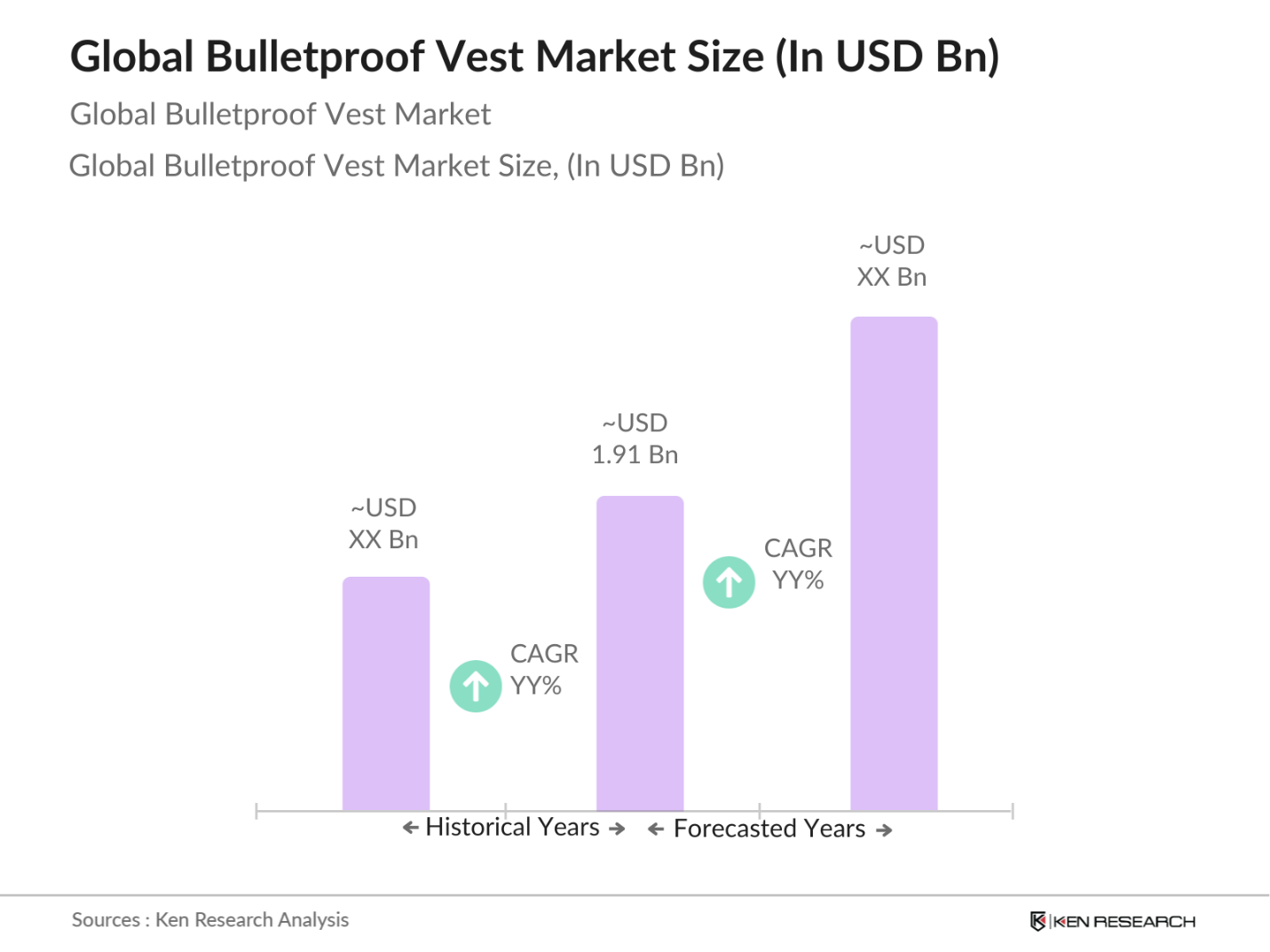
- The markets dominance lies primarily in North America, with the United States leading due to its substantial defense budget and strong emphasis on officer and military safety. Europe follows closely, particularly with countries like Germany and France investing heavily in advanced protective equipment. Asia-Pacific is also emerging as a prominent market, driven by heightened security threats and increased government spending in defense. Additionally, high crime rates and terrorist threats in certain countries contribute to the demand for bulletproof vests across these regions.
- National and international standards regulate bulletproof vest performance across the defense sector. The National Institute of Justice (NIJ) in the U.S. sets ballistic standards, requiring over 500,000 vests annually to undergo rigorous testing for certification. NATO also mandates specific criteria for vests used within its member countries, ensuring all protective gear meets uniform safety levels, crucial for multinational operations.
Global Bulletproof Vest Market Segmentation
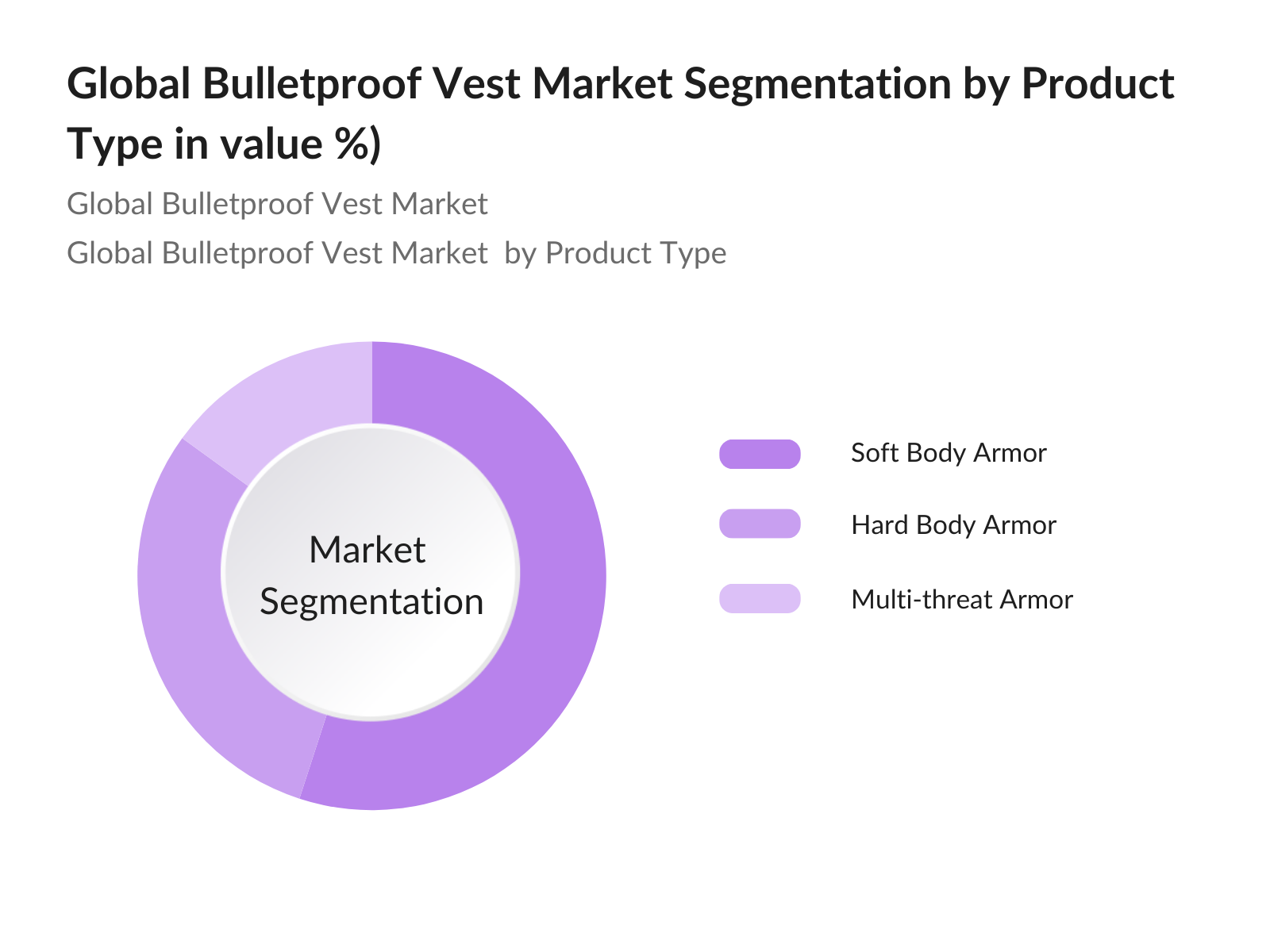
By Product Type: The Bulletproof Vest market is segmented by product type into soft body armor, hard body armor, and multi-threat armor. Soft body armor dominates due to its flexibility, lightweight nature, and wide application across law enforcement agencies. This segment is popular as it balances protection with comfort, making it a preferred choice for officers on patrol and personnel in active duty environments. While hard body armor offers higher protection levels, it is less commonly used outside of high-threat military applications due to its weight and rigidity.
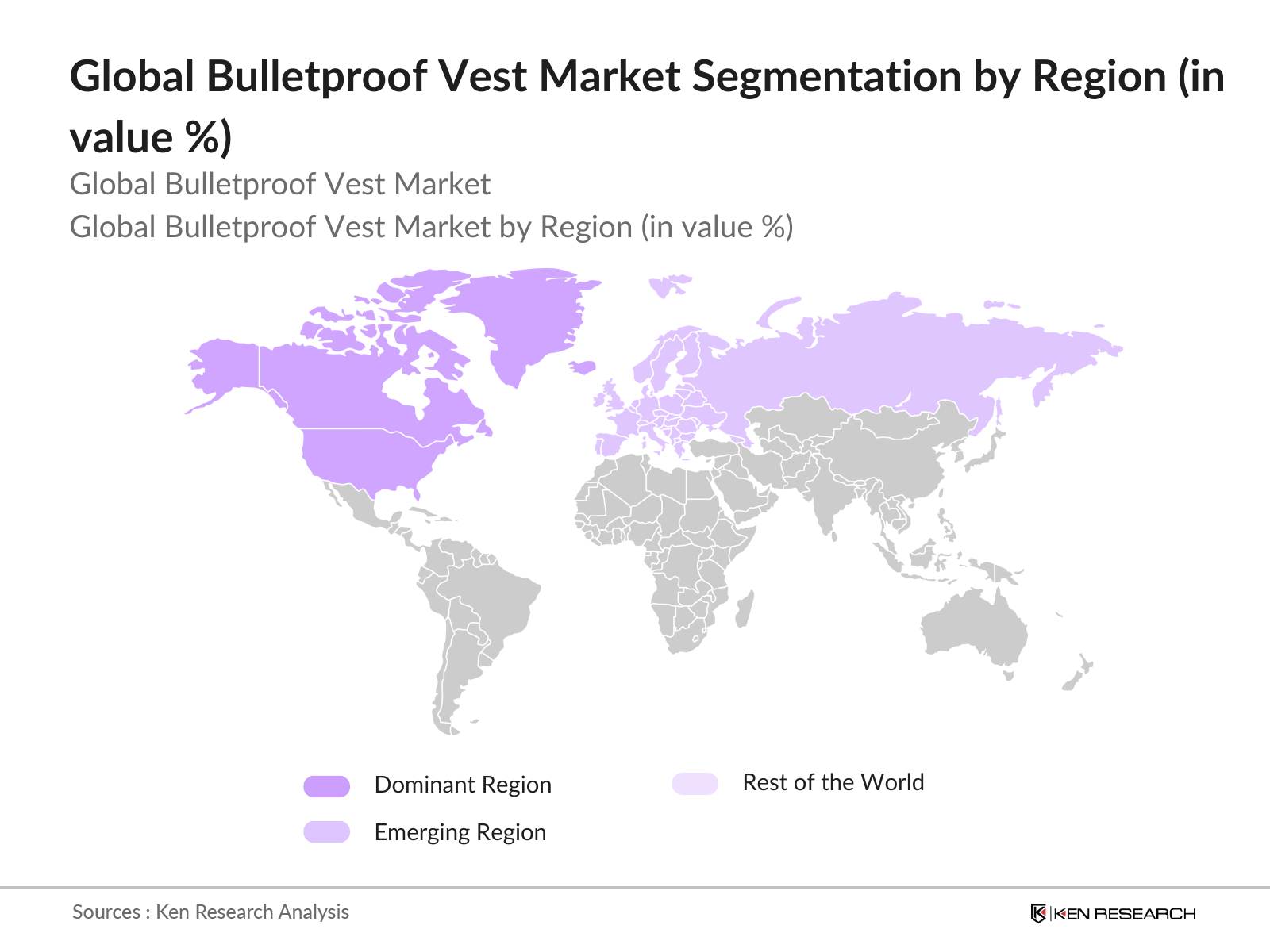
By Region: The Bulletproof Vest market is segmented by region into North America, Europe, Asia-Pacific, Latin America, and the Middle East & Africa. North America leads the market, driven by its high defense budget and continuous investment in safety for law enforcement and military personnel. Europe also shows strong demand, with significant contributions from Germany and France. Asia-Pacific is an emerging market as countries in this region prioritize safety amid rising security concerns, which is further bolstered by growing urbanization and industrialization.
Global Bulletproof Vest Market Competitive Landscape
The Global Bulletproof Vest market is highly competitive, with a few major companies holding significant market influence due to their advanced technology, extensive distribution networks, and established relationships with defense agencies. Companies such as 3M, DuPont, and Honeywell International dominate the market, leveraging their expertise in materials science to produce durable and lightweight vests. This competitive landscape emphasizes the strategic importance of partnerships, particularly with government bodies and security agencies, to maintain market presence.
|
Company |
Establishment Year |
Headquarters |
Employees |
Revenue |
Product Range |
Distribution Network |
Technological Innovations |
Strategic Partnerships |
|
3M Company |
1902 |
St. Paul, USA |
90,000 |
|||||
|
DuPont |
1802 |
Wilmington, USA |
35,000 |
|||||
|
Honeywell International |
1906 |
Charlotte, USA |
99,000 |
|||||
|
ArmorSource LLC |
2006 |
Hebron, USA |
300 |
|||||
|
Point Blank Enterprises |
1973 |
Pompano Beach, USA |
1,200 |
Global Bulletproof Vest Market Analysis
Market Growth Drivers
- Increased Demand from Military and Law Enforcement: With rising security demands, military and law enforcement agencies worldwide are increasingly investing in protective gear. According to NATO, approximately 2.6 million active-duty personnel in member countries have been equipped with body armor to enhance their safety in high-risk environments. Similarly, the U.S. Department of Defense reported an increase in body armor orders, with over 50,000 units procured for various branches in 2023. Increased operational deployments and law enforcement modernization initiatives are key factors driving this demand.
- Advancements in Lightweight, High-Durability Materials: Developments in materials science have led to the creation of lighter, more durable bulletproof vests. Data from the International Organization for Standardization (ISO) indicates that new materials, like ultra-high molecular weight polyethylene (UHMWPE), are now lighter than traditional Kevlar while providing similar or enhanced protection levels. In 2024, these advanced materials are seeing wider use across various defense sectors globally, including in countries like Germany and Japan.
- Growing Government and Defense Budgets for Enhanced Safety: Government defense budgets continue to allocate funds toward protective gear amid rising security threats. According to SIPRI (Stockholm International Peace Research Institute), global defense spending reached $2.1 trillion in 2023, with a significant portion directed toward personnel safety measures. This includes the purchase of advanced bulletproof vests for both military and law enforcement. In the U.S. alone, $100 million was allocated specifically for protective gear, underscoring a global commitment to personnel safety.
Market Challenges:
- High Initial Investment for Advanced Materials: Manufacturing bulletproof vests with advanced materials such as ceramics and UHMWPE requires substantial initial investment. The European Commission reports that setting up production facilities for high-grade ballistic materials costs manufacturers an estimated $50 million per facility in 2023. This high cost limits the number of manufacturers that can compete in this market, particularly in developing economies where capital investment for advanced technology is less accessible.
- Limited Access to Advanced Materials for Some Manufacturers: Certain advanced materials required for high-quality bulletproof vests are restricted for export, limiting access for many manufacturers. For instance, the U.S. Department of Commerce categorizes advanced fibers such as Dyneema and Twaron as controlled substances, allowing export only to allied countries. In 2023, this restriction has impacted over 2,000 small-scale manufacturers globally, particularly those in countries with limited domestic resources for advanced material production.
Global Bulletproof Vest Market Future Outlook
Over the next five years, the Bulletproof Vest market is expected to grow significantly, supported by rising defense and security budgets globally. Demand is anticipated to increase due to technological innovations in ballistic protection materials, such as the integration of nanotechnology and sensor-embedded smart vests. Additionally, expanding applications in the civilian and private security sectors will likely contribute to this market's growth, as individuals and organizations seek enhanced personal protection solutions.
Market Opportunities:
- Research into Nanomaterial-Based Vests: Nanotechnology is creating new opportunities in bulletproof vest production. The National Nanotechnology Initiative reports that nanomaterial research has accelerated, with the U.S. investing over $1 billion in 2023 to develop stronger, lighter armor. Nanomaterials, like carbon nanotubes, offer enhanced strength and flexibility, making vests more adaptable to body movement while providing superior protection. This innovation is expected to redefine future body armor designs, aligning with defense sectors' emphasis on lightweight yet robust protective solutions.
- Increasing Adoption in Private Security and Civilian Use: There is growing demand for bulletproof vests in the private security and civilian markets. According to data from the Security Industry Association, private security firms in the U.S. employ over 1.1 million guards, many of whom are now equipped with body armor due to rising threats. Additionally, regions like South America and parts of Africa have seen an increase in civilian purchases for personal protection amid security concerns, marking a shift in the demand landscape.
Scope of the Report
|
By Product Type |
Soft Body Armor Hard Body Armor Multi-threat Armor |
|
By End-User |
Military |
|
By Material Type |
Kevlar |
|
By Level of Protection |
Level IIA |
|
By Region |
North America |
Products
Key Target Audience
Military Defense Agencies (e.g., U.S. Department of Defense)
Law Enforcement Agencies (e.g., FBI, Police Departments)
Private Security Firms
Civilian Protection Organizations
High-Risk Industry Workers (e.g., Mining, Construction)
Investments and Venture Capitalist Firms
Government and Regulatory Bodies (e.g., NATO, European Defence Agency)
Technology Innovators in Defense Equipment
Companies
Players Mention in the Report
3M Company
DuPont
Honeywell International Inc.
ArmorSource LLC
Point Blank Enterprises Inc.
MKU Ltd.
Safariland LLC
U.S. Armor Corporation
BAE Systems
Avon Rubber PLC
Mehler Vario System GmbH
Hardshell FZE
BulletSafe
Tencate Advanced Armor
EnGarde
Table of Contents
01. Global Bulletproof Vest Market Overview
1.1 Definition and Scope
1.2 Market Taxonomy
1.3 Market Growth Rate
1.4 Market Segmentation Overview
02. Global Bulletproof Vest Market Size (In USD Billion)
2.1 Historical Market Size
2.2 Year-On-Year Growth Analysis
2.3 Key Market Developments and Milestones
03. Global Bulletproof Vest Market Analysis
3.1 Growth Drivers (Rising Security Concerns, Technological Advancements in Armor, Government Investment)
3.1.1 Increased Demand from Military and Law Enforcement
3.1.2 Advancements in Lightweight, High-Durability Materials
3.1.3 Growing Government and Defense Budgets for Enhanced Safety
3.1.4 Increased Threats to Security and Crime Rates in Certain Regions
3.2 Market Challenges (High Production Costs, Regulatory Compliance, Restricted Availability of High-Grade Materials)
3.2.1 High Initial Investment for Advanced Materials
3.2.2 Regulatory Challenges Across Different Countries
3.2.3 Limited Access to Advanced Materials for Some Manufacturers
3.3 Opportunities (R&D in Lightweight Materials, Potential Expansion into Civilian Market, Partnerships with Security Providers)
3.3.1 Research into Nanomaterial-Based Vests
3.3.2 Increasing Adoption in Private Security and Civilian Use
3.3.3 Collaboration Opportunities with Police Forces and Private Security Firms
3.4 Trends (Integration of Smart Technologies, Customization Demand, Focus on Sustainability)
3.4.1 Development of Smart Vests with Embedded Sensors
3.4.2 Growing Demand for Custom-Fit Body Armor Solutions
3.4.3 Increased Focus on Sustainable and Environmentally Friendly Production
3.5 Government Regulations (Quality Standards, Export Restrictions, Testing Protocols)
3.5.1 Government Standards for Ballistic Protection (NIJ Standards, NATO Specifications)
3.5.2 Export Restrictions in Key Manufacturing Countries
3.5.3 Testing and Certification Processes in Defense and Civilian Markets
3.6 SWOT Analysis
3.7 Stakeholder Ecosystem
3.8 Porters Five Forces Analysis
3.9 Competition Ecosystem
04. Global Bulletproof Vest Market Segmentation
4.1 By Product Type (In Value %)
4.1.1 Soft Body Armor
4.1.2 Hard Body Armor
4.1.3 Multi-threat Armor
4.2 By End-User (In Value %)
4.2.1 Military
4.2.2 Law Enforcement
4.2.3 Civilian
4.2.4 Private Security Firms
4.3 By Material Type (In Value %)
4.3.1 Kevlar
4.3.2 Ultra High Molecular Weight Polyethylene (UHMWPE)
4.3.3 Ceramic
4.3.4 Steel
4.4 By Level of Protection (In Value %)
4.4.1 Level IIA
4.4.2 Level II
4.4.3 Level IIIA
4.4.4 Level III
4.4.5 Level IV
4.5 By Region (In Value %)
4.5.1 North America
4.5.2 Europe
4.5.3 Asia-Pacific
4.5.4 Latin America
4.5.5 Middle East & Africa
05. Global Bulletproof Vest Market Competitive Analysis
5.1 Detailed Profiles of Major Companies
5.1.1 3M Company
5.1.2 DuPont
5.1.3 Honeywell International Inc.
5.1.4 ArmorSource LLC
5.1.5 Point Blank Enterprises Inc.
5.1.6 MKU Ltd.
5.1.7 Safariland LLC
5.1.8 U.S. Armor Corporation
5.1.9 BAE Systems
5.1.10 Avon Rubber PLC
5.1.11 Mehler Vario System GmbH
5.1.12 Hardshell FZE
5.1.13 BulletSafe
5.1.14 Tencate Advanced Armor
5.1.15 EnGarde
5.2 Cross Comparison Parameters (Headquarters, Inception Year, Revenue, Product Range, Distribution Reach, Technological Innovations, Strategic Partnerships, Certifications)
5.3 Market Share Analysis
5.4 Strategic Initiatives
5.5 Mergers and Acquisitions
5.6 Investment Analysis
5.6.1 Venture Capital Funding
5.6.2 Private Equity Investments
5.6.3 Government Defense Grants
06. Global Bulletproof Vest Market Regulatory Framework
6.1 Standards for Ballistic Performance
6.2 Quality Compliance Requirements
6.3 Certification and Testing Protocols
07. Global Bulletproof Vest Future Market Size (In USD Billion)
7.1 Future Market Size Projections
7.2 Key Factors Driving Future Market Growth
08. Global Bulletproof Vest Future Market Segmentation
8.1 By Product Type (In Value %)
8.2 By End-User (In Value %)
8.3 By Material Type (In Value %)
8.4 By Level of Protection (In Value %)
8.5 By Region (In Value %)
09. Global Bulletproof Vest Market Analysts Recommendations
9.1 TAM/SAM/SOM Analysis
9.2 Customer Cohort Analysis
9.3 Marketing Initiatives
9.4 White Space Opportunity Analysis
Disclaimer Contact UsResearch Methodology
Step 1: Identification of Key Variables
The research process begins with mapping out the Global Bulletproof Vest market, including stakeholders such as manufacturers, military suppliers, and regulatory bodies. A combination of proprietary databases and secondary research was used to capture a comprehensive view of market dynamics, with a focus on technological, economic, and security-related drivers.
Step 2: Market Analysis and Construction
Historical data was compiled and analyzed to assess trends in end-user adoption, material usage, and protection standards. Additionally, the analysis included examining how government contracts and defense budgets impact revenue generation, with an emphasis on technology advancements and shifts in demand.
Step 3: Hypothesis Validation and Expert Consultation
Industry assumptions were validated through interviews with professionals from major defense contractors and ballistic protection experts. Insights from these discussions provided detailed operational and strategic perspectives, adding depth to the market analysis and improving accuracy.
Step 4: Research Synthesis and Final Output
Final data synthesis was conducted by consolidating quantitative data with qualitative insights from interviews. This allowed for a comprehensive, verified, and nuanced view of the Global Bulletproof Vest market, producing a report that reflects real-world applications and future potential.
Frequently Asked Questions
01. How big is the Global Bulletproof Vest Market?
The Global Bulletproof Vest Market is valued at approximately USD 1.91 billion, driven by increased demand for security and protection in military and civilian sectors worldwide.
02. What are the challenges in the Global Bulletproof Vest Market?
Challenges include high production costs, regulatory compliance in different regions, and restricted access to high-grade materials, impacting overall production and availability.
03. Who are the major players in the Global Bulletproof Vest Market?
Key players include 3M, DuPont, Honeywell International, Point Blank Enterprises, and MKU Ltd. These companies are prominent due to their advanced technology and strategic partnerships with government agencies.
04. What are the growth drivers of the Global Bulletproof Vest Market?
Major growth drivers include increasing government defense budgets, advancements in lightweight and durable materials, and heightened security threats globally, fueling demand for protective gear.
Why Buy From Us?

What makes us stand out is that our consultants follows Robust, Refine and Result (RRR) methodology. i.e. Robust for clear definitions, approaches and sanity checking, Refine for differentiating respondents facts and opinions and Result for presenting data with story

We have set a benchmark in the industry by offering our clients with syndicated and customized market research reports featuring coverage of entire market as well as meticulous research and analyst insights.

While we don't replace traditional research, we flip the method upside down. Our dual approach of Top Bottom & Bottom Top ensures quality deliverable by not just verifying company fundamentals but also looking at the sector and macroeconomic factors.

With one step in the future, our research team constantly tries to show you the bigger picture. We help with some of the tough questions you may encounter along the way: How is the industry positioned? Best marketing channel? KPI's of competitors? By aligning every element, we help maximize success.

Our report gives you instant access to the answers and sources that other companies might choose to hide. We elaborate each steps of research methodology we have used and showcase you the sample size to earn your trust.

If you need any support, we are here! We pride ourselves on universe strength, data quality, and quick, friendly, and professional service.