Global Camera Lens Market Outlook to 2030

Region:Global

Author(s):Shubham Kashyap

Product Code:KROD1848

Published On

November 2024

Total pages

92

About the Report

Global Camera Lens Market Overview

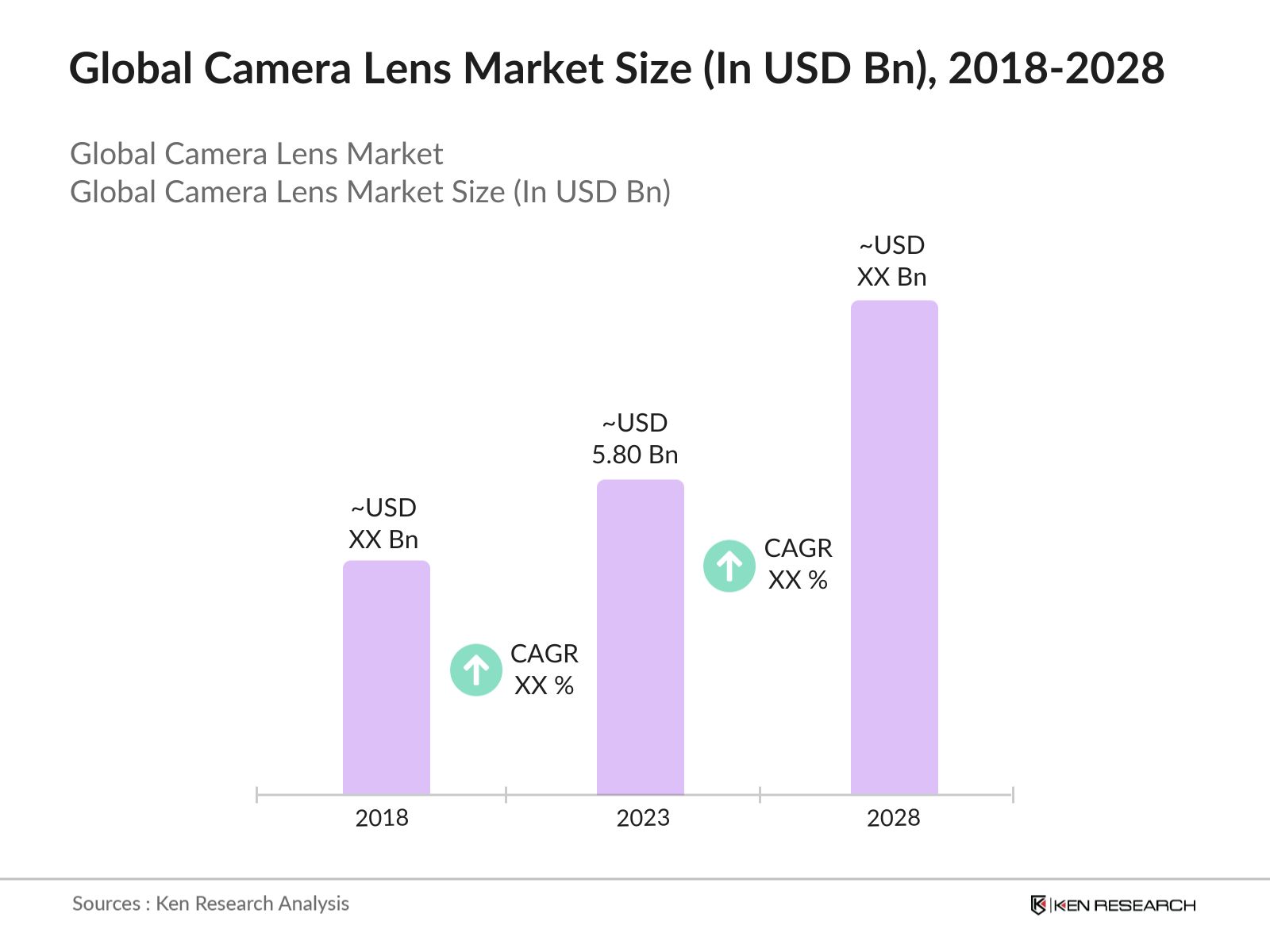
  • In 2023, the Global Camera Lens Market was estimated at USD 5.80 billion, reflecting substantial growth during the historical period of 2018-2023. This expansion is driven by the increasing demand for high-quality imaging in various sectors, including smartphones, surveillance, automotive, and professional photography.
  • Prominent players in the global camera lens market include Canon Inc., Sony Corporation, Nikon Corporation, Fujifilm Holdings Corporation, and Olympus Corporation. These companies are leading the innovation in lens technology, offering products that cater to diverse consumer needs, from everyday photography to professional and industrial applications.
  • Key regions leading the market include North America, Asia-Pacific, and Europe, with these regions benefiting from robust technological infrastructure, strong consumer bases, and substantial investments in research and development.
  • In May 2023, Canon Inc. launched a new line of RF lenses tailored for mirrorless cameras, enhancing the capabilities of their EOS R series. This innovation highlights Canon's commitment to maintaining its leadership position in the rapidly evolving camera lens market, which is increasingly influenced by advancements in digital imaging technologies.

Global Camera Lens Market

Global Camera Lens Market Segmentation

The Global Camera Lens Market can be segmented based on type, application, end-user, distribution channel, and region:

  • By Type: The market is segmented into prime lenses, zoom lenses and specialty lenses. In 2023, zoom lenses held the largest market share due to their versatility and high demand across various photography applications, including wildlife, sports, and event photography. These lenses allow photographers to adjust the focal length without changing the lens, making them ideal for dynamic shooting environments.

Global Camera Lens Market Segmentation

  • By Application: The market is further segmented into smartphones, professional cameras, automotive, and surveillance. The smartphone segment led the market in 2023, driven by the rising trend of mobile photography and the integration of multi-lens camera systems in smartphones. Consumers' increasing preference for mobile photography, driven by social media trends and the desire for high-resolution imaging, has boosted the demand for smartphone lenses.

Global Camera Lens Market Segmentation

  • By Region: The global market is segmented into North America, Europe, Asia-Pacific (APAC), Latin America, and Middle East & Africa (MEA). Asia-Pacific dominated the market with a substantial share in 2023 due to the presence of leading manufacturers, technological advancements, and a growing consumer base interested in photography and videography.

Global Camera Lens Market Competitive Landscape

Company

Establishment Year

Headquarters

Canon Inc.

1937

Tokyo, Japan

Sony Corporation

1946

Tokyo, Japan

Nikon Corporation

1917

Tokyo, Japan

Fujifilm Holdings Corporation

1934

Tokyo, Japan

Olympus Corporation

1919

Tokyo, Japan

  • Nikon Corporation: In June 2024, Nikon released the NIKKOR Z 35mm f/1.4, a wide-angle lens designed for the Nikon Z mount system, catering to both professional and enthusiast photographers. This lens is part of Nikon's ongoing efforts to enhance its lens lineup and meet the increasing demand for high-quality optics in the mirrorless camera segment.
  • Sony Corporation: Sony introduced the 50mm F1.4 G Master lens in February 2023, which is designed for full-frame cameras and features enhanced optical performance and fast autofocus capabilities. This addition reflects Sony's ongoing strategy to cater to the needs of professional and enthusiast photographers, ensuring they have access to high-quality, versatile lenses suitable for various shooting scenarios.

Global Camera Lens Industry Analysis

Growth Drivers:

  • Increasing Adoption of Multi-Lens Camera Systems in Smartphones: The rising integration of multi-lens camera systems in smartphones has become an important growth driver in the camera lens market. In 2024, smartphone manufacturers are projected to ship over 1.23 billion units globally by the end of the year reflecting a year-over-year growth of about 5.8%, with a substantial portion incorporating dual or triple-lens setups to enhance image quality and versatility. The shift towards multi-lens systems is primarily driven by consumer demand for enhanced photography and videography capabilities, contributing to the robust growth of the camera lens market.
  • Expansion of Surveillance Systems Due to Rising Security Concerns: With escalating concerns over public safety and crime rates, there has been a substantial increase in investments in surveillance systems worldwide. The integration of advanced technologies, such as IP-based cameras and video analytics, is fueling the demand for high-resolution camera lenses capable of operating in diverse environments, including low light and extreme weather conditions. This surge in surveillance infrastructure investments has created a substantial demand for high-resolution camera lenses capable of operating in diverse environments, including low light and extreme weather conditions.
  • Advancements in Autonomous Vehicle Technology: The rapid advancements in autonomous vehicle technology are another key driver of growth in the camera lens market. In 2019, 31 million cars equipped with at least some forms of automation were in use around the world., each equipped with various forms such as multiple camera systems for navigation, obstacle detection, and environment mapping. The automotive industrys increasing reliance on advanced camera lenses with superior optical performance, wide-angle coverage, and robust durability has fueled market demand. These camera lenses are crucial for ensuring safety and functionality in autonomous driving systems, driving further growth in this segment

Challenges:

  • High Production Costs and Price Sensitivity: The market faces challenges related to high production costs and price sensitivity among consumers. The development and manufacturing of high-quality lenses involve noteworthy investment in R&D and materials, leading to higher prices. This price sensitivity is particularly evident in emerging markets, where consumers prioritize cost over advanced features.
  • Intense Competition and Market Saturation: The market is highly competitive, with numerous players vying for market share. In 2024, the market witnessed increased competition from new entrants, particularly in the smartphone lens segment, where innovations are rapidly replicated, leading to market saturation and price wars. As a result, companies are pressured to continually innovate and reduce prices to maintain their competitive edge.

Global Camera Lens Market Government Initiatives

  • Japan's Support for Camera Industry Innovation: The Japanese government has been actively supporting the growth of its camera and lens industry through various initiatives. In 2023, the government provided funding for research and development to enhance the capabilities of Japanese camera lens manufacturers. This investment aims to bolster Japan's position in the global market and foster innovation in lens technologies.
  • China's Strategic Investments in Optical Technology: China has made strategic investments to strengthen its position as a leader in optical technology. In 2024, the Chinese government announced incentives for domestic manufacturers to expand their production capabilities and improve their technological infrastructure, making China an attractive hub for camera lens production and innovation.

Global Camera Lens Market Future Outlook to 2028

The global camera lens market is expected to witness steady growth during the forecast period of 2023-2028, driven by the increasing demand for high-quality imaging, advancements in lens technology, and the expansion of application areas such as automotive and surveillance.

Future Market Trends:

  • Expansion of Multi-Lens Systems in Smartphones: The next five years will likely see further expansion of multi-lens systems in smartphones, with manufacturers incorporating more sophisticated lenses to enhance imaging capabilities. By 2028, it is expected that most smartphones will feature advanced lens systems capable of professional-level photography.
  • Integration of AI in Lens Manufacturing and Functionality: The integration of AI in lens manufacturing and functionality is expected to become more widespread by 2028. AI technologies will not only optimize lens production processes but also enhance lens performance in real-time applications, such as autofocus and image stabilization. Furthermore, AI-driven predictive maintenance and quality control will reduce manufacturing defects, leading to more reliable and high-quality lenses in the market.

Scope of the Report

By Region

North America

Europe

APAC

Latin America

MEA

By Type

Prime Lenses

Zoom Lenses

Macro Lenses

Specialty Lenses

By Application

Smartphones

Professional Cameras

Automotive

Surveillance

By End-User

Individual Consumers

Professional Photographers

Industrial Sectors

By Distribution Channel

Online Channels

Offline Retail Stores

Specialty Stores

Products

Key Target Audience Organizations and Entities Who Can Benefit by Subscribing to This Report:

  • Camera Manufacturers

  • Lens Manufacturers

  • Smartphone Manufacturers

  • Automotive OEMs

  • Surveillance Equipment Providers

  • Photography Enthusiasts

  • E-Commerce Companies

  • Technology Providers for Imaging Solutions

  • Banks and Financial Institutions

  • VCs and Investors

  • Government and Regulatory Bodies (METI and FCC)

Time Period Captured in the Report:

  • Historical Period: 2018-2023

  • Base Year: 2023

  • Forecast Period: 2023-2028

Companies

Players Mentioned in the Report:

  • Canon Inc.

  • Sony Corporation

  • Nikon Corporation

  • Fujifilm Holdings Corporation

  • Olympus Corporation

  • Panasonic Corporation

  • Sigma Corporation

  • Tamron Co., Ltd.

  • Leica Camera AG

  • Carl Zeiss AG

  • Tokina Co., Ltd.

  • Samyang Optics Co., Ltd.

  • Samsung Electronics Co., Ltd.

  • Xiaomi Corporation

  • Huawei Technologies Co., Ltd.

Table of Contents

1. Global Camera Lens Market Overview

1.1. Definition and Scope
1.2. Market Taxonomy
1.3. Market Growth Rate
1.4. Market Segmentation Overview

2. Global Camera Lens Market Size (in USD Bn), 2018-2023

2.1. Historical Market Size
2.2. Year-on-Year Growth Analysis
2.3. Key Market Developments and Milestones

3. Global Camera Lens Market Analysis

3.1. Growth Drivers
3.1.1. Increasing Demand for High-Quality Imaging
3.1.2. Technological Advancements in Lens Design
3.2. Restraints
3.2.1. High Production Costs
3.2.2. Intense Competition
3.3. Opportunities
3.3.1. Expansion of Multi-Lens Systems
3.3.2. Growth of AI-Integrated Lenses
3.4. Trends
3.4.1. Increased Adoption of AI
3.4.2. Expansion of Application Areas
3.5. Government Regulation
3.5.1. Japan's Government Support
3.5.2. China's Strategic Investments
3.6. SWOT Analysis
3.7. Stake Ecosystem
3.8. Competition Ecosystem

4. Global Camera Lens Market Segmentation, 2023

4.1. By Type (in Value %)
4.1.1. Prime Lenses
4.1.2. Zoom Lenses
4.2. By Application (in Value %)
4.2.1. Smartphones
4.2.2. Professional Cameras
4.3. By End-User (in Value %)
4.3.1. Individual Consumers
4.3.2. Professional Photographers
4.4. By Distribution Channel (in Value %)
4.4.1. Online Channels
4.4.2. Offline Retail Stores
4.5. By Region (in Value %)
4.5.1. North America
4.5.2. Europe
4.5.3. Asia-Pacific (APAC)
4.5.4. Latin America
4.5.5. Middle East & Africa (MEA)

5. Global Camera Lens Market Cross Comparison

5.1. Detailed Profiles of Major Companies
5.1.1. Canon Inc.
5.1.2. Sony Corporation
5.1.3. Nikon Corporation
5.1.4. Fujifilm Holdings Corporation
5.1.5. Olympus Corporation
5.2. Cross Comparison Parameters (No. of Employees, Headquarters, Inception Year, Revenue)

6. Global Camera Lens Market Competitive Landscape

6.1. Market Share Analysis
6.2. Strategic Initiatives
6.3. Mergers and Acquisitions
6.4. Investment Analysis
6.4.1. Venture Capital Funding
6.4.2. Government Grants
6.4.3. Private Equity Investments

7. Global Camera Lens Market Regulatory Framework

7.1. Regulatory Policies
7.2. Compliance Requirements
7.3. Certification Processes

8. Global Camera Lens Market Future Size (in USD Bn), 2023-2028

8.1. Future Market Size Projections
8.2. Key Factors Driving Future Market Growth

9. Global Camera Lens Market Future Segmentation, 2028

9.1. By Type (in Value %)
9.2. By Application (in Value %)
9.3. By End-User (in Value %)
9.4. By Distribution Channel (in Value %)
9.5. By Region (in Value %)

10. Global Camera Lens Market Analysts Recommendations

10.1. TAM/SAM/SOM Analysis
10.2. Customer Cohort Analysis
10.3. Marketing Initiatives
10.4. White Space Opportunity Analysis

Disclaimer

Contact Us

Research Methodology

Step 1: Identifying Key Variables

Ecosystem creation for all the major entities and referring to multiple secondary and proprietary databases to perform desk research around the market to collate industry-level information.

Step 2: Market Building

Collating statistics on the global camera lens market over the years, penetration of camera lens manufacturers, and service providers ratio to compute revenue generated for the global camera lens market. We will also review product quality statistics to understand revenue generated, which can ensure accuracy behind the data points shared.

Step 3: Validating and Finalizing

Building market hypotheses and conducting CATIs with industry experts belonging to different companies to validate statistics and seek operational and financial information from company representatives.

Step 4: Research Output

Our team will approach multiple essential camera lens companies and understand the nature of product segments and sales, consumer preference, and other parameters, which will support us in validating statistics derived through a bottom-to-top approach from camera lens companies.

Frequently Asked Questions

01. How big is the Global Camera Lens Market?

The Global Camera Lens Market was valued at USD 45 billion in 2023, driven by the increasing demand for high-quality imaging across various applications and advancements in lens technology.

02. What are the challenges in the Global Camera Lens Market?

Challenges in the Global Camera Lens Market include high production costs, price sensitivity among consumers, intense competition, and market saturation. These factors create complexities in maintaining market stability and profitability.

03. Who are the major players in the Global Camera Lens Market?

Key players in the Global Camera Lens Market include Canon Inc., Sony Corporation, Nikon Corporation, Fujifilm Holdings Corporation, and Olympus Corporation. These companies are central to the global camera lens market due to their strategic investments in technology and innovation.

04. What are the growth drivers of the Global Camera Lens Market?

The Global Camera Lens Market is propelled by the increasing global demand for high-quality imaging, the expansion of multi-lens systems in smartphones, and the integration of advanced technologies like AI in lens functionality.

Why Buy From Us?

RRR
Refine Robust Result (RRR) Framework

What makes us stand out is that our consultants follows Robust, Refine and Result (RRR) methodology. i.e. Robust for clear definitions, approaches and sanity checking, Refine for differentiating respondents facts and opinions and Result for presenting data with story

Our Reach Is Unmatched

We have set a benchmark in the industry by offering our clients with syndicated and customized market research reports featuring coverage of entire market as well as meticulous research and analyst insights.

Research
Shifting the Research Paradigm

While we don't replace traditional research, we flip the method upside down. Our dual approach of Top Bottom & Bottom Top ensures quality deliverable by not just verifying company fundamentals but also looking at the sector and macroeconomic factors.

Insite
More Insights-Better Decisions

With one step in the future, our research team constantly tries to show you the bigger picture. We help with some of the tough questions you may encounter along the way: How is the industry positioned? Best marketing channel? KPI's of competitors? By aligning every element, we help maximize success.

Trust
Transparency and Trust

Our report gives you instant access to the answers and sources that other companies might choose to hide. We elaborate each steps of research methodology we have used and showcase you the sample size to earn your trust.

support
Round the Clock Support

If you need any support, we are here! We pride ourselves on universe strength, data quality, and quick, friendly, and professional service.

Why Client Choose Us?

400000+ Reports in repository
150+ Consulting project a year
100+ Analysts
8000+ Client Queries in 2022