Ken Research Logo

Global Ceramic Matrix Composites Market outlook to 2030

Region:Global

Author(s):Shubham

Product Code:KROD-076

Published On

June 2025

Total pages

90

About the Report

Global Ceramic Matrix Composites Market Overview

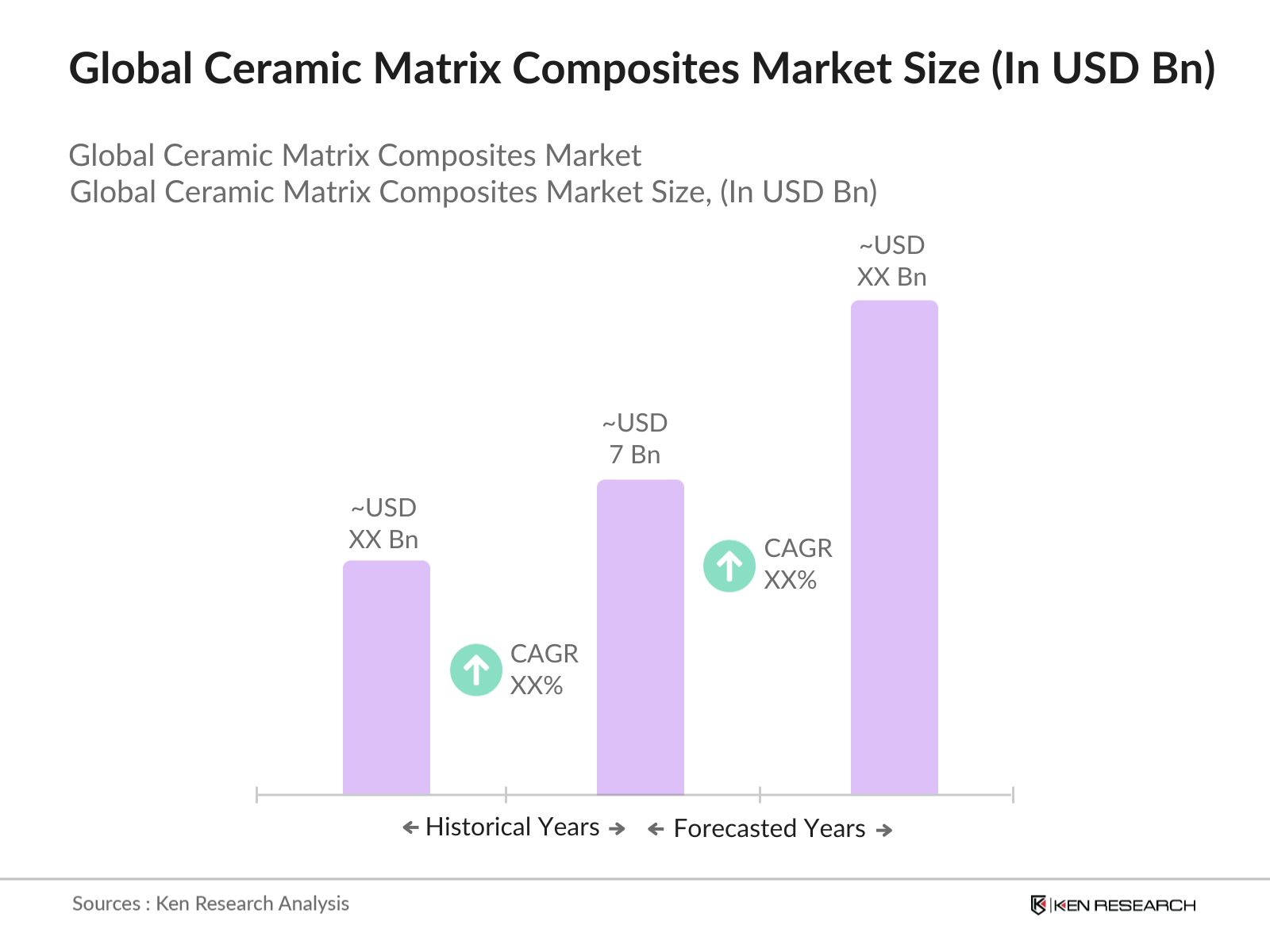
  • The Global Ceramic Matrix Composites Market was valued at USD 7 billion in 2024. This growth is primarily driven by the increasing demand for lightweight and high-performance materials in aerospace, automotive, and defense sectors. The need for materials that can withstand extreme temperatures and harsh environments has further propelled the market, as industries seek to enhance efficiency and reduce emissions.
  • Key players in this market include the United States, Germany, and Japan, which dominate due to their advanced technological capabilities and strong manufacturing bases. The presence of leading aerospace and automotive companies in these regions fosters innovation and drives demand for ceramic matrix composites, making them pivotal in the global market landscape.
  • In 2023, the U.S. government implemented regulations aimed at promoting the use of advanced materials in defense applications. This initiative includes funding for research and development in ceramic matrix composites, encouraging manufacturers to innovate and adopt these materials in military aircraft and vehicles, thereby enhancing performance and safety.
market overviews

Global Ceramic Matrix Composites Market Segmentation

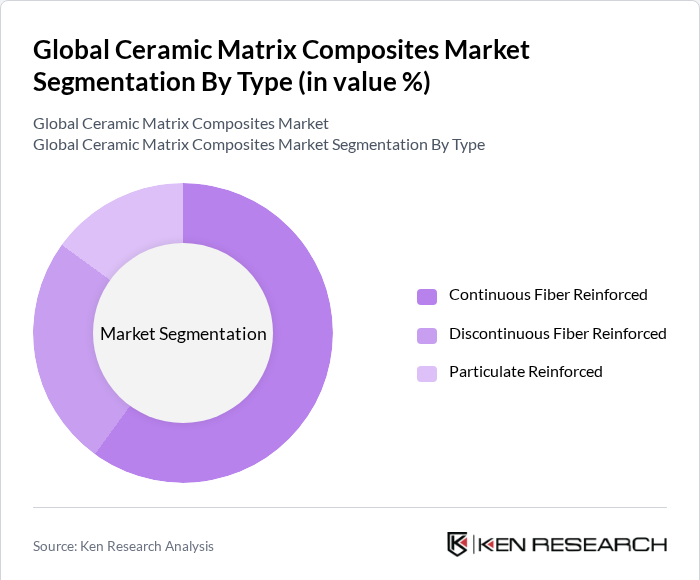
By Type: The ceramic matrix composites market is segmented into continuous fiber reinforced, discontinuous fiber reinforced, and particulate reinforced composites. Among these, continuous fiber reinforced composites dominate the market due to their superior mechanical properties and thermal stability. These composites are increasingly used in high-performance applications such as aerospace and automotive, where strength-to-weight ratio and thermal resistance are critical. The trend towards lightweight materials in these industries further drives the demand for continuous fiber reinforced composites, making them the preferred choice for manufacturers.

Segmentation Infographic 1

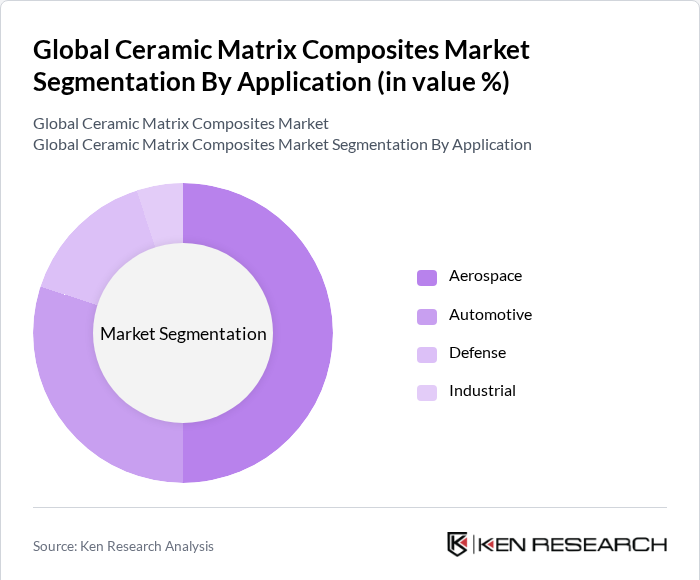
By Application: The applications of ceramic matrix composites include aerospace, automotive, defense, and industrial. The aerospace sector holds the largest share due to the increasing demand for lightweight and high-strength materials that can withstand extreme conditions. The trend towards fuel efficiency and reduced emissions in aircraft design drives the adoption of ceramic matrix composites, as they offer significant weight savings compared to traditional materials. Additionally, advancements in manufacturing processes are making these composites more accessible for various applications, further boosting their market presence.

Segmentation Infographic 2

Global Ceramic Matrix Composites Market Competitive Landscape

The Global Ceramic Matrix Composites Market is characterized by a competitive landscape with several key players, including General Electric, Rolls-Royce, and 3M. These companies are at the forefront of innovation, focusing on advanced manufacturing techniques and expanding their product portfolios to meet the growing demand for high-performance materials. The market is moderately concentrated, with a mix of established firms and emerging players striving to capture market share through technological advancements and strategic partnerships.
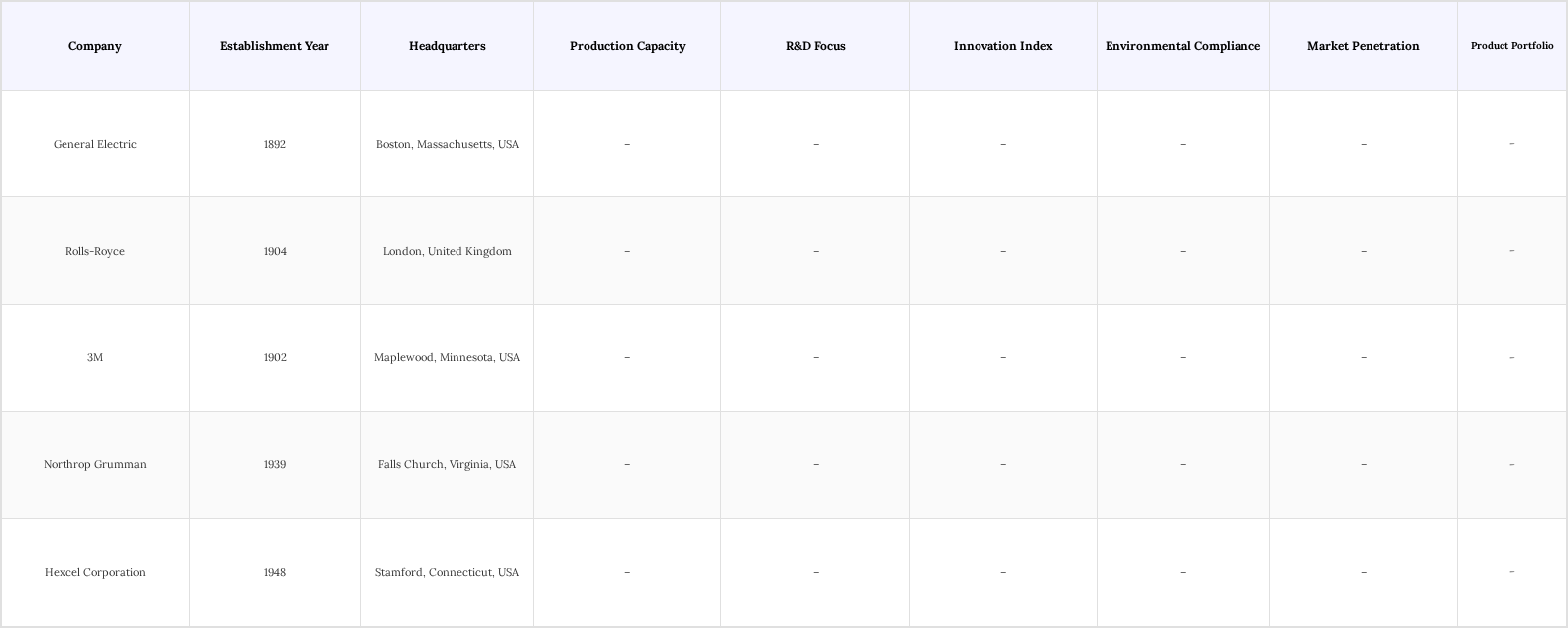
Competitive Landscape Image

Global Ceramic Matrix Composites Market Industry Analysis

Growth Drivers

  • Increasing Demand in Aerospace and Automotive: The aerospace and automotive sectors are projected to grow significantly, with the aerospace industry alone expected to reach $1 trillion by 2024. This growth is driven by the need for lightweight materials that enhance fuel efficiency and performance. The automotive sector is also shifting towards lightweight composites, with a projected increase in demand for ceramic matrix composites to reduce vehicle weight by 10-15%, thereby improving fuel economy and reducing emissions.
  • Advancements in Manufacturing Technologies: Innovations in manufacturing processes, such as chemical vapor infiltration and liquid infiltration, are enhancing the performance of ceramic matrix composites. These technologies are expected to reduce production times by up to 30% while improving material properties. As a result, manufacturers can produce higher-quality composites that meet stringent industry standards, leading to increased adoption in high-performance applications across various sectors, including aerospace and defense.
  • Growing Applications in High-Temperature Environments: The demand for ceramic matrix composites is surging in high-temperature applications, particularly in the aerospace and energy sectors. For instance, the global gas turbine market is projected to reach $32 billion by 2024, driving the need for materials that can withstand extreme conditions. Ceramic matrix composites offer superior thermal resistance, making them ideal for turbine components, thereby expanding their market presence and driving growth in this segment.

Market Challenges

  • High Production Costs: The production of ceramic matrix composites involves complex processes that contribute to high manufacturing costs, often exceeding $105 per kilogram. This financial barrier limits accessibility for smaller manufacturers and end-users, particularly in emerging markets. As a result, the high costs can deter potential customers from adopting these advanced materials, hindering overall market growth and limiting the expansion of applications across various industries.
  • Technical Challenges in Material Processing: The integration of ceramic matrix composites into existing manufacturing processes presents significant technical challenges. Issues such as brittleness and difficulty in machining can complicate the production of components. For example, achieving the desired mechanical properties often requires extensive testing and validation, which can delay product development timelines. These challenges can impede the widespread adoption of ceramic matrix composites in critical applications, affecting market growth.

Global Ceramic Matrix Composites Market Future Outlook

The future of the ceramic matrix composites market appears promising, driven by ongoing advancements in material science and increasing demand across various sectors. As industries prioritize lightweight and high-performance materials, the adoption of ceramic matrix composites is expected to rise. Furthermore, the integration of smart technologies and sustainable practices will likely shape the market landscape, fostering innovation and collaboration among key players. This evolving environment presents opportunities for growth and expansion in both established and emerging markets.

Market Opportunities

  • Expanding Applications in Renewable Energy: The renewable energy sector is increasingly adopting ceramic matrix composites for applications such as wind turbine blades and solar panels. With the global renewable energy market projected to reach $2.1 trillion by 2024, the demand for durable and lightweight materials is expected to rise, presenting significant opportunities for manufacturers of ceramic matrix composites to penetrate this growing market.
  • Investments in Research and Development: Increased investments in R&D for innovative solutions in ceramic matrix composites are anticipated to drive market growth. Governments and private entities are allocating substantial funds, with global R&D spending expected to exceed $2.1 trillion by 2024. This focus on innovation will lead to the development of advanced materials with enhanced properties, opening new avenues for applications in various industries, including aerospace and defense.

Global Ceramic Matrix Composites Market Industry Analysis

Growth Drivers

  • Increasing Demand in Aerospace and Automotive: The aerospace and automotive sectors are projected to grow significantly, with the aerospace industry alone expected to reach $1 trillion by 2024. This growth is driven by the need for lightweight materials that enhance fuel efficiency and performance. The automotive sector is also shifting towards lightweight composites, with a projected increase in demand for ceramic matrix composites to reduce vehicle weight by 10-15%, thereby improving fuel economy and reducing emissions.
  • Advancements in Manufacturing Technologies: Innovations in manufacturing processes, such as chemical vapor infiltration and liquid infiltration, are enhancing the performance of ceramic matrix composites. These technologies are expected to reduce production times by up to 30% while improving material properties. As a result, manufacturers can produce higher-quality composites that meet stringent industry standards, leading to increased adoption in high-performance applications across various sectors, including aerospace and defense.
  • Growing Applications in High-Temperature Environments: The demand for ceramic matrix composites is surging in high-temperature applications, particularly in the aerospace and energy sectors. For instance, the global gas turbine market is projected to reach $32 billion by 2024, driving the need for materials that can withstand extreme conditions. Ceramic matrix composites offer superior thermal resistance, making them ideal for turbine components, thereby expanding their market presence and driving growth in this segment.

Market Challenges

  • High Production Costs: The production of ceramic matrix composites involves complex processes that contribute to high manufacturing costs, often exceeding $105 per kilogram. This financial barrier limits accessibility for smaller manufacturers and end-users, particularly in emerging markets. As a result, the high costs can deter potential customers from adopting these advanced materials, hindering overall market growth and limiting the expansion of applications across various industries.
  • Technical Challenges in Material Processing: The integration of ceramic matrix composites into existing manufacturing processes presents significant technical challenges. Issues such as brittleness and difficulty in machining can complicate the production of components. For example, achieving the desired mechanical properties often requires extensive testing and validation, which can delay product development timelines. These challenges can impede the widespread adoption of ceramic matrix composites in critical applications, affecting market growth.

Global Ceramic Matrix Composites Market Future Outlook

The future of the ceramic matrix composites market appears promising, driven by ongoing advancements in material science and increasing demand across various sectors. As industries prioritize lightweight and high-performance materials, the adoption of ceramic matrix composites is expected to rise. Furthermore, the integration of smart technologies and sustainable practices will likely shape the market landscape, fostering innovation and collaboration among key players. This evolving environment presents opportunities for growth and expansion in both established and emerging markets.

Market Opportunities

  • Expanding Applications in Renewable Energy: The renewable energy sector is increasingly adopting ceramic matrix composites for applications such as wind turbine blades and solar panels. With the global renewable energy market projected to reach $2.1 trillion by 2024, the demand for durable and lightweight materials is expected to rise, presenting significant opportunities for manufacturers of ceramic matrix composites to penetrate this growing market.
  • Investments in Research and Development: Increased investments in R&D for innovative solutions in ceramic matrix composites are anticipated to drive market growth. Governments and private entities are allocating substantial funds, with global R&D spending expected to exceed $2.1 trillion by 2024. This focus on innovation will lead to the development of advanced materials with enhanced properties, opening new avenues for applications in various industries, including aerospace and defense.

Scope of the Report

By Type

Continuous Fiber Reinforced

Discontinuous Fiber Reinforced

Particulate Reinforced

By Application

Aerospace

Automotive

Defense

Industrial

By Region

North America

Europe

Asia-Pacific

Latin America

Middle East & Africa

By Manufacturing Process

Liquid Infiltration

Chemical Vapor Infiltration

Precursor Impregnation

By End-User Industry

Aerospace & Defense

Automotive

Energy

Electronics

Products

Key Target Audience

  • Investors and Venture Capitalist Firms

  • Government and Regulatory Bodies (e.g., U.S. Department of Defense, European Space Agency)

  • Manufacturers and Producers

  • Aerospace and Defense Contractors

  • Automotive Industry Stakeholders

  • Energy Sector Companies

  • Material Science Research Organizations

  • Industrial Equipment Manufacturers

Companies

Players Mentioned in the Report:

  • General Electric

  • Rolls-Royce

  • 3M

  • Northrop Grumman

  • Hexcel Corporation

  • CeramTec AG

  • CoorsTek, Inc.

  • SGL Carbon SE

  • Mitsubishi Chemical Corporation

  • Owens Corning

Table of Contents

1. Global Ceramic Matrix Composites Market Overview

1.1. Definition and Scope
1.2. Market Taxonomy
1.3. Market Growth Rate
1.4. Market Segmentation Overview

2. Global Ceramic Matrix Composites Market Size (In USD Mn)

2.1. Historical Market Size
2.2. Year-On-Year Growth Analysis
2.3. Key Market Developments and Milestones

3. Global Ceramic Matrix Composites Market Analysis

3.1. Growth Drivers
3.1.1. Increasing demand for lightweight materials in aerospace and automotive industries
3.1.2. Advancements in manufacturing technologies enhancing product performance
3.1.3. Growing applications in high-temperature environments driving market expansion
3.2. Market Challenges
3.2.1. High production costs limiting market accessibility
3.2.2. Technical challenges in material processing and integration
3.2.3. Limited awareness and understanding of ceramic matrix composites among end-users
3.3. Opportunities
3.3.1. Expanding applications in renewable energy sectors
3.3.2. Increasing investments in research and development for innovative solutions
3.3.3. Rising demand for advanced materials in defense applications
3.4. Trends
3.4.1. Growing focus on sustainability and eco-friendly materials
3.4.2. Integration of smart technologies in composite materials
3.4.3. Collaborations and partnerships among key players for market growth
3.5. Government Regulation
3.5.1. Compliance with international environmental standards
3.5.2. Regulations governing the use of materials in aerospace and automotive sectors
3.5.3. Safety standards for manufacturing processes and end products
3.5.4. Incentives for research and development in advanced materials
3.6. SWOT Analysis
3.7. Stake Ecosystem
3.8. Porter’s Five Forces
3.9. Competition Ecosystem

4. Global Ceramic Matrix Composites Market Segmentation

4.1. By Type

4.1.1 Continuous Fiber Reinforced

4.1.2 Discontinuous Fiber Reinforced

4.1.3 Particulate Reinforced

4.2. By Application

4.2.1 Aerospace

4.2.2 Automotive

4.2.3 Defense

4.2.4 Industrial

4.3. By Region

4.3.1 North America

4.3.2 Europe

4.3.3 Asia-Pacific

4.3.4 Latin America

4.3.5 Middle East & Africa

4.4. By Manufacturing Process

4.4.1 Liquid Infiltration

4.4.2 Chemical Vapor Infiltration

4.4.3 Precursor Impregnation

4.5. By End-User Industry

4.5.1 Aerospace & Defense

4.5.2 Automotive

4.5.3 Energy

4.5.4 Electronics

6. Global Ceramic Matrix Composites Market Competitive Analysis

5.1. Detailed Profiles of Major Companies

5.1.1 General Electric

5.1.2 Rolls-Royce

5.1.3  3M

5.1.4  Northrop Grumman

5.1.5  Hexcel Corporation

5.1.6  CeramTec AG

5.1.7  CoorsTek, Inc.

5.1.8  SGL Carbon SE

5.1.9  Mitsubishi Chemical Corporation

5.1.10  Owens Corning


5.2. Cross Comparison Parameters
5.2.1. Market Share Analysis
5.2.2. Product Portfolio Comparison
5.2.3. Geographic Presence
5.2.4. Financial Performance Metrics
5.2.5. Research and Development Investments
5.2.6. Customer Base and Target Markets
5.2.7. Strategic Initiatives and Partnerships
5.2.8. Innovation and Technology Adoption

6. Global Ceramic Matrix Composites Market Regulatory Framework

6.1. Environmental Standards
6.2. Compliance Requirements
6.3. Certification Processes

7. Global Ceramic Matrix Composites Market Future Market Size (In USD Bn)

7.1. Future Market Size Projections
7.2. Key Factors Driving Future Market Growth

8. Global Ceramic Matrix Composites Market Future Market Segmentation

8.1. By Type

8.1.1 Continuous Fiber Reinforced

8.1.2 Discontinuous Fiber Reinforced

8.1.3 Particulate Reinforced

8.2. By Application

8.2.1 Aerospace

8.2.2 Automotive

8.2.3 Defense

8.2.4 Industrial

8.3. By Region

8.3.1 North America

8.3.2 Europe

8.3.3 Asia-Pacific

8.3.4 Latin America

8.3.5 Middle East & Africa

8.4. By Manufacturing Process

8.4.1 Liquid Infiltration

8.4.2 Chemical Vapor Infiltration

8.4.3 Precursor Impregnation

8.5. By End-User Industry

8.5.1 Aerospace & Defense

8.5.2 Automotive

8.5.3 Energy

8.5.4 Electronics


9. Global Ceramic Matrix Composites Market Analysts’ Recommendations

9.1. TAM/SAM/SOM Analysis
9.2. Customer Cohort Analysis
9.3. Marketing Initiatives
9.4. White Space Opportunity Analysis

Disclaimer Contact Us

Research Methodology

Step 1: Identification of Key Variables

The initial phase involves mapping the ecosystem of the Global Ceramic Matrix Composites Market, identifying all key stakeholders such as manufacturers, suppliers, and end-users. This step relies on extensive desk research, utilizing secondary data sources and proprietary databases to gather relevant industry information. The primary goal is to pinpoint and define the critical variables that drive market dynamics.

Step 2: Market Analysis and Construction

In this phase, historical data related to the Global Ceramic Matrix Composites Market will be compiled and analyzed. This includes evaluating market penetration rates, the ratio of manufacturers to service providers, and the resulting revenue generation. Additionally, an assessment of service quality metrics will be conducted to ensure the reliability and accuracy of the revenue estimates.

Step 3: Hypothesis Validation and Expert Consultation

Market hypotheses will be formulated and validated through structured interviews with industry experts from various companies within the sector. These consultations will yield valuable operational and financial insights, which are crucial for refining and corroborating the market data. The expert opinions will help in understanding the nuances of market trends and challenges.

Step 4: Research Synthesis and Final Output

The final phase will involve engaging with multiple manufacturers to gather in-depth insights into product segments, sales performance, and consumer preferences. This direct interaction will help verify and enhance the statistics obtained from the bottom-up approach, ensuring a comprehensive, accurate, and validated analysis of the Global Ceramic Matrix Composites Market.

Frequently Asked Questions

01. How big is the Global Ceramic Matrix Composites Market?

The Global Ceramic Matrix Composites Market is valued at USD 7 billion, driven by factors such as increasing demand, technological advancements, and supportive government initiatives.

02. What are the key challenges in the Global Ceramic Matrix Composites Market?

Key challenges in the Global Ceramic Matrix Composites Market include intense competition, regulatory complexities, and infrastructure limitations affecting market dynamics.

03. Who are the major players in the Global Ceramic Matrix Composites Market?

Major players in the Global Ceramic Matrix Composites Market include General Electric, Rolls-Royce, 3M, Northrop Grumman, Hexcel Corporation, among others.

04. What are the growth drivers for the Global Ceramic Matrix Composites Market?

The primary growth drivers for the Global Ceramic Matrix Composites Market are increasing consumer demand, favorable policies, innovation, and substantial investment inflows.

Why Buy From Us?

RRR
Refine Robust Result (RRR) Framework

What makes us stand out is that our consultants follows Robust, Refine and Result (RRR) methodology. i.e. Robust for clear definitions, approaches and sanity checking, Refine for differentiating respondents facts and opinions and Result for presenting data with story

Our Reach Is Unmatched

We have set a benchmark in the industry by offering our clients with syndicated and customized market research reports featuring coverage of entire market as well as meticulous research and analyst insights.

Research
Shifting the Research Paradigm

While we don't replace traditional research, we flip the method upside down. Our dual approach of Top Bottom & Bottom Top ensures quality deliverable by not just verifying company fundamentals but also looking at the sector and macroeconomic factors.

Insite
More Insights-Better Decisions

With one step in the future, our research team constantly tries to show you the bigger picture. We help with some of the tough questions you may encounter along the way: How is the industry positioned? Best marketing channel? KPI's of competitors? By aligning every element, we help maximize success.

Trust
Transparency and Trust

Our report gives you instant access to the answers and sources that other companies might choose to hide. We elaborate each steps of research methodology we have used and showcase you the sample size to earn your trust.

support
Round the Clock Support

If you need any support, we are here! We pride ourselves on universe strength, data quality, and quick, friendly, and professional service.
Why Client Choose Us?

400000+ Reports in repository
150+ Consulting project a year
100+ Analysts
8000+ Client Queries in 2022