
Global Chip on Board (COB) LED Market Outlook 2030
Region:Global
Author(s):Shivani Mehra
Product Code:KROD6083
Region:Global
Author(s):Shivani Mehra
Product Code:KROD6083
November 2024
88
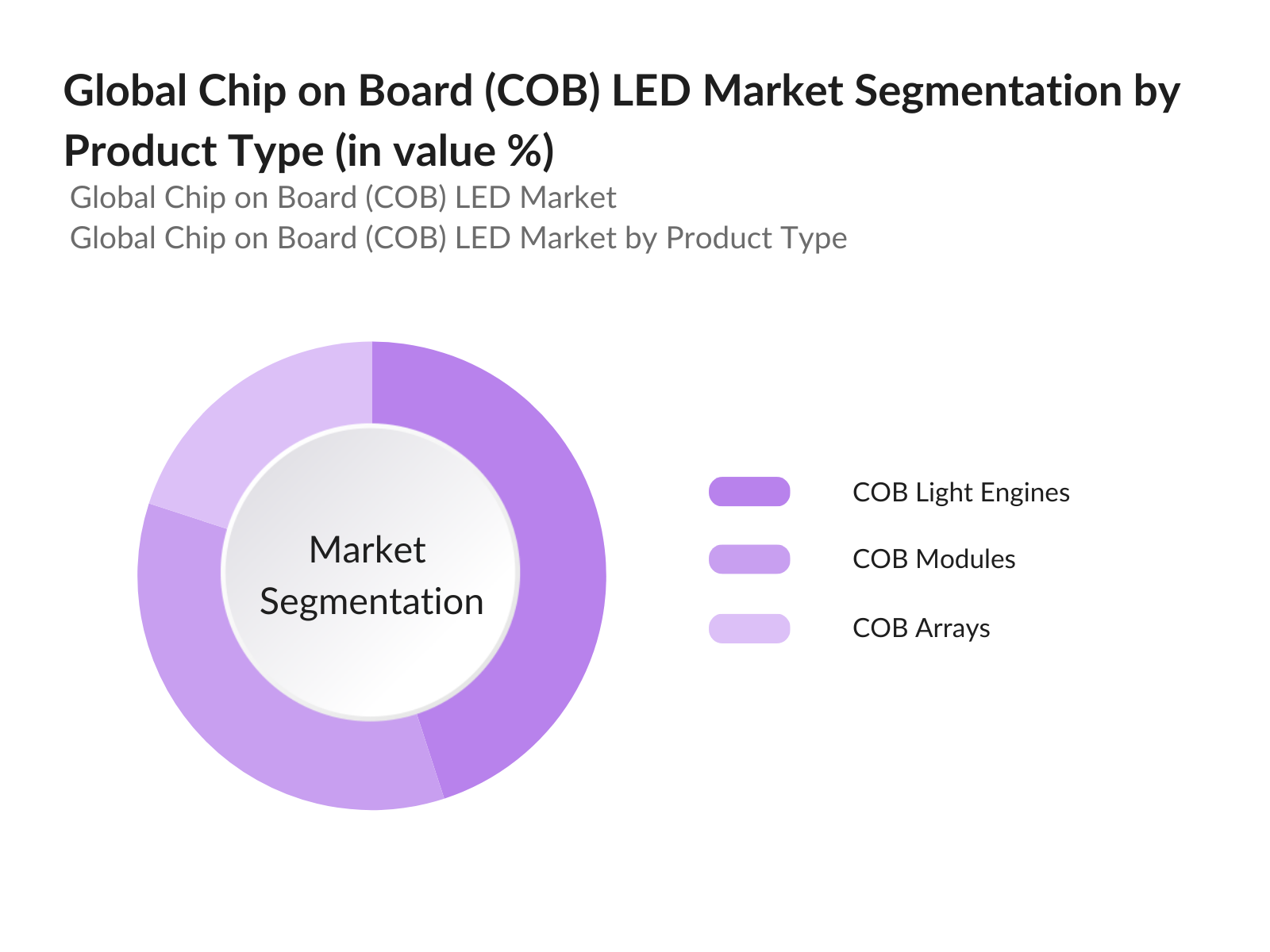
By Product Type: The global COB LED market is segmented by product type into COB light engines, COB modules, and COB arrays. Among these, COB light engines dominate the market, primarily due to their extensive use in automotive and commercial lighting applications. Their ability to provide high lumens per watt makes them a preferred choice for high-intensity lighting solutions, particularly in outdoor and industrial lighting projects. Major players in this sub-segment, such as Cree and Philips Lumileds, have introduced innovative designs, ensuring superior performance, which contributes to the dominance of this product type in the market.
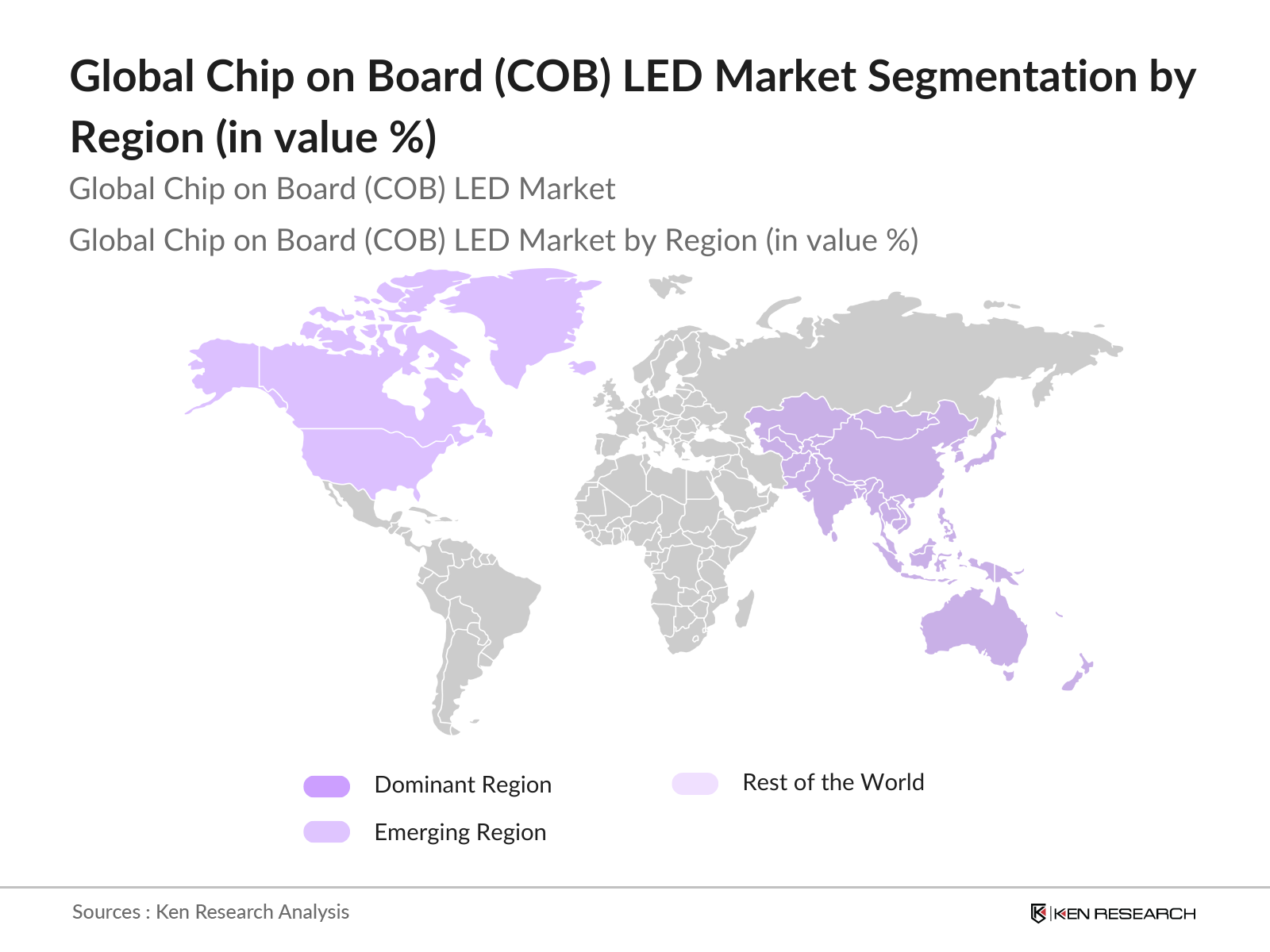
By Region: The global COB LED market is segmented into North America, Europe, Asia-Pacific, Latin America, and the Middle East & Africa. Asia-Pacific, led by China, Japan, and South Korea, holds the largest market share. This dominance is attributed to Chinas established LED production ecosystem, high domestic demand for lighting solutions, and strong government support for energy-efficient technologies. Additionally, the Asia-Pacific region has seen increased adoption of smart city initiatives and LED street lighting projects, further driving the demand for COB LEDs in this region.
The COB LED market is highly competitive, with several global players focusing on innovation, cost-efficiency, and expanding their market presence. The market is dominated by key players such as Cree Inc., Philips Lumileds, and Osram Opto Semiconductors, which have extensive R&D capabilities and established distribution networks. These companies lead in terms of technological advancements and product portfolio diversification, contributing to their dominance in the market.
|
Company Name |
Establishment Year |
Headquarters |
Revenue (USD Bn) |
Product Portfolio |
R&D Investment |
Innovation Index |
Geographical Reach |
Market Position |
|
Cree Inc. |
1987 |
Durham, USA |
- |
- |
- |
- |
- |
- |
|
Philips Lumileds |
1999 |
San Jose, USA |
- |
- |
- |
- |
- |
- |
|
Osram Opto Semiconductors |
1978 |
Munich, Germany |
- |
- |
- |
- |
- |
- |
|
Seoul Semiconductor |
1992 |
Ansan, South Korea |
- |
- |
- |
- |
- |
- |
|
Nichia Corporation |
1956 |
Anan, Japan |
- |
- |
- |
- |
- |
- |
Over the next five years, the global Chip on Board (COB) LED market is expected to show substantial growth driven by continuous technological innovations, an increasing focus on energy efficiency, and the rising demand from key industries such as automotive, electronics, and healthcare. Additionally, government initiatives promoting the adoption of LED lighting solutions and advancements in IoT-based smart lighting systems are likely to further accelerate market growth. The development of high-performance, cost-efficient COB LEDs will also drive wider adoption across new applications such as horticultural lighting and medical devices.
|
By Product Type |
COB Light Engines COB Modules COB Arrays |
|
By Application |
Residential Lighting Commercial Lighting Industrial Lighting Automotive Lighting |
|
By Power Range |
Low Power (<10W) Medium Power (10W-50W) High Power (>50W) |
|
By End-User Industry |
Consumer Electronics Automotive Healthcare Retail and Hospitality |
|
By Region |
North America Europe Asia-Pacific Latin America Middle East & Africa |
1.1 Definition and Scope
1.2 Market Taxonomy
1.3 Market Growth Rate
1.4 Market Segmentation Overview
2.1 Historical Market Size
2.2 Year-On-Year Growth Analysis
2.3 Key Market Developments and Milestones
3.1 Growth Drivers
3.1.1 Increased Energy Efficiency Demand
3.1.2 Rise in Smart Lighting Solutions
3.1.3 Advancements in Miniaturization Technology
3.1.4 Government Regulations on Energy Conservation
3.2 Market Challenges
3.2.1 High Initial Cost
3.2.2 Heat Dissipation Issues
3.2.3 Complexity in Manufacturing
3.3 Opportunities
3.3.1 Technological Innovations in Heat Management
3.3.2 Expanding Applications in Automotive and Consumer Electronics
3.3.3 Integration with IoT and Smart Devices
3.4 Trends
3.4.1 Adoption of COB in Display Technology
3.4.2 Enhanced Durability and Efficiency Features
3.4.3 Growing Preference for Compact Lighting Solutions
3.5 Government Regulation
3.5.1 Energy Efficiency Standards
3.5.2 Safety Certifications and Compliance
3.5.3 Incentives for LED Adoption
3.6 SWOT Analysis
3.7 Stakeholder Ecosystem
3.8 Porters Five Forces Analysis
3.9 Competition Ecosystem
4.1 By Product Type [In Value %]
4.1.1 COB Light Engines
4.1.2 COB Modules
4.1.3 COB Arrays
4.2 By Application [In Value %]
4.2.1 Residential Lighting
4.2.2 Commercial Lighting
4.2.3 Industrial Lighting
4.2.4 Automotive Lighting
4.3 By Power Range [In Value %]
4.3.1 Low Power (<10W)
4.3.2 Medium Power (10W-50W)
4.3.3 High Power (>50W)
4.4 By End-User Industry [In Value %]
4.4.1 Consumer Electronics
4.4.2 Automotive
4.4.3 Healthcare
4.4.4 Retail and Hospitality
4.5 By Region [In Value %]
4.5.1 North America
4.5.2 Europe
4.5.3 Asia-Pacific
4.5.4 Latin America
4.5.5 Middle East & Africa
5.1 Detailed Profiles of Major Companies
5.1.1 Cree Inc.
5.1.2 Philips Lumileds
5.1.3 Nichia Corporation
5.1.4 Osram Opto Semiconductors
5.1.5 Samsung Electronics
5.1.6 LG Innotek
5.1.7 Citizen Electronics Co., Ltd.
5.1.8 Seoul Semiconductor Co., Ltd.
5.1.9 Bridgelux, Inc.
5.1.10 Lumens Co., Ltd.
5.1.11 Epistar Corporation
5.1.12 Everlight Electronics Co., Ltd.
5.1.13 Sharp Corporation
5.1.14 Lite-On Technology Corporation
5.1.15 Advanced Optoelectronic Technology, Inc.
5.2 Cross-Comparison Parameters [Number of Employees, Headquarters, Inception Year, Revenue, Market Share, Product Portfolio, Innovation Score, Geographical Reach]
5.3 Market Share Analysis
5.4 Strategic Initiatives
5.5 Mergers & Acquisitions
5.6 Investment Analysis
5.7 Venture Capital Funding
5.8 Government Grants
5.9 Private Equity Investments
6.1 Energy Efficiency Standards
6.2 Compliance Requirements
6.3 Certification Processes
7.1 Future Market Size Projections
7.2 Key Factors Driving Future Market Growth
8.1 By Product Type [In Value %]
8.2 By Application [In Value %]
8.3 By Power Range [In Value %]
8.4 By End-User Industry [In Value %]
8.5 By Region [In Value %]
9.1 TAM/SAM/SOM Analysis
9.2 Customer Cohort Analysis
9.3 Marketing Initiatives
9.4 White Space Opportunity Analysis
In the first step, the key variables influencing the COB LED market are identified through extensive secondary research. This involves mapping out the entire stakeholder ecosystem, including manufacturers, suppliers, end-users, and regulators. The objective is to understand the critical market dynamics and the factors influencing demand, product innovation, and competitive positioning.
This step includes collecting and analyzing historical data related to market penetration, product performance, and revenue generation. Historical data helps establish market trends and assists in creating a reliable market model for projections. Industry standards and benchmarks are used to assess service quality and market size estimations.
The data collected is validated through expert interviews and consultations with COB LED manufacturers, industry analysts, and regulatory bodies. These consultations provide insights into market growth drivers, challenges, and the competitive landscape, which are integral for fine-tuning the analysis.
In the final phase, all data points are synthesized into a coherent market report. This includes verification from industry experts and COB LED manufacturers to ensure that the data accurately reflects the current market landscape and future growth opportunities. The final report provides actionable insights for business professionals.
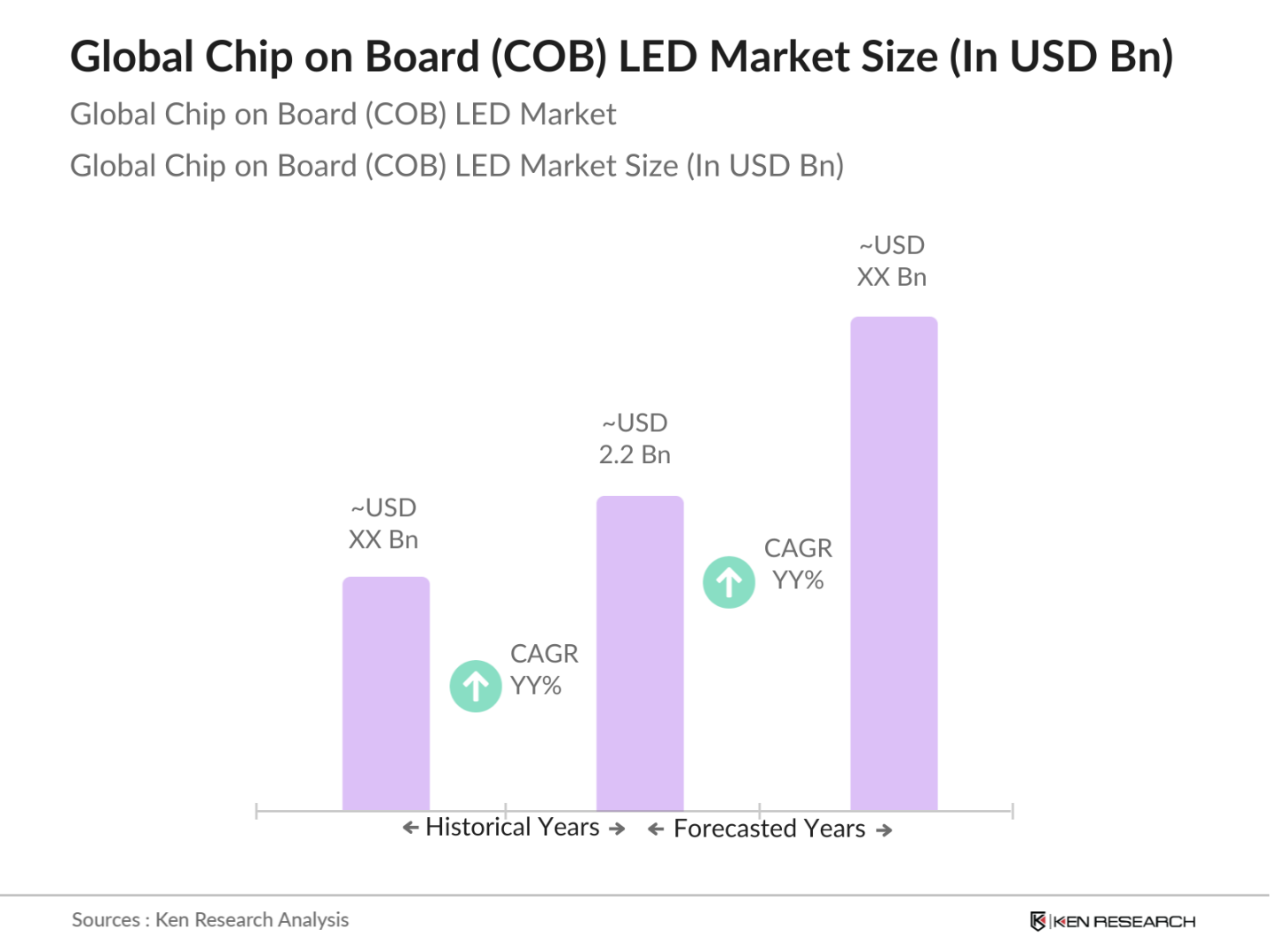
The global COB LED market is valued at USD 2.2 billion, with strong growth driven by technological innovations, energy efficiency demand, and rising applications across various sectors.
Challenges in the COB LED market include high initial costs, issues with heat dissipation, and the complexity of manufacturing processes, which can limit the adoption of COB technology in some regions.
Key players include Cree Inc., Philips Lumileds, Nichia Corporation, Osram Opto Semiconductors, and Seoul Semiconductor Co., Ltd., which dominate due to their strong R&D capabilities, diverse product portfolios, and extensive global reach.
The market is primarily driven by the increasing demand for energy-efficient lighting solutions, advancements in miniaturization technology, and strong government initiatives promoting the adoption of LED lighting across sectors.

What makes us stand out is that our consultants follows Robust, Refine and Result (RRR) methodology. i.e. Robust for clear definitions, approaches and sanity checking, Refine for differentiating respondents facts and opinions and Result for presenting data with story

We have set a benchmark in the industry by offering our clients with syndicated and customized market research reports featuring coverage of entire market as well as meticulous research and analyst insights.

While we don't replace traditional research, we flip the method upside down. Our dual approach of Top Bottom & Bottom Top ensures quality deliverable by not just verifying company fundamentals but also looking at the sector and macroeconomic factors.

With one step in the future, our research team constantly tries to show you the bigger picture. We help with some of the tough questions you may encounter along the way: How is the industry positioned? Best marketing channel? KPI's of competitors? By aligning every element, we help maximize success.

Our report gives you instant access to the answers and sources that other companies might choose to hide. We elaborate each steps of research methodology we have used and showcase you the sample size to earn your trust.

If you need any support, we are here! We pride ourselves on universe strength, data quality, and quick, friendly, and professional service.