Global Cleaning Robots Market Outlook to 2030

Region:Global

Author(s):Naman Rohilla

Product Code:KROD1345

Published On

November 2024

Total pages

97

About the Report

Global Cleaning Robots Market Overview

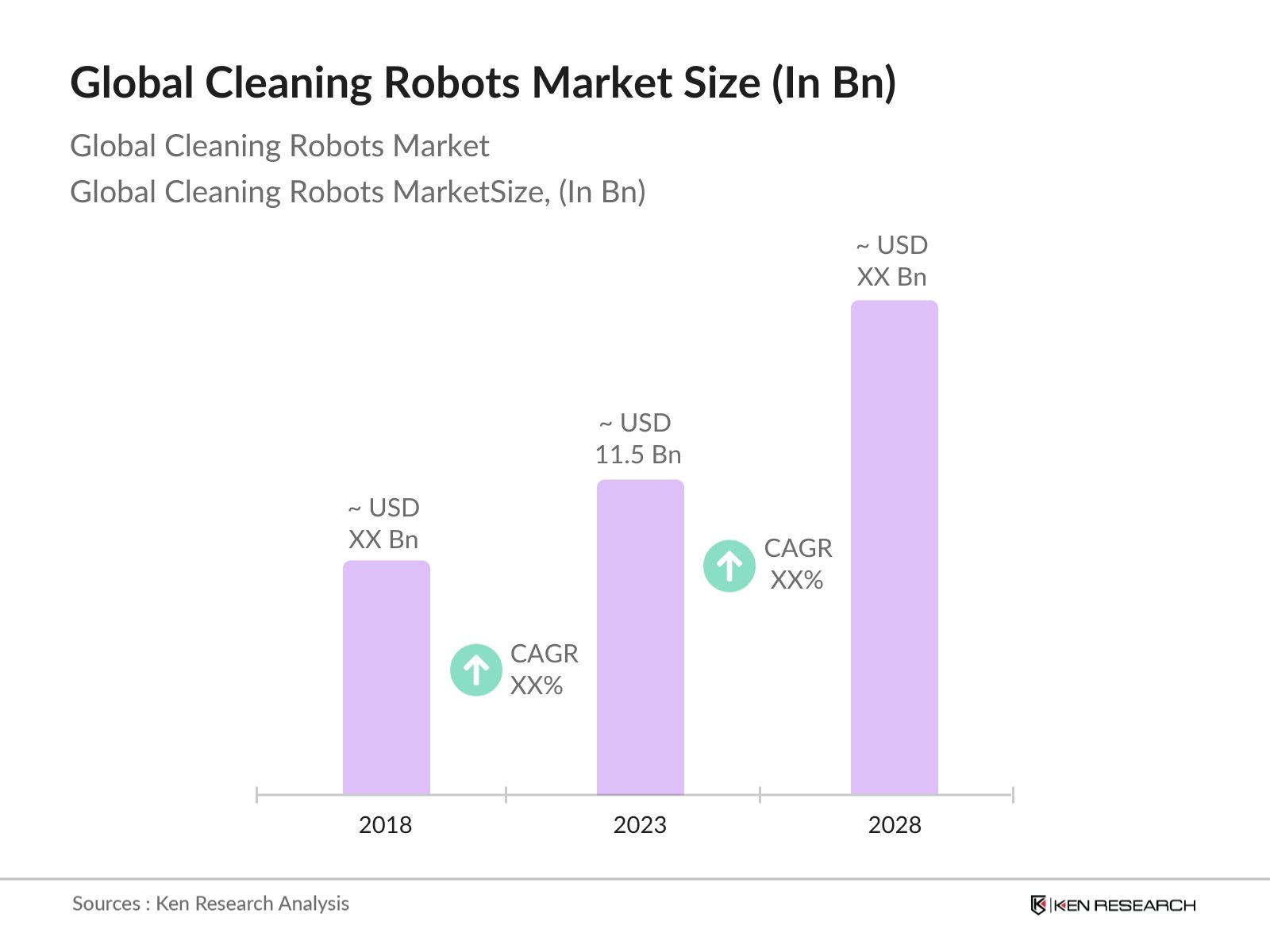
  • The Global Cleaning Robots Market was valued at USD 11.5 billion in 2023. This market is primarily driven by the increasing adoption of automation in household chores, advancements in AI and machine learning, and the growing consumer preference for smart home devices.
  • The major players in the global cleaning robots market include iRobot Corporation, Ecovacs Robotics, Neato Robotics, Dyson Ltd., and Samsung Electronics. These companies are at the forefront of developing innovative cleaning solutions, focusing on improving efficiency, navigation, and user experience.
  • In 2021, iRobot Corporation launched the Roomba j7+, which features advanced obstacle detection and avoidance, setting a new standard for autonomous cleaning devices. This initiative aligns with the growing trend of integrating AI-driven technologies in household products, emphasizing convenience, efficiency, and the seamless integration of smart home ecosystems.
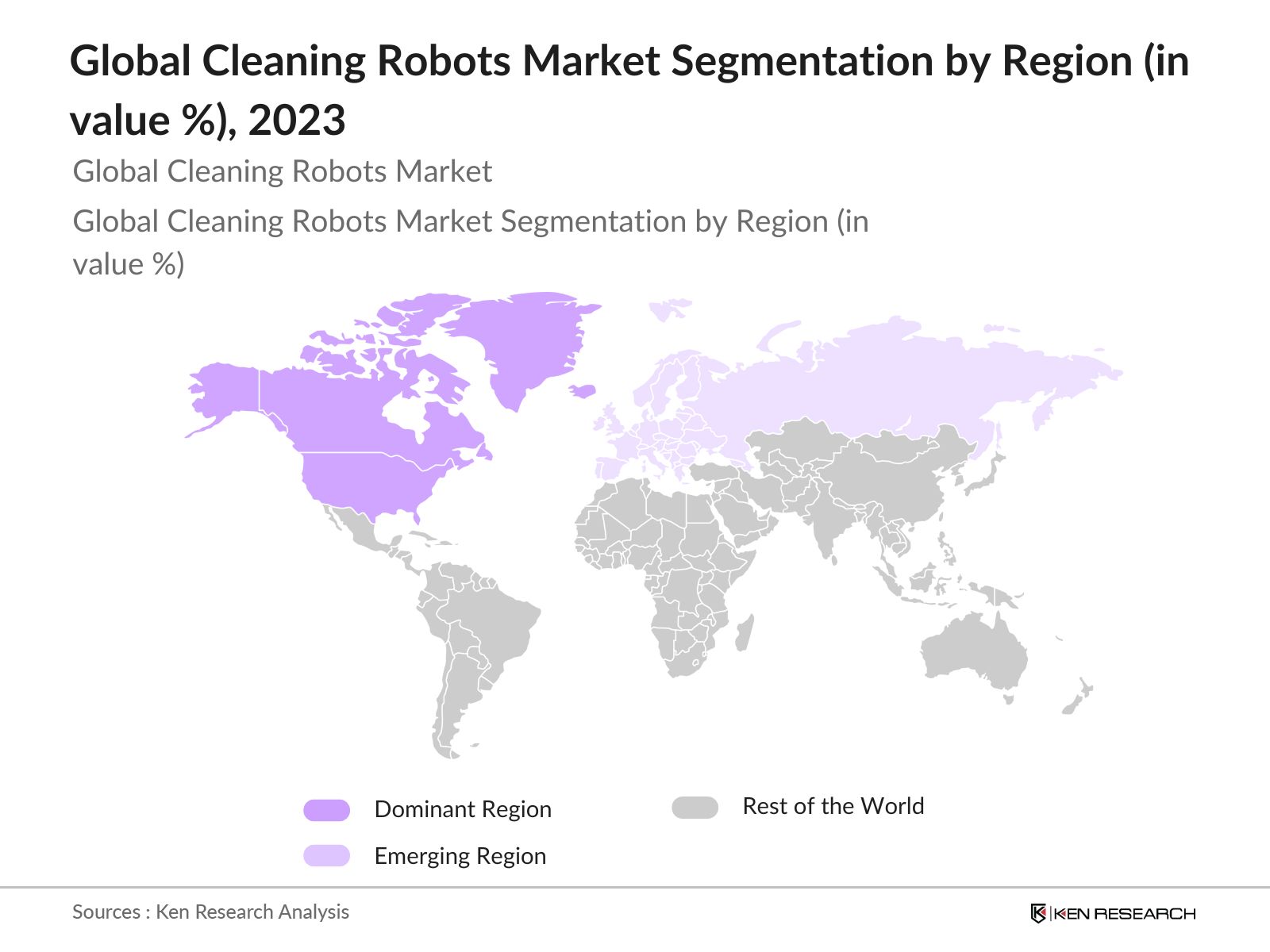
  • In 2023, North America dominated the global cleaning robots market due to the strong presence of major manufacturers, high consumer awareness, and substantial investments in smart home technologies.

Global Cleaning Robots Market Size

Global Cleaning Robots Market Segmentation

The global cleaning robots market is segmented by type, application, and region.
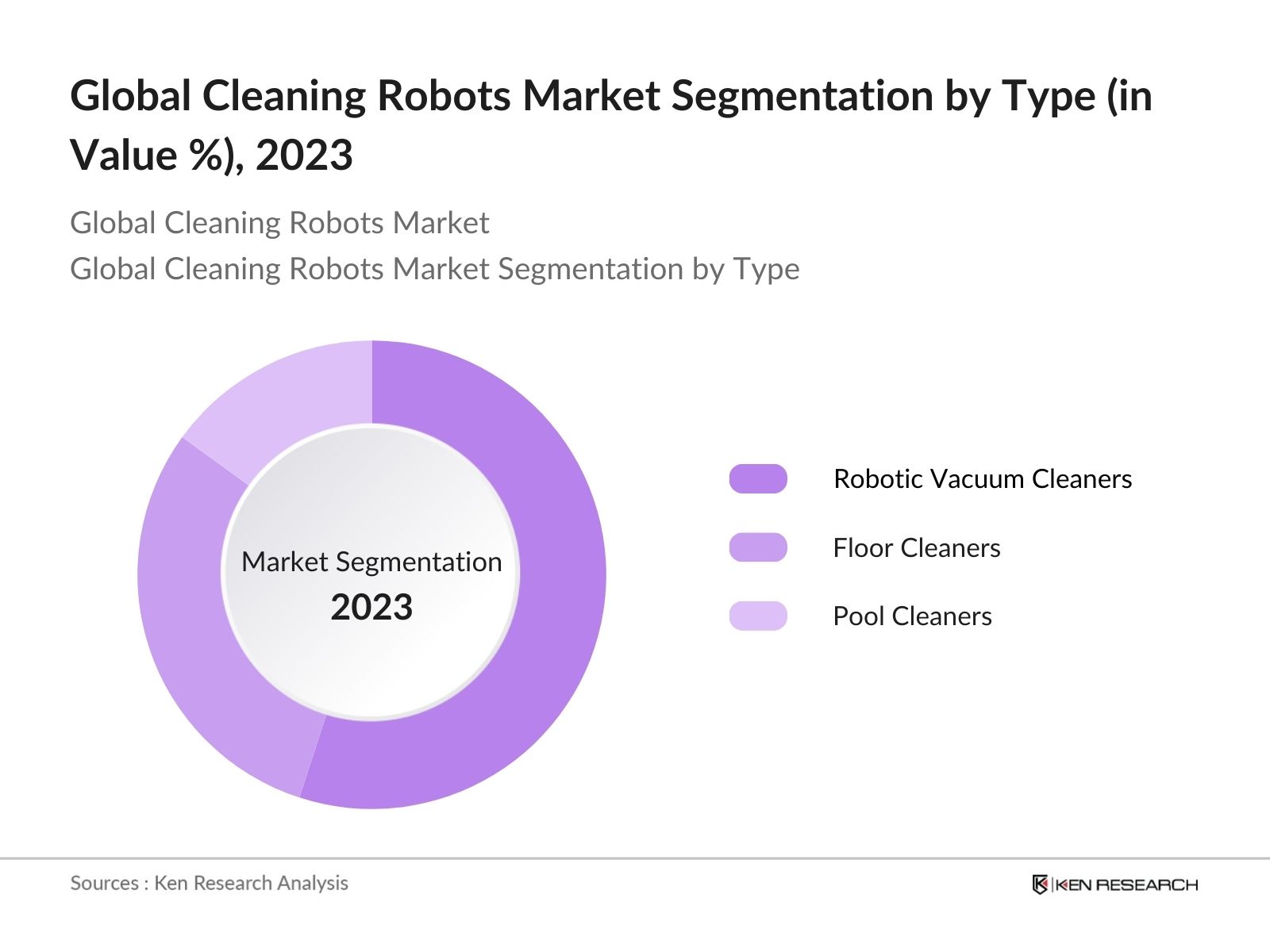
  • By Type: The market is segmented into robotic vacuum cleaners, robotic pool cleaners, and robotic window cleaners. In 2023, the robotic vacuum cleaner segment held the highest market share, driven by increasing consumer demand for efficient and time-saving cleaning solutions.

Global Cleaning Robots Market Segmentation by type

  • By Application: The market is segmented into residential, commercial, and industrial. In 2023, the residential segment held the largest market share due to the growing adoption of smart home devices and the increasing demand for automated cleaning solutions in households.
  • By Region: The global cleaning robots market is segmented into North America, Europe, Asia-Pacific (APAC), Middle East & Africa (MEA), and Latin America. In 2023, North America held the largest market share, supported by the high penetration of smart home devices and strong consumer spending on advanced household technologies.

Global Cleaning Robots Market Segmentation by region

Global Cleaning Robots Market Competitive Landscape

Company

Establishment Year

Headquarters

iRobot Corporation

1990

Bedford, USA

Ecovacs Robotics

1998

Suzhou, China

Neato Robotics

2005

San Jose, USA

Dyson Ltd.

1991

Malmesbury, UK

Samsung Electronics

1969

Suwon, South Korea

  • Neato Robotics: In 2023, Neato Robotics announced the discontinuation of its operations, marking the end of its 18-year journey in the robotic vacuum market. Despite innovative products like the D10, which featured advanced LIDAR navigation and a True HEPA filter, the company struggled to meet economic goals, leading to its closure by parent company Vorwerk as part of a restructuring strategy.
  • Ecovacs Robotics: In 2021, Ecovacs Robotics introduced the Deebot T10, featuring advanced AI-driven object recognition and enhanced mapping capabilities. This development underscores Ecovacs' commitment to delivering cutting-edge cleaning solutions tailored to modern consumer needs, combining powerful 3000Pa suction and an enhanced OZMO Pro 3.0 Oscillating Mopping System for effective home cleaning.

Global Cleaning Robots Market Analysis

Global Cleaning Robots Market Growth Drivers:

  • Increasing Adoption of Smart Home Devices: The rapid growth of the smart home market is evident, with 65% of Americans owning at least one smart device in 2023, up from 51% in 2020. This trend highlights the integration of cleaning robots within smart ecosystems, driven by consumer preferences for convenience and enhanced home automation functionalities.
  • Technological Advancements in AI and Machine Learning: The incorporation of AI and machine learning in robotic cleaning devices has improved their performance. For instance, 77% of smart home users believe these technologies enhance their quality of life, particularly through better navigation and obstacle avoidance, making robotic cleaners more efficient and user-friendly.
  • Rising Consumer Demand for Convenience: Convenience remains a primary factor driving the adoption of cleaning robots, with 46% of consumers citing it as their main reason for embracing smart home technology. As lifestyles become busier, automated cleaning solutions are increasingly appealing to consumers seeking to save time and reduce manual effort in household chores.

Global Cleaning Robots Market Challenges:

  • High Initial Costs: In 2023, the average price of high-end robotic vacuum cleaners was around $500. This price point can deter potential buyers, especially in price-sensitive markets, where consumers may opt for more affordable cleaning solutions instead of investing in advanced robotic technology that offers automation and convenience.
  • Technical Limitations: Despite technological advancements, many robotic vacuum cleaners still face challenges such as limited battery life and suction power. Moreover, their ability to effectively clean corners and edges remains a concern. These limitations can lead to user dissatisfaction, as consumers expect comprehensive cleaning performance from their devices, impacting overall market adoption.

Global Cleaning Robots Market Government Initiatives:

  • Energy Efficiency Standards: In 2023, the European Union introduced the revised Energy Efficiency Directive (EU 2023/1791), which mandates lower energy consumption for household appliances, including robotic vacuum cleaners. This regulation aims to reduce overall energy consumption by 11.7% by 2030, promoting sustainable practices across the industry.
  • Smart Home Incentives: Various regions, including North America, are implementing incentives and subsidies for smart home devices to encourage energy efficiency. These initiatives aim to boost the adoption of advanced technologies, such as cleaning robots, by making them more financially accessible to consumers, thereby promoting energy-efficient solutions in households.

Global Cleaning Robots Market Future Market Outlook

The Global Cleaning robot market is expected to grow steadily over the coming years, driven by the increasing adoption of smart home devices, advancements in AI and machine learning, and the growing demand for convenient and efficient cleaning solutions.

Global Cleaning Robots Market Future Market Trends:

  • Increased Integration with Smart Home Ecosystems: By 2028, the integration of cleaning robots with broader smart home ecosystems is expected to accelerate, allowing seamless interaction with devices such as thermostats, lights, and security systems. This trend is driven by the growing consumer demand for interconnected home automation, enhancing convenience and efficiency in daily cleaning tasks.
  • Enhanced AI Capabilities: The future of cleaning robots will see advancements in AI, leading to improved decision-making, object recognition, and autonomous operation. This evolution will make robotic cleaners more reliable and efficient, as manufacturers increasingly focus on integrating sophisticated AI technologies to enhance user experience and operational performance.

Scope of the Report

By Type

Robotic Vacuum Cleaners

Robotic Pool Cleaners

Robotic Window Cleaners

By Application

Residential

Commercial

Industrial

By Technology

AI and Machine Learning-Based Robots

Sensor-Based Robots

By Distribution Channel

Online Retail

Offline Retail

By Region

North America

Europe

Asia-Pacific (APAC)

Middle East & Africa (MEA)

Latin America

Products

Key Target Audience Organizations and Entities Who Can Benefit by Subscribing This Report:

  • Government and Regulatory Bodies

  • Banks and Financial Institutes

  • Investors and Venture Capitalists

  • Cleaning Robot Manufacturers

  • Smart Home Device OEMs

  • Home Appliance Manufacturers

Time Period Captured in the Report

  • Historical Period: 2018-2023

  • Base Year: 2023

  • Forecast Period: 2023-2028

Companies


  • iRobot Corporation

  • Ecovacs Robotics

  • Neato Robotics

  • Samsung Electronics

  • Dyson Ltd

  • LG Electronics

  • Panasonic Corporation

  • Xiaomi Corporation

  • SharkNinja Operating LLC

  • Black+Decker Inc.

  • Miele & Cie. KG

  • Hoover Ltd

  • Bissell Homecare, Inc.

  • Krcher GmbH & Co. KG

Table of Contents

1. Global Cleaning Robots Market Overview

1.1. Definition and Scope

1.2. Market Taxonomy

1.3. Market Growth Rate

1.4. Market Segmentation Overview

2. Global Cleaning Robots Market Size (in USD Bn), 2018-2023

2.1. Historical Market Size

2.2. Year-on-Year Growth Analysis

2.3. Key Market Developments and Milestones

3. Global Cleaning Robots Market Analysis

3.1. Growth Drivers

3.1.1. Rising Demand for Smart Home Devices

3.1.2. Advancements in AI and Robotics

3.1.3. Increasing Adoption of Automation

3.1.4. Growing Public Awareness of Hygiene

3.2. Restraints

3.2.1. High Implementation Costs

3.2.2. Technical Challenges in AI Integration

3.2.3. Privacy Concerns

3.3. Opportunities

3.3.1. Expansion into Emerging Markets

3.3.2. Technological Innovations in Robotics

3.3.3. Integration with IoT and Smart Home Systems

3.4. Trends

3.4.1. Increased Use of AI and Machine Learning

3.4.2. Adoption of Multi-functional Robots

3.4.3. Growth in E-commerce Distribution Channels

3.5. Government Regulation

3.5.1. Consumer Safety Standards

3.5.2. Environmental Regulations

3.5.3. Data Privacy Laws

3.5.4. Smart Home Initiatives

3.6. SWOT Analysis

3.7. Stake Ecosystem

3.8. Competition Ecosystem

4. Global Cleaning Robots Market Segmentation, 2023

4.1. By Product Type (in Value %)

4.1.1. Robotic Vacuum Cleaners

4.1.2. Floor Cleaners

4.1.3. Pool Cleaners

4.2. By Application (in Value %)

4.2.1. Residential

4.2.2. Commercial

4.2.3. Industrial

4.3. By Technology (in Value %)

4.3.1. AI and Machine Learning-Based Robots

4.3.2. Sensor-Based Robots

4.4. By Distribution Channel (in Value %)

4.4.1. Online Retail

4.4.2. Offline Retail

4.5. By Region (in Value %)

4.5.1. North America

4.5.2. Europe

4.5.3. Asia-Pacific

4.5.4. Middle East & Africa

4.5.5. Latin America

5. Global Cleaning Robots Market Cross Comparison

5.1. Detailed Profiles of Major Companies

5.1.1. iRobot Corporation

5.1.2. Ecovacs Robotics

5.1.3. Neato Robotics

5.1.4. Samsung Electronics

5.1.5. Dyson Ltd

5.1.6. LG Electronics

5.1.7. Panasonic Corporation

5.1.8. Xiaomi Corporation

5.1.9. SharkNinja Operating LLC

5.1.10. Miele & Cie. KG

5.1.11. Black+Decker Inc.

5.1.12. Hoover Ltd

5.1.13. Krcher GmbH & Co. KG

5.2. Cross Comparison Parameters (No. of Employees, Headquarters, Inception Year, Revenue)

6. Global Cleaning Robots Market Competitive Landscape

6.1. Market Share Analysis

6.2. Strategic Initiatives

6.3. Mergers and Acquisitions

6.4. Investment Analysis

6.4.1. Venture Capital Funding

6.4.2. Government Grants

6.4.3. Private Equity Investments

7. Global Cleaning Robots Market Regulatory Framework

7.1. Consumer Safety Standards

7.2. Environmental Compliance

7.3. Certification Processes

8. Global Cleaning Robots Market Future Market Size (in USD Bn), 2023-2028

8.1. Future Market Size Projections

8.2. Key Factors Driving Future Market Growth

9. Global Cleaning Robots Market Future Market Segmentation, 2028

9.1. By Product Type (in Value %)

9.2. By Application (in Value %)

9.3. By Technology (in Value %)

9.4. By Distribution Channel (in Value %)

9.5. By Region (in Value %)

10. Global Cleaning Robots Market Analysts Recommendations

10.1. TAM/SAM/SOM Analysis

10.2. Customer Cohort Analysis

10.3. Marketing Initiatives

10.4. White Space Opportunity Analysis

11. Disclaimer

12. Contact Us

Research Methodology

Step: 1 Identifying Key Variables

Ecosystem creation for all the major entities and referring to multiple secondary and proprietary databases to perform desk research around the market to collate market-level information.

Step: 2 Market Building

Collating statistics on the Global Cleaning Robots market over the years and analyzing the penetration of products as well as the ratio of suppliers to compute the revenue generated for the market. We will also review product quality statistics to ensure accuracy behind the data points shared.

Step: 3 Validating and Finalizing

Building market hypotheses and conducting CATIs with market experts from different companies to validate statistics and seek operational and financial information from company representatives.

Step: 4 Research Output

Our team will approach multiple cleaning robot manufacturers to understand the nature of product segments and sales, consumer preference, and other parameters, which will support us in validating statistics derived through the bottom-to-top approach from these cleaning robot manufacturers.

Frequently Asked Questions

01. How big is the Global Cleaning Robots Market?

The Global Cleaning Robots Market was valued at USD 11.5 billion in 2023. The market's growth is fueled by the increasing adoption of smart home devices, technological advancements, and rising consumer demand for convenient cleaning solutions.

02. Who are the major players in the Global Cleaning Robots market?

The major players in the global cleaning robots market include iRobot Corporation, Ecovacs Robotics, Neato Robotics, Dyson Ltd., and Samsung Electronics. These companies lead innovation and maintain strong market positions with advanced and reliable cleaning solutions.

03. What are the growth drivers of the Global Cleaning Robots market?

The growth drivers of the Global Cleaning Robots market include the increasing adoption of smart home devices, technological advancements in AI and machine learning, and rising consumer demand for convenience in household chores.

04. What are the challenges in the Global Cleaning Robots market?

The Global Cleaning Robots market faces challenges such as high initial costs, technical limitations in current models, and the need for continuous improvements in battery life and suction power.

Why Buy From Us?

RRR
Refine Robust Result (RRR) Framework

What makes us stand out is that our consultants follows Robust, Refine and Result (RRR) methodology. i.e. Robust for clear definitions, approaches and sanity checking, Refine for differentiating respondents facts and opinions and Result for presenting data with story

Our Reach Is Unmatched

We have set a benchmark in the industry by offering our clients with syndicated and customized market research reports featuring coverage of entire market as well as meticulous research and analyst insights.

Research
Shifting the Research Paradigm

While we don't replace traditional research, we flip the method upside down. Our dual approach of Top Bottom & Bottom Top ensures quality deliverable by not just verifying company fundamentals but also looking at the sector and macroeconomic factors.

Insite
More Insights-Better Decisions

With one step in the future, our research team constantly tries to show you the bigger picture. We help with some of the tough questions you may encounter along the way: How is the industry positioned? Best marketing channel? KPI's of competitors? By aligning every element, we help maximize success.

Trust
Transparency and Trust

Our report gives you instant access to the answers and sources that other companies might choose to hide. We elaborate each steps of research methodology we have used and showcase you the sample size to earn your trust.

support
Round the Clock Support

If you need any support, we are here! We pride ourselves on universe strength, data quality, and quick, friendly, and professional service.

Why Client Choose Us?

400000+ Reports in repository
150+ Consulting project a year
100+ Analysts
8000+ Client Queries in 2022