
Global Commercial Greenhouse Market Outlook to 2030
Region:Global
Author(s):Shambhavi
Product Code:KROD4986
December 2024
81
About the Report
Global Commercial Greenhouse Market Overview
- The global commercial greenhouse market is valued at USD 40 billion, driven by the increasing demand for sustainable agriculture and technological advancements. With controlled environments that enable year-round cultivation, commercial greenhouses are increasingly used to improve crop yield and quality. Factors such as energy-efficient technologies, integration of artificial intelligence (AI) for monitoring, and the growing demand for organic farming are driving the markets growth.
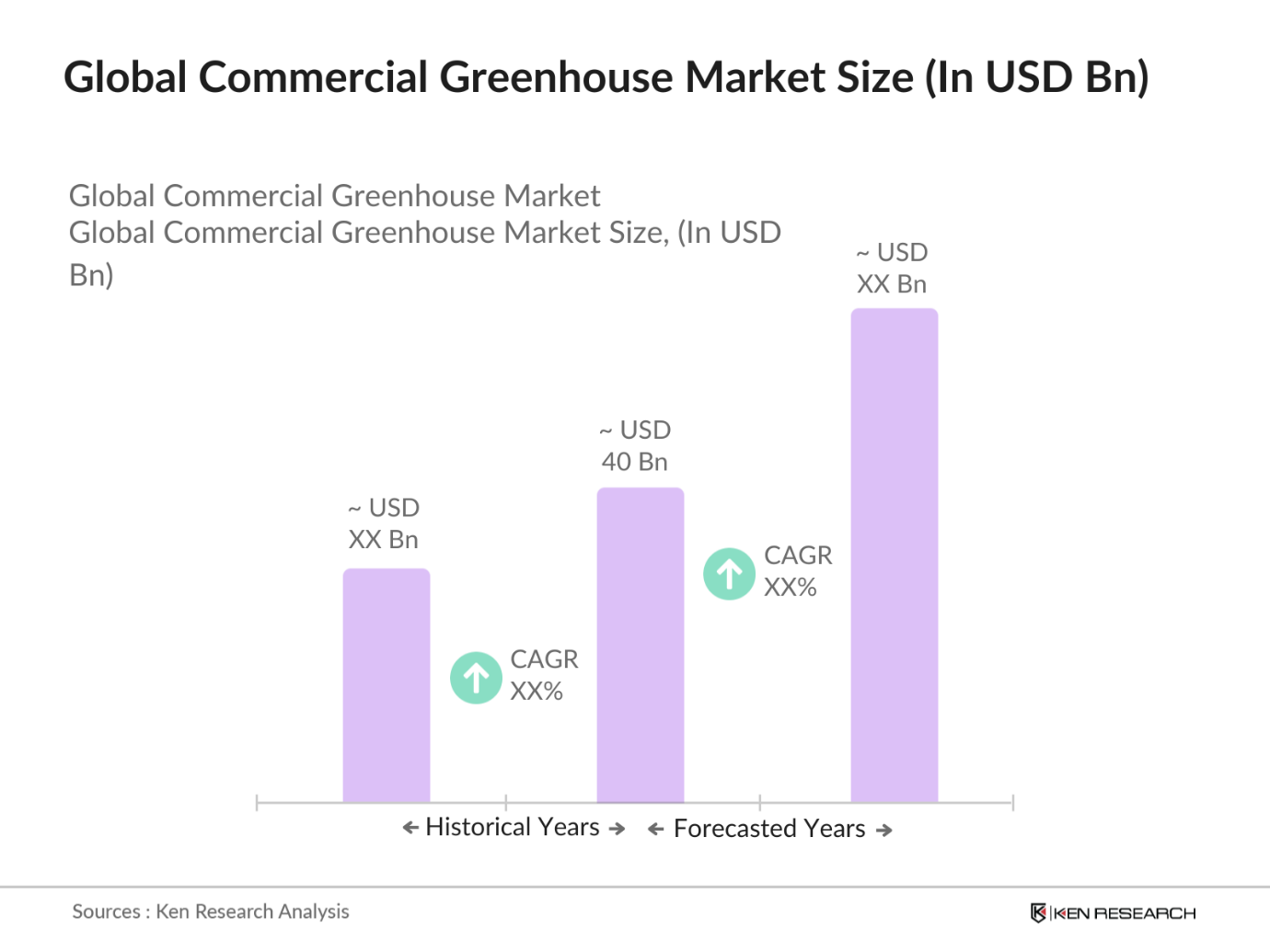
- Countries such as the Netherlands, Spain, and China dominate the global commercial greenhouse market due to their favourable climates, technological expertise, and well-established supply chains. The Netherlands is particularly prominent, boasting advanced greenhouse technologies that maximize crop yields. Spain has also leveraged its optimal growing conditions, while China, with significant government investment in greenhouse projects, is emerging as a key player. These regions benefit from both technological infrastructure and the capacity to meet large-scale production demands.
- Governments enforce building codes to ensure the structural integrity and safety of greenhouse constructions. These codes address factors such as snow and wind loads, fire safety, and material specifications. For instance, in the United States, the National Greenhouse Manufacturers Association (NGMA) provides guidelines that align with local building codes to ensure greenhouses can withstand regional climatic conditions. Compliance with these standards is mandatory to obtain construction permits and to ensure the safety of both workers and crops.
Global Commercial Greenhouse Market Segmentation
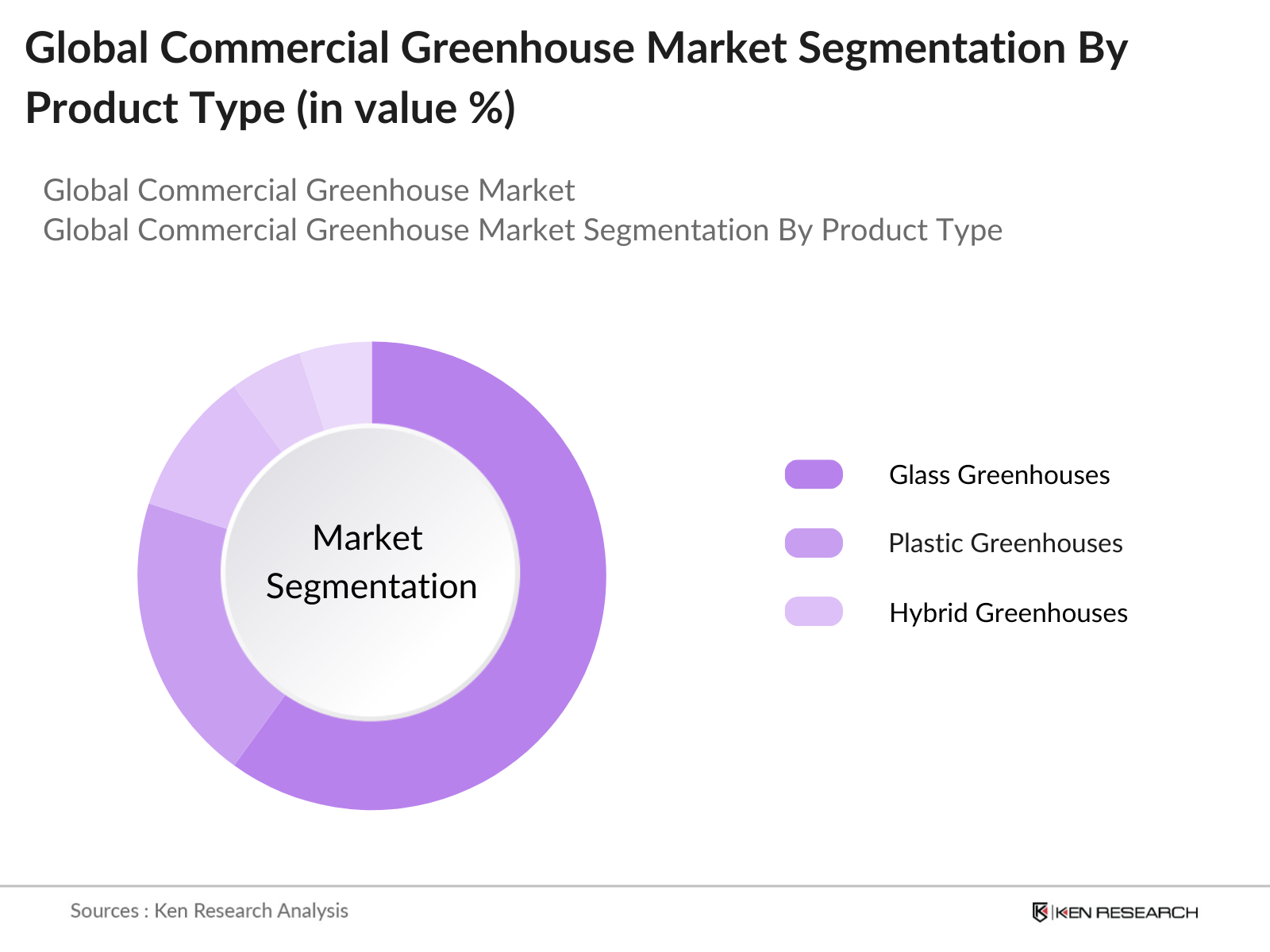
By Product Type: The global commercial greenhouse market is segmented into glass greenhouses, plastic greenhouses, and hybrid greenhouses. Among these, plastic greenhouses hold a dominant market share, driven by their cost-effectiveness and ease of installation. Unlike glass greenhouses, which are more expensive to set up and maintain, plastic structures provide a more affordable alternative while still offering optimal environmental control. Countries with a strong agricultural background, such as China and India, prefer plastic greenhouses due to their versatility and lower energy consumption.
By Technology: When segmented by technology, the market includes heating systems, cooling systems, LED lighting, and automated control systems. LED lighting is the leading technology due to its energy efficiency and ability to provide optimal lighting conditions regardless of external weather conditions. LED lighting solutions have been adopted widely, especially in regions like North America and Europe, where environmental regulations are stricter and energy-saving measures are prioritized. The growing emphasis on sustainable agriculture has further fueled the adoption of LED technology within commercial greenhouses.
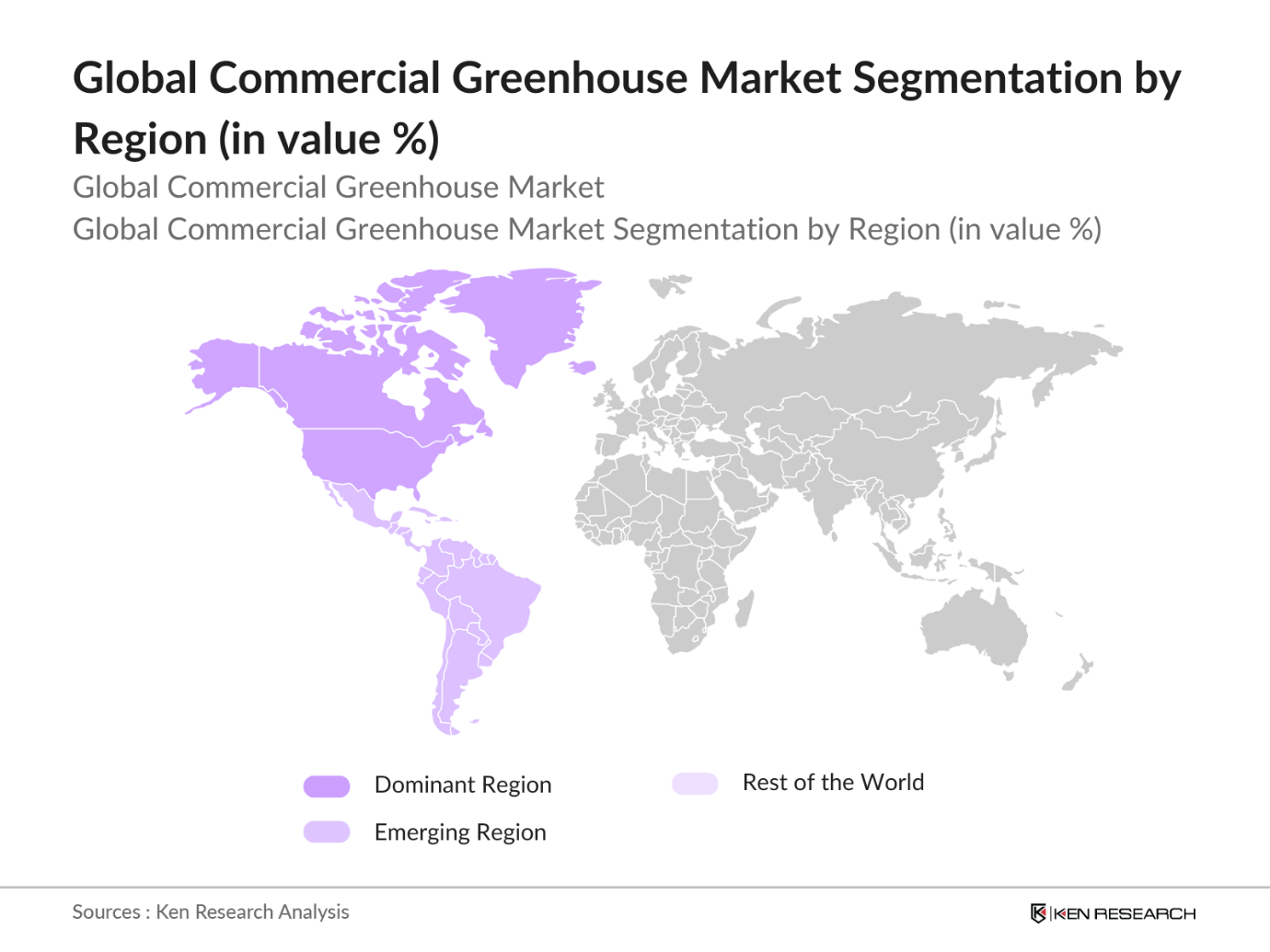
By Region: In terms of geographical segmentation, North America, Europe, Asia Pacific, the Middle East and Africa, and Latin America are key regions. North America holds the largest market share, with the U.S. at the forefront of adopting advanced greenhouse technologies, including AI and IoT, to enhance productivity and efficiency.
Global Commercial Greenhouse Market Competitive Landscape
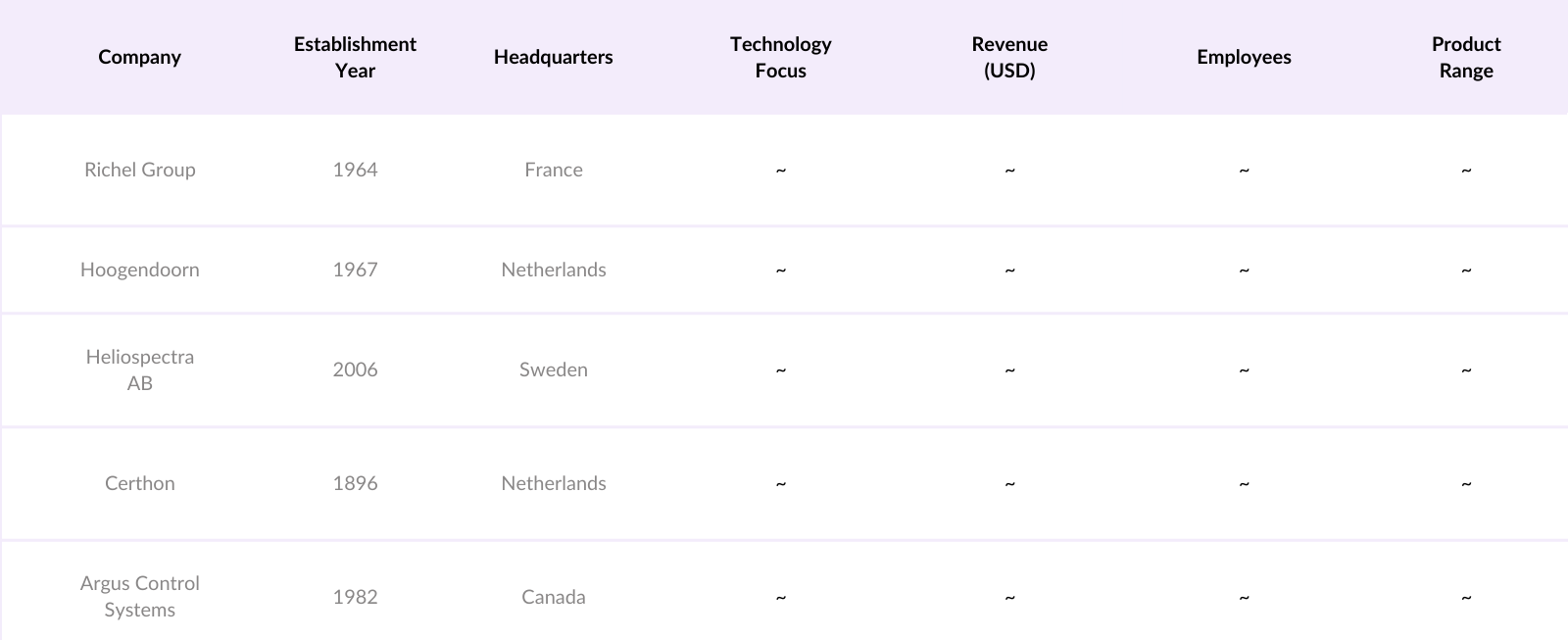
The global commercial greenhouse market is dominated by a mix of established players and emerging companies that specialize in various greenhouse technologies. The market is competitive due to technological advancements and the introduction of innovative solutions tailored for specific climates. Companies are investing in energy-efficient solutions and smart technologies to gain a competitive edge. The global commercial greenhouse market is characterized by the presence of companies such as Richel Group, Hoogendoorn, and Heliospectra AB, which focus on innovation and technological advancements. The Netherlands-based Richel Group and Hoogendoorn lead in providing automated solutions that enhance operational efficiency in greenhouses.
Global Commercial Greenhouse Market Analysis
Growth Drivers
- Rising demand for year-round crop production: The increasing global demand for food security has accelerated the need for year-round crop production, driving the growth of commercial greenhouses. According to the FAO, global food demand is set to increase by 70% by 2050, necessitating advancements in agricultural practices. In 2024, greenhouse facilities are helping mitigate supply chain issues in agriculture by maintaining consistent production, particularly in regions prone to harsh weather conditions. In India, 12 million hectares of arable land are estimated to benefit from controlled-environment agriculture (CEA), supporting the sustainability and productivity of the farming sector.
- Adoption of advanced technologies (Automation, AI, IoT): Advanced technologies such as automation, artificial intelligence (AI), and the Internet of Things (IoT) have significantly enhanced greenhouse operations. Data from the World Economic Forum in 2024 shows that AI-powered precision farming technologies have increased greenhouse crop yields by 30% in North America. Automation and IoT sensors are being widely used to optimize climate control, irrigation, and fertilization. In Europe, the adoption of AI-driven monitoring systems has reduced water usage by 40% in commercial greenhouse operations, promoting resource efficiency and sustainability.
- Climate control benefits in extreme weather conditions: Greenhouses equipped with climate control technologies are critical in regions facing extreme weather events, such as droughts and floods. In 2023, Australia saw a 20% increase in greenhouse installations due to fluctuating weather patterns, which caused open-field agricultural losses. Controlled-environment agriculture allows growers to maintain optimal growing conditions regardless of external factors, increasing crop resilience. According to the World Bank, the global adoption of climate-resilient infrastructure, including greenhouses, has been instrumental in preventing crop losses worth $8 billion annually.
Market Challenges
- Infrastructure and setup cost barriers: The initial investment required for greenhouse infrastructure, including construction, technology integration, and energy systems, remains a significant barrier. Data from the International Energy Agency in 2024 shows that advanced greenhouses can cost up to $250,000 per acre for setup. This high upfront capital expenditure often limits adoption, particularly in developing countries where access to financing is restricted. However, government incentive programs in Europe and Asia are working to reduce these barriers by offering subsidies for greenhouse technology installation, particularly for small and medium-sized farms.
- Lack of skilled labor for greenhouse technology management: Managing modern greenhouse operations requires specialized skills, particularly in handling automation and climate control technologies. According to the International Labour Organization (ILO), in 2023, 25% of greenhouse businesses globally faced operational delays due to a shortage of skilled workers. In Japan, where greenhouses are increasingly high-tech, the government is addressing the labor gap by introducing training programs, but the challenge persists. The lack of skilled labor increases operational costs, as greenhouses require technical expertise for optimal performance and troubleshooting.
Global Commercial Greenhouse Market Future Outlook
Over the next five years, the global commercial greenhouse market is poised for significant growth. This expansion will be driven by increasing investments in sustainable agriculture, technological innovations, and rising demand for organic produce. Government support in the form of subsidies and grants, particularly for energy-efficient greenhouse solutions, will further enhance market growth. Additionally, advancements in automation and climate control technologies will make greenhouses more cost-efficient, attracting new investments and accelerating the adoption of greenhouse farming worldwide.
Market Opportunities
- Expansion of organic and sustainable farming methods: Organic farming within greenhouses is rapidly gaining popularity as consumers increasingly demand sustainably produced food. In 2024, data from the USDA shows that organic greenhouse farming in the U.S. increased by 15%, supported by consumer preferences for pesticide-free products. European markets have also seen significant growth, with the European Commission reporting that 25% of all greenhouse-produced vegetables are now organic. This shift is further supported by government incentives that promote sustainable agricultural practices, offering subsidies for organic certification and production.
- Vertical farming integration with greenhouse technology: The integration of vertical farming systems with greenhouse technology presents a significant opportunity to maximize crop yields in limited spaces. In 2023, Singapore, a leader in urban agriculture, saw a 50% increase in vertically integrated greenhouse systems, significantly improving local food security. Data from the World Bank suggests that vertical farming can increase crop output by up to 12 times per square meter, offering a sustainable solution for urban areas. The ability to stack crops vertically within greenhouses reduces land use while enhancing production efficiency.
Scope of the Report
|
Segment |
Sub-Segment |
|
By Product Type |
Glass Greenhouses Plastic Greenhouses Hybrid Greenhouses |
|
By Technology |
Heating Systems Cooling Systems LED Lighting Automated Control Systems |
|
By Structure Type |
Freestanding Greenhouses Gutter Connected Greenhouses |
|
By Crop Type |
Fruits and Vegetables Flowers and Ornamentals Nursery Crops Cannabis |
|
By Region |
North America Europe Asia Pacific Middle East and Africa Latin America |
Products
Key Target Audience
Greenhouse Manufacturers
Agricultural Technology Providers
Food and Beverage Companies
Retailers and Distributors
Government and Regulatory Bodies (e.g., FAO, USDA)
Investors and Venture Capitalist Firms
Organic Farming Associations
Environmental Sustainability Groups
Companies
Players mentioned in the report
Richel Group
Hoogendoorn
Heliospectra AB
Nexus Corporation
Certhon
Logiqs BV
Lumigrow
Agra Tech Inc.
Argus Control Systems Ltd.
Stuppy Greenhouse
Greentech Agro LLC
Van Wingerden Greenhouse Company
Kubo Greenhouse Projects
Priva
Rough Brothers Inc.
Table of Contents
1. Global Commercial Greenhouse Market Overview
1.1 Definition and Scope
1.2 Market Taxonomy
1.3 Market Growth Rate and Milestones
1.4 Market Segmentation Overview (Product Type, Technology, Structure Type, Crop Type, Region)
2. Global Commercial Greenhouse Market Size (In USD Bn)
2.1 Historical Market Size
2.2 Growth Analysis (in %) by Key Metrics
2.3 Key Market Developments
3. Global Commercial Greenhouse Market Analysis
3.1 Growth Drivers (Sustainability Initiatives, Technology Adoption, Government Incentives)
3.1.1 Rising demand for year-round crop production
3.1.2 Adoption of advanced technologies (Automation, AI, IoT)
3.1.3 Climate control benefits in extreme weather conditions
3.2 Market Challenges (High Initial Costs, Limited Skilled Workforce, Operational Complexity)
3.2.1 Infrastructure and setup cost barriers
3.2.2 Lack of skilled labor for greenhouse technology management
3.2.3 Energy and operational inefficiencies
3.3 Opportunities (Organic Farming, Vertical Integration, Technological Innovation)
3.3.1 Expansion of organic and sustainable farming methods
3.3.2 Vertical farming integration with greenhouse technology
3.3.3 Technological innovations in lighting and energy efficiency
3.4 Trends (LED Lighting, IoT Solutions, Data-Driven Farming)
3.4.1 Growing use of LED lighting for energy savings
3.4.2 IoT integration for precision farming
3.4.3 Adoption of data analytics for crop yield optimization
3.5 Government Regulation (Subsidies, Environmental Standards, Certification Processes)
3.5.1 Government subsidies and funding for greenhouse projects
3.5.2 Environmental regulations and greenhouse gas reduction mandates
3.5.3 Certification standards for organic greenhouse farming
3.6 SWOT Analysis (Strengths, Weaknesses, Opportunities, Threats)
3.7 Stakeholder Ecosystem (Manufacturers, Suppliers, Distributors, End-users)
3.8 Porters Five Forces (Competitive Rivalry, Supplier Power, Buyer Power, Threat of Substitutes, Barriers to Entry)
3.9 Competitive Landscape (Global and Regional Key Players)
4. Global Commercial Greenhouse Market Segmentation
4.1 By Product Type (In Value %)
4.1.1 Glass Greenhouses
4.1.2 Plastic Greenhouses
4.1.3 Hybrid Greenhouses
4.2 By Technology (In Value %)
4.2.1 Heating Systems
4.2.2 Cooling Systems
4.2.3 LED Lighting
4.2.4 Automated Control Systems
4.3 By Structure Type (In Value %)
4.3.1 Freestanding Greenhouses
4.3.2 Gutter Connected Greenhouses
4.4 By Crop Type (In Value %)
4.4.1 Fruits and Vegetables
4.4.2 Flowers and Ornamentals
4.4.3 Nursery Crops
4.4.4 Cannabis
4.5 By Region (In Value %)
4.5.1 North America
4.5.2 Europe
4.5.3 Asia Pacific
4.5.4 Middle East and Africa
4.5.5 Latin America
5. Global Commercial Greenhouse Market Competitive Analysis
5.1 Detailed Profiles of Major Companies
5.1.1 Richel Group
5.1.2 Hoogendoorn
5.1.3 Heliospectra AB
5.1.4 Nexus Corporation
5.1.5 Certhon
5.1.6 Logiqs BV
5.1.7 Lumigrow
5.1.8 Agra Tech Inc.
5.1.9 Argus Control Systems Ltd.
5.1.10 Stuppy Greenhouse
5.1.11 Greentech Agro LLC
5.1.12 Van Wingerden Greenhouse Company
5.1.13 Kubo Greenhouse Projects
5.1.14 Priva
5.1.15 Rough Brothers Inc.
5.2 Cross Comparison Parameters (Headquarters, Employees, Market Share, Revenue, Product Portfolio, Technology Adoption, Global Reach, Innovation Investments)
5.3 Market Share Analysis
5.4 Strategic Initiatives (Partnerships, New Product Launches)
5.5 Mergers and Acquisitions
5.6 Investment Analysis (Venture Capital Funding, Private Equity Investments)
5.7 Government Grants and Subsidies
6. Global Commercial Greenhouse Market Regulatory Framework
6.1 Environmental Standards
6.2 Compliance Requirements (Energy Efficiency, Waste Management)
6.3 Certification Processes (Organic, Sustainability Certifications)
7. Global Commercial Greenhouse Future Market Size (In USD Bn)
7.1 Future Market Growth Projections
7.2 Key Factors Driving Future Market Expansion
8. Global Commercial Greenhouse Future Market Segmentation
8.1 By Product Type (In Value %)
8.2 By Technology (In Value %)
8.3 By Structure Type (In Value %)
8.4 By Crop Type (In Value %)
8.5 By Region (In Value %)
9. Global Commercial Greenhouse Market Analysts Recommendations
9.1 TAM/SAM/SOM Analysis
9.2 White Space Opportunities in Emerging Markets
9.3 Key Marketing and Investment Strategies
9.4 Technology Adoption Roadmap for Industry Players
Disclaimer Contact UsResearch Methodology
Step 1: Identification of Key Variables
The initial phase involves mapping all key stakeholders in the global commercial greenhouse market. This includes manufacturers, technology providers, and end-users, allowing for the identification of critical market variables such as technology adoption rates, investment patterns, and crop yield optimization strategies.
Step 2: Market Analysis and Construction
Historical market data, including growth rates and technological adoption, is analyzed to build a comprehensive understanding of the market dynamics. This step focuses on understanding the link between technological advancements and market penetration, ensuring the accuracy of revenue estimates.
Step 3: Hypothesis Validation and Expert Consultation
Market hypotheses are validated through interviews with industry experts and greenhouse technology providers. This feedback ensures that the data is accurate and reflects the latest industry trends, providing valuable insights into future market dynamics.
Step 4: Research Synthesis and Final Output
The final phase includes synthesizing all data points and presenting the findings in a comprehensive report format. Key insights are validated through direct engagement with greenhouse operators and manufacturers to ensure the accuracy and reliability of the analysis.
Frequently Asked Questions
-
How big is the global commercial greenhouse market?
The global commercial greenhouse market is valued at USD 40 billion, driven by the increasing demand for sustainable farming solutions and technological advancements. -
What are the major challenges in the global commercial greenhouse market?
Key challenges include high initial investment costs, energy consumption concerns, and the lack of skilled labor required for managing high-tech greenhouse systems. -
Who are the major players in the global commercial greenhouse market?
Key players include Richel Group, Hoogendoorn, Heliospectra AB, Nexus Corporation, and Certhon. These companies dominate the market due to their technological innovations and strong global presence. -
What are the growth drivers of the global commercial greenhouse market?
The market is driven by the increasing demand for sustainable agriculture, technological advancements such as LED lighting and IoT integration, and government subsidies supporting greenhouse farming. -
Which regions are dominating the global commercial greenhouse market?
Europe, particularly the Netherlands and Spain, dominates the market due to their technological advancements and favorable climatic conditions for year-round cultivation.
Why Buy From Us?

What makes us stand out is that our consultants follows Robust, Refine and Result (RRR) methodology. i.e. Robust for clear definitions, approaches and sanity checking, Refine for differentiating respondents facts and opinions and Result for presenting data with story

We have set a benchmark in the industry by offering our clients with syndicated and customized market research reports featuring coverage of entire market as well as meticulous research and analyst insights.

While we don't replace traditional research, we flip the method upside down. Our dual approach of Top Bottom & Bottom Top ensures quality deliverable by not just verifying company fundamentals but also looking at the sector and macroeconomic factors.

With one step in the future, our research team constantly tries to show you the bigger picture. We help with some of the tough questions you may encounter along the way: How is the industry positioned? Best marketing channel? KPI's of competitors? By aligning every element, we help maximize success.

Our report gives you instant access to the answers and sources that other companies might choose to hide. We elaborate each steps of research methodology we have used and showcase you the sample size to earn your trust.

If you need any support, we are here! We pride ourselves on universe strength, data quality, and quick, friendly, and professional service.