
Global CRM Market Outlook to 2030
Region:Global
Author(s):Anshika and Anmol
Product Code:KENGR029
October 2024
82
About the Report
Global CRM Market Overview
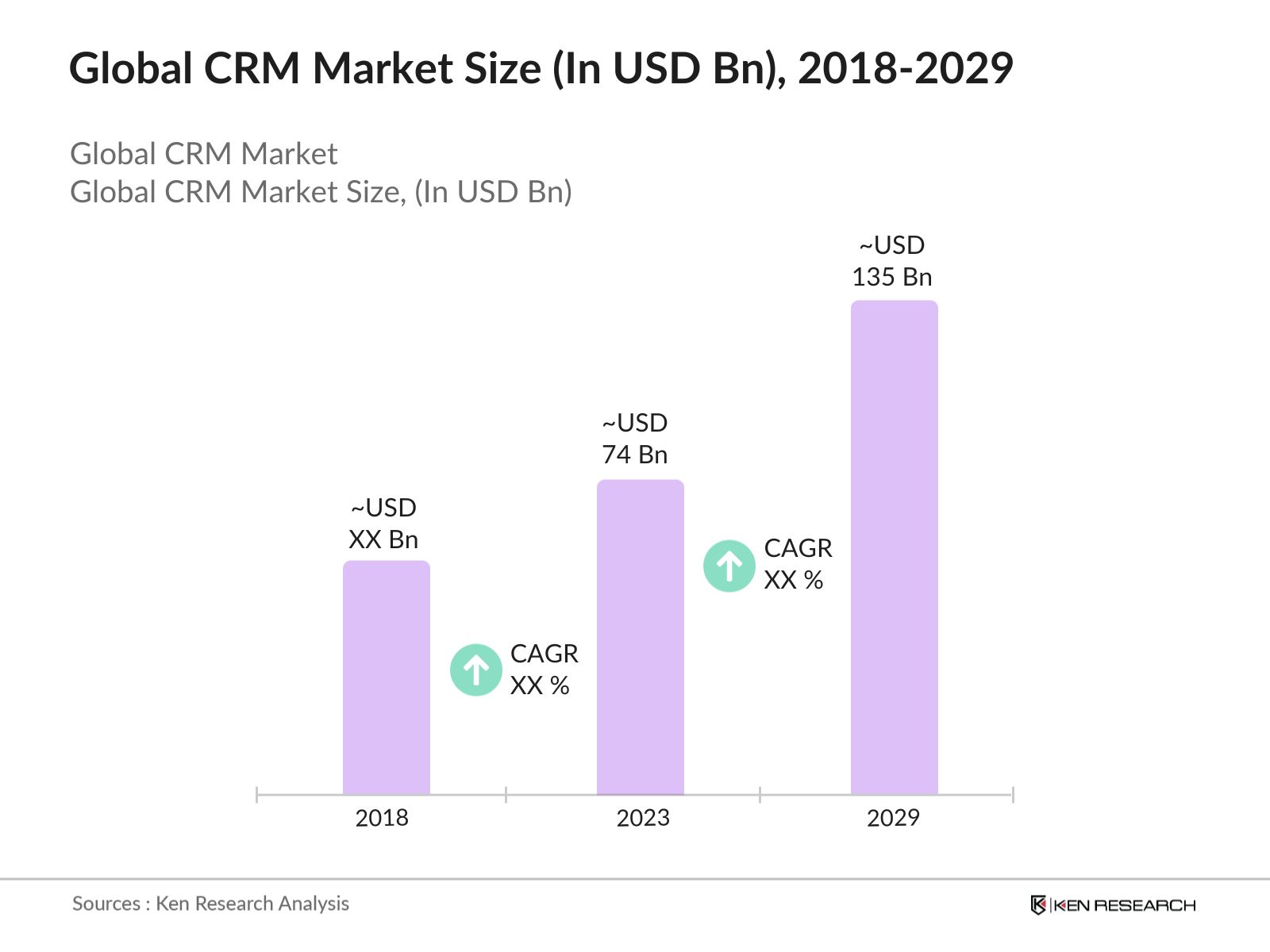
- In 2023, the global customer relationship managementmarket was valued at USD 74 Bn and is forecasted to reach a market size of USD 135 Bn in 2029 driven by growing customer-centric strategies through CRM solutions, increasing CRM adoption amid digital transformation, expanding to emerging markets, and focus on small and medium enterprises (SMEs).
- The market is highly consolidated with prominent players including Salesforce, Microsoft Dynamics 365, Adobe, SAP, Hubspot, Zendesk and Oracle.
- In September 2022, Salesforce introduced Salesforce Genie, a hyper-scale real-time data platform that improves the capability of the complete Salesforce Customer 360 platform. Through this launch, every company could transform data into customer magic, offering smooth, highly customized experiences in marketing, service, sales, and commerce which continuously align to transforming customer information and requirements in real-time.
Global CRM Current Market Analysis
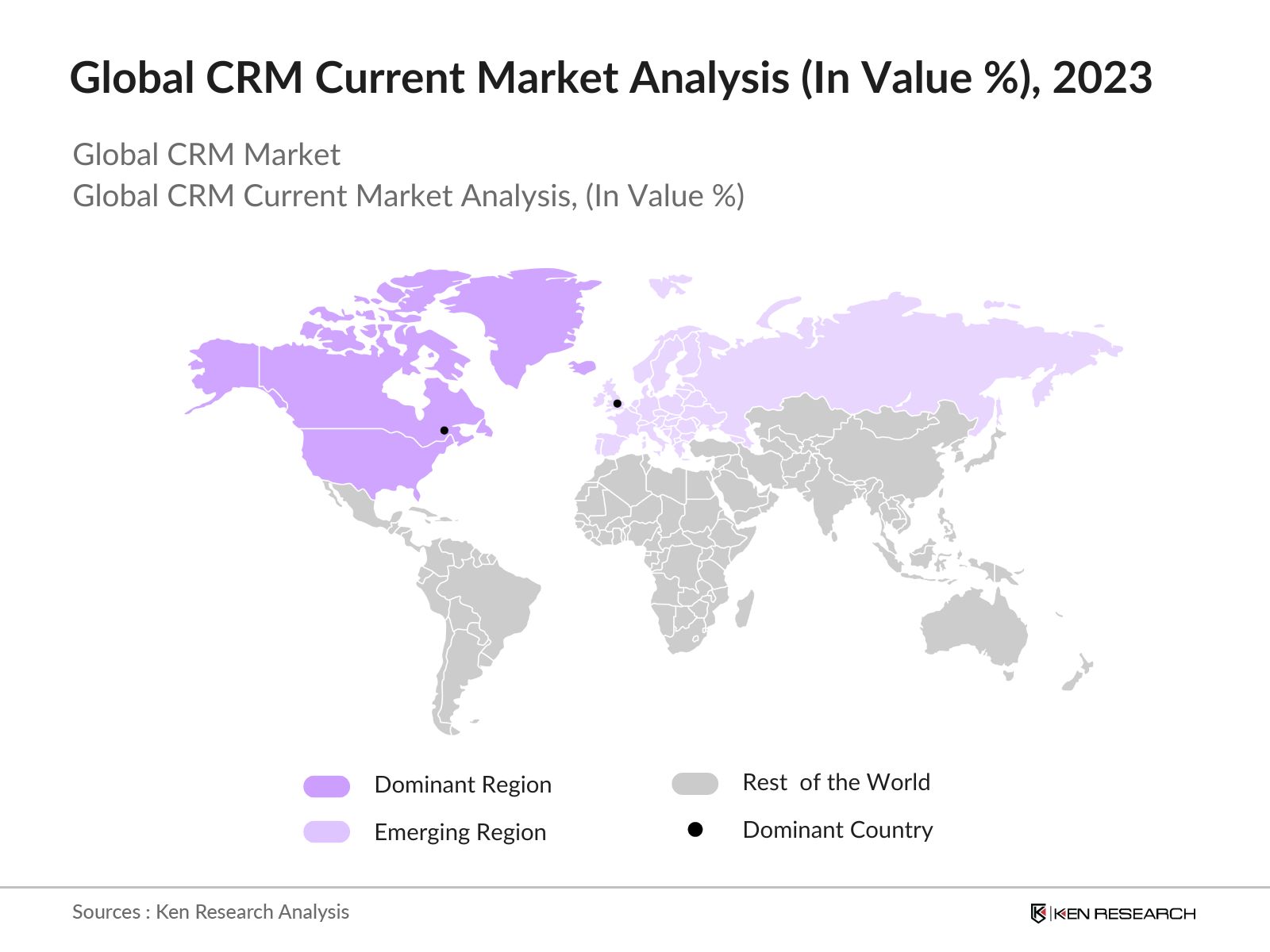
- North America as Dominant Region: North America dominates the market owing to the growth of the CRM software market in North America as this is the increasing importance of customer experience. Additionally, high adoption rates, digital transformation and presence of major CRM vendors are also driving the market. In the United States specifically, about55%of businesses utilize CRM platforms, indicating a robust market presence and reliance on CRM solutions for managing customer relationships. Prominent CRM providers are investing aggressively in the market, HubSpot, one of the leading players in the market has invested over USD 100 million in its US-based research and development centers since 2018.
- Europe as Emerging Region: Europe is the second-largest market in the market driven by digitalization, stringent regulations concerned with business management, and the presence of key players operating in the region. In June 2023, Salesforce announced a USD 4 billion investment in its UK operations over five years. This initiative aims to drive innovation and support its expanding customer base, particularly through AI-driven solutions. In July 2023, Veeva Systems announced that Veeva Vault MedInquiry is being used as the worldwide medical information management system by Merck KGaA. This partnership demonstrates SAP's commitment to offering improved CRM solutions in Europe.
- USA as the dominant country: The USA leads the market due to high demand for customer-centric solutions, advanced technology integration, e-commerce expansion, and cloud-based solutions. In 2023, U.S. e-commerce sales surpassed USD 1.119 trillion, a 7.6% increase from USD 1.040 trillion in 2022, marking a 22.0% share of total retail sales, the highest ever. Companies are heavily investing in AI and automation to enhance their platforms, improving customer relationship management and expanding their services.
Global CRM Market Segmentation
The Global CRM Market can be segmented based on several factors:
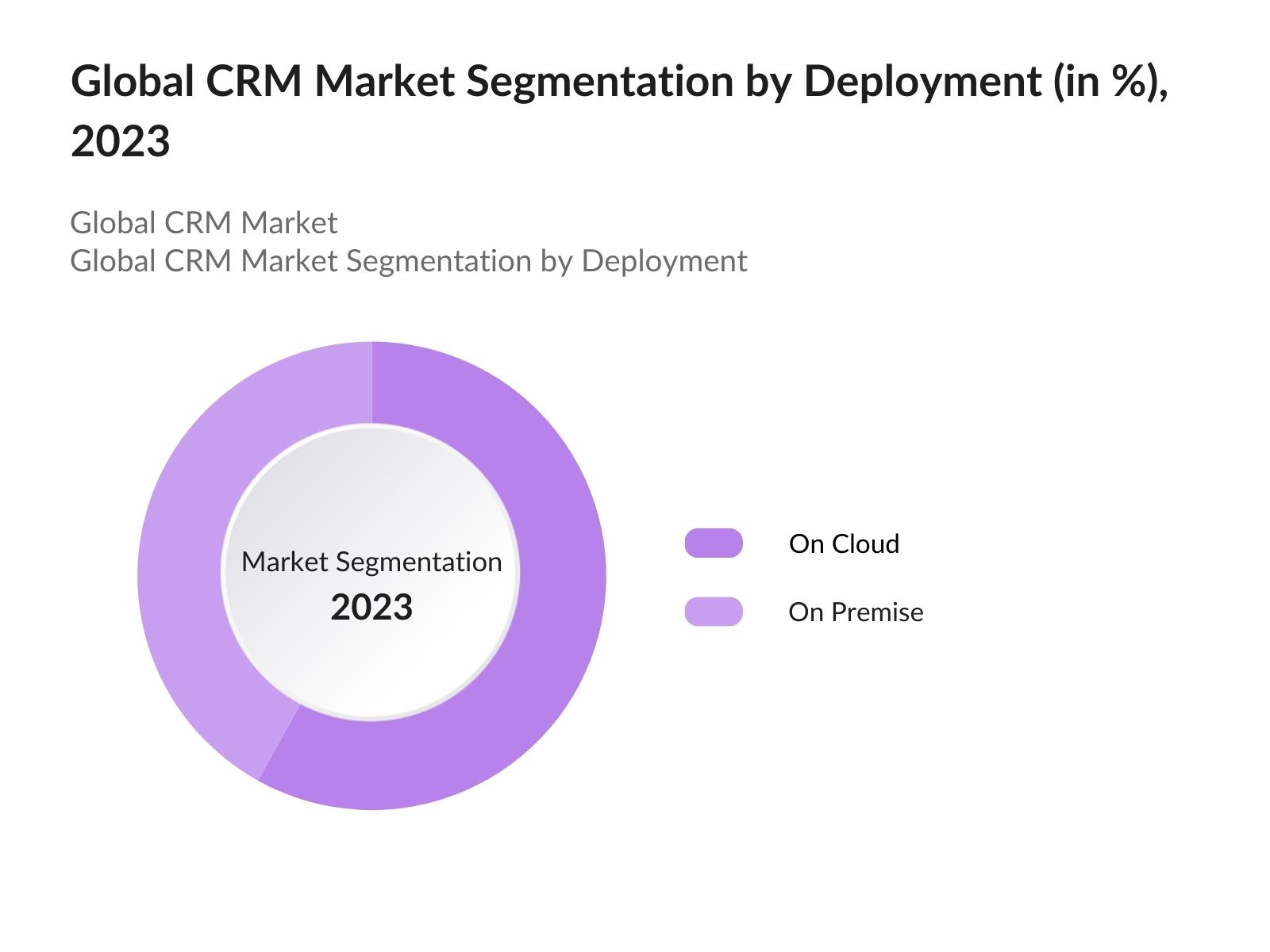
- By Deployment: The global CRM market segmentation by deployment type into On Cloud and On-Premise. In 2023, On-Premise CRM deployment dominated the market due to the growing preference for cloud solutions, on-premise CRM systems continue to hold a significant market share, particularly among large enterprises with stringent data security and compliance requirements. These organizations opt for on-premise deployments to maintain greater control over their data and customize their CRM systems to meet specific business needs.
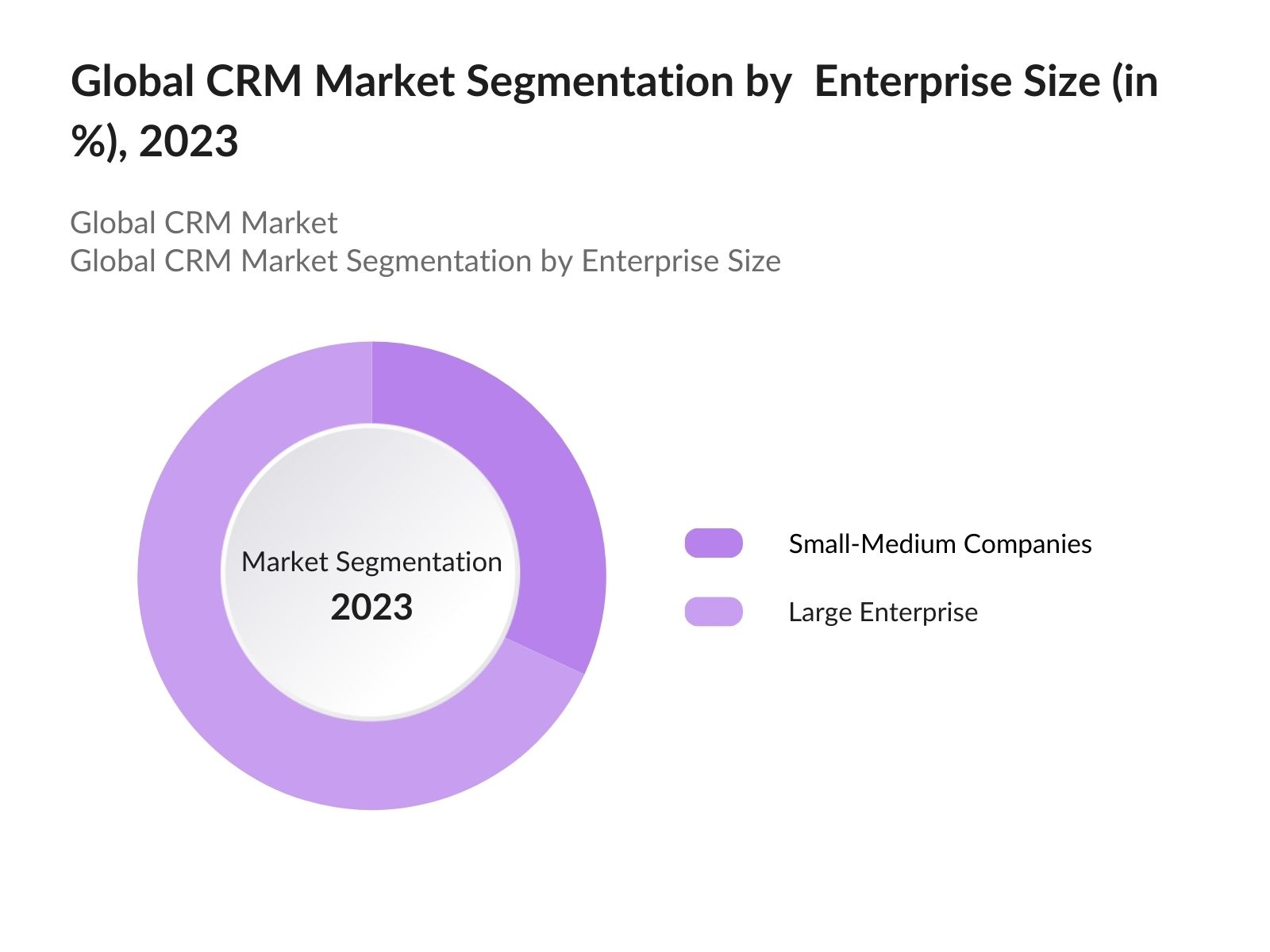
- By Enterprise Size: The global CRM market segmentation by enterprise size into Small-medium companies and large enterprises. In 2023, Large enterprise represented a substantial portion of the global CRM market. Large enterprises dominate the CRM market in terms of value, as they invest heavily in sophisticated CRM systems to manage complex customer interactions and vast amounts of data. These organizations require advanced features, customization, and integration capabilities.
- By End-User: The global CRM market segmentation by end-user into Computer & IT Services, BFSI, Retail & E-commerce, Manufacturing, Healthcare, and Others. In 2023, the computer and IT services segment dominated the global CRM market due to the sector's reliance on advanced technological solutions to manage client relationships and projects effectively. IT services firms, which often handle large volumes of client interactions and data, prefer CRM systems that can integrate seamlessly with other IT tools and platforms.
Global CRM Market Competitive Landscape
|
Company |
Parent Company |
Headquarter |
Establishment Year/Vintage |
Geographical Presence (No. of countries) |
|
Salesforce CRM |
Salesforce Inc. |
San Francisco, California, USA |
1999 |
100 |
|
|
Adobe Inc |
San Jose, California, USA |
2012 |
Global |
|
Microsoft Dynamics 365 |
Microsoft Corporation |
Redmond, Washington, USA |
2003 |
160+ |
|
Oracle Siebel |
Oracle |
Redwood City, California, USA |
1977 |
161 |
|
SAP CRM |
SAP |
Walldorf, Germany |
1972 |
Global |
|
Zendesk Sell |
Zendesk |
San Francisco, California, USA |
2007 |
160+ |
|
Zoho Corporation Pvt. Ltd. |
Zoho Corporation |
Chennai, India |
1996 |
15+ |
- Oracle Siebel Oracle NetSuite: In October 2022, Oracle signed an agreement with HSBC, a financial services organization. Following this collaboration, Oracle would boost the banks digital transformation. Under this agreement, Oracle would enable HSBC to consolidate critical systems on a scalable, secure on-premises cloud platform and develop cloud-based services faster.
- Adobe Experience Cloud: In June 2023, Adobe unveiled new offerings at Adobe Summit EMEA 2023, enabling brands to deliver highly personalized experiences across various touchpoints while maximizing operational efficiency. The company's latest innovations aim to help brands navigate through an uncertain business climate and deliver engaging and personalized experiences to accelerate profitable growth.
- Microsoft Dynamics 365: In January 2023, Microsoft partnered with YES Bank; an Indian bank engaged in providing banking solutions. Following this partnership, companies would bring the latest generation mobile application (app) to deliver customers with a customized banking experience. Additionally, with the help of Microsofts Azure platform, YES Bank would build the app to provide customers with a host of services including customized dashboards, shopping, offers, rewards, and online payments.
Global CRM Industry Analysis
Global CRM Market Growth Drivers:
- Growing customer-centric strategies through CRM solutions: The adoption of CRM solutions is significantly driven by the increasing focus on customer-centric strategies. These systems enable businesses to enhance customer engagement by providing comprehensive data analytics that help understand customer preferences and behaviors. CRM enables businesses to anticipate and respond to customer preferences more effectively, fostering stronger relationships and driving competitive advantage in today's dynamic market landscape.
- Increasing CRM adoption amid digital transformation: Digital transformation across various industries has accelerated the adoption of CRM solutions, integrating them with advanced digital tools like artificial intelligence, machine learning, and data analytics. This integration enhances operational efficiency and customer satisfaction by automating marketing campaigns, sales processes, and customer service operations. Additionally, CRM systems play a pivotal role in enabling organizations to digitize their customer engagement processes, improve operational efficiency, and stay competitive in today's digital economy.
- Expanding to emerging markets: Emerging markets present significant growth opportunities for the CRM industry as businesses in these regions modernize and digitize their operations. Rapid economic growth, increasing internet penetration, and a growing number of SMEs adopting CRM to enhance their competitive edge are key drivers in these markets. Furthermore, the proliferation of smartphones and other digital devices has made it easier for companies to reach and engage with customers through multiple channels. A growing number of small and medium-sized enterprises (SMEs) in these regions are adopting CRM solutions to enhance their competitive edge by leveraging data-driven insights to improve customer satisfaction and loyalty.
Global CRM Market Challenges:
- High Cost of Implementation: Expenses associated with software licensing, customization, integration with existing systems, and employee training can quickly escalate. This financial barrier often prevents organizations from adopting or upgrading CRM solutions, limiting their ability to improve customer relationships and streamline operations. Moreover, ongoing maintenance costs add to the total cost of ownership, making it challenging for businesses to justify the investment in CRM technology. As a result, cost considerations remain a significant restraint for companies looking to leverage CRM solutions effectively.
- Growing Privacy Concerns: Growing concerns about privacy, as well as increasing regulations such as GDPR and CCPA, are posing challenges to the expansion of the customer relationship management (CRM) market. Organizations are facing pressure to ensure compliance with these regulations while managing vast amounts of customer data. The rising complexity of customer data management and integration across various systems is a barrier to CRM adoption for some businesses.
Global CRM Market Future Outlook
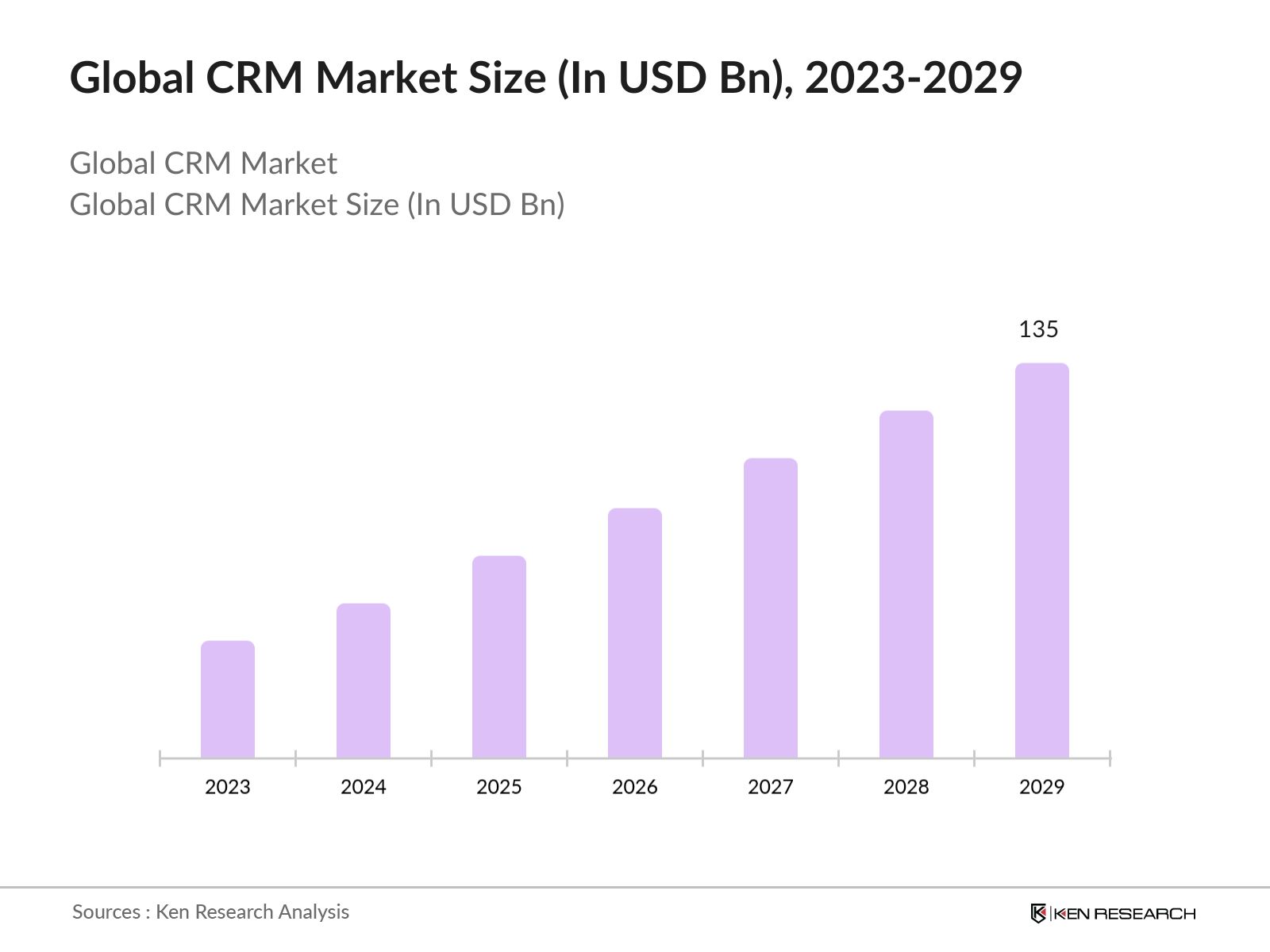
The Global CRM market is expected to reach a market size of USD 135 Bn by 2029 showing substantial growth driven by rise in shift towards omnichannel engagement, increasing demands customer service delivery, and enhancing digitalization among organizations.
Future Market Trends
- Rise In Shift Towards Omnichannel Engagement: Businesses are investing in CRM solutions to unify customer data from various touchpoints such as social media, email,mobile apps, and in-person interactions. Adopting omnichannel CRM strategies, organizations can deliver personalized experiences, anticipate customer needs, and foster stronger relationships. This approach enhances customer satisfaction and improves operational efficiency and drives revenue growth, driving the demand for advanced CRM solutions tailored for omnichannel engagement.
- Increasing Demands Customer Service Delivery: New tools such as Genesys' AI-driven customer experience solutions launched in 2021, fuels growth opportunities in the global CRM market. Genesys' offerings, including open messaging API, bot development, orchestration, and employee development features, demonstrate the evolving capabilities of CRM applications to meet the increasing demands of businesses for enhanced customer engagement and service delivery. These advancements enable organizations to leverage AI-driven insights, streamline communication channels, and empower employees, driving adoption and investment in CRM solutions.
Scope of the Report
|
By Region |
North America Europe APAC Latin America MEA |
|
By Deployment Type |
On Cloud On Premise |
|
By Enterprise Size Type |
Small-Medium Companies Large Enterprise |
|
By End-User Type |
Computer & IT Services BFSI Retail & E-commerce Manufacturing Healthcare Others |
|
By Revenue Type |
Subscription & Support Revenues Professional Services & Other Revenues |
Products
Key Target Audience Organizations and Entities Who Can Benefit by Subscribing This Report:
CRM Software Providers
Technology and IT Service Providers
System Integrator Firms
Banks and Financial Institutions
Government and Regulatory Bodies (GDPR, and FTC)
Investors and Venture Capitalists
IT Consultants
Small and Medium-sized Enterprises (SMEs)
Retail Companies
Healthcare Organizations
Time Period Captured in the Report:
Historical Period: 2018-2023
Base Year: 2023
Forecast Period: 2023-2029
Companies
Players Mentioned in the Report:
Salesforce CRM
Adobe Experience Cloud
Microsoft Dynamics 365
"Oracle Siebel
Oracle NetSuite"
SAP CRM
Zendesk Sell
Zoho Corporation Pvt. Ltd.
Hubspot Inc
Monday.com
FreshSales CRM
Table of Contents
1. Executive Summary
1.1 Global Enterprise Software Market
1.2 Global CRM Market
2. Global Overview
2.1 Overview of Global Economics
2.2 Overview of Global Enterprise Software Market
2.3 Global Enterprise Software Revenue
2.4 Global CRM Infrastructure
3. Global CRM Market Overview
3.1 Ecosystem
3.2 Value Chain
3.3 Case Study
4. Global CRM Market Size (in USD Bn), 2018-2023
5. Global CRM Market Segmentation (in value %), 2018-2023
5.1 By Region (North America, Europe, APAC, Latin America and MEA) in value %, 2018-2023
5.2 By Deployment (On Cloud and On Premise) in value%, 2018-2023
5.3 By Enterprise Size (Small-Medium Companies and Large Enterprise) in value %, 2018-2023
5.4 By End-User (Computer & IT Services, BFSI, Retail & E-commerce, Manufacturing, Healthcare, and Others) in value %, 2018-2023
5.5 By Revenue (Subscription & Support Revenues and Professional Services & Other Revenues) in value %, 2018-2023
6. Global CRM Market Competition Landscape
6.1 Market Share Analysis
6.2 Market Heat Map Analysis (By Technology)
6.3 Market Heat Map Analysis (By Offerings)
6.4 Market Cross Comparison
6.5 Comparison Matrix
6.6 Investment Landscape
7. Global CRM Market Dynamics
7.1 Growth Drivers
7.2 Challenges
7.3 Trends
7.4 Case Studies
7.5 Strategic Initiatives
8. Global CRM Future Market Size (in USD Bn), 2023-2029
9. Global CRM Future Market Segmentation (in value %), 2023-2029
9.1 By Region (North America, Europe, APAC, Latin America and MEA) in value %, 2023-2029
9.2 By Deployment (On Cloud and On Premise) in value%, 2023-2029
9.3 By Enterprise Size (Small-Medium Companies and Large Enterprise) in value %, 2023-2029
9.4 By End-User (Computer & IT Services, BFSI, Retail & E-commerce, Manufacturing, Healthcare, and Others) in value %, 2023-2029
9.5 By Revenue (Subscription & Support Revenues and Professional Services & Other Revenues) in value %, 2023-2029
10. Analyst Recommendations
11. Research Methodology
11.1 Market Definitions and Assumptions
11.2 Abbreviations
11.3 Market Sizing Approach
11.4 Consolidated Research Approach
11.5 Understanding Market Potential Through In-Depth Industry Interviews
11.6 Primary Research Approach
11.7 Limitations and Future Conclusion
Disclaimer
Contact Us
Research Methodology
Step: 1 Secondary Research and Data Collection:
Reviewed company reports, industry publications, presentations, websites, press releases, news articles, journals, and paid databases related to CRM. Identified key players, market size, segmentation, trends, and regional variations within the CRM market.
Step: 2 Primary Research and Industry Expert Interviews:
Interviewed CEOs, CTOs, and other industry leaders to gather insights on market size, trends, competition, and segmentation within the CRM industry. Validate data collected from secondary sources and obtained qualitative insights from these interviews. Selected respondents across different levels and functions within CRM companies to ensure a comprehensive understanding of the market.
Step:3 Vendor Identification and Evaluation:
Identified key vendors in the data center colocation market through secondary research and expert interviews. Vendors were evaluated based on product features, company size, and past research. A final shortlist of 10 significant companies in the global market was created based on these parameters.
Step: 4 Market Size Calculation and Financial Analysis:
Calculated the overall market size for the CRM market in terms of value in USD by integrating segment-wise data across different levels. Utilized financial statements such as annual reports, quarterly earnings, and expert opinions to analyze the CRM market's size and growth.
Step: 5 Regional Market Profiling and Forecasting:
Utilized collected data to construct regional market profiles for each continent, analyzing variations in the CRM market and market growth. Estimated segment size for each country individually using relevant key market indicators such as GDP, level of digitization, sector composition, and observed software adoption rates. Applied forecasting techniques, including advanced statistical methods, to project market trends based on drivers like GDP and level of digitization.
Step: 6 Data Validation and Methodological Rigor:
Conducted a rigorous validation process to ensure the accuracy and reliability of the obtained CRM market data. Employed statistical methods to assess the robustness of findings and mitigate potential biases in the research process. Ensured that the research methodology adheres to best practices and standards in market analysis to provide credible insights into the global CRM market.
Frequently Asked Questions
01 How big is the global CRM market?
In 2023, the global customer relationship management market was valued at USD 74 Bn and is forecasted to reach a market size of USD 135 Bn in 2029 driven by growing customer-centric strategies through CRM solutions, increasing CRM adoption amid digital transformation, expanding to emerging markets, and focus on small and medium enterprises (SMEs).
02 What are the challenges in the global CRM market?
Challenges in the global CRM market include data privacy concerns, integration issues with existing systems, and the high cost of implementation and maintenance. Additionally, the complexity of CRM solutions can hinder user adoption and satisfaction.
03 Who are the major players in the global CRM market?
Key players in the global CRM market include Salesforce, Microsoft, Oracle, SAP, and Adobe. These companies lead the market due to their robust product offerings, extensive customer base, and continuous innovation.
04 What are the growth drivers of the global CRM market?
The global CRM market is driven by factors such as the increasing need for customer retention, the rise in digital transformation initiatives, and the demand for personalized customer experiences. The shift towards cloud-based CRM solutions also supports market growth.
Why Buy From Us?

What makes us stand out is that our consultants follows Robust, Refine and Result (RRR) methodology. i.e. Robust for clear definitions, approaches and sanity checking, Refine for differentiating respondents facts and opinions and Result for presenting data with story

We have set a benchmark in the industry by offering our clients with syndicated and customized market research reports featuring coverage of entire market as well as meticulous research and analyst insights.

While we don't replace traditional research, we flip the method upside down. Our dual approach of Top Bottom & Bottom Top ensures quality deliverable by not just verifying company fundamentals but also looking at the sector and macroeconomic factors.

With one step in the future, our research team constantly tries to show you the bigger picture. We help with some of the tough questions you may encounter along the way: How is the industry positioned? Best marketing channel? KPI's of competitors? By aligning every element, we help maximize success.

Our report gives you instant access to the answers and sources that other companies might choose to hide. We elaborate each steps of research methodology we have used and showcase you the sample size to earn your trust.

If you need any support, we are here! We pride ourselves on universe strength, data quality, and quick, friendly, and professional service.