
Global Dairy Herd Management Market Outlook to 2030
Region:Global
Author(s):Sanjeev
Product Code:KROD1733
November 2024
96
About the Report
Global Dairy Herd Management Market Overview
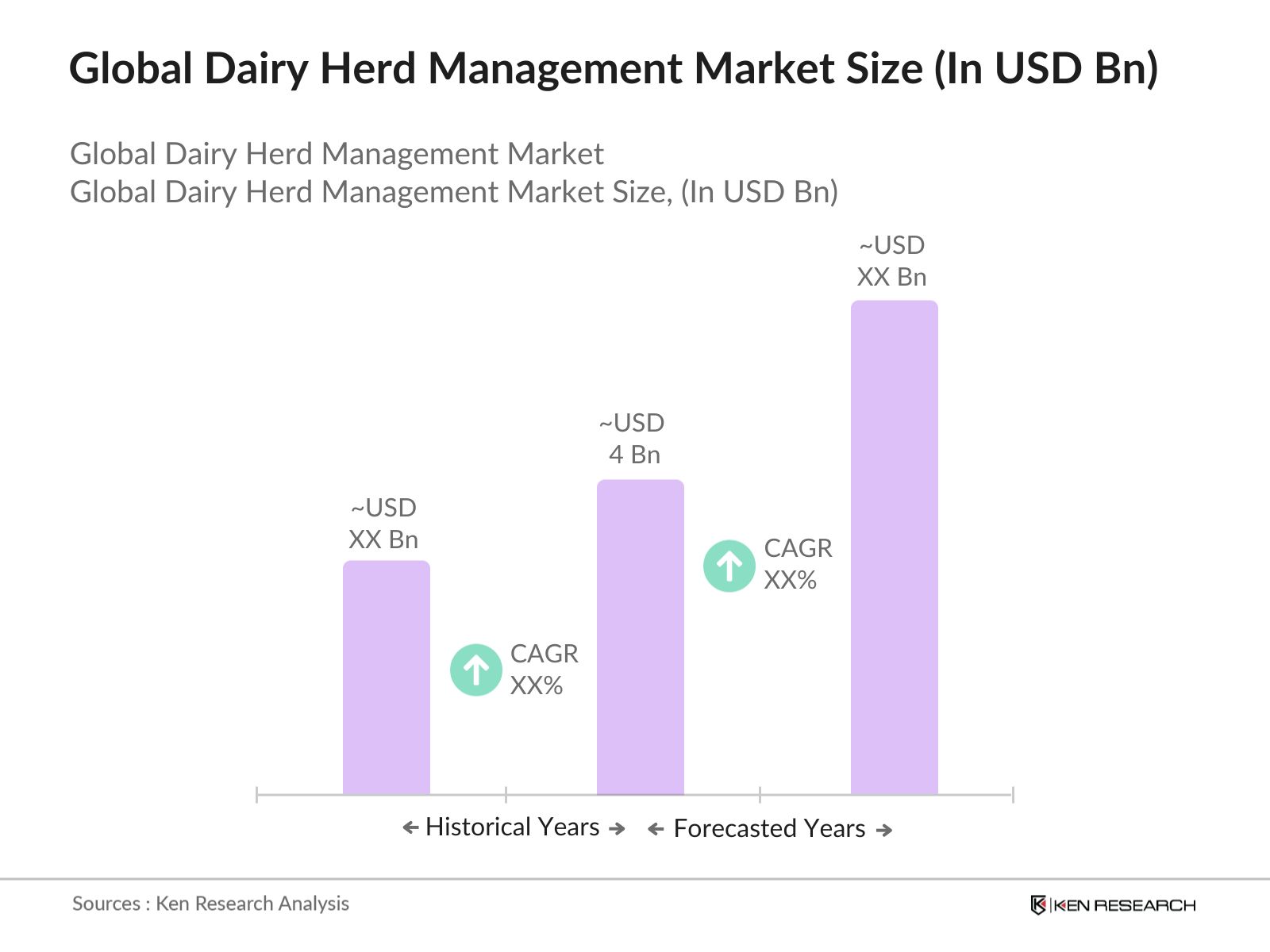
- In 2023, the Global Dairy Herd Management Market was valued at USD 4 billion, driven by the increasing demand for efficient dairy production and herd management solutions. The market's growth is fueled by the rising adoption of automated and digital technologies in dairy farming, aiming to enhance productivity and profitability while ensuring animal health and welfare.
- Key players in the Dairy Herd Management market include DeLaval Inc., GEA Group, Lely, BouMatic, and SCR Dairy. These companies are leading the industry with innovative herd management solutions, including automated milking systems, health monitoring devices, and data analytics platforms. For instance, DeLaval's VMS V300 robotic milking system is renowned for its advanced technology that optimizes milk yield and reduces labor costs.
- In Europe, the Netherlands is a prominent country in the Dairy Herd Management market, attributed to its advanced dairy farming practices and high adoption of precision farming technologies. The countrys dairy industry is characterized by strong government support and investment in research and development, contributing to its leadership in the global market.
- In 2023, GEA Group introduced a new version of its DairyProQ, an automated milking rotary that incorporates advanced sensors and data analytics to enhance herd management efficiency. This innovation underscores the ongoing technological advancements within the Dairy Herd Management market.
Global Dairy Herd Management Market Segmentation
The Global Dairy Herd Management Market can be segmented based on product type, application, and region:
- By Product Type: The Global Dairy Herd Management market is segmented into Automated Systems (milking systems, feeding systems, heat stress management systems, etc.) and Software (herd health monitoring, milk management, breeding management, etc.). In 2023, Automated Systems dominated the market due to their ability to significantly reduce labor costs and improve operational efficiency.
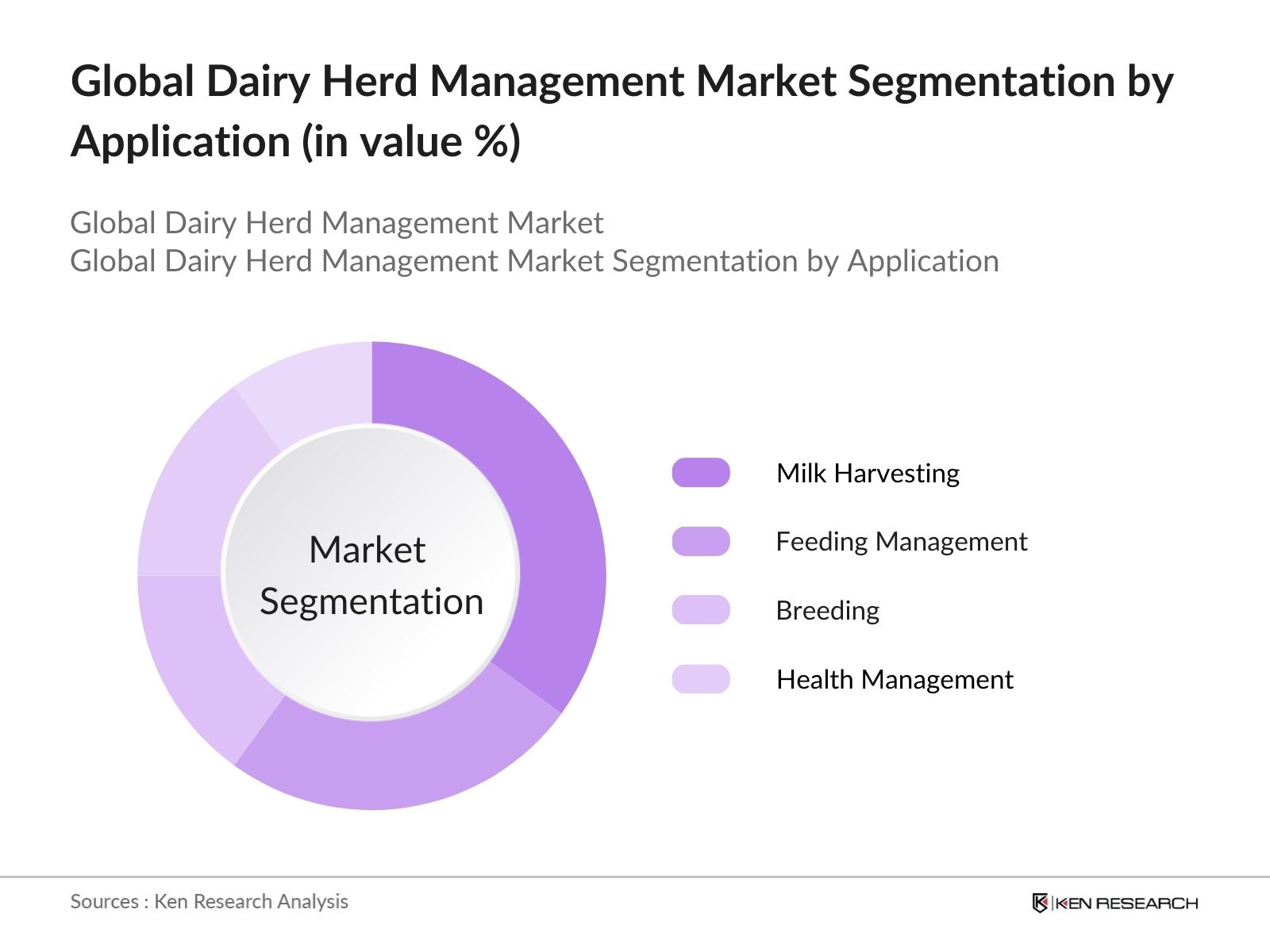
- By Application: The Global Dairy Herd Management market is segmented into Milk Harvesting, Feeding Management, Breeding, and Health Management. In 2023, the Milk Harvesting segment led the market due to the widespread adoption of automated milking systems that offer improved milk yield and quality.
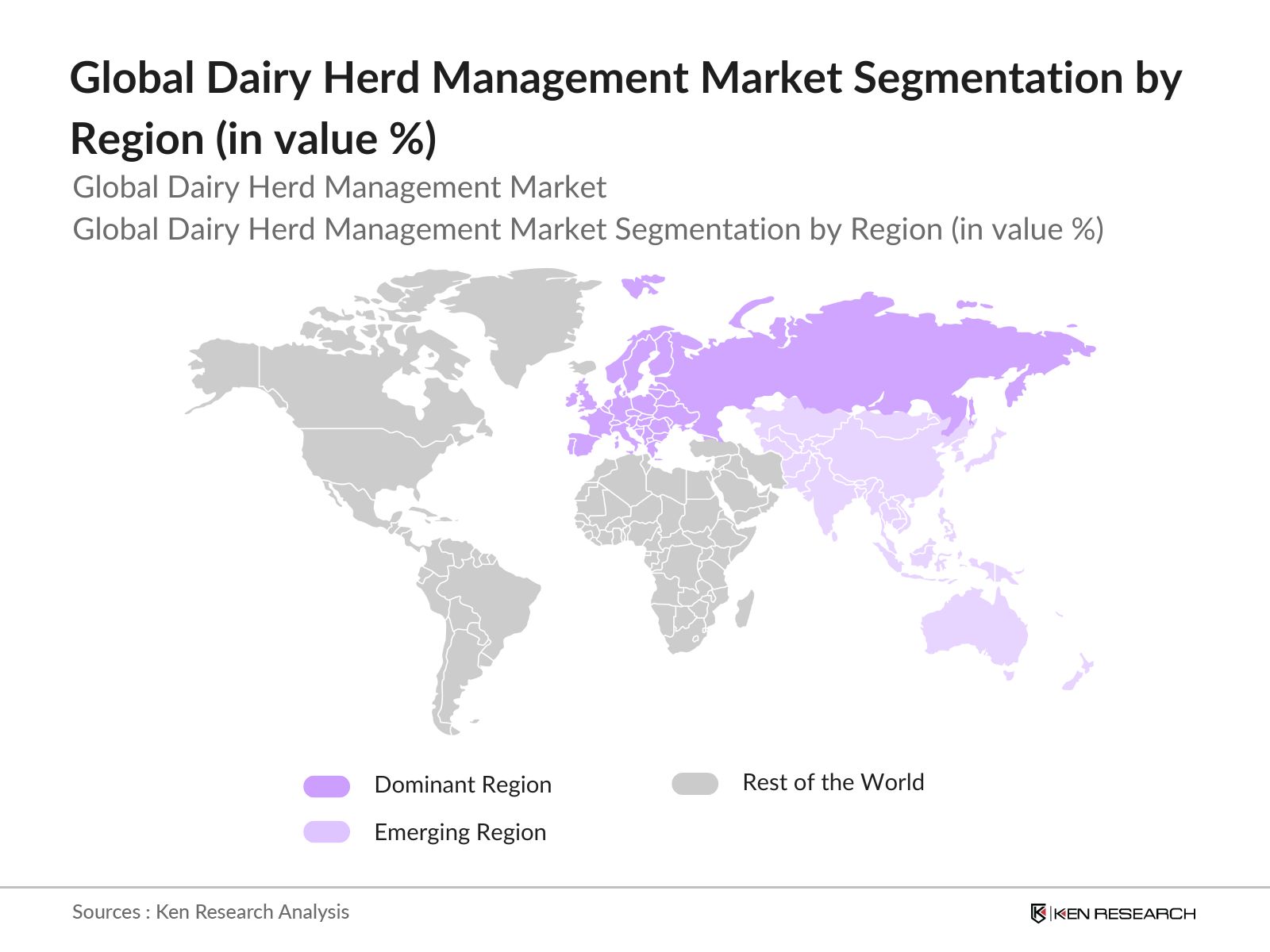
- By Region: The Global Dairy Herd Management market is segmented into North America, Europe, Asia-Pacific, Latin America, and Middle East & Africa. Europe led the global market in 2023, holding the largest share due to the high adoption rate of advanced dairy farming technologies and strong government support for the dairy industry.
Global Dairy Herd Management Market Competitive Landscape
|
Company |
Establishment Year |
Headquarters |
|
DeLaval Inc. |
1883 |
Tumba, Sweden |
|
GEA Group |
1881 |
Dsseldorf, Germany |
|
Lely |
1948 |
Maassluis, Netherlands |
|
BouMatic |
1939 |
Madison, USA |
|
SCR Dairy |
1976 |
Netanya, Israel |
- DeLaval Inc.: In 2023, DeLaval continued to lead the Dairy Herd Management market with its advanced VMS V300 robotic milking system, offering enhanced milk yield and reducing labor requirements. This innovation solidifies DeLaval's position as a key player in the market.
- GEA Group: In 2023, GEA Group launched an upgraded version of its DairyProQ milking rotary, which includes enhanced sensors and data analytics to optimize herd management. This development highlights GEA's commitment to advancing dairy farming technologies.
Global Dairy Herd Management Market Analysis
Market Growth Drivers:
- Rising Demand for Dairy Products: The increasing global demand for dairy products is driving the need for efficient herd management solutions. The global dairy production has seen a significant increase in recent years, with milk production reaching over 965 million metric tons in 2023. This surge in production requires advanced herd management systems to maintain high-quality output and meet the growing consumer demand for dairy products.
- Rising Demand for Organic Dairy Products: The organic dairy sector has seen substantial growth, with global sales of organic dairy products surpassing USD 44 billion in 2023, according to the Organic Trade Association. This growing demand for organic dairy is pushing farms to adopt more sophisticated herd management systems that ensure compliance with organic farming standards, including the use of non-GMO feed, reduced antibiotic use, and sustainable farming practices.
- Government Support and Subsidies: Governments in key dairy-producing regions are providing significant subsidies and incentives to support the adoption of advanced dairy technologies. For instance, the European Union allocated over 59 billion in subsidies under the Common Agricultural Policy (CAP) to modernize agricultural practices, including dairy farming, between 2020 and 2027, according to the European Commission. This financial support is accelerating the adoption of dairy herd management systems.
Market Challenges:
- High Initial Investment: The cost of implementing advanced dairy herd management systems can be substantial, especially for small and medium-sized farms. These systems often require significant upfront capital for purchasing automated milking equipment, sensors, and software platforms. Additionally, the cost of training staff to operate and maintain these technologies adds to the financial burden. This poses a barrier to market growth, particularly in developing regions where access to financing and credit facilities is limited.
- Integration Challenges: Integrating new technologies with existing farming practices and systems can be complex and time-consuming, requiring significant technical expertise and resources. Many dairy farms still operate with traditional methods, making the transition to advanced digital and automated systems daunting. The process often involves reconfiguring existing infrastructure, updating legacy systems, and ensuring compatibility between different technologies, which can lead to operational disruptions.
- Data Management Issues: The vast amount of data generated by herd management systems can be challenging to manage and analyze effectively, necessitating advanced data analytics tools and skilled personnel. With the proliferation of sensors, automated systems, and IoT devices on dairy farms, the volume of data collected on animal health, milk production, feeding patterns, and environmental conditions is enormous. Processing and making sense of this data require sophisticated analytics platforms that can integrate various data sources and provide actionable insights
Government Initiatives:
- EU Common Agricultural Policy (CAP): The European Union's Common Agricultural Policy (CAP) is designed to support and modernize agriculture across member states, including the dairy sector. The CAP encourages the adoption of advanced farming technologies, including dairy herd management systems, to enhance productivity and sustainability. As part of this initiative, the EU has allocated over 387 billion in subsidies from 2021 to 2027, aimed at improving farming practices, investing in digital agriculture, and reducing environmental impact. These funds are critical in helping farmers transition to more efficient and technology-driven operations.
- U.S. Dairy Margin Coverage (DMC) Program: In the United States, the Dairy Margin Coverage (DMC) program, part of the 2018 Farm Bill, provides financial protection to dairy farmers when the difference between the price of milk and the cost of feed falls below a certain level. The program also includes provisions for supporting investments in advanced dairy management technologies, such as automated milking systems and herd health monitoring tools. The U.S. Department of Agriculture (USDA) has committed over USD 1.5 billion in support under this program through 2028, helping farmers adopt new technologies that enhance operational efficiency and profitability.
Global Dairy Herd Management Market Future Outlook
The Global Dairy Herd Management Market is expected to continue its growth trajectory, driven by the increasing demand for dairy products, advancements in farming technologies, and the focus on sustainable and efficient farming practices.
Future Market Trends:
- Expansion of Automated Systems: By 2028, the adoption of automated dairy herd management systems is expected to rise significantly as farms increasingly seek ways to improve operational efficiency and reduce labor costs. These systems, which include automated milking, feeding, and environmental control technologies, are becoming essential in managing large-scale dairy operations. The growing labor shortages in agriculture, particularly in developed regions, further accelerate this trend as farmers look for reliable alternatives to maintain productivity.
- Integration of AI and Data Analytics: The integration of artificial intelligence and data analytics into herd management systems is set to revolutionize dairy farming by enhancing decision-making and optimizing herd health management. AI tools can analyze large datasets from various farm operations, providing real-time insights that enable farmers to make informed decisions regarding feeding, breeding, and disease prevention. This not only improves milk yield but also contributes to better overall herd health.
- Growth in Precision Farming: Precision farming, characterized by the use of advanced technologies such as sensors, drones, and data analytics, is increasingly being adopted in the dairy industry. These technologies enable farmers to monitor and manage their resources more efficiently, leading to optimized feeding strategies, better pasture management, and improved animal welfare. Precision farming allows for the collection of detailed data on various aspects of farm operations, which can be used to make informed decisions that enhance productivity and sustainability.
Scope of the Report
Market Scope:
|
By Region |
North America Europe Asia-Pacific Latin America Middle East & Africa |
|
By Product Type |
Automated Milking Systems Herd Health Monitoring Systems Feeding Management Systems Breeding Management Software Milk Cooling & Storage Systems |
|
By Application |
Milk Harvesting Feeding Management Breeding Health Management |
|
By Farm Size |
Small & Medium-sized Farms Large Farms Mega Farms |
|
By End-User |
Dairy Farmers Cooperatives Research & Academic Institutions Veterinary Clinics |
Products
Key Target Audience Organizations and Entities Who Can Benefit by Subscribing This Report:
Dairy Farms and Cooperatives
Agricultural Equipment Manufacturers
Government and Regulatory Bodies (USDA, FAO, DAFF, NDDB)
Dairy Industry Associations
Technology Integrators and Consultants
Bank and Financial Institutions
Venture Capital Firms
Time Period Captured in the Report:
Historical Period: 2018-2023
Base Year: 2023
Forecast Period: 2023-2028
Companies
Players Mentioned in the Report:
DeLaval Inc.
GEA Group
Lely
BouMatic
SCR Dairy
Afimilk Ltd.
Fullwood Packo
Dairymaster
Nedap N.V.
Pearson International LLC
Waikato Milking Systems
Trioliet B.V.
VAS (Valley Agricultural Software)
Sum-It Computer Systems, Ltd.
Connecterra B.V.
Table of Contents
1. Global Dairy Herd Management Market Overview
1.1. Definition and Scope
1.2. Market Taxonomy
1.3. Market Growth Rate
1.4. Market Segmentation Overview
2. Global Dairy Herd Management Market Size (in USD Bn), 2018-2023
2.1. Historical Market Size
2.2. Year-on-Year Growth Analysis
2.3. Key Market Developments and Milestones
3. Global Dairy Herd Management Market Analysis
3.1. Growth Drivers
3.1.1. Rising Demand for Dairy Products
3.1.2. Technological Advancements
3.1.3. Government Support and Subsidies
3.1.4. Increasing Demand for Organic Dairy Products
3.2. Restraints
3.2.1. High Initial Investment
3.2.2. Integration Challenges
3.2.3. Data Management Issues
3.3. Opportunities
3.3.1. Expansion of Automated Systems
3.3.2. Integration of AI and Data Analytics
3.3.3. Growth in Precision Farming
3.4. Trends
3.4.1. Increased Adoption of IoT
3.4.2. Rise in Sustainable Farming Practices
3.4.3. Focus on Animal Welfare and Health
3.5. Government Regulation
3.5.1. EU Common Agricultural Policy (CAP)
3.5.2. U.S. Dairy Margin Coverage (DMC) Program
3.5.3. National Dairy Plan (NDP) - India
3.5.4. China's Dairy Industry Revitalization Plan
3.6. SWOT Analysis
3.7. Stake Ecosystem
3.8. Competition Ecosystem
4.Global Dairy Herd Management Market Segmentation, 2023
4.1. By Product Type (in Value %)
4.1.1. Automated Milking Systems
4.1.2. Herd Health Monitoring Systems
4.1.3. Feeding Management Systems
4.1.4. Breeding Management Software
4.1.5. Milk Cooling & Storage Systems
4.2. By Application (in Value %)
4.2.1. Milk Harvesting
4.2.2. Feeding Management
4.2.3. Breeding
4.2.4. Health Management
4.3. By Farm Size (in Value %)
4.3.1. Small & Medium-sized Farms
4.3.2. Large Farms
4.3.3. Mega Farms
4.4. By End-User (in Value %)
4.4.1. Dairy Farmers
4.4.2. Cooperatives
4.4.3. Research & Academic Institutions
4.4.4. Veterinary Clinics
4.5. By Region (in Value %)
4.5.1. North America
4.5.2. Europe
4.5.3. Asia-Pacific
4.5.4. Latin America
4.5.5. Middle East & Africa
5. Global Dairy Herd Management Market Cross Comparison
5.1. Detailed Profiles of Major Companies
5.1.1. DeLaval Inc.
5.1.2. GEA Group
5.1.3. Lely
5.1.4. BouMatic
5.1.5. SCR Dairy
5.1.6. Afimilk Ltd.
5.1.7. Fullwood Packo
5.1.8. Dairymaster
5.1.9. Nedap N.V.
5.1.10. Pearson International LLC
5.1.11. Waikato Milking Systems
5.1.12. Trioliet B.V.
5.1.13. VAS (Valley Agricultural Software)
5.1.14. Sum-It Computer Systems, Ltd.
5.1.15. Connecterra B.V.
5.2. Cross Comparison Parameters (No. of Employees, Headquarters, Inception Year, Revenue)
6. Global Dairy Herd Management Market Competitive Landscape
6.1. Market Share Analysis
6.2. Strategic Initiatives
6.3. Mergers and Acquisitions
6.4. Investment Analysis
6.4.1. Venture Capital Funding
6.4.2. Government Grants
6.4.3. Private Equity Investments
7. Global Dairy Herd Management Market Regulatory Framework
7.1. Environmental Standards
7.2. Compliance Requirements
7.3. Certification Processes
8. Global Dairy Herd Management Future Market Size (in USD Bn), 2023-2028
8.1. Future Market Size Projections
8.2. Key Factors Driving Future Market Growth
9. Global Dairy Herd Management Future Market Segmentation, 2028
9.1. By Product Type (in Value %)
9.2. By Application (in Value %)
9.3. By Farm Size (in Value %)
9.4. By End-User (in Value %)
9.5. By Region (in Value %)
10. Global Dairy Herd Management Market Analysts Recommendations
10.1. TAM/SAM/SOM Analysis
10.2. Customer Cohort Analysis
10.3. Marketing Initiatives
10.4. White Space Opportunity Analysis
Disclaimer Contact UsResearch Methodology
Step 1: Identifying Key Variables
Building an ecosystem of major entities in the Global Dairy Herd Management Market and referencing multiple secondary and proprietary databases to conduct desk research. This includes gathering industry-level information on market drivers, challenges, and key players, as well as understanding technological advancements and regulatory impacts.
Step 2: Market Building
Collecting statistics on the global Dairy Herd Management market over the years, including historical market size, growth rates, and adoption of dairy technologies. We will analyze market share, revenue generated by major players, and emerging trends to ensure accuracy and reliability in the data presented.
Step 3: Validating and Finalizing
Formulating market hypotheses and conducting CATIs (Computer-Assisted Telephone Interviews) with industry experts from leading dairy technology companies. These interviews will help validate the collected statistics and provide insights into operational and financial aspects directly from company representatives.
Step 4: Research Output
Our team will engage with multiple dairy technology providers to understand the dynamics of market segments, consumer preferences, and sales trends. This process will validate the derived statistics using a bottom-to-top approach, ensuring that the final data accurately reflects the actual market conditions.
Frequently Asked Questions
01. How big is the Global Dairy Herd Management Market?
In 2023, the Global Dairy Herd Management Market was valued at USD 4 billion. The market is driven by the increasing demand for efficient and sustainable dairy farming practices, coupled with technological advancements in herd management systems. The market's growth reflects the critical role of these systems in enhancing dairy production efficiency and animal health.
02. What are the challenges in the Global Dairy Herd Management Market?
Challenges in the Global Dairy Herd Management Market include high initial investment costs and the complexity of integrating new technologies into traditional farming practices. Additionally, data management and analysis pose challenges due to the vast amounts of data generated by modern herd management systems.
03. Who are the major players in the Global Dairy Herd Management Market?
Major players in the Global Dairy Herd Management Market include DeLaval Inc., GEA Group, Lely, BouMatic, and SCR Dairy. These companies are at the forefront of innovation in dairy farming technologies, offering comprehensive solutions that cater to various aspects of herd management.
04. What are the growth drivers of the Global Dairy Herd Management Market?
Key growth drivers in Global Dairy Herd Management Market include the increasing global demand for dairy products, which necessitates efficient and scalable herd management systems. Technological advancements, such as automation and data analytics, are also driving the market by enabling farmers to optimize productivity and ensure animal health and welfare.
Why Buy From Us?

What makes us stand out is that our consultants follows Robust, Refine and Result (RRR) methodology. i.e. Robust for clear definitions, approaches and sanity checking, Refine for differentiating respondents facts and opinions and Result for presenting data with story

We have set a benchmark in the industry by offering our clients with syndicated and customized market research reports featuring coverage of entire market as well as meticulous research and analyst insights.

While we don't replace traditional research, we flip the method upside down. Our dual approach of Top Bottom & Bottom Top ensures quality deliverable by not just verifying company fundamentals but also looking at the sector and macroeconomic factors.

With one step in the future, our research team constantly tries to show you the bigger picture. We help with some of the tough questions you may encounter along the way: How is the industry positioned? Best marketing channel? KPI's of competitors? By aligning every element, we help maximize success.

Our report gives you instant access to the answers and sources that other companies might choose to hide. We elaborate each steps of research methodology we have used and showcase you the sample size to earn your trust.

If you need any support, we are here! We pride ourselves on universe strength, data quality, and quick, friendly, and professional service.