
Global Dark Fiber Network Market Outlook to 2030
Region:Global
Author(s):Abhinav kumar
Product Code:KROD9976
November 2024
82
About the Report
Global Dark Fiber Network Market Overview
- The Global Dark Fiber Network market is valued at approximately USD 5.7 billion, driven by a surge in data traffic, increased demand for higher bandwidth, and expansion of 5G networks. This growth is supported by enterprises leveraging dark fiber for secure and high-speed data transmission and the rising adoption of IoT and cloud-based applications. The dark fiber network's scalability and potential for future upgrades are key factors contributing to its sustained demand across industries.
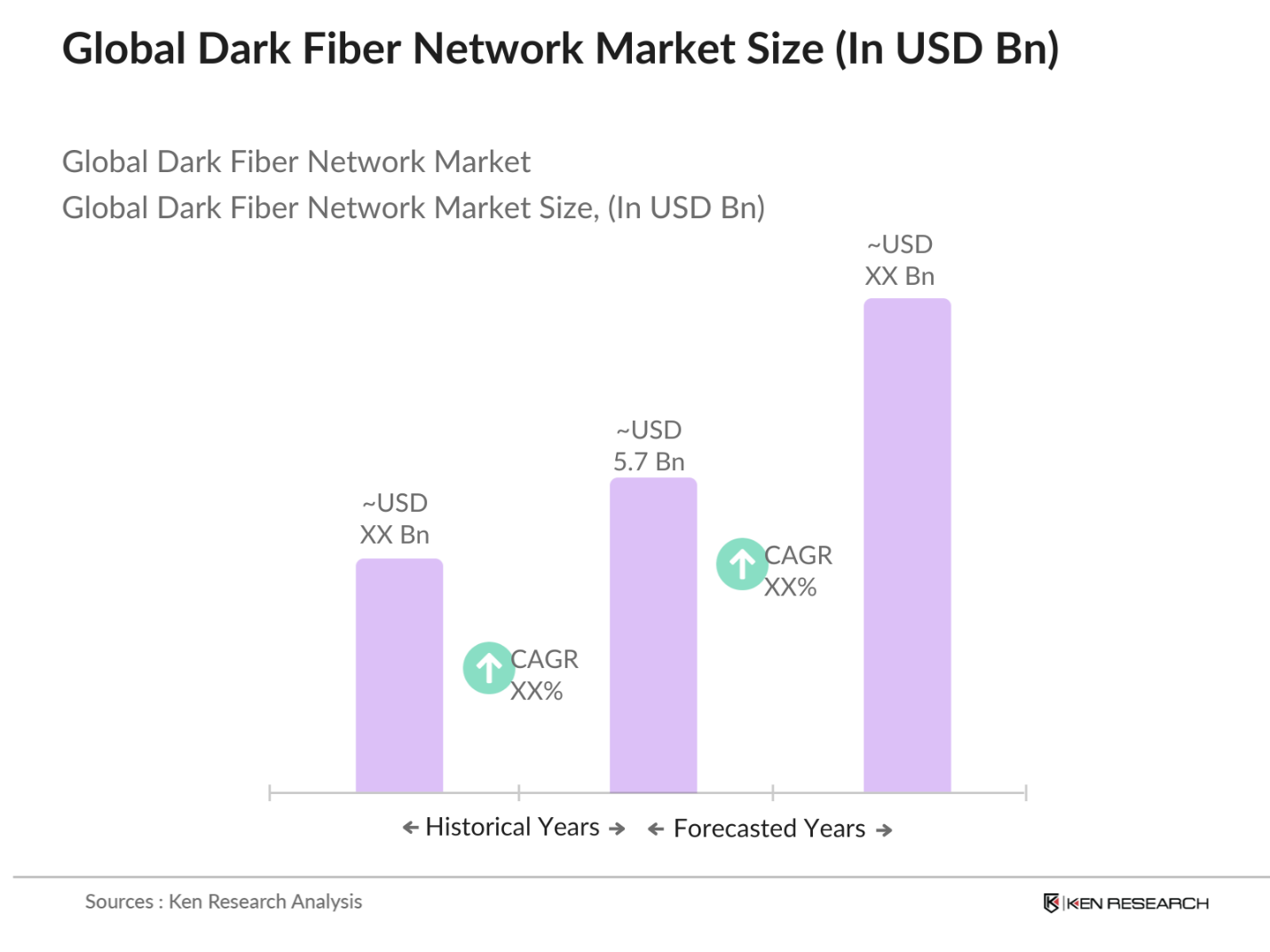
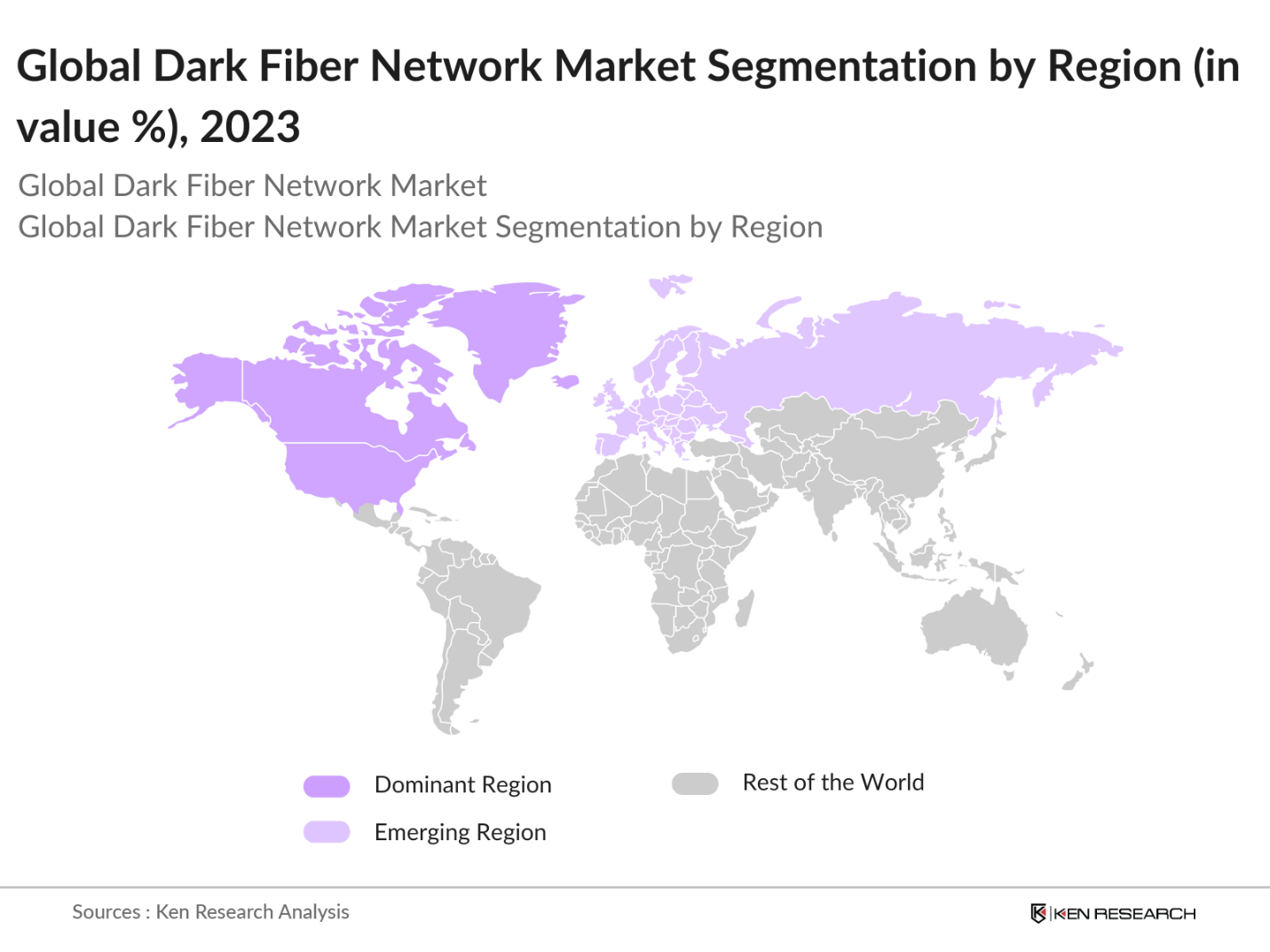
- The North American region, particularly the United States, along with Europe, leads the Global Dark Fiber Network market. This dominance is due to high investments in fiber infrastructure, the proliferation of data centers, and robust 5G infrastructure. In the Asia-Pacific region, countries like China and Japan are rapidly expanding their dark fiber deployments to meet increasing data demands and support their extensive urban development projects.
- Global regulatory frameworks are increasingly defining standards for fiber infrastructure. For example, the European Electronic Communications Code (EECC) mandates fiber infrastructure upgrades across EU member states to support digital transformation initiatives. National governments, like Japan, are also enforcing similar policies, creating opportunities for private players to engage in public-private partnerships to expand fiber networks.
Global Dark Fiber Network Market Segmentation
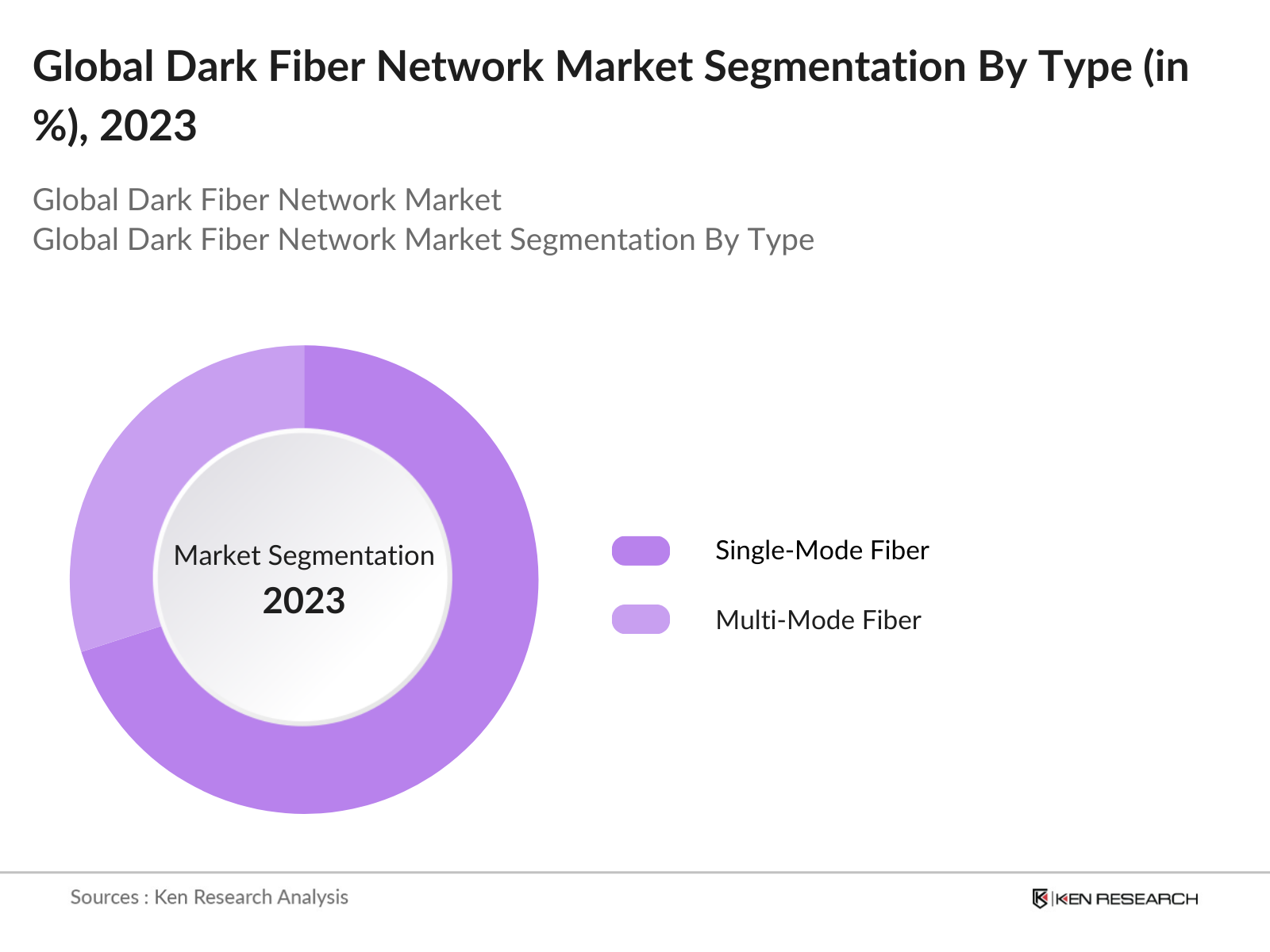
By Type: The Global Dark Fiber Network market is segmented by type into Single-Mode Fiber and Multi-Mode Fiber. Currently, Single-Mode Fiber holds the dominant market share under the type segmentation due to its long-distance transmission capability, which is essential for high-bandwidth applications. It is widely used in metro and long-haul networks, making it the preferred choice for internet service providers and large enterprises requiring vast network coverage.
By Region: The Global Dark Fiber Network market is segmented into North America, Europe, Asia-Pacific, Middle East & Africa, and Latin America. North America holds a significant share due to well-established infrastructure and substantial investments in fiber deployment by tech giants and telecom operators. The United States, in particular, leads this segment, driven by increased adoption of advanced technologies, cloud computing, and a rise in data centers across the region.
By Network Type: By network type, the market is segmented into Metro Dark Fiber Networks and Long-Haul Dark Fiber Networks. Metro Dark Fiber Networks hold a dominant share due to the increasing demand for high-speed internet in urban areas and the growing trend of fiber-to-the-home (FTTH) and fiber-to-the-premises (FTTP) solutions. With metropolitan areas continually expanding, metro networks are critical to supporting reliable connectivity in densely populated regions.
Global Dark Fiber Network Market Competitive Landscape
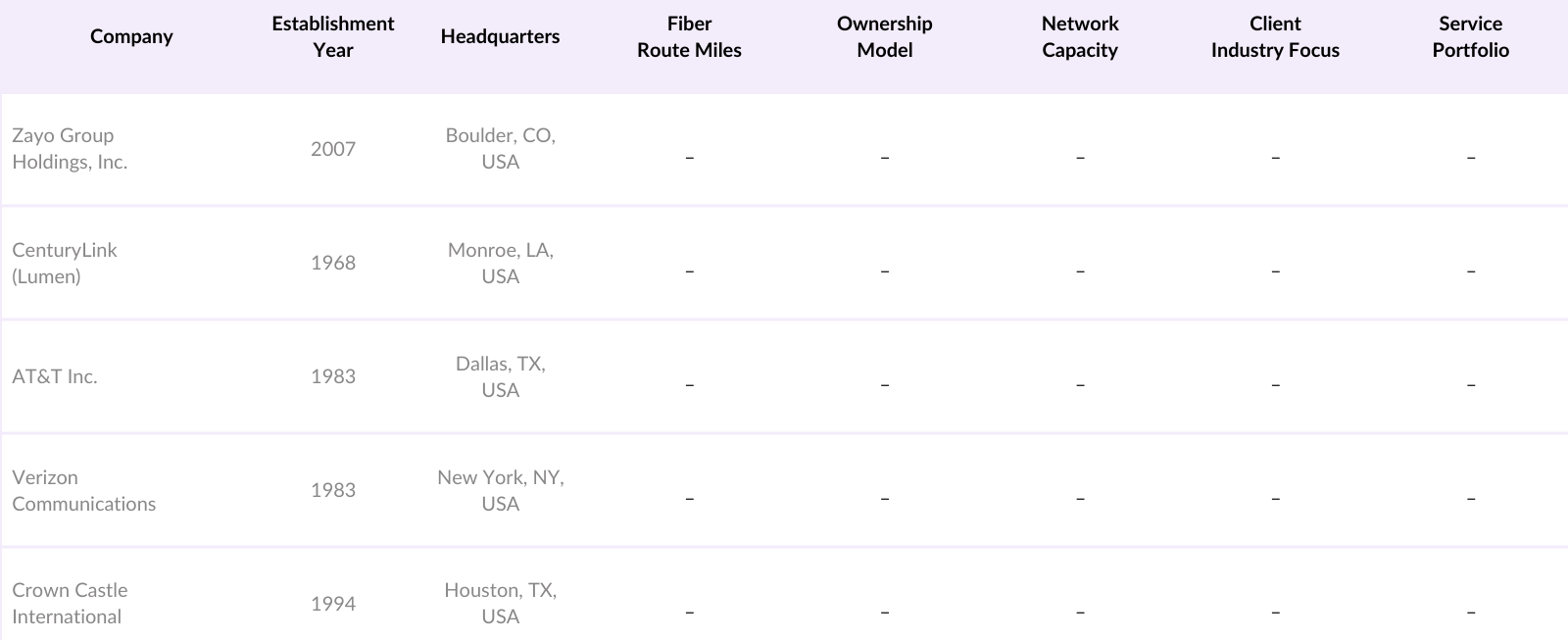
The Global Dark Fiber Network market is dominated by a few major players that have established strong footprints due to their extensive network reach, investments in technology, and mergers & acquisitions. Key players include:
Global Dark Fiber Network Industry Analysis
Growth Drivers
- Increasing Data Consumption: The exponential growth of data consumption is a pivotal driver for the dark fiber network market, particularly as global data traffic approaches 78 zettabytes in 2024, according to data from the International Data Corporation (IDC). This surge is fueled by increased internet use across sectors, with over 4.9 billion internet users worldwide generating vast amounts of data daily. High-bandwidth applications, especially video streaming, data-intensive gaming, and enterprise cloud applications, necessitate robust fiber optic infrastructure. With an estimated 70% of this traffic sourced from mobile networks, particularly in emerging markets, dark fiber's role in addressing bandwidth and latency demands is critical.
- Rise of 5G Deployment: As 5G rollouts intensify, demand for dark fiber infrastructure is rising to support ultra-fast, low-latency connections. By 2024, nearly 1.5 billion global mobile users will access 5G networks, particularly in North America, Europe, and East Asia, requiring robust fiber backhaul to minimize latency and support higher data loads. The European Commission notes a deployment rate of 5G services covering over 65% of the EU population, signifying a considerable shift toward network-ready infrastructure. Consequently, dark fiber networks play an essential role in supporting these expanding high-speed connections.
- Fiber Optic Technology Advancements: Advancements in fiber optic technology, such as wavelength division multiplexing (WDM) and signal amplification, are accelerating the adoption of dark fiber. The global application of WDM systems, which enable multiple data channels on a single fiber, enhances data transmission capacities by up to 80%. These technological strides reduce the need for additional fibers and improve network efficiency, critical for high-demand areas like metropolitan regions. Governments in developed economies are focusing on enhancing such technology in public infrastructure to drive growth in broadband and dark fiber services.
Market Challenges
- High Initial Infrastructure Costs: Dark fiber infrastructure entails significant initial costs, including land acquisition, excavation, cable deployment, and ongoing maintenance, with fiber optic cable deployment costs reaching approximately $27,000 per mile. This high upfront investment remains a barrier for many telecom operators, particularly in regions with less developed infrastructure. Maintenance of this infrastructure is also costly, with regular inspections and repairs needed due to environmental wear and tear.
- Regulatory and Policy Constraints: Regulatory hurdles affect the deployment of dark fiber, with varying policies across regions. For example, in the United States, each state sets unique guidelines and requirements for fiber deployment, impacting the speed and cost of network expansion. Additionally, licensing processes in regions like the EU are subject to stringent environmental assessments, which can slow project timelines. Policy variability impacts the feasibility and attractiveness of dark fiber projects, especially for new entrants.
Global Dark Fiber Network Market Future Outlook
Over the next five years, the Global Dark Fiber Network market is expected to experience notable growth driven by continuous expansion of 5G networks, rising data consumption, and the increasing need for private and secure data transfer solutions. Key factors propelling this growth include urbanization, the proliferation of IoT applications, and the expansion of smart cities. Enterprises seeking reliable and scalable connectivity solutions are expected to further fuel demand.
Opportunities
- Growing Demand for Data Centers: With global data generation expected to reach 175 zettabytes annually, the demand for data centers is growing rapidly, particularly hyperscale and colocation centers. In North America alone, data center construction grew by 17% in 2023. This growth is driving demand for dark fiber infrastructure to provide secure, high-capacity connections between data centers and enterprise locations, aligning with stringent data privacy regulations in markets such
- Enterprise Applications: Enterprise demand for dark fiber networks is increasing as companies expand globally and require secure, high-bandwidth connectivity. Cross-border data traffic among multinational corporations rose by 25% in 2024, according to the OECD. Dark fiber infrastructure allows enterprises to build secure, private networks with the scalability to handle large volumes of data across regions, ideal for industries like finance, healthcare, and manufacturing.
Scope of the Report
|
Type |
Single-Mode Fiber Multi-Mode Fiber |
|
Network Type |
Metro Dark Fiber Networks Long-Haul Dark Fiber Networks |
|
Application |
Telecom ISPs Data Centers BFSI Military and Defense |
|
Industry Vertical |
Healthcare IT & Telecom Oil & Gas Government |
|
Region |
North America Europe Asia-Pacific Middle East & Africa Latin America |
Products
Key Target Audience Organizations and Entities Who Can Benefit by Subscribing This Report:
Telecom Operator Companies
Internet Service Provider Companies
Data Center Companies
BFSI Companies
Healthcare Companies
Government and Regulatory Bodies (e.g., FCC, ITU)
Investment and Venture Capitalist Firms
Enterprise and Corporate Network User Companies
Companies
Players Mentioned in the Report
Zayo Group Holdings, Inc.
CenturyLink (Lumen Technologies)
AT&T Inc.
Verizon Communications Inc.
Crown Castle International Corp.
GTT Communications, Inc.
Level 3 Communications, LLC
Windstream Holdings, Inc.
NTT Communications Corporation
Spectrum Enterprise (Charter Communications)
Table of Contents
1. Global Dark Fiber Network Market Overview
1.1. Definition and Scope
1.2. Market Taxonomy
1.3. Market Growth Rate
1.4. Market Segmentation Overview
2. Global Dark Fiber Network Market Size (In USD Mn)
2.1. Historical Market Size
2.2. Year-On-Year Growth Analysis
2.3. Key Market Developments and Milestones
3. Global Dark Fiber Network Market Analysis
3.1. Growth Drivers
3.1.1. Increasing Data Consumption (Data Traffic, Bandwidth Requirements)
3.1.2. Rise of 5G Deployment (5G Network Infrastructure, Latency Reduction)
3.1.3. Fiber Optic Technology Advancements (Signal Amplification, Wavelength Division Multiplexing)
3.1.4. Cloud Computing Expansion (Data Center Demand, Cloud Connectivity Needs)
3.2. Market Challenges
3.2.1. High Initial Infrastructure Costs (Deployment, Maintenance Expenses)
3.2.2. Regulatory and Policy Constraints (Regional Restrictions, Licensing)
3.2.3. Complexity in Network Management (Operation & Maintenance)
3.3. Opportunities
3.3.1. Growing Demand for Data Centers (Data Storage, Colocation Services)
3.3.2. Enterprise Applications (Enterprise Connectivity, Cross-Border Solutions)
3.3.3. Increasing Demand for Smart Cities (IoT Integration, Urban Infrastructure)
3.4. Trends
3.4.1. Adoption of SD-WAN (Software-Defined Networking)
3.4.2. Expansion of Long-Haul Dark Fiber Routes (Cross-Continent Connectivity)
3.4.3. Increase in M&A Activity (Consolidation, Acquisition of Fiber Assets)
3.5. Government Regulation
3.5.1. Regulatory Frameworks for Fiber Infrastructure
3.5.2. Policies Supporting Dark Fiber Leasing
3.5.3. Regional Standards for Fiber Deployment
3.5.4. Data Privacy and Security Regulations
3.6. SWOT Analysis
3.7. Stake Ecosystem
3.8. Porters Five Forces
3.9. Competition Ecosystem
4. Global Dark Fiber Network Market Segmentation
4.1. By Type (In Value %)
4.1.1. Single-Mode Fiber
4.1.2. Multi-Mode Fiber
4.2. By Network Type (In Value %)
4.2.1. Metro Dark Fiber Networks
4.2.2. Long-Haul Dark Fiber Networks
4.3. By Application (In Value %)
4.3.1. Telecom
4.3.2. Internet Service Providers (ISPs)
4.3.3. Data Centers
4.3.4. BFSI (Banking, Financial Services, and Insurance)
4.3.5. Military and Defense
4.4. By Industry Vertical (In Value %)
4.4.1. Healthcare
4.4.2. IT & Telecom
4.4.3. Oil & Gas
4.4.4. Government
4.5. By Region (In Value %)
4.5.1. North America
4.5.2. Europe
4.5.3. Asia-Pacific
4.5.4. Middle East & Africa
4.5.5. Latin America
5. Global Dark Fiber Network Market Competitive Analysis
5.1. Detailed Profiles of Major Companies
5.1.1. Zayo Group Holdings, Inc.
5.1.2. CenturyLink (Lumen Technologies)
5.1.3. AT&T Inc.
5.1.4. Verizon Communications Inc.
5.1.5. Level 3 Communications, LLC
5.1.6. GTT Communications, Inc.
5.1.7. Colt Technology Services Group Limited
5.1.8. Crown Castle International Corp.
5.1.9. Windstream Holdings, Inc.
5.1.10. Comcast Corporation
5.1.11. NTT Communications Corporation
5.1.12. Spectrum Enterprise (Charter Communications, Inc.)
5.1.13. FirstLight Fiber
5.1.14. euNetworks GmbH
5.1.15. EXA Infrastructure
5.2. Cross Comparison Parameters (Fiber Route Miles, Ownership Model, Network Capacity, Client Industry, Service Portfolio, Innovation and R&D, Market Presence, Pricing Structure)
5.3. Market Share Analysis
5.4. Strategic Initiatives
5.5. Mergers and Acquisitions
5.6. Investment Analysis
5.7. Venture Capital Funding
5.8. Government Grants
5.9. Private Equity Investments
6. Global Dark Fiber Network Market Regulatory Framework
6.1. Fiber Network Infrastructure Standards
6.2. Compliance and Licensing Requirements
6.3. Certification and Quality Assurance Processes
7. Global Dark Fiber Network Future Market Size (In USD Mn)
7.1. Future Market Size Projections
7.2. Key Factors Driving Future Market Growth
8. Global Dark Fiber Network Future Market Segmentation
8.1. By Type (In Value %)
8.2. By Network Type (In Value %)
8.3. By Application (In Value %)
8.4. By Industry Vertical (In Value %)
8.5. By Region (In Value %)
9. Global Dark Fiber Network Market Analysts Recommendations
9.1. TAM/SAM/SOM Analysis
9.2. Customer Cohort Analysis
9.3. Marketing Initiatives
9.4. White Space Opportunity Analysis
Research Methodology
Step 1: Identification of Key Variables
The initial phase includes mapping the entire ecosystem of the Global Dark Fiber Network market. Key industry stakeholders, ranging from telecom operators to data centers, were identified to construct a comprehensive understanding. A thorough review of secondary and proprietary databases provided critical insights into key market variables.
Step 2: Market Analysis and Construction
In this step, historical data for the Global Dark Fiber Network market was analyzed, focusing on market penetration, network types, and application areas. Market trends, operational statistics, and revenue estimates were also reviewed to strengthen the accuracy of projections.
Step 3: Hypothesis Validation and Expert Consultation
Hypotheses about market drivers and trends were tested through expert consultations. Industry leaders provided insights on operational strategies, network expansions, and technology adoption, which validated our assumptions and reinforced data precision.
Step 4: Research Synthesis and Final Output
The final phase included direct interaction with dark fiber network providers to obtain granular data on market segments, product performance, and customer preferences. The synthesis of qualitative and quantitative data ensured a robust and validated market analysis.
Frequently Asked Questions
01. How big is the Global Dark Fiber Network Market?
The Global Dark Fiber Network Market, valued at USD 5.7 billion, is driven by rising data traffic, enhanced bandwidth needs, and the spread of 5G technology across regions.
02. What are the challenges in the Global Dark Fiber Network Market?
Key challenges include high initial infrastructure costs, regulatory hurdles, and complex network management needs, which can pose obstacles to widespread market adoption.
03. Who are the major players in the Global Dark Fiber Network Market?
Prominent players in the market include Zayo Group Holdings, CenturyLink, AT&T, Verizon Communications, and Crown Castle International, known for their extensive network reach and service portfolios.
04. What are the growth drivers of the Global Dark Fiber Network Market?
Growth drivers include the demand for high-speed data transmission, the expansion of 5G networks, and the need for secure and scalable data solutions, which are propelling market expansion.
Why Buy From Us?

What makes us stand out is that our consultants follows Robust, Refine and Result (RRR) methodology. i.e. Robust for clear definitions, approaches and sanity checking, Refine for differentiating respondents facts and opinions and Result for presenting data with story

We have set a benchmark in the industry by offering our clients with syndicated and customized market research reports featuring coverage of entire market as well as meticulous research and analyst insights.

While we don't replace traditional research, we flip the method upside down. Our dual approach of Top Bottom & Bottom Top ensures quality deliverable by not just verifying company fundamentals but also looking at the sector and macroeconomic factors.

With one step in the future, our research team constantly tries to show you the bigger picture. We help with some of the tough questions you may encounter along the way: How is the industry positioned? Best marketing channel? KPI's of competitors? By aligning every element, we help maximize success.

Our report gives you instant access to the answers and sources that other companies might choose to hide. We elaborate each steps of research methodology we have used and showcase you the sample size to earn your trust.

If you need any support, we are here! We pride ourselves on universe strength, data quality, and quick, friendly, and professional service.