
Global Deck Design Software Market Outlook to 2030
Region:Global
Author(s):Yogita Sahu
Product Code:KROD7988
December 2024
81
About the Report
Global Deck Design Software Market Overview
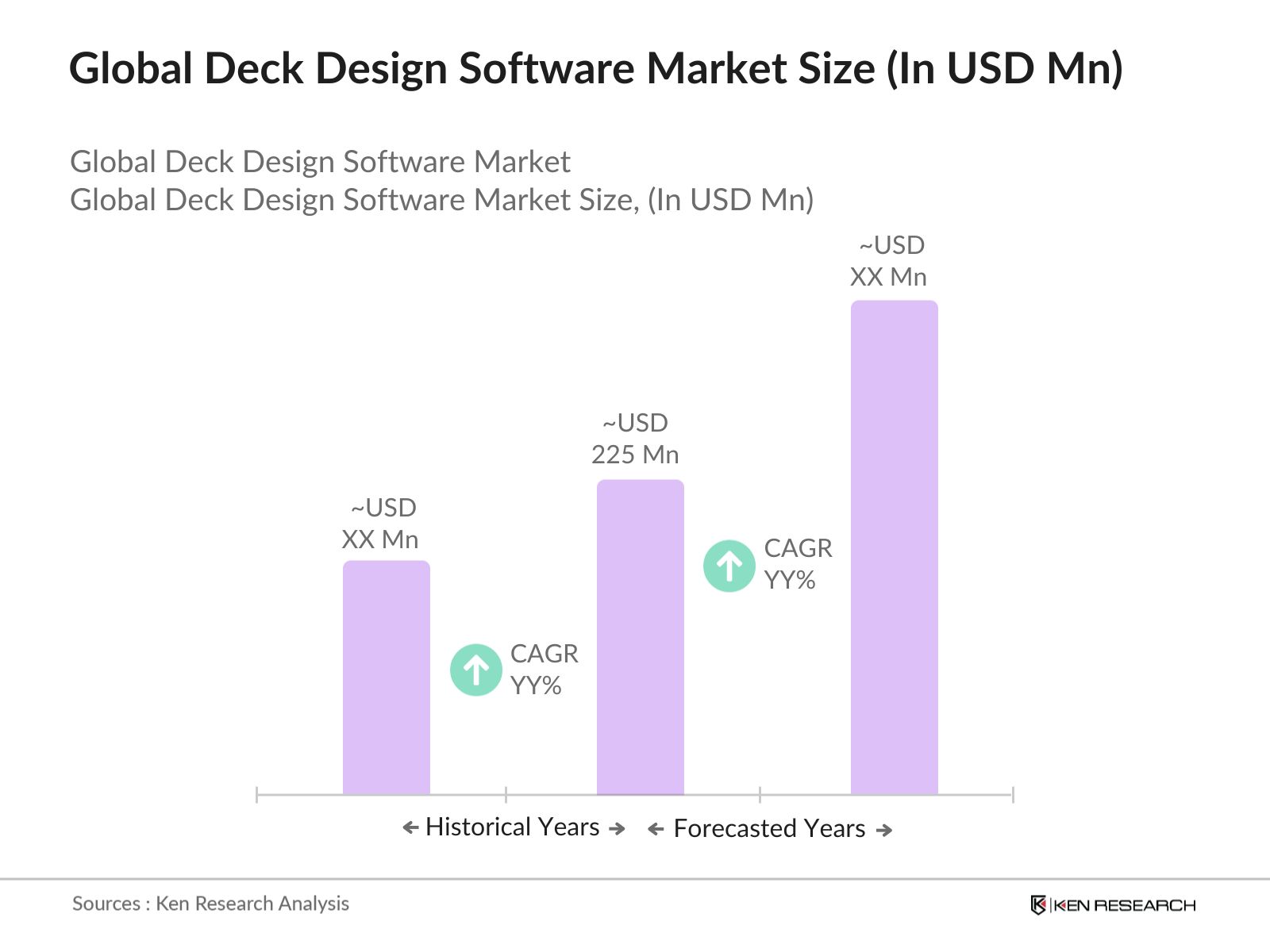
- The global deck design software market is valued at USD 225 million. This market growth is driven by the increasing adoption of advanced digital design tools in the construction and real estate sectors. The software enables planners, architects, and designers to create customized decks with ease, using features such as 2D and 3D representations, cost estimations, and material lists.
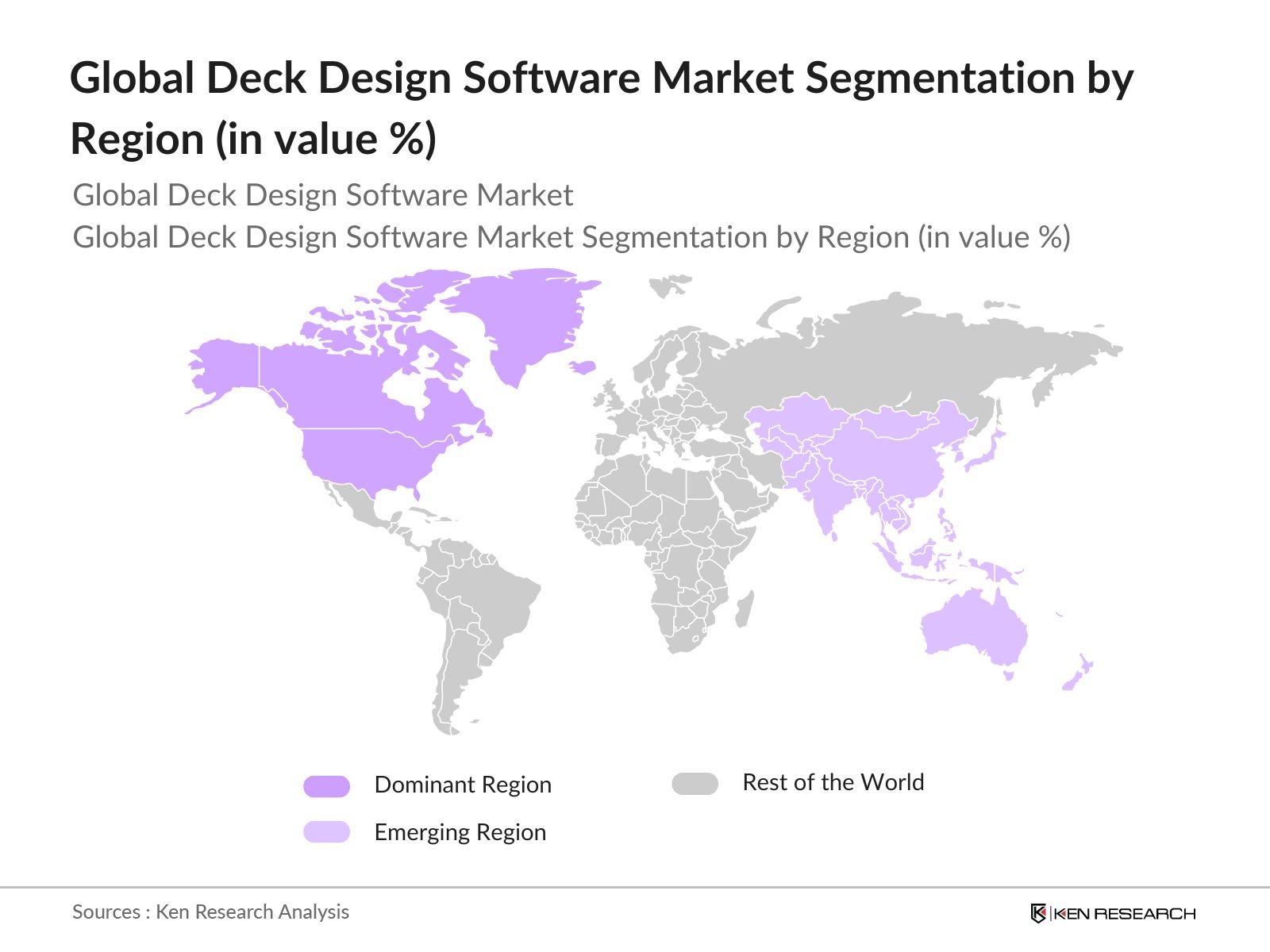
- North America dominates the market, with countries like the United States and Canada leading the way due to the high rate of construction and renovation activities in the region. The demand for home improvement projects, coupled with a strong emphasis on aesthetic design and outdoor living spaces, is a major reason for the market dominance in these countries. Additionally, Europe, particularly Germany and the UK, follows due to the increased use of advanced building technologies.
- Several countries, including the U.S., Canada, and Australia, have launched housing initiatives that encourage outdoor living spaces in newly developed homes. In 2024, the U.S. Department of Housing and Urban Development (HUD) facilitated the construction of 300,000 new homes, many of which featured outdoor decks. These government-supported projects are boosting the need for efficient deck design software to streamline the planning and approval process for contractors.
Global Deck Design Software Market Segmentation
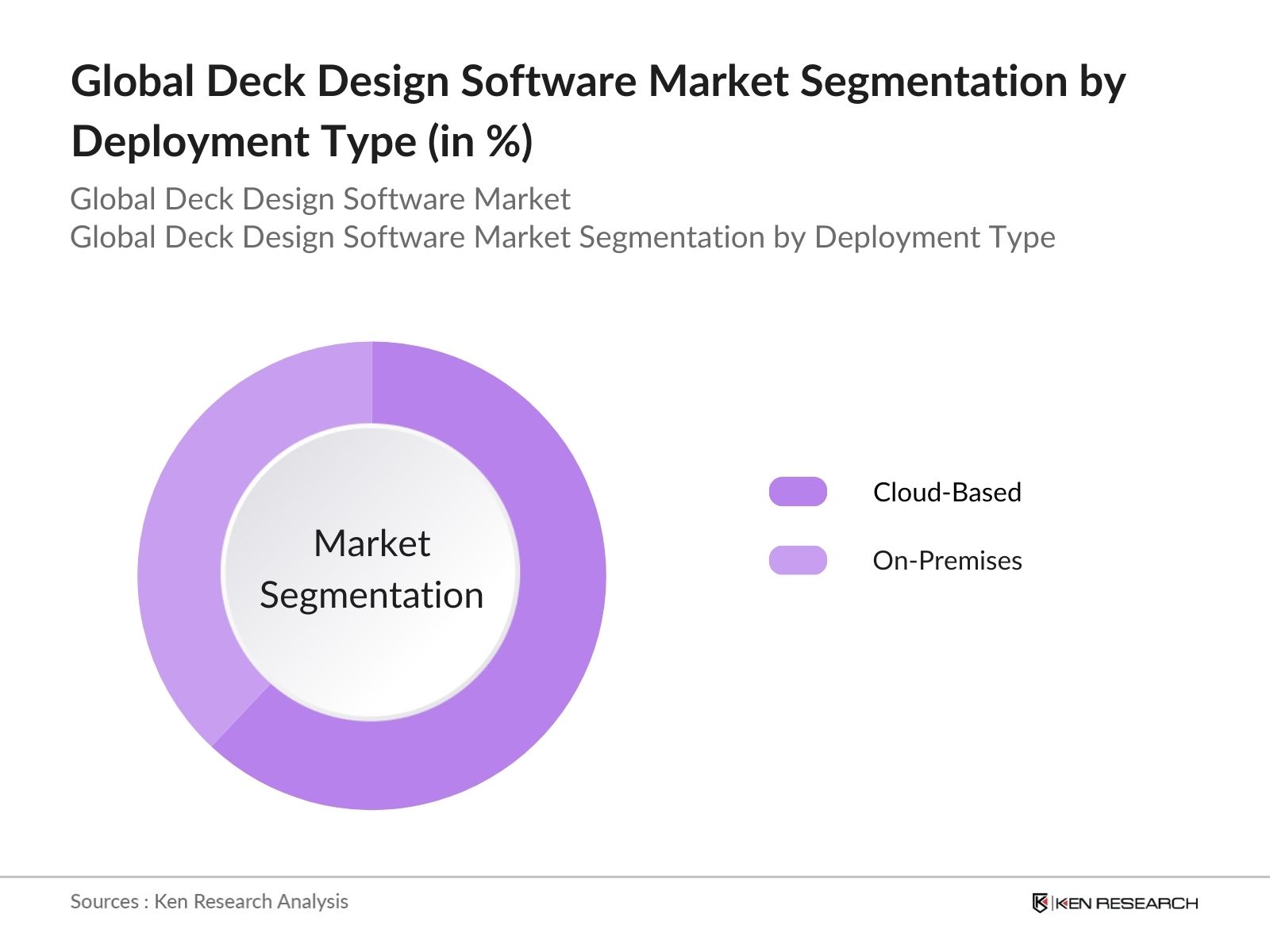
By Deployment: The market is segmented by deployment into cloud-based and on-premises software. Cloud-based deployment holds a dominant share in 2023 due to its accessibility, scalability, and cost-efficiency. Many companies prefer cloud-based solutions as they do not require local hardware installations, offering real-time collaboration and automatic updates. On-premises software still holds a share, especially for users who prioritize data security and customization needs.
By Application: The market is divided into residential and commercial applications. Residential projects hold a dominant market share due to the growing trend of outdoor living spaces, including customized decks for personal homes. Many homeowners are looking to upgrade their outdoor areas, which increases the demand for deck design software. The commercial segment is also growing steadily, driven by the rise in public projects that require detailed designs for parks, recreational areas, and outdoor spaces in hospitality sectors
By Region: North America leads the market, followed by Europe and the Asia Pacific. North America is driven by a strong renovation market and technological adoption. Europe is seeing growth, especially in countries like Germany, due to stringent regulations on construction and growing awareness of environmental-friendly design solutions. The Asia Pacific region is expected to grow rapidly due to increasing urbanization and construction activities.
Global Deck Design Software Market Competitive Landscape
The market is moderately consolidated, with several key players leading the market. These companies leverage advanced technological integrations, such as 3D modeling, AR/VR features, and robust customer support services, to gain a competitive edge.
|
Company Name |
Established Year |
Headquarters |
Revenue (USD Mn) |
Employees |
Technology Integration |
Market Presence (Regions) |
Software Features |
Cloud Offering |
|
Punch! Software |
1998 |
USA |
||||||
|
Chief Architect |
1993 |
USA |
||||||
|
SmartDraw |
1994 |
USA |
||||||
|
SketchUp (Trimble) |
2000 |
USA |
||||||
|
Decks.com (Trex) |
1997 |
USA |
Global Deck Design Software Market Analysis
Market Growth Drivers
- Rising Demand for Enhanced Outdoor Living Spaces: Consumers are increasingly investing in outdoor spaces, particularly in residential properties, leading to a rise in deck constructions. For example, in the United States alone, over 2 million households undertook major outdoor renovation projects in 2024, including deck installations, driving demand for specialized design tools like deck design software.
- Growing DIY (Do-It-Yourself) Culture: The global DIY market is experiencing growth, with 2024 figures showing approximately 30 million DIY-related home improvement projects across the U.S. and Europe alone. The accessibility of user-friendly deck design software has played a pivotal role in this surge, offering homeowners intuitive tools to plan and design their decks without professional assistance.
- Increasing Urban Housing Projects with Outdoor Spaces: Urban development has seen a surge in housing projects featuring balconies, terraces, and outdoor spaces. In 2024, over 500,000 new housing units with outdoor living spaces were developed in urban centers globally, driving the need for software solutions that offer quick and efficient deck designs.
Market Challenges
- Limited Awareness in Developing Regions: Despite the growing popularity of deck design software in North America and Europe, awareness remains relatively low in developing regions like Latin America and Southeast Asia. In 2024, it was estimated that only 10% of potential users in these regions were familiar with deck design software solutions.
- High Initial Investment for Professional Software: Many advanced decks design software solutions come with substantial licensing costs, which can deter small-scale contractors and individual users from adopting them. For instance, professional-grade software can cost upwards of $2,000 per license annually, limiting its appeal to larger companies or frequent users.
Global Deck Design Software Market Future Outlook
The global deck design software industry is expected to experience growth over the next five years, driven by technological advancements such as AR/VR integration and the rising demand for sustainable construction solutions.
Future Market Opportunities
- Increased Adoption of AI-Powered Design Tools: In the next five years, AI-powered deck design tools will become more prevalent, helping users automate the design process and generate customized solutions based on specific preferences. It is estimated that by 2029, around 500,000 design professionals and DIY enthusiasts will be using AI-enabled deck design software for rapid prototyping and design automation.
- Expansion of Cloud-Based Platforms for Collaboration: By 2029, cloud-based design platforms will become the industry standard, enabling better collaboration between homeowners, contractors, and suppliers. The number of users on cloud-based deck design software platforms is expected to surpass 2 million globally, driven by the increasing demand for remote collaboration tools in the construction and renovation sectors.
Scope of the Report
|
Deployment |
Cloud-Based On-Premises |
|
Application |
Residential Commercial |
|
End Use |
Architects & Builders Remodelers DIY Enthusiasts |
|
Technology |
2D Design Tools 3D Design Tools |
|
Region |
North America Europe Asia-Pacific Latin America Middle East & Africa |
Products
Key Target Audience Organizations and Entities Who Can Benefit by Subscribing This Report:
Banks and Financial Institution
Private Equity Firms
Construction Companies
Outdoor Furniture Manufacturers
Government and Regulatory Bodies (e.g., U.S. Environmental Protection Agency, European Construction Authority)
Investors and Venture Capitalist Firms
Companies
Players Mentioned in the Report:
Punch! Software
Chief Architect
Idea Spectrum
SmartDraw
SketchUp
AZEK
Decks.com
Lowes
Trex
Simpson Strong-Tie
Table of Contents
Global Deck Design Software Market Overview
1.1 Definition and Scope
1.2 Market Taxonomy
1.3 Market Growth Rate
1.4 Market Segmentation Overview
Global Deck Design Software Market Size (In USD Mn)
2.1 Historical Market Size
2.2 Year-On-Year Growth Analysis
2.3 Key Market Developments and Milestones
Global Deck Design Software Market Analysis
3.1 Growth Drivers
3.1.1 Rise in Adoption of AR/VR (Market-specific)
3.1.2 Digital Transformation in Construction (Market-specific)
3.1.3 Integration of 3D Modeling Tools (Market-specific)
3.1.4 Increasing Demand for Customization in Residential Projects (Market-specific)
3.2 Market Challenges
3.2.1 High Implementation Costs (Market-specific)
3.2.2 Data Security Concerns in Cloud Deployment (Market-specific)
3.2.3 Lack of Skilled Designers (Market-specific)
3.3 Opportunities
3.3.1 Expansion in Emerging Markets (Market-specific)
3.3.2 Increased Adoption by Small and Medium-Sized Builders (Market-specific)
3.3.3 Growing Demand for Sustainable Design Tools (Market-specific)
3.4 Trends
3.4.1 Cloud-Based Software Adoption (Market-specific)
3.4.2 AR/VR Integration in Design Processes (Market-specific)
3.4.3 Subscription-Based Pricing Models (Market-specific)
3.5 Government Regulations (Certification and Compliance in Building Standards)
3.6 SWOT Analysis
3.7 Stakeholder Ecosystem
3.8 Porters Five Forces Analysis
3.9 Competition Ecosystem
Global Deck Design Software Market Segmentation
4.1 By Deployment (In Value %)
4.1.1 Cloud-Based
4.1.2 On-Premises
4.2 By Application (In Value %)
4.2.1 Residential
4.2.2 Commercial
4.3 By End Use (In Value %)
4.3.1 Architects & Builders
4.3.2 Remodelers
4.3.3 DIY Enthusiasts
4.4 By Technology (In Value %)
4.4.1 2D Design Tools
4.4.2 3D Design Tools
4.5 By Region (In Value %)
4.5.1 North America
4.5.2 Europe
4.5.3 Asia-Pacific
4.5.4 Latin America
4.5.5 Middle East & Africa
Global Deck Design Software Market Competitive Analysis
5.1 Detailed Profiles of Major Companies
5.1.1 Punch! Software
5.1.2 Chief Architect
5.1.3 Idea Spectrum
5.1.4 SmartDraw
5.1.5 SketchUp
5.1.6 AZEK
5.1.7 Decks.com
5.1.8 Lowes
5.1.9 Trex
5.1.10 Simpson Strong-Tie
5.1.11 SoftPlan Systems
5.1.12 MiTek Inc.
5.1.13 Structure Studios
5.1.14 Envisioneer
5.1.15 Lumion
5.2 Cross Comparison Parameters (Market Share, Revenue, Headquarters, Founding Year, Regional Presence)
5.3 Market Share Analysis
5.4 Strategic Initiatives (Partnerships, Expansions, Product Launches)
5.5 Mergers and Acquisitions
5.6 Investment Analysis
5.7 Venture Capital and Funding
5.8 Government Grants
Global Deck Design Software Market Regulatory Framework
6.1 Compliance with International Building Codes
6.2 Licensing Requirements for Software Providers
6.3 Certifications for Sustainability
Global Deck Design Software Future Market Size (In USD Mn)
7.1 Future Market Size Projections
7.2 Key Factors Driving Future Market Growth
Global Deck Design Software Future Market Segmentation
8.1 By Deployment (In Value %)
8.2 By Application (In Value %)
8.3 By End Use (In Value %)
8.4 By Technology (In Value %)
8.5 By Region (In Value %)
Global Deck Design Software Market Analysts' Recommendations
9.1 TAM/SAM/SOM Analysis
9.2 White Space Opportunities
9.3 Key Growth Strategies
9.4 Market Expansion Initiatives
Disclaimer Contact UsResearch Methodology
Step 1: Identification of Key Variables
The research begins by mapping the deck design software industry, identifying the primary stakeholders, including software providers, architects, and contractors. The objective is to pinpoint the key variables that impact market dynamics, such as technological adoption and market preferences.
Step 2: Market Analysis and Construction
Historical data for the market is gathered, focusing on adoption rates, geographical expansion, and software upgrades. The data is analyzed to forecast future trends and determine the revenue potential for each segment.
Step 3: Hypothesis Validation and Expert Consultation
Market hypotheses are validated through consultations with industry experts, software developers, and architects. This is carried out via structured interviews and surveys to ensure accuracy and depth of data.
Step 4: Research Synthesis and Final Output
All gathered data is synthesized to form a comprehensive report. The data validation process includes engaging with deck design software manufacturers to ensure consistency and reliability in the final analysis.
Frequently Asked Questions
01. How big is the Global Deck Design Software Market?
The global deck design software market is valued at USD 225 million, driven by the rise in home renovation projects and the integration of AR/VR technologies.
02. What are the challenges in the Global Deck Design Software Market?
Key challenges in the global deck design software market include high costs of implementation, data security concerns in cloud-based deployments, and a shortage of skilled software designers who can fully utilize the capabilities of the tools.
03. Who are the major players in the Global Deck Design Software Market?
The major players in the global deck design software market include Punch! Software, Chief Architect, Idea Spectrum, SmartDraw, and SketchUp. These companies dominate due to their comprehensive software offerings and strong presence in key markets.
04. What are the growth drivers of the Global Deck Design Software Market?
The growth drivers in the global deck design software market include the rise in demand for customized outdoor spaces, the integration of advanced 3D design tools, and the increasing adoption of cloud-based software for real-time collaboration.
05. What trends are shaping the Global Deck Design Software Market?
Key trends in the global deck design software market include the rise of subscription-based pricing models, the growing demand for sustainable design solutions, and the increased use of VR/AR tools for more interactive design experiences.
Why Buy From Us?

What makes us stand out is that our consultants follows Robust, Refine and Result (RRR) methodology. i.e. Robust for clear definitions, approaches and sanity checking, Refine for differentiating respondents facts and opinions and Result for presenting data with story

We have set a benchmark in the industry by offering our clients with syndicated and customized market research reports featuring coverage of entire market as well as meticulous research and analyst insights.

While we don't replace traditional research, we flip the method upside down. Our dual approach of Top Bottom & Bottom Top ensures quality deliverable by not just verifying company fundamentals but also looking at the sector and macroeconomic factors.

With one step in the future, our research team constantly tries to show you the bigger picture. We help with some of the tough questions you may encounter along the way: How is the industry positioned? Best marketing channel? KPI's of competitors? By aligning every element, we help maximize success.

Our report gives you instant access to the answers and sources that other companies might choose to hide. We elaborate each steps of research methodology we have used and showcase you the sample size to earn your trust.

If you need any support, we are here! We pride ourselves on universe strength, data quality, and quick, friendly, and professional service.