Global Electric Motors Market Outlook to 2030

Region:Global

Author(s):Mukul

Product Code:KROD10812

Published On

December 2024

Total pages

84

About the Report

Global Electric Motors Market Overview

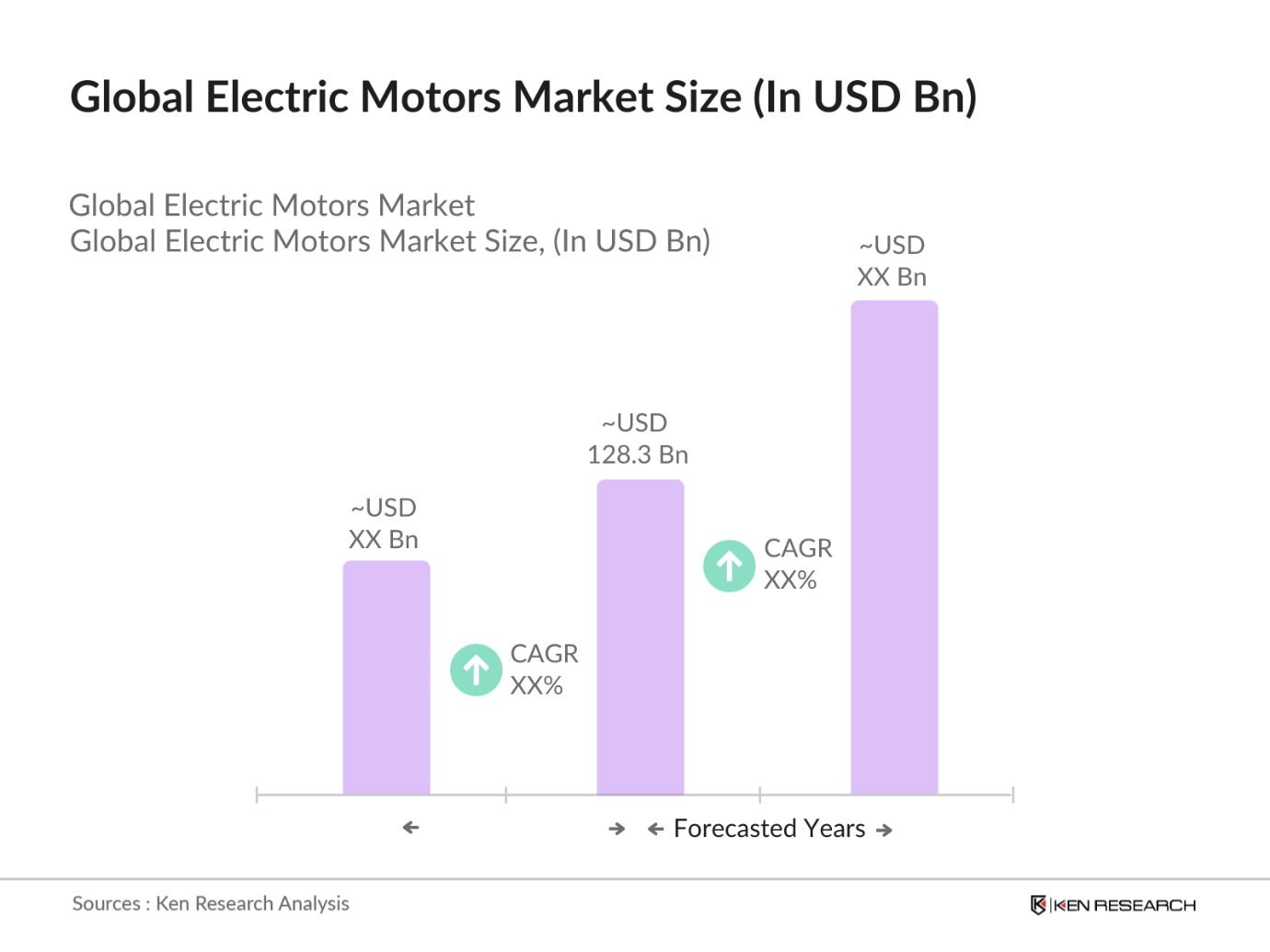
  • The global electric motors market is valued at USD 128.3 billion, based on a five-year historical analysis, reflecting consistent growth driven by increasing applications across industrial automation, electric vehicles, and renewable energy sectors. Demand for efficient and environmentally sustainable solutions has spurred investments in electric motor technologies, making this market essential for industrial productivity. Rising energy efficiency standards, primarily influenced by government initiatives, continue to push adoption, particularly in manufacturing and automotive industries.

Global Electric Motors Market Size

  • The market is primarily dominated by the Asia Pacific region, with China and India as the key contributors due to their rapidly growing industrial and automotive sectors. China's established manufacturing capabilities and Indias expanding infrastructure developments make these countries key hubs for electric motor production and distribution. North America and Europe also hold significant market shares, supported by advanced technology integration and the prominence of electric vehicle adoption.
  • Energy-efficient motors have gained momentum as businesses aim to cut energy consumption costs. By 2024, electric motors complying with high-efficiency standards represent a larger share in industrial applications, contributing to significant power savings across sectors. The EUs stringent regulations have encouraged businesses to adopt these motors, reducing industrial energy use by over 8% year-on-yea

Global Electric Motors Market Segmentation

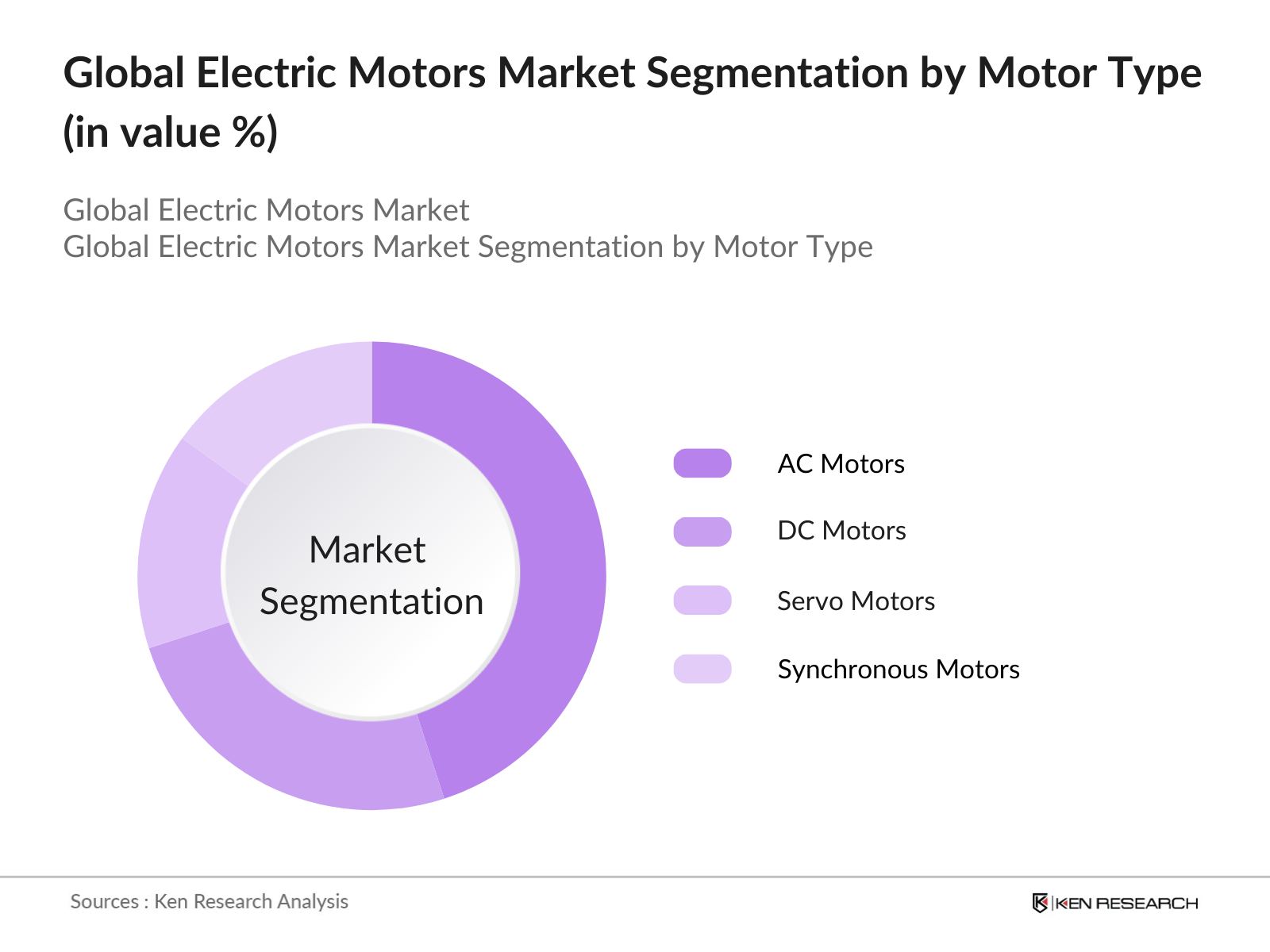
  • By Motor Type: The global electric motors market is segmented by motor type into AC motors, DC motors, servo motors, and synchronous motors. Recently, AC motors dominate market share under the segmentation of motor type due to their widespread application in industrial and residential sectors. Their robust efficiency, lower cost, and compatibility with alternating current supply make them highly preferred for various uses, such as HVAC systems, electric vehicles, and manufacturing equipment.

Global Electric Motors Market Segmentation By Motor Type

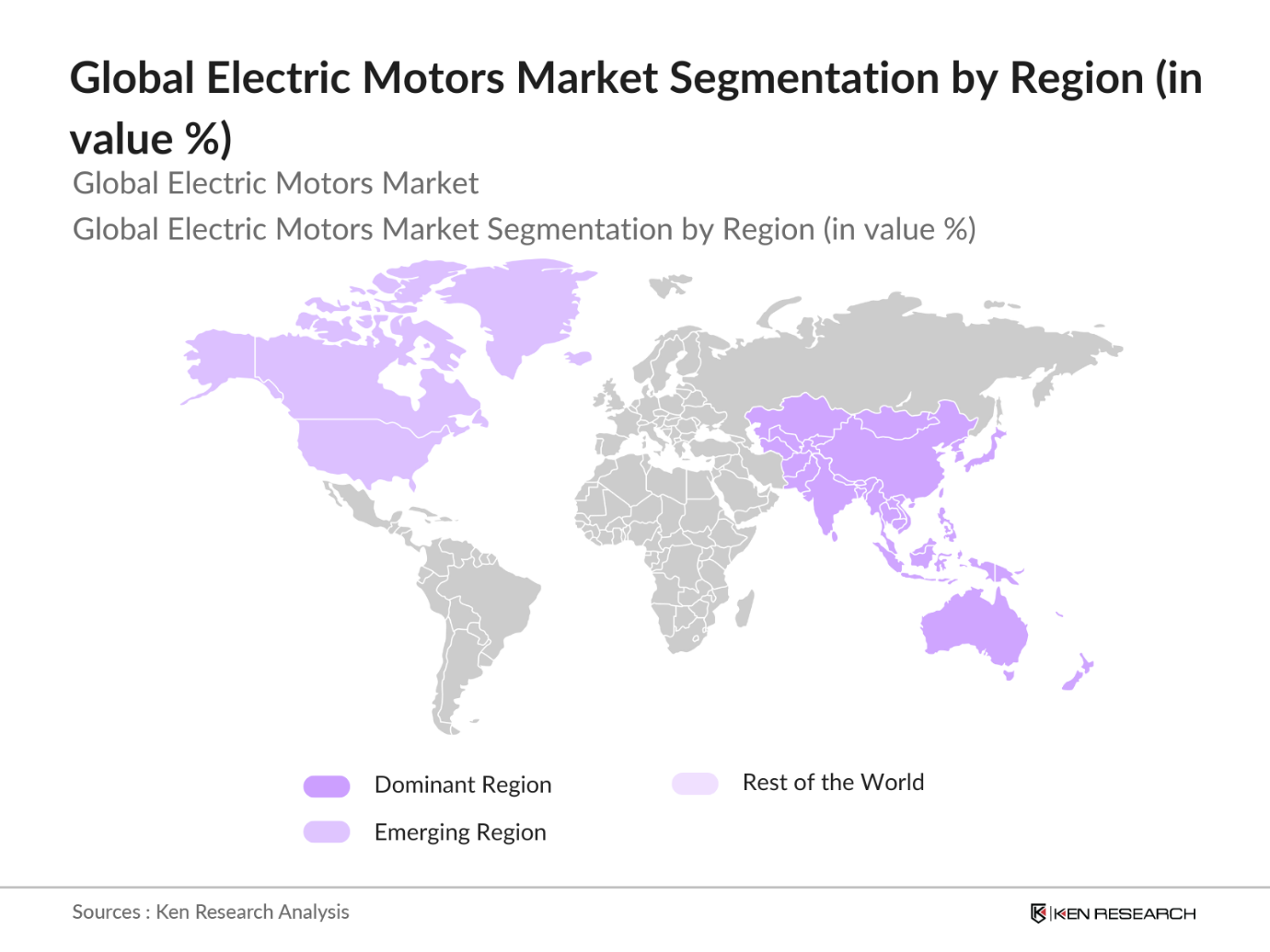
  • By Region: The regional segmentation of the global electric motors market includes North America, Europe, Asia Pacific, Latin America, and the Middle East & Africa. Asia Pacific holds the largest market share, driven by high demand in industrial automation and electric vehicle production, especially in China, Japan, and India. The regions robust manufacturing sector and supportive government policies further solidify its dominance.

Global Electric Motors Market Segmentation By Region

  • By Voltage Range: The market is categorized by voltage range into low voltage, medium voltage, and high voltage motors. Low voltage motors dominate this segment, as they are primarily utilized in applications requiring efficient power solutions at relatively lower energy consumption levels. Their versatility in powering industrial machinery and home appliances supports their dominant share in the electric motors market.

Global Electric Motors Market Competitive Landscape

The global electric motors market is dominated by a mix of well-established global brands and regional manufacturers, emphasizing efficiency, sustainability, and innovation to maintain their market positions. Key players have made substantial investments in research and development to cater to diverse industrial demands and adapt to emerging technologies like IoT and automation.
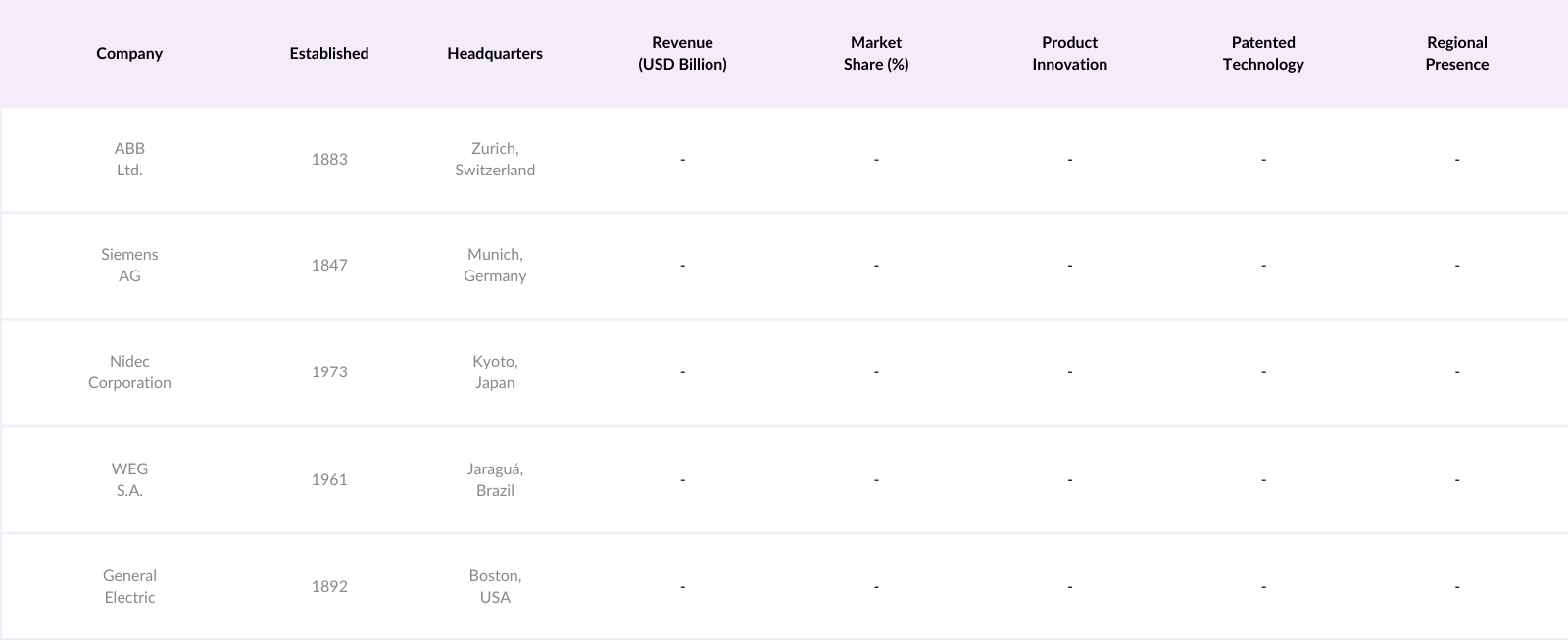
Global Electric Motors Market Competitive Landscape

Global Electric Motors Industry Analysis

Growth Drivers

  • Industrial Automation Demand In 2024, the push for industrial automation has intensified as manufacturers in major economies adopt advanced technologies to meet rising demand and optimize productivity. Notably, automation is driving productivity up by over 2.3% globally, with regions like North America and Europe seeing sharp increases in automated operations across manufacturing and logistics. Automation technologies are now implemented in over 40% of high-volume factories, especially in precision manufacturing sectors. This shift supports economic growth by enhancing operational efficiency, directly impacting the electric motors market by increasing the need for motors in robotic and automation equipment.
  • Renewable Energy Integration Global demand for renewable energy is growing robustly, especially as governments aim to cut down greenhouse emissions by significant levels in 2024. Countries like China and the United States are ramping up investments in wind and solar power infrastructure, which depend on efficient electric motors for turbine operations. By 2024, an estimated 300 gigawatts (GW) of renewable energy capacity will have been added worldwide, necessitating high-performance electric motors for optimal energy conversion and minimal downtime, bolstering market growth.
  • Electric Vehicle (EV) Market Growth The EV sector is experiencing rapid growth, with sales anticipated to reach nearly 15 million units in 2024 across global markets. Electric motors are essential components for EVs, and as consumer and regulatory pressures drive adoption, motor manufacturers are racing to develop energy-efficient models suitable for EV drivetrains. In the United States alone, electric vehicles now comprise around 15% of new vehicle registrations, underscoring a sustained rise in motor demand.

Market Restraints

  • High Manufacturing Costs The production of electric motors has seen a cost rise in 2024, driven by the increasing prices of raw materials, especially copper and rare earth metals. In fact, copper prices have increased by approximately 25% over the past two years due to limited mining output and high demand in renewable energy sectors. Such elevated costs pose profitability challenges for manufacturers, impacting market dynamics as companies search for cost-effective alternatives.
  • Complexity in Motor Control Systems With advanced technologies embedded in electric motors, control systems have grown complex, requiring skilled labor for maintenance and higher upfront costs for sophisticated motor setups. In 2024, this technical complexity is particularly challenging in emerging economies, where skilled labor may be scarce, potentially hindering adoption rates in automation and EV sectors that rely on advanced motor control.

Global Electric Motors Market Future Outlook

Over the next five years, the global electric motors market is expected to experience strong growth driven by innovations in automation, energy efficiency standards, and demand from the electric vehicle industry. Increasing investments in energy-efficient and environmentally sustainable solutions will continue to enhance the market dynamics. Additionally, emerging markets, particularly in Asia and Latin America, are anticipated to offer significant growth opportunities, with growing industrialization and demand for automotive applications.

Market Opportunities

  • Demand for Smart Motors Smart motors, equipped with IoT sensors and connectivity capabilities, are increasingly adopted across industrial and commercial applications. In 2024, approximately 20% of new electric motors sold in industrial applications are smart motors, which allow real-time monitoring and predictive maintenance, reducing downtime significantly. This trend highlights substantial growth potential for companies in the motor market, especially in regions investing in automation and smart manufacturing.
  • Expansion in Emerging Economies Emerging economies are increasingly investing in electric motor infrastructure, aiming to enhance manufacturing and reduce carbon footprints. For instance, India has increased its focus on motor-driven equipment in agriculture and infrastructure projects, making it one of the fastest-growing electric motor markets in 2024. This shift underscores the untapped market potential in emerging economies, where electric motors are critical for economic growth and energy efficiency.

Scope of the Report

Motor Type

AC Motors
DC Motors
Servo Motors
Synchronous Motors

Voltage Range

Low Voltage
Medium Voltage
High Voltage

Application

Industrial
Residential
Automotive
Aerospace & Defense
Agriculture

Output Power

Less than 1 HP
1-10 HP
Above 10 HP

Region

North America
Europe
Asia Pacific
Latin America
Middle East & Africa

Products

Key Target Audience

  • Electric Vehicle Manufacturers

  • Industrial Automation Companies

  • Investor and Venture Capitalist Firms

  • Energy Sector Companies

  • Government and Regulatory Bodies (Department of Energy, Environmental Protection Agency)

  • Renewable Energy Organizations

  • Commercial Real Estate Developers

  • Original Equipment Manufacturers (OEMs)

Companies

Players Mentioned in the Report

  • ABB Ltd.

  • Siemens AG

  • Nidec Corporation

  • WEG S.A.

  • General Electric

  • Johnson Electric

  • Bosch Rexroth AG

  • Toshiba Corporation

  • Emerson Electric Co.

  • Hitachi Ltd.

  • Yaskawa Electric Corporation

  • Regal Beloit Corporation

  • Baldor Electric Company

  • Rockwell Automation, Inc.

  • Allied Motion Technologies Inc.

Table of Contents

1. Global Electric Motors Market Overview

1.1 Definition and Scope

1.2 Market Taxonomy

1.3 Market Growth Rate

1.4 Market Segmentation Overview

2. Global Electric Motors Market Size (In USD Million)

2.1 Historical Market Size

2.2 Year-On-Year Growth Analysis

2.3 Key Market Developments and Milestones

3. Global Electric Motors Market Analysis

3.1 Growth Drivers

3.1.1 Industrial Automation Demand

3.1.2 Renewable Energy Integration

3.1.3 Electric Vehicle (EV) Market Growth

3.1.4 Advancements in Efficiency Standards

3.2 Market Challenges

3.2.1 High Manufacturing Costs

3.2.2 Complexity in Motor Control Systems

3.2.3 Supply Chain Disruptions

3.3 Opportunities

3.3.1 Demand for Smart Motors

3.3.2 Expansion in Emerging Economies

3.3.3 Investment in Green Technologies

3.4 Trends

3.4.1 Adoption of IoT and Automation

3.4.2 Energy-Efficient Motor Technologies

3.4.3 Increase in Direct-Drive Systems

3.5 Regulatory Landscape

3.5.1 Efficiency Regulations

3.5.2 Environmental Standards

3.5.3 Energy Labeling Policies

3.6 SWOT Analysis

3.7 Stakeholder Ecosystem

3.8 Porters Five Forces Analysis

3.9 Competitive Ecosystem

4. Global Electric Motors Market Segmentation

4.1 By Motor Type (In Value %)

4.1.1 AC Motors

4.1.2 DC Motors

4.1.3 Servo Motors

4.1.4 Synchronous Motors

4.2 By Voltage Range (In Value %)

4.2.1 Low Voltage

4.2.2 Medium Voltage

4.2.3 High Voltage

4.3 By Application (In Value %)

4.3.1 Industrial

4.3.2 Residential

4.3.3 Automotive

4.3.4 Aerospace & Defense

4.3.5 Agriculture

4.4 By Output Power (In Value %)

4.4.1 Less than 1 HP

4.4.2 1-10 HP

4.4.3 Above 10 HP

4.5 By Region (In Value %)

4.5.1 North America

4.5.2 Europe

4.5.3 Asia Pacific

4.5.4 Latin America

4.5.5 Middle East & Africa

5. Global Electric Motors Market Competitive Analysis

5.1 Detailed Profiles of Major Companies

5.1.1 ABB Ltd.

5.1.2 Siemens AG

5.1.3 Nidec Corporation

5.1.4 WEG S.A.

5.1.5 General Electric

5.1.6 Toshiba Corporation

5.1.7 Johnson Electric

5.1.8 Rockwell Automation, Inc.

5.1.9 Bosch Rexroth AG

5.1.10 Allied Motion Technologies Inc.

5.1.11 Emerson Electric Co.

5.1.12 Regal Beloit Corporation

5.1.13 Baldor Electric Company

5.1.14 Hitachi Ltd.

5.1.15 Yaskawa Electric Corporation

5.2 Cross Comparison Parameters (Annual Revenue, Manufacturing Capacity, Motor Efficiency Rating, Regional Presence, R&D Expenditure, Patented Technologies, Sustainability Practices, Market Share)

5.3 Market Share Analysis

5.4 Strategic Initiatives

5.5 Mergers and Acquisitions

5.6 Investment Analysis

5.7 Venture Capital and Private Equity Investments

5.8 Government Grants and Subsidies

6. Global Electric Motors Market Regulatory Framework

6.1 Environmental and Energy Efficiency Standards

6.2 Compliance and Certification Requirements

6.3 Emission Regulations and Guidelines

7. Global Electric Motors Future Market Size (In USD Million)

7.1 Projected Market Growth

7.2 Key Factors Influencing Future Market Demand

8. Global Electric Motors Future Market Segmentation

8.1 By Motor Type (In Value %)

8.2 By Voltage Range (In Value %)

8.3 By Application (In Value %)

8.4 By Output Power (In Value %)

8.5 By Region (In Value %)

9. Global Electric Motors Market Analysts Recommendations

9.1 TAM/SAM/SOM Analysis

9.2 White Space Opportunity Analysis

9.3 Marketing and Distribution Strategy

9.4 Emerging Market Opportunities

Disclaimer Contact Us

Research Methodology

Step 1: Identification of Key Variables

The research process begins with identifying core variables impacting the global electric motors market. This includes in-depth analysis of end-user applications, key industry stakeholders, and emerging trends. Secondary sources and proprietary databases are used to gather initial insights, establishing a comprehensive view of market factors.

Step 2: Market Analysis and Construction

Historical data on market revenue, production capacities, and applications is gathered and analyzed. A thorough examination of past trends and market shares helps in estimating the current market structure, providing reliable insights for constructing a segmented analysis.

Step 3: Hypothesis Validation and Expert Consultation

Industry experts are consulted through telephone interviews and surveys to validate research hypotheses. The input from these experts contributes to refining market estimations and gaining qualitative insights, enhancing the report's reliability.

Step 4: Research Synthesis and Final Output

The final synthesis involves cross-verifying quantitative findings with qualitative insights, ensuring a balanced analysis. Engaging with manufacturers provides detailed perspectives on consumer trends and preferences, yielding an accurate and validated overview of the global electric motors market.

Frequently Asked Questions

01. How big is the global electric motors market?

The global electric motors market, valued at USD 128.3 billion, is driven by demand across industrial automation, electric vehicles, and renewable energy sectors.

02. What are the growth drivers for the electric motors market?

Key growth drivers include rising adoption of automation, increasing production of electric vehicles, and government incentives promoting energy-efficient technologies.

03. Who are the major players in the global electric motors market?

Leading companies include ABB Ltd., Siemens AG, Nidec Corporation, WEG S.A., and General Electric, all of which contribute to technological advancements and product innovations.

04. What challenges face the electric motors market?

Challenges include high production costs, complex motor control systems, and fluctuations in raw material prices, impacting market profitability and scalability.

Why Buy From Us?

RRR
Refine Robust Result (RRR) Framework

What makes us stand out is that our consultants follows Robust, Refine and Result (RRR) methodology. i.e. Robust for clear definitions, approaches and sanity checking, Refine for differentiating respondents facts and opinions and Result for presenting data with story

Our Reach Is Unmatched

We have set a benchmark in the industry by offering our clients with syndicated and customized market research reports featuring coverage of entire market as well as meticulous research and analyst insights.

Research
Shifting the Research Paradigm

While we don't replace traditional research, we flip the method upside down. Our dual approach of Top Bottom & Bottom Top ensures quality deliverable by not just verifying company fundamentals but also looking at the sector and macroeconomic factors.

Insite
More Insights-Better Decisions

With one step in the future, our research team constantly tries to show you the bigger picture. We help with some of the tough questions you may encounter along the way: How is the industry positioned? Best marketing channel? KPI's of competitors? By aligning every element, we help maximize success.

Trust
Transparency and Trust

Our report gives you instant access to the answers and sources that other companies might choose to hide. We elaborate each steps of research methodology we have used and showcase you the sample size to earn your trust.

support
Round the Clock Support

If you need any support, we are here! We pride ourselves on universe strength, data quality, and quick, friendly, and professional service.

Why Client Choose Us?

400000+ Reports in repository
150+ Consulting project a year
100+ Analysts
8000+ Client Queries in 2022