
Global Hardware Market Outlook to 2029
Region:Global
Author(s):Dev
Product Code:KROD-054
June 2025
80
About the Report
Global Hardware Market Overview
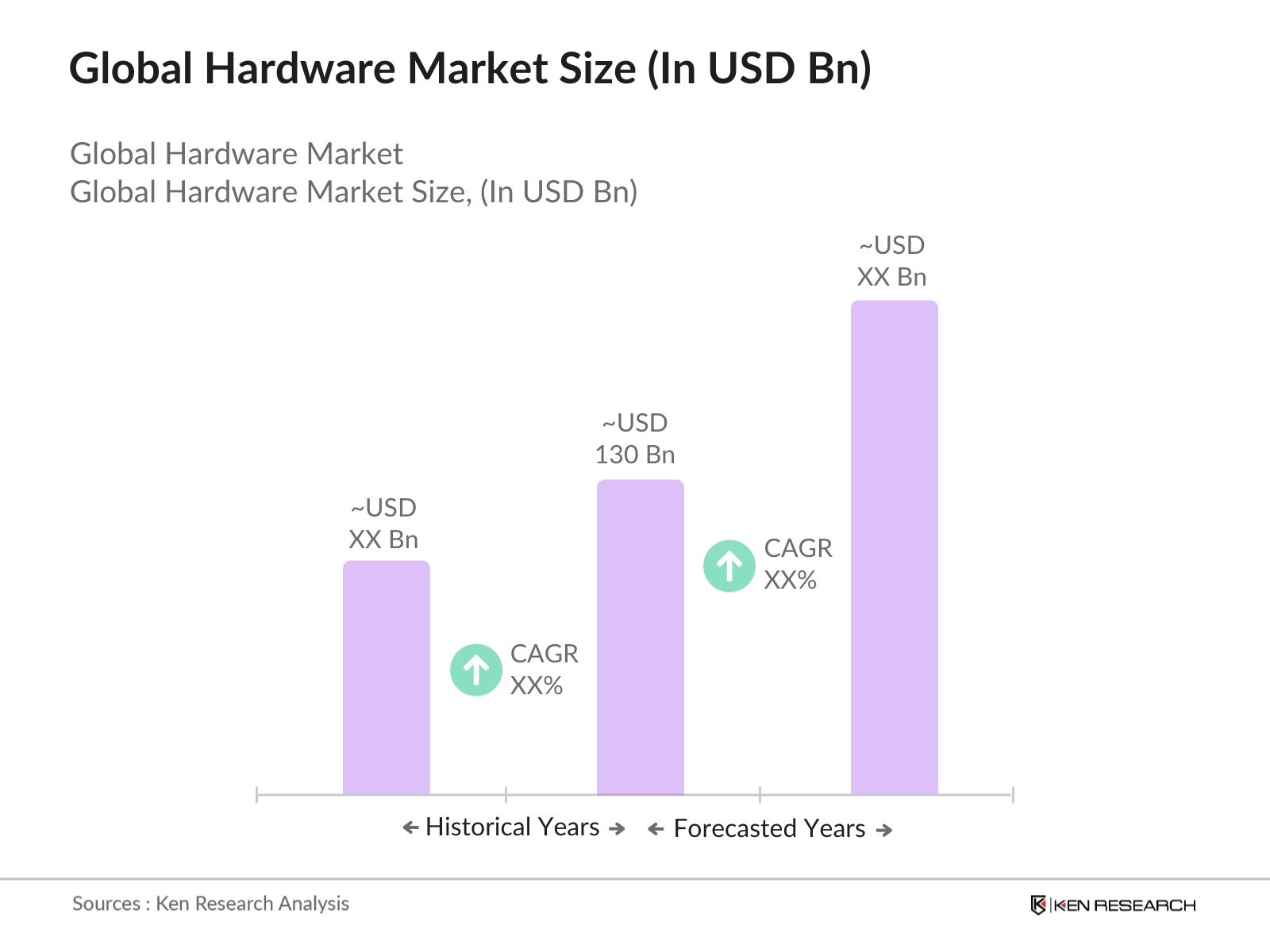
- The Global Hardware Market was valued at USD 130 billion. This growth is primarily driven by the increasing demand for consumer electronics, advancements in technology, and the rise of smart devices. The market has seen a surge in hardware sales due to the growing trend of digital transformation across various industries, including healthcare, automotive, and manufacturing.
- Key players in this market include the United States, China, and Germany. The United States dominates due to its strong technological infrastructure and innovation capabilities. China, as a manufacturing powerhouse, benefits from its vast production capacity and cost-effective labor. Germany is known for its engineering excellence and high-quality hardware products, making it a significant player in the European market.
- In 2024, the European Union implemented the Ecodesign for Sustainable Products Regulation (ESPR), which replaces the previous Ecodesign Directive and broadens its scope to cover a wide range of physical products, including electronic devices and hardware. This regulation mandates that products must meet specific requirements related to energy efficiency, durability, repairability, and recyclability.
Global Hardware Market Segmentation
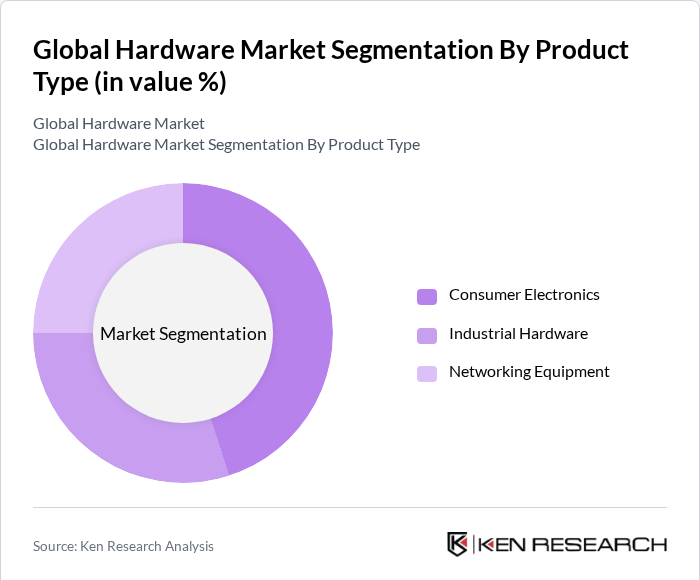
By Product Type: The hardware market can be segmented into several product types, including consumer electronics, industrial hardware, and networking equipment. Among these, consumer electronics dominate the market due to the increasing adoption of smartphones, laptops, and smart home devices. The growing trend of remote work and online learning has further accelerated the demand for personal computing devices, making this sub-segment a key driver of market growth. Additionally, the rise of the Internet of Things (IoT) has led to a surge in smart devices, further solidifying the consumer electronics segment's position in the market.
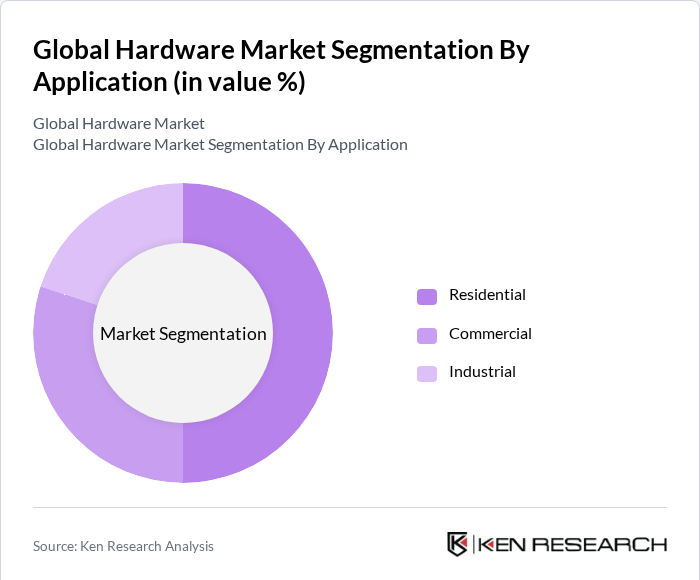
By Application: The hardware market is also segmented by application, including residential, commercial, and industrial applications. The residential application segment is currently leading the market, driven by the increasing demand for smart home technologies and consumer electronics. The trend towards home automation and the integration of smart devices into everyday life has significantly boosted this segment. Furthermore, the commercial application segment is growing as businesses invest in advanced hardware solutions to enhance productivity and efficiency, particularly in sectors like retail and healthcare.
Global Hardware Market Competitive Landscape
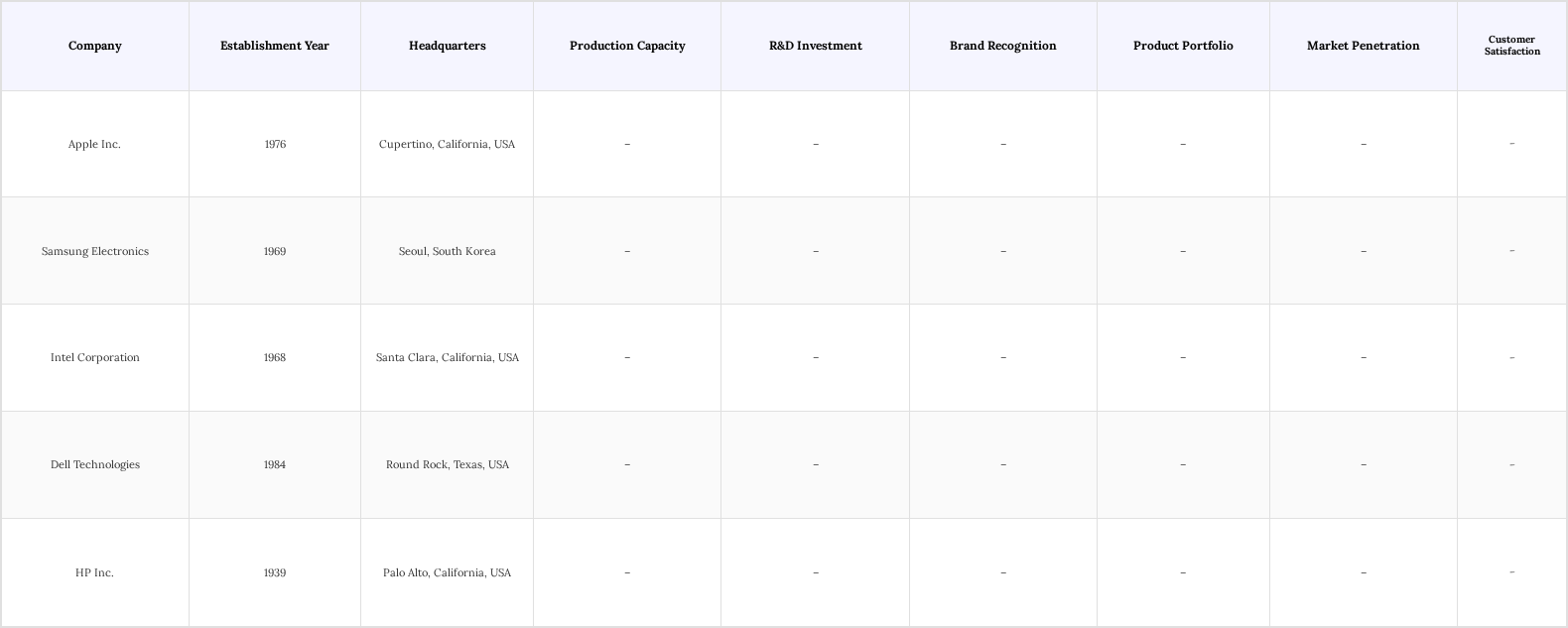
The Global Hardware Market is characterized by intense competition among key players such as Apple Inc., Samsung Electronics, Intel Corporation, Dell Technologies, and HP Inc. These companies are known for their innovation, extensive product portfolios, and strong brand recognition. The market is also witnessing a trend towards consolidation, with larger firms acquiring smaller companies to enhance their technological capabilities and market reach.
Global Hardware Market Industry Analysis
Growth Drivers
- Increasing Demand for Consumer Electronics: The global consumer electronics market is experiencing strong growth driven by rising disposable incomes and rapid technological advancements. Demand for smartphones and laptops is increasing by about 8% annually, reflecting consumers' shift toward digital lifestyles. Additionally, household spending on electronics has grown by approximately 6%, fueled by innovations in AI, IoT, and 5G connectivity that enhance device functionality and user experience. Asia Pacific leads the market, supported by major manufacturers and expanding consumer bases, while trends like smart homes, and energy-efficient products.
- Advancements in Technology and Innovation: The hardware sector is rapidly advancing through significant investments in AI and IoT integration, with over 75% of companies planning to embed AI into their devices to enhance functionality and user experience. AI enables personalization, predictive maintenance, and energy optimization, while IoT innovations create adaptive, intelligent environments such as smart homes and autonomous systems. Technologies like Edge AI reduce latency and improve privacy by processing data locally, and federated learning enhances collaborative AI training without compromising user data.
- Rising Adoption of Smart Home Devices: The smart home device market is witnessing rapid adoption, with about 42% of households expected to own at least one smart device, driven by improved internet connectivity and growing consumer awareness. Adoption rates are increasing by around 16% annually in key regions, supported by government initiatives promoting energy-efficient technologies. AI-powered devices and voice assistants like Alexa and Google Assistant are enhancing convenience, security, and personalization, further propelling demand.
Market Challenges
- Supply Chain Disruptions: The hardware industry is grappling with significant supply chain challenges, largely driven by geopolitical tensions and residual impacts from global disruptions. Delays in the delivery of critical components are affecting production timelines, while rising raw material costs continue to pressure profit margins. Maintaining adequate inventory levels has become increasingly difficult, resulting in potential revenue losses and declining customer satisfaction factors that could ultimately hinder overall market growth.
- Intense Competition Among Key Players: The hardware market is marked by intense competition, with numerous players actively competing across segments such as consumer electronics. This fierce rivalry often results in price wars and margin compression. Additionally, the rapid pace of technological innovation demands continuous investment in product development and marketing. These pressures strain financial resources and pose challenges to long-term profitability and market positioning.
Global Hardware Market Future Outlook
The future of the hardware market in None appears promising, driven by ongoing technological advancements and increasing consumer demand for innovative products. As companies invest in AI and IoT technologies, the integration of smart features into hardware will become more prevalent. Additionally, the shift towards sustainable manufacturing practices is expected to gain momentum, aligning with global environmental goals. This evolving landscape presents opportunities for businesses to differentiate themselves through unique offerings and enhanced customer experiences.
Market Opportunities
- Expansion into Emerging Markets: Emerging markets present significant growth opportunities for consumer electronics companies due to rapid expansion of the middle class and increasing disposable incomes. For example, in key regions like Asia-Pacific, the middle-class population is projected to grow substantially, creating a larger customer base for hardware products. This demographic shift is driving strong demand for affordable, feature-rich devices such as smartphones, smart TVs, and wearables
- Growth in E-commerce and Online Sales: The e-commerce sector for consumer electronics is experiencing rapid growth, with a forecasted increase of around 27% in 2024 in key markets. Approximately 65% of consumers prefer shopping online for electronics, driven by convenience, competitive pricing, and a wide product selection. This shift enables hardware companies to reach a broader audience through digital marketing strategies, enhancing brand visibility and sales.
Scope of the Report
| By Product Type |
Consumer Electronics Industrial Hardware Networking Equipment |
| By Application |
Residential Commercial Industrial Applications |
| By Distribution Channel |
Online Retail Offline Retail Direct Sales |
| By Region |
North America Europe Asia-Pacific Latin America Middle East & Africa |
| By End User |
Individual Consumers Small and Medium Enterprises (SMEs) Large Enterprises |
Products
Key Target Audience
Investors and Venture Capitalist Firms
Government and Regulatory Bodies (e.g., Federal Trade Commission, International Trade Administration)
Manufacturers and Producers
Distributors and Retailers
Technology Providers
Industry Associations (e.g., Consumer Technology Association, Electronics Industry Association)
Financial Institutions
Supply Chain and Logistics Companies
Companies
Players Mentioned in the Report:
Apple Inc.
Samsung Electronics
Intel Corporation
Dell Technologies
HP Inc.
Lenovo Group Limited
ASUS Computer International
Acer Inc.
MSI (Micro-Star International)
Seagate Technology Holdings PLC
Table of Contents
1. Global Hardware Market Overview
1.1. Definition and Scope
1.2. Market Taxonomy
1.3. Market Growth Rate
1.4. Market Segmentation Overview
2. Global Hardware Market Size (In USD Bn)
2.1. Historical Market Size
2.2. Year-On-Year Growth Analysis
2.3. Key Market Developments and Milestones
3. Global Hardware Market Analysis
3.1. Growth Drivers
3.1.1. Increasing demand for consumer electronics
3.1.2. Advancements in technology and innovation
3.1.3. Rising adoption of smart home devices
3.2. Market Challenges
3.2.1. Supply chain disruptions
3.2.2. Intense competition among key players
3.2.3. Rapid technological changes
3.3. Opportunities
3.3.1. Expansion into emerging markets
3.3.2. Growth in e-commerce and online sales
3.3.3. Development of sustainable hardware solutions
3.4. Trends
3.4.1. Increasing integration of AI in hardware products
3.4.2. Shift towards modular and customizable hardware
3.4.3. Growing focus on cybersecurity in hardware design
3.5. Government Regulation
3.5.1. Compliance with international safety standards
3.5.2. Environmental regulations impacting manufacturing
3.5.3. Trade policies affecting import/export dynamics
3.5.4. Data protection laws influencing hardware design
3.6. SWOT Analysis
3.7. Stake Ecosystem
3.8. Porter’s Five Forces
3.9. Competition Ecosystem
4. Global Hardware Market Segmentation
4.1. By Product Type
4.1.1. Consumer Electronics
4.1.2. Industrial Hardware
4.1.3. Networking Equipment
4.2. By Application
4.2.1. Residential
4.2.2. Commercial
4.2.3. Industrial Applications
4.3. By Distribution Channel
4.3.1. Online Retail
4.3.2. Offline Retail
4.3.3. Direct Sales
4.4. By Region
4.4.1. North America
4.4.2. Europe
4.4.3. Asia-Pacific
4.4.4. Latin America
4.4.5. Middle East & Africa
4.5. By End User
4.5.1. Individual Consumers
4.5.2. Small and Medium Enterprises (SMEs)
4.5.3. Large Enterprises
5. Global Hardware Market Competitive Analysis
5.1. Detailed Profiles of Major Companies
5.1.1. Apple Inc.
5.1.2. Samsung Electronics
5.1.3. Intel Corporation
5.1.4. Dell Technologies
5.1.5. HP Inc.
5.1.6. Lenovo Group Limited
5.1.7. ASUS Computer International
5.1.8. Acer Inc.
5.1.9. MSI (Micro-Star International)
5.1.10. Seagate Technology Holdings PLC
5.2. Cross Comparison Parameters
5.2.1. Market Share
5.2.2. Revenue Growth Rate
5.2.3. Product Portfolio Diversity
5.2.4. Geographic Presence
5.2.5. R&D Investment
5.2.6. Customer Satisfaction Ratings
5.2.7. Supply Chain Efficiency
5.2.8. Brand Recognition
6. Global Hardware Market Regulatory Framework
6.1. Environmental Standards
6.2. Compliance Requirements
6.3. Certification Processes
7. Global Hardware Market Future Market Size (In USD Bn)
7.1. Future Market Size Projections
7.2. Key Factors Driving Future Market Growth
8. Global Hardware Market Future Market Segmentation
8.1. By Product Type
8.1.1. Consumer Electronics
8.1.2. Industrial Hardware
8.1.3. Networking Equipment
8.2. By Application
8.2.1. Residential
8.2.2. Commercial
8.2.3. Industrial Applications
8.3. By Distribution Channel
8.3.1. Online Retail
8.3.2. Offline Retail
8.3.3. Direct Sales
8.4. By Region
8.4.1. North America
8.4.2. Europe
8.4.3. Asia-Pacific
8.4.4. Latin America
8.4.5. Middle East & Africa
8.5. By End User
8.5.1. Individual Consumers
8.5.2. Small and Medium Enterprises (SMEs)
8.5.3. Large Enterprises
9. Global Hardware Market Analysts’ Recommendations
9.1. TAM/SAM/SOM Analysis
9.2. Customer Cohort Analysis
9.3. Marketing Initiatives
9.4. White Space Opportunity Analysis
Research Methodology
Step 1: Identification of Key Variables
The initial phase involves constructing an ecosystem map encompassing all major stakeholders within the Global Hardware Market. This step is underpinned by extensive desk research, utilizing a combination of secondary and proprietary databases to gather comprehensive industry-level information. The primary objective is to identify and define the critical variables that influence market dynamics.
Step 2: Market Analysis and Construction
In this phase, we will compile and analyze historical data pertaining to the Global Hardware Market. This includes assessing market penetration, the ratio of marketplaces to service providers, and the resultant revenue generation. Furthermore, an evaluation of service quality statistics will be conducted to ensure the reliability and accuracy of the revenue estimates.
Step 3: Hypothesis Validation and Expert Consultation
Market hypotheses will be developed and subsequently validated through computer-assisted telephone interviews (CATIs) with industry experts representing a diverse array of companies. These consultations will provide valuable operational and financial insights directly from industry practitioners, which will be instrumental in refining and corroborating the market data.
Step 4: Research Synthesis and Final Output
The final phase involves direct engagement with multiple manufacturers to acquire detailed insights into product segments, sales performance, consumer preferences, and other pertinent factors. This interaction will serve to verify and complement the statistics derived from the bottom-up approach, thereby ensuring a comprehensive, accurate, and validated analysis of the Global Hardware Market.
Frequently Asked Questions
01. How big is the Global Hardware Market?
The Global Hardware Market is valued at USD 130 billion, driven by factors such as increasing demand, technological advancements, and supportive government initiatives.
02. What are the key challenges in the Global Hardware Market?
Key challenges in the Global Hardware Market include intense competition, regulatory complexities, and infrastructure limitations affecting market dynamics.
03. Who are the major players in the Global Hardware Market?
Major players in the Global Hardware Market include Apple Inc., Samsung Electronics, Intel Corporation, Dell Technologies, HP Inc., among others.
04. What are the growth drivers for the Global Hardware Market?
The primary growth drivers for the Global Hardware Market are increasing consumer demand, favorable policies, innovation, and substantial investment inflows.
Why Buy From Us?

What makes us stand out is that our consultants follows Robust, Refine and Result (RRR) methodology. i.e. Robust for clear definitions, approaches and sanity checking, Refine for differentiating respondents facts and opinions and Result for presenting data with story

We have set a benchmark in the industry by offering our clients with syndicated and customized market research reports featuring coverage of entire market as well as meticulous research and analyst insights.

While we don't replace traditional research, we flip the method upside down. Our dual approach of Top Bottom & Bottom Top ensures quality deliverable by not just verifying company fundamentals but also looking at the sector and macroeconomic factors.

With one step in the future, our research team constantly tries to show you the bigger picture. We help with some of the tough questions you may encounter along the way: How is the industry positioned? Best marketing channel? KPI's of competitors? By aligning every element, we help maximize success.

Our report gives you instant access to the answers and sources that other companies might choose to hide. We elaborate each steps of research methodology we have used and showcase you the sample size to earn your trust.

If you need any support, we are here! We pride ourselves on universe strength, data quality, and quick, friendly, and professional service.