
Global In-line UV-Vis Spectroscopy Market Outlook to 2030
Region:Global
Author(s):Naman Rohilla
Product Code:KROD6536
Region:Global
Author(s):Naman Rohilla
Product Code:KROD6536
December 2024
89
The Global In-line UV-Vis Spectroscopy Market is dominated by major players who focus on technological innovation, strategic partnerships, and continuous product development. Companies such as Agilent Technologies Inc., Thermo Fisher Scientific Inc., and PerkinElmer Inc. have made investments in R&D to enhance their product offerings. The competitive landscape is marked by the integration of advanced software solutions and real-time monitoring capabilities, making spectroscopy systems more efficient and user-friendly.
|
Company |
Establishment Year |
Headquarters |
No. of Employees |
Revenue (USD) |
Global Presence |
Product Innovation |
R&D Investment |
Key Partnerships |
Technology Integration |
|
Agilent Technologies Inc. |
1999 |
Santa Clara, USA |
- |
- |
- |
- |
- |
- |
- |
|
Thermo Fisher Scientific Inc. |
1956 |
Waltham, USA |
- |
- |
- |
- |
- |
- |
- |
|
PerkinElmer Inc. |
1937 |
Waltham, USA |
- |
- |
- |
- |
- |
- |
- |
|
Shimadzu Corporation |
1875 |
Kyoto, Japan |
- |
- |
- |
- |
- |
- |
- |
|
Horiba Ltd. |
1945 |
Kyoto, Japan |
- |
- |
- |
- |
- |
- |
- |
Over the next five years, the Global In-line UV-Vis Spectroscopy Market is expected to witness considerable growth. This is primarily driven by advancements in real-time analytical technologies, the integration of AI and IoT into monitoring systems, and the growing need for quality control across industries like pharmaceuticals and chemical processing. The increasing demand for precision in production processes, coupled with technological innovations in spectroscopy instruments, is likely to drive market expansion further.
|
Product Type |
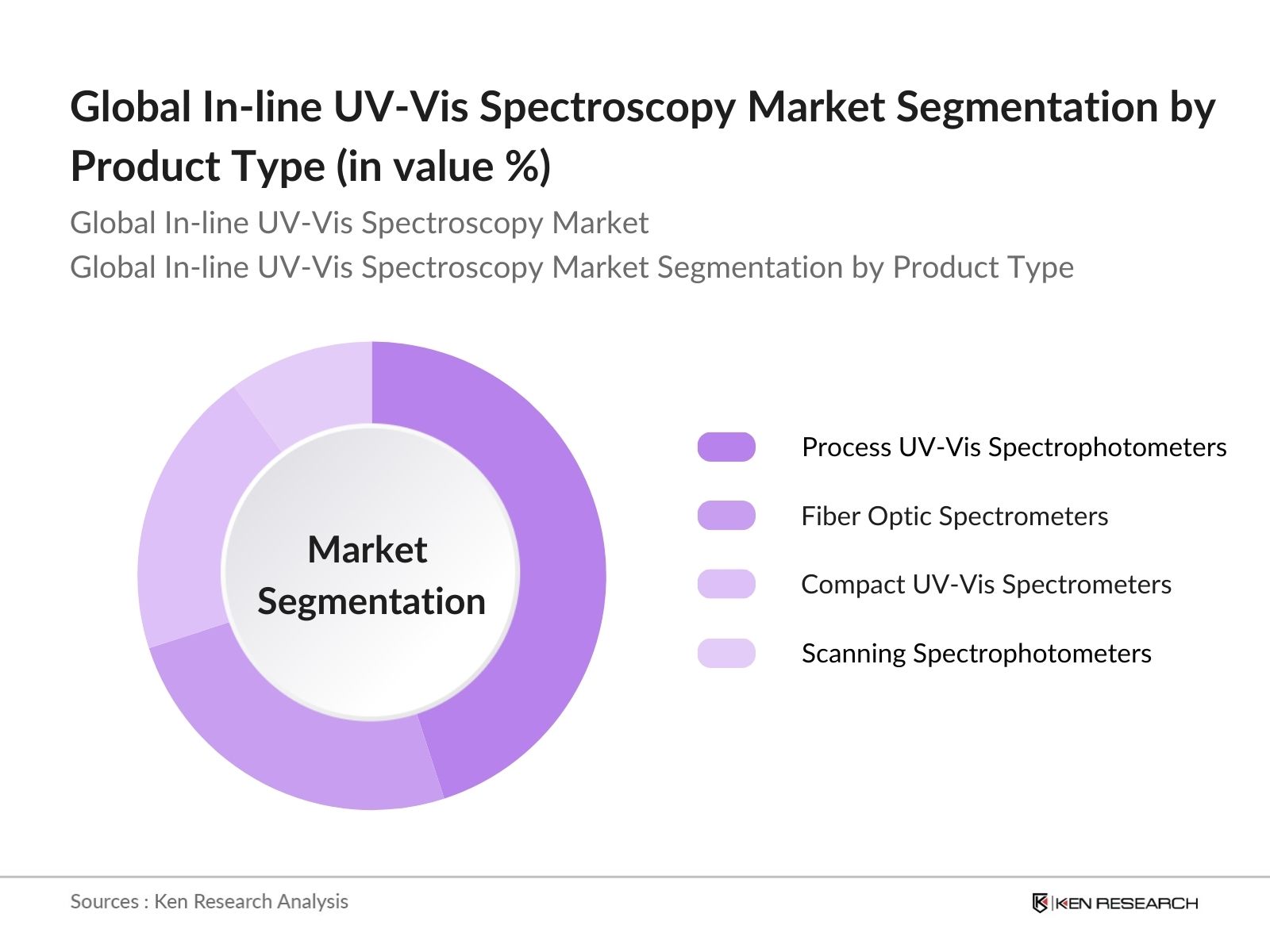
Process UV-Vis Spectrophotometers Fiber Optic Spectrometers Compact UV-Vis Spectrometers Scanning Spectrophotometers |
|
Application |
Pharmaceutical & Biotechnology Chemical Processing Food & Beverage Environmental Monitoring Academic Research |
|
End-User |
Manufacturing Industries R&D Laboratories Quality Assurance/Quality Control Departments |
|
Wavelength Range |
Visible Spectroscopy Ultraviolet Spectroscopy Extended Wavelength Spectroscopy |
|
Region |
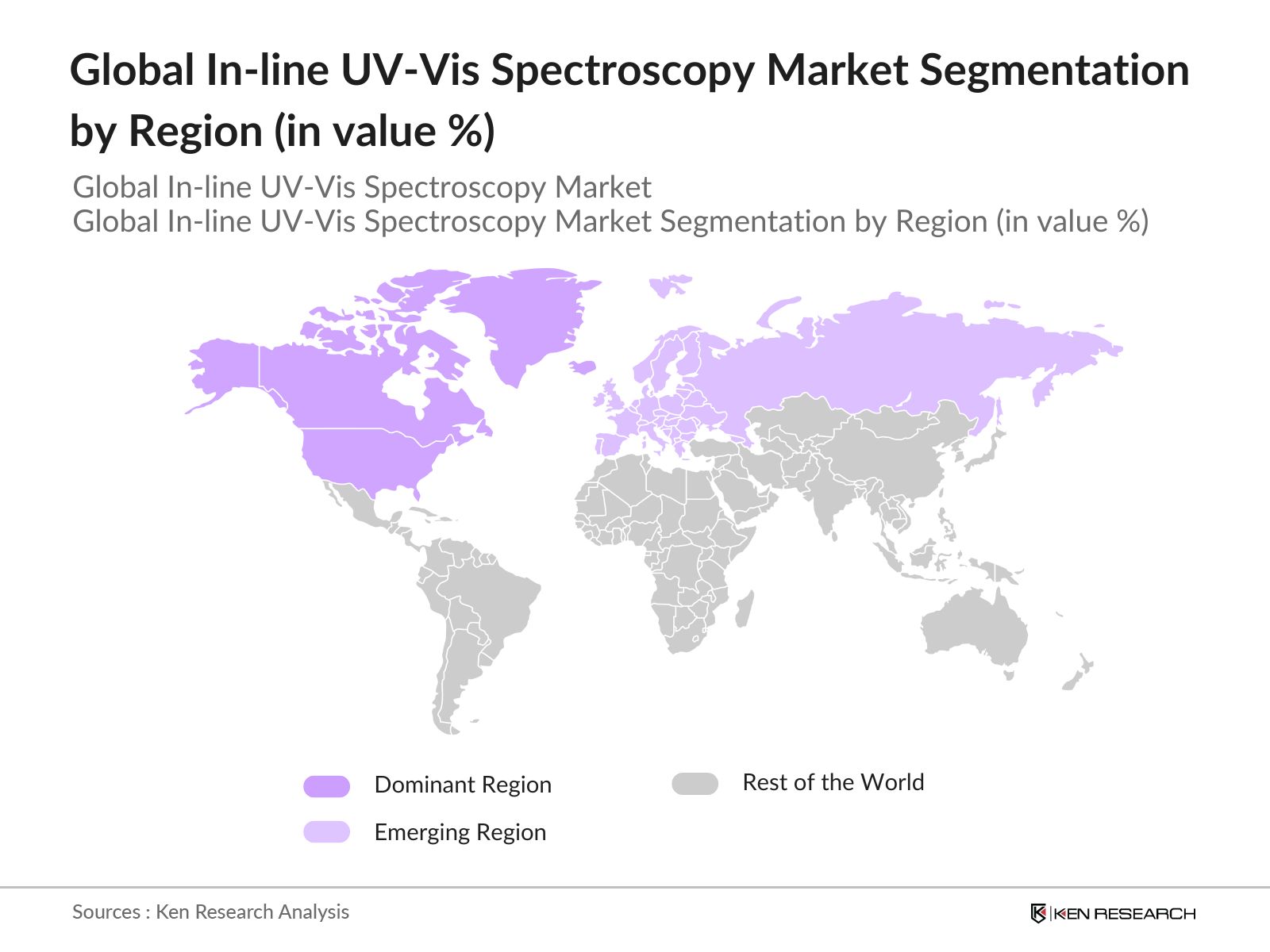
North America Europe Asia-Pacific Latin America Middle East & Africa |
1.1. Definition and Scope
1.2. Market Taxonomy
1.3. Market Growth Rate
1.4. Market Segmentation Overview
2.1. Historical Market Size
2.2. Year-On-Year Growth Analysis
2.3. Key Market Developments and Milestones
3.1. Growth Drivers
3.1.1. Advancements in Analytical Technologies
3.1.2. Growing Demand for Quality Control in Manufacturing (Pharmaceutical, Food & Beverage, Chemicals)
3.1.3. Integration of Automation in Analytical Processes
3.1.4. Increasing Adoption in Academic and Research Institutions
3.2. Market Challenges
3.2.1. High Initial Investment Costs
3.2.2. Technical Complexity in Operational Settings
3.2.3. Limited Penetration in Developing Economies
3.3. Opportunities
3.3.1. Emergence of Real-time Monitoring Systems
3.3.2. Expansion in Biopharmaceuticals and Advanced Material Science
3.3.3. Collaboration with Industry 4.0 and IoT Technologies
3.4. Trends
3.4.1. Shift Towards Cloud-based Analytical Solutions
3.4.2. Miniaturization of In-line Spectroscopy Instruments
3.4.3. AI-driven Analytical Insights for Enhanced Process Efficiency
3.5. Government Regulations
3.5.1. FDA Guidelines on Analytical Instrumentation
3.5.2. EU Directives for Process Analytical Technologies
3.5.3. Quality Standards for UV-Vis Spectroscopy in Industrial Settings
3.6. SWOT Analysis
3.7. Porters Five Forces Analysis
3.8. Stake Ecosystem
3.9. Competition Ecosystem
4.1. By Product Type (In Value %)
4.1.1. Process UV-Vis Spectrophotometers
4.1.2. Fiber Optic Spectrometers
4.1.3. Compact UV-Vis Spectrometers
4.1.4. Scanning Spectrophotometers
4.2. By Application (In Value %)
4.2.1. Pharmaceutical & Biotechnology
4.2.2. Chemical Processing
4.2.3. Food & Beverage Industry
4.2.4. Environmental Monitoring
4.2.5. Academic Research
4.3. By End-User (In Value %)
4.3.1. Manufacturing Industries
4.3.2. R&D Laboratories
4.3.3. Quality Assurance/Quality Control Departments
4.4. By Wavelength Range (In Value %)
4.4.1. Visible Spectroscopy (400700 nm)
4.4.2. Ultraviolet Spectroscopy (200400 nm)
4.4.3. Extended Wavelength Spectroscopy (1901100 nm)
4.5. By Region (In Value %)
4.5.1. North America
4.5.2. Europe
4.5.3. Asia-Pacific
4.5.4. Latin America
4.5.5. Middle East & Africa
5.1. Detailed Profiles of Major Competitors (In-depth profiles of 15 key competitors)
5.1.1. Agilent Technologies Inc.
5.1.2. Thermo Fisher Scientific Inc.
5.1.3. PerkinElmer Inc.
5.1.4. Shimadzu Corporation
5.1.5. Ocean Insight
5.1.6. Horiba Ltd.
5.1.7. Jasco Inc.
5.1.8. Hitachi High-Technologies Corporation
5.1.9. Hach Company
5.1.10. ABB Analytical
5.1.11. Metrohm AG
5.1.12. Mettler-Toledo International Inc.
5.1.13. Sartorius AG
5.1.14. Xenon Corporation
5.1.15. StellarNet Inc.
5.2. Cross Comparison Parameters (Headquarters, No. of Employees, Revenue, Product Innovation, Market Share, Global Presence, Product Portfolio, Technological Collaboration)
5.3. Market Share Analysis (In Value %)
5.4. Strategic Initiatives (Key partnerships, collaborations, and innovation strategies)
5.5. Mergers and Acquisitions
5.6. Investment Analysis (Venture capital and private equity involvement)
5.7. Key R&D Initiatives
6.1. Industry-Specific Compliance and Standards
6.2. Validation and Calibration Requirements
6.3. Environmental and Safety Regulations
7.1. Future Market Size Projections
7.2. Key Factors Driving Future Market Growth
8.1. By Product Type (In Value %)
8.2. By Application (In Value %)
8.3. By End-User (In Value %)
8.4. By Wavelength Range (In Value %)
8.5. By Region (In Value %)
9.1. TAM/SAM/SOM Analysis
9.2. Customer Cohort Analysis
9.3. Emerging Markets and Opportunities
9.4. Technological White Space Opportunity Analysis
This phase involved mapping all stakeholders in the global UV-Vis spectroscopy market. Secondary data from proprietary databases and industry sources were used to identify crucial variables influencing market dynamics, including technological trends and regulatory mandates.
Historical data on market penetration and revenue generation was gathered, along with a ratio analysis of in-line spectroscopy installations versus off-line solutions. This helped in constructing a robust understanding of market growth trends.
Industry experts were consulted through CATIs to validate key hypotheses about market trends and technological innovations. These insights were crucial in corroborating and fine-tuning our research findings.
In the final stage, extensive data was collected directly from manufacturers to validate insights about product performance, market demand, and technological advancements, ensuring a comprehensive, validated report.
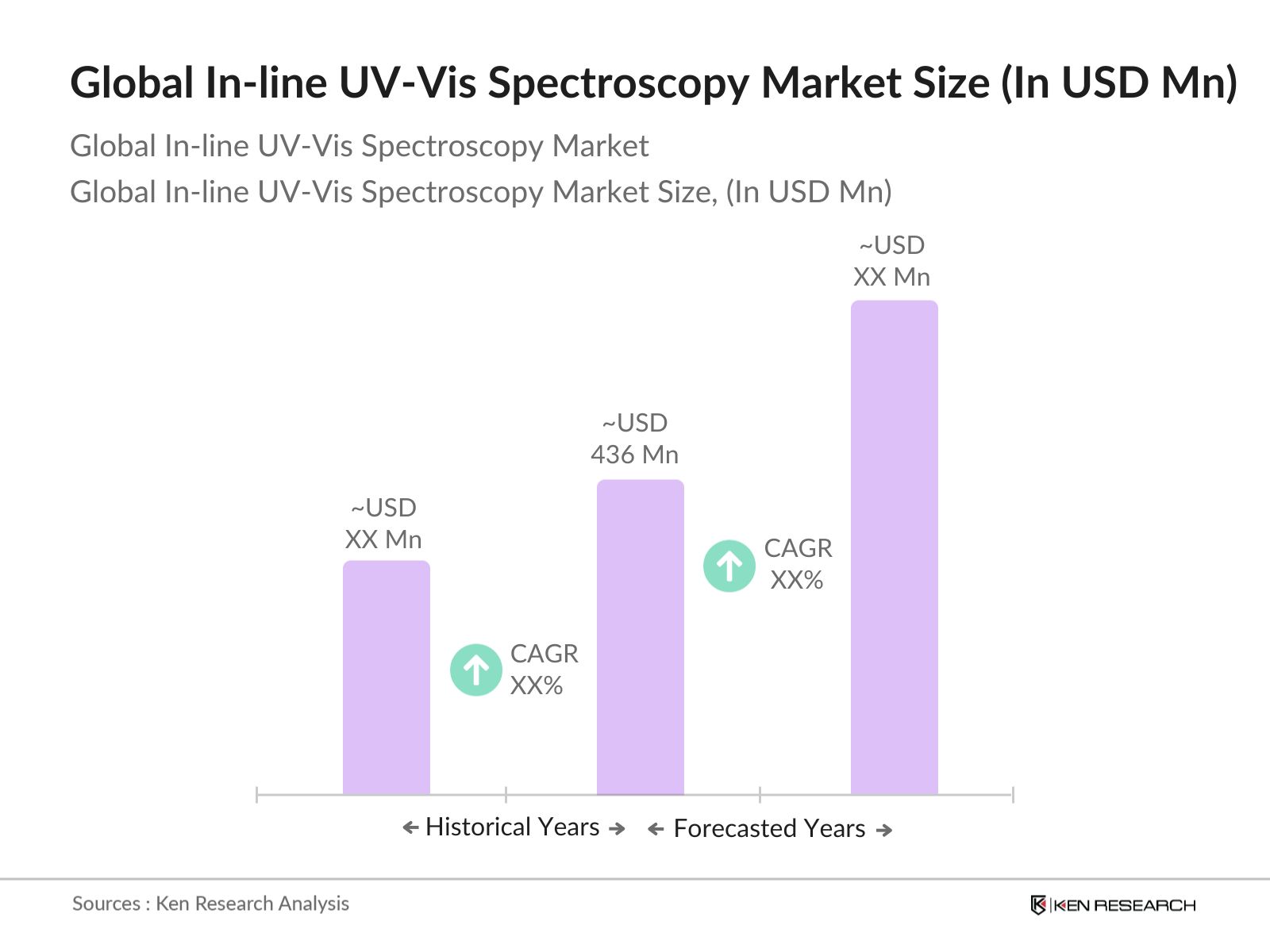
The Global In-line UV-Vis Spectroscopy Market is valued at USD 436 million and is primarily driven by advancements in real-time monitoring technologies across several industries, including pharmaceuticals and food & beverage.
Challenges in the Global In-line UV-Vis Spectroscopy Market include high initial investment costs, technical complexity in process settings, and limited penetration in developing economies where the infrastructure for real-time monitoring is still evolving.
Key players in the Global In-line UV-Vis Spectroscopy Market include Agilent Technologies Inc., Thermo Fisher Scientific Inc., PerkinElmer Inc., Shimadzu Corporation, and Horiba Ltd.. These companies dominate the market due to their innovative solutions and global presence.
Growth drivers in the Global In-line UV-Vis Spectroscopy Market include increasing demand for real-time quality control, advancements in spectroscopy technology, and integration with automation systems in industries such as pharmaceuticals, chemicals, and food processing.

What makes us stand out is that our consultants follows Robust, Refine and Result (RRR) methodology. i.e. Robust for clear definitions, approaches and sanity checking, Refine for differentiating respondents facts and opinions and Result for presenting data with story

We have set a benchmark in the industry by offering our clients with syndicated and customized market research reports featuring coverage of entire market as well as meticulous research and analyst insights.

While we don't replace traditional research, we flip the method upside down. Our dual approach of Top Bottom & Bottom Top ensures quality deliverable by not just verifying company fundamentals but also looking at the sector and macroeconomic factors.

With one step in the future, our research team constantly tries to show you the bigger picture. We help with some of the tough questions you may encounter along the way: How is the industry positioned? Best marketing channel? KPI's of competitors? By aligning every element, we help maximize success.

Our report gives you instant access to the answers and sources that other companies might choose to hide. We elaborate each steps of research methodology we have used and showcase you the sample size to earn your trust.

If you need any support, we are here! We pride ourselves on universe strength, data quality, and quick, friendly, and professional service.