
Global Lawn Mower Robot Market Outlook to 2030
Region:Global
Author(s):Sanjna
Product Code:KROD4338
December 2024
125
About the Report
Global Lawn Mower Robot Market Overview
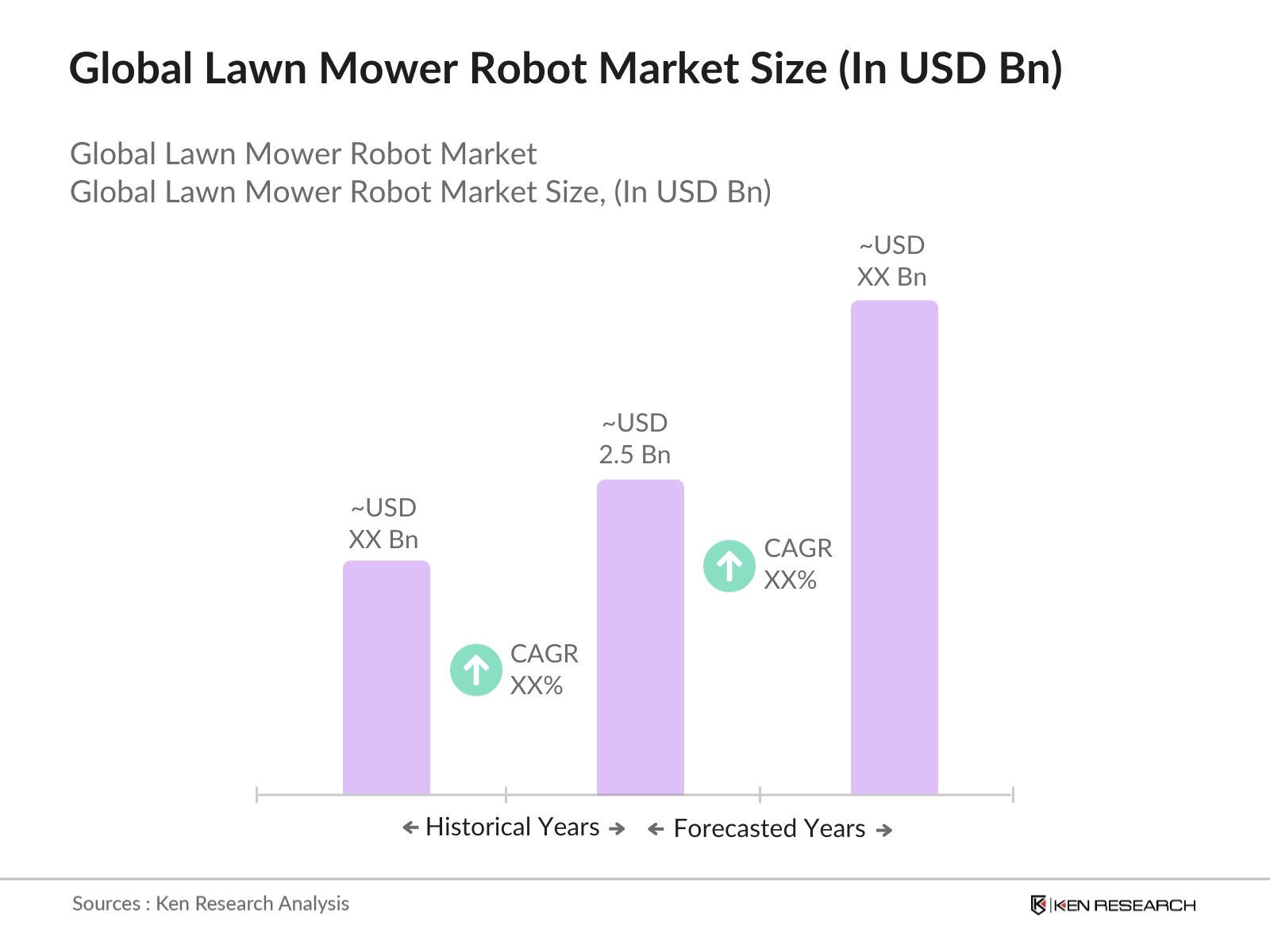
- The Global Lawn Mower Robot Market is valued at USD 2.5 billion, driven by the increasing adoption of automation and smart home technologies. The market is witnessing significant growth due to consumers' preference for efficient and eco-friendly lawn maintenance solutions. Additionally, the integration of AI and IoT into these devices has attracted a tech-savvy audience, leading to heightened demand.
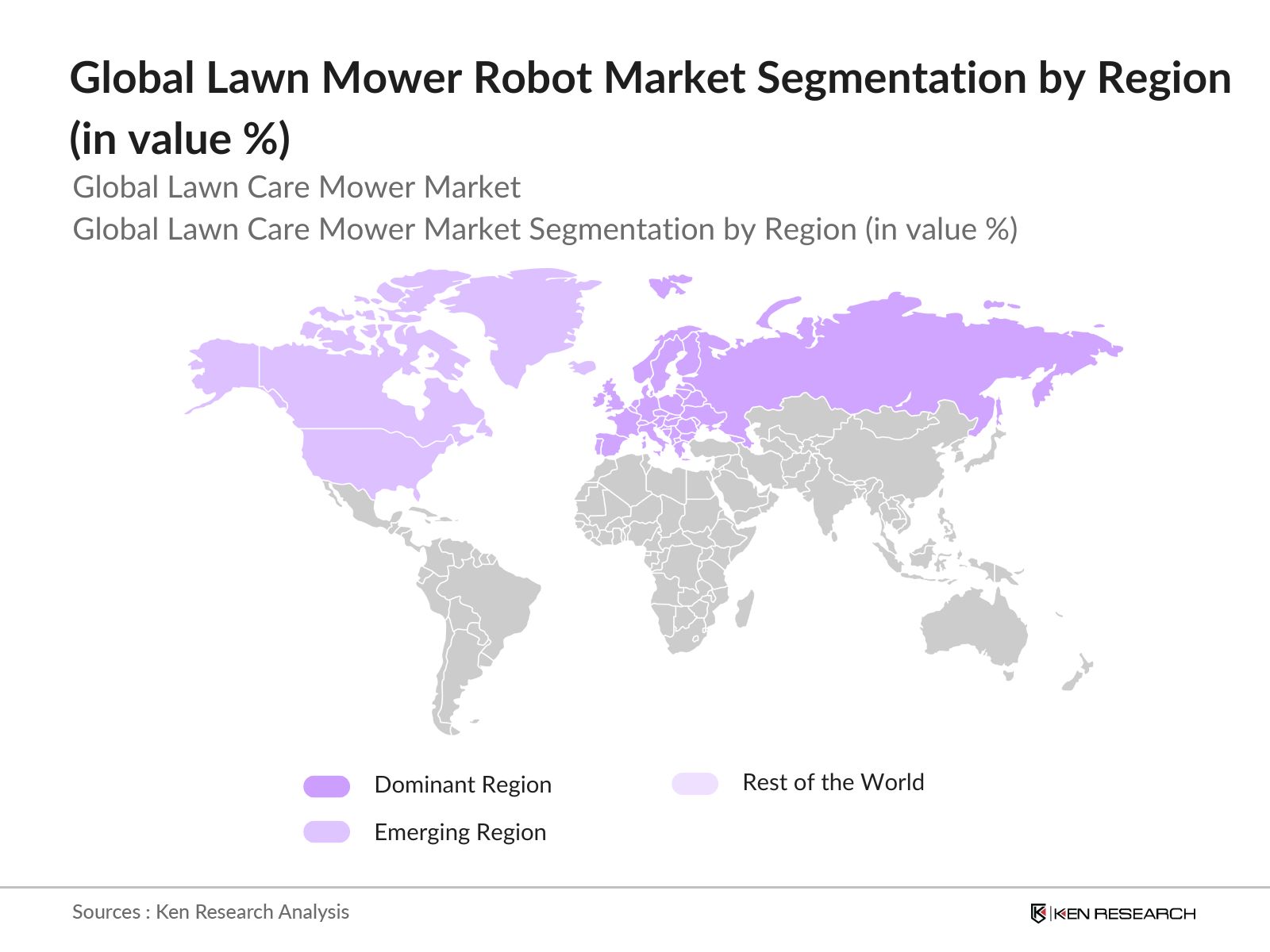
- Europe is the leading region in the Lawn Mower Robot market, with countries such as Germany, the Netherlands, and the UK dominating due to their advanced technological infrastructure and high disposable income. These nations have a mature market for home automation and a strong focus on environmental sustainability, making them early adopters of innovative robotic solutions. Moreover, their consumer base prioritizes convenience and eco-friendly products, giving them a competitive edge in market penetration.
- Governments worldwide are tightening safety and certification standards for autonomous devices, including Lawn Mower Robots. In 2023, the European Union introduced new safety regulations for autonomous mowers, mandating that all devices meet stringent certification standards for operation in residential areas. This regulatory framework ensures that Lawn Mower Robots meet high safety standards, reducing the risk of accidents and boosting consumer confidence.
Global Lawn Mower Robot Market Segmentation
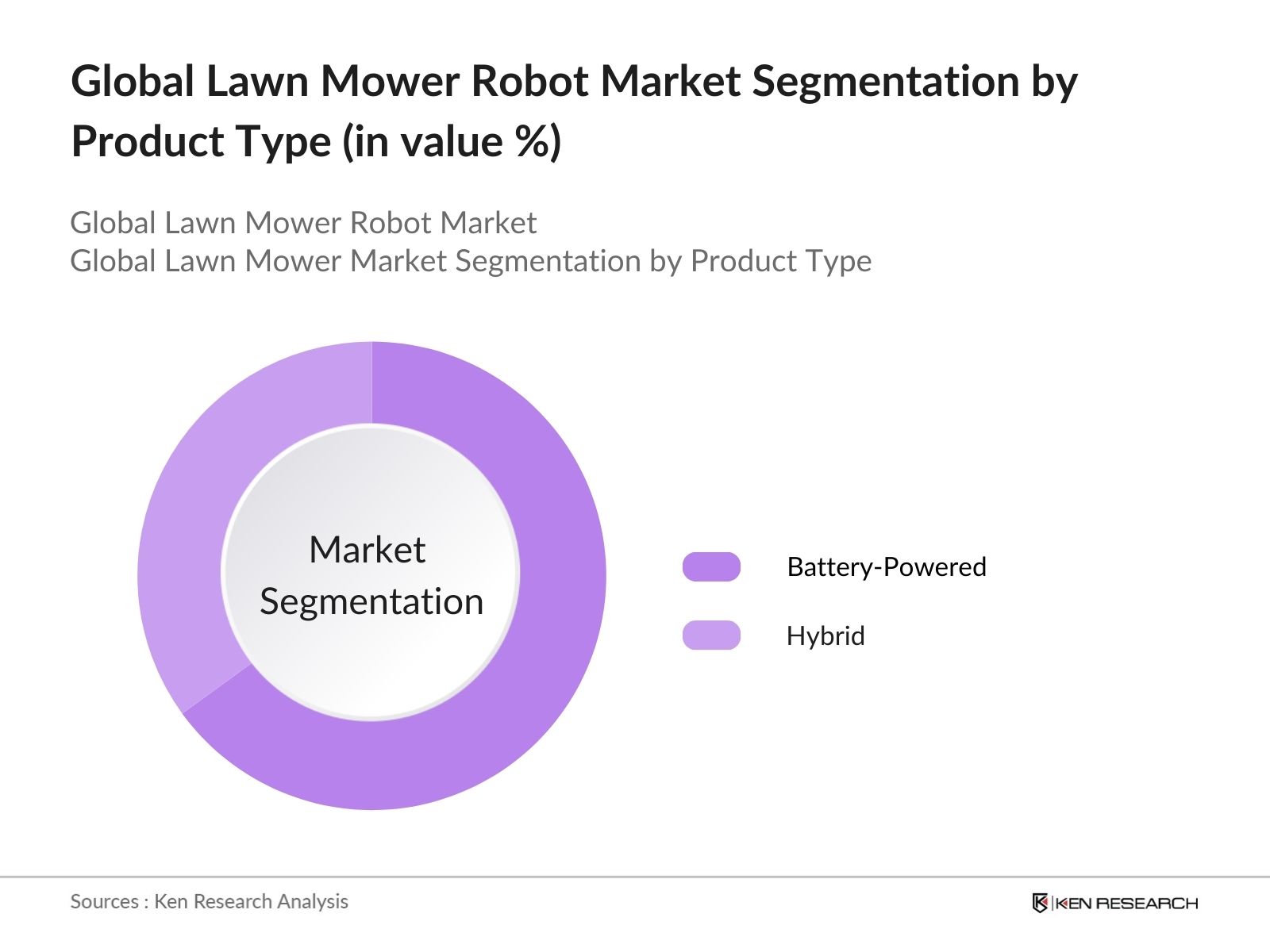
By Product Type: The Global Lawn Mower Robot market is segmented by product type into battery-powered and hybrid models. The battery-powered segment holds a dominant market share as it aligns with the growing consumer preference for energy-efficient, eco-friendly solutions. Brands are leveraging lithium-ion battery technology to improve mower runtime and charging speeds, making these products more attractive to consumers concerned about reducing their carbon footprint.
By Region: The market is also segmented by region into North America, Europe, Asia Pacific, Latin America, and the Middle East & Africa. Europe leads the market as consumers in countries such as Germany and the Netherlands are more inclined toward automated lawn maintenance solutions. These countries have well-established infrastructures that support the adoption of Lawn Mower Robots, making them a dominant force in the global market.
By Lawn Size: The market is segmented by lawn size into small (up to 0.4 acres), medium (0.4 to 1 acre), and large (above 1 acre). The small lawn segment dominates due to the increasing urbanization and the trend toward smaller gardens, especially in Europe and Asia Pacific. Urban dwellers with limited green space seek efficient robotic solutions that can manage their lawn areas without much human intervention, driving demand for small-sized Lawn Mower Robots.
Global Lawn Mower Robot Market Competitive Landscape
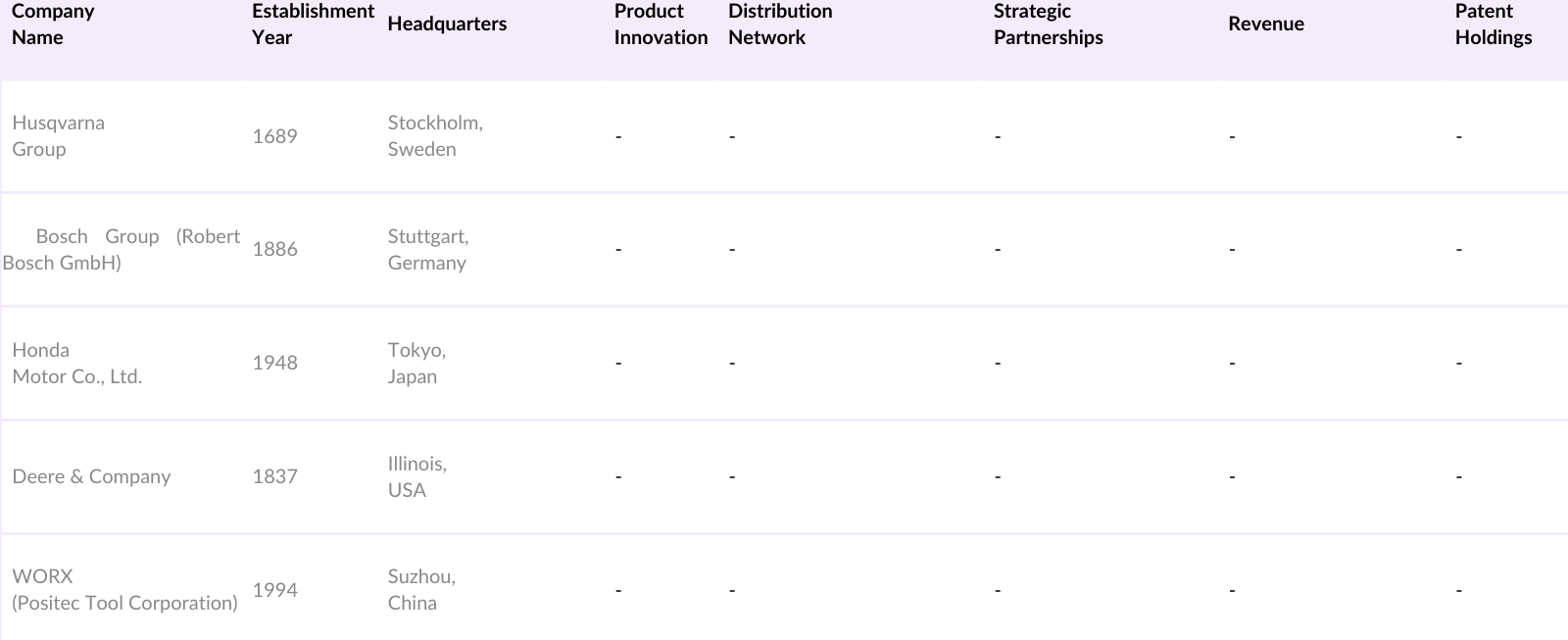
The global Lawn Mower Robot market is dominated by both established players and new entrants, focusing on technological advancements, product differentiation, and strategic partnerships. Companies are constantly innovating to meet consumer demands for efficiency, convenience, and environmental sustainability. The market is characterized by high competition, with a few players holding a significant share due to their extensive product portfolios and brand presence.
Global Lawn Mower Robot Market Analysis
Market Growth Drivers
- Increased Adoption of Autonomous Technology: The global Lawn Mower Robot market is experiencing substantial growth due to the rising adoption of autonomous technology. In 2024, global spending on autonomous technologies in the home sector reached $95 billion, with robotics playing a key role in consumer demand for automation. This surge is attributed to advancements in AI and machine learning, helping households maintain lawns without human intervention, thus driving a shift towards fully autonomous solutions.
- Smart Garden Integration with IoT Devices: Lawn Mower Robots are increasingly integrating with Internet of Things (IoT) ecosystems in 2024. According to the World Bank, the global IoT-enabled device market grew to 18 billion devices in 2023, with 10% linked to smart home systems. This rise in IoT-connected devices enables users to control lawn mowers via mobile apps or voice assistants like Amazon Alexa or Google Home, providing seamless lawn management.
- Rise in Demand for Energy-Efficient Lawn Maintenance: Energy efficiency is a critical factor driving the adoption of Lawn Mower Robots, particularly in 2024, where energy conservation policies are gaining momentum. The International Energy Agency (IEA) reported that global energy consumption in households dropped by 3% in 2023 due to efficiency-driven appliances. This has aligned with sustainability goals globally, where governments in regions like the EU provide incentives for energy-efficient equipment.
Market Challenges
- High Initial Investment for Consumers: The high initial investment required for Lawn Mower Robots remains a significant challenge for widespread adoption. In 2024, the average cost of Lawn Mower Robots ranged between $800 to $2,500, depending on features and capabilities. Consequently, price sensitivity in these regions slows down the adoption of this technology despite its long-term benefits.
- Technical Barriers in Challenging Terrains: Lawn Mower Robots face significant challenges in navigating complex terrains such as uneven lawns, slopes, and gardens with dense foliage. As per 2023 data from the World Bank, about 42% of residential gardens in Europe and North America have challenging terrain, making it difficult for robots to operate efficiently. This technical barrier impacts performance and reduces the market potential for such devices in certain geographical locations, necessitating continued innovation in navigation technologies.
Global Lawn Mower Robot Market Future Outlook
The Global Lawn Mower Robot Market is expected to experience significant growth over the next five years, driven by advancements in AI and IoT, increasing consumer preference for sustainable solutions, and continuous technological improvements. The growing urbanization and the shrinking size of gardens globally are also likely to push demand for Lawn Mower Robots, especially in regions like Europe and North America. Moreover, partnerships with smart home ecosystem providers will help integrate these devices into consumers' existing setups, further boosting market growth.
Market Opportunities
- Emergence of Solar-Powered Lawn Mower Robots: Solar-powered robot lawn mowers are an emerging opportunity in 2024, aligning with global sustainability efforts. According to the International Renewable Energy Agency (IRENA), solar energy generation capacity grew by 22% in 2023, providing an ideal environment for solar-powered devices. Robot mowers powered by solar panels can operate in regions with high solar exposure, particularly in markets like the Middle East, Africa, and Southern Europe.
- Opportunities in Emerging Markets in APAC and Latin America: The APAC and Latin American regions present untapped markets for Lawn Mower Robots. In 2023, World Bank data revealed that urbanization rates in these regions grew by 3%, with more residential areas adopting smart technologies. Additionally, rising disposable incomes in countries like China and Brazil are increasing consumer spending on automated home devices, creating opportunities for market expansion.
Scope of the Report
|
Segments |
Sub-Segments |
|
Product Type |
Battery-Powered Hybrid |
|
Lawn Size |
Small Medium Large |
|
Connectivity |
Wi-Fi-Enabled Bluetooth-Enabled GPS-Enabled |
|
End-User |
Residential Commercial |
|
Region |
North America Europe Asia Pacific Latin America Middle East & Africa |
Products
Key Target Audience
Lawn Mower Robot Manufacturers
Smart Home Device Providers
Agricultural Technology Firms
Battery Technology Providers
E-commerce Platforms
Landscaping Service Providers
Investors and Venture Capitalist Firms
Government and Regulatory Bodies (European Union, U.S. Environmental Protection Agency)
Companies
Players Mentioned in the Report:
Husqvarna Group
Bosch Group (Robert Bosch GmbH)
Honda Motor Co., Ltd.
Deere & Company
WORX (Positec Tool Corporation)
Robomow (MTD Products Inc.)
STIGA S.p.A
LG Electronics
Mamibot Manufacturing USA, Inc.
Zucchetti Centro Sistemi S.p.A
Table of Contents
1. Global Lawn Mower Robot Market Overview
1.1. Definition and Scope
1.2. Market Taxonomy
1.3. Market Growth Rate
1.4. Market Segmentation Overview
2. Global Lawn Mower Robot Market Size (In USD Bn)
2.1. Historical Market Size
2.2. Year-On-Year Growth Analysis
2.3. Key Market Developments and Milestones
3. Global Lawn Mower Robot Market Analysis
3.1. Growth Drivers (Technological Advancements, Consumer Preferences, Smart Home Integration, Sustainability Demands)
3.1.1. Increased Adoption of Autonomous Technology
3.1.2. Smart Garden Integration with IoT Devices
3.1.3. Rise in Demand for Energy-Efficient Lawn Maintenance
3.1.4. Growing Trend of Time-Saving Solutions in Household Activities
3.2. Market Challenges (Cost Barriers, Regulatory Standards, Battery Life, Technological Complexity)
3.2.1. High Initial Investment for Consumers
3.2.2. Technical Barriers in Challenging Terrains
3.2.3. Battery Life Limitations for Large Lawns
3.2.4. Lack of Awareness in Emerging Markets
3.3. Opportunities (Green Technology, Expansion in Untapped Markets, Urbanization, Partnerships)
3.3.1. Emergence of Solar-Powered Lawn Mower Robots
3.3.2. Opportunities in Emerging Markets in APAC and Latin America
3.3.3. Urbanization and Smaller Gardens Driving Demand
3.3.4. Strategic Partnerships with Smart Home Ecosystem Providers
3.4. Trends (AI-Based Innovations, Sustainability Focus, Battery Technology Evolution, Smart Integration)
3.4.1. AI and Machine Learning Capabilities for Advanced Navigation
3.4.2. Growth of Eco-Friendly and Sustainable Lawn Mowers
3.4.3. Enhanced Battery Storage and Charging Technologies
3.4.4. Increased Integration with Voice-Controlled Assistants
3.5. Government Regulation (Safety Standards, Environmental Regulations, Certification Requirements, Incentive Programs)
3.5.1. Safety and Certification Standards for Autonomous Lawn Mowers
3.5.2. Regulations Regarding Noise Pollution
3.5.3. Incentives for Sustainable Lawn Mower Adoption
3.5.4. EU and U.S. Regulatory Guidelines for Autonomous Systems
3.6. SWOT Analysis
3.7. Stakeholder Ecosystem
3.8. Porters Five Forces
3.9. Competition Ecosystem
4. Global Lawn Mower Robot Market Segmentation
4.1. By Product Type (In Value %)
4.1.1. Battery-Powered Lawn Mower Robots
4.1.2. Hybrid Lawn Mower Robots
4.2. By Lawn Size (In Value %)
4.2.1. Small (Up to 0.4 Acres)
4.2.2. Medium (0.4 to 1 Acre)
4.2.3. Large (Above 1 Acre)
4.3. By Connectivity (In Value %)
4.3.1. Wi-Fi-Enabled
4.3.2. Bluetooth-Enabled
4.3.3. GPS-Enabled
4.4. By End-User (In Value %)
4.4.1. Residential
4.4.2. Commercial
4.5. By Region (In Value %)
4.5.1. North America
4.5.2. Europe
4.5.3. Asia Pacific
4.5.4. Latin America
4.5.5. Middle East & Africa
5. Global Lawn Mower Robot Market Competitive Analysis
5.1. Detailed Profiles of Major Companies
5.1.1. Husqvarna Group
5.1.2. Honda Motor Co., Ltd.
5.1.3. Bosch Group (Robert Bosch GmbH)
5.1.4. Deere & Company
5.1.5. Zucchetti Centro Sistemi S.p.A
5.1.6. STIGA S.p.A
5.1.7. LG Electronics
5.1.8. WORX (Positec Tool Corporation)
5.1.9. Robomow (MTD Products Inc.)
5.1.10. Mamibot Manufacturing USA, Inc.
5.2. Cross Comparison Parameters (Revenue, Headquarters, Product Innovations, Distribution Network, Strategic Partnerships, Patent Holdings, R&D Investments, Customer Base)
5.3. Market Share Analysis
5.4. Strategic Initiatives
5.5. Mergers and Acquisitions
5.6. Investment Analysis
5.7. Venture Capital Funding
5.8. Government Grants
5.9. Private Equity Investments
6. Global Lawn Mower Robot Market Regulatory Framework
6.1. Compliance Requirements
6.2. Certification Processes
6.3. Environmental and Safety Standards
7. Global Lawn Mower Robot Future Market Size (In USD Bn)
7.1. Future Market Size Projections
7.2. Key Factors Driving Future Market Growth
8. Global Lawn Mower Robot Future Market Segmentation
8.1. By Product Type (In Value %)
8.2. By Lawn Size (In Value %)
8.3. By Connectivity (In Value %)
8.4. By End-User (In Value %)
8.5. By Region (In Value %)
9. Global Lawn Mower Robot Market Analysts' Recommendations
9.1. TAM/SAM/SOM Analysis
9.2. Marketing Initiatives
9.3. White Space Opportunity Analysis
9.4. Customer Cohort Analysis
Disclaimer Contact UsResearch Methodology
Step 1: Identification of Key Variables
The initial phase involves constructing an ecosystem map encompassing all major stakeholders within the Global Lawn Mower Robot Market. This step is underpinned by extensive desk research, utilizing secondary and proprietary databases to gather comprehensive industry-level information. The primary objective is to identify and define critical variables that influence market dynamics.
Step 2: Market Analysis and Construction
In this phase, we compile and analyze historical data pertaining to the Global Lawn Mower Robot Market. This includes assessing market penetration, the ratio of products to service providers, and the resultant revenue generation. Additionally, service quality statistics are evaluated to ensure the reliability and accuracy of the revenue estimates.
Step 3: Hypothesis Validation and Expert Consultation
Market hypotheses are developed and subsequently validated through computer-assisted telephone interviews (CATIs) with industry experts representing a diverse array of companies. These consultations provide valuable operational and financial insights directly from industry practitioners, instrumental in refining and corroborating the market data.
Step 4: Research Synthesis and Final Output
The final phase involves direct engagement with multiple Lawn Mower Robot manufacturers to acquire detailed insights into product segments, sales performance, consumer preferences, and other pertinent factors. This interaction verifies and complements the statistics derived from the bottom-up approach, ensuring a comprehensive and validated analysis of the market.
Frequently Asked Questions
01. How big is the Global Lawn Mower Robot Market?
The Global Lawn Mower Robot Market is valued at USD 2.5 billion, driven by technological innovations and the increasing demand for smart home integration.
02. What are the challenges in the Global Lawn Mower Robot Market?
Challenges in Global Lawn Mower Robot include high initial investment costs for consumers, limited awareness in emerging markets, and battery life issues in large lawn areas.
03. Who are the major players in the Global Lawn Mower Robot Market?
Key players in Global Lawn Mower Robot market include Husqvarna Group, Bosch Group, Honda Motor Co., Ltd., WORX, and Deere & Company.
04. What are the growth drivers in the Global Lawn Mower Robot Market?
Growth drivers of Global Lawn Mower Robot include the increasing demand for smart home solutions, advancements in AI and battery technology, and growing awareness of eco-friendly lawn maintenance practices. The push towards automation and time-saving devices is further boosting market demand.
Why Buy From Us?

What makes us stand out is that our consultants follows Robust, Refine and Result (RRR) methodology. i.e. Robust for clear definitions, approaches and sanity checking, Refine for differentiating respondents facts and opinions and Result for presenting data with story

We have set a benchmark in the industry by offering our clients with syndicated and customized market research reports featuring coverage of entire market as well as meticulous research and analyst insights.

While we don't replace traditional research, we flip the method upside down. Our dual approach of Top Bottom & Bottom Top ensures quality deliverable by not just verifying company fundamentals but also looking at the sector and macroeconomic factors.

With one step in the future, our research team constantly tries to show you the bigger picture. We help with some of the tough questions you may encounter along the way: How is the industry positioned? Best marketing channel? KPI's of competitors? By aligning every element, we help maximize success.

Our report gives you instant access to the answers and sources that other companies might choose to hide. We elaborate each steps of research methodology we have used and showcase you the sample size to earn your trust.

If you need any support, we are here! We pride ourselves on universe strength, data quality, and quick, friendly, and professional service.