
Global Light Sensor Market Outlook to 2030
Region:Global
Author(s):Mukul
Product Code:KROD10453
November 2024
95
About the Report
Global Light Sensor Market Overview
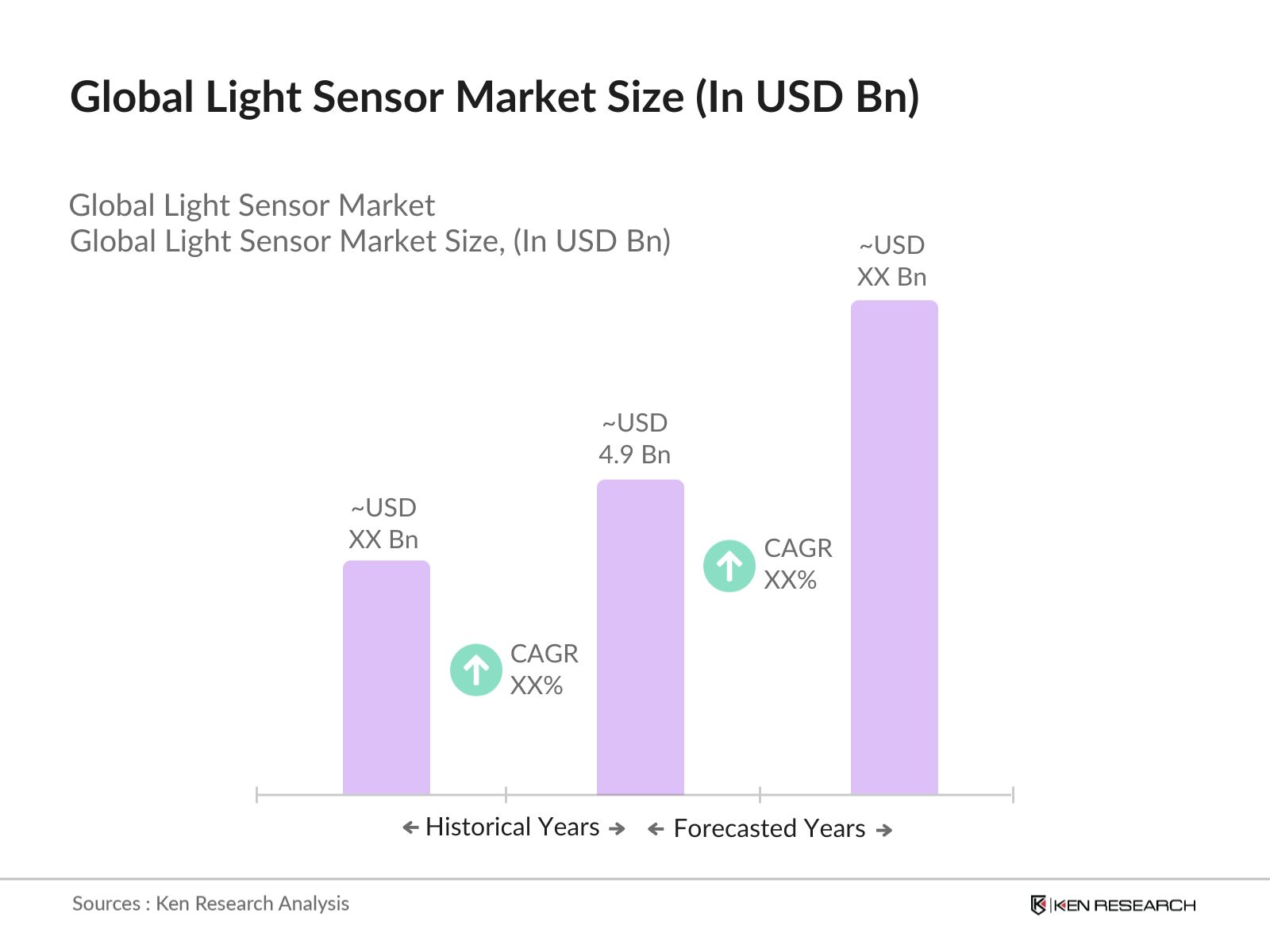
- The global light sensor market is valued at USD 4.9 billion, driven by the increasing demand for energy-efficient and smart devices in consumer electronics, automotive, and industrial applications. The proliferation of smart technologies, such as IoT-enabled devices and the rise of automated systems, has significantly increased the adoption of light sensors in diverse applications, such as brightness control and proximity sensing. Continuous innovations in the field of sensor miniaturization and the integration of artificial intelligence in light-sensing devices have further fueled the market's growth.
- Countries like the United States, China, and Germany dominate the light sensor market due to their technological advancements and robust electronics manufacturing industries. The United States leads in the adoption of light sensors in smartphones, automotive applications, and industrial automation, while China and Germany benefit from strong industrial bases and investments in smart cities and infrastructure development. The presence of key market players and the push for greener and smarter solutions contribute to these countries' dominance.
- Governments across the globe are implementing stricter regulations on the accuracy of sensors used in critical applications such as healthcare, automotive, and aerospace. In 2023, the International Electrotechnical Commission (IEC) introduced updated standards for sensor accuracy, particularly for those used in medical devices and autonomous vehicles. This regulation ensures that sensors meet minimum performance requirements, creating a more standardized and reliable global market.
Global Light Sensor Market Segmentation
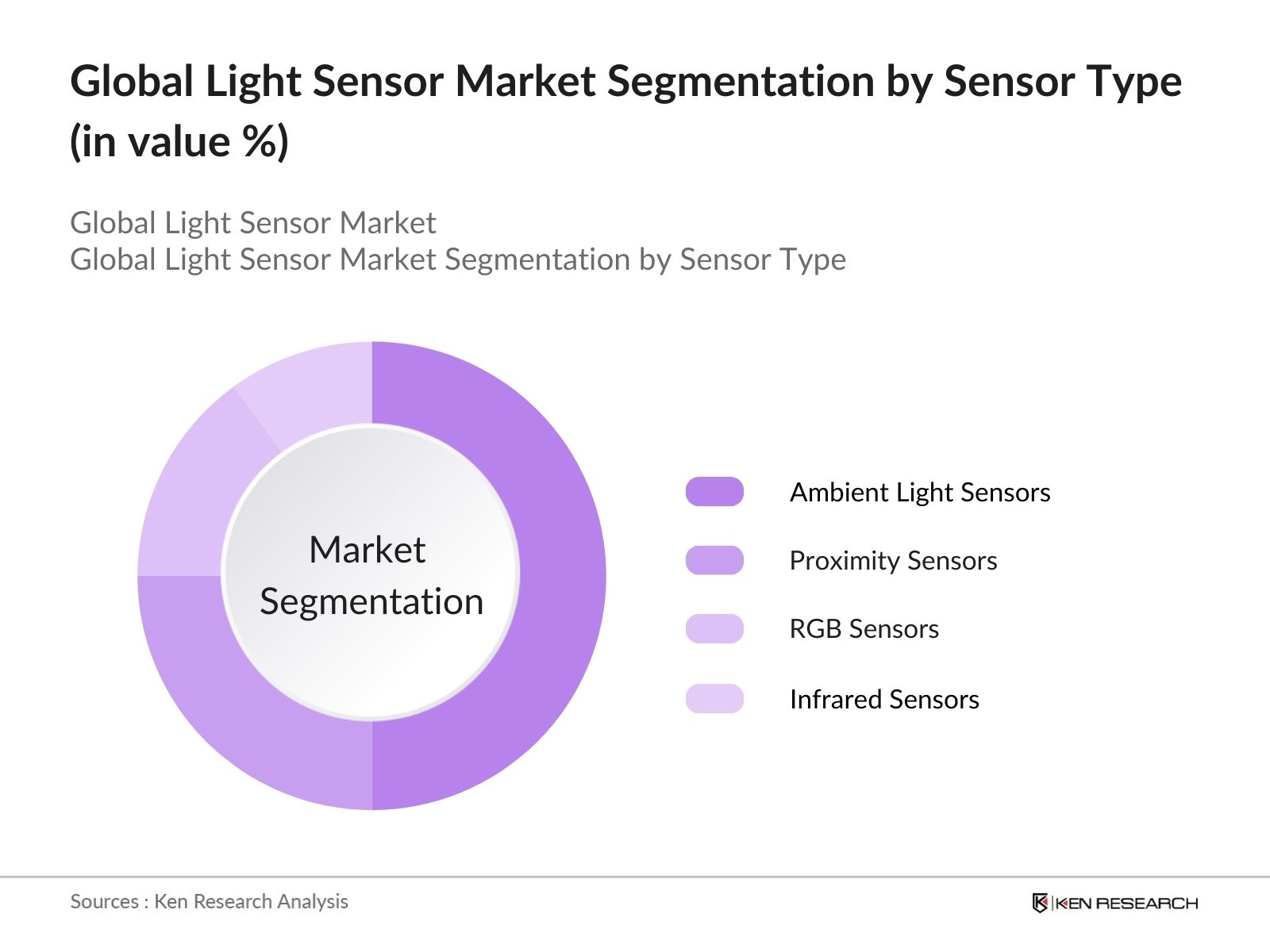
- By Sensor Type: The global light sensor market is segmented by sensor type into ambient light sensors, proximity sensors, RGB sensors, infrared sensors, and UV sensors. Ambient light sensors dominate the market owing to their widespread application in consumer electronics, particularly in smartphones and wearable devices. These sensors provide automatic brightness control and energy efficiency, a key requirement in modern devices. Proximity sensors also hold a significant share due to their use in automotive applications, such as in parking sensors and driver-assistance systems.
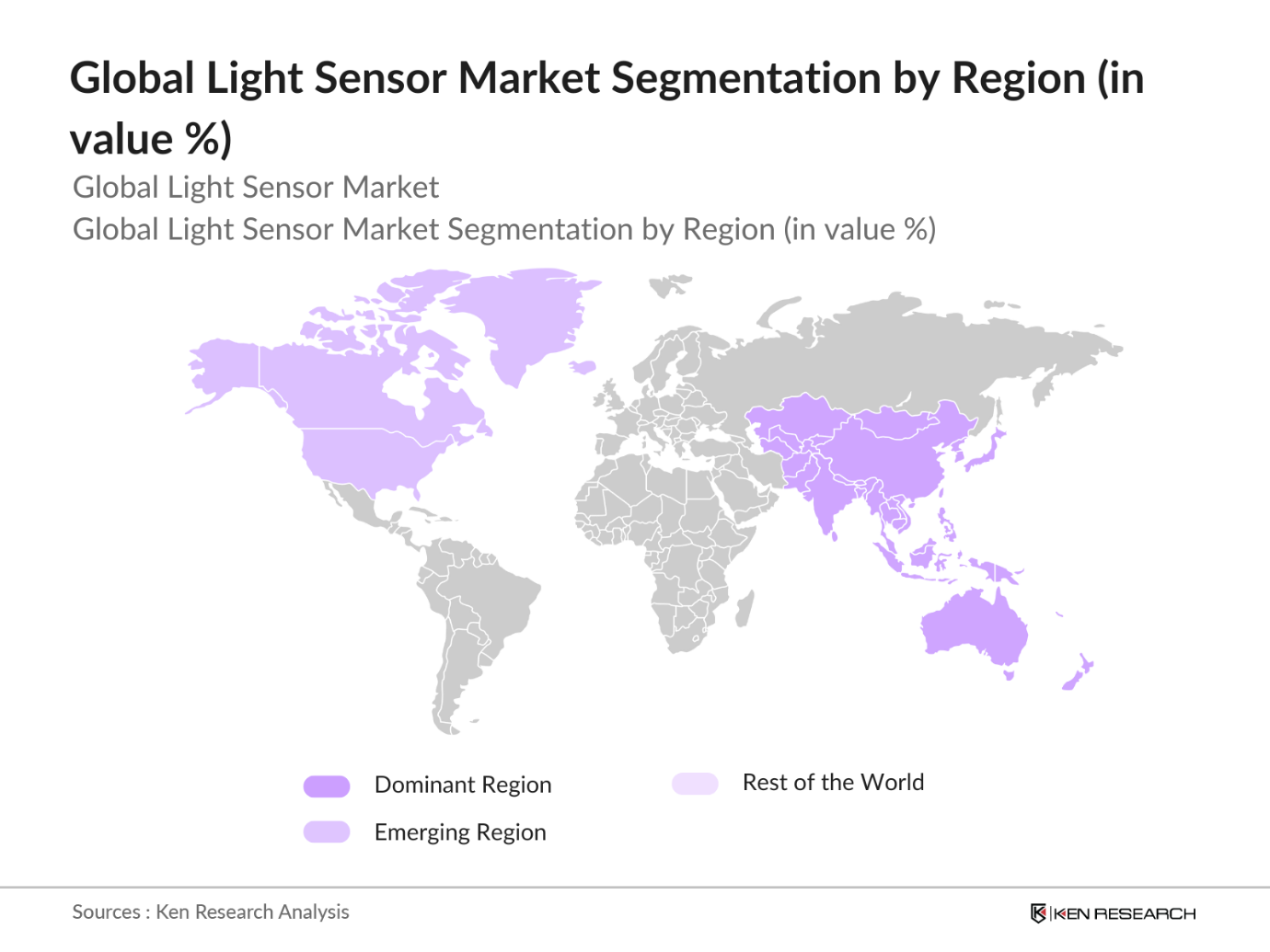
- By Region: Regionally, the global light sensor market is segmented into North America, Europe, Asia-Pacific, Latin America, and Middle East & Africa. Asia-Pacific dominates the market, driven by the large consumer electronics manufacturing hubs in China, South Korea, and Japan. These countries are at the forefront of smartphone and electronics production, integrating advanced light sensors into their products. North America follows closely, benefiting from technological advancements and high demand in automotive and industrial applications.
- By Application: The light sensor market is segmented by application into consumer electronics, automotive, healthcare, industrial, and security & surveillance. Consumer electronics holds the dominant share of the market due to the rapid adoption of smart devices like smartphones, tablets, and smart home appliances that require ambient light sensors for energy-saving and enhanced user experience. The automotive sector also contributes significantly, driven by the increasing incorporation of light sensors in autonomous vehicles and advanced driver assistance systems (ADAS).
Global Light Sensor Market Competitive Landscape
The global light sensor market is characterized by intense competition with several key players dominating the landscape. These companies are investing heavily in research and development to innovate and stay competitive. Mergers and acquisitions are also prevalent, aimed at expanding their technological capabilities and geographical presence. Companies like STMicroelectronics, Vishay Intertechnology, and AMS AG are leading the market with their comprehensive portfolios in light sensor technologies.
|
Company |
Year of Establishment |
Headquarters |
Revenue |
Employees |
Product Portfolio |
Key Patents |
Strategic Partnerships |
Manufacturing Footprint |
R&D Investment |
|
STMicroelectronics |
1987 |
Geneva, Switzerland |
- |
- |
- |
- |
- |
- |
- |
|
Vishay Intertechnology |
1962 |
Malvern, Pennsylvania, USA |
- |
- |
- |
- |
- |
- |
- |
|
AMS AG |
1981 |
Premsttten, Austria |
- |
- |
- |
- |
- |
- |
- |
|
ON Semiconductor |
1999 |
Phoenix, Arizona, USA |
- |
- |
- |
- |
- |
- |
- |
|
Broadcom Limited |
1961 |
San Jose, California, USA |
- |
- |
- |
- |
- |
- |
- |
Global Light Sensor Industry Analysis
Growth Drivers
- Rising Demand for Ambient Light Sensors in Smartphones: The demand for ambient light sensors in smartphones is surging due to the increasing use of mobile phones worldwide. In 2024, over 7.4 billion smartphone connections are expected globally, with India leading the market, having crossed 1.3 billion connections. This growth is driving the need for sensors that enhance user experience by adjusting screen brightness based on ambient lighting. According to the World Bank, global smartphone penetration will continue to increase, further boosting the demand for these sensors, particularly in emerging economies such as India and Southeast Asia.
- Expansion of IoT Applications: The proliferation of the Internet of Things (IoT) is pushing demand for light sensors integrated into smart devices. With more than 15 billion IoT-connected devices recorded in 2023, light sensors are becoming pivotal in enabling automation in smart homes and industries. The global rollout of 5G networks is further accelerating the adoption of IoT applications, enhancing the functionality of light sensors in controlling energy consumption in smart buildings. According to the International Telecommunication Union (ITU), IoT connections are expected to surpass 25 billion by 2025, emphasizing the growing role of sensors.
- with Wearable Devices: Wearable devices, particularly fitness trackers and smartwatches, have become integral to modern healthcare and consumer electronics markets. The demand for light sensors in wearables has increased as these devices use them to monitor environmental conditions such as UV exposure. In 2023, over 533 million wearables were sold globally, with growth projected in markets like Europe and North America, where health-conscious consumers are driving adoption. According to World Bank data, this sector's expansion is further supported by rising disposable income levels in developed economies.
Market Restraints
- High Competition Among Manufacturers: The global light sensor market faces intense competition due to the presence of numerous manufacturers, primarily in Asia, which remains the hub for electronic component production. In 2023, China accounted for nearly 70% of global sensor manufacturing capacity, resulting in price wars that limit profitability. The World Trade Organization (WTO) reports that tariff regulations and supply chain disruptions are adding pressure on manufacturers, particularly in countries dependent on semiconductor imports.
- Complex Integration in Advanced Applications: Integrating light sensors into advanced applications, such as autonomous vehicles, poses challenges due to the need for precise calibration and reliability under various environmental conditions. Autonomous vehicle manufacturers, including those in the U.S. and Europe, require sensors capable of performing consistently in low-light and adverse weather conditions. According to the European Commission, the automotive industry spent over 80 billion in 2023 on R&D to enhance sensor accuracy in autonomous systems.
Global Light Sensor Market Future Outlook
The global light sensor market is poised for significant growth over the next five years, driven by advancements in sensor technology, increasing demand in smart devices, and the growth of IoT and AI applications. The integration of light sensors in emerging sectors such as autonomous vehicles and smart cities is expected to propel the market. The growing need for energy-efficient systems in consumer electronics and industrial applications will further drive demand for innovative light-sensing technologies.
Market Opportunities
- Growth in Automotive Applications: The rise of autonomous vehicles and advanced driver-assistance systems (ADAS) is generating significant opportunities for light sensor applications. In 2024, it is estimated that over 2.5 million vehicles worldwide will incorporate ADAS, driving the demand for sensors that improve adaptive headlights and environmental awareness. According to the International Organization of Motor Vehicle Manufacturers (OICA), the automotive industry's focus on safety and automation is expected to solidify the position of light sensors as a critical component in next-generation vehicles.
- Expansion into Healthcare: The healthcare industry is increasingly utilizing light sensors in wearable medical devices and for therapies like light-based treatments. As per the World Health Organization (WHO), the global healthcare sector saw significant growth in demand for wearable medical technologies in 2023, particularly in monitoring chronic conditions. With over 1 billion adults worldwide suffering from hypertension, wearable devices equipped with light sensors are becoming essential in tracking health data, offering significant growth potential in the healthcare sector.
Scope of the Report
|
Sensor Type |
Ambient Light Sensors |
|
Proximity Sensors |
|
|
RGB Sensors |
|
|
Infrared Sensors |
|
|
UV Sensors |
|
|
Application |
Consumer Electronics |
|
Automotive |
|
|
Healthcare |
|
|
Industrial |
|
|
Security & Surveillance |
|
|
Technology |
CMOS |
|
CCD |
|
|
IC Sensors |
|
|
Region |
North America |
|
Europe |
|
|
Asia-Pacific |
|
|
Latin America |
|
|
Middle East & Africa |
Products
Key Target Audience
Sensor Manufacturers
Consumer Electronics OEMs
Automotive OEMs
Industrial Automation Providers
Security and Surveillance Firms
Healthcare Equipment Manufacturers
Investor and Venture Capitalist Firms
Government and Regulatory Bodies (Federal Communications Commission, U.S. Environmental Protection Agency)
Companies
Players Mentioned in the Report:
STMicroelectronics
Vishay Intertechnology
AMS AG
ON Semiconductor
Broadcom Limited
Osram Opto Semiconductors
Rohm Semiconductor
Texas Instruments
Melexis
Maxim Integrated
Panasonic Corporation
Samsung Electronics
Sharp Corporation
Omron Corporation
Sensirion AG
Table of Contents
1. Global Light Sensor Market Overview
1.1. Definition and Scope
1.2. Market Taxonomy
1.3. Market Growth Rate
1.4. Market Segmentation Overview
2. Global Light Sensor Market Size (In USD Bn)
2.1. Historical Market Size
2.2. Year-On-Year Growth Analysis
2.3. Key Market Developments and Milestones
3. Global Light Sensor Market Analysis
3.1. Growth Drivers (e.g., Increasing Adoption in Consumer Electronics, Expansion in Smart City Projects)
3.1.1. Rising Demand for Ambient Light Sensors in Smartphones
3.1.2. Expansion of IoT Applications
3.1.3. Integration with Wearable Devices
3.1.4. Energy Efficiency and Sustainability Trends
3.2. Market Challenges (e.g., Pricing Volatility, Technological Constraints)
3.2.1. High Competition Among Manufacturers
3.2.2. Complex Integration in Advanced Applications
3.2.3. Short Life Cycle of Consumer Electronics
3.3. Opportunities (e.g., Emerging Markets, Technological Advancements)
3.3.1. Growth in Automotive Applications (Autonomous Vehicles, Adaptive Headlights)
3.3.2. Expansion into Healthcare (Wearable Medical Devices, Light Therapy)
3.3.3. Development of Advanced Image Sensors
3.4. Trends (e.g., Miniaturization, AI Integration, Use in Biometric Devices)
3.4.1. Proliferation of AI-based Image Sensing Technology
3.4.2. Increasing Demand for Gesture Recognition in Electronics
3.4.3. Enhanced Performance for Low-Light Imaging
3.5. Government Regulation
3.5.1. International Standards for Sensor Accuracy
3.5.2. Regulations on Energy-Efficient Devices
3.5.3. Environmental Regulations on Raw Materials
3.5.4. Incentives for Smart Infrastructure Initiatives
3.6. SWOT Analysis
3.7. Stakeholder Ecosystem (Sensor Manufacturers, OEMs, Regulatory Bodies)
3.8. Porters Five Forces Analysis
3.9. Competitive Ecosystem
4. Global Light Sensor Market Segmentation
4.1. By Sensor Type (In Value %)
4.1.1. Ambient Light Sensors
4.1.2. Proximity Sensors
4.1.3. RGB Sensors
4.1.4. Infrared Sensors
4.1.5. UV Sensors
4.2. By Application (In Value %)
4.2.1. Consumer Electronics
4.2.2. Automotive
4.2.3. Healthcare
4.2.4. Industrial
4.2.5. Security & Surveillance
4.3. By Technology (In Value %)
4.3.1. Complementary Metal-Oxide-Semiconductor (CMOS)
4.3.2. Charge-Coupled Device (CCD)
4.3.3. Integrated Circuit (IC) Sensors
4.4. By Region (In Value %)
4.4.1. North America
4.4.2. Europe
4.4.3. Asia-Pacific
4.4.4. Latin America
4.4.5. Middle East & Africa
5. Global Light Sensor Market Competitive Analysis
5.1. Detailed Profiles of Major Companies
5.1.1. STMicroelectronics
5.1.2. Vishay Intertechnology
5.1.3. AMS AG
5.1.4. ON Semiconductor
5.1.5. Broadcom Limited
5.1.6. Osram Opto Semiconductors
5.1.7. Rohm Semiconductor
5.1.8. Texas Instruments
5.1.9. Melexis
5.1.10. Maxim Integrated
5.1.11. Panasonic Corporation
5.1.12. Samsung Electronics
5.1.13. Sharp Corporation
5.1.14. Omron Corporation
5.1.15. Sensirion AG
5.2. Cross Comparison Parameters (Revenue, Headquarters, No. of Employees, Product Portfolio, Market Share, Key Patents, Strategic Partnerships, Manufacturing Footprint)
5.3. Market Share Analysis
5.4. Strategic Initiatives
5.5. Mergers and Acquisitions
5.6. Investment Analysis
5.7. Venture Capital Funding
5.8. Government Grants
5.9. Private Equity Investments
6. Global Light Sensor Market Regulatory Framework
6.1. Environmental Standards
6.2. Certification Requirements for Sensor Safety
6.3. Compliance with Energy Efficiency Guidelines
7. Global Light Sensor Future Market Size (In USD Bn)
7.1. Future Market Size Projections
7.2. Key Factors Driving Future Market Growth
8. Global Light Sensor Market Future Segmentation
8.1. By Sensor Type (In Value %)
8.2. By Application (In Value %)
8.3. By Technology (In Value %)
8.4. By Region (In Value %)
9. Global Light Sensor Market Analysts Recommendations
9.1. TAM/SAM/SOM Analysis
9.2. Customer Cohort Analysis
9.3. Marketing Initiatives
9.4. White Space Opportunity Analysis
Research Methodology
Step 1: Identification of Key Variables
The initial phase involves mapping the ecosystem of the global light sensor market. This step includes extensive secondary research from proprietary databases to gather in-depth information on key industry stakeholders, such as manufacturers, OEMs, and regulatory bodies. The goal is to identify critical variables affecting the market, such as technological advancements and application-specific adoption.
Step 2: Market Analysis and Construction
This step focuses on compiling and analyzing historical data on market size, technological trends, and key product segments within the light sensor market. Quantitative and qualitative assessments are performed to evaluate market dynamics, technological innovations, and the penetration of light sensors across various applications.
Step 3: Hypothesis Validation and Expert Consultation
To validate market hypotheses, interviews with industry experts from sensor manufacturing companies, electronics OEMs, and R&D specialists are conducted. These consultations help refine the market forecast and gather operational insights.
Step 4: Research Synthesis and Final Output
The final stage involves synthesizing all data gathered from secondary research, expert interviews, and market analysis into a comprehensive report. This includes validated market forecasts, competitive landscape assessment, and the identification of emerging opportunities within the light sensor industry.
Frequently Asked Questions
1. How big is the Global Light Sensor Market?
The global light sensor market is valued at USD 4.9 billion, driven by the increasing demand for energy-efficient devices in consumer electronics, automotive, and industrial applications.
2. What are the challenges in the Global Light Sensor Market?
Challenges in the light sensor market include high competition among manufacturers, technical integration challenges, and short life cycles in consumer electronics products.
3. Who are the major players in the Global Light Sensor Market?
Key players in the market include STMicroelectronics, Vishay Intertechnology, AMS AG, ON Semiconductor, and Broadcom Limited. These companies dominate due to their strong technological portfolios and established partnerships.
4. What are the growth drivers of the Global Light Sensor Market?
Growth drivers include the increasing demand for smart devices, advancements in sensor technology, and the rise of IoT applications. The automotive sectors growth, particularly with autonomous vehicles, is also contributing to market expansion.
Why Buy From Us?

What makes us stand out is that our consultants follows Robust, Refine and Result (RRR) methodology. i.e. Robust for clear definitions, approaches and sanity checking, Refine for differentiating respondents facts and opinions and Result for presenting data with story

We have set a benchmark in the industry by offering our clients with syndicated and customized market research reports featuring coverage of entire market as well as meticulous research and analyst insights.

While we don't replace traditional research, we flip the method upside down. Our dual approach of Top Bottom & Bottom Top ensures quality deliverable by not just verifying company fundamentals but also looking at the sector and macroeconomic factors.

With one step in the future, our research team constantly tries to show you the bigger picture. We help with some of the tough questions you may encounter along the way: How is the industry positioned? Best marketing channel? KPI's of competitors? By aligning every element, we help maximize success.

Our report gives you instant access to the answers and sources that other companies might choose to hide. We elaborate each steps of research methodology we have used and showcase you the sample size to earn your trust.

If you need any support, we are here! We pride ourselves on universe strength, data quality, and quick, friendly, and professional service.