
Global Merchant Cash Advance Market Outlook to 2030
Region:Global
Author(s):Meenakshi Bisht
Product Code:KROD4709
December 2024
90
About the Report
Global Merchant Cash Advance Market Overview
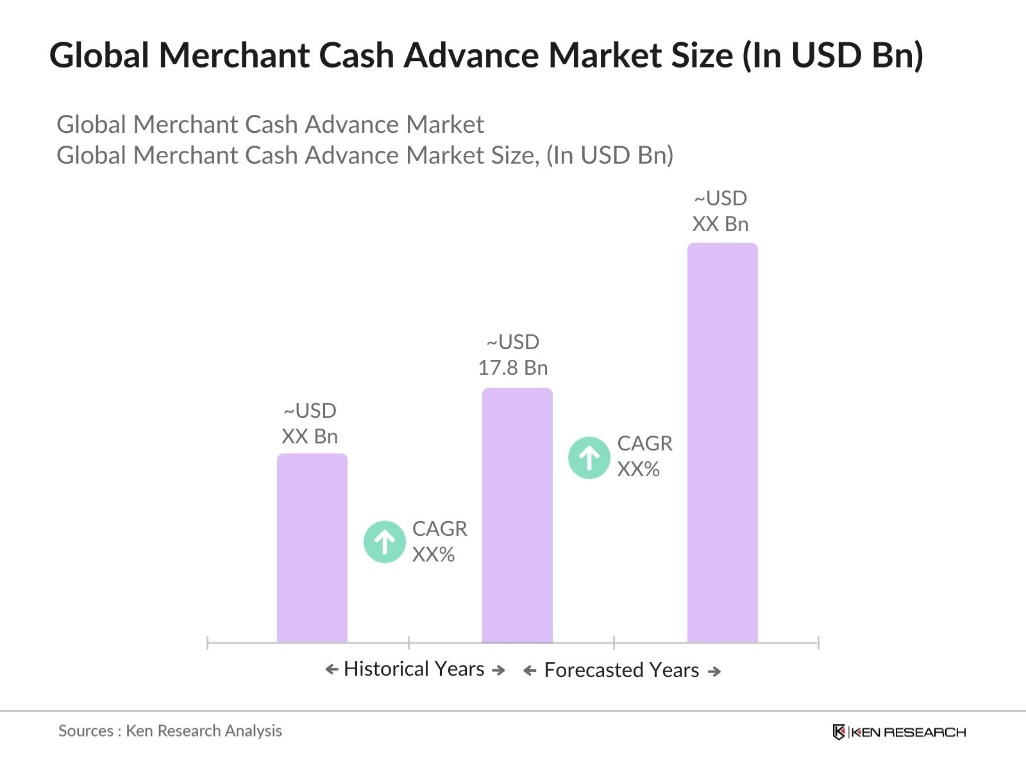
- The Global Merchant Cash Advance (MCA) Market is valued at USD 17.8 billion based on a detailed analysis of market activity over the last five years. This market is primarily driven by the growing demand from small and medium-sized enterprises (SMEs), which often struggle to secure traditional bank loans due to strict requirements. The flexible repayment terms of MCA, which are tied to a businesss daily or weekly revenue, make it an attractive financing option. This method provides immediate working capital to merchants, fueling market expansion.
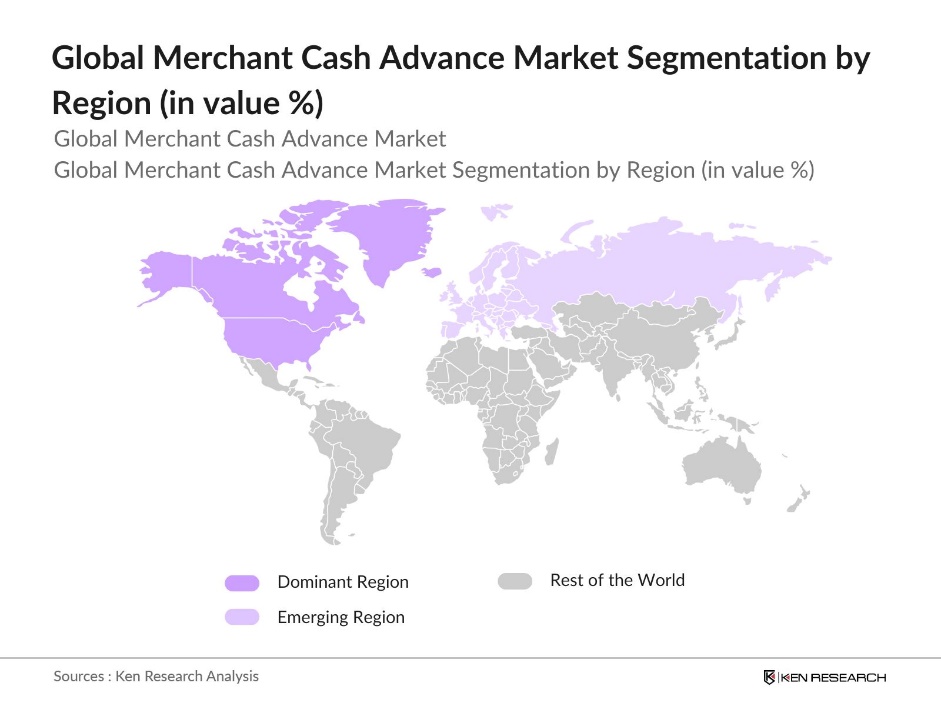
- The market is dominated by cities with vibrant small business ecosystems, such as New York, London, and Toronto. These cities host a dense concentration of SMEs and high-volume retail businesses, leading to the increased adoption of MCA services. Additionally, North America, particularly the United States, has a well-established fintech infrastructure, further reinforcing the dominance of these regions in this market.
- In 2024, Merchant Cash Advance (MCA) regulations have focused on increasing transparency and borrower protection. States like New York and California have introduced laws requiring clear disclosures of terms, fees, and costs in MCA contracts. At the federal level, the Consumer Financial Protection Bureau (CFPB) is playing a more active role, proposing national guidelines to standardize MCA practices. These regulations aim to protect businesses from predatory lending while ensuring fair practices in the industry.
Global Merchant Cash Advance Market Segmentation
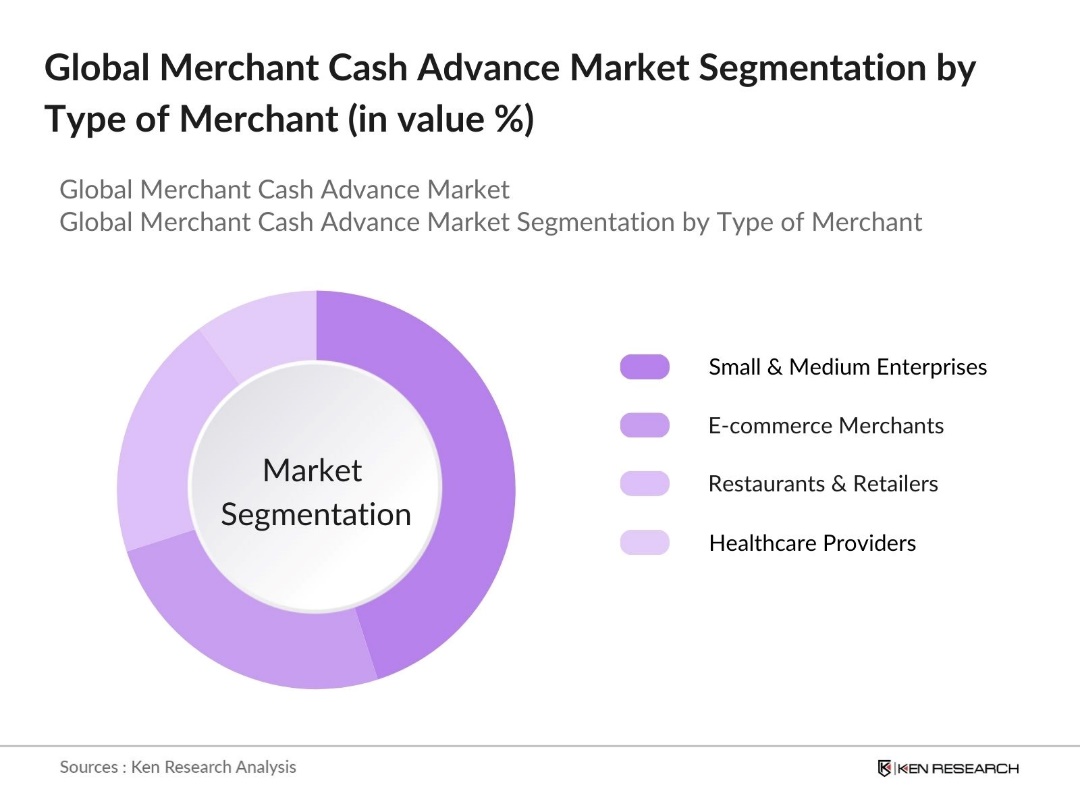
By Type of Merchant: The MCA market is segmented by the type of merchants utilizing this financial product, including small & medium enterprises (SMEs), e-commerce merchants, restaurants & retailers, and healthcare providers. Among these, small & medium enterprises (SMEs) dominate the market due to their increasing reliance on MCA as a financing alternative to traditional bank loans. SMEs often struggle to access credit through banks due to strict lending requirements, making MCA a more accessible and flexible option. Furthermore, MCA provides quick access to capital without the lengthy approval processes common with other financial institutions.
By Funding Type: The MCA market is also segmented by the type of funding, including revenue-based financing, invoice factoring, and hybrid MCA financing. Revenue-based financing dominates the market share due to its flexible repayment terms, which allow businesses to pay back a percentage of their sales. This model appeals to businesses with fluctuating revenue streams, such as seasonal retailers or businesses with inconsistent cash flow. Revenue-based financing also offers simplicity and ease, as businesses are only obligated to repay when they generate sales.
By Region: The MCA market is segmented into North America, Europe, Asia-Pacific, Latin America, and the Middle East & Africa. North America continues to hold the dominant market share due to the region's mature financial technology ecosystem and widespread acceptance of alternative lending solutions. The regulatory environment in North America also supports innovation in the alternative financing space, contributing to the growth of MCA services. Europe follows closely, driven by the UKs strong fintech presence, while Asia-Pacific is expected to emerge as a significant player due to rapid digitalization in the region.
Global Merchant Cash Advance Market Competitive Landscape
The market is highly competitive, with key players dominating through product innovation, strong partnerships, and technology integration. The market is composed of both fintech companies and traditional financial institutions offering MCA solutions. The competition is also characterized by mergers and acquisitions, as companies look to expand their market presence and technological capabilities.
|
Company |
Established |
Headquarters |
Funding Volume |
Merchant Network |
Revenue |
Technology Infrastructure |
Customer Reach |
Growth Rate |
|
Rapid Finance |
2001 |
USA |
||||||
|
PayPal Working Capital |
1998 |
USA |
||||||
|
OnDeck Capital |
2007 |
USA |
||||||
|
CAN Capital |
1998 |
USA |
||||||
|
Square Capital |
2009 |
USA |
Global Merchant Cash Advance Industry Analysis
Growth Drivers
- Increasing SME Demand: The growing demand for Merchant Cash Advance (MCA) among small and medium-sized enterprises (SMEs) is driven by the need for accessible, fast funding. In 2023, SMEs accounted for nearly 90% of businesses globally, contributing about 50% of global employment and up to 40% of GDP in emerging economies. As traditional bank loans remain harder to access, MCA has become a significant alternative funding option, providing crucial liquidity to support their expansion and operational costs.
- Shift from Traditional Bank Loans: A notable shift away from traditional bank loans is fueling the growth of MCA, as small businesses continue to face significant barriers to obtaining credit. The U.S. is home to 33.2 million small businesses employing 46.4% of the private workforce, accounting for 44% of US economic activity. In contrast, the MCA market is flourishing due to its simplified application process and faster approval times, appealing to business owners who seek quick funding solutions without stringent credit score requirements.
- Rise in Alternative Finance Adoption: Alternative financing options like MCA are becoming increasingly popular as business owners look for capital outside of traditional loans. This trend is driven by the flexibility and speed that alternative finance offers, with MCA being a preferred option for many. As technological advancements improve the efficiency of underwriting and credit evaluation, MCA providers are able to serve a wider range of businesses, especially those that might not qualify for conventional bank loans. This shift allows underserved segments to access much-needed funding through more innovative and accessible platforms.
Market Challenges
- High Costs of MCA Services: A key challenge in the MCA market is the high cost of services, which often leads to premium interest rates and fees. These costs can make MCA a less attractive option for long-term financial planning, especially for smaller businesses with tighter profit margins. The higher costs compared to traditional loans can act as a barrier for growth, leading some businesses to explore other funding alternatives when available. For many, the price of accessing MCA services may outweigh the immediate benefit of fast capital, especially for businesses with limited cash flow flexibility.
- Regulatory and Legal Scrutiny: MCA services are increasingly facing regulatory and legal scrutiny, particularly concerning the transparency and fairness of terms. Government efforts at both federal and state levels are focused on implementing stricter disclosure requirements to protect merchants from potentially unfair practices. New regulatory frameworks are emerging, with some states introducing laws aimed at enhancing transparency in MCA agreements, ensuring businesses are fully informed about costs and repayment conditions.
Global Merchant Cash Advance Market Future Outlook
The future of the Global Merchant Cash Advance market is promising, with strong growth anticipated due to the continued expansion of fintech and alternative lending platforms. Businesses are increasingly turning to non-traditional financing as bank loans become more difficult to obtain due to stringent regulations. The digitization of MCA processes is expected to continue, making the funding process even more streamlined for merchants.
Market Opportunities
- Digitalization in MCA Processes: The digitalization of MCA processes, particularly through automated credit underwriting, is creating significant opportunities in the industry. Automation allows for faster and more efficient assessments of creditworthiness, dramatically reducing approval times compared to traditional methods. This advancement not only streamlines operations but also expands access to funding for a broader range of businesses, including those with limited credit histories.
- Expansion in Emerging Markets: Emerging markets are experiencing rapid growth in demand for MCA services, largely due to underdeveloped traditional banking systems. In many developing economies, MCA has become an increasingly popular financing option due to its speed and accessibility, particularly in regions where SMEs face challenges in securing traditional loans. The expansion of digital payment platforms and initiatives to increase financial inclusion are further driving this demand, creating new opportunities for MCA providers to tap into these underserved markets and support local business growth.
Scope of the Report
|
Type of Merchant |
Small & Medium Enterprises (SMEs) |
|
Funding Type |
Revenue-Based Financing |
|
Mode of Delivery |
Online Platforms |
|
Industry Vertical |
Retail & Wholesale |
|
Region |
North America |
Products
Key Target Audience
Small & Medium Enterprises (SMEs)
E-commerce Merchants
Fintech Companies
Alternative Lending Platforms
Investments and Venture Capitalist Firms
Banks and Financial Institutions
Government and Regulatory Bodies (Financial Conduct Authority (FCA), Consumer Financial Protection Bureau (CFPB))
Companies
Players Mentioned in the Report
Rapid Finance
PayPal Working Capital
OnDeck Capital
CAN Capital
Square Capital
Credibly
National Funding
Fora Financial
Fundbox
Kabbage
Bitty Advance
Fundera
BlueVine
Funding Circle
Headway Capital
Table of Contents
1. Global Merchant Cash Advance Market Overview
1.1. Definition and Scope
1.2. Market Taxonomy
1.3. Market Growth Rate
1.4. Market Segmentation Overview
2. Global Merchant Cash Advance Market Size (In USD Billion)
2.1. Historical Market Size
2.2. Year-on-Year Growth Analysis
2.3. Key Market Developments and Milestones
3. Global Merchant Cash Advance Market Analysis
3.1. Growth Drivers
3.1.1. Increasing SME Demand (MCA for SME Funding Needs)
3.1.2. Shift from Traditional Bank Loans (Decline in Bank Lending for SMEs)
3.1.3. Rise in Alternative Finance Adoption (Innovative Funding Platforms)
3.1.4. Flexibility in Repayment Terms (Revenue-Based Repayment)
3.2. Market Challenges
3.2.1. High Costs of MCA Services (Premium Interest Rates and Fees)
3.2.2. Regulatory and Legal Scrutiny (Compliance and Legal Frameworks)
3.2.3. Default Risks (High Default Rates in Riskier Segments)
3.2.4. Lack of Awareness Among Merchants (Low Market Penetration)
3.3. Opportunities
3.3.1. Digitalization in MCA Processes (Automated Credit Underwriting)
3.3.2. Expansion in Emerging Markets (Growing MCA Demand in Developing Economies)
3.3.3. Partnerships with Fintech (Collaborations Between MCA Providers and Fintechs)
3.3.4. Product Diversification (Customized MCA Offerings for Niche Sectors)
3.4. Trends
3.4.1. Data-Driven Decision Making (AI and Big Data in Risk Assessment)
3.4.2. Hybrid MCA Models (Combination of MCA and Other Lending Models)
3.4.3. Growth in Online MCA Providers (Dominance of Digital MCA Platforms)
3.4.4. Merchant-Centric MCA Solutions (Tailored Funding Solutions Based on Merchant Profiles)
3.5. Government Regulation
3.5.1. Disclosure Requirements (Regulations on Transparency in MCA Agreements)
3.5.2. State and Federal Compliance (Regulatory Policies Across Regions)
3.5.3. Consumer Protection Laws (Protecting Merchants from Predatory Practices)
3.5.4. Future Legislative Changes (Anticipated Legal Adjustments Impacting MCA)
3.6. SWOT Analysis
3.7. Merchant Ecosystem
3.8. Porters Five Forces
3.9. Competition Ecosystem
4. Global Merchant Cash Advance Market Segmentation
4.1. By Type of Merchant (In Value %)
4.1.1. Small & Medium Enterprises (SMEs)
4.1.2. E-commerce Merchants
4.1.3. Restaurants and Retailers
4.1.4. Healthcare Providers
4.2. By Funding Type (In Value %)
4.2.1. Revenue-Based Financing
4.2.2. Invoice Factoring
4.2.3. Hybrid MCA Financing
4.3. By Mode of Delivery (In Value %)
4.3.1. Online Platforms
4.3.2. Offline Lending Institutions
4.3.3. Direct Funding Channels
4.4. By Industry Vertical (In Value %)
4.4.1. Retail & Wholesale
4.4.2. Hospitality
4.4.3. Healthcare
4.4.4. Technology
4.4.5. Construction
4.5. By Region (In Value %)
4.5.1. North America
4.5.2. Europe
4.5.3. Asia-Pacific
4.5.4. Latin America
4.5.5. Middle East & Africa
5. Global Merchant Cash Advance Market Competitive Analysis
5.1. Detailed Profiles of Major Companies
5.1.1. Rapid Finance
5.1.2. PayPal Working Capital
5.1.3. OnDeck Capital
5.1.4. CAN Capital
5.1.5. Credibly
5.1.6. National Funding
5.1.7. Fundbox
5.1.8. Fora Financial
5.1.9. Square Capital
5.1.10. Kabbage
5.1.11. Bitty Advance
5.1.12. Fundera
5.1.13. BlueVine
5.1.14. Funding Circle
5.1.15. Headway Capital
5.2. Cross Comparison Parameters (Revenue, Customer Reach, Funding Volume, Tech Infrastructure, Merchant Network, Loan Origination, Market Penetration, Growth Rate)
5.3. Market Share Analysis
5.4. Strategic Initiatives
5.5. Mergers and Acquisitions
5.6. Investment Analysis
5.7. Venture Capital Funding
5.8. Government Grants
5.9. Private Equity Investments
6. Global Merchant Cash Advance Market Regulatory Framework
6.1. Regulatory Standards for MCA Providers
6.2. Merchant Contractual Obligations
6.3. Certification and Licensing Requirements
7. Global Merchant Cash Advance Future Market Size (In USD Billion)
7.1. Future Market Size Projections
7.2. Key Factors Driving Future Market Growth
8. Global Merchant Cash Advance Future Market Segmentation
8.1. By Type of Merchant (In Value %)
8.2. By Funding Type (In Value %)
8.3. By Mode of Delivery (In Value %)
8.4. By Industry Vertical (In Value %)
8.5. By Region (In Value %)
9. Global Merchant Cash Advance Market Analysts Recommendations
9.1. TAM/SAM/SOM Analysis
9.2. Customer Cohort Analysis
9.3. White Space Opportunity Analysis
9.4. Merchant Education and Outreach Strategies
Research Methodology
Step 1: Identification of Key Variables
The initial step involves mapping out the global MCA ecosystem, identifying key stakeholders, including financial institutions, fintech companies, and merchant categories. Extensive secondary research was conducted using proprietary databases and industry reports to gather insights into major market variables.
Step 2: Market Analysis and Construction
Historical data on MCA market size, merchant adoption rates, and funding volumes were analyzed. This step focused on understanding the ratio between traditional loans and MCA, comparing service providers’ market penetration and the resultant revenue generation for MCA services.
Step 3: Hypothesis Validation and Expert Consultation
To validate market hypotheses, structured interviews were conducted with industry experts from MCA service providers and fintech companies. The experts provided real-world insights, which were used to corroborate the gathered data and refine market projections.
Step 4: Research Synthesis and Final Output
The final step involved synthesizing the insights and data collected from various sources, cross-referencing market statistics, and formulating a comprehensive, data-backed analysis. This approach ensured the report's accuracy and relevance to industry stakeholders.
Frequently Asked Questions
1. How big is the Global Merchant Cash Advance Market?
The Global Merchant Cash Advance Market is valued at USD 17.8 billion, driven by growing demand for alternative financing among small and medium enterprises (SMEs).
2. What are the challenges in the Global MCA Market?
Challenges in the global MCA market include high costs of financing for merchants, regulatory scrutiny, and increasing default rates in risk-prone merchant segments.
3. Who are the major players in the Global MCA Market?
Major players in the Global MCA market include Rapid Finance, PayPal Working Capital, OnDeck Capital, CAN Capital, and Square Capital. These companies dominate due to their innovative platforms and strong market presence.
4. What are the growth drivers of the Global MCA Market?
Key growth drivers in Global Merchant Cash Advance Market include the increasing adoption of fintech solutions, the need for flexible financing by SMEs, and the decline in traditional bank lending to small businesses.
Why Buy From Us?

What makes us stand out is that our consultants follows Robust, Refine and Result (RRR) methodology. i.e. Robust for clear definitions, approaches and sanity checking, Refine for differentiating respondents facts and opinions and Result for presenting data with story

We have set a benchmark in the industry by offering our clients with syndicated and customized market research reports featuring coverage of entire market as well as meticulous research and analyst insights.

While we don't replace traditional research, we flip the method upside down. Our dual approach of Top Bottom & Bottom Top ensures quality deliverable by not just verifying company fundamentals but also looking at the sector and macroeconomic factors.

With one step in the future, our research team constantly tries to show you the bigger picture. We help with some of the tough questions you may encounter along the way: How is the industry positioned? Best marketing channel? KPI's of competitors? By aligning every element, we help maximize success.

Our report gives you instant access to the answers and sources that other companies might choose to hide. We elaborate each steps of research methodology we have used and showcase you the sample size to earn your trust.

If you need any support, we are here! We pride ourselves on universe strength, data quality, and quick, friendly, and professional service.