
Global Nickel Metal Hydride (NiMH) Battery Market Outlook to 2030
Region:Global
Author(s):Yogita Sahu
Product Code:KROD4538
Region:Global
Author(s):Yogita Sahu
Product Code:KROD4538
October 2024
87
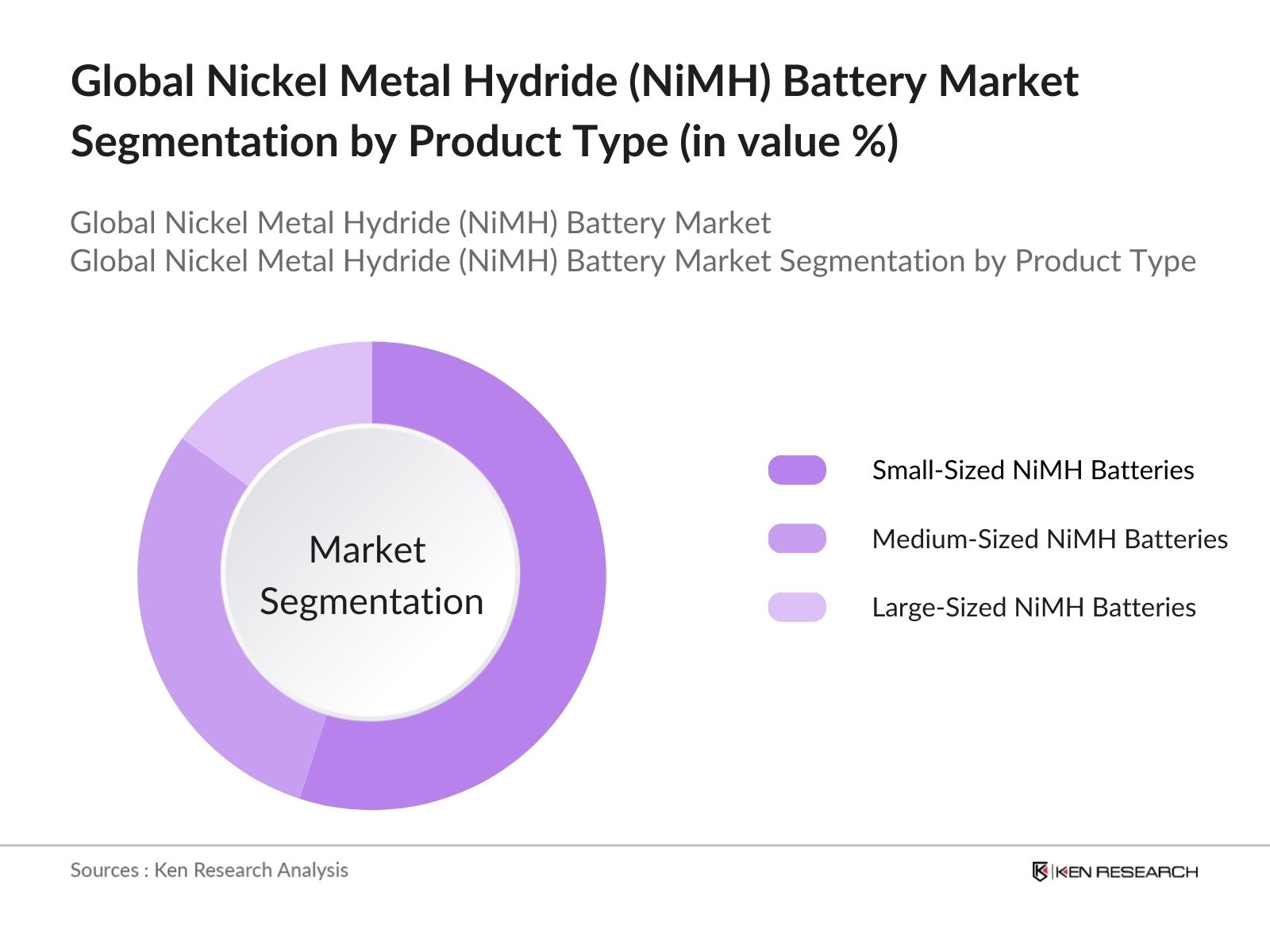
By Product Type: The market is segmented by product type into small-sized, medium-sized, and large-sized NiMH batteries. Small-sized NiMH batteries dominate this segment due to their widespread use in consumer electronics like cameras, portable medical devices, and household gadgets. Their high energy density and cost-effectiveness make them a preferred choice for many consumer applications, sustaining their dominant market share.
By Application: The market is segmented by application into automotive, consumer electronics, industrial, and medical devices. The automotive sector holds the largest share in the application segment, driven by the growing demand for hybrid electric vehicles (HEVs). NiMH batteries' reliability and affordability, coupled with their favorable recycling options, have made them a popular choice in HEVs, thus securing their leadership in this market.
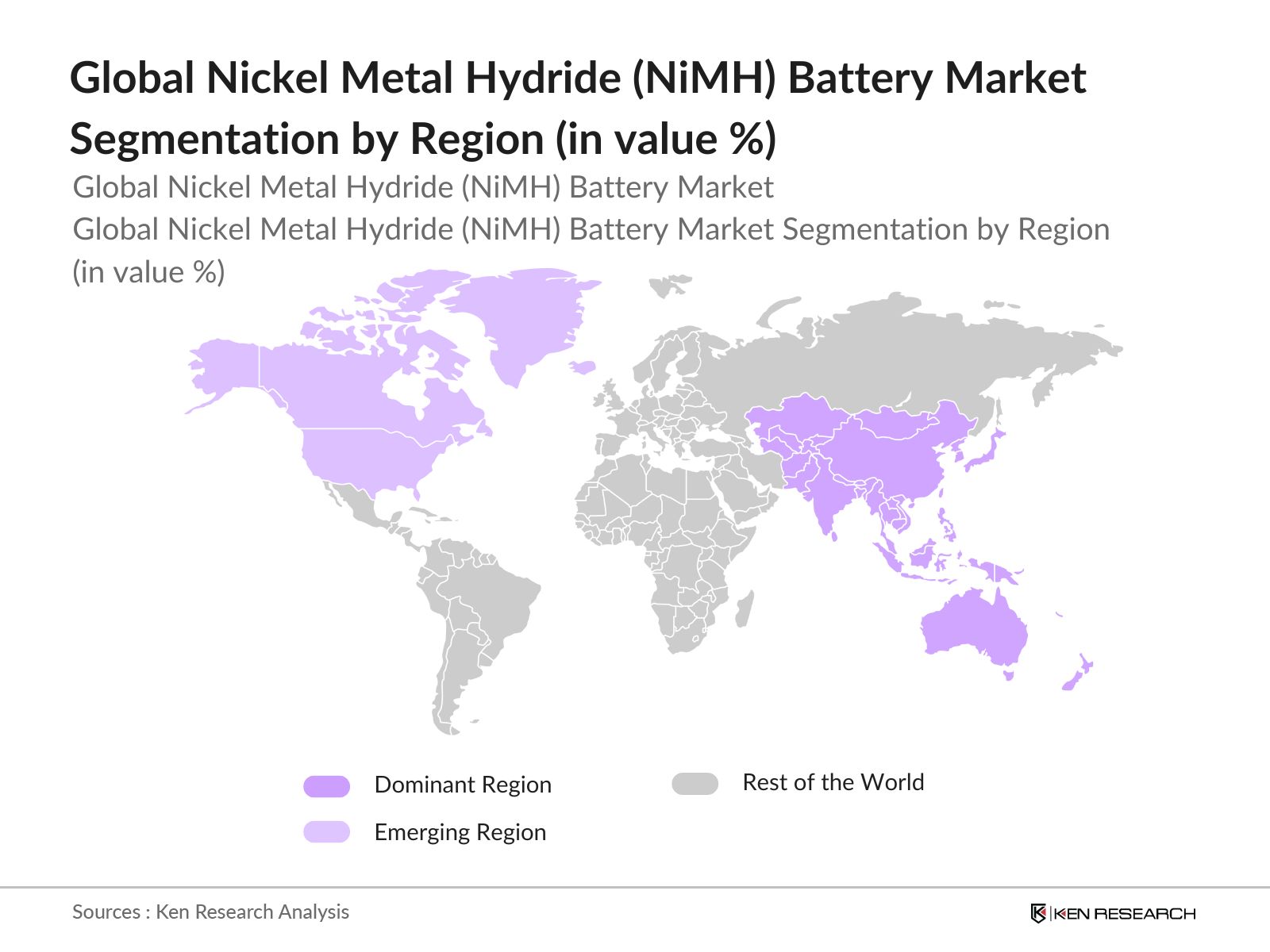
By Region: The market is segmented into North America, Europe, Asia-Pacific, the Middle East & Africa, and Latin America. Asia-Pacific dominates the regional segment the market share, largely driven by the strong presence of NiMH battery manufacturers in Japan and China. In these countries, the presence of established automotive and electronics sectors has bolstered the market. Government support for greener technologies further strengthens the regions market leadership.
The market is highly competitive, with a few dominant players controlling a share of the market. These companies maintain their market leadership through a combination of strong distribution networks, continuous R&D, and strategic collaborations with automakers and electronics manufacturers.
|
Company |
Establishment Year |
Headquarters |
Market Share |
Key Products |
Battery Capacity (in mAh) |
Strategic Initiatives |
Partnerships |
|
Panasonic Corporation |
1918 |
Osaka, Japan |
|||||
|
GS Yuasa Corporation |
2004 |
Kyoto, Japan |
|||||
|
Johnson Controls International |
1885 |
Cork, Ireland |
|||||
|
FDK Corporation |
1950 |
Tokyo, Japan |
|||||
|
Saft Groupe S.A. |
1918 |
Bagnolet, France |
Over the next five years, the Global NiMH Battery industry is expected to grow steadily, fueled by the increasing adoption of hybrid electric vehicles (HEVs), expanding usage in consumer electronics, and supportive government policies promoting clean energy solutions. Market players are likely to invest more in R&D to enhance battery efficiency, reduce costs, and improve recycling techniques.
|
By Product Type |
Small-Sized NiMH Batteries |
|
By Application |
Automotive |
|
By Sales Channel |
OEMs |
|
By Capacity |
<2,000 mAh |
|
By Region |
North America |
1.1. Definition and Scope
1.2. Market Taxonomy
1.3. Market Growth Rate (CAGR, Market Momentum)
1.4. Market Segmentation Overview
2.1. Historical Market Size
2.2. Year-On-Year Growth Analysis (Volume & Revenue)
2.3. Key Market Developments and Milestones (New Product Launches, R&D, Capacity Expansions)
3.1. Growth Drivers
3.1.1. Automotive Sector Expansion (Hybrid and Electric Vehicles)
3.1.2. Consumer Electronics Demand (Power Tools, Cameras, and Portable Devices)
3.1.3. Increased Preference for Environmentally Friendly Batteries
3.1.4. Government Incentives for Clean Energy Adoption
3.2. Market Challenges
3.2.1. Competition from Lithium-Ion Batteries
3.2.2. High Initial Manufacturing Costs (Production Efficiency, Material Costs)
3.2.3. Recycling and Disposal Complexities
3.3. Opportunities
3.3.1. Development of Advanced NiMH Batteries (Longer Lifecycle, Higher Energy Density)
3.3.2. Expanding Market for Renewable Energy Storage Solutions
3.3.3. Increasing Demand in Emerging Economies (Asia-Pacific and Latin America)
3.4. Trends
3.4.1. Integration with Smart Devices and IoT Ecosystems
3.4.2. NiMH Battery Standardization in Electric Vehicles
3.4.3. Miniaturization of Battery Sizes for Portable Devices
3.5. Government Regulation
3.5.1. Battery Safety Standards (IEC, ISO)
3.5.2. Subsidies for Green Energy Technologies
3.5.3. Recycling and Disposal Regulations (WEEE, Battery Directive)
3.6. SWOT Analysis
3.6.1. Strengths
3.6.2. Weaknesses
3.6.3. Opportunities
3.6.4. Threats
3.7. Stakeholder Ecosystem (Raw Material Suppliers, Manufacturers, Distributors, End Users)
3.8. Porters Five Forces Analysis
3.8.1. Bargaining Power of Suppliers
3.8.2. Bargaining Power of Buyers
3.8.3. Threat of New Entrants
3.8.4. Threat of Substitutes
3.8.5. Competitive Rivalry
3.9. Competition Ecosystem (Supply Chain Integration, Strategic Partnerships)
4.1. By Product Type (In Value %)
4.1.1. Small-Sized NiMH Batteries
4.1.2. Medium-Sized NiMH Batteries
4.1.3. Large-Sized NiMH Batteries
4.2. By Application (In Value %)
4.2.1. Automotive (Hybrid Electric Vehicles, Plug-In Hybrid Electric Vehicles)
4.2.2. Consumer Electronics (Laptops, Cameras, Portable Devices)
4.2.3. Industrial (Renewable Energy Storage, Power Tools)
4.2.4. Medical Devices (Implantable Devices, Diagnostic Equipment)
4.3. By Sales Channel (In Value %)
4.3.1. OEMs (Original Equipment Manufacturers)
4.3.2. Aftermarket
4.4. By Capacity (In Value %)
4.4.1. <2,000 mAh
4.4.2. 2,0004,000 mAh
4.4.3. >4,000 mAh
4.5. By Region (In Value %)
4.5.1. North America
4.5.2. Europe
4.5.3. Asia-Pacific
4.5.4. Middle East & Africa
4.5.5. Latin America
5.1. Detailed Profiles of Major Companies
5.1.1. Panasonic Corporation
5.1.2. GS Yuasa Corporation
5.1.3. Toshiba Corporation
5.1.4. Duracell Inc.
5.1.5. Johnson Controls International
5.1.6. FDK Corporation
5.1.7. VARTA AG
5.1.8. Saft Groupe S.A.
5.1.9. Primearth EV Energy Co. Ltd.
5.1.10. A123 Systems LLC
5.1.11. GP Batteries International Ltd.
5.1.12. PowerSonic Corporation
5.1.13. EnerSys
5.1.14. BYD Company Limited
5.1.15. Zhejiang Mustang Battery Co., Ltd.
5.2. Cross Comparison Parameters (Revenue, Headquarters, Product Portfolio, Market Share, Strategic Initiatives, Battery Capacity)
5.3. Market Share Analysis (Top 5 Players, Regional Analysis)
5.4. Strategic Initiatives (Partnerships, New Product Launches, Joint Ventures)
5.5. Mergers and Acquisitions
5.6. Investment Analysis
5.7. Government Grants and Incentives
5.8. Venture Capital Funding
6.1. Battery Safety and Environmental Regulations
6.2. Certification Processes (UN38.3, IEC 62133)
6.3. Compliance with Global Standards
7.1. Future Market Size Projections
7.2. Key Factors Driving Future Market Growth
8.1. By Product Type (In Value %)
8.2. By Application (In Value %)
8.3. By Sales Channel (In Value %)
8.4. By Capacity (In Value %)
8.5. By Region (In Value %)
9.1. TAM/SAM/SOM Analysis
9.2. Market Penetration Strategies
9.3. Customer Acquisition Strategies
9.4. Growth Opportunities for Market Players
In this phase, we mapped out the ecosystem of the Global NiMH Battery Market, identifying the major stakeholders across automotive, electronics, and energy storage industries. Data was collected from secondary sources and proprietary databases to define key variables influencing market dynamics.
Historical data was analyzed to assess the penetration of NiMH batteries in various sectors. Market revenue and market share were determined by studying production volumes, sales trends, and market competition. Service quality statistics were also evaluated to ensure data reliability.
Interviews with industry experts from NiMH battery manufacturing companies were conducted to validate market assumptions. These consultations provided operational insights that helped refine the market data.
The final phase involved synthesizing data from multiple sources and expert consultations to deliver an accurate and validated analysis of the Global NiMH Battery Market, covering all key market segments and trends.
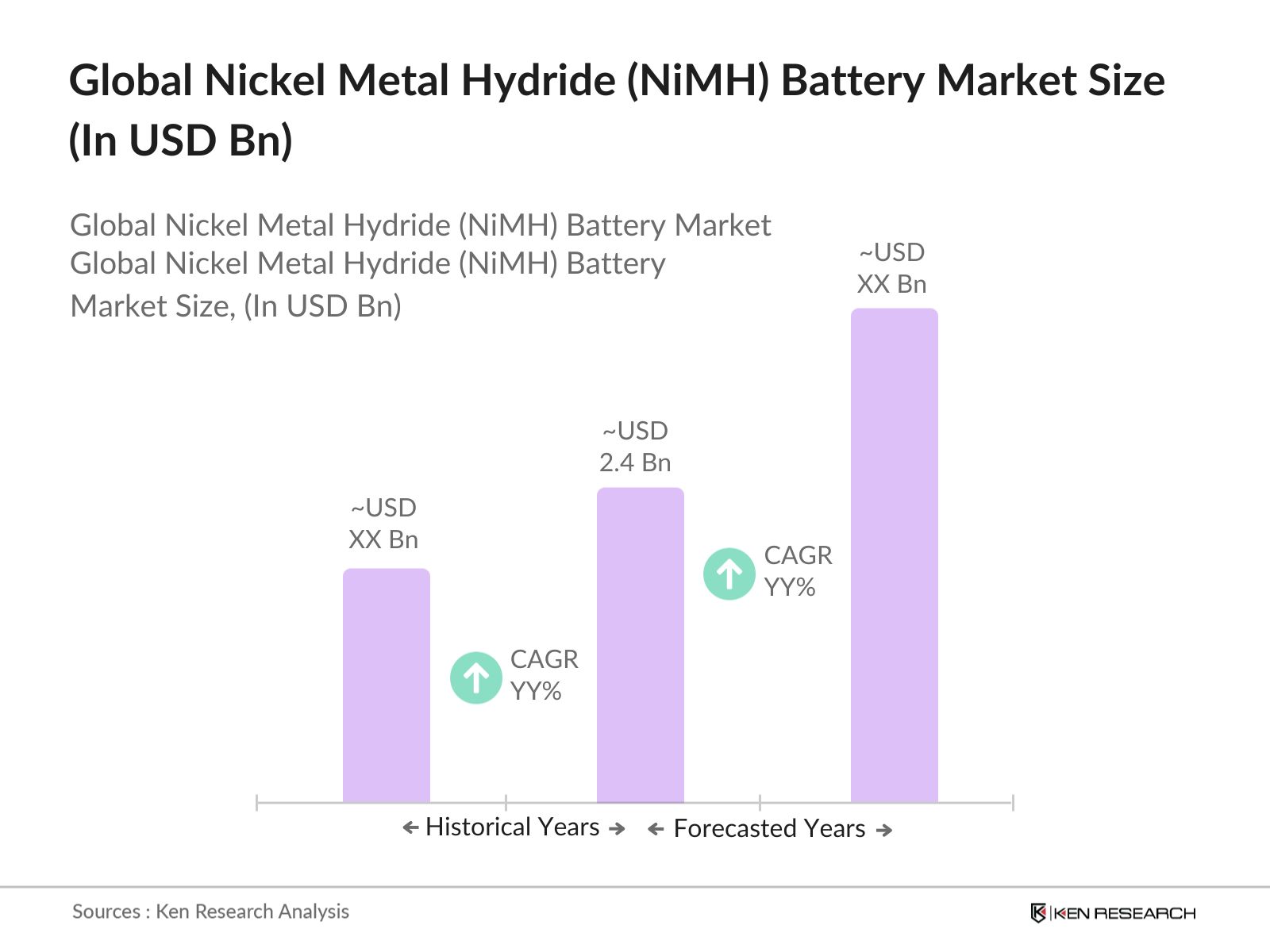
The Global NiMH Battery Market is valued at USD 2.4 billion, driven by rising demand from automotive and consumer electronics sectors.
The Global NiMH Battery Market faces challenges from competition with lithium-ion batteries, higher initial manufacturing costs, and complexities related to battery recycling and disposal.
Major players in the Global NiMH Battery Market include Panasonic Corporation, GS Yuasa Corporation, Johnson Controls International, FDK Corporation, and Saft Groupe S.A.
The Global NiMH Battery Market is primarily driven by the growing adoption of hybrid electric vehicles, expanding applications in consumer electronics, and supportive government regulations for clean energy.
The Global NiMH Battery Market is expected to witness steady growth over the next five years, with increased investments in R&D, especially for enhancing battery performance and recyclability.

What makes us stand out is that our consultants follows Robust, Refine and Result (RRR) methodology. i.e. Robust for clear definitions, approaches and sanity checking, Refine for differentiating respondents facts and opinions and Result for presenting data with story

We have set a benchmark in the industry by offering our clients with syndicated and customized market research reports featuring coverage of entire market as well as meticulous research and analyst insights.

While we don't replace traditional research, we flip the method upside down. Our dual approach of Top Bottom & Bottom Top ensures quality deliverable by not just verifying company fundamentals but also looking at the sector and macroeconomic factors.

With one step in the future, our research team constantly tries to show you the bigger picture. We help with some of the tough questions you may encounter along the way: How is the industry positioned? Best marketing channel? KPI's of competitors? By aligning every element, we help maximize success.

Our report gives you instant access to the answers and sources that other companies might choose to hide. We elaborate each steps of research methodology we have used and showcase you the sample size to earn your trust.

If you need any support, we are here! We pride ourselves on universe strength, data quality, and quick, friendly, and professional service.