
Global PCB Design Software Market Outlook 2030
Region:Global
Author(s):Shivani
Product Code:KROD7426
October 2024
93
About the Report
Global PCB Design Software Market Overview
- The global PCB (Printed Circuit Board) design software market is valued at USD 3.17 billion. This market is driven by increasing demand from industries such as consumer electronics, automotive, and telecommunications. The surge in the development of complex electronic devices and miniaturized components has fueled the adoption of advanced PCB design software. Moreover, the rise of IoT (Internet of Things) applications and wearable technology has accelerated the demand for efficient PCB designs that cater to more compact, multifunctional devices.
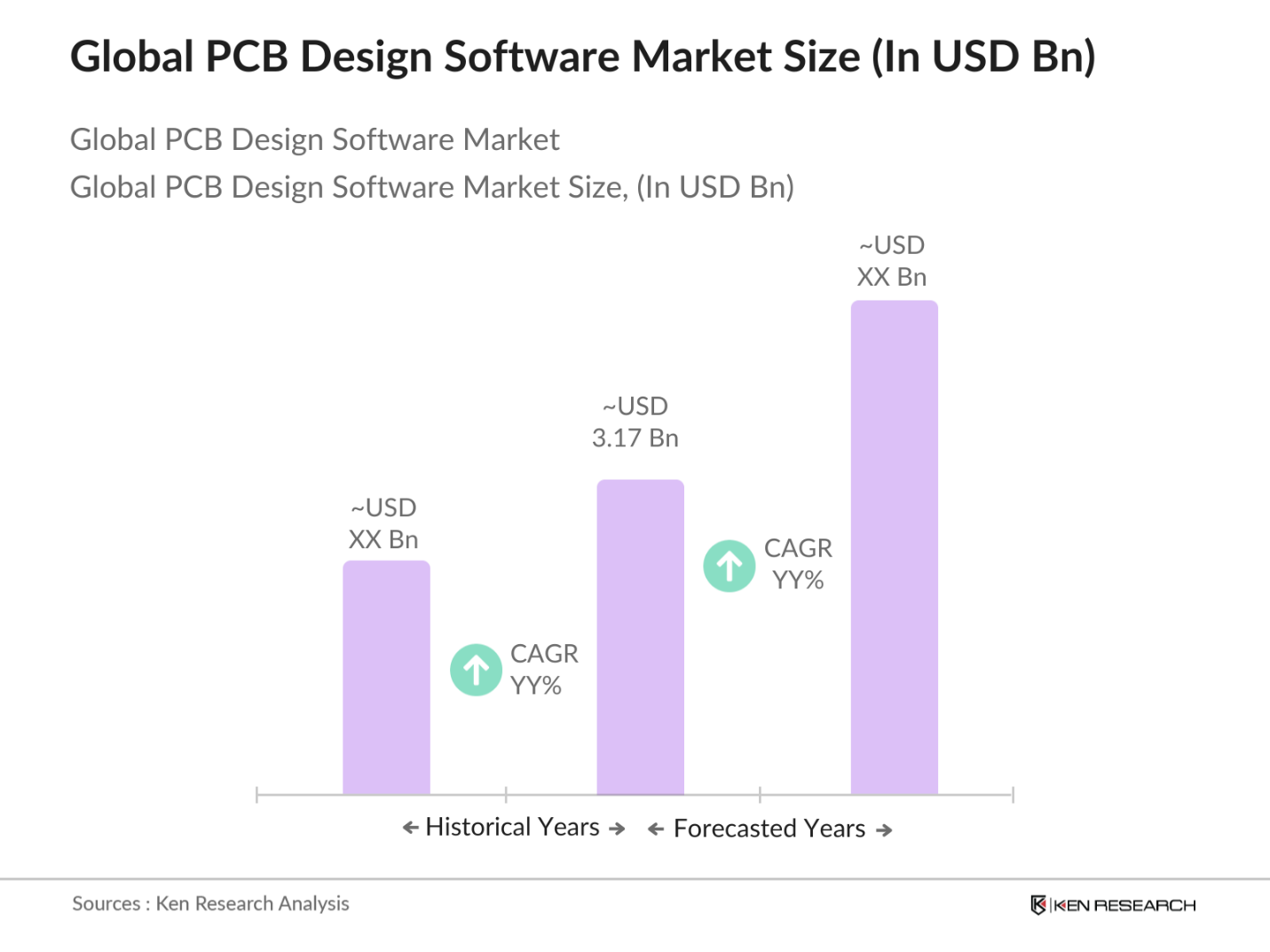
- Countries like the United States, Germany, and China dominate the PCB design software market due to their strong electronics manufacturing bases and continuous advancements in automation technologies. These countries have well-established electronics industries and benefit from a high concentration of tech-savvy talent and research infrastructure. Moreover, Chinas rapid industrialization and lower production costs provide it with an edge in producing cost-effective solutions for PCB designs.
- The U.S. governments CHIPS and Science Act, passed in 2022, allocated $52.7 billion for semiconductor research, development, and manufacturing, directly benefiting the PCB design software market. PCB design is critical to semiconductor production, and with an additional $13 billion designated for R&D and workforce development, the initiative is fostering innovation in advanced PCB designs for semiconductor applications. This funding is expected to spur growth in PCB design software by enhancing domestic production capacities, reducing reliance on foreign imports, and boosting the adoption of cutting-edge design tools.
Global PCB Design Software Market Segmentation
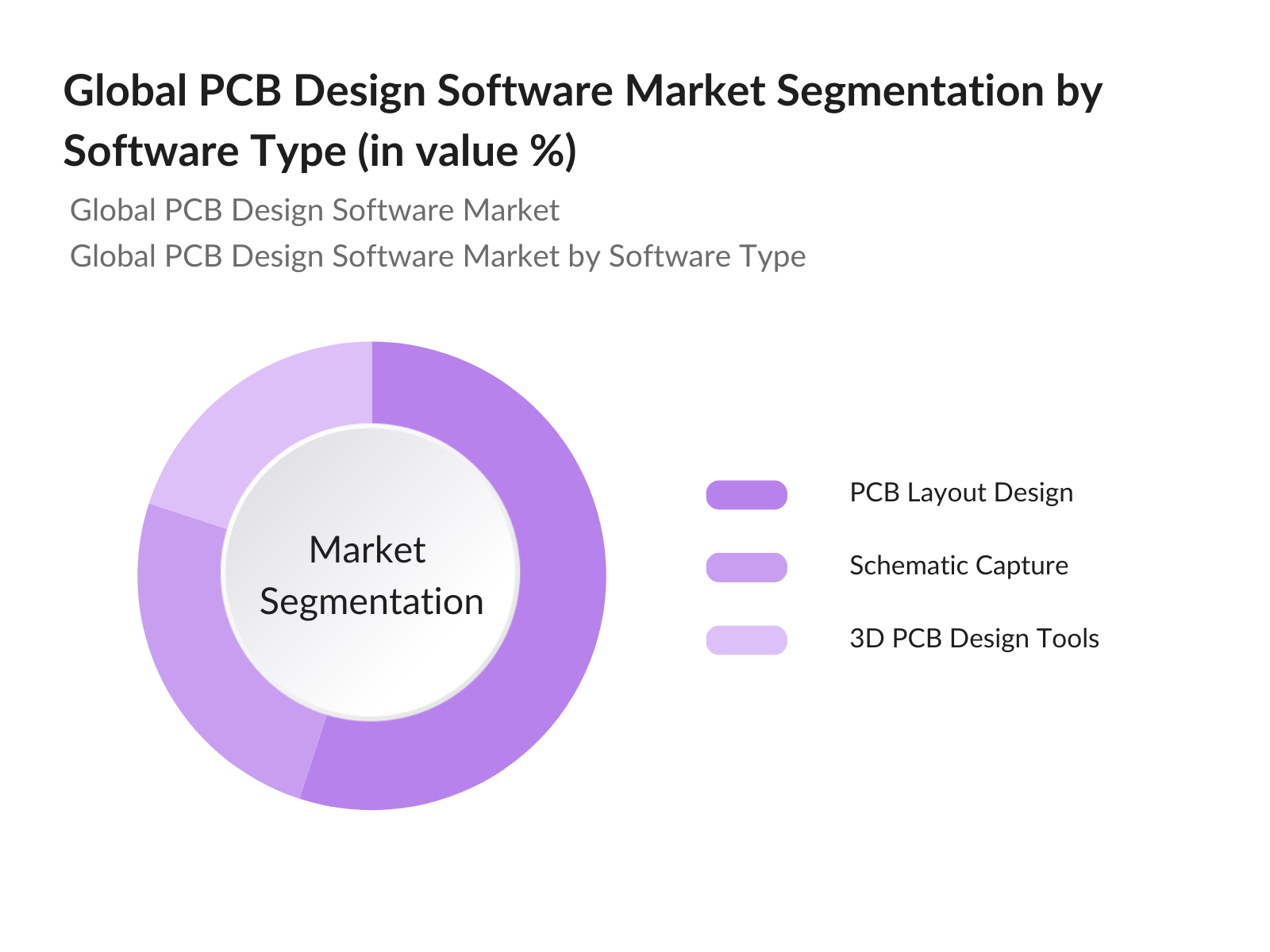
By Software Type: The PCB design software market is segmented by software type into schematic capture, PCB layout design, and 3D PCB design tools. Among these, PCB layout design tools hold a dominant share This is largely due to their extensive application in industries requiring precise, multilayer boards that support complex circuits. Layout tools enable designers to simulate and verify circuits, reducing time and cost in prototype manufacturing.
|
Software Type |
Market Share (2023) |
|---|---|
|
Schematic Capture |
25% |
|
PCB Layout Design |
55% |
|
3D PCB Design Tools |
20% |
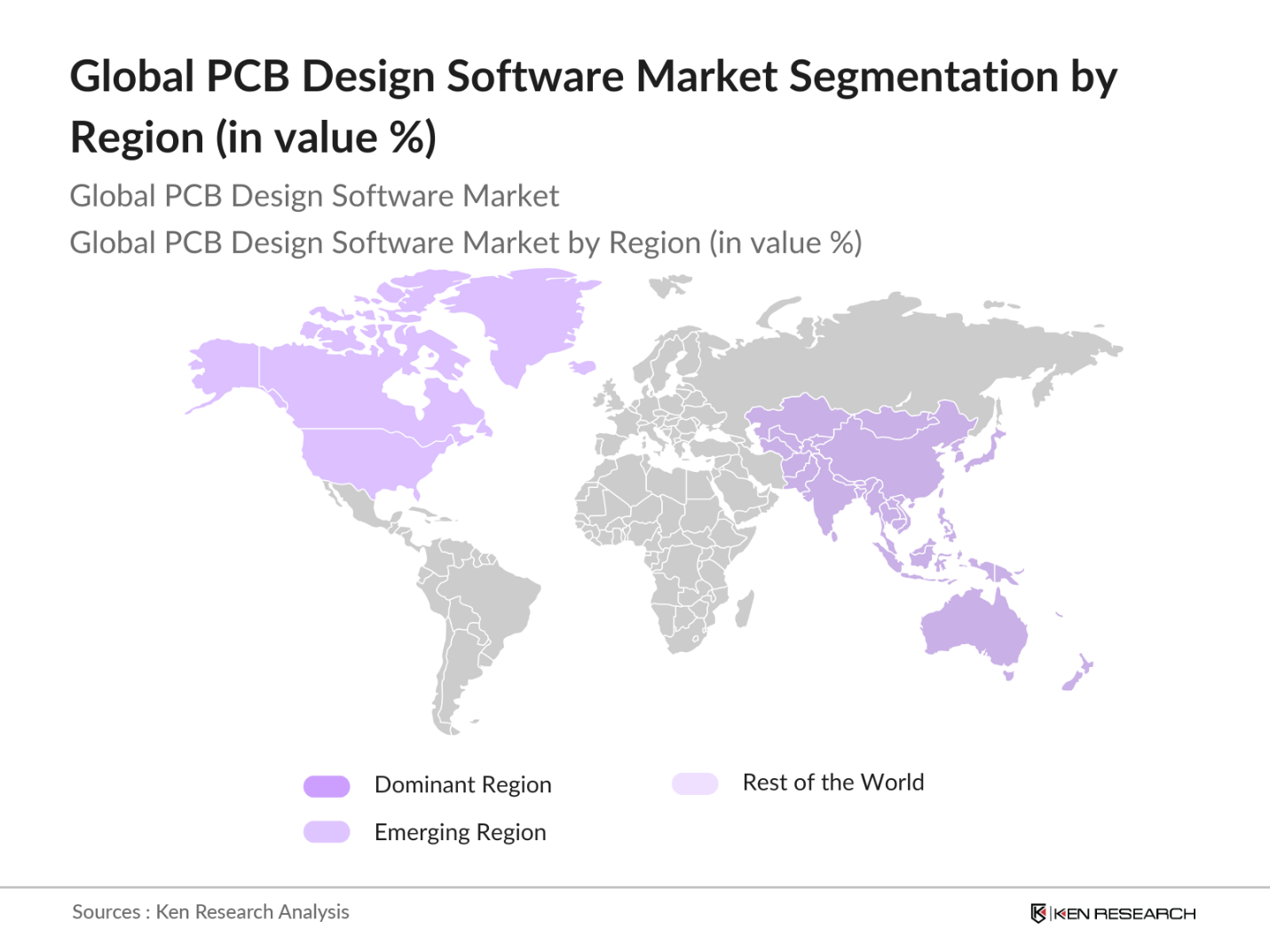
By Region: The PCB design software is segmentation includes North America, Europe, Asia-Pacific, Latin America, and the Middle East & Africa. Asia-Pacific dominates the market with the highest share, driven by countries like China, Japan, and South Korea. These countries benefit from robust electronics manufacturing ecosystems and significant investments in new technologies. North America follows, with the U.S. being a hub for high-tech innovation and PCB design tools development.
|
Region |
Market Share (2023) |
|---|---|
|
North America |
25% |
|
Europe |
20% |
|
Asia-Pacific |
40% |
|
Latin America |
10% |
|
Middle East & Africa |
5% |
Global PCB Design Software Market Competitive Landscape
The global PCB design software market is characterized by intense competition, with key players continuously innovating to offer better tools for PCB designers. Companies are focusing on integrating AI and cloud solutions into their software to provide real-time collaboration and enhanced productivity.
|
Company |
Establishment Year |
Headquarters |
Revenue (USD) |
No. of Employees |
Global Presence |
R&D Investments |
Software Portfolio |
Client Base |
|
Cadence Design Systems |
1988 |
San Jose, CA |
2.99 Bn |
|||||
|
Mentor Graphics (Siemens) |
1981 |
Wilsonville, OR |
1.2 Bn |
|||||
|
Zuken Inc. |
1976 |
Yokohama, Japan |
600 Mn |
|||||
|
Altium Limited |
1985 |
Sydney, Australia |
500 Mn |
|||||
|
Autodesk, Inc. |
1982 |
San Rafael, CA |
4.8 Bn |
Global PCB Design Software Market Analysis
Market Growth Drivers
- Increasing Demand for Consumer Electronics: The growing consumer electronics sector is a major driver for PCB design software. In 2023, global electronics production saw a surge, with consumer electronics reaching nearly 13.8 billion devices, driven by the demand for smartphones, wearables, and home automation systems. Major electronics hubs, such as China, produced over 7.2 billion devices in 2023, increasing the need for advanced PCB design software to meet growing demand. Moreover, the U.S. market alone accounted for over 350 million electronic devices sold in 2023, further bolstering PCB software adoption.
- Rise of IoT and Embedded Systems: With the number of connected IoT devices globally surpassing 15.14 billion in 2023, the demand for PCB design software has increased to support embedded systems in smart home devices, industrial equipment, and medical devices. Countries like Germany and Japan, known for their IoT manufacturing prowess, reported an 8% increase in production of IoT devices in the same year, driving the adoption of software for complex multi-layer PCB designs.
- Rapid Growth of Electric Vehicles and Autonomous Technology: The electric vehicle market, with global sales of EVs reaching over 10.2 million units in 2023, significantly drives PCB design software demand. EVs rely heavily on PCB-based components for battery management, infotainment, and sensors. Moreover, autonomous vehicles, with 6 million active units worldwide by 2024, require intricate PCBs for LiDAR and radar systems. Countries like the U.S. and China are leading the expansion of EV production, thereby boosting PCB software adoption.
Market Challenges:
- High Software Licensing Costs: One of the significant barriers to adoption is the high cost of PCB design software licenses, with an average price ranging between $5,000 and $15,000 per license. Countries like India and Brazil, which are emerging markets for electronics manufacturing, face budget constraints, impeding the wide-scale adoption of high-end software. This is particularly challenging for small and medium-sized enterprises (SMEs), which contribute significantly to PCB production in these countries. Government support remains limited, making it harder for SMEs to invest in these critical tools.
- Complexity in PCB Design for Advanced Applications: Advanced applications such as 5G infrastructure, aerospace systems, and medical devices require highly complex PCBs with multi-layered designs, creating challenges for even experienced engineers. In 2024, PCB design engineers reported significant difficulty in managing multi-layer designs, particularly in emerging markets where technological infrastructure is still developing. In regions like Southeast Asia, limited expertise in advanced applications has slowed the pace of innovation, impacting the ability of manufacturers to meet the demands of industries such as telecommunications and healthcare.
Global PCB Design Software Market Future Outlook
The global PCB design software market is expected to experience significant growth in the coming years, driven by the increasing demand for consumer electronics, advancements in IoT applications, and the rise of electric vehicles. Automation in design processes and cloud-based design solutions will become more prevalent, providing businesses with enhanced scalability and flexibility. Additionally, the adoption of AI-powered design tools is anticipated to further streamline the design process, reducing development times and costs.
Market Opportunities:
- Adoption of 3D PCB Design Tools: The adoption of 3D PCB design tools saw significant growth in 2023, with manufacturers increasingly incorporating 3D visualization into their design processes. Countries like South Korea and Japan, which are leaders in advanced electronics manufacturing, have integrated 3D PCB tools to improve accuracy and reduce errors, especially in high-density PCB designs used in sectors such as telecommunications and automotive. The global market for 3D design technology within the electronics sector reached $3 billion in 2023, reflecting a strong shift toward more precise, efficient design methodologies in high-tech industries.
- Growing Preference for Open-Source PCB Design Software: The open-source movement in PCB design gained momentum in 2023, with over 15,000 engineers globally adopting open-source solutions for PCB design. Countries like Germany and the U.K. have been strong proponents of open-source software, particularly for academic and small-scale industrial projects. This trend is supported by government initiatives encouraging innovation, such as Germanys $1.5 billion funding for open-source development in 2023.
Scope of the Report
|
By Software Type |
Schematic Capture PCB Layout Design 3D PCB Design Tools |
|
By Deployment Type |
On-Premise Cloud-Based |
|
By Application |
Consumer Electronics Automotive Electronics Industrial Control Systems Medical Devices |
|
By End-User |
OEMs Design Service Providers Educational Institutions Research Centers |
|
By Region |
North America Europe Asia-Pacific Latin America Middle East and Africa |
Products
Key Target Audience
OEMs (Original Equipment Manufacturers)
PCB Design Service Providers
Consumer Electronics Manufacturers
Automotive Electronics Companies
Industrial Control Systems Manufacturers
Venture Capital Firms and Investment Groups
Government and Regulatory Bodies (IPC Standards, RoHS Compliance Regulators)
Cloud Service Providers
Companies
Major Players
-
Cadence Design Systems
Mentor Graphics (A Siemens Business)
Zuken Inc.
Altium Limited
Autodesk, Inc.
Eagle PCB (Autodesk)
KiCad
Proteus (Labcenter Electronics)
DipTrace
EasyEDA
CircuitMaker
Orcad (Cadence)
Fritzing
Multisim (National Instruments)
3D PCB Design by Upverter
Table of Contents
1. Global PCB Design Software Market Overview
1.1. Definition and Scope
1.2. Market Taxonomy
1.3. Market Growth Rate
1.4. Market Segmentation Overview
2. Global PCB Design Software Market Size (In USD Bn)
2.1. Historical Market Size
2.2. Year-On-Year Growth Analysis
2.3. Key Market Developments and Milestones
3. Global PCB Design Software Market Analysis
3.1. Growth Drivers
3.1.1. Increasing Demand for Consumer Electronics
3.1.2. Rise of IoT and Embedded Systems
3.1.3. Growing Adoption of Automation in Manufacturing
3.1.4. Rapid Growth of Electric Vehicles and Autonomous Technology
3.2. Market Challenges
3.2.1. High Software Licensing Costs
3.2.2. Complexity in PCB Design for Advanced Applications
3.2.3. Skill Shortages in Emerging Markets
3.3. Opportunities
3.3.1. Integration with AI and ML for Design Automation
3.3.2. Expansion into Cloud-Based PCB Design Tools
3.3.3. Increasing Investments in Industry 4.0
3.4. Trends
3.4.1. Adoption of 3D PCB Design Tools
3.4.2. Growing Preference for Open-Source PCB Design Software
3.4.3. Integration of Real-Time Collaboration Features
3.5. Regulatory Landscape
3.5.1. Compliance with RoHS (Restriction of Hazardous Substances)
3.5.2. IPC Standards for PCB Design and Manufacturing
3.5.3. Cybersecurity Regulations for Cloud-Based Software
3.6. SWOT Analysis
3.7. Stakeholder Ecosystem
3.8. Porters Five Forces Analysis
3.9. Competition Ecosystem
4. Global PCB Design Software Market Segmentation
4.1. By Software Type (In Value %)
4.1.1. Schematic Capture
4.1.2. PCB Layout Design
4.1.3. 3D PCB Design Tools
4.2. By Deployment Type (In Value %)
4.2.1. On-Premise
4.2.2. Cloud-Based
4.3. By Application (In Value %)
4.3.1. Consumer Electronics
4.3.2. Automotive Electronics
4.3.3. Industrial Control Systems
4.3.4. Medical Devices
4.4. By End-User (In Value %)
4.4.1. OEMs (Original Equipment Manufacturers)
4.4.2. Design Service Providers
4.4.3. Educational Institutions and Research Centers
4.5. By Region (In Value %)
4.5.1. North America
4.5.2. Europe
4.5.3. Asia-Pacific
4.5.4. Latin America
4.5.5. Middle East and Africa
5. Global PCB Design Software Market Competitive Analysis
5.1. Detailed Profiles of Major Companies
5.1.1. Cadence Design Systems, Inc.
5.1.2. Mentor Graphics (A Siemens Business)
5.1.3. Zuken Inc.
5.1.4. Altium Limited
5.1.5. Autodesk, Inc.
5.1.6. Dassault Systmes SE
5.1.7. KiCad
5.1.8. Eagle PCB (Autodesk)
5.1.9. DipTrace
5.1.10. EasyEDA
5.1.11. Proteus (Labcenter Electronics)
5.1.12. Orcad (Cadence)
5.1.13. CircuitMaker
5.1.14. Fritzing
5.1.15. Multisim (National Instruments)
5.2. Cross Comparison Parameters (Revenue, Headquarters, Global Presence, Number of Employees, Client Base, Product Portfolio, Innovation Capabilities, Partnerships)
5.3. Market Share Analysis
5.4. Strategic Initiatives (Partnerships, Product Development, Mergers & Acquisitions)
5.5. Investment Analysis (Venture Capital, Private Equity, Government Grants)
5.6. Key Technological Innovations
5.7. Corporate Social Responsibility (CSR) Initiatives
5.8. Customer Satisfaction Index
6. Global PCB Design Software Market Regulatory Framework
6.1. Software Licensing Regulations
6.2. Environmental and Safety Compliance
6.3. Industry-Specific Design Standards
6.4. Intellectual Property Protection
7. Global PCB Design Software Future Market Size (In USD Bn)
7.1. Future Market Size Projections
7.2. Key Factors Driving Future Market Growth
8. Global PCB Design Software Future Market Segmentation
8.1. By Software Type (In Value %)
8.2. By Deployment Type (In Value %)
8.3. By Application (In Value %)
8.4. By End-User (In Value %)
8.5. By Region (In Value %)
9. Global PCB Design Software Market Analysts Recommendations
9.1. Total Addressable Market (TAM), Serviceable Available Market (SAM), and Serviceable Obtainable Market (SOM) Analysis
9.2. Customer Segmentation Analysis
9.3. Market Penetration Strategies
9.4. Product Differentiation and Innovation
Research Methodology
Step 1: Identification of Key Variables
This stage involves mapping all stakeholders in the PCB design software market ecosystem, leveraging secondary data sources such as industry reports and proprietary databases. The goal is to identify the factors influencing market growth, including technological advancements and end-user demand.
Step 2: Market Analysis and Construction
Historical data is gathered to analyze market penetration and the adoption of PCB design tools across various sectors. Market share analysis is conducted to identify leading software solutions, alongside revenue growth rates for key industry players.
Step 3: Hypothesis Validation and Expert Consultation
To validate market trends, consultations are conducted with experts in the PCB design industry through interviews and surveys. These insights are used to validate the statistical models and projections for future market growth.
Step 4: Research Synthesis and Final Output
The final stage consolidates data from multiple sources, including direct feedback from design software users and vendors. The data is verified through bottom-up and top-down approaches to ensure an accurate and holistic market analysis.
Frequently Asked Questions
01. How big is the Global PCB Design Software Market?
The global PCB design software market is valued at USD 3.17 billion, driven by rising demand for electronic devices, increased automation, and advancements in IoT applications.
02. What are the challenges in the PCB Design Software Market?
Key challenges include the high cost of licensing advanced design tools and the complexity of creating designs for emerging applications like automotive and medical devices. Additionally, skill shortages in using advanced design tools can be a barrier.
03. Who are the major players in the Global PCB Design Software Market?
Leading players include Cadence Design Systems, Mentor Graphics (Siemens), Altium Limited, Zuken Inc., and Autodesk. These companies dominate due to their robust software portfolios and global customer bases.
04. What are the growth drivers of the PCB Design Software Market?
The market is propelled by factors such as increased consumer demand for electronic devices, the rise of IoT applications, and the growing need for complex, multi-layer PCBs in automotive and medical sectors.
Why Buy From Us?

What makes us stand out is that our consultants follows Robust, Refine and Result (RRR) methodology. i.e. Robust for clear definitions, approaches and sanity checking, Refine for differentiating respondents facts and opinions and Result for presenting data with story

We have set a benchmark in the industry by offering our clients with syndicated and customized market research reports featuring coverage of entire market as well as meticulous research and analyst insights.

While we don't replace traditional research, we flip the method upside down. Our dual approach of Top Bottom & Bottom Top ensures quality deliverable by not just verifying company fundamentals but also looking at the sector and macroeconomic factors.

With one step in the future, our research team constantly tries to show you the bigger picture. We help with some of the tough questions you may encounter along the way: How is the industry positioned? Best marketing channel? KPI's of competitors? By aligning every element, we help maximize success.

Our report gives you instant access to the answers and sources that other companies might choose to hide. We elaborate each steps of research methodology we have used and showcase you the sample size to earn your trust.

If you need any support, we are here! We pride ourselves on universe strength, data quality, and quick, friendly, and professional service.