Global Prussian Blue Market Outlook to 2030

Region:Global

Author(s):Shubham Kashyap

Product Code:KROD4131

Published On

December 2024

Total pages

98

About the Report

Global Prussian Blue Market Overview

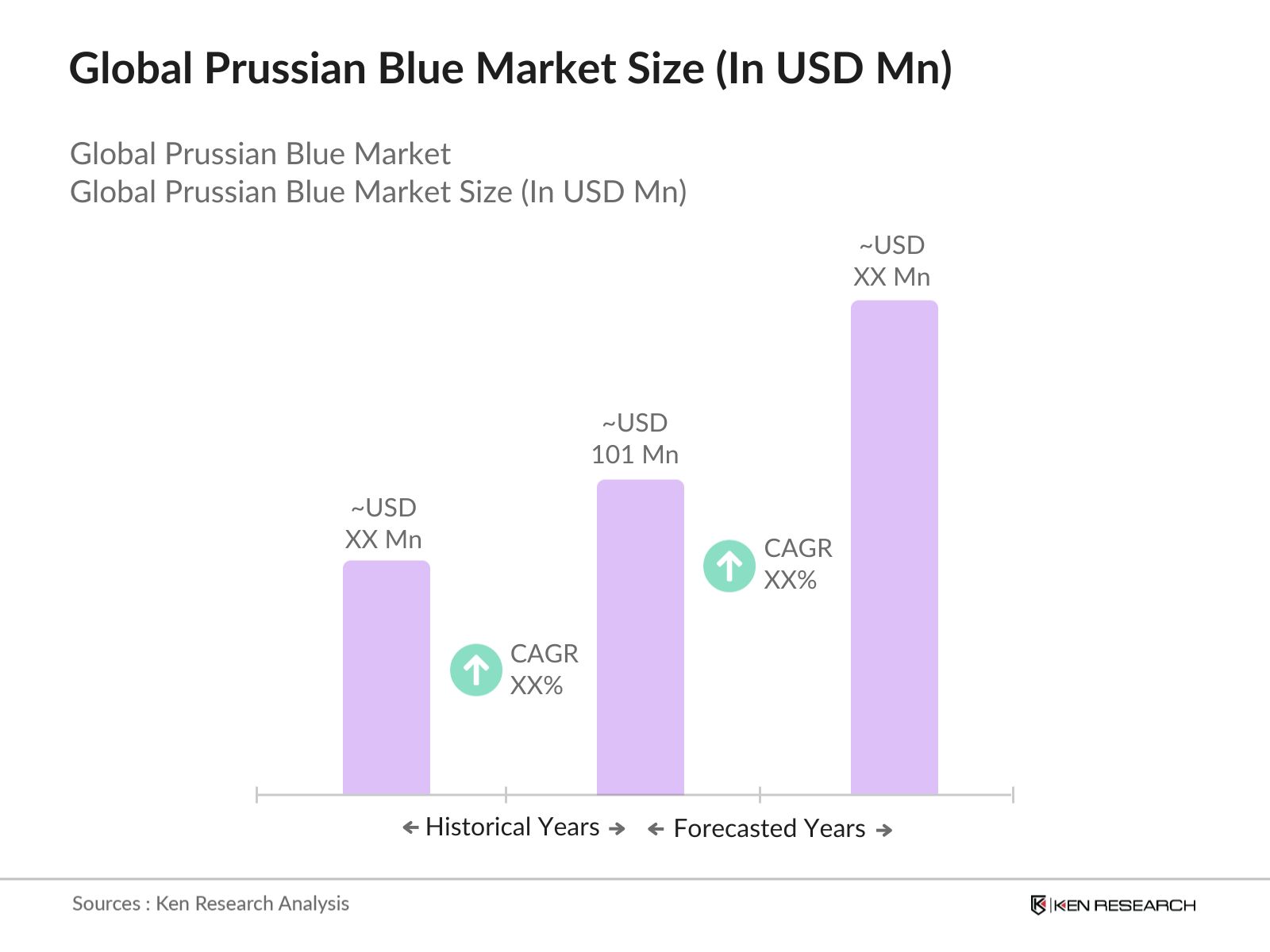
  • The global Prussian Blue market is expected to witness substantial growth over the forecast period, reaching a market size of USD 101 Mn driven by its wide range of applications in industries such as healthcare, environmental protection, and energy storage. As a compound known for its ability to act as an ion-exchanger, Prussian Blue has found significant usage in medical treatments, particularly for heavy metal poisoning, and has shown promising potential in the development of sodium-ion batteries for energy storage. Additionally, advancements in nanotechnology have expanded the material's scope in environmental applications, where it is used for the removal of cesium from nuclear waste.

Global Prussian Blue Marke Size

  • The healthcare sector, particularly in regions like North America and Europe, is expected to be a major growth driver for the Prussian Blue market. The use of Prussian Blue as an antidote for radioactive contamination has led to its inclusion in strategic national stockpiles. In 2023, the United States maintained a significant share of the market due to government stockpiling efforts and advancements in medical applications, while Europe followed closely with strong demand driven by the region's focus on environmental remediation.
  • Governments around the world are prioritizing radiological emergency preparedness by stockpiling Prussian Blue. In 2023, the U.S. Department of Health and Human Services allocated over USD 740 million for emergency medical countermeasures, including Prussian Blue. Similarly, the European Union allocated $350 million for stockpiling radiological emergency supplies. This level of investment reflects the ongoing threat of nuclear accidents or terrorist attacks and the importance of Prussian Blue as a life-saving treatment in such emergencies.

Global Prussian Blue Market Segmentation

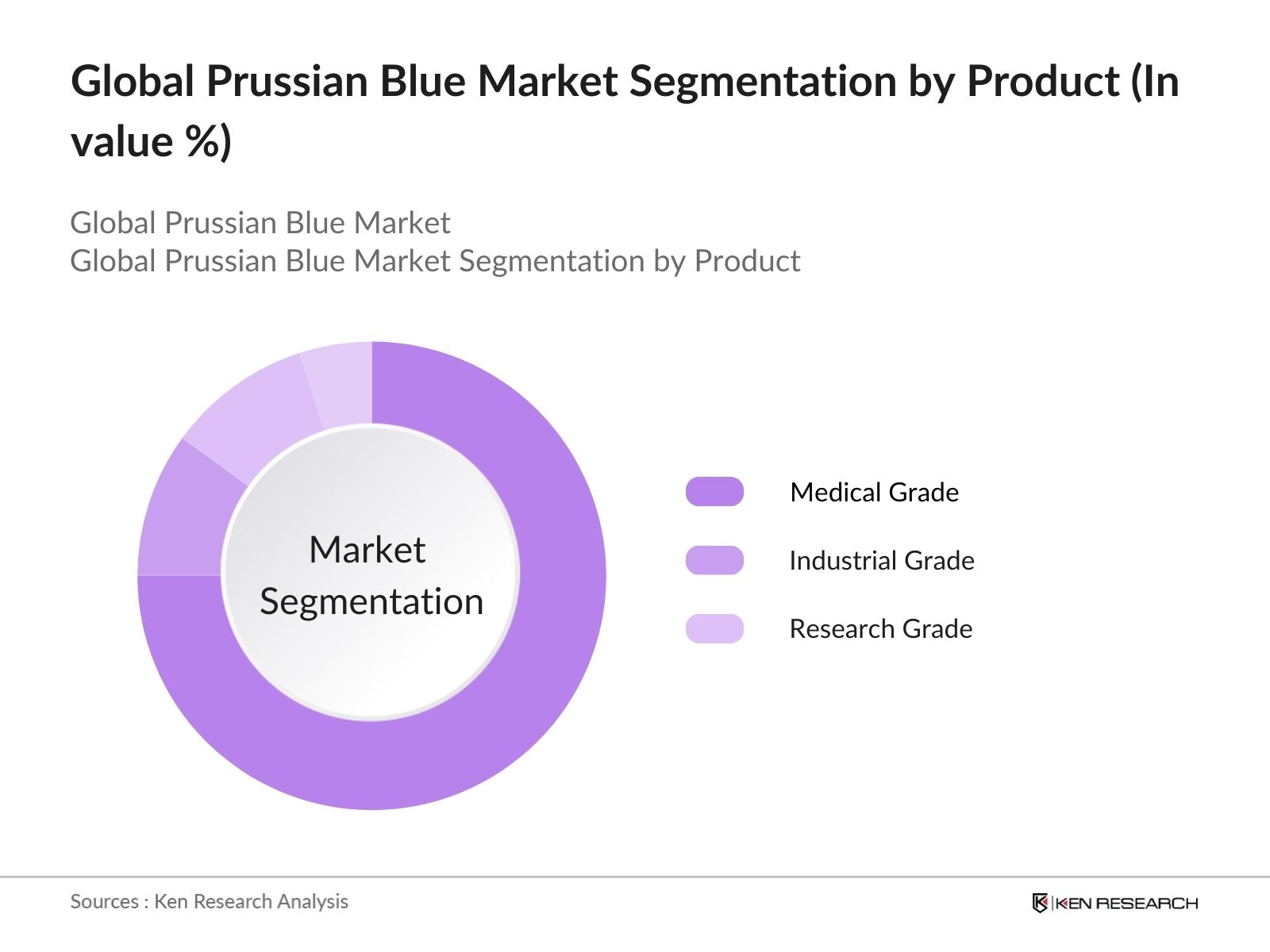
  • By Product Type:The market is further segmented by product type into medical grade, industrial grade, and research grade Prussian Blue. Medical grade Prussian Blue dominates due to its importance in healthcare, where high purity and stringent manufacturing standards are required for human use. Industrial grade Prussian Blue, though significant, is primarily used in applications like environmental protection and energy storage, where purity standards are less strict but still crucial.

Global Prussian Blue Market Segmentation by Product Type

  • By Application: The market is segmented into healthcare, environmental protection, and energy storage. The healthcare segment holds the largest market share due to the compound's critical role in treating heavy metal and radioactive poisoning. This segment is expected to continue leading the market, driven by ongoing governmental initiatives to stockpile Prussian Blue for emergency situations. The environmental protection segment is gaining traction as countries focus on addressing nuclear waste and contamination issues. Lastly, the energy storage segment, although in the nascent stage, is projected to experience rapid growth due to Prussian Blues potential in sodium-ion battery applications.
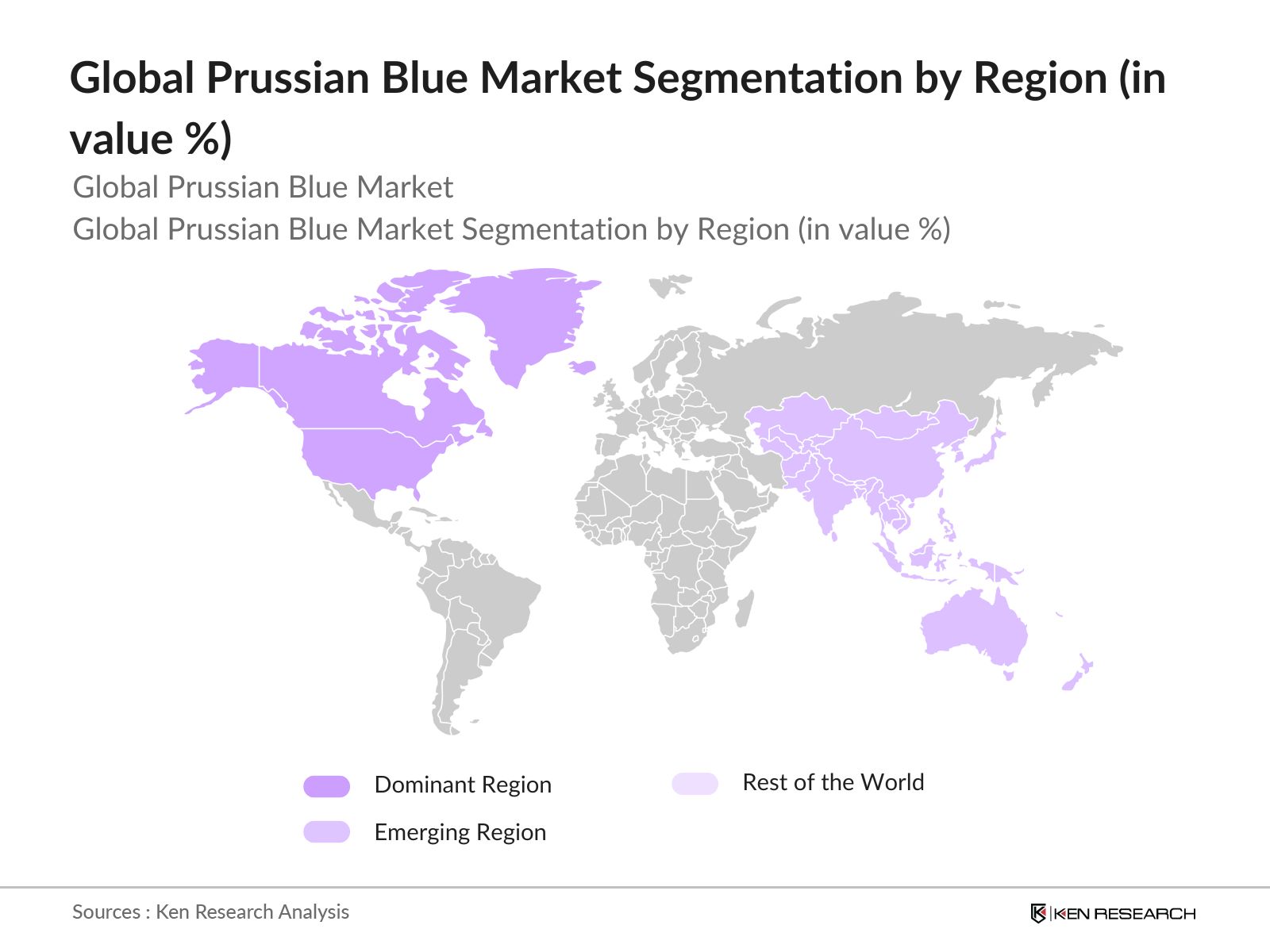
  • By Region: The market is segmented into North America, Europe, Asia Pacific, Latin America, and the Middle East & Africa. North America dominates the global Prussian Blue market, largely due to the U.S. governments strategic stockpiling of Prussian Blue for use in radiation emergencies. Europe holds the second-largest share, driven by environmental remediation projects and stringent regulations around radioactive waste management. Asia Pacific is expected to emerge as a key growth region, with strong demand for Prussian Blue in energy storage solutions, particularly in China and Japan, where sodium-ion battery development is gaining momentum.

Global Prussian Blue Market Segmentation by Region

Global Prussian Blue Market Competitive Landscape

The global Prussian Blue market is highly fragmented, with key players investing in research and development to explore new applications of the compound. Companies such as American Elements, Alfa Aesar, and Thermo Fisher Scientific are leading the market, focusing on expanding their product portfolios to cater to the growing demand for Prussian Blue in medical and environmental applications. These companies are also collaborating with governments and healthcare organizations to ensure a steady supply of the compound for emergency use.

Company Name

Establishment Year

Headquarters

Revenue (2023)

Global Reach

Product Portfolio

R&D Investment

Recent Drug Approvals

Strategic Initiatives

American Elements

1997

Los Angeles, USA


Alfa Aesar

1963

Haverhill, USA


Thermo Fisher Scientific

1956

Waltham, USA


Merck Group

1668

Darmstadt, Germany


BASF SE

1865

Ludwigshafen, Germany


Global Prussian Blue Market Analysis

Growth Drivers

  • Increasing Demand for Radiological Contamination Treatment: The increasing focus on radiological contamination treatment, especially for cesium and thallium poisoning, is driving the demand for Prussian Blue. In the aftermath of nuclear accidents and radiological events, governments have bolstered their emergency response capabilities. The U.S. government, has allocated a substantial amount in 2023 towards strategic health and safety stockpiles, which include Prussian, Blue-based treatments. The World Health Organization (WHO) has emphasized the need for radiological emergency preparedness, increasing demand globally, including initiatives in Asia and Europe. Radiological threats in 2024 remain significant, requiring immediate medical interventions using such compounds.
  • Growing Demand for Sustainable Energy Storage Solutions: The increasing focus on developing sustainable energy solutions is significantly driving the demand for Prussian Blue in the energy storage segment. Sodium-ion batteries, which use Prussian Blue as a cathode material, are gaining attention as a cost-effective and environmentally friendly alternative to lithium-ion batteries. This trend is particularly strong in Asia Pacific, where governments are investing in research and development to promote the use of sodium-ion technology. The adoption of Prussian Blue in this sector is expected to experience exponential growth as the demand for renewable energy and sustainable storage solutions increases globally.
  • Expansion in Energy Storage Applications: Prussian Blue has emerged as a crucial material in the rapidly growing field of energy storage, particularly in sodium-ion batteries. As of 2023, global energy storage capacity grew to 45 GWh, driven by investments in renewable energy technologies. The energy storage sector is set to receive a boost with a USD 35 billion global investment in grid-level energy storage projects in 2024, as reported by the International Energy Agency (IEA). Prussian Blues low-cost production compared to lithium-ion batteries makes it an attractive alternative for sodium-ion technology in Europe and APAC markets.

Market Challenges

  • High Production Costs: Despite its growing applications, the high production cost of Prussian Blue remains a challenge, limiting its accessibility, especially in developing regions. The synthesis of high-purity Prussian Blue for medical and energy storage applications involves complex processes, leading to higher production expenses. This limits the compounds affordability in low-income regions, thereby hindering its widespread adoption in key applications such as environmental remediation and energy storage.
  • Regulatory Hurdles: The regulatory framework for the use of Prussian Blue in various applications, particularly in the healthcare sector, is stringent and often acts as a barrier to market entry. The need for stringent approval processes from health authorities such as the U.S. Food and Drug Administration (FDA) and the European Medicines Agency (EMA) for the use of Prussian Blue in medical applications has slowed the pace of product commercialization. Additionally, the varying regulations across regions regarding the disposal and handling of radioactive materials have created complexities for companies looking to expand their operations globally.

Global Prussian Blue Market Future Outlook

The global Prussian Blue market is poised for significant growth, driven by its expanding applications in healthcare, environmental protection, and energy storage. Companies are expected to focus on reducing production costs and overcoming regulatory barriers to meet the increasing demand for Prussian Blue across diverse industries.

Future Market Opportunities

  • Sodium-Ion Battery Applications: The global shift towards renewable energy sources has propelled the demand for cost-effective energy storage solutions, with sodium-ion batteries emerging as a promising alternative to lithium-ion technology. Prussian Blue's unique ability to function as a cathode material in sodium-ion batteries positions it at the forefront of this trend. In 2023, the global sodium-ion battery market witnessed substantial growth, driven by demand from the renewable energy sector. Prussian Blue offers a cost-effective solution compared to conventional lithium-ion batteries, spurring increased investment in research and production.
  • Increasing Investments in Environmental Projects: Global investments in environmental remediation projects, particularly for nuclear waste management, are on the rise, creating a robust market opportunity for Prussian Blue. In 2024, government-backed environmental remediation projects accounted for USD 12 billion in spending, with a significant portion allocated to nuclear decommissioning and waste management efforts. Prussian Blues efficacy in removing cesium from contaminated environments makes it an attractive solution for these projects. As more countries invest in environmental sustainability, the demand for Prussian Blue in cleanup initiatives is expected to grow.

Scope of the Report

Application

Healthcare

Environmental Protection

Energy Storage

Industrial Catalysts

Research & Development

Product Type

Medical Grade

Industrial Grade

Research Grade

Technology

Advanced Nanotechnology

Ion Exchange Mechanisms

Catalytic Applications

Distribution Channel

Direct Sales

Online Channels

Region

North America

Europe

Asia Pacific

Latin America

Middle East & Africa

Products

Key Target Audience

  • Healthcare Providers and Hospitals

  • Government and Regulatory Bodies (FDA, WHO, EPA)

  • Environmental Protection Agencies

  • Energy Storage Manufacturers

  • Radiological Safety Authorities

  • Pharmaceutical Companies

  • Investors and Venture Capitalist Firms

  • Battery Manufacturers

  • Banks and Financial Institutions

Companies

Major Players Mentioned in the Report

  • American Elements

  • Alfa Aesar

  • Thermo Fisher Scientific

  • Merck Group

  • BASF SE

  • Solvay SA

  • Shanghai Xinglu Chemical Technology Co.

  • Sigma-Aldrich

  • Strem Chemicals

  • Valence Industries

  • Sinopharm Group

  • Noah Technologies

  • GFS Chemicals

  • Gelest, Inc.

  • Iodine Pharma Inc.

Table of Contents

1. Global Prussian Blue Market Overview

1.1. Definition and Scope
1.2. Market Taxonomy
1.3. Market Growth Rate
1.4. Market Segmentation Overview

2. Global Prussian Blue Market Size (In USD Mn)

2.1. Historical Market Size
2.2. Year-On-Year Growth Analysis
2.3. Key Market Developments and Milestones

3. Global Prussian Blue Market Analysis

3.1. Growth Drivers
3.1.1. Increasing Demand for Radiological Contamination Treatment
3.1.2. Expansion in Energy Storage Applications
3.1.3. Environmental Remediation and Nuclear Waste Management
3.1.4. Government Support for Strategic Stockpiling
3.2. Market Challenges
3.2.1. High Production Costs (Production Complexity)
3.2.2. Regulatory Compliance in Healthcare and Environmental Sectors
3.2.3. Competition from Alternative Materials (Alternative Technologies)
3.3. Opportunities
3.3.1. Sodium-Ion Battery Applications
3.3.2. Increasing Investments in Environmental Projects
3.3.3. Technological Advancements in Nanotechnology (Nano-structured Prussian Blue)
3.4. Trends
3.4.1. Adoption of Prussian Blue in Next-Generation Energy Storage
3.4.2. Research on Hybrid Materials and Advanced Drug Delivery
3.4.3. Expanding Use in Environmental Protection
3.5. Government Regulation
3.5.1. Strategic National Stockpiling for Radiological Emergencies
3.5.2. Environmental Standards for Radioactive Waste Management
3.5.3. Energy Storage and Sustainability Policies
3.6. SWOT Analysis
3.7. Stake Ecosystem
3.8. Porters Five Forces
3.9. Competition Ecosystem

4. Global Prussian Blue Market Segmentation

4.1. By Application (In Value %)
4.1.1. Healthcare
4.1.2. Environmental Protection
4.1.3. Energy Storage
4.1.4. Industrial Catalysts
4.1.5. Research & Development
4.2. By Product Type (In Value %)
4.2.1. Medical Grade Prussian Blue
4.2.2. Industrial Grade Prussian Blue
4.2.3. Research Grade Prussian Blue
4.3. By Technology (In Value %)
4.3.1. Advanced Nanotechnology
4.3.2. Ion Exchange Mechanisms
4.3.3. Catalytic Applications
4.4. By Distribution Channel (In Value %)
4.4.1. Direct Sales
4.4.2. Online Channels
4.5. By Region (In Value %)
4.5.1. North America
4.5.2. Europe
4.5.3. Asia Pacific
4.5.4. Latin America
4.5.5. Middle East & Africa

5. Global Prussian Blue Market Competitive Analysis

5.1. Detailed Profiles of Major Companies
5.1.1. American Elements
5.1.2. Alfa Aesar
5.1.3. Thermo Fisher Scientific
5.1.4. Merck Group
5.1.5. BASF SE
5.1.6. Shanghai Xinglu Chemical Technology Co.
5.1.7. Iodine Pharma Inc.
5.1.8. Solvay SA
5.1.9. Valence Industries
5.1.10. Sigma-Aldrich
5.1.11. Strem Chemicals
5.1.12. GFS Chemicals
5.1.13. Sinopharm Group
5.1.14. Noah Technologies
5.1.15. Gelest, Inc.
5.2. Cross Comparison Parameters (Company Revenue, Number of Employees, Geographical Reach, Product Portfolio, Strategic Initiatives, Certifications, Recent Developments, R&D Investments)
5.3. Market Share Analysis
5.4. Strategic Initiatives
5.5. Mergers and Acquisitions
5.6. Investment Analysis
5.7. Venture Capital Funding
5.8. Government Grants
5.9. Private Equity Investments

6. Global Prussian Blue Market Regulatory Framework

6.1. Healthcare Regulations for Radiological Applications
6.2. Environmental Standards for Nuclear Waste Remediation
6.3. Certification Requirements for Energy Storage Applications
6.4. Compliance Standards for Industrial Use

7. Global Prussian Blue Future Market Size (In USD Mn)

7.1. Future Market Size Projections
7.2. Key Factors Driving Future Market Growth

8. Global Prussian Blue Future Market Segmentation

8.1. By Application (In Value %)
8.2. By Product Type (In Value %)
8.3. By Technology (In Value %)
8.4. By Distribution Channel (In Value %)
8.5. By Region (In Value %)

9. Global Prussian Blue Market Analysts Recommendations

9.1. TAM/SAM/SOM Analysis
9.2. Market Penetration Strategies
9.3. Marketing Initiatives
9.4. White Space Opportunity Analysis

Disclaimer Contact Us

Research Methodology

Step 1: Identification of Key Variables


The initial phase involves constructing an ecosystem map encompassing all major stakeholders within the Global Prussian Blue Market. This is supported by extensive desk research and secondary data sources, focusing on key variables influencing market dynamics such as product usage, regulatory landscape, and emerging technologies.

Step 2: Market Analysis and Construction


In this phase, we compile and analyze historical data for the Global Prussian Blue Market. This includes market penetration, usage trends across industries (healthcare, energy storage), and revenue generation patterns. A bottom-up approach ensures accurate market estimates.

Step 3: Hypothesis Validation and Expert Consultation


Market hypotheses are tested and validated through consultations with industry experts, ensuring the data reflects real-world industry practices. These consultations provide insights into operational challenges, product innovations, and future market trajectories.

Step 4: Research Synthesis and Final Output


The final phase includes direct engagement with manufacturers and stakeholders to gather insights on product innovations, customer preferences, and regulatory hurdles. These insights, combined with primary data, ensure a comprehensive analysis of the Prussian Blue market.

Frequently Asked Questions

01. How big is the Global Prussian Blue Market?

The Global Prussian Blue market is valued at USD 101 million, driven by its expanding applications in healthcare, energy storage, and environmental remediation.

02. What are the challenges in the Global Prussian Blue Market?

Challenges in the Global Prussian Blue market include high production costs, stringent regulatory compliance in healthcare and environmental applications, and competition from alternative materials.

03. Who are the major players in the Global Prussian Blue Market?

Key players in the Global Prussian Blue market include American Elements, Alfa Aesar, Thermo Fisher Scientific, Merck Group, and BASF SE. These companies dominate due to their extensive R&D investments and broad product portfolios.

04. What are the growth drivers of the Global Prussian Blue Market?

The Global Prussian Blue market is driven by expanding applications in healthcare for treating radiological contamination, rising demand for energy storage in sodium-ion batteries, and growing environmental remediation efforts.

Why Buy From Us?

RRR
Refine Robust Result (RRR) Framework

What makes us stand out is that our consultants follows Robust, Refine and Result (RRR) methodology. i.e. Robust for clear definitions, approaches and sanity checking, Refine for differentiating respondents facts and opinions and Result for presenting data with story

Our Reach Is Unmatched

We have set a benchmark in the industry by offering our clients with syndicated and customized market research reports featuring coverage of entire market as well as meticulous research and analyst insights.

Research
Shifting the Research Paradigm

While we don't replace traditional research, we flip the method upside down. Our dual approach of Top Bottom & Bottom Top ensures quality deliverable by not just verifying company fundamentals but also looking at the sector and macroeconomic factors.

Insite
More Insights-Better Decisions

With one step in the future, our research team constantly tries to show you the bigger picture. We help with some of the tough questions you may encounter along the way: How is the industry positioned? Best marketing channel? KPI's of competitors? By aligning every element, we help maximize success.

Trust
Transparency and Trust

Our report gives you instant access to the answers and sources that other companies might choose to hide. We elaborate each steps of research methodology we have used and showcase you the sample size to earn your trust.

support
Round the Clock Support

If you need any support, we are here! We pride ourselves on universe strength, data quality, and quick, friendly, and professional service.

Why Client Choose Us?

400000+ Reports in repository
150+ Consulting project a year
100+ Analysts
8000+ Client Queries in 2022