
Global Renewable Energy Market Outlook to 2030
Region:Global
Author(s):Vanshika and Anurag
Product Code:KENGR043
October 2024
98
About the Report
Global Renewable Energy Market Overview
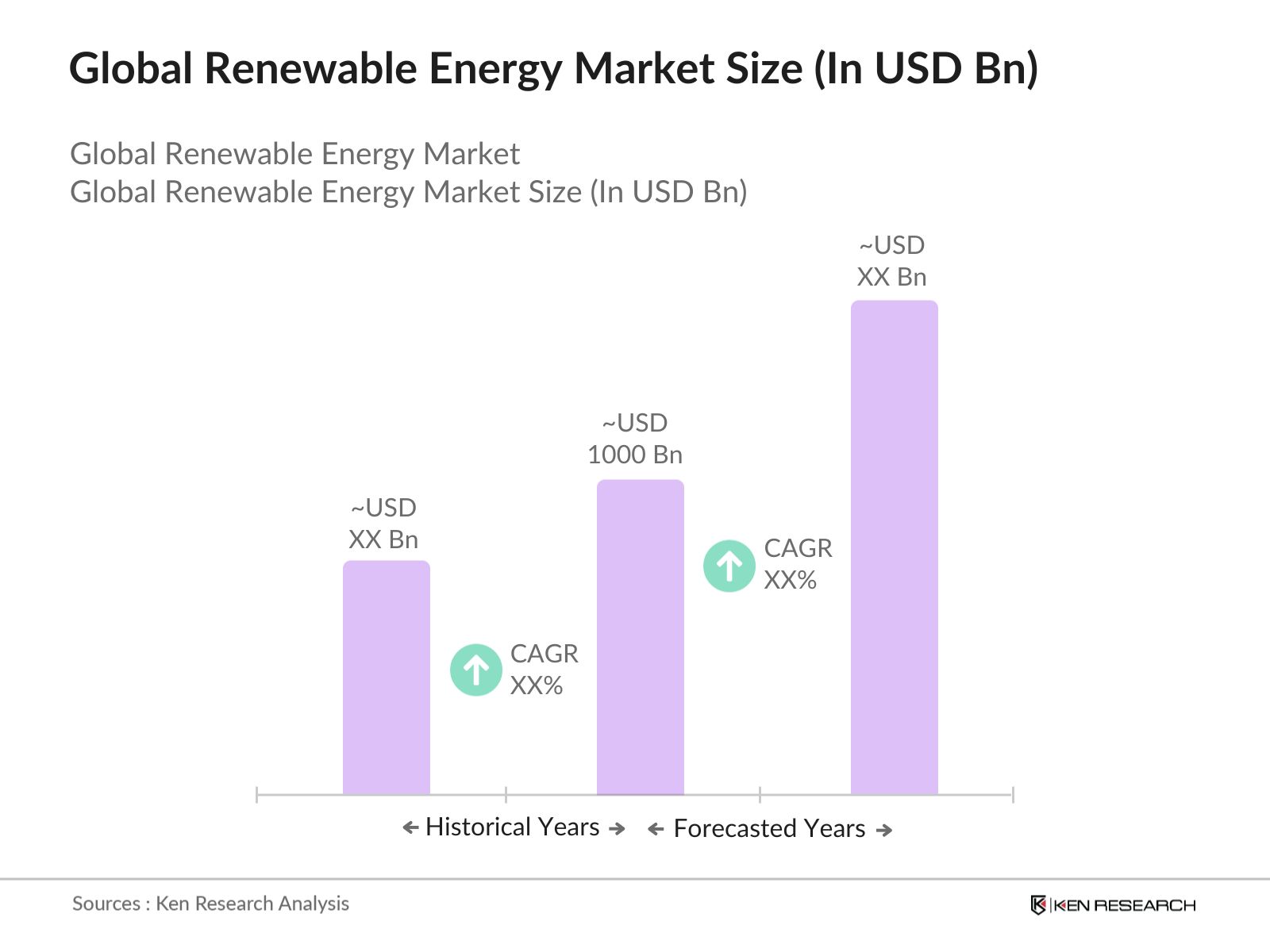
- In 2023, the Global Renewable Energy Market was estimated at USD 1000 billion, driven by Growing Concerns about Climate Change and Environmental Stability, Declining Costs of Renewable Technologies, Energy Security Concerns, Technological Advancements, and Significant New Discoveries of Rare Earth Metals.
- The market is highly fragmented with companies ranging from large multinational corporations to small startups and local players operating in the market. This fragmentation is characterized by a diverse range of technologies and services, including solar, wind, hydro, geothermal, and biomass energy.
- On December 17, 2022, China Three Gorges Renewables (Group) Co. Ltd. (CTGR) set a new industry milestone by generating 233 million kilowatt-hours (kWh) of electricity in a single day. This impressive achievement underscores CTGRs substantial energy production capacity and highlights its role as a leading player in the renewable energy sector.
Global Renewable Energy Current Market Analysis
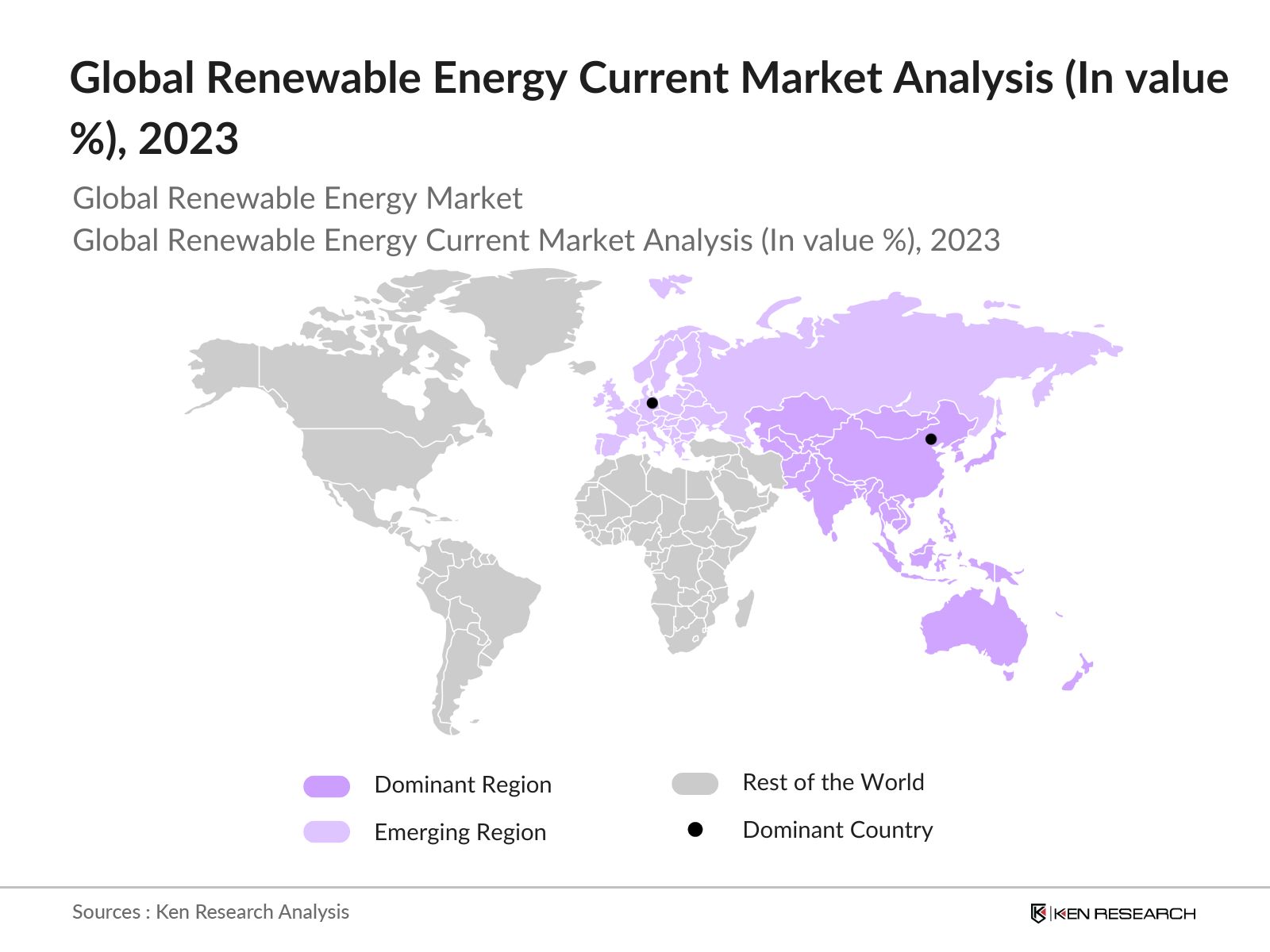
- APAC as the dominant region: APAC dominates the global renewable energy market driven by rapid urbanization and industrialization, falling costs of renewable technologies, government policies and initiatives, and government policies and initiatives.In 2022, the Indian government allocated an additional INR 19,500 crore to support solar PV module manufacturing under the Production Linked Incentive (PLI) scheme. Additionally, the International Energy Agency's Announced Pledges Scenario anticipates that APAC renewables investments made from 2022 through 2030 will hit USD 286 billion.Further, the declining cost of solar generation and the advancement in battery storage technology have underpinned the solar energy market growth in the region.
- Europe as an emerging region: Europe is as second largest region in the market owing to Established Market Infrastructure, substantial Investment and Funding, and Technological Leadership. In 2022, renewable sources accounted for nearly 40% of total electricity generation in the European Union (EU). Notably, wind and solar power generated 22% of the EUs electricity, surpassing gas for the first time. In 2022 alone, the EU added 41 GW of solar power generation capacity, contributing to a record increase in solar electricity production. Wind energy similarly saw a notable rise, with an increase of 33 TWh in generation compared to the previous year.
- China as the dominant country: APACs renewable energy market is led by China due to its significant investments, supportive government policies, and high domestic demand. China plans to install 1,200 GW of wind and solar power capacity, dominating the sector with record-breaking achievements. In 2023, China added as much solar PV capacity as the rest of the world did in 2022 and saw a 66% increase in wind power additions. The Green Subsidy Policy further fuels Chinas leadership, with forecasts predicting that China will account for 38% of global renewable energy capacity by 2029. Meanwhile, India is also investing heavily, with an USD 8 billion allocation for solar power in 2023-24, but remains behind China in scale.
Global Renewable Energy Market Segmentation
The Global Renewable Energy Market can be segmented based on several factors:
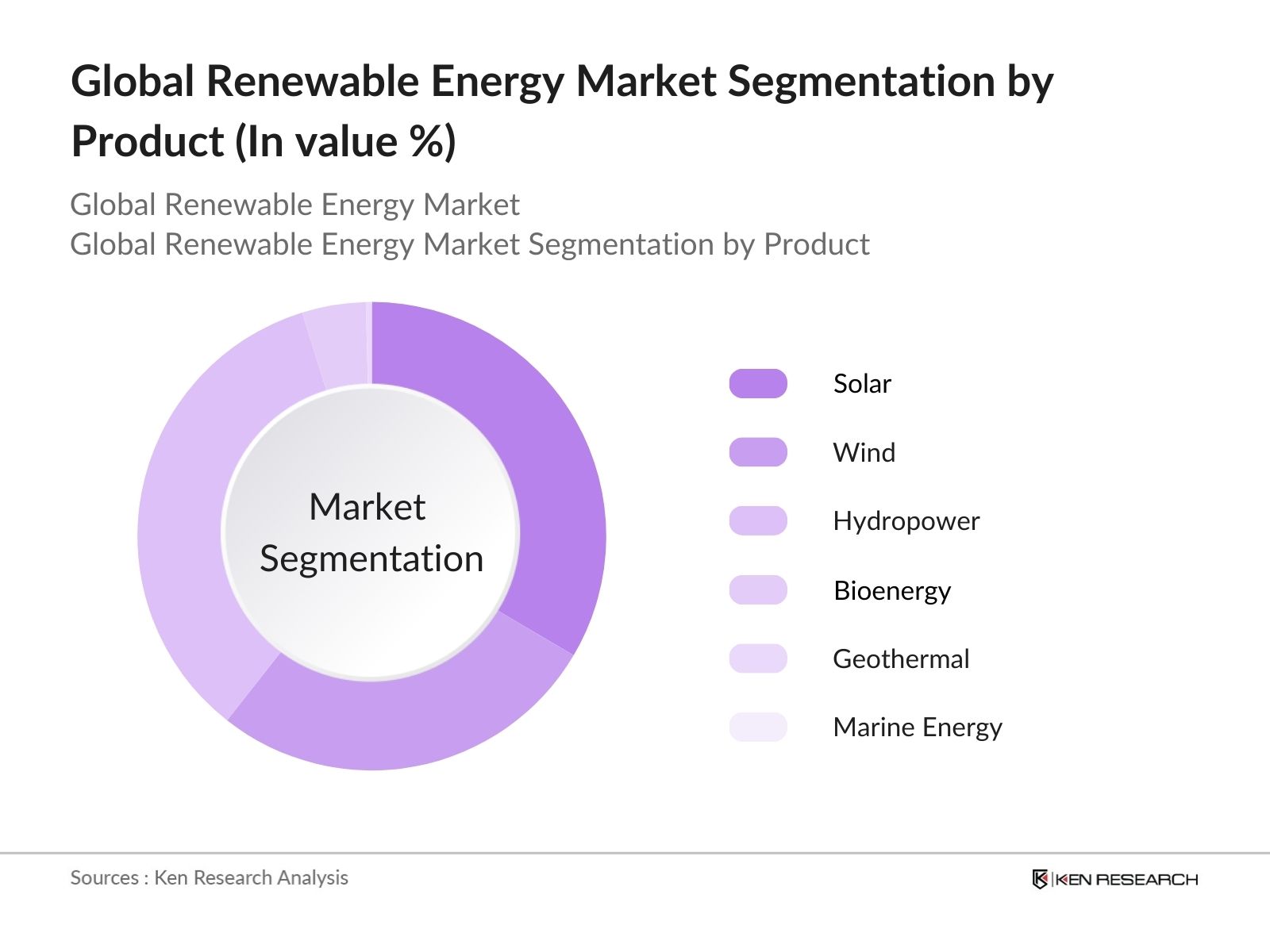
- By Product: The global renewable energy market segmentation by product type is divided into solar, wind, hydropower, bioenergy, geothermal, and marine energy. In 2023, the Hydropower dominated the market, accounting for the largest volume share. This is driven by the long-established infrastructure, reliable energy generation, and significant capacity of hydroelectric plants worldwide.
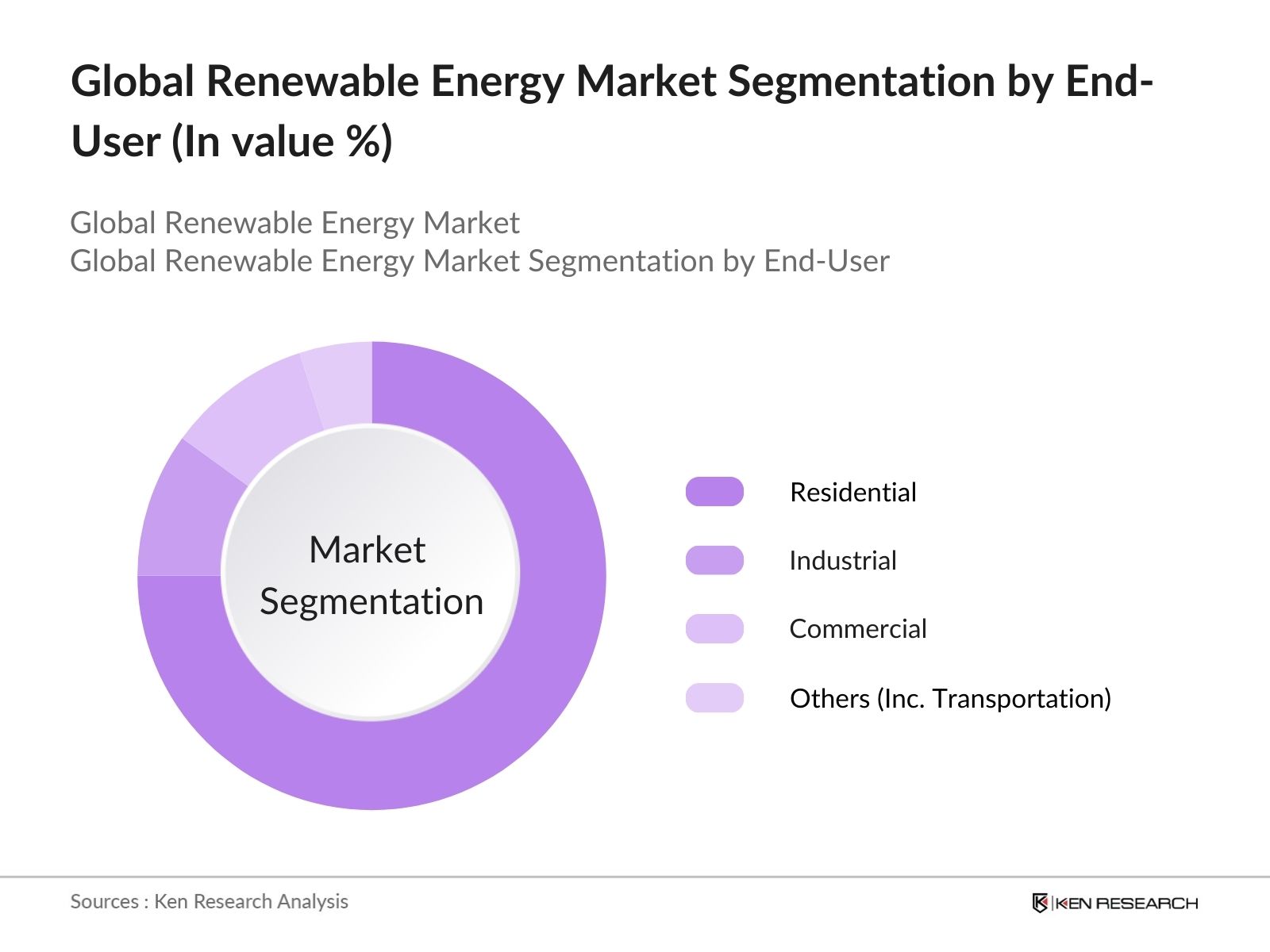
- By End-User: The global renewable energy market segmentation by end-user is divided into Residential, Industrial, Commercial, and Others (including Transportation). In 2023, the Residential sub-segment dominated the market by end-user, accounting for the largest volume share. This is driven by the increasing adoption of renewable energy solutions in homes, supported by incentives, falling technology costs, and growing consumer awareness of sustainability.
Global Renewable Energy Market Competitive Landscape
|
Company |
Headquarter |
Establishment Year/Vintage |
Geographical Presence |
Installed Capacity (GW) |
|
China Three Gorges Renewables Group |
Beijing, China |
1999 |
55 |
120 |
|
State Power Investment Corporation (SPIC) |
Beijing, China |
2002 |
47 |
94 |
|
China Huaneng Group |
Beijing, China |
1989 |
7 |
33.2 |
|
China Datang Corporation |
Beijing, China |
2002 |
5 |
14 |
|
Enel |
Rome, Italy |
1962 |
29 |
59 |
|
Iberdrola SA |
Bilbao, Spain |
1958 |
9 |
42 |
|
Constellation Energy Corp. |
Baltimore, Maryland, USA |
2000 |
1 |
3 |
|
Engie SA |
Paris, France |
2008 |
41 |
41.4 |
|
Statkraft |
Oslo, Norway |
1895 |
21 |
16.9 |
- China Huaneng Group: China Huanengs first KW-level ultra-low temperature vertical axis wind turbine achieved a significant milestone by successfully generating electricity at Zhongshan Station in Antarctica. This cutting-edge turbine, designed to operate efficiently in extremely cold conditions, was tested in one of the harshest environments on Earth.
- China Datang Corporation: China Datang Corporation has signed pivotal cooperation agreements with Uzbekistan to develop and construct world-class power plants, marking a significant step in transforming and advancing Uzbekistan's power industry. These agreements underscore China Datang's commitment to investing in Uzbekistans energy sector, which includes the construction of advanced power plants equipped with cutting-edge technology to enhance energy production and efficiency.
- Iberdrola SA: Iberdrola has signed a significant agreement with IB Vogt to develop a 245 MW photovoltaic project in Sicily, Italy. This collaboration represents a major investment in solar energy, aimed at expanding Italys renewable energy capacity. The photovoltaic project will harness the abundant solar resources in Sicily, contributing to the regions energy transition and sustainability goals.
Global Renewable Energy Industry Analysis
Global Renewable Energy Market Growth Drivers:
- Global Renewable Energy Market Challenges: Growing public awareness about climate change is driving a significant push towards renewable energy. According to the International Renewable Energy Agency (IRENA), the global energy sector is responsible for two-thirds of greenhouse gas (GHG) emissions, underscoring the urgent need for cleaner energy solutions. As a result, the market is witnessing huge investment, in 2023, total investment in renewable energy sector reached USD 1.7 trillion, a growth of 8.8% (YoY) as governments and businesses commit themselves to Net Zero Emissions Target by 2050. This awareness is fueling substantial demand for renewable energy sources as individuals, businesses, and governments seek to mitigate environmental impacts and transition towards more sustainable energy practices.
- Declining Costs of Renewable Technologies: The declining costs of renewable technologies are a major growth driver in the renewable energy market. As technology advances and economies of scale are achieved, the cost of producing and installing renewable energy systems has significantly decreased. According to the International Renewable Energy Agency (IRENA), the average global cost of utility-scale solar PV fell from USD 0.36 per kWh in 2010 to USD 0.09 per kWh in 2020. Similarly, the global weighted-average levelized cost of electricity (LCOE) from new capacity additions of onshore wind declined by 13% in 2020 compared to 2019.
- Energy Security Concerns: Energy security concerns are driving significant investments and interest in renewable energy. Countries are increasingly focusing on renewable energy to reduce their dependence on imported fossil fuels, which can be subject to volatile prices and geopolitical risks. According to the U.S. Energy Information Administration (EIA), more than 80% of the natural gas supplied to the EU-27 and the UK in 2020 was imported, with pipeline imports making up 74% of those imports and liquefied natural gas (LNG) accounting for the remaining 26%. The push for renewable energy is seen as a way to achieve greater energy independence and stability.
Global Renewable Energy Market Government Initiatives:
- Paris Agreement: The Paris Agreement, adopted by 196 countries, aims to limit global warming to well below 2C above pre-industrial levels, with efforts to restrict the temperature increase to 1.5C. This international agreement drives national policies and targets for reducing greenhouse gas emissions and increasing the share of renewable energy
- Germany's Government Initiative: Energiewende: Germanys government initiative known as Energiewende (Energy Transition) is a comprehensive policy framework aimed at transforming the countrys energy system towards greater sustainability and lower carbon emissions. Germany has set ambitious targets to increase the share of renewable energy in its electricity mix. The country aims to achieve a 65% share of renewable energy in electricity generation by 2030 and to phase out coal power by 2038.
Global Renewable Energy Future Market Outlook
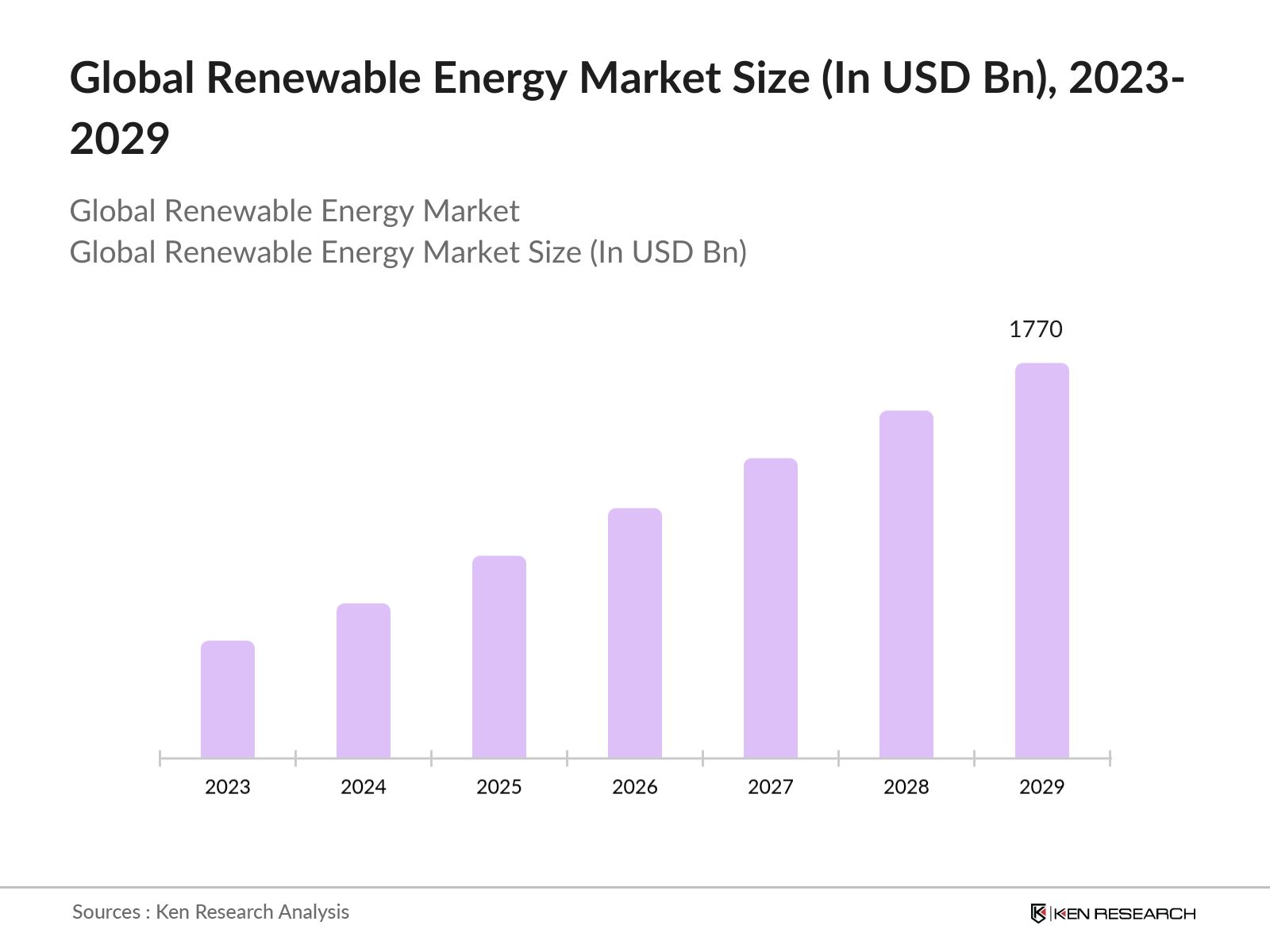
The global renewable energy market is predicted to grow exceptionally in the forecasted period of 2023-2029 reaching a market size of USD 1770 Bn driven by growing investments in renewable energy, increased integration of renewable energy storage solutions, and expansion of green hydrogen production.
Future Market Trends:
- Growing Investments in Renewable Energy: Growing investments in renewable energy represent a key future trend driven by several factors. As global awareness of climate change intensifies and governments commit to reducing greenhouse gas emissions, there is a notable shift towards funding renewable energy projects and technologies. Investments in renewable energy are expected to surge as both private and public sectors recognize the economic and environmental benefits.
- Increased Integration of Renewable Energy Storage Solutions: As renewable energy sources like solar and wind become more prevalent, the need for effective energy storage solutions is growing. The future trend is towards the increased integration of advanced energy storage technologies to address the intermittent nature of renewable energy generation. Innovations in battery storage, such as lithium-ion and solid-state batteries, are expected to play a crucial role in stabilizing the grid and ensuring a reliable energy supply.
Scope of the Report
|
By Region |
North America Europe APAC Latin America MEA |
|
By Product |
Solar Wind Hydropower Bioenergy Geothermal Marine Energy |
|
By End-User |
Residential Industrial Commercial Others (Inc. Transportation) |
Products
Key Target Audience Organizations and Entities Who Can Benefit by Subscribing This Report:
Energy Production Companies
Renewable Energy Equipment Manufacturers
Infrastructure Development Companies
Energy Service Providers
Renewable Energy Project Developers
Utility Regulators and Commissions
Banks and Financial Institutions
Investors and VCs
Government Agencies and Policy Makers (U.S. Department of Energy (DOE) and European Commissions Directorate-General for Energy)
Time Period Captured in the Report:
Historical Period: 2018-2023
Base Year: 2023
Forecast Period: 2023-2029
Companies
Players Mentioned in the Report:
China Three Gorges Renewables Group
State Power Investment Corporation (SPIC)
China Huaneng Group
China Datang Corporation
Enel
Iberdrola SA
Constellation Energy Corp.
Engie SA
Statkraft
NextEra Energy
Algonquin Power and Utilities Corp.
Adani Green Energy Limited
Clearway Energy
ReNew
Tata Power
Orsted
Scatec
Table of Contents
1. Executive Summary
1.1 Global Energy Market
1.1 Global Renewable Energy Market
2. Global Overview
2.1 Overview of Global Economics
2.2 Overview of Global Energy Industry
2.3 Global Energy (Renewable and Non-Renewable) Revenue
2.4 Global Renewable Energy Infrastructure
3. Global Renewable Energy Market Overview
3.1 Ecosystem
3.2 Value Chain
3.3 Case Study
4. Global Renewable Energy Market Size (in USD Bn), 2018-2023
5. Global Renewable Energy Market Segmentation (in value %), 2018-2023
5.1 By Region (North America, Europe, APAC, Latin America and MEA) in value %, 2018-2023
5.2 By Product (Solar, Wind, Hydropower, Bioenergy, Geothermal, and Marine Energy) in value%, 2018-2023
5.3 By End-User (Residential, Industrial, Commercial, and Others (including Transportation)), in value %, 2018-2023
6. Global Renewable Energy Market Competition Landscape
6.1 Market Share Analysis
6.2 Market Heat Map Analysis (By Technology)
6.3 Market Heat Map Analysis (By Offerings)
6.4 Market Cross Comparison
6.5 Comparison Matrix
6.6 Investment Landscape
7. Global Renewable Energy Market Dynamics
7.1 Growth Drivers
7.2 Challenges
7.3 Trends
7.4 Case Studies
7.5 Strategic Initiatives
8. Global Renewable Energy Future Market Size (in USD Bn), 2023-2029
9. Global Renewable Energy Future Market Segmentation (in value %), 2023-2029
9.1 By Region (North America, Europe, APAC, Latin America and MEA) in value %, 2023-2029
9.2 By Product (Solar, Wind, Hydropower, Bioenergy, Geothermal, and Marine Energy) in value%, 2018-2023
9.3 By End-User (Residential, Industrial, Commercial, and Others (including Transportation)), in value %, 2018-2023
10. Analyst Recommendations
Research Methodology
Step 01 Ecosystem Identification:
Identification of comprehensive ecosystem of global producers of renewable energy.
Step 02 Hypothesis Formation:
Extensive desk-based research was conducted to form initial level hypothesis about the installed capacity of measure players across the world by different energy types. Further, CATIs were conducted with these players to understand their operational and financial indicators like average price of each energy type (solar, wind, hydropower, bioenergy, geothermal and marine), capacity, revenues, future strategies and other value-adding information. Later, our team has adopted a bottom-to-top approach in order to evaluate the overall capacity by energy type and by end user.
Step 03 Market Value Evaluation:
Bottom-to-Top & top-to-bottom approach in order to evaluate the overall market value. Sanity Checking from Industry Veterans, Professionals and proxy variables.
Frequently Asked Questions
01 How big is the global renewable energy market?
In 2023, the global renewable energy market was valued at USD 1000 billion, driven by Growing Concerns about Climate Change and Environmental Stability, Declining Costs of Renewable Technologies, Energy Security Concerns, Technological Advancements, and Significant New Discoveries of Rare Earth Metals.
02 What are the challenges in the global renewable energy market?
Challenges in global renewable energy market include the intermittent nature of renewable energy sources, high initial investment costs, and limited energy storage solutions. Additionally, regulatory and policy uncertainties can impact market growth and investment decisions.
03 Who are the major players in the global renewable energy market?
Major players in global renewable energy market include rsted, Siemens Gamesa, Vestas Wind Systems, and First Solar. These companies lead the market due to their technological advancements, extensive project portfolios, and global presence.
04 What are the growth drivers of the global renewable energy market?
Growth drivers in global renewable energy market include technological advancements in energy generation and storage, supportive government policies, declining costs of renewable technologies, and increasing public and corporate investments in sustainability.
Why Buy From Us?

What makes us stand out is that our consultants follows Robust, Refine and Result (RRR) methodology. i.e. Robust for clear definitions, approaches and sanity checking, Refine for differentiating respondents facts and opinions and Result for presenting data with story

We have set a benchmark in the industry by offering our clients with syndicated and customized market research reports featuring coverage of entire market as well as meticulous research and analyst insights.

While we don't replace traditional research, we flip the method upside down. Our dual approach of Top Bottom & Bottom Top ensures quality deliverable by not just verifying company fundamentals but also looking at the sector and macroeconomic factors.

With one step in the future, our research team constantly tries to show you the bigger picture. We help with some of the tough questions you may encounter along the way: How is the industry positioned? Best marketing channel? KPI's of competitors? By aligning every element, we help maximize success.

Our report gives you instant access to the answers and sources that other companies might choose to hide. We elaborate each steps of research methodology we have used and showcase you the sample size to earn your trust.

If you need any support, we are here! We pride ourselves on universe strength, data quality, and quick, friendly, and professional service.