
Ken Research Logo

Global Robotic Lawn Mower Market Outlook 2030

Global Methacrylate Butadiene Styrene Market Outlook 2028

Region:Global

Author(s):Shivani Mehra

Product Code:KROD6447

Published On

December 2024

Total pages

86

About the Report

Global Robotic Lawn Mower Market Overview
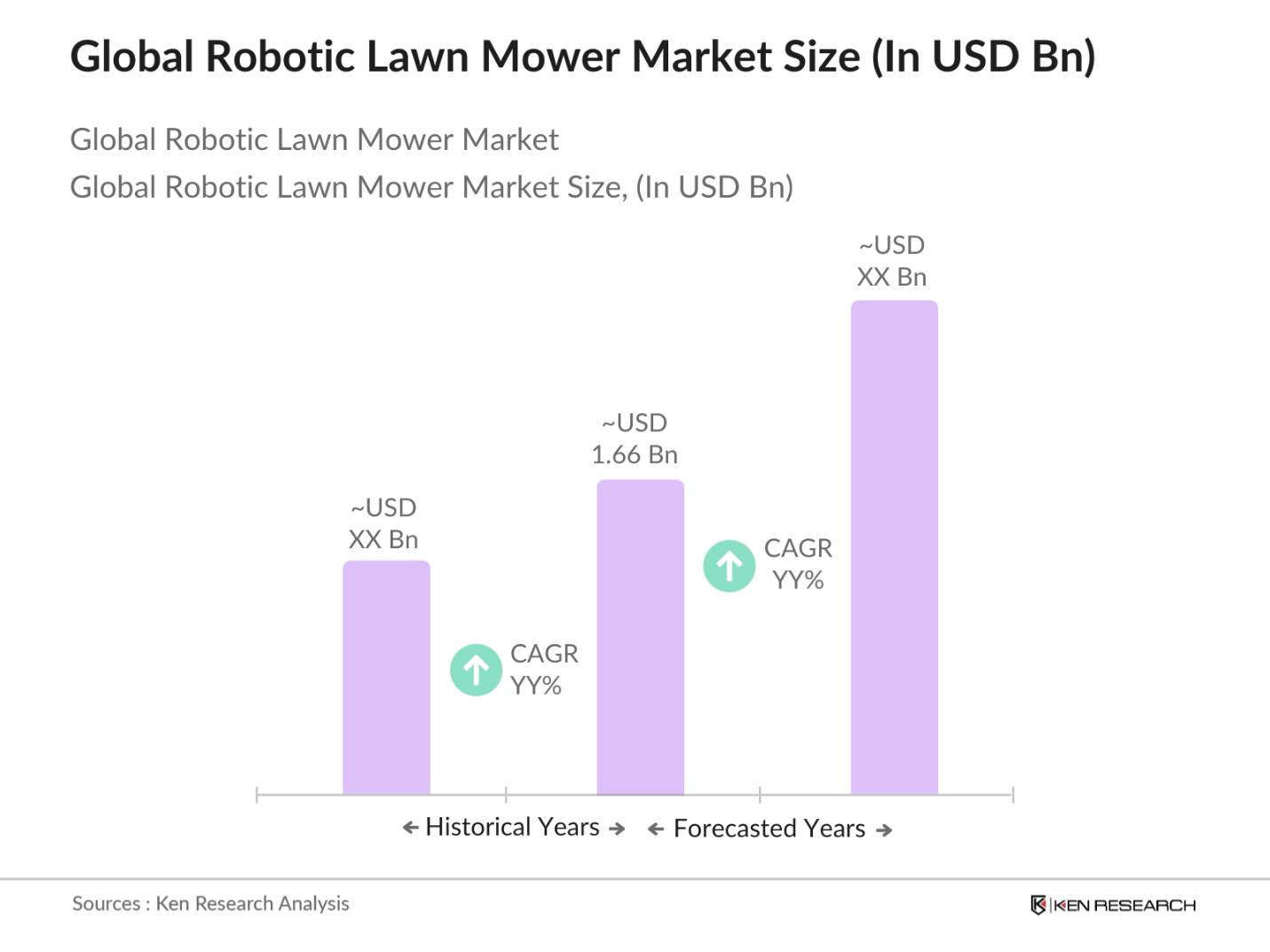
  • The global robotic lawn mower market is valued at USD 1.66 billion, driven by technological advancements, urbanization, and the demand for eco-friendly solutions. Consumers' preference for hands-free and energy-efficient lawn maintenance is accelerating market growth. Robotic mowers equipped with GPS navigation and smart connectivity offer superior convenience, allowing users to automate the process without manual intervention, contributing significantly to the market's expansion.

market overviews

  • Europe and North America dominate the robotic lawn mower market due to high disposable income, consumer inclination toward smart home devices, and well-established infrastructure. Countries like Germany, Sweden, and the U.S. lead because of their technological innovations and increased demand from residential sectors. These regions also benefit from the widespread adoption of battery-powered robotic lawn mowers, which aligns with the growing environmental concerns.
  • In the U.S., federal and state governments are promoting eco-friendly technologies by offering grants and tax incentives for businesses and municipalities that adopt battery-operated lawn care equipment, including robotic lawn mowers. Programs such as the Environmental Protection Agencys (EPA) Clean Air Act provide funds to help replace older gas-powered equipment with cleaner, more efficient alternatives, helping public parks and schools lower their carbon footprint.

Global Robotic Lawn Mower Market Segmentation

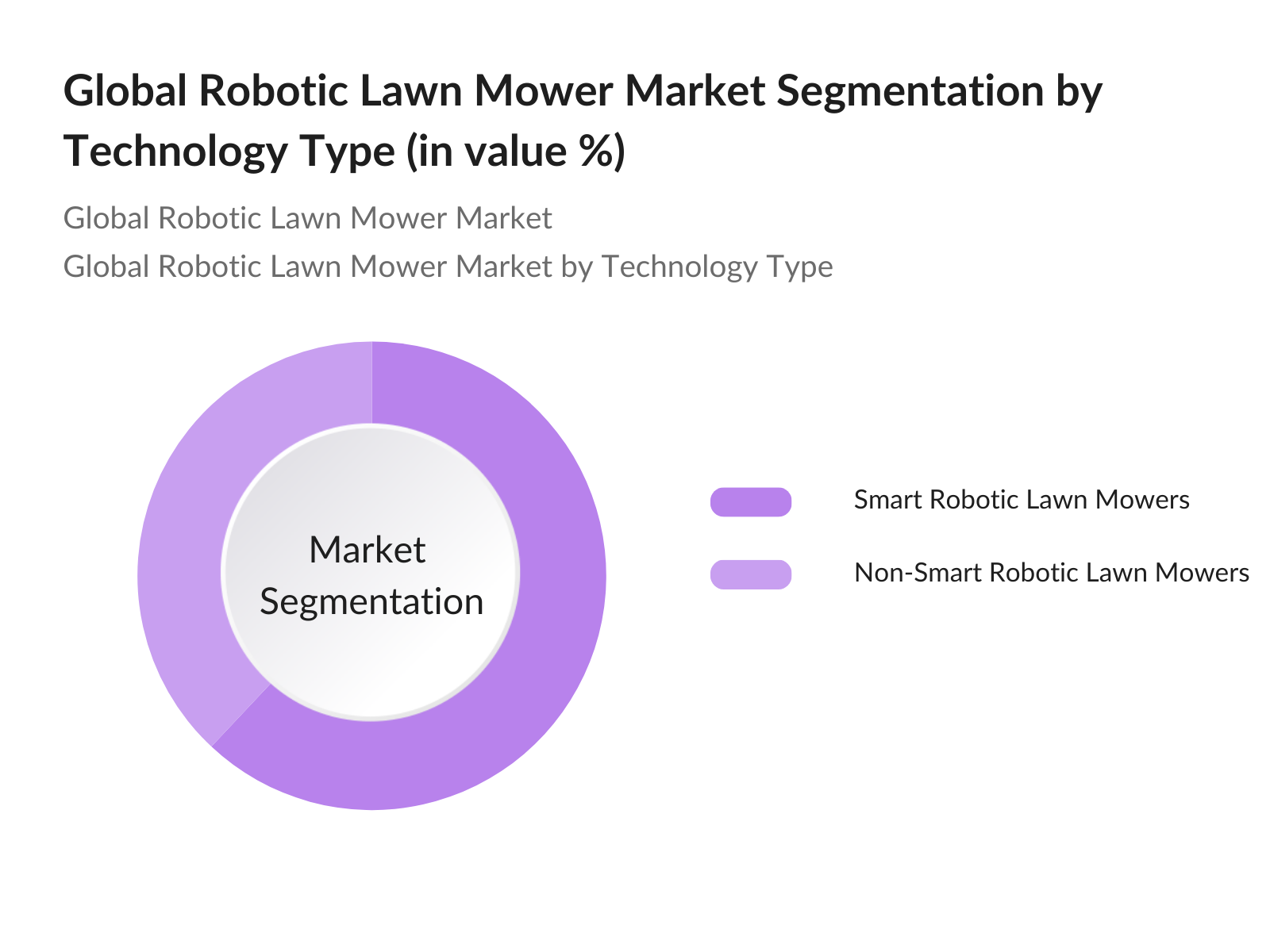
By Technology Type: The global robotic lawn mower market is segmented into smart robotic lawn mowers and non-smart robotic lawn mowers. Recently, smart robotic lawn mowers have taken the dominant market share due to the rising demand for IoT-enabled devices. These mowers feature advanced navigation systems, connectivity to smart home networks, and the ability to optimize lawn mowing schedules, making them highly efficient for residential use.
market overviews

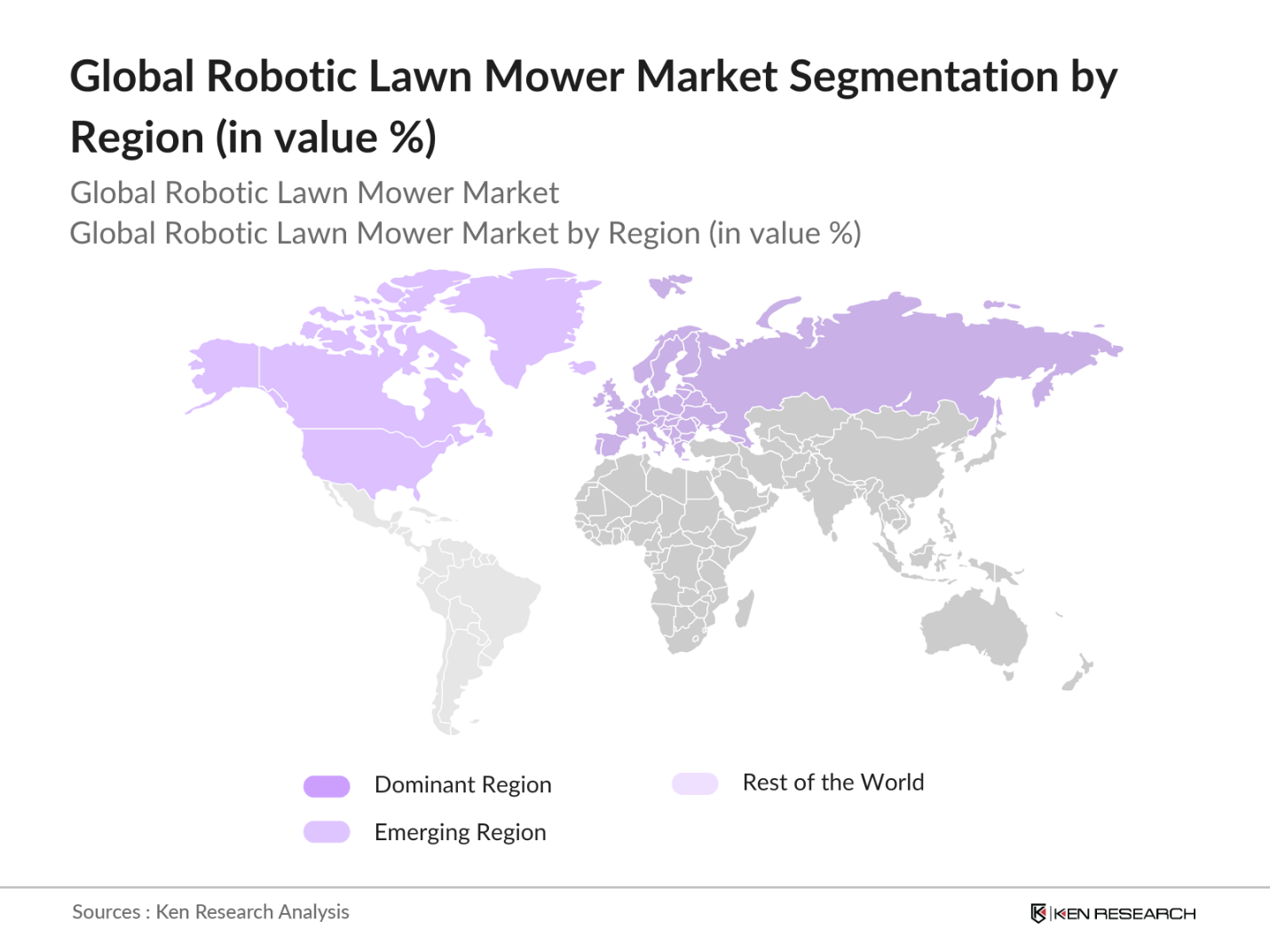
By Region: The global robotic lawn mower market is segmented by region into North America, Europe, Asia Pacific, Middle East & Africa, and South America. Europe holds the dominant market share, driven by the high adoption rate of smart home technologies and the popularity of autonomous gardening tools. Countries such as Germany and Sweden lead in Europe due to advanced infrastructure, high disposable incomes, and a strong inclination toward energy-efficient, eco-friendly solutions for lawn maintenance.
market overviews

Global Robotic Lawn Mower Market Competitive Landscape

The global robotic lawn mower market is characterized by a few major players dominating the scene, with key companies such as Husqvarna Group, Robert Bosch GmbH, and STIGA S.p.A. being pivotal contributors. These companies invest heavily in research and development to introduce innovative products with enhanced features, including better navigation systems and longer battery life. These firms have a strong presence in Europe and North America, and their continuous innovation efforts set them apart from other competitors.

Company Name

Establishment Year

Headquarters

Revenue (USD bn)

Employees

Product Innovation

Global Presence

M&A Activities

R&D Investment

Husqvarna Group

1689

Stockholm, SE

5.5

Robert Bosch GmbH

1886

Gerlingen, DE

88.2

STIGA S.p.A.

1934

Veneto, IT

1.2

Deere & Company

1837

Illinois, US

47.0

Honda Motor Co.

1946

Tokyo, JP

126.3

Global Robotic Lawn Mower Market Analysis

Market Growth Drivers:

  • Technological Advancements (Smart Sensors, GPS-enabled Lawn Mowers): The introduction of smart sensors and GPS-enabled robotic lawn mowers is significantly transforming the market. As of 2024, many new robotic lawn mowers in Europe are equipped with smart navigation systems, allowing for optimized route planning and energy efficiency, which reduces downtime significantly. The adoption of GPS-enabled models in urban areas has facilitated higher accuracy in lawn maintenance across uneven terrains, contributing to growing sales. The European Union has seen a sharp rise in patents filed for AI-integrated lawn mowers since 2022, reaching 120 patents in 2023.
  • Increasing Aging Population Adoption: The aging global population is accelerating the adoption of robotic lawn mowers. As older consumers seek to reduce physical strain, they are increasingly turning to automated solutions for lawn care. This demographic's preference for robotic mowers is particularly evident in regions with a rapidly aging population, where automation offers convenience and efficiency. Countries with high proportions of elderly individuals, such as Japan and parts of Europe, are witnessing a growing demand for these devices as they align with the needs of older homeowners looking for ease in maintaining their outdoor spaces.
  • Demand for Eco-friendly Solutions: As global initiatives to curb carbon emissions intensify, the demand for eco-friendly robotic lawn mowers has surged. In 2023, the majority of robotic lawn mowers sold in developed markets like the U.S. and Europe were battery-powered, significantly reducing carbon emissions annually. Countries such as Germany are incentivizing the use of electric-powered lawn equipment, helping to lower emissions from traditional gas-powered mowers, which contribute notably to national outdoor equipment emissions. This shift is supported by stricter regulations across multiple regions aiming to phase out gas-powered equipment.

Market Challenges:

  • Battery Life Limitations: Battery technology remains a significant challenge for robotic lawn mowers, with the average operational runtime still limited to 60-90 minutes per charge as of 2024. This constraint is particularly notable in regions with larger lawn sizes, where users need more efficient battery systems. Despite improvements in lithium-ion batteries, the need for frequent recharging in large estates in markets like the U.S. and Australia affects adoption, with users requiring models that can handle at least 2 acres in one cycle.
  • High Initial Installation Costs: The upfront cost of installing robotic lawn mowers, which includes the mower unit and perimeter wire setup, remains a challenge for broader market penetration. In 2023, the average installation cost for robotic lawn mowers in Europe and North America was between $1,200 and $2,000 per unit, which has slowed adoption among middle-income households. This high initial investment deters many potential users, despite long-term savings on labor costs. Government subsidies, like those offered in Scandinavian countries, are still limited to eco-friendly initiatives, leaving most consumers with high initial costs.

Global Robotic Lawn Mower Market Future Outlook

Over the next five years, the global robotic lawn mower market is anticipated to experience substantial growth, driven by continuous technological advancements, increasing consumer demand for smart home integration, and eco-friendly solutions. The integration of AI, better battery technology, and enhanced GPS navigation will continue to fuel the market, particularly in developed economies. Growth is also expected in the commercial sector, especially for maintaining parks and golf courses.

Market Opportunities:

  • Integration with Smart Home Ecosystems (AI-based Connectivity): The integration of robotic lawn mowers with smart home ecosystems presents significant growth opportunities. By 2023, millions of households in Europe and North America had adopted smart home systems, with many seeking AI-based connectivity solutions. As smart home adoption continues to grow, more homeowners are looking to integrate robotic lawn mowers with systems such as Amazon Alexa and Google Home, driving demand for such devices. Manufacturers are investing in AI-driven connectivity to ensure seamless integration, offering predictive maintenance, enhanced user control, and improved convenience for users.
  • Expansion into Commercial Sectors (Golf Courses, Parks): Robotic lawn mowers are expanding into the commercial sector, particularly in large-scale areas such as golf courses, parks, and municipal green spaces. These environments require efficient and consistent lawn care, making robotic mowers an ideal solution. As the global number of golf courses and public parks continues to grow, there is a substantial opportunity for robotic mowers to cater to these spaces, offering cost-effective and eco-friendly alternatives to traditional lawn maintenance methods. This expansion into commercial applications is set to drive further growth in the robotic lawn mower market.

Scope of the Report

By Product Type

Smart Robotic Lawn Mowers

Non-Smart Robotic Lawn Mowers

By Application

Residential

Commercial

By End-User

Commercial Users

Residential Users

By Power Source

Battery-powered

Solar-powered

By Region

North America

Europe

Asia Pacific

Middle East & Africa

South America

Major Players

  • Husqvarna Group
  • Robert Bosch GmbH
  • STIGA S.p.A.
  • Deere & Company
  • HONDA MOTOR CO., LTD.
  • Hitachi Ltd.
  • LawnMaster
  • Toro Company
  • GLOBGRO AB
  • ANDREAS STIHL AG
  • Robin Autopilot
  • Robomow
  • WOLF-Garten
  • Cub Cadet
  • AL-KO

Products

Key Target Audience

  • Robotic Lawn Mower Manufacturers

  • Smart Home Device Providers

  • Battery Manufacturers

  • Gardening Equipment Distributors

  • Government and Regulatory Bodies (e.g., Environmental Protection Agencies)

  • Landscape Maintenance Companies

  • Investments and Venture Capitalist Firms

  • Technology and Software Developers

Table of Contents

1. Global Robotic Lawn Mower Market Overview

  • 1.1. Definition and Scope
  • 1.2. Market Taxonomy (Technology Type, Application, End-User)
  • 1.3. Market Growth Rate (CAGR, Market Demand Drivers)
  • 1.4. Market Segmentation Overview

2. Global Robotic Lawn Mower Market Size (In USD Mn)

  • 2.1. Historical Market Size
  • 2.2. Growth Analysis (YoY Growth Rate, Key Developments)
  • 2.3. Market Dynamics (Demand Drivers: Smart Home Integration, Demographic Trends)

3. Global Robotic Lawn Mower Market Analysis

  • 3.1. Growth Drivers
    • 3.1.1. Technological Advancements (Smart Sensors, GPS-enabled Lawn Mowers)
    • 3.1.2. Demand for Eco-friendly Solutions
    • 3.1.3. Increasing Aging Population Adoption
  • 3.2. Market Challenges
    • 3.2.1. Battery Life Limitations
    • 3.2.2. High Initial Installation Costs
    • 3.2.3. Competition from Manual and Gas-powered Mowers
  • 3.3. Opportunities
    • 3.3.1. Integration with Smart Home Ecosystems (AI-based Connectivity)
    • 3.3.2. Expansion into Commercial Sectors (Golf Courses, Parks)
    • 3.3.3. Advancements in Lithium-ion Battery Technology
  • 3.4. Market Trends
    • 3.4.1. Autonomous and Perimeter Wire-free Models
    • 3.4.2. Increasing Online Sales Channel
  • 3.5. SWOT Analysis
  • 3.6. Porters Five Forces Analysis
  • 3.7. Industry Stakeholder Ecosystem

4. Global Robotic Lawn Mower Market Segmentation (Market-specific parameters)

  • 4.1. By Technology Type (In Value %)
    • 4.1.1. Smart Robotic Lawn Mowers
    • 4.1.2. Non-Smart Robotic Lawn Mowers
  • 4.2. By Application (In Value %)
    • 4.2.1. Residential Lawns
    • 4.2.2. Commercial Lawns (Parks, Golf Courses)
  • 4.3. By End-User (In Value %)
    • 4.3.1. Commercial Users
    • 4.3.2. Residential Users
  • 4.4. By Power Source (In Value %)
    • 4.4.1. Battery-powered Mowers
    • 4.4.2. Solar-powered Mowers
  • 4.5. By Lawn Size (In Value %)
    • 4.5.1. Small Lawns (Up to 800 sqm)
    • 4.5.2. Medium Lawns (800-1,500 sqm)
    • 4.5.3. Large Lawns (1,500+ sqm)

5. Global Robotic Lawn Mower Market Competitive Analysis

  • 5.1. Profiles of Major Companies (Headquarters, Market Presence, Revenue)
    • 5.1.1. Husqvarna Group
    • 5.1.2. Robert Bosch GmbH
    • 5.1.3. STIGA S.p.A.
    • 5.1.4. Deere & Company
    • 5.1.5. HONDA MOTOR CO., LTD.
    • 5.1.6. Hitachi Ltd.
    • 5.1.7. LawnMaster
    • 5.1.8. Toro Company
    • 5.1.9. GLOBGRO AB
    • 5.1.10. ANDREAS STIHL AG
    • 5.1.11. Robin Autopilot
    • 5.1.12. Robomow
    • 5.1.13. WOLF-Garten
    • 5.1.14. Cub Cadet
    • 5.1.15. AL-KO
  • 5.2. Cross Comparison Parameters (Revenue, Headquarters, Employee Count, R&D Investments, Product Range, M&A activity, Smart Features, Battery Technology)
  • 5.3. Market Share Analysis
  • 5.4. Strategic Initiatives (Partnerships, Product Innovations)
  • 5.5. Mergers and Acquisitions
  • 5.6. Investment Analysis (Private Equity, Government Grants)

6. Global Robotic Lawn Mower Market Regulatory Framework

  • 6.1. Environmental Standards
  • 6.2. Product Certification
  • 6.3. Safety Compliance Requirements

7. Global Robotic Lawn Mower Market Future Market Size (In USD Mn)

  • 7.1. Market Projections
  • 7.2. Key Drivers of Future Growth

8. Global Robotic Lawn Mower Future Market Segmentation

  • 8.1. By Technology (In Value %)
  • 8.2. By Application (In Value %)
  • 8.3. By End-User (In Value %)
  • 8.4. By Power Source (In Value %)
  • 8.5. By Lawn Size (In Value %)

9. Global Robotic Lawn Mower Market Analysts Recommendations

  • 9.1. TAM/SAM/SOM Analysis
  • 9.2. Market Penetration Strategies
  • 9.3. Emerging Opportunities
  • 9.4. White Space Analysis

Research Methodology

Step 1: Identification of Key Variables


The initial phase involves constructing a market ecosystem map of the robotic lawn mower sector, identifying key stakeholders. Desk research is conducted using proprietary and public databases to gather detailed market data and define the key variables that affect the industry.

Step 2: Market Analysis and Construction


In this phase, we compile historical data on the penetration of robotic lawn mowers and evaluate their growth across different regions. Market penetration rates, sales trends, and key factors driving customer adoption are all assessed.

Step 3: Hypothesis Validation and Expert Consultation


Consultations with industry professionals are carried out via telephone interviews (CATIs) to validate key market assumptions. These insights, gathered directly from manufacturers and suppliers, help verify market size, trends, and projections.

Step 4: Research Synthesis and Final Output


In the final stage, feedback from key market players is gathered to ensure that the analysis reflects the true state of the market. This comprehensive synthesis provides a validated, reliable assessment of the global robotic lawn mower market.

Frequently Asked Questions

01. How big is the Global Robotic Lawn Mower Market?

The global robotic lawn mower market is valued at USD 1.66 billion, driven by advancements in battery technology and increased demand for automated lawn maintenance solutions.

02. What are the key challenges in the Global Robotic Lawn Mower Market?

Challenges include high upfront installation costs and limited battery life, which restrict operational capacity. The complexity of setup also deters some consumers from adopting these solutions.

03. Who are the major players in the Global Robotic Lawn Mower Market?

Major players include Husqvarna Group, Robert Bosch GmbH, STIGA S.p.A., Deere & Company, and Honda Motor Co., all of which lead the market due to their technological innovations and extensive distribution networks.

04. What is driving growth in the Global Robotic Lawn Mower Market?

The market is driven by consumer demand for eco-friendly and smart home solutions, coupled with the growing adoption of IoT-enabled devices for autonomous lawn maintenance.

Why Buy From Us?

RRR
Refine Robust Result (RRR) Framework

What makes us stand out is that our consultants follows Robust, Refine and Result (RRR) methodology. i.e. Robust for clear definitions, approaches and sanity checking, Refine for differentiating respondents facts and opinions and Result for presenting data with story

Our Reach Is Unmatched

We have set a benchmark in the industry by offering our clients with syndicated and customized market research reports featuring coverage of entire market as well as meticulous research and analyst insights.

Research
Shifting the Research Paradigm

While we don't replace traditional research, we flip the method upside down. Our dual approach of Top Bottom & Bottom Top ensures quality deliverable by not just verifying company fundamentals but also looking at the sector and macroeconomic factors.

Insite
More Insights-Better Decisions

With one step in the future, our research team constantly tries to show you the bigger picture. We help with some of the tough questions you may encounter along the way: How is the industry positioned? Best marketing channel? KPI's of competitors? By aligning every element, we help maximize success.

Trust
Transparency and Trust

Our report gives you instant access to the answers and sources that other companies might choose to hide. We elaborate each steps of research methodology we have used and showcase you the sample size to earn your trust.

support
Round the Clock Support

If you need any support, we are here! We pride ourselves on universe strength, data quality, and quick, friendly, and professional service.

Why Client Choose Us?

400000+ Reports in repository
150+ Consulting project a year
100+ Analysts
8000+ Client Queries in 2022