
Global Robotic Operating System (ROS) Market Outlook To 2030
Region:Global
Author(s):Shreya
Product Code:KROD2465
Region:Global
Author(s):Shreya
Product Code:KROD2465
October 2024
89
The global Robotic Operating System (ROS) market was valued at USD 580 million, exhibiting a compound annual growth rate (CAGR) of 18%. This growth is driven by the increasing adoption of robotics across various industries, such as manufacturing, healthcare, and logistics, to enhance operational efficiency and reduce costs. Technological advancements in AI and machine learning are also contributing to the widespread adoption of ROS.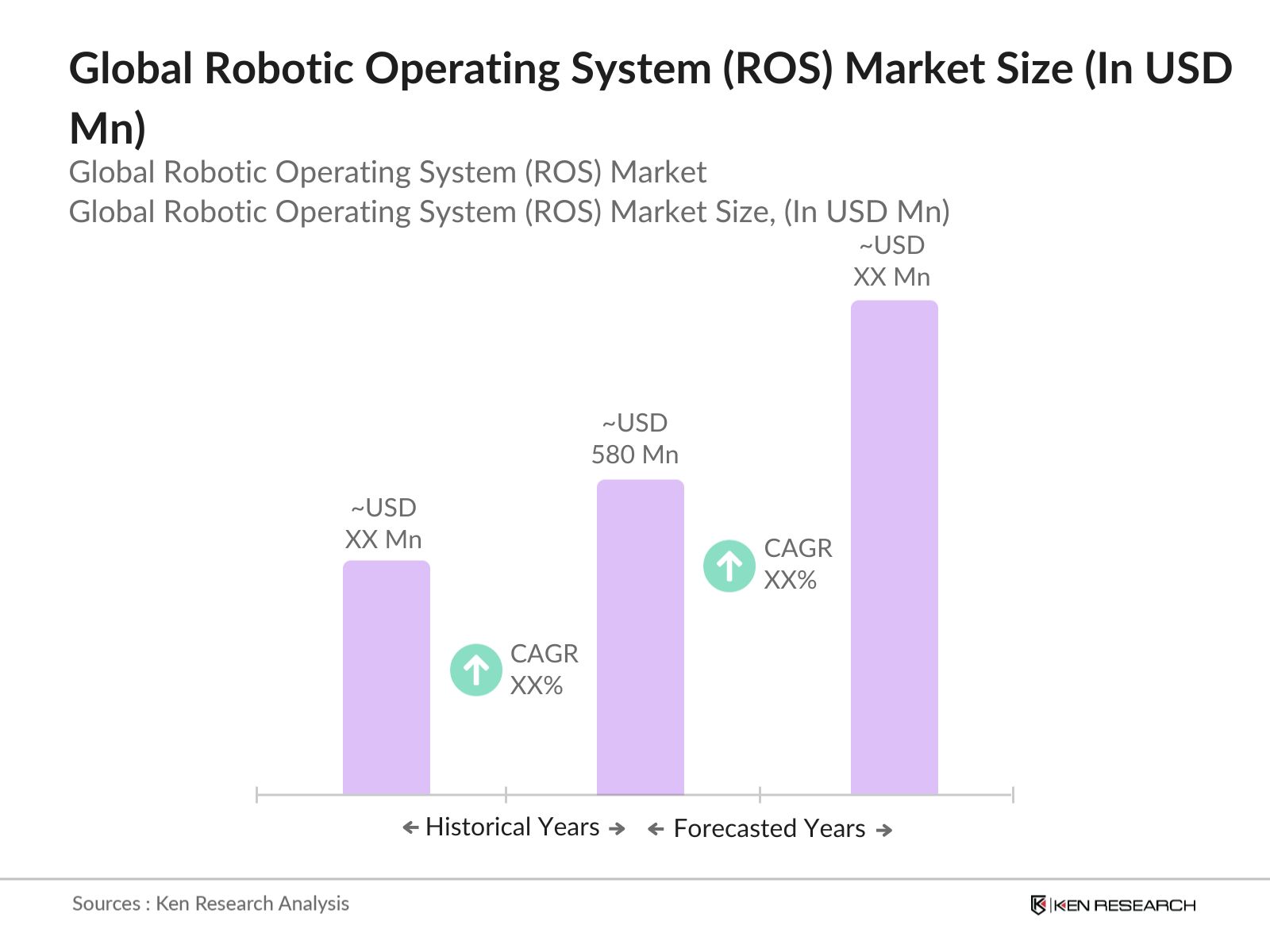
Prominent players in the ROS market include Microsoft Corporation, Clearpath Robotics, Omron Adept Technologies, Rethink Robotics and ABB Group. These companies are investing heavily in research and development to innovate and improve ROS capabilities, ensuring they remain competitive in this rapidly evolving market.
In 2023, Microsoft Corporation announced the integration of its Azure cloud platform with ROS 2, enhancing the capabilities of ROS-based robots by providing robust cloud computing resources. This development is expected to accelerate the deployment and scalability of ROS applications across various sectors, leveraging Microsoft's extensive cloud infrastructure to provide enhanced processing power and data management capabilities.
North America, particularly the United States, dominates the ROS market. In 2023, North America accounted for around half of the market share. This dominance is attributed to the region's advanced technological infrastructure, high investment in robotics research, and the presence of major ROS developers. The US government's supportive policies and funding for robotics innovation further bolster this leadership.
By Application: The market is segmented by application into manufacturing, healthcare, and logistics. In 2023, manufacturing held a dominant market share. The widespread adoption of ROS in automation and assembly lines has enhanced production efficiency and reduced labor costs. The flexibility and scalability of ROS allow manufacturers to adapt to changing production needs, making it a preferred choice.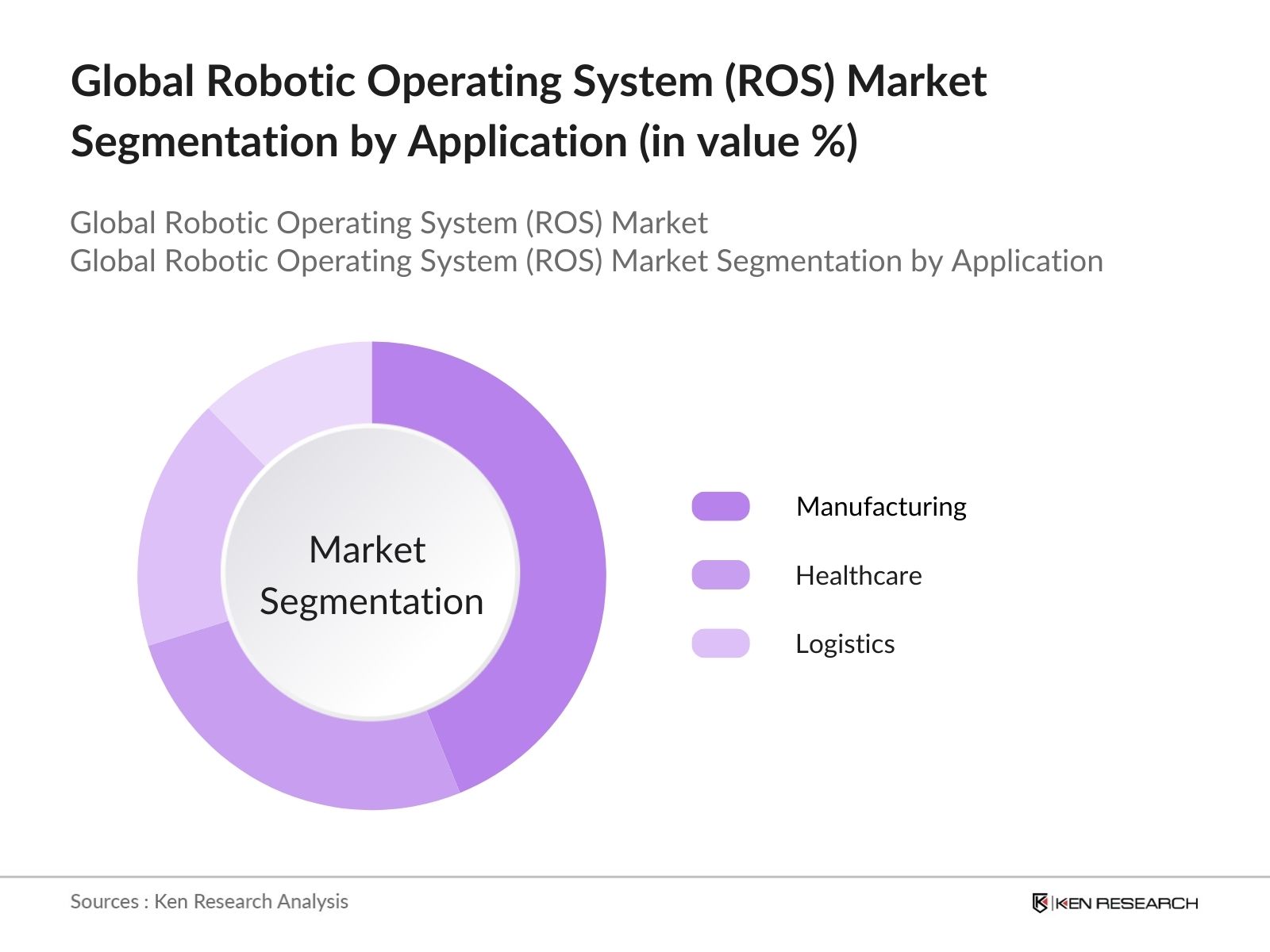
By Component: The market is also segmented by components into hardware, software, and services. Hardware held a dominant market share in 2023. The increasing demand for advanced robotic components such as sensors, actuators, and controllers are driving this segment. Continuous innovation in hardware to enhance the capabilities of ROS-based systems contributes to its dominance.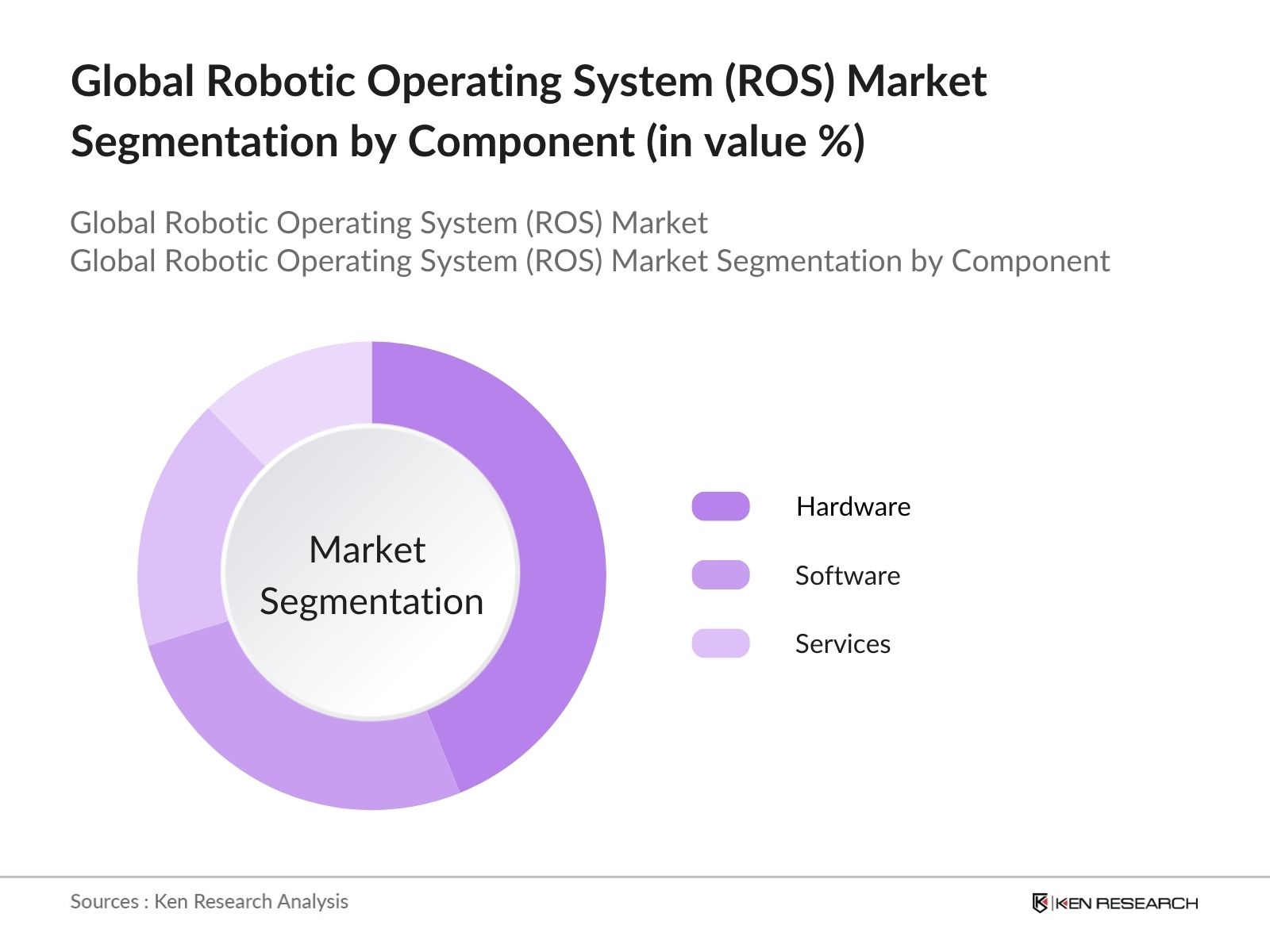
By Region: The market is segmented by region into North America, Europe, APAC, MEA, Latin America North America held a dominant market share in 2023. The region's advanced technological infrastructure, high investment in robotics research, and the presence of major ROS developers contribute to its leadership. The US government's supportive policies and funding for robotics innovation further bolster this dominance.
|
Company |
Establishment Year |
Headquarters |
|
Microsoft Corporation |
1975 |
Redmond, USA |
|
Clearpath Robotics |
2009 |
Kitchener, Canada |
|
Omron Adept Technologies |
1983 |
San Jose, USA |
|
Rethink Robotics |
2008 |
Boston, USA |
|
ABB Group |
1883 |
Zurich, Switzerland |
Rising Demand for Automation in Manufacturing: The global manufacturing sector is witnessing an increasing demand for automation, driven by the need to improve efficiency and reduce labor costs. It has been recorded that there have been 553,052 industrial robot installations in factories around the world in 2022, with a portion utilizing ROS for enhanced flexibility and scalability in automation processes.
Growth in E-commerce and Logistics: The e-commerce industry continues to drive the demand for automation in logistics and warehousing. It is projected that the global e-commerce market will generate over USD 6 trillion in sales by the end of 2024, Amazon leads the charge, deploying across its facilities in 2023 for efficient inventory management, order fulfillment, and last-mile delivery. The integration of ROS in logistics operations ensures streamlined processes and reduced delivery times.
Investments in Research and Development: Substantial investments in research and development are propelling the advancements in ROS technology. R&D spending on robotics is expected to increase, with a huge portion dedicated to enhancing ROS capabilities. These investments are aimed at developing more sophisticated and adaptable robotic systems, ensuring the continuous evolution and application of ROS across various industries.
Technical Complexity: The technical complexity of ROS integration presents another major challenge. In 2024, it is estimated that over 40% of companies planning to adopt ROS cite technical difficulties as a hurdle. The need for specialized knowledge and expertise in configuring and maintaining ROS-based systems can deter businesses from investing in these technologies, necessitating the development of more user-friendly and accessible solutions.
Integration with Legacy Systems: Integrating ROS with existing legacy systems can be problematic for many businesses. It is anticipated that companies will face challenges in integrating ROS with their current infrastructure. This issue is compounded by the need for seamless interoperability between new and existing technologies, which can be technically demanding and resource intensive.
National Robotics Initiative 2.0: In the United States, the National Robotics Initiative 2.0 continues to support ROS development. In this year, the initiative will provide USD 250,000 to USD 1,500,000,in grants to research institutions and companies developing ROS-based solutions. This funding is crucial for driving innovation and ensuring the US remains competitive in the global robotics market.
Japan's Robot Revolution Initiative: Japan's Robot Revolution Initiative is another key government program promoting ROS technology. In 2024, the initiative will see investments of JPY 100 billion to enhance the country's robotics capabilities, with a focus on integrating ROS in manufacturing and healthcare sectors. This initiative aims to address labor shortages and improve productivity through advanced automation.
The global ROS market is projected to grow exponentially by 2028, driven by continuous advancements in robotics technology and increasing investments from both public and private sectors. The integration of ROS with emerging technologies such as the Internet of Things (IoT), edge computing, and 5G networks will further expand its application scope, enabling more intelligent and interconnected robotic systems.
Increased Adoption in Healthcare: Over the next five years, the adoption of ROS in healthcare is expected to rise. By 2028, it is projected that the global market for medical robots will increase, driven by the increasing demand for precision in surgical procedures and the growing prevalence of minimally invasive surgeries. The integration of ROS in healthcare will enhance the capabilities of medical robots, improving patient outcomes and operational efficiency.
Growth in Collaborative Robotics: The market for collaborative robots, or cobots, is expected to see substantial growth over the next five years. By 2028, it is projected that the sales of cobots will increase, driven by the demand for safe and flexible automation solutions in various industries. The integration of ROS in cobots will enhance their capabilities, enabling more seamless human-robot collaboration and expanding their application across different sectors.
|
By Application |
Manufacturing Healthcare Logistics |
|
By Component |
Hardware Software Services |
|
Operating System |
Gazebo Open CV Point Cloud Library Movelt ROS Industrial |
|
By Robot Type |
Articulated Robots SCARA Robots Parallel Robots Cartesian Robots Collaborative Robots Autonomous Mobile Robots |
|
By Region |
North South East West |
1.1. Definition and Scope
1.2. Market Taxonomy
1.3. Market Growth Rate
1.4. Market Segmentation Overview
2.1. Historical Market Size
2.2. Year-On-Year Growth Analysis
2.3. Key Market Developments and Milestones
3.1. Growth Drivers
3.1.1. Surge in Autonomous Robotics Applications
3.1.2. Growing Demand for Industrial Automation
3.1.3. Increase in AI and ML Capabilities
3.1.4. Rising R&D Investments in Robotics
3.2. Market Challenges
3.2.1. High Costs Associated with Implementation
3.2.2. Complexity of Software Integration
3.2.3. Limited Standardization in ROS Packages
3.2.4. Cybersecurity Concerns
3.3. Opportunities
3.3.1. Growth of Collaborative Robots (Cobots)
3.3.2. Expanding Applications in Healthcare and Logistics
3.3.3. Rising Demand for Edge Computing in Robotics
3.3.4. Opportunities in Emerging Markets
3.4. Trends
3.4.1. Integration with AI and Deep Learning Algorithms
3.4.2. Use of Simulation for Robotic System Design
3.4.3. Growing Adoption in the Agriculture Sector
3.4.4. Development of ROS 2 for Real-Time Capabilities
3.5. Government Regulations
3.5.1. Robotics Standardization Initiatives
3.5.2. Regulatory Frameworks for Autonomous Systems
3.5.3. Public-Private Partnerships in Robotics Development
3.5.4. National Robotics Development Programs
3.6. SWOT Analysis
3.7. Stake Ecosystem (OEMs, Software Providers, End-Users)
3.8. Porters Five Forces Analysis
3.8.1. Bargaining Power of Suppliers
3.8.2. Bargaining Power of Buyers
3.8.3. Threat of New Entrants
3.8.4. Threat of Substitutes
3.8.5. Intensity of Competitive Rivalry
3.9. Competition Ecosystem
4.1. By Application (In Value %)
4.1.1. Industrial Robots
4.1.2. Service Robots
4.1.3. Collaborative Robots
4.1.4. Healthcare Robotics
4.1.5. Autonomous Mobile Robots (AMRs)
4.2. By End-User Industry (In Value %)
4.2.1. Manufacturing
4.2.2. Healthcare
4.2.3. Logistics and Warehousing
4.2.4. Automotive
4.2.5. Agriculture
4.3. By Platform Type (In Value %)
4.3.1. Hardware-Agnostic Platforms
4.3.2. Middleware Solutions
4.3.3. Software Development Kits (SDKs)
4.3.4. Cloud-Based Solutions
4.4. By Region (In Value %)
4.4.1. North America
4.4.2. Europe
4.4.3. Asia-Pacific
4.4.4. Latin America
4.4.5. Middle East & Africa
4.5. By ROS Version (In Value %)
4.5.1. ROS 1
4.5.2. ROS 2
5.1 Detailed Profiles of Major Companies
5.1.1. Microsoft Corporation
5.1.2. Clearpath Robotics Inc.
5.1.3. ABB Ltd.
5.1.4. Yaskawa Electric Corporation
5.1.5. FANUC Corporation
5.1.6. KUKA AG
5.1.7. Universal Robots
5.1.8. Rethink Robotics
5.1.9. iRobot Corporation
5.1.10. Open Robotics
5.1.11. Omron Corporation
5.1.12. Fetch Robotics
5.1.13. Aethon Inc.
5.1.14. Cyberbotics Ltd.
5.1.15. PAL Robotics
5.2 Cross Comparison Parameters5.3 Market Share Analysis
5.4 Strategic Initiatives
5.5 Mergers and Acquisitions
5.6 Investment Analysis
5.7 Venture Capital Funding
5.8 Government Grants
5.9 Private Equity Investments
6.1. Industry Standards for ROS
6.2. Safety and Compliance Certifications
6.3. Global Robotics Regulations
6.4. Cybersecurity Guidelines
7.1. Future Market Size Projections
7.2. Key Factors Driving Future Market Growth
8.1. By Application (In Value %)
8.2. By End-User Industry (In Value %)
8.3. By Platform Type (In Value %)
8.4. By ROS Version (In Value %)
8.5. By Region (In Value %)
9.1. TAM/SAM/SOM Analysis
9.2. Customer Cohort Analysis
9.3. Marketing Initiatives
9.4. White Space Opportunity Analysis
Ecosystem creation for all the major entities and referring to multiple secondary and proprietary databases to perform desk research around market to collate industry level information.
Collating statistics on market over the years, penetration of marketplaces and service providers ratio to compute revenue generated for Global Robotic Operating System (ROS) market. We will also review service quality statistics to understand revenue generated which can ensure accuracy behind the data points shared.
Building market hypothesis and conducting CATIs with industry experts belonging to different companies to validate statistics and seek operational and financial information from company representatives.
Our team will approach multiple Robotic Operating System (ROS) companies and understand nature of product segments and sales, consumer preference and other parameters, which will support us validate statistics derived through bottom to top approach from Global Robotic Operating System (ROS) companies.
The global ROS market was valued at USD 580 million by 2023. The market is driven by increasing adoption across industries such as manufacturing, healthcare, and logistics.
Key growth drivers in the Global Robotic Operating System (ROS) Market include the rising demand for automation in manufacturing, expansion in healthcare robotics, growth in e-commerce and logistics, and substantial investments in research and development. These factors are enhancing the capabilities and adoption of ROS across various sectors.
Challenges in the Global Robotic Operating System (ROS) Market include high implementation costs, technical complexity, regulatory and compliance issues, and integration difficulties with legacy systems. These hurdles can deter businesses from adopting ROS technology, particularly small and medium-sized enterprises.
Major players in the Global Robotic Operating System (ROS) Market include Microsoft Corporation, Clearpath Robotics, Omron Adept Technologies, Rethink Robotics, and ABB Group. These companies are leading the innovation and adoption of ROS-based systems, driving advancements and market growth through investments in research and development.

What makes us stand out is that our consultants follows Robust, Refine and Result (RRR) methodology. i.e. Robust for clear definitions, approaches and sanity checking, Refine for differentiating respondents facts and opinions and Result for presenting data with story

We have set a benchmark in the industry by offering our clients with syndicated and customized market research reports featuring coverage of entire market as well as meticulous research and analyst insights.

While we don't replace traditional research, we flip the method upside down. Our dual approach of Top Bottom & Bottom Top ensures quality deliverable by not just verifying company fundamentals but also looking at the sector and macroeconomic factors.

With one step in the future, our research team constantly tries to show you the bigger picture. We help with some of the tough questions you may encounter along the way: How is the industry positioned? Best marketing channel? KPI's of competitors? By aligning every element, we help maximize success.

Our report gives you instant access to the answers and sources that other companies might choose to hide. We elaborate each steps of research methodology we have used and showcase you the sample size to earn your trust.

If you need any support, we are here! We pride ourselves on universe strength, data quality, and quick, friendly, and professional service.