
Ken Research Logo

Global Robotics Market Outlook to 2030

Region:Global

Author(s):Mukul

Product Code:KROD11052

Published On

December 2024

Total pages

82

About the Report

Global Robotics Market Overview

  • The Global Robotics Market is valued at USD 85 billion, with steady growth influenced by industrial automation and advancements in artificial intelligence (AI) and machine learning. Increased demand for automation across industries such as manufacturing, healthcare, and logistics continues to fuel the market, as companies aim to enhance efficiency, accuracy, and productivity in operational processes.
  • Countries such as Japan, the United States, and Germany dominate the robotics market due to their technological advancements, well-developed infrastructure, and high investment in research and development. Japan, for instance, benefits from a strong manufacturing base and high robot density, while the United States leverages a robust tech sector and high investment in autonomous robotics.
  • Governments mandate regulatory compliance to ensure ethical and safe robotic use in industrial settings. For instance, the U.S. implemented the Robot Safety Program in 2023, impacting over 100,000 manufacturing units, as reported by OSHA. Compliance frameworks are developed to protect workers and ensure transparent data handling, especially in robotics-intensive industries like automotive and electronics.

Global Robotics Market Segmentation

  • By Type: The robotics market is segmented by type into industrial robots, service robots, and collaborative robots. Recently, industrial robots have captured a dominant market share in this segmentation due to their critical role in manufacturing and automation processes across sectors like automotive and electronics. The precision and efficiency these robots provide make them a preferred choice for high-volume production, particularly in regions with strong manufacturing bases.
  • By Region: The robotics market is segmented by region into North America, Europe, Asia Pacific, Middle East & Africa, and Latin America. Asia Pacific leads in this segmentation, propelled by substantial investment in automation across countries like China, Japan, and South Korea. The regions rapid industrialization and high demand for automation in sectors such as electronics and automotive manufacturing underscore its dominant position.
  • By Application: The market is segmented by application into manufacturing, healthcare, agriculture, and defense & security. Within this segmentation, manufacturing holds a dominant position as the largest application sector for robotics, driven by the need to streamline complex production tasks. Automation in manufacturing reduces labor costs and increases production speed, making robots essential for companies striving to enhance output quality and efficiency.

Global Robotics Market Competitive Landscape

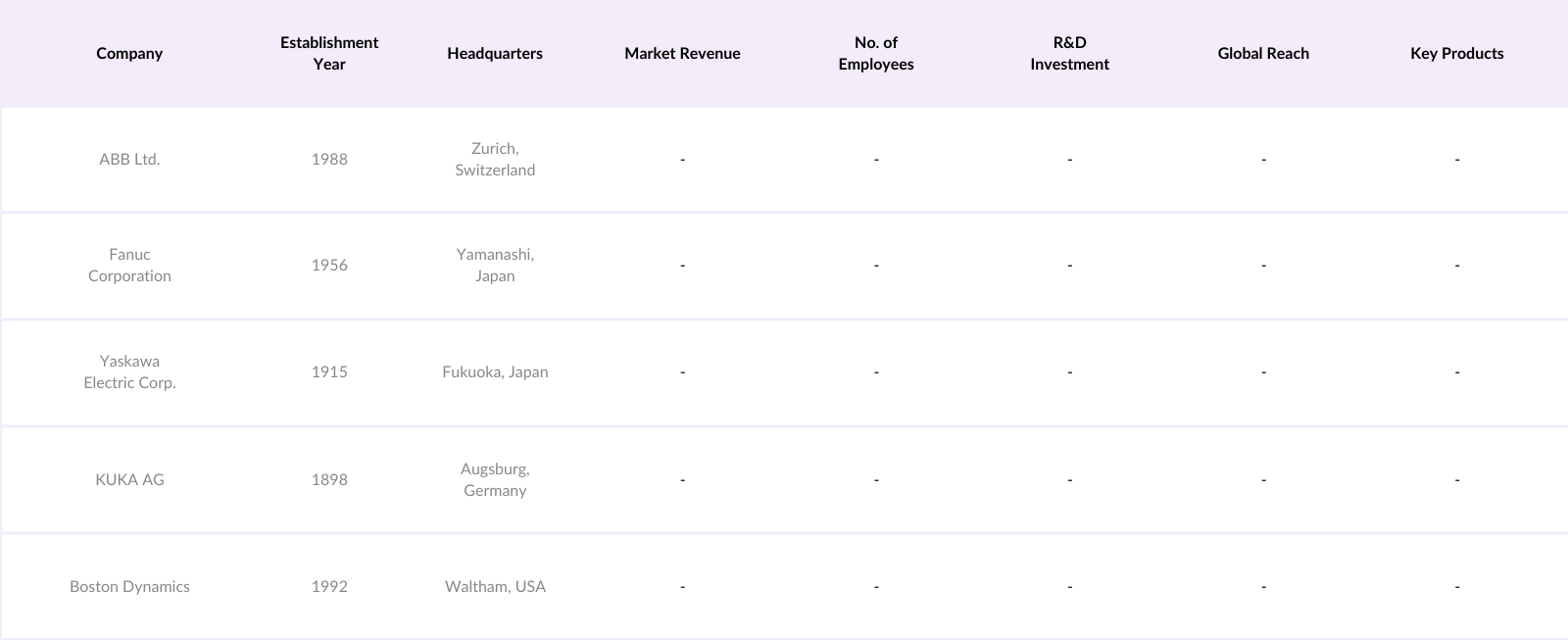
The Global Robotics Market is marked by the presence of both established global companies and regional players. Major players include renowned manufacturers that continuously invest in R&D to improve robotics technology and gain a competitive edge.
market overviews

Global Robotics Industry Analysis

Growth Drivers

  • Advancements in Artificial Intelligence (AI): Advances in artificial intelligence are powering the robotics market by enhancing efficiency and accuracy in manufacturing and service applications. The global AI sector received investments totaling around $176 billion in 2023, as reported by the OECD, supporting rapid R&D that feeds directly into robotics innovation. AI algorithms improve real-time decision-making in robots, particularly in industries such as automotive and electronics. According to the International Federation of Robotics, AI-driven robots increased productivity levels by 32% in sectors that deployed automation since 2022.
  • Adoption in Industrial Sectors: The robotics market has seen a surge in industrial sector adoption, driven by the need to increase production speed and reduce labor costs. In 2023, manufacturing robotics in sectors like automotive and electronics manufacturing exceeded installations of over 500,000 units globally, as per UNIDO data, showing a strong adoption trend. The automotive sector alone invested over $15 billion in robotic technology for automation and quality control enhancements. These high adoption rates highlight the sector's reliance on robotics for operational efficiency and cost-cutting.
  • Expansion of Collaborative Robots: Collaborative robots (cobots) have become crucial in industries seeking flexible automation solutions. Cobots installations worldwide rose by 22% in 2023, with over 30,000 units deployed in sectors like packaging and assembly lines, according to the International Federation of Robotics. The rise in cobots aligns with the $1.2 trillion global manufacturing sectors demand for safe human-robot collaboration to improve workplace safety and efficiency. Cobots are widely adopted in SMEs, where they enhance productivity without substantial space or safety concerns.

Market Restraints

  • High Initial Costs: Despite the benefits, the high initial costs of robotics remain a challenge, with average installations costing upwards of $100,000 per industrial robot in 2023, based on OECD data. These costs encompass both hardware and training expenses, making it challenging for SMEs to adopt robotics extensively. Only 20% of small manufacturing businesses could afford robotics integration in 2023, highlighting a significant barrier in industries with lower capital reserves.
  • Skilled Labor Shortage: The robotics sector faces a substantial shortage of skilled professionals, with the International Labour Organization reporting a gap of approximately 2 million skilled robotics engineers globally in 2023. As industries require technicians proficient in programming and maintaining advanced robotics systems, the shortage impedes rapid adoption, particularly in countries with lower rates of technical education. This labor gap has resulted in longer implementation times and reduced operational efficiencies for robotics in various sectors.

Global Robotics Market Future Outlook

The Global Robotics Market is projected to expand significantly in the next five years. Increased automation in manufacturing and a rising demand for service robotics across healthcare, logistics, and agriculture will be primary growth drivers. This expansion will be further supported by advancements in AI and machine learning, making robotics technology more versatile and accessible across industries.

Market Opportunities

  • Growth in Service Robotics: Service robots are witnessing considerable growth, with deployments increasing by 40% in 2023, primarily within logistics and retail, as per data from the International Federation of Robotics. Service robots have facilitated efficient inventory management, enhancing accuracy and customer satisfaction. The logistics sector alone utilized over 80,000 service robots in 2023 to optimize delivery times and warehouse operations, reflecting the critical role of robotics in transforming service-oriented tasks.
  • Expansion in Healthcare Applications: Healthcare robotics have expanded significantly, with hospitals globally employing over 15,000 surgical and therapeutic robots in 2023, according to World Health Organization statistics. Robotic-assisted surgeries have seen increased demand in orthopedic and cardiac procedures, enhancing precision and reducing patient recovery times. This trend is driven by a healthcare sector focused on improving outcomes, reducing human error, and managing an aging population.

Scope of the Report

Type

Industrial Robots


Service Robots


Collaborative Robots

Application

Manufacturing


Healthcare


Agriculture


Defense and Security

Technology

Autonomous Robots


Semi-Autonomous Robots

End-User

Automotive


Electronics


Food & Beverage


Logistics

Region

North America


Europe


Asia Pacific


Middle East & Africa


Latin America

Products

Key Target Audience

  • Robotics Manufacturers

  • Automation Service Providers

  • Investor and Venture Capitalist Firms

  • Government and Regulatory Bodies (e.g., Federal Trade Commission)

  • Healthcare Institutions

  • Automotive Industry Associations

  • Logistics and Supply Chain Companies

  • Electronics Manufacturers

Companies

Players Mentioned in the Report:

  • ABB Ltd.

  • Fanuc Corporation

  • Yaskawa Electric Corporation

  • KUKA AG

  • Boston Dynamics

  • Kawasaki Robotics

  • Denso Corporation

  • Mitsubishi Electric Corporation

  • Universal Robots

  • Omron Adept Technology

  • Staubli International AG

  • Seiko Epson Corporation

  • Comau Robotics

  • Rethink Robotics

  • Epson Robots

Table of Contents

1. Global Robotics Market Overview

1.1. Definition and Scope
1.2. Market Taxonomy
1.3. Market Penetration Rate
1.4. Market Segmentation Overview

2. Global Robotics Market Size (In USD Mn)

2.1. Historical Market Size
2.2. Year-On-Year Growth Analysis
2.3. Key Market Developments and Milestones

3. Global Robotics Market Analysis

3.1. Growth Drivers
3.1.1. Advancements in Artificial Intelligence (AI)
3.1.2. Adoption in Industrial Sectors
3.1.3. Expansion of Collaborative Robots
3.1.4. Technological Integration in Manufacturing
3.2. Market Challenges
3.2.1. High Initial Costs
3.2.2. Skilled Labor Shortage
3.2.3. Cybersecurity Concerns
3.3. Opportunities
3.3.1. Growth in Service Robotics
3.3.2. Expansion in Healthcare Applications
3.3.3. Government Support and Initiatives
3.4. Trends
3.4.1. Integration with IoT and Big Data
3.4.2. Rise of Autonomous Mobile Robots
3.4.3. Increasing Adoption of AI-Powered Robots
3.5. Government Regulation
3.5.1. Safety Standards for Robotics
3.5.2. Funding Programs for Innovation
3.5.3. Regulatory Compliance for Industrial Robotics
3.6. SWOT Analysis
3.7. Stakeholder Ecosystem
3.8. Porters Five Forces
3.9. Competition Ecosystem

4. Global Robotics Market Segmentation

4.1. By Type (In Value %)
4.1.1. Industrial Robots
4.1.2. Service Robots
4.1.3. Collaborative Robots
4.2. By Application (In Value %)
4.2.1. Manufacturing
4.2.2. Healthcare
4.2.3. Agriculture
4.2.4. Defense and Security
4.3. By Technology (In Value %)
4.3.1. Autonomous Robots
4.3.2. Semi-Autonomous Robots
4.4. By End-User (In Value %)
4.4.1. Automotive
4.4.2. Electronics
4.4.3. Food & Beverage
4.4.4. Logistics
4.5. By Region (In Value %)
4.5.1. North America
4.5.2. Europe
4.5.3. Asia Pacific
4.5.4. Middle East & Africa
4.5.5. Latin America

5. Global Robotics Market Competitive Analysis

5.1. Detailed Profiles of Major Companies
5.1.1. ABB Ltd.
5.1.2. Fanuc Corporation
5.1.3. Yaskawa Electric Corporation
5.1.4. KUKA AG
5.1.5. Mitsubishi Electric Corporation
5.1.6. Kawasaki Robotics
5.1.7. Denso Corporation
5.1.8. Universal Robots
5.1.9. Omron Adept Technology
5.1.10. Epson Robots
5.1.11. Rethink Robotics
5.1.12. Staubli International AG
5.1.13. Seiko Epson Corporation
5.1.14. Comau Robotics
5.1.15. Boston Dynamics
5.2. Cross Comparison Parameters (Revenue, No. of Employees, Global Reach, R&D Expenditure, Production Capacity, Regional Presence, Innovation Index, Market Share)
5.3. Market Share Analysis
5.4. Strategic Initiatives
5.5. Mergers and Acquisitions
5.6. Investment Analysis
5.7. Venture Capital Funding
5.8. Government Grants
5.9. Private Equity Investments

6. Global Robotics Market Regulatory Framework

6.1. Safety Standards for Autonomous Robots
6.2. Compliance Requirements for Industrial Robotics
6.3. Certification Processes
6.4. National and International Robotics Laws

7. Global Robotics Future Market Size (In USD Mn)

7.1. Future Market Size Projections
7.2. Key Factors Driving Future Market Growth

8. Global Robotics Future Market Segmentation

8.1. By Type (In Value %)
8.2. By Application (In Value %)
8.3. By Technology (In Value %)
8.4. By End-User (In Value %)
8.5. By Region (In Value %)

9. Global Robotics Market Analysts Recommendations

9.1. TAM/SAM/SOM Analysis
9.2. Customer Cohort Analysis
9.3. Marketing Initiatives
9.4. White Space Opportunity Analysis

Disclaimer Contact Us

Research Methodology

Step 1: Identification of Key Variables

The first phase identifies key variables influencing the Global Robotics Market, including AI integration, industry demand, and automation trends. Extensive desk research is conducted to map these factors accurately.

Step 2: Market Analysis and Construction

Historical data on market segments, demand, and industry usage is analyzed to assess current and potential market trends. This process involves quantitative assessments for accuracy.

Step 3: Hypothesis Validation and Expert Consultation

Initial findings are validated through structured interviews with industry experts and stakeholders, providing first-hand insights and confirming trends observed in secondary research.

Step 4: Research Synthesis and Final Output

The concluding phase consolidates validated insights to produce a detailed market report, emphasizing accuracy and alignment with the verified data gathered from top-down and bottom-up methodologies.


Frequently Asked Questions

01. How big is the Global Robotics Market?

The global robotics market, valued at USD 85 billion, is driven by industrial automation and rising applications in diverse sectors, including manufacturing and healthcare.

02. What are the key challenges in the Global Robotics Market?

Key challenges include high initial costs, limited availability of skilled labor, and cybersecurity risks, which can affect the adoption rate of robotics technology in certain regions.

03. Who are the major players in the Global Robotics Market?

Major players include ABB Ltd., Fanuc Corporation, Yaskawa Electric Corporation, and KUKA AG, all of which benefit from advanced R&D facilities and extensive global reach.

04. What factors are driving growth in the Global Robotics Market?

Growth is driven by the increasing adoption of automation, advancements in AI and machine learning, and the expansion of robotics applications across healthcare and logistics sectors.


Why Buy From Us?

RRR
Refine Robust Result (RRR) Framework

What makes us stand out is that our consultants follows Robust, Refine and Result (RRR) methodology. i.e. Robust for clear definitions, approaches and sanity checking, Refine for differentiating respondents facts and opinions and Result for presenting data with story

Our Reach Is Unmatched

We have set a benchmark in the industry by offering our clients with syndicated and customized market research reports featuring coverage of entire market as well as meticulous research and analyst insights.

Research
Shifting the Research Paradigm

While we don't replace traditional research, we flip the method upside down. Our dual approach of Top Bottom & Bottom Top ensures quality deliverable by not just verifying company fundamentals but also looking at the sector and macroeconomic factors.

Insite
More Insights-Better Decisions

With one step in the future, our research team constantly tries to show you the bigger picture. We help with some of the tough questions you may encounter along the way: How is the industry positioned? Best marketing channel? KPI's of competitors? By aligning every element, we help maximize success.

Trust
Transparency and Trust

Our report gives you instant access to the answers and sources that other companies might choose to hide. We elaborate each steps of research methodology we have used and showcase you the sample size to earn your trust.

support
Round the Clock Support

If you need any support, we are here! We pride ourselves on universe strength, data quality, and quick, friendly, and professional service.

Why Client Choose Us?

400000+ Reports in repository
150+ Consulting project a year
100+ Analysts
8000+ Client Queries in 2022