
Global Smart Cities Market Outlook to 2030
Region:Global
Author(s):sanjeev
Product Code:KROD2008
October 2024
113
About the Report
Global Smart Cities Market Overview
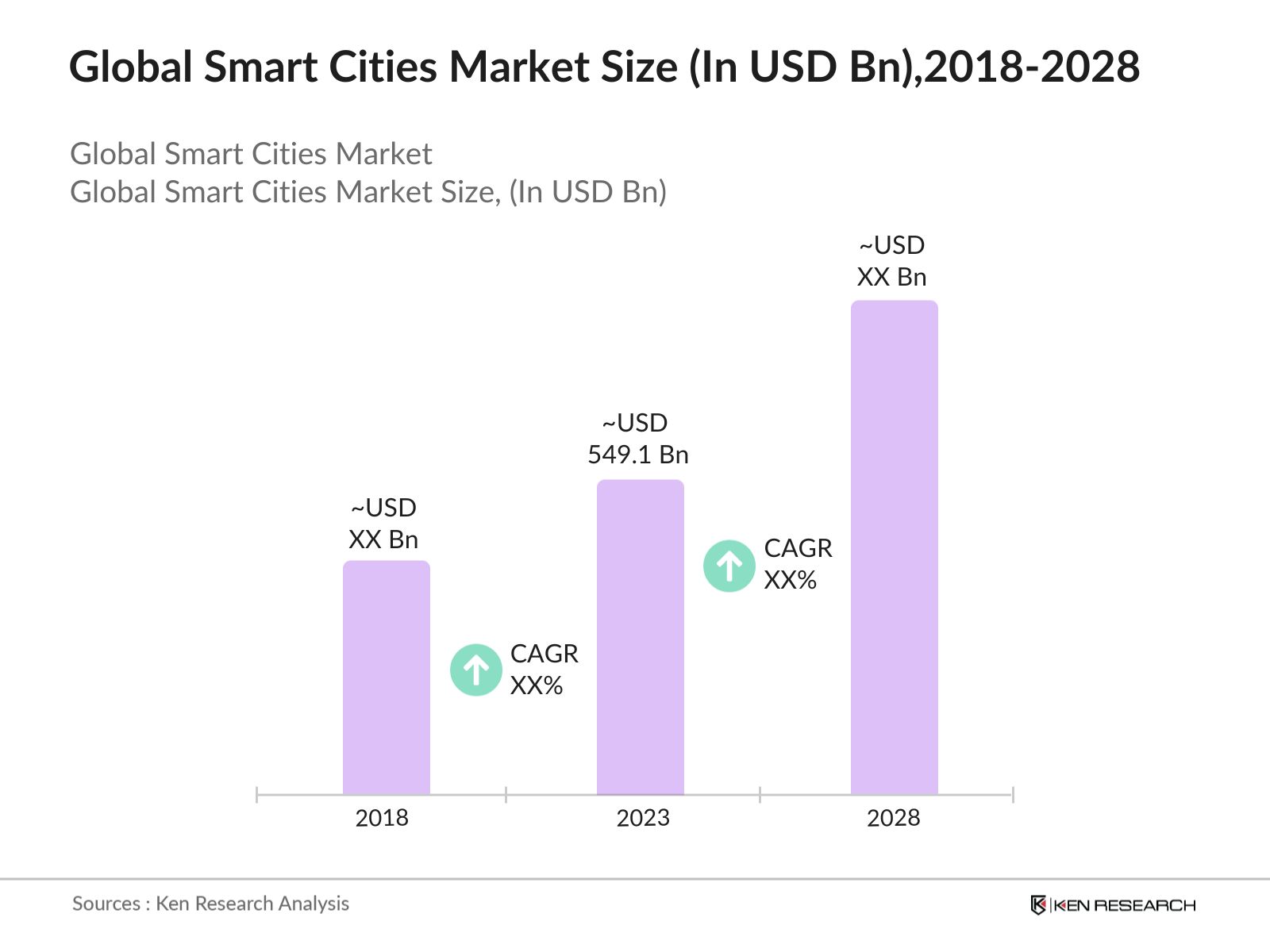
- The Global Smart Cities Market was valued at USD 549.1 billion in 2023, driven by increasing urbanization, the adoption of IoT technologies, and the growing need for sustainable and efficient urban management systems. The market encompasses sectors such as smart infrastructure, smart energy, smart mobility, and smart governance, with smart infrastructure leading due to its foundational role in smart city development.
- Major players in the Smart Cities Market include Siemens, IBM, Cisco, and Schneider Electric, known for their innovative technologies and comprehensive solutions across various smart city sectors. Siemens leads the market with its integrated smart infrastructure systems.
- Urban areas like Tokyo, New York, and Singapore are characterized by the early adoption of smart city technologies, driven by high population densities and strong government initiatives supporting smart city projects. These regions serve as global examples of effective smart city planning and execution.
- In 2023, Singapore launched its Smart Nation Sensor Platform, which integrates IoT sensors for real-time urban data collection, showcasing a growing trend in data-driven urban management.
Global Smart Cities Market Segmentation
The Global Smart Cities Market can be segmented by component, application, and region:
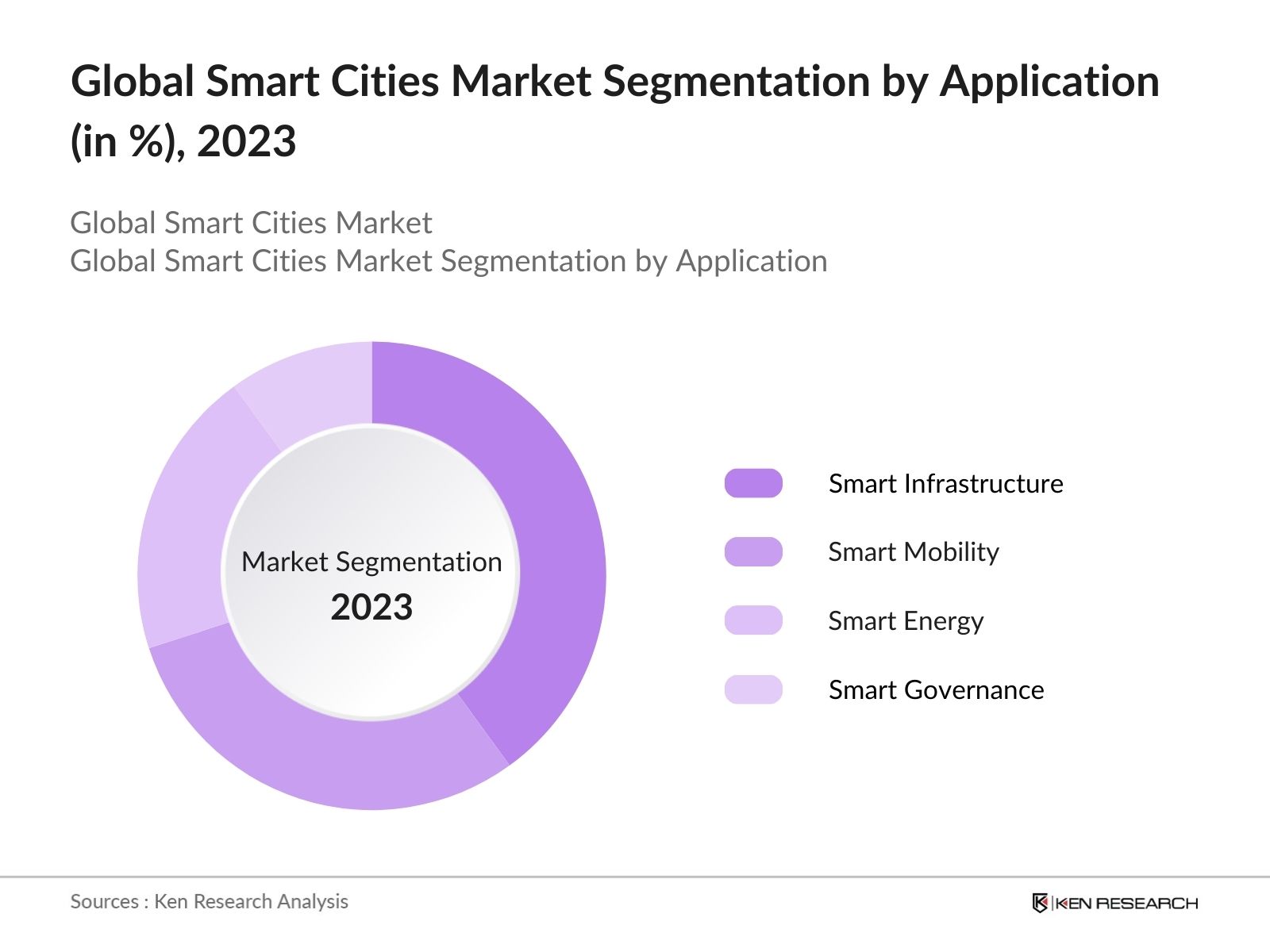
- By Application: The market is segmented into smart infrastructure, smart energy, smart mobility, and smart governance. Smart infrastructure leads the market due to its critical role in urban planning, sustainability, and efficient resource management.
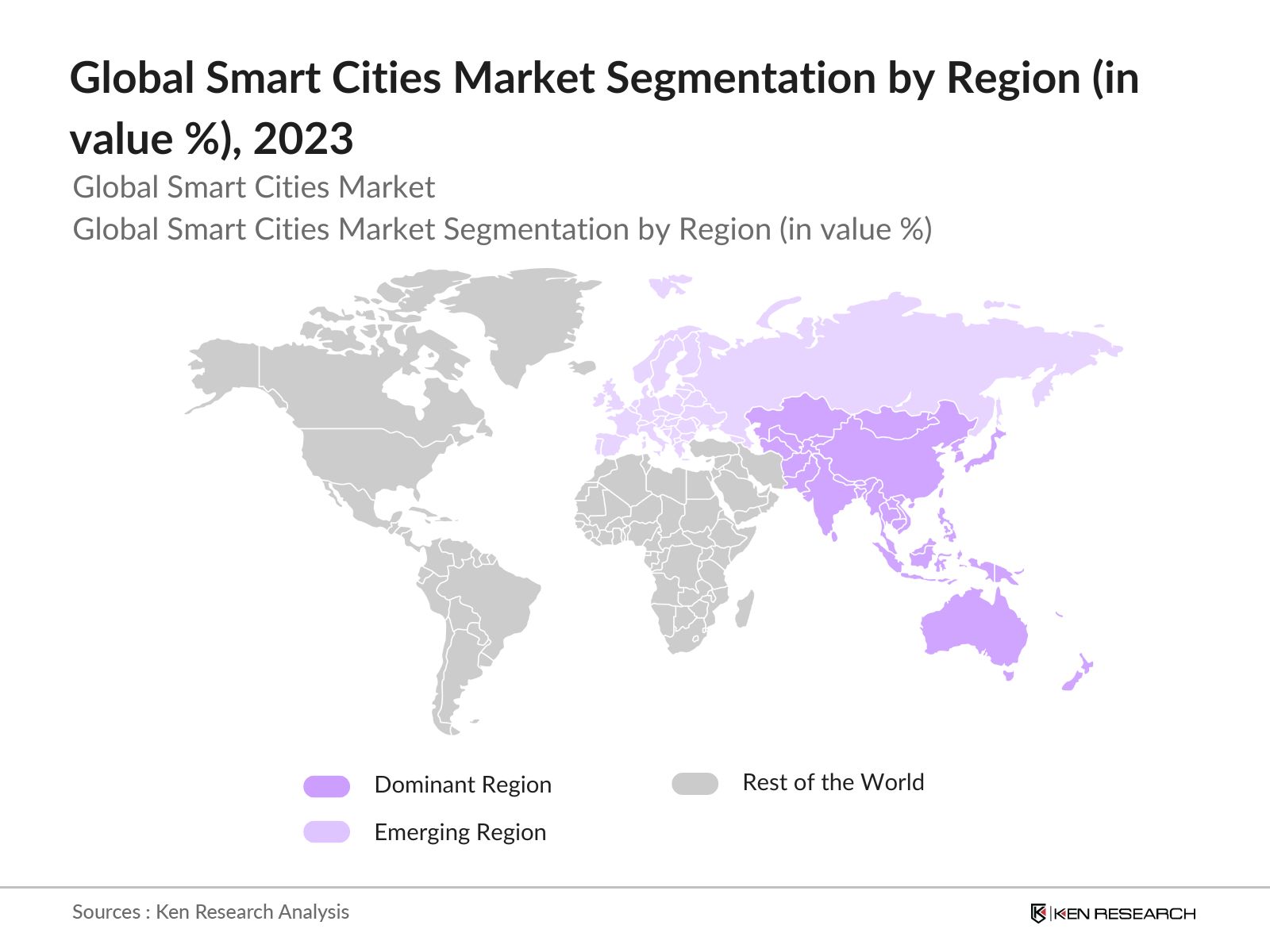
- By Region: The market is regionally segmented into North America, Europe, Asia-Pacific, and Rest of the World. In 2023, Asia-Pacific led the market due to rapid urbanization, government initiatives, and heavy investments in smart city projects, particularly in China and India.
- By Component: The market is segmented into hardware, software, and services. In 2023, services dominated the market due to the rising need for consultation, deployment, and maintenance of smart city solutions.
Global Smart Cities Market Competitive Landscape
|
Company |
Establishment Year |
Headquarters |
|
Siemens |
1847 |
Munich, Germany |
|
IBM |
1911 |
New York, USA |
|
Cisco |
1984 |
San Jose, USA |
|
Schneider Electric |
1836 |
Rueil-Malmaison, France |
|
Ericsson |
1876 |
Stockholm, Sweden |
- Siemens: In 2023, Siemens launched an advanced smart infrastructure solution focusing on IoT-powered building management systems. This initiative aims to improve urban energy efficiency and sustainability, bolstering Siemens' leadership in smart city infrastructure by addressing the growing need for eco-friendly solutions.
- IBM: In 2024, IBM introduced a new AI-driven platform for urban governance, which enables city administrators to make data-driven decisions. This platform is designed to optimize city operations, such as traffic management and public safety, further solidifying IBM's position in smart governance.
Global Smart Cities Market Analysis
Market Growth Drivers:
- Increasing Urbanization and Population Growth: The rapid rise in urban populations is driving the need for smart city solutions. According to the UN, 6.7 billion people are projected to live in urban areas by 2050, necessitating the adoption of smart technologies to manage resources and infrastructure efficiently.
- Sustainability Goals: The global push for more sustainable urban environments is fueling demand for smart city technologies that reduce energy consumption and carbon footprints. Cities worldwide are investing heavily in smart energy grids and waste management systems, which are key contributors to achieving sustainability targets.
- Advancements in IoT and AI Technologies: The growing adoption of IoT and AI technologies in urban management is enabling cities to implement smart solutions across infrastructure, transportation, and public safety. In 2023, more than 1,000 smart city initiatives incorporated AI-based decision-making tools.
Market Challenges:
- High Implementation Costs: Developing and deploying smart city infrastructure, including sensors, IoT devices, and data management systems, requires significant investment. This presents a challenge for many cities, particularly in developing regions where financial resources are limited.
- Data Privacy and Security Concerns: The collection and analysis of vast amounts of data through smart city technologies raise significant concerns about data privacy and cybersecurity. Cities must implement robust regulatory frameworks and security measures to protect citizen data from breaches and misuse.
Government Initiatives:
- Indias Smart Cities Mission: Launched in 2015, Indias Smart Cities Mission aims to develop 100 smart cities by 2025, with a focus on smart infrastructure, mobility, and governance. Regarding financial allocations, the mission has an overall budget of approximately 48,000 crores which is around USD 5.76 billion over a five-year period, which is supplemented by contributions from state governments and urban local bodies.
- Chinas New Urbanization Plan: As part of its broader urbanization strategy, China has committed to developing over 500 smart cities by 2028. This initiative includes significant investments in smart transportation, energy management, and urban infrastructure, aiming to improve city livability and sustainability.
- European Union's Horizon 2020 Program: Horizon 2020 is the EU's research and innovation framework program, running from 2014 to 2020 with a total budget of nearly The Commission considers that proposals requesting a contribution from the EU of between EUR 15 to 20 million would allow this specific challenge to be addressed appropriately.
Global Smart Cities Market Future Outlook
The Global Smart Cities Market is expected to grow at a CAGR of 22% from 2023 to 2028, driven by advancements in IoT, AI, growth of smart mobility solutions and sustainable urban planning.
Future Market Trends:
- AI and IoT Integration: The integration of AI and IoT technologies will continue to transform urban management systems, enabling predictive maintenance, optimized traffic management, and enhanced public safety measures.
- Growth of Smart Mobility Solutions: The demand for smart mobility solutions, such as electric vehicles, autonomous transportation, and intelligent traffic systems, is expected to increase, addressing congestion and pollution in cities.
Scope of the Report
|
By Region |
North America Europe Asia-Pacific Latin America Middle East and Africa |
|
By Component |
Hardware Software Services |
|
By Application |
Smart Infrastructure Smart Energy Smart Mobility Smart Governance |
|
By Technology |
IoT AI Big Data Cloud Computing |
Products
Key Target Audience Organizations and Entities Who Can Benefit by Subscribing to This Report:
Urban Planners
Government and Regulatory Bodies (FCC, NIST, ITU, UN)
IoT Solution Providers
Infrastructure Developers
Technology Providers
Transportation Authorities
Utility Companies
Investors
Banks and Financial Institutions
Venture Capitalist Firms
Time Period Captured in the Report:
Historical Period: 2018-2023
Base Year: 2023
Forecast Period: 2023-2028
Companies
Players Mentioned in the Report:
Siemens
IBM
Cisco
Schneider Electric
Ericsson
Huawei
Hitachi
Honeywell
Oracle
ABB
Microsoft
GE Digital
Panasonic
Toshiba
Fujitsu
Table of Contents
1. Global Smart Cities Market Overview
1.1. Definition and Scope
1.2. Market Taxonomy
1.3. Market Growth Rate
1.4. Market Segmentation Overview
2. Global Smart Cities Market Size (in USD Bn), 2018-2023
2.1. Historical Market Size
2.2. Year-on-Year Growth Analysis
2.3. Key Market Developments and Milestones
3. Global Smart Cities Market Analysis
3.1. Growth Drivers
3.1.1. Increasing Urbanization
3.1.2. Sustainability Goals
3.1.3. IoT and AI Technologies
3.2. Restraints
3.2.1. High Implementation Costs
3.2.2. Data Privacy and Security Concerns
3.3. Opportunities
3.3.1. Technological Advancements
3.3.2. Public-Private Partnerships
3.3.3. Expansion into Emerging Markets
3.4. Trends
3.4.1. Integration of AI and IoT
3.4.2. Smart Mobility Solutions
3.4.3. Renewable Energy Initiatives
3.5. Government Regulation
3.5.1. Indias Smart Cities Mission
3.5.2. Chinas New Urbanization Plan
3.5.3. European Union's Horizon 2020 Program
3.6. SWOT Analysis
3.7. Stakeholder Ecosystem
3.8. Competitive Ecosystem
4. Global Smart Cities Market Segmentation, 2023
4.1. By Component (in Value %)
4.1.1. Hardware
4.1.2. Software
4.1.3. Services
4.2. By Application (in Value %)
4.2.1. Smart Infrastructure
4.2.2. Smart Energy
4.2.3. Smart Mobility
4.2.4. Smart Governance
4.3. By Technology (in Value %)
4.3.1. IoT
4.3.2. AI
4.3.3. Big Data
4.3.4. Cloud Computing
4.4. By Region (in Value %)
4.4.1. North America
4.4.2. Europe
4.4.3. Asia-Pacific
4.4.4. Latin America
4.4.5. Middle East and Africa
5. Global Smart Cities Market Cross Comparison
5.1 Detailed Profiles of Major Companies
5.1.1. Siemens
5.1.2. IBM
5.1.3. Cisco
5.1.4. Schneider Electric
5.1.5. Ericsson
5.1.6. Huawei
5.1.7. Hitachi
5.1.8. Honeywell
5.1.9. Oracle
5.1.10. ABB
5.1.11. Microsoft
5.1.12. GE Digital
5.1.13. Panasonic
5.1.14. Toshiba
5.1.15. Fujitsu
5.2 Cross Comparison Parameters (No. of Employees, Headquarters, Inception Year, Revenue)
6. Global Smart Cities Market Competitive Landscape
6.1. Market Share Analysis
6.2. Strategic Initiatives
6.3. Mergers and Acquisitions
6.4. Investment Analysis
6.4.1. Venture Capital Funding
6.4.2. Government Grants
6.4.3. Private Equity Investments
7. Global Smart Cities Market Regulatory Framework
7.1. Environmental Standards
7.2. Compliance Requirements
7.3. Certification Processes
8. Global Smart Cities Future Market Size (in USD Bn), 2023-2028
8.1. Future Market Size Projections
8.2. Key Factors Driving Future Market Growth
9. Global Smart Cities Future Market Segmentation, 2028
9.1. By Component (in Value %)
9.2. By Application (in Value %)
9.3. By Technology (in Value %)
9.4. By Region (in Value %)
10. Global Smart Cities Market Analysts Recommendations
10.1. TAM/SAM/SOM Analysis
10.2. Customer Cohort Analysis
10.3. Marketing Initiatives
10.4. White Space Opportunity Analysis
11. Disclaimer
Top of Form
Bottom of Form
Research Methodology
Step 1: Identifying Key Variables:
We begin by referencing multiple secondary and proprietary databases to conduct desk research. This includes gathering industry-level information on market drivers, challenges, key players, urbanization trends, and technological advancements in smart cities. We also assess regulatory impacts and market dynamics specific to global smart city initiatives.
Step 2: Market Building:
We collect historical data on market size, growth rates, segmentation (smart infrastructure, smart energy, smart mobility, and smart governance), and the regional distribution of projects (North America, Europe, Asia-Pacific). We analyze market share and revenue generated by leading companies, emerging technologies like IoT and AI, and public-private partnerships to ensure data accuracy and reliability.
Step 3: Validating and Finalizing:
We perform Computer-Assisted Telephone Interviews (CATIs) with industry experts, including representatives from smart city solution providers, urban planners, and government officials. These interviews validate the statistics collected and provide insights into financial and operational strategies, such as government policies, funding, and implementation challenges.
Step 4: Research Output:
Our team interacts with technology providers, urban planners, government bodies, and market analysts to understand market dynamics, technological adoption rates, and project execution. This process helps validate the derived statistics through a bottom-up approach, ensuring that the final data accurately reflects the real-world market conditions.
Frequently Asked Questions
-
How big is the Global Smart Cities Market?
In 2023, the Global Smart Cities Market was valued at USD 549.1 billion. The market is driven by increasing urbanization, the adoption of IoT and AI technologies, and government initiatives focusing on sustainable and efficient urban management. -
What are the challenges in the Global Smart Cities Market?
Key challenges include high implementation costs for smart infrastructure, concerns over data privacy and cybersecurity, and the complexities of integrating diverse systems and technologies. Additionally, developing regions may struggle with limited financial resources to adopt smart city technologies. -
Who are the major players in the Global Smart Cities Market?
Major players in the Global Smart Cities Market include Siemens, IBM, Cisco, Schneider Electric, and Ericsson. These companies lead with their innovative solutions in smart infrastructure, energy, and mobility, as well as their strong partnerships with government bodies and municipalities. -
What are the growth drivers of the Global Smart Cities Market?
Growth drivers include rapid urbanization, increasing adoption of IoT and AI for efficient city management, and global sustainability goals that encourage the development of smart energy and infrastructure solutions. Government initiatives and public-private partnerships are also major contributors to market expansion.Top of Form
Bottom of Form
Why Buy From Us?

What makes us stand out is that our consultants follows Robust, Refine and Result (RRR) methodology. i.e. Robust for clear definitions, approaches and sanity checking, Refine for differentiating respondents facts and opinions and Result for presenting data with story

We have set a benchmark in the industry by offering our clients with syndicated and customized market research reports featuring coverage of entire market as well as meticulous research and analyst insights.

While we don't replace traditional research, we flip the method upside down. Our dual approach of Top Bottom & Bottom Top ensures quality deliverable by not just verifying company fundamentals but also looking at the sector and macroeconomic factors.

With one step in the future, our research team constantly tries to show you the bigger picture. We help with some of the tough questions you may encounter along the way: How is the industry positioned? Best marketing channel? KPI's of competitors? By aligning every element, we help maximize success.

Our report gives you instant access to the answers and sources that other companies might choose to hide. We elaborate each steps of research methodology we have used and showcase you the sample size to earn your trust.

If you need any support, we are here! We pride ourselves on universe strength, data quality, and quick, friendly, and professional service.