
Global Solar Energy Market Outlook to 2032
Region:Global
Author(s):Vanshika and Anurag
Product Code:KENGR045
October 2024
88
About the Report
Global Solar Energy Market Overview
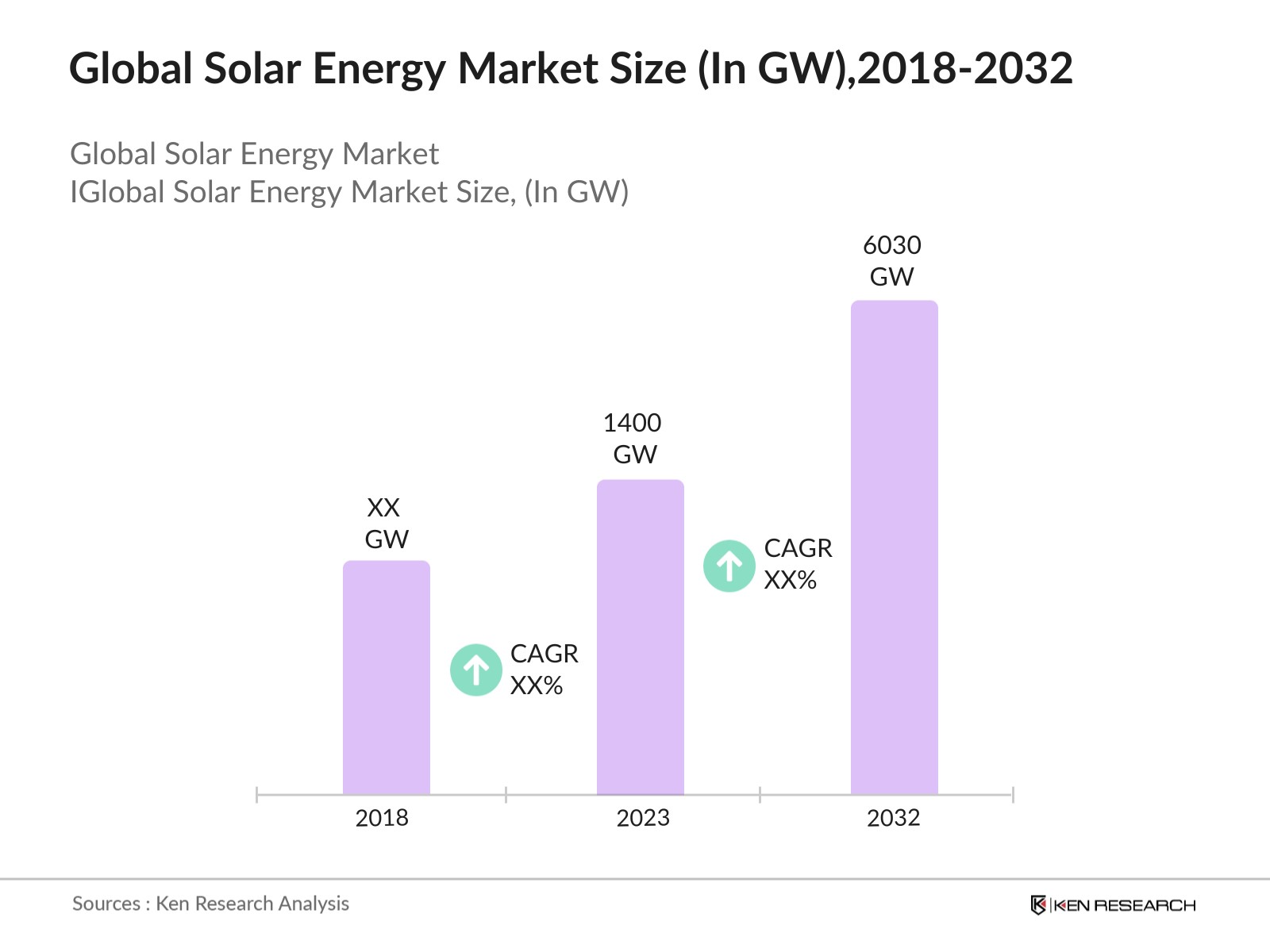
- Global solar energy market reached 1400 GW in 2023, driven by the growing emphasis on renewable energy and global efforts to reduce carbon emissions. The market's expansion has been bolstered by declining solar panel costs and technological advancements in photovoltaic (PV) systems, leading to increased adoption in both residential and commercial sectors.
- Key players in the market include Enel Group, Engie, State Power Investment Corporation, China Resource Power Holdings to name a few. These companies dominate the market due to their extensive portfolios in solar modules, PV systems, and related technologies.
- In 2024, Enel S.p.A. had agreed with ORMAT Technologies Inc. for the sale of entire geothermal portfolio and a number of small solar plants, with a total capacity of about .150 GW of operating plants in the United States. The portfolio includes two geothermal power plants and a hybrid plant that combines geothermal, solar PV, and solar thermal energy.
Global Solar Energy Current Market Analysis

- Asia-Pacific (APAC) as dominant region: The Asia-Pacific region leads the market, supported by strong governmental backing and technological advancements. Offshore wind energy, with a localization potential of USD 425 billion from a total investment of USD 621 billion, is a key growth sector.Indias Bhadla Solar Park, with 2,245 MW capacity, highlights its solar potential, while Indias renewable capacity reached 195 GW by May 2024, including 85.47 GW from solar. Chinas dominance as a major solar panel producer complements this growth, driven by sustainability and energy security goals.
- Europe as emerging region: Europe is emerging as a key player in market, driven by ambitious goals and significant investments. The European Investment Bank allocated nearly $115.5 billion to the energy sector over the past decade, with $18.5 billion in 2022 alone for renewables and energy efficiency.The EU's Green Deal and national policies aim for 40% domestic solar tech production by 2030. In 2023, $1.53 billion was dedicated to clean tech manufacturing, reinforcing Europe's leadership in solar energy.
- China as dominant country: China dominates the market, leading in both production and deployment. In 2021, it added 53 GW of solar capacity, about 40% of the global total. By 2023, China's solar PV capacity surged to 609,490 MW, up from 392,610 MW in 2022, reflecting rapid growth.It manufactures over 70% of the world's solar panels and invested over USD 50 billion in 2023, ten times that of Europe, cutting PV costs by over 80%. China controls key components like polysilicon and boasts extensive solar farms. Strong government policies have fueled domestic adoption, with 87.41 GW added in 2022 alone.
Global Solar Energy Market Segmentation
The Global Solar Energy Market can be segmented based on several factors:
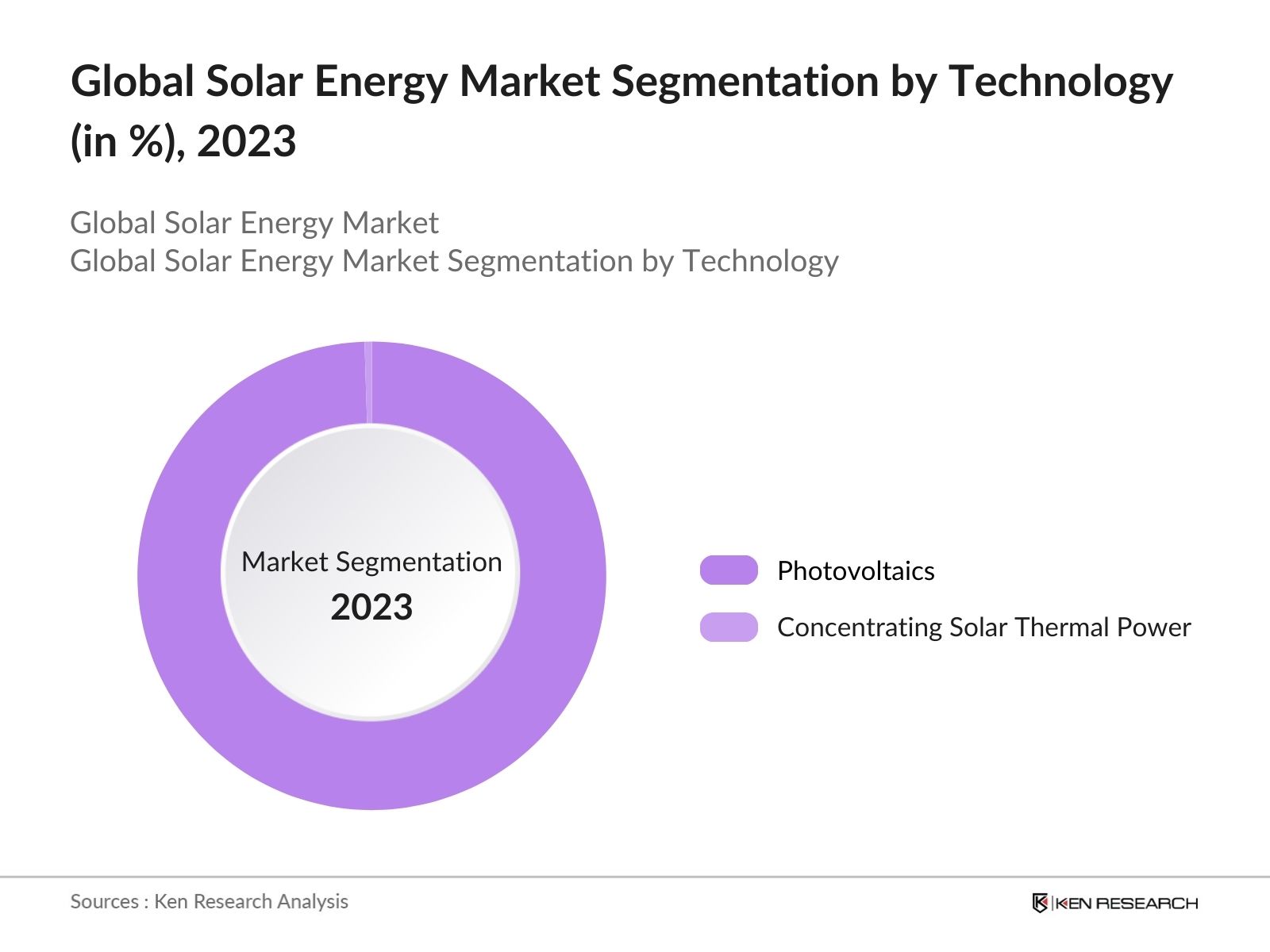
By Technology: Global solar energy market is segmented by technology into photovoltaics and concentrating solar thermal power. In 2023, photovoltaics leads the market. In 2023, photovoltaics leads the market in terms of revenue and installation capacity, driven by advancements in solar panel technology, decreasing costs, and increasing adoption for residential, commercial, and utility-scale applications.
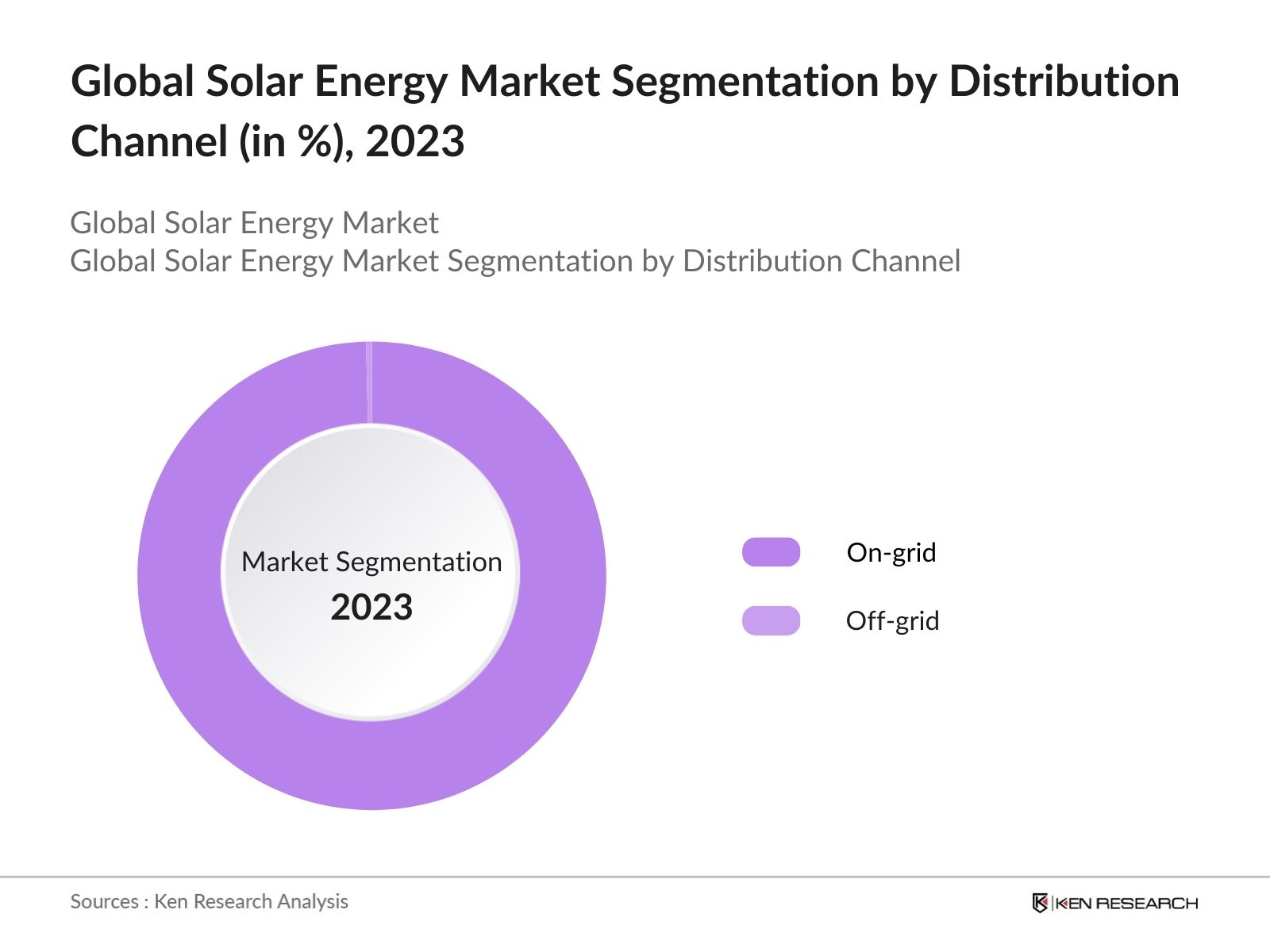
By Distribution Channel: Global solar energy market is segmented by distribution channel into On-grid & Off-grid. In 2023, the on-grid dominates the market due to its advantages in integrating with existing power grids, enabling efficient energy distribution and management, and benefiting from established infrastructure and supportive government policies that promote grid-connected solar installations.
By End-User: Global solar energy market is segmented by end-user into Utility Scale, Residential, Commercial and Industrial. In 2023, Utility scale dominate the market due to large-scale solar power plants' ability to generate substantial amounts of electricity, economies of scale, and significant investments in renewable energy infrastructure by governments and private sector players to meet growing energy demands and sustainability targets.
Global Solar Energy Market Competitive Landscape
|
Company |
Headquarters |
Establishment Year |
Geographical Presence |
|
Enel Group |
Rome, Italy |
1962 |
43 |
|
Engie |
Paris, France |
2008 |
31 |
|
State Power Investment Corporation (SPIC) |
Beijing, China |
2015 |
47 |
|
China Resources Power Holdings |
Hong Kong |
2001 |
1 |
|
China Three Gorges Group |
Wuhan, China |
1993 |
20 |
|
Iberdrola |
Bilbao, Spain |
1958 |
19 |
|
NextEra Energies |
Florida, United States |
1925 |
2 |
|
Acciona |
Madrid, Spain |
1900 |
40 |
- ACCIONA Energia: In 2024, ACCIONA Energa expanded its Sierra Brava floating solar plant in Zorita, Spain, as part of a pilot project aimed at testing innovative floating technologies. This extension involves the installation of a new photovoltaic floating system that utilizes a two-millimeter-thick reinforced hydro-elastic membrane as the base for 770 photovoltaic modules.
- China Resource Power Holdings Group: In 2023, China Resources Power Holdings Company Limited completed the acquisition of 100% of Guangdong Runneng New Energy Co., Ltd. for approximately RMB 1.44 billion (around USD 0.2 billion). This acquisition is part of China Resources Power's strategy to enhance its renewable energy capabilities, particularly in wind energy, as Runneng operates projects primarily located in central and eastern China, regions known for their rich wind energy resources.
- 3SUN: In 2023, 3SUN, Enel Green Power's company dedicated to the production of innovative photovoltaic modules based in Catania, Italy, unveils new next-generation photovoltaic modules, based on 3SUN CORE-H and will be available to the market in 2024 and are designed to enhance the efficiency and sustainability of solar energy production.
Global Solar Energy Industry Analysis
Global Solar Energy Market Growth Drivers:
- Policy Instruments: Feed-in Tariffs (FITs) are incentives that guarantee a fixed price for renewable energy producers per unit of electricity generated. They encourage the adoption of solar energy by providing long-term contracts, ensuring profitability. FITs significantly boosted Germanys solar market, which accounted for 8.2% of its electricity in 2022.
- Growing Investments in Solar Energy: The solar energy sector captured 52% of renewable energy investments in 2022, amounting to over $300 billion globally a 36% increase from 2021. This surge reflects solars growing importance, representing 11.5% of global energy investments and underscoring its role in the transition to sustainable energy.
- Decentralization of Solar Energy: Solar energy's versatility allows for decentralized deployment on rooftops, carports, and buildings, minimizing land use. Moreover, the overall global cumulative installed capacity of solar PV systems reached approximately 1,177 GW by the end of 2022, reflecting a substantial growth from the previous year.
Global Solar Energy Market Challenges:
- Grid constraints: To address the rising power demand driven by electrification in sectors like heating and transportation, expanding grid capacity is crucial. However, many nations face grid congestion issues, resulting in significant delays in solar project deployment and activation. Without proper grid infrastructure upgrades, the push towards renewable energy sources like solar power may falter, limiting their potential contribution to a sustainable energy future.
- Fossil Fuel Subsidies: Fossil fuel subsidies create market distortions by diverting resources away from more sustainable energy solutions, ultimately reducing social welfare. In 2022, the International Monetary Fund (IMF) estimated that global fossil fuel subsidies amounted to $7 trillion, representing 7.1% of the global GDP. Redirecting these subsidies towards renewable energy could significantly enhance efforts to mitigate climate change and promote economic sustainability.
Global Solar Energy Market Government Initiatives:
- The U.S. Solar Investment Tax Credit (ITC) Extension (2023): In August 2022, the Inflation Reduction Act extended the ITC to 2032, offering a 30% tax credit for residential and commercial solar installations. This initiative aims to boost solar adoption across the country, with an expected increase in installed capacity by 100 GW by 2025, enabling homeowners and businesses to reduce their upfront costs and encouraging the transition to renewable energy sources.
- European Unions RE Power EU Plan (2024): The European Union introduced the RE Power EU plan in 2024, allocating 300 billion to renewable energy projects, with a significant portion dedicated to solar energy. This plan aims to double the EU's solar capacity by 2027, with a target of 600 GW. The RE Power EU plan includes funding for research and development, subsidies for solar installations, and support for grid infrastructure improvements to accommodate increased solar energy generation.
Global Solar Energy Future Market Outlook
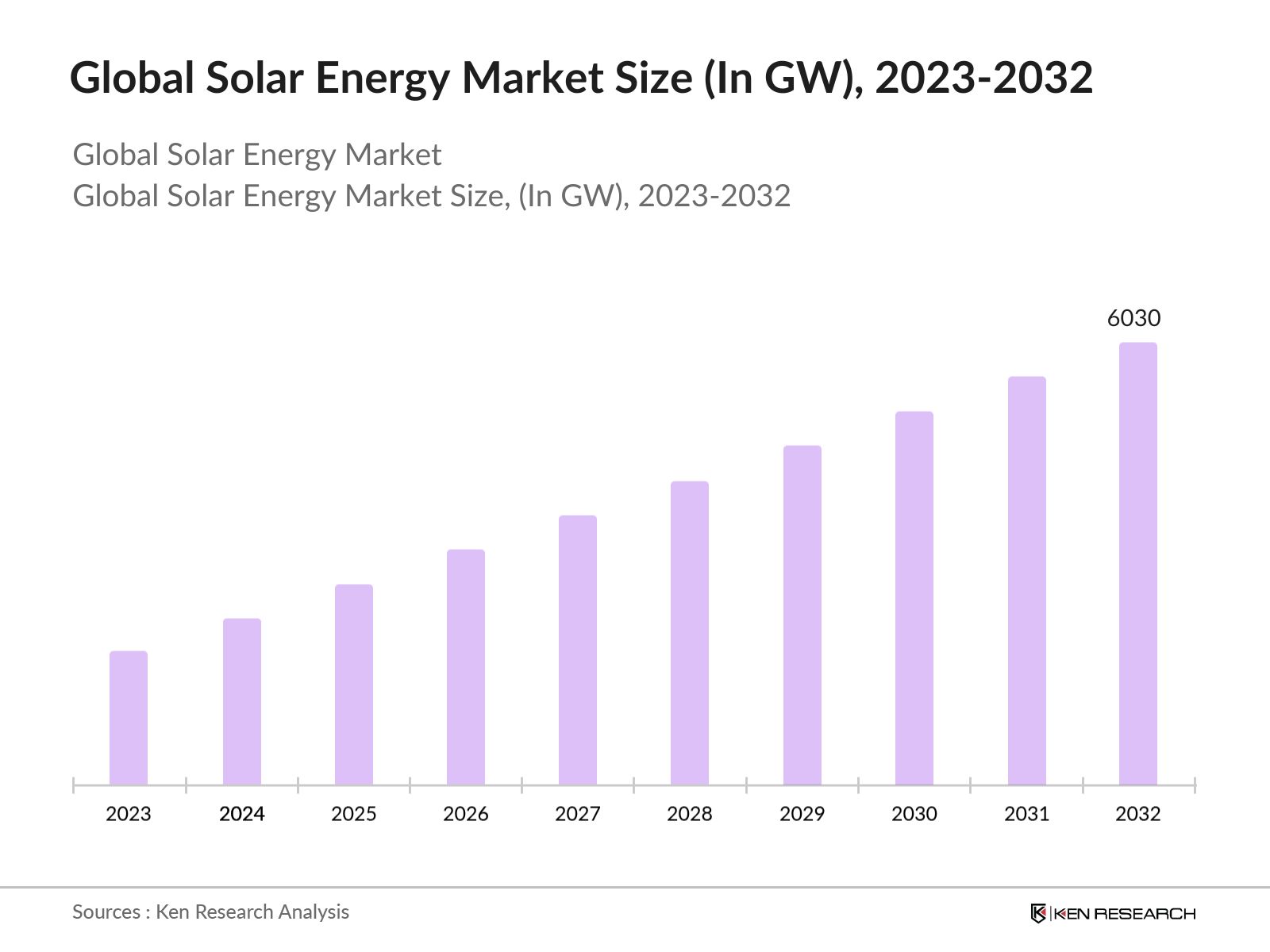
The market is expected to reach 6030 GW by 2032 driven by continued advancements in solar technology, supportive government policies, and increasing demand for clean and sustainable energy.
Future Market Trends
- Integration with Energy Storage Systems: Over the next five years, the integration of solar energy with advanced energy storage systems, such as lithium-ion batteries, will become more prevalent. This trend will address the intermittency issue of solar power, allowing excess energy to be stored and used during non-sunny periods.
- Growth in Distributed Solar Power Generation: The future will see a significant increase in distributed solar power generation, where solar energy is produced close to the point of use, such as rooftop installations on homes and businesses. This trend will be driven by advancements in solar panel efficiency, falling installation costs, and supportive policies that encourage self-consumption of solar power.
Scope of the Report
Products
Key Target Audience Organizations and Entities who can benefit by Subscribing This Report:
Solar Panel Manufacturers
Utility Companies
Electric Vehicle Manufacturers
Project Developers and EPC (Engineering, Procurement, Construction) Companies
Energy Storage Companies
Automotive Companies
Investment & Venture Capitalist Firms
Government and Regulatory Bodies (U.S. Department of Energy, International Renewable Energy Agency)
Time Period Captured in the Report:
Historical Period: 2018-2023
Base Year: 2023
Forecast Period: 2023-2032
Companies
Players Mentioned in the Report:
Enel Group
Engie
State Power Investment Corporation (SPIC)
China Resources Power Holdings
China Three Gorges Group
Iberdrola
NextEra Energies
Acciona
Tata Power
Adani Green Energy Ltd. (AGEL)
Table of Contents
1. Executive Summary
1.1 Global Renewable Energy Market
1.2 Global Solar Energy Market
2. Global Overview
2.1 Overview of Global Economics
2.2 Overview of Global Renewable Energy Industry
2.3 Global Renewable Energy (Solar Energy, Wind Energy, Hydroelectric Energy) Revenue
2.4 Global Solar Energy Infrastructure
3. Global Solar Energy Market Overview
3.1 Ecosystem: Solar Energy Producers
3.2 Ecosystem: EPC Partners
3.3 Ecosystem: Solar Energy Equipment Manufacturers
3.4 Value Chain
4. Global Solar Energy Market Size (in GW), 2018-2023
5. Global Solar Energy Market Segmentation (in value %), 2018-2023
5.1 By Region (North America, Europe, APAC, Latin America and MEA) in value %, 2018-2023
5.2 By Technology (Photovoltaics and Concentrating Solar Thermal Power (CSP)) in value%, 2018-2023
5.3 By Distribution Channel (On-grid and Off-grid) in value %, 2018-2023
5.4 By Industry (Utility Scale, Residential, Commercial & Industrial) in value %, 2018-2023
6. Global Solar Energy Market Competition Landscape
6.1 Market Share Analysis
6.2 Market Heat Map Analysis
6.3 Market Cross Comparison
6.4 Comparison Matrix
7. Global Solar Energy Market Dynamics
7.1 Growth Drivers
7.2 Challenges
7.3 Trends
8. Global Solar Energy Future Market Size (in USD Bn), 2023-2032
9. Global Solar Energy Future Market Segmentation (in value %), 2023-2032
9.1 By Region (North America, Europe, APAC, Latin America and MEA) in value %, 2023-2032
9.2 By Technology (Photovoltaics and Concentrating Solar Thermal Power (CSP)) in value%, 2023-2032
9.3 By Distribution Channel (On-grid and Off-grid) in value %, 2023-2032
9.4 By Industry (Utility Scale, Residential, Commercial & Industrial) in value %, 2023-2032
10. Analyst Recommendations
Research Methodology
Step 1: Hypothesis Creation:
The research team framed a hypothesis about the market through an analysis of existing industry factors obtained from global reports, company reports, magazines, journals, online articles, ministries, government associations and data from IRENA, IMF and World Bank, among others.
Step 2: Market Sizing:
The market size was estimated based on region-wise installed capacity of solar energy based on the technology deployed by solar energy producers. Both public and proprietary databases were referred to define each market and collect data points about the same.
Step 3: Hypothesis Testing:
The research team then conducted CATIs and others in the ecosystem to get their insights on market and justify the hypothesis framed by the team.
Step 4: Future Forecasting via Poll Opinions:
The market is forecasted region-wise using the growth trends and capacity expansion strategies as stated by solar energy producers, industry experts, global reports, articles, among others.
Step 5: Interpretation and Proofreading:
The final analysis was then interpreted in the research report by our expert team well versed with the Global Solar Energy Market.
Frequently Asked Questions
01. How big is Global Solar Energy Market?
Global solar energy market reached a valuation of 1400 GW in 2023, driven by the growing emphasis on renewable energy and global efforts to reduce carbon emissions. The market's expansion has been bolstered by declining solar panel costs and technological advancements in photovoltaic (PV) systems
02. What are the challenges in Global Solar Energy Market?
Challenges in the global solar energy market include grid constraints, fossil fuel subsidies and resistance to change. To address the rising power demand driven by electrification in sectors like heating and transportation, expanding grid capacity is crucial.
03. Who are the major players in Global Solar Energy Market?
Key players in global solar energy market Enel Group, Engie, State Power Investment Corporation, China Resource Power Holdings to name a few. These companies dominate the market due to their extensive portfolios in solar modules, PV systems, and related technologies.
04 What are the growth drivers of the Global Solar Energy Market?
Global solar energy market is propelled by the growing investments in solar energy, decentralization of solar energy and policy instruments. Solar energy's versatility allows for decentralized deployment on rooftops, carports, and buildings, minimizing land use.
Why Buy From Us?

What makes us stand out is that our consultants follows Robust, Refine and Result (RRR) methodology. i.e. Robust for clear definitions, approaches and sanity checking, Refine for differentiating respondents facts and opinions and Result for presenting data with story

We have set a benchmark in the industry by offering our clients with syndicated and customized market research reports featuring coverage of entire market as well as meticulous research and analyst insights.

While we don't replace traditional research, we flip the method upside down. Our dual approach of Top Bottom & Bottom Top ensures quality deliverable by not just verifying company fundamentals but also looking at the sector and macroeconomic factors.

With one step in the future, our research team constantly tries to show you the bigger picture. We help with some of the tough questions you may encounter along the way: How is the industry positioned? Best marketing channel? KPI's of competitors? By aligning every element, we help maximize success.

Our report gives you instant access to the answers and sources that other companies might choose to hide. We elaborate each steps of research methodology we have used and showcase you the sample size to earn your trust.

If you need any support, we are here! We pride ourselves on universe strength, data quality, and quick, friendly, and professional service.