
Global Text-to-Speech-Market Outlook to 2030
Region:Global
Author(s):Paribhasha Tiwari
Product Code:KROD2718
December 2024
90
About the Report
Global Text-to-Speech market Overview
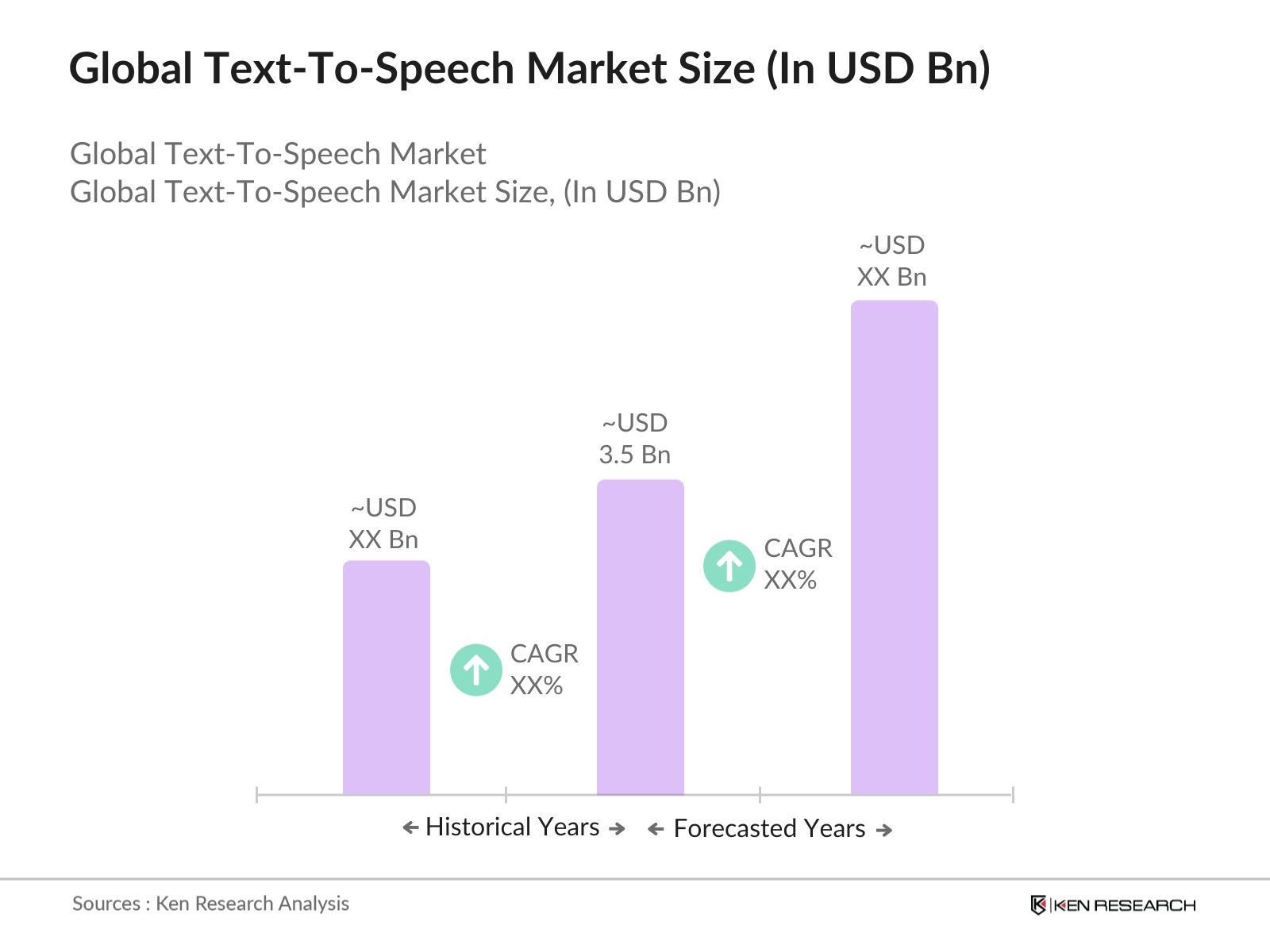
- The Global Text-to-Speech (TTS) market, valued at USD 3.5 billion in 2023, is driven by the increasing integration of artificial intelligence across various industries, notably in education, customer service, and assistive technologies. The surge in demand for accessibility solutions for the visually impaired and the integration of TTS into smart devices and automotive systems have accelerated its growth. TTS technology is becoming a fundamental component in e-learning platforms, driving a significant uptick in usage, especially post-pandemic.
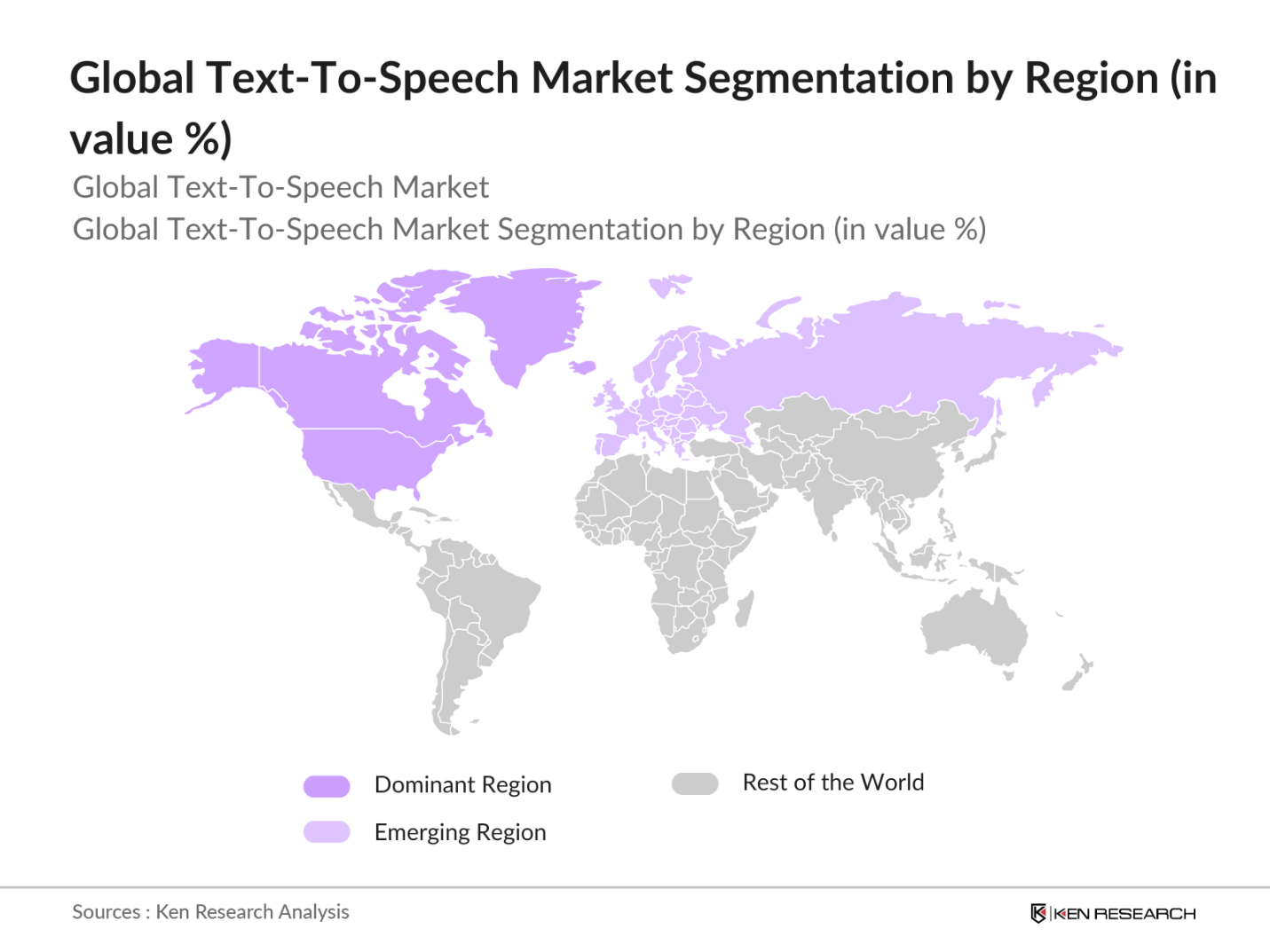
- Geographically, North America and Europe dominate the TTS market due to their strong adoption of AI and advanced technology frameworks, particularly in sectors such as automotive, healthcare, and media. The United States and key European countries, including Germany and the United Kingdom, lead this dominance because of well-established tech infrastructure, high internet penetration, and government regulations mandating accessibility in public and private sectors.
- Tobi's eye-tracking technology is coming to the iPad with the TD Pilot cover, which transforms Apple's tablet into a powerful all-in-one tool for individuals with physical disabilities. Users who have TD Pilot may use their sight to open and operate apps, write swiftly, and talk with a synthetic voice.
Global Text-to-Speech market Segmentation
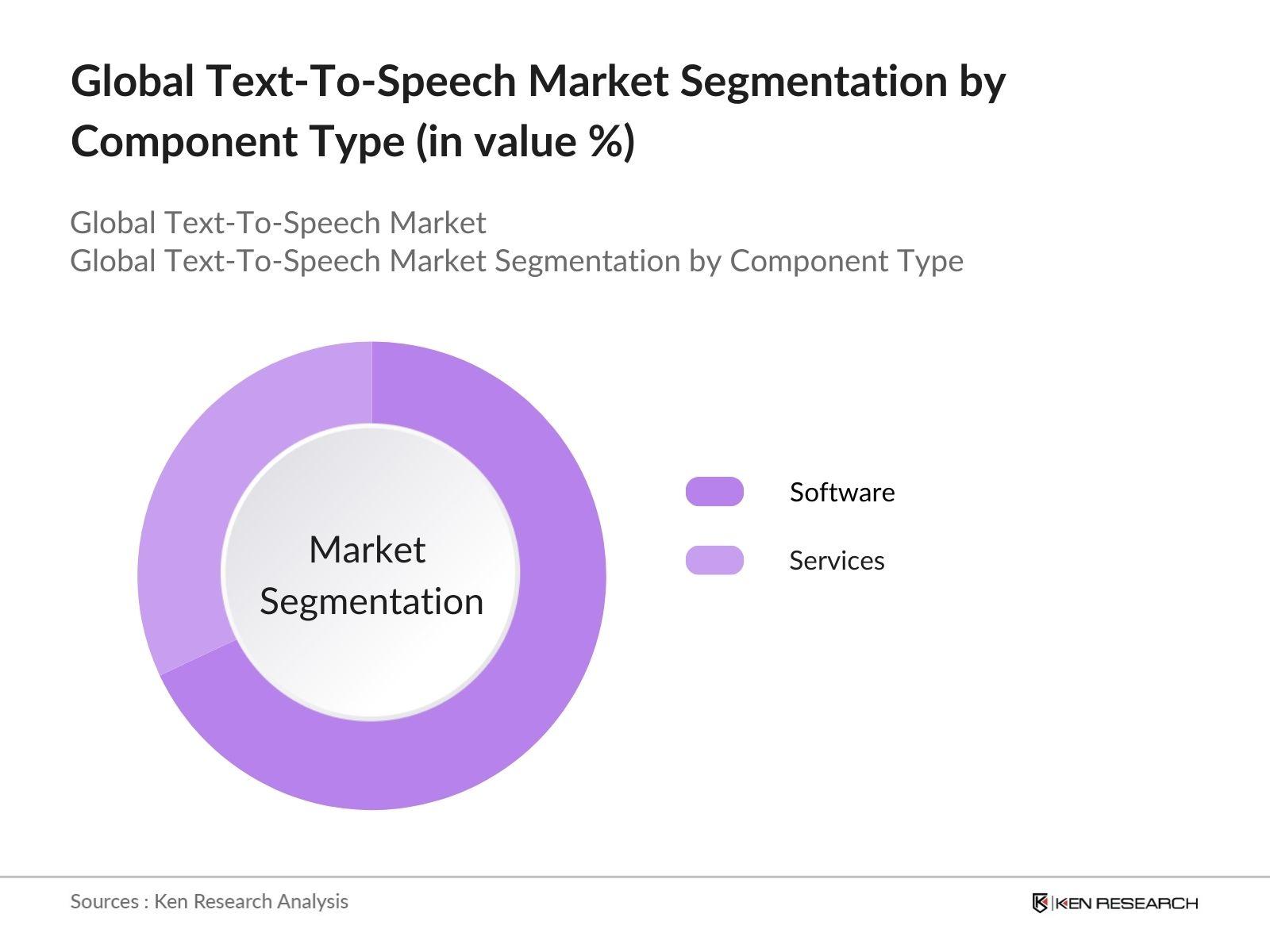
By Component Type: The market is segmented by component into software and services. The software segment holds a dominant market share, primarily driven by the growing adoption of cloud-based solutions. Major players like Google and Amazon Web Services (AWS) have introduced flexible, scalable TTS software that allows businesses to implement advanced speech technology with minimal on-premise setup. The service segment, while smaller, is expanding due to increasing demand for personalized voice services and integration support across sectors.
By Region: The TTS market is divided into North America, Europe, Asia-Pacific, Latin America, and the Middle East & Africa. North America leads the market, with the United States driving substantial growth due to high adoption rates of voice AI and the integration of TTS in everyday consumer devices. In Europe, countries like Germany and the UK are prominent due to their regulatory framework supporting assistive technologies. The Asia-Pacific region is poised for rapid growth, driven by rising smartphone penetration, an increase in smart city initiatives, and a surge in online education platforms in countries like China and India.
Global Text-to-Speech market Competitive Landscape
The Global Text-to-Speech market is moderately consolidated, with major players like Microsoft, Google, and AWS leading the competition. These tech giants dominate due to their substantial investment in AI and machine learning technologies, enabling them to offer advanced TTS solutions. Their global distribution networks and strong partnerships further enhance their market position. Emerging players in the Asia-Pacific region are focusing on regional language support, which is expected to challenge the market leaders in coming years.
|
Company Name |
Year Established |
Headquarters |
Employees |
Revenue (USD bn) |
R&D Investment |
Key Product |
Regional Presence |
Customer Base |
|
Microsoft Corporation |
1975 |
Redmond, USA |
- | - | - | - | - | - |
|
Google LLC |
1998 |
Mountain View, USA |
- | - | - | - | - | - |
|
Amazon Web Services |
2006 |
Seattle, USA |
- | - | - | - | - | - |
|
Nuance Communications |
1992 |
Burlington, USA |
- | - | - | - | - | - |
|
Baidu, Inc. |
2000 |
Beijing, China |
- | - | - | - | - | - |
Global Text-to-Speech market Analysis
Growth Drivers
- Increasing Adoption of AI in Enterprises: The increasing adoption of AI in enterprises, especially for automation and customer interaction, is a major growth driver for the text-to-speech (TTS) market. The World Economic Forum reported that by 2024, over 85 million jobs could be displaced by automation while creating 97 million new roles that rely on AI technologies. Companies are using AI-powered solutions to streamline communication, with TTS playing a critical role in converting text-based content into natural-sounding speech. This is particularly significant for industries like finance and healthcare, where customer service is increasingly automated.
- Accessibility Initiatives for the Disabled: Accessibility standards such as the Americans with Disabilities Act (ADA) and Web Content Accessibility Guidelines (WCAG) are spurring the adoption of TTS technologies. According to the World Bank, 15% of the global population experiences some form of disability, driving demand for TTS solutions to improve accessibility. For example, public sectors are integrating these technologies into websites and apps to ensure inclusivity in education and employment. The implementation of AI in government services has enhanced digital accessibility for disabled populations, particularly in developed economies like the U.S. and the EU.
- Proliferation of Smart Devices and IoT: The proliferation of smart devices, including smart speakers, smartphones, and wearable tech, has accelerated the demand for TTS services. According to the International Telecommunication Union (ITU), over 3.9 billion people are using IoT-connected devices globally in 2024. These devices rely on voice interfaces, and TTS solutions enable communication between users and machines. With billions of devices connected to the Internet, the integration of TTS into IoT systems enhances user engagement and allows for more intuitive device control.
Market Challenges
- High Costs of Implementation: Despite the advantages, the high cost of implementing advanced TTS systems is a significant challenge, particularly for small and medium-sized enterprises (SMEs). Many organizations cite concerns over initial setup costs and ongoing maintenance expenses. The World Bank reports that 90% of businesses globally are SMEs, with limited budgets for adopting high-tech solutions. This financial constraint limits the uptake of TTS technology, especially in developing economies where IT infrastructure investment is already low.
- Quality of Speech Output and Naturalness: One of the technical challenges facing the TTS market is achieving high-quality, natural-sounding speech output. TTS systems often struggle to replicate human-like prosody and intonation, which can be off-putting for end users. As of 2024, only a few AI models achieve near-human speech quality. However, the International Telecommunications Union (ITU) has emphasized that 75% of AI-related complaints globally involve unnatural speech output, posing a barrier to wider adoption, particularly in sectors like customer service, where voice quality is critical.
Global Text-to-Speech market Future Outlook
Over the next five years, the Text-to-Speech market is expected to exhibit significant growth, driven by continuous advancements in AI technology, increasing integration of TTS solutions in consumer devices, and the demand for multilingual support across sectors. With governments enforcing stricter accessibility regulations and organizations investing in voice-driven customer service channels, TTS will continue to gain momentum as a critical technology in the digital transformation landscape.
Market Opportunities
- Expansion of Cloud-Based TTS Solutions: Cloud-based TTS services offer a cost-effective alternative for enterprises looking to leverage advanced speech technologies without the need for significant on-premises investment. As of 2024, over 60% of global businesses are transitioning their IT operations to the cloud, according to the International Data Corporation (IDC). This shift creates significant opportunities for TTS providers to offer scalable, subscription-based solutions that cater to varying business sizes and industries, especially as cloud infrastructure grows more accessible and affordable globally.
- Growing Demand for Voice Assistants: The demand for voice assistants, which rely heavily on TTS, continues to grow, particularly in consumer electronics and automotive industries. The International Telecommunication Union (ITU) notes that over 1.2 billion voice-enabled devices, such as Amazon Alexa and Google Assistant, are in active use worldwide as of 2024. Voice assistants are increasingly being integrated into everyday devices like smart speakers, smartphones, and cars, creating a lucrative market for TTS solutions that can provide natural, multi-language voice outputs.
Scope of the Report
|
By Component Type |
Software Services |
|
By Application |
E-Learning Customer Support Assistive Tech Content Creation Personal Assistants |
|
By Deployment |
On-Premises Cloud-Based |
|
By Vertical |
Healthcare Education BFSI Retail & E-Commerce Media & Entertainment |
|
By Region |
North America Europe Asia-Pacific Latin America Middle East & Africa |
Products
Key Target Audience
AI and Speech Technology Developers
Healthcare Service Providers
E-learning Platforms
Media and Entertainment Companies
Automotive Manufacturers
Investments and Venture Capitalist Firms
Government and Regulatory Bodies (ADA, WCAG Compliance Bodies)
Cloud Service Providers
Time Period Captured in the Report
Historical Period: 2018-2023
Base Year: 2023
Forecast Period: 2023-2028
Companies
Players mentioned in the report:
Microsoft Corporation
Amazon Web Services (AWS)
Google LLC
IBM Corporation
Nuance Communications, Inc.
Baidu, Inc.
iFLYTEK Co., Ltd.
Sensory, Inc.
Acapela Group
ReadSpeaker
Cepstral LLC
VocaliD, Inc.
LumenVox, LLC
Voxygen SAS
WellSaid Labs
Table of Contents
1. Global Text-to-Speech (TTS) Market Overview
1.1. Definition and Scope
1.2. Market Taxonomy
1.3. Market Growth Rate
1.4. Market Segmentation Overview
2. Global Text-to-Speech (TTS) Market Size (In USD Bn)
2.1. Historical Market Size
2.2. Year-On-Year Growth Analysis
2.3. Key Market Developments and Milestones
3. Global Text-to-Speech (TTS) Market Analysis
3.1. Growth Drivers
3.1.1. Increasing Adoption of AI in Enterprises
3.1.2. Accessibility Initiatives for the Disabled
3.1.3. Proliferation of Smart Devices and IoT
3.1.4. Integration of Multilingual Support
3.2. Market Challenges
3.2.1. High Costs of Implementation
3.2.2. Quality of Speech Output and Naturalness
3.2.3. Privacy Concerns in AI-Driven Solutions
3.3. Opportunities
3.3.1. Expansion of Cloud-based TTS Solutions
3.3.2. Growing Demand for Voice Assistants
3.3.3. Increase in E-Learning Platforms
3.4. Trends
3.4.1. Neural Networks and Deep Learning Models
3.4.2. Adoption in Multichannel Customer Service Platforms
3.4.3. Personalized Speech Synthesis
3.5. Government Regulations
3.5.1. Accessibility Standards (WCAG, ADA Compliance)
3.5.2. Data Privacy Regulations (GDPR, HIPAA Compliance)
3.5.3. Support for Multilingual Governance Initiatives
3.6. SWOT Analysis
3.7. Stakeholder Ecosystem
3.8. Porters Five Forces Analysis (Bargaining Power of Suppliers, Buyers, Threat of Substitutes, New Entrants, and Industry Rivalry)
3.9. Competition Ecosystem
4. Global Text-to-Speech (TTS) Market Segmentation
4.1. By Component (In Value %)
4.1.1. Software
4.1.2. Services
4.2. By Deployment Type (In Value %)
4.2.1. On-Premises
4.2.2. Cloud-Based
4.3. By Application (In Value %)
4.3.1. E-Learning
4.3.2. Customer Support
4.3.3. Assistive Technology
4.3.4. Content Creation
4.3.5. Personal Assistants
4.4. By Vertical (In Value %)
4.4.1. Healthcare
4.4.2. Education
4.4.3. BFSI
4.4.4. Retail & E-Commerce
4.4.5. Media & Entertainment
4.5. By Region (In Value %)
4.5.1. North America
4.5.2. Europe
4.5.3. Asia-Pacific
4.5.4. Latin America
4.5.5. Middle East & Africa
5. Global Text-to-Speech (TTS) Market Competitive Analysis
5.1. Detailed Profiles of Major Companies
5.1.1. Microsoft Corporation
5.1.2. Amazon Web Services (AWS)
5.1.3. Google LLC
5.1.4. IBM Corporation
5.1.5. Nuance Communications, Inc.
5.1.6. Baidu, Inc.
5.1.7. iFLYTEK Co., Ltd.
5.1.8. Sensory, Inc.
5.1.9. Acapela Group
5.1.10. ReadSpeaker
5.1.11. Cepstral LLC
5.1.12. VocaliD, Inc.
5.1.13. LumenVox, LLC
5.1.14. Voxygen SAS
5.1.15. WellSaid Labs
5.2. Cross Comparison Parameters (Revenue, Product Portfolio, Market Presence, Strategic Initiatives)
5.3. Market Share Analysis
5.4. Strategic Initiatives (Product Launches, Partnerships, and Collaborations)
5.5. Mergers and Acquisitions
5.6. Investment Analysis (Private Equity Investments, Venture Capital Funding)
5.7. Government Grants and Initiatives
5.8. Patent Landscape Analysis
6. Global Text-to-Speech (TTS) Market Regulatory Framework
6.1. Accessibility Standards and Compliance
6.2. Data Privacy and Security Requirements
6.3. Regional Regulations (North America, Europe, Asia-Pacific)
7. Global Text-to-Speech (TTS) Future Market Size (In USD Bn)
7.1. Future Market Size Projections
7.2. Key Factors Driving Future Market Growth
8. Global Text-to-Speech (TTS) Future Market Segmentation
8.1. By Component (In Value %)
8.2. By Deployment Type (In Value %)
8.3. By Application (In Value %)
8.4. By Vertical (In Value %)
8.5. By Region (In Value %)
9. Global Text-to-Speech (TTS) Market Analysts Recommendations
9.1. TAM/SAM/SOM Analysis
9.2. Customer Persona Analysis
9.3. Marketing Strategies for Voice AI Adoption
9.4. White Space Opportunity Analysis
Research Methodology
Step 1: Identification of Key Variables
This step involved extensive desk research and interaction with industry stakeholders to create a comprehensive ecosystem map of the Text-to-Speech market. The objective was to identify key drivers, trends, and challenges influencing the market.
Step 2: Market Analysis and Construction
Historical data was compiled and analyzed, assessing TTS penetration across applications like e-learning and customer support. Data from proprietary and secondary databases provided insight into market dynamics, helping estimate the market size.
Step 3: Hypothesis Validation and Expert Consultation
Key hypotheses around market growth were validated through consultations with industry experts. Interviews with top executives and engineers helped provide accurate insights into technological advancements and future prospects.
Step 4: Research Synthesis and Final Output
The final step involved synthesizing all collected data and conducting a final verification phase with major market players to ensure accurate and reliable insights were included in the report.
Frequently Asked Questions
01. How big is the Global Text-to-Speech Market?
The global Text-to-Speech market was valued at USD 3.5 billion in 2023, driven by the rising demand for AI-driven voice solutions across industries such as education, automotive, and customer support.
02. What are the challenges in the Global Text-to-Speech Market?
Key challenges in the global Text-to-Speech market include the high cost of deploying high-quality TTS systems, ensuring natural-sounding speech synthesis, and privacy concerns associated with voice data usage.
03. Who are the major players in the Global Text-to-Speech Market?
The major players in the global Text-to-Speech market include Microsoft Corporation, Amazon Web Services, Google LLC, IBM Corporation, and Nuance Communications. These companies dominate the market due to their advanced AI capabilities and extensive product offerings.
04. What are the growth drivers of the Global Text-to-Speech Market?
Growth drivers in the global Text-to-Speech market include the increasing integration of AI across various sectors, rising demand for multilingual support, and growing use of TTS in e-learning and assistive technologies for the visually impaired.
Why Buy From Us?

What makes us stand out is that our consultants follows Robust, Refine and Result (RRR) methodology. i.e. Robust for clear definitions, approaches and sanity checking, Refine for differentiating respondents facts and opinions and Result for presenting data with story

We have set a benchmark in the industry by offering our clients with syndicated and customized market research reports featuring coverage of entire market as well as meticulous research and analyst insights.

While we don't replace traditional research, we flip the method upside down. Our dual approach of Top Bottom & Bottom Top ensures quality deliverable by not just verifying company fundamentals but also looking at the sector and macroeconomic factors.

With one step in the future, our research team constantly tries to show you the bigger picture. We help with some of the tough questions you may encounter along the way: How is the industry positioned? Best marketing channel? KPI's of competitors? By aligning every element, we help maximize success.

Our report gives you instant access to the answers and sources that other companies might choose to hide. We elaborate each steps of research methodology we have used and showcase you the sample size to earn your trust.

If you need any support, we are here! We pride ourselves on universe strength, data quality, and quick, friendly, and professional service.