Ken Research Logo

Global Train Battery Market Outlook to 2030

Region:Global

Author(s):Naman Rohilla

Product Code:KROD2493

Published On

November 2024

Total pages

94

About the Report

Global Train Battery Market Overview

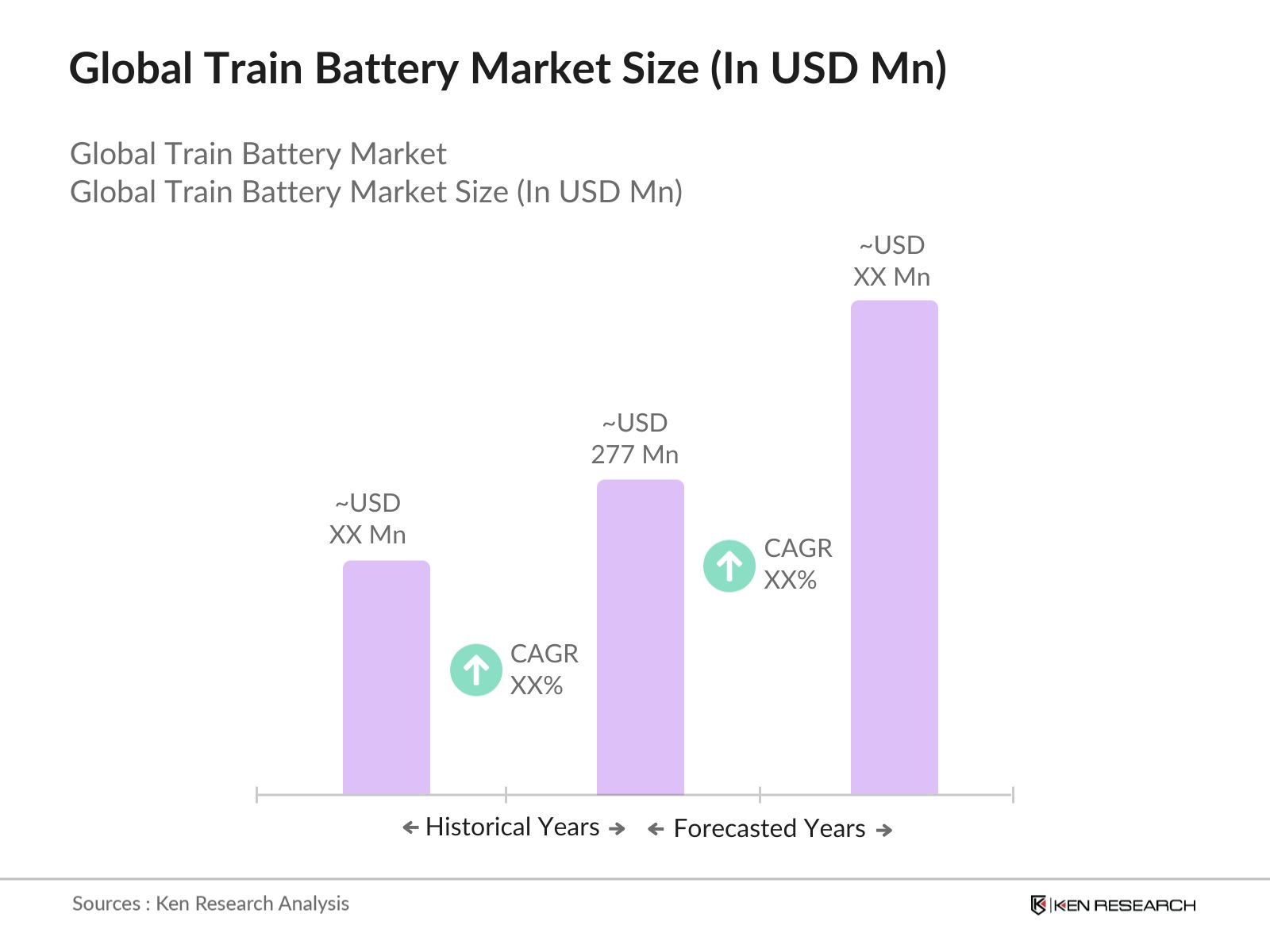
  • The Global Train Battery market was valued at USD 277 million, driven by the increasing focus on sustainable transportation solutions and the modernization of railway infrastructure. With the Globaln government investing in electrified train systems, the demand for efficient and reliable train battery technologies has surged.
  • Key players in the Global Train Battery market include EnerSys, Saft Groupe S.A., Exide Technologies, HBL Power Systems Ltd., and GS Yuasa Corporation. These companies are at the forefront of innovation, offering a range of battery solutions to power various types of electric and hybrid trains.
  • EnerSys, a battery maker, plans to build a $500 million lithium-ion cell gigafactory in Greenville, South Carolina, creating 500 jobs and starting production by late 2027 with a capacity of four gigawatt hours per year.
  • Regions such as Europe (Germany, France), Asia-Pacific (China, Japan, India), and North America (USA, Canada) are emerging as major hubs for train battery deployment, with their expanding electric and hybrid rail networks playing a crucial role in reducing carbon emissions and supporting sustainable mobility.

Global Train Battery market size

Global Train Battery Market Segmentation

The Global Train Battery market is segmented by battery type, application, and region.
  • By Battery Type: The market is segmented into lithium-ion batteries, lead-acid batteries, and nickel-cadmium batteries. Lithium-ion batteries dominated the market due to their higher energy density and longer lifespan.
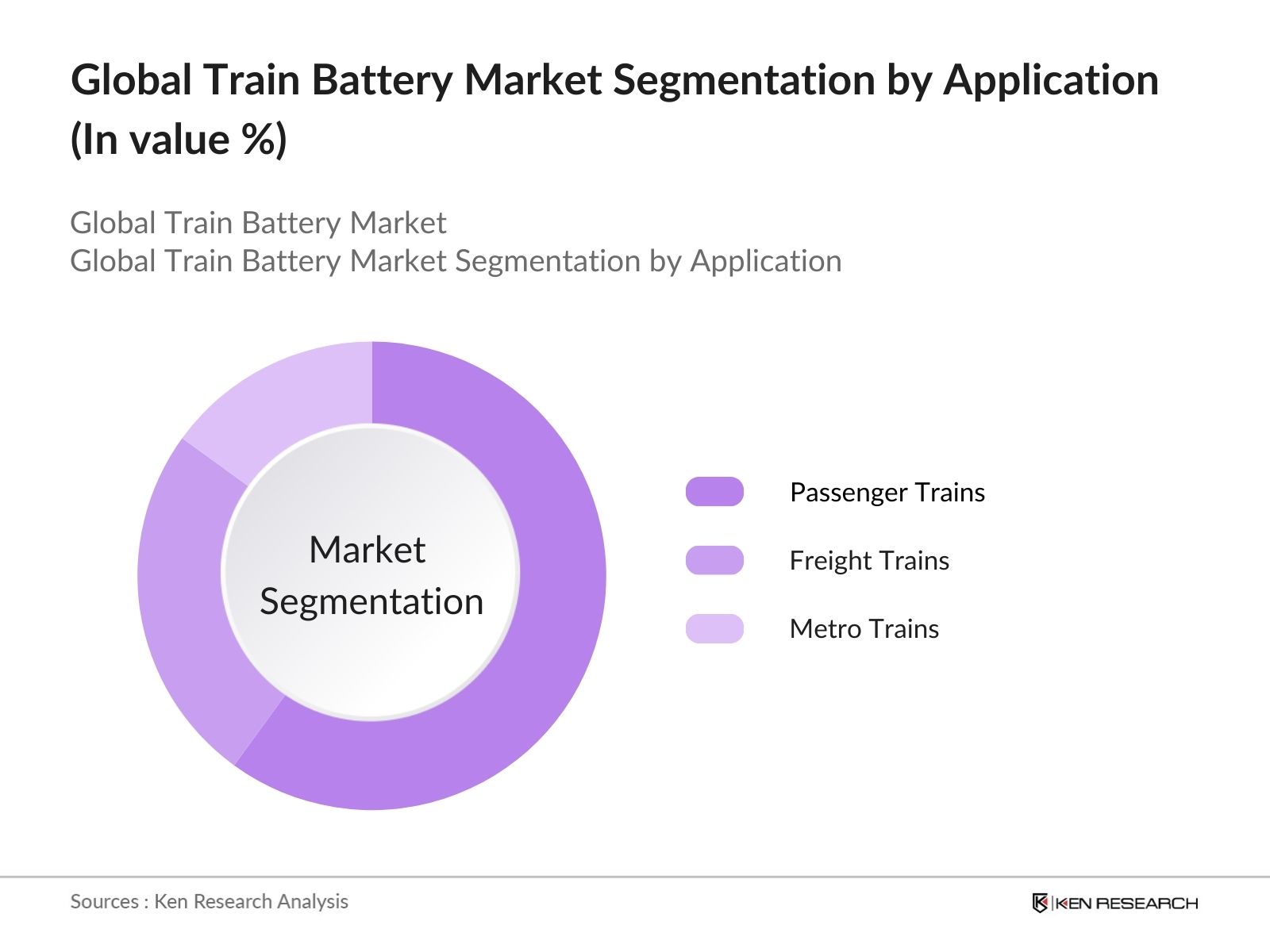
  • By Application: The market is segmented by applications such as passenger trains, freight trains, and metro trains. Passenger trains held the largest market share due to the growing demand for commuter and intercity rail services.

Global Train Battery Market Segmentation by Application

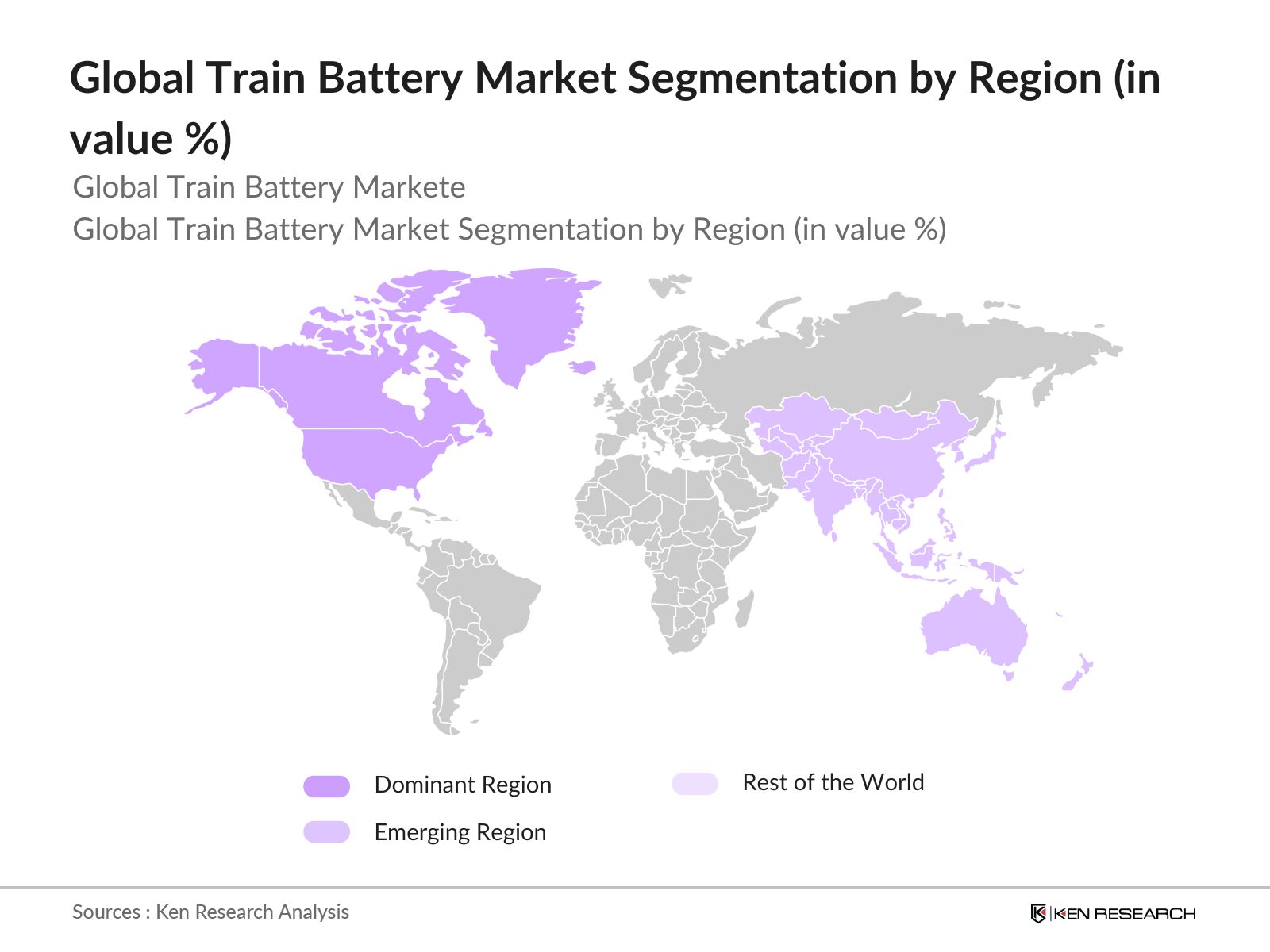
  • By Region: The global market is segmented into North America, Europe, Asia-Pacific (APAC), the Middle East & Africa (MEA), and Latin America. North America and Europe are leading in terms of electrification, while Asia-Pacific, particularly China and India, is rapidly expanding its electric rail networks.

Global Train Battery Market Segmentation By Region

Global Train Battery Market Competitive Landscape

Company Name

Establishment Year

Headquarters

EnerSys

2000

Reading, USA

Saft Groupe S.A.

1918

Levallois-Perret, France

Exide Technologies

1888

Milton, USA

HBL Power Systems Ltd.

1977

Hyderabad, India

GS Yuasa Corporation

2004

Kyoto, Japan

  • Exide Technologies: Hyundai Motor, Kia, and Exide Energy have signed an MoU to source LFP batteries for EVs, aiming to localize battery production and gain a competitive advantage in the Indian EV market.
  • HBL Power Systems Ltd.: HBL Power Systems, a prominent player in the Indian battery and electronic component manufacturing sector, is poised to shape the future with its innovative solutions in defence and electric vehicles (EVs). With a strong focus on quality and indigenous efforts, HBL has emerged as a trusted name, gaining the confidence of investors and customers alike.

Global Train Battery Market Analysis

Global Train Battery Market Growth Drivers:

  • Electrification of Railways: Global aims to electrify 90% of urban mass public transport by 2030, transitioning from diesel to electric trains. This shift is expected to reduce emissions, with electric trains generating up to 50% less greenhouse gas, thereby supporting sustainable transport initiatives.
  • Increasing Urbanization and Congestion: As of mid-2023, approximately 57% of the global population lives in urban areas, an increase from 51% in 2010. This rapid urbanization highlights the urgent need for efficient public transportation solutions to address the challenges posed by growing urban populations and congestion.
  • Environmental Concerns and Emissions Reduction Targets: Global's transportation sector contributes to greenhouse gas emissions, prompting the government to set ambitious targets for reduction. The country aims for a 29% reduction in emissions by 2030, with electric trains playing a crucial role in achieving these environmental goals and improving air quality.

Global Train Battery Market Challenges:

  • High Initial Investment Costs: Establishing electrified rail systems requires substantial upfront investments, with costs up to $11.5 million per kilometre for electrification infrastructure alone, making it challenging for regions outside major cities to fund these projects.
  • Limited Infrastructure in Rural Areas: With 43% of the Global population residing in rural areas, many regions lack the necessary electrical infrastructure to support electric rail networks, constraining the expansion of electrified train systems beyond urban centres.

Global Train Battery Market Government Initiatives:

  • EU's Green Deal: The EU's "Green Deal" aims for carbon-neutral transport systems by 2050, which includes substantial investment in electric rail technologies. The EU has set a target of at least 55% reduction in greenhouse gas emissions by 2030 compared to 1990 levels, putting it on a path to climate neutrality by 2050.
  • Indian Railways Electrification Program: India's initiative to electrify its entire broad-gauge rail network by 2030 is on track, with 94% of the network already electrified as of early 2024. The total electrified broad-gauge network spans 60,814 km, with 39,013 km electrified since 2014. This rapid shift underscores India's commitment to achieving carbon neutrality by 2030 and reducing dependence on fossil fuels.

Global Train Battery Market Future Market Outlook

The Global Train Battery market is projected to experience robust growth over the next five years, supported by government initiatives to expand electric train services and advancements in battery technology.

Global Train Battery Market Future Market Trends:

  • Increased Use of Lithium-Ion Batteries: Lithium-ion batteries are projected to dominate the rail market due to their superior energy density and cost-effectiveness. Their lightweight and efficient energy storage capabilities make them ideal for long-distance and high-speed rail applications, enhancing performance and supporting the transition to electric train systems.
  • Focus on Urban Rail Development: Cities across Europe and Asia-Pacific are investing in the expansion of urban rail networks. Initiatives like the Paris Metro expansion and India Mumbai Metro will enhance the adoption of train battery technologies, reducing carbon emissions and traffic congestion.

Scope of the Report

By Battery Type

Lithium-Ion Batteries

Lead-Acid Batteries

Nickel-Cadmium Batteries

By Application

Passenger Trains

Freight Trains

Metro Trains

By Region

North America

Europe

Asia-Pacific

Middle East & Africa

Latin America

Products

Key Target Audience Organizations and Entities Who Can Benefit by Subscribing This Report:

  • Government and Regulatory Bodies

  • Banks and Financial Institutes

  • Investors and Venture Capitalists

  • Battery Manufacturers

  • Railway Infrastructure Companies

  • Train Manufacturers

  • Power Generation Companies

Time Period Captured in the Report

  • Historical Period: 2018-2023

  • Base Year: 2023

  • Forecast Period: 2023-2028

Companies

Players Mentioned in the Report:

  • EnerSys

  • Saft Groupe S.A.

  • Exide Technologies

  • HBL Power Systems Ltd.

  • GS Yuasa Corporation

  • BYD Company Ltd.

  • Toshiba Corporation

  • Amara Raja Batteries Ltd.

  • Crown Battery Manufacturing

  • Hitachi Rail

  • Panasonic Corporation

  • Johnson Controls International

  • Leclanch SA

  • Banner Batterien

  • East Penn Manufacturing Company

Table of Contents

1. Global Train Battery Market Overview

1.1 Definition and Scope

1.2 Market Taxonomy

1.3 Market Growth Rate and Trends

1.4 Market Segmentation Overview

1.5 Key Technological Innovations and Developments

2. Global Train Battery Market Size (in USD Million)

2.1 Historical Market Size

2.2 Year-on-Year Growth Analysis

2.3 Forecast Market Size and Growth Projections

2.4 Key Market Developments and Milestones

3. Global Train Battery Market Analysis

3.1 Growth Drivers

3.1.1 Electrification of Railways

3.1.2 Increasing Urbanization and Congestion

3.1.3 Environmental Concerns and Emission Reduction Targets

3.1.4 Government Investments in Sustainable Transport

3.2 Market Challenges

3.2.1 High Initial Investment Costs

3.2.2 Limited Infrastructure in Rural Areas

3.2.3 Technological and Supply Chain Challenges

3.3 Opportunities

3.3.1 Increased Demand for Electric and Hybrid Trains

3.3.2 Growth of Lithium-Ion Batteries in Rail Applications

3.3.3 Adoption of Smart Grid and Energy Storage Technologies

3.4 Market Trends

3.4.1 Focus on Urban Rail Development

3.4.2 Integration of Renewable Energy into Rail Systems

3.4.3 Shift Towards Lighter and Longer-Lasting Batteries

3.5 Global Train Battery Market SWOT Analysis

3.5.1 Strengths

3.5.2 Weaknesses

3.5.3 Opportunities

3.5.4 Threats

4. Global Train Battery Market Segmentation

4.1 By Battery Type (in Value %)

4.1.1 Lithium-Ion Batteries

4.1.2 Lead-Acid Batteries

4.1.3 Nickel-Cadmium Batteries

4.2 By Application (in Value %)

4.2.1 Passenger Trains

4.2.2 Freight Trains

4.2.3 Metro Trains

4.3 By Region (in Value %)

4.3.1 North America

4.3.2 Europe

4.3.3 Asia-Pacific

4.3.4 Middle East & Africa

4.3.5 Latin America

5. Global Train Battery Market Competitive Landscape

5.1 Market Share Analysis

5.2 Company Profiles

5.2.1 EnerSys (Established 2000, Reading, USA)

5.2.2 Saft Groupe S.A. (Established 1918, Levallois-Perret, France)

5.2.3 Exide Technologies (Established 1888, Milton, USA)

5.2.4 HBL Power Systems Ltd. (Established 1977, Hyderabad, India)

5.2.5 GS Yuasa Corporation (Established 2004, Kyoto, Japan)

5.2.6 BYD Company Ltd.

5.2.7 Toshiba Corporation

5.2.8 Amara Raja Batteries Ltd.

5.2.9 Crown Battery Manufacturing

5.2.10 Hitachi Rail

5.2.11 Panasonic Corporation

5.2.12 Johnson Controls International

5.2.13 Leclanch SA

5.2.14 Banner Batterien

5.2.15 East Penn Manufacturing Company

5.3 Strategic Initiatives and Investments

5.4 Recent Mergers and Acquisitions

5.5 Technological Innovations and R&D Investments

6. Global Train Battery Market Regulatory Framework

6.1 EU Green Deal and Its Impact on Rail Electrification

6.2 Indian Railways Electrification Program

6.3 Government Incentives for Sustainable Rail Development

6.4 Battery Recycling and Disposal Regulations

6.5 International Standards for Rail Battery Safety

7. Global Train Battery Market Future Market Size Projections

7.1 Future Market Size Projections (in USD Million)

7.2 Key Factors Driving Future Market Growth

7.3 Impact of Emerging Technologies on Market Expansion

7.4 Role of Government Policies in Future Growth

8. Global Train Battery Market Future Segmentation

8.1 By Battery Type

8.2 By Application

8.3 By Region

9. Global Train Battery Market Cross Comparison

9.1 Company Profiles Cross Comparison

9.2 Financial Performance Cross Comparison

9.3 Product Portfolio Cross Comparison

9.4 Regional Presence Cross Comparison

9.5 Technological Innovations Cross Comparison

10. Global Train Battery Market Analysts Recommendations

10.1 TAM/SAM/SOM Analysis

10.2 Strategic Market Entry and Expansion Recommendations

10.3 Innovative Product Development and R&D Focus

10.4 Collaboration and Partnership Opportunities

10.5 Market Positioning Strategies for Key Players

11. Global Train Battery Market Investment and Funding Landscape

11.1 Key Investments in Rail Battery Technology

11.2 Private Equity and Venture Capital Investments

11.3 Government Grants and Subsidies for Rail Electrification

11.4 Mergers and Acquisitions in the Train Battery Sector

Disclaimer Contact Us

Research Methodology

Step: 1 Identifying Key Variables

Ecosystem creation for all the major entities and referring to multiple secondary and proprietary databases to perform desk research around the market to collate market-level information.

Step: 2 Market Building

Collating statistics on the Global Train Battery market over the years and analyzing the penetration of products as well as the ratio of suppliers to compute the revenue generated for the market. We will also review product quality statistics to ensure accuracy behind the data points shared.

Step: 3 Validating and Finalizing

Building market hypotheses and conducting CATIs with market experts from different companies to validate statistics and seek operational and financial information from company representatives.

Step: 4 Research Output

Our research team approaches multiple battery manufacturers to understand product segments, sales trends, consumer preferences, and other parameters. This approach supports us in validating the statistics derived from the bottom-up approach of these dairy producers and Train Battery processing companies.

Frequently Asked Questions

01. How big is the Global Train Battery Market?

The Global Train Battery Market was valued at USD 277 million, driven by the rising demand for eco-friendly packaging and increasing beverage consumption.

02. Who are the major players in the Global Train Battery market?

Leading companies in the Global Train Battery Market include Amcor Plc, Ball Corporation, Crown Holdings, Tetra Pak International, and Ardagh Group, dominating the market with sustainable and innovative packaging solutions.

03. What are the growth drivers of the Global Train Battery market?

The Global Train Battery Market is driven by increasing demand for sustainable packaging, growing beverage consumption, and government support for recycling initiatives across the region.

04. What are the Global Train Battery market challenges?

Challenges in the Global Train Battery Market include the high cost of sustainable packaging and limited recycling infrastructure in rural and underdeveloped areas of Global.

Why Buy From Us?

RRR
Refine Robust Result (RRR) Framework

What makes us stand out is that our consultants follows Robust, Refine and Result (RRR) methodology. i.e. Robust for clear definitions, approaches and sanity checking, Refine for differentiating respondents facts and opinions and Result for presenting data with story

Our Reach Is Unmatched

We have set a benchmark in the industry by offering our clients with syndicated and customized market research reports featuring coverage of entire market as well as meticulous research and analyst insights.

Research
Shifting the Research Paradigm

While we don't replace traditional research, we flip the method upside down. Our dual approach of Top Bottom & Bottom Top ensures quality deliverable by not just verifying company fundamentals but also looking at the sector and macroeconomic factors.

Insite
More Insights-Better Decisions

With one step in the future, our research team constantly tries to show you the bigger picture. We help with some of the tough questions you may encounter along the way: How is the industry positioned? Best marketing channel? KPI's of competitors? By aligning every element, we help maximize success.

Trust
Transparency and Trust

Our report gives you instant access to the answers and sources that other companies might choose to hide. We elaborate each steps of research methodology we have used and showcase you the sample size to earn your trust.

support
Round the Clock Support

If you need any support, we are here! We pride ourselves on universe strength, data quality, and quick, friendly, and professional service.

Why Client Choose Us?

400000+ Reports in repository
150+ Consulting project a year
100+ Analysts
8000+ Client Queries in 2022