
Global Translation Management Systems Market Outlook to 2030
Region:Global
Author(s):Shubham Kashyap
Product Code:KROD1672
November 2024
84
About the Report
Global Translation Management Systems Market Overview
- The global Translation Management Systems (TMS) market is valued at USD 2.10 billion, following a five-year analysis of the growing adoption of TMS solutions. The market is experiencing robust growth, with an increasing demand for streamlined localization processes across various industries. This growth is driven primarily by the need for businesses to manage and scale their multilingual content efficiently, coupled with the rising globalization of companies expanding into international markets.

- With businesses operating across multiple countries, the demand for automated translation and localization tools has skyrocketed, especially in industries such as technology, healthcare, e-commerce, and entertainment. The TMS market offers various features, including workflow automation, collaboration tools, and integrations with content management systems, which help businesses reduce translation turnaround times and enhance the consistency of translations across languages.
- The rise in cloud-based solutions has also accelerated the adoption of TMS platforms. Cloud TMS tools offer easy scalability, flexibility, and remote collaboration features, making them highly appealing to businesses of all sizes. Moreover, advancements in artificial intelligence (AI) and machine learning (ML) technologies have enhanced the translation capabilities of TMS platforms, allowing for more accurate and context-aware translations.
Global Translation Management Systems Market Segmentation
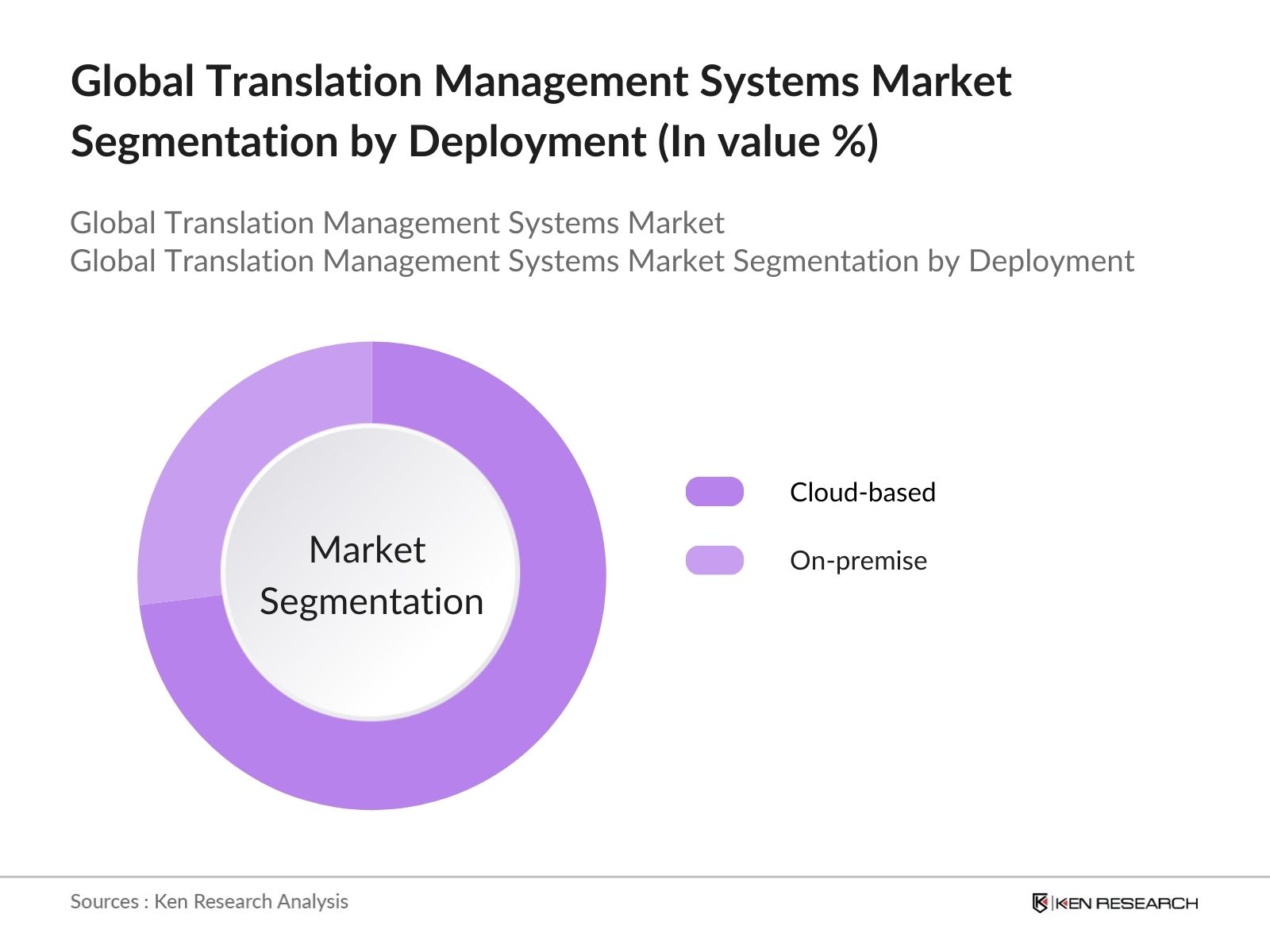
- By Deployment Type: The market is segmented into cloud-based and on-premises solutions. Cloud-based solutions dominate the market, accounting for the largest share due to their ease of integration, scalability, and cost-effectiveness. On-premises solutions, though limited in adoption, are preferred by businesses with stringent data security and compliance requirements, especially in sectors like finance and government.
- By End-User: The market is further segmented into industries such as IT & Telecommunications, Healthcare, E-commerce & Retail, BFSI, and Media & Entertainment. IT & Telecommunications lead the market due to the high volume of technical documents and user interface (UI) translations required for software localization. Healthcare is another significant segment, as TMS platforms help streamline the translation of medical documentation, which is critical for compliance and patient safety in international markets.

Global Translation Management Systems Market Competitive Landscape
The TMS market is highly competitive, with several players offering a range of solutions catering to different industries and localization needs. Key players are focusing on expanding their product offerings by incorporating AI and machine translation capabilities. In addition, companies are investing in partnerships and acquisitions to strengthen their market position and improve customer experience.
|
Company |
Establishment Year |
Headquarters |
Revenue (2023) |
Global Reach |
Product Portfolio |
R&D Investment |
Technology Stack |
Key Partnerships |
Certifications |
|
SDL PLC |
1992 |
Maidenhead, UK |
|||||||
|
Lionbridge |
1996 |
Waltham, USA |
|||||||
|
TransPerfect |
1992 |
New York, USA |
|||||||
|
Memsource |
2010 |
Prague, Czech Republic |
|||||||
|
Smartling |
2009 |
New York, USA |
Global Translation Management Systems Market Analysis
Growth Drivers:
- Rising Demand for Multilingual Content: In 2024, the global demand for multilingual content is driven by the increasing international expansion of businesses, with more than 60% of Fortune 500 companies operating across multiple countries. The UN estimates that 7,139 languages are spoken globally, necessitating efficient translation tools for reaching diverse audiences. The World Bank indicates that international trade grew by over 8% in 2022, highlighting the growing importance of multilingual capabilities for cross-border communication. Localization is a critical factor in ensuring cultural relevance, with companies investing heavily in technology to streamline translations.
- Globalization of Businesses: According to the World Bank, global trade expanded by over 10.00 % reaching a record of USD 32 Bn in 2022, reflecting increased business globalization. More than 78% of businesses are expanding to new international markets, requiring translation management systems (TMS) to navigate language barriers. In 2023, the IMF recorded a surge in the number of multinational corporations from 82,000 in 2010 to over 100,000 by 2022. This expansion demands seamless localization and translation workflows, driving the adoption of TMS solutions to meet the needs of international markets.
- AI and Machine Learning Integration: The integration of AI and machine learning into translation management systems is revolutionizing automation capabilities. As of 2024, more than majority of global translations are supported by AI tools, significantly reducing turnaround time and increasing accuracy. World Bank data shows that in 2022, the global AI industry saw over 45% growth in AI deployment for automation in various sectors, including translation. This shift has optimized translation processes, eliminating manual tasks and improving real-time capabilities, essential for globalized business communication.
Market Challenges:
- High Initial Setup Costs: The initial setup costs of translation management systems (TMS) can be challenging, particularly for small and medium-sized enterprises (SMEs). Many SMEs face difficulties in securing the necessary capital to invest in advanced technology solutions like TMS. This financial hurdle is more pronounced in emerging economies, where access to capital is further constrained. The high costs associated with setting up and integrating TMS solutions limit broader adoption and can slow down market penetration, particularly for businesses that are still building their technology infrastructure.
- Data Security Concerns: Data security is a critical concern for companies using TMS solutions, as they handle sensitive and private information throughout the translation process. Compliance with international standards, such as GDPR and HIPAA, is essential to mitigate risks. The global tightening of data protection regulations has amplified the focus on ensuring secure translation processes. Multinational corporations often encounter significant challenges when trying to comply with varying data privacy laws in different regions, which adds complexity to implementing and maintaining TMS systems.
Global Translation Management Systems Market Future Outlook
The global Translation Management Systems market is poised for continuous growth through 2028, driven by technological advancements, the increasing need for efficient localization, and the growing adoption of AI and machine learning in translation processes.
Future Market Opportunities:
- Expansion into Emerging Markets: Emerging markets in Asia and Africa present significant opportunities for the expansion of TMS solutions. The World Bank has noted a substantial increase in internet users in Sub-Saharan Africa, with over 160 million Africans gaining broadband access between 2019 and 2022, opening up new markets for multilingual content and translation tools. The demand for localized content is growing as businesses expand into these regions, with over majority of global businesses planning to enter new markets within the next year, driven by digital transformation and cross-border e-commerce.
- AI-driven Innovations in Translation Accuracy: Technological advancements in AI are enhancing the accuracy of translations, creating new opportunities for TMS providers. The World Bank indicates that more than half of businesses employing AI technologies have reported improved translation accuracy in 2023, reducing human error and increasing efficiency. This has led to the development of AI-driven tools that provide real-time, context-sensitive translations, a critical need for businesses operating in multilingual environments. AI innovations continue to drive growth and create new use cases for translation management systems globally.
Scope of the Report
|
By Deployment |
Cloud-based |
|
By End-User |
IT & Telecommunications Healthcare E-commerce & Retail BFSI Media & Entertainment |
|
By Organization Size |
Large Enterprises Small & Medium Enterprises (SMEs) |
|
By Component |
Software Services |
|
By Region |
North America Europe Asia-Pacific Latin America Middle East & Africa |
Products
Key Target Audience
Translation Service Providers
Multinational Corporations
E-commerce Platforms
Healthcare Providers
Government and Regulatory Bodies (ISO, GDPR Authorities)
IT & Telecommunications Companies
Investments and Venture Capitalist Firms
BFSI Institutions
Banks and Financial Institutions
Companies
Major Players Mentioned in the Report
SDL PLC
Lionbridge
TransPerfect
Memsource
Smartling
RWS Holdings
Lokalise
Weglot
Phrase
Pangeanic
Crowdin
Lingotek
TextUnited
OneSky
MotionPoint
Table of Contents
1. Global Translation Management Systems Market Overview
1.1 Definition and Scope
1.2 Market Taxonomy
1.3 Market Growth Rate
1.4 Market Segmentation Overview
2. Global Translation Management Systems Market Size (In USD Bn)
2.1 Historical Market Size
2.2 Year-On-Year Growth Analysis
2.3 Key Market Developments and Milestones
3. Global Translation Management Systems Market Analysis
3.1 Growth Drivers
3.1.1 Rising Demand for Multilingual Content (Localization Metrics)
3.1.2 Globalization of Businesses (International Expansion)
3.1.3 AI and Machine Learning Integration (Automation Metrics)
3.1.4 Increasing Cloud Adoption (Cloud Computing Integration)
3.2 Market Challenges
3.2.1 High Initial Setup Costs (Cost-Benefit Analysis)
3.2.2 Data Security Concerns (Compliance and Security Standards)
3.2.3 Limited Localization Talent (Human Resources and Talent Acquisition)
3.3 Opportunities
3.3.1 Expansion into Emerging Markets (Geographical Expansion)
3.3.2 AI-driven Innovations in Translation Accuracy (Technological Advancements)
3.3.3 Cross-Platform Integrations (Technology Partnerships)
3.4 Trends
3.4.1 Real-time Translation (Real-Time Collaboration Tools)
3.4.2 Cloud-based Translation Management Systems (SaaS Model Adoption)
3.4.3 Multi-Language Workflow Automation (Content Management Integration)
3.5 Government Regulations
3.5.1 Data Privacy Laws (GDPR, HIPAA Compliance)
3.5.2 Localization Standards (ISO 17100:2015)
3.5.3 Cross-border E-commerce Regulations (Trade & Language Mandates)
3.6 SWOT Analysis
3.7 Stakeholder Ecosystem (Buyers, Translators, LSPs, TMS Providers)
3.8 Porters Five Forces
3.8.1 Threat of New Entrants
3.8.2 Bargaining Power of Buyers
3.8.3 Bargaining Power of Suppliers
3.8.4 Threat of Substitutes
3.8.5 Competitive Rivalry
3.9 Competition Ecosystem
4. Global Translation Management Systems Market Segmentation
4.1 By Deployment Type (In Value %)
4.1.1 Cloud-based
4.1.2 On-premise
4.2 By End-Use Industry (In Value %)
4.2.1 IT & Telecommunications
4.2.2 Healthcare
4.2.3 E-commerce & Retail
4.2.4 BFSI
4.2.5 Media & Entertainment
4.3 By Organization Size (In Value %)
4.3.1 Large Enterprises
4.3.2 Small & Medium Enterprises (SMEs)
4.4 By Region (In Value %)
4.4.1 North America
4.4.2 Europe
4.4.3 Asia-Pacific
4.4.4 Latin America
4.4.5 Middle East & Africa
4.5 By Component (In Value %)
4.5.1 Software
4.5.2 Services
5. Global Translation Management Systems Market Competitive Analysis
5.1 Detailed Profiles of Major Companies
5.1.1 SDL PLC
5.1.2 Lionbridge
5.1.3 TransPerfect
5.1.4 Memsource
5.1.5 RWS Holdings
5.1.6 Smartling
5.1.7 Lokalise
5.1.8 Weglot
5.1.9 Phrase
5.1.10 Pangeanic
5.1.11 Crowdin
5.1.12 Lingotek
5.1.13 TextUnited
5.1.14 OneSky
5.1.15 Lokalise
5.2 Cross Comparison Parameters (No. of Employees, Headquarters, Inception Year, Revenue, Market Presence, R&D Investment, Technology Stack, Certifications)
5.3 Market Share Analysis
5.4 Strategic Initiatives
5.5 Mergers and Acquisitions
5.6 Investment Analysis
5.7 Venture Capital Funding
5.8 Government Grants
5.9 Private Equity Investments
6. Global Translation Management Systems Market Regulatory Framework
6.1 Compliance Standards (ISO 9001, ISO 17100)
6.2 Localization Certification Processes
6.3 Data Security Regulations (GDPR, HIPAA Compliance)
7. Global Translation Management Systems Future Market Size (In USD Bn)
7.1 Future Market Size Projections
7.2 Key Factors Driving Future Market Growth
8. Global Translation Management Systems Future Market Segmentation
8.1 By Deployment Type (In Value %)
8.2 By End-Use Industry (In Value %)
8.3 By Organization Size (In Value %)
8.4 By Region (In Value %)
8.5 By Component (In Value %)
9. Global Translation Management Systems Market Analysts Recommendations
9.1 TAM/SAM/SOM Analysis
9.2 Customer Cohort Analysis
9.3 Marketing Initiatives
9.4 White Space Opportunity Analysis
Research Methodology
Step 1: Identification of Key Variables
The first step involves developing an extensive understanding of the Translation Management Systems market by identifying key variables such as deployment type, end-use industries, and market growth drivers. This process is based on comprehensive desk research and industry analysis, gathering information from proprietary databases and secondary research sources.
Step 2: Market Analysis and Construction
This phase focuses on analyzing historical data related to the TMS market, including market penetration rates, deployment ratios, and revenue streams. Data from industry reports and public filings are used to evaluate market dynamics and assess future growth opportunities.
Step 3: Hypothesis Validation and Expert Consultation
To validate market assumptions, consultations are conducted with key industry stakeholders, including TMS providers and end-users, through CATIs (Computer-Assisted Telephone Interviews). Insights from these experts help refine and corroborate the findings.
Step 4: Research Synthesis and Final Output
In the final step, data gathered from primary and secondary sources is synthesized to create a comprehensive report. The synthesis includes final validations from industry practitioners and key market players, ensuring the report provides accurate and reliable insights into the global TMS market.
Frequently Asked Questions
01. How big is the Global Translation Management Systems Market?
The global Translation Management Systems market is valued at USD 2.10 billion, driven by the increasing globalization of businesses and the need for automated translation processes.
02. What are the challenges in the Global Translation Management Systems Market?
Challenges in the global Translation Management Systems market include high implementation costs, data security concerns with cloud-based solutions, and the limited availability of qualified localization experts in emerging markets.
03. Who are the major players in the Global Translation Management Systems Market?
Key players in the global Translation Management Systems market include SDL PLC, Lionbridge, TransPerfect, Memsource, and Smartling, each contributing to the growth and innovation of the TMS landscape.
04. What are the growth drivers of the Global Translation Management Systems Market?
Growth drivers in the global Translation Management Systems market include the increasing demand for multilingual content management, advancements in AI-powered translation tools, and the growing adoption of cloud-based TMS solutions.
Why Buy From Us?

What makes us stand out is that our consultants follows Robust, Refine and Result (RRR) methodology. i.e. Robust for clear definitions, approaches and sanity checking, Refine for differentiating respondents facts and opinions and Result for presenting data with story

We have set a benchmark in the industry by offering our clients with syndicated and customized market research reports featuring coverage of entire market as well as meticulous research and analyst insights.

While we don't replace traditional research, we flip the method upside down. Our dual approach of Top Bottom & Bottom Top ensures quality deliverable by not just verifying company fundamentals but also looking at the sector and macroeconomic factors.

With one step in the future, our research team constantly tries to show you the bigger picture. We help with some of the tough questions you may encounter along the way: How is the industry positioned? Best marketing channel? KPI's of competitors? By aligning every element, we help maximize success.

Our report gives you instant access to the answers and sources that other companies might choose to hide. We elaborate each steps of research methodology we have used and showcase you the sample size to earn your trust.

If you need any support, we are here! We pride ourselves on universe strength, data quality, and quick, friendly, and professional service.