CHAPTER 1 - MARKET SUMMARY
Market Overview
The India Space Launch Services Market Size, Share & Forecast, By Service Type, Technology & Application, 2025-2032 monetizes mission planning, payload integration, launch execution, deployment and directly attributable mission-support services. Commercial demand is increasingly diversified beyond sovereign missions: India had launched 433 foreign satellites by October 2025, providing a substantial reference base for international satellite operators evaluating Indian launch capacity.
South India is the principal operating cluster because Sriharikota contains India's established orbital launch infrastructure while Kulasekarapattinam is being developed as the dedicated second spaceport for small-satellite missions. The new complex is designed for approximately 20-25 orbital launches annually, increasing potential cadence for polar missions and creating capacity for private non-government launch providers.
Market Value
USD 219 million
2025
Dominant Region
South India
2025
Dominant Segment
Service Type, led by Launch Execution Services
fastest growing: Technology
Total Number of Players
10
Future Outlook
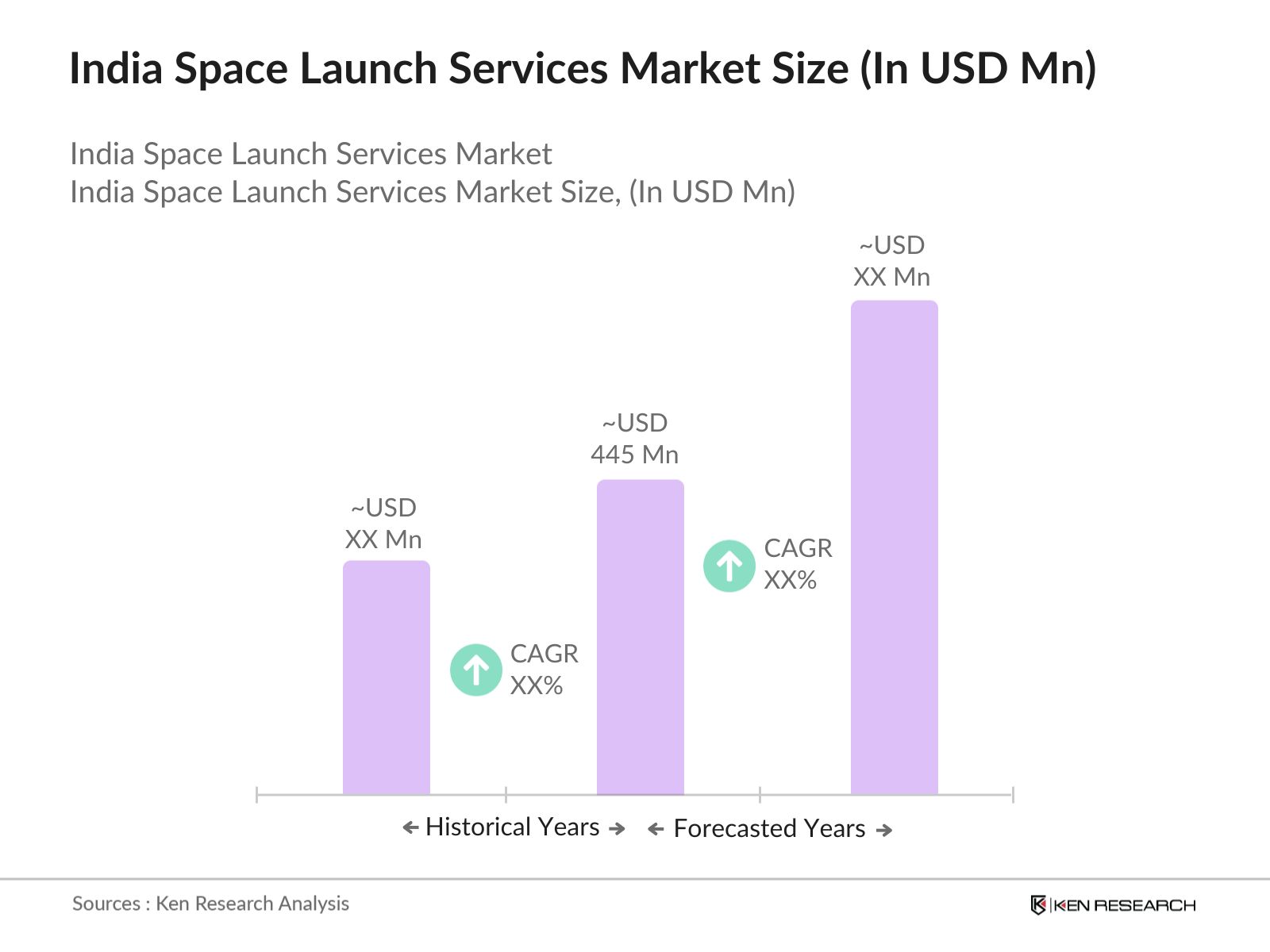
The commercial revenue pool is projected to move from USD 219 million in 2025 to approximately USD 581 million by 2032, corresponding to a modeled 15.00% CAGR across the 2025-2032 forecast period. Historical growth was approximately 10.16% during 2020-2025, with annual performance affected by the timing of high-value dedicated missions. By 2031, market revenue is projected at approximately USD 505 million. Growth increasingly depends on repeatable private launch cadence, international payload acquisition, higher spaceport utilization and integration of smaller dedicated missions alongside established PSLV, SSLV and LVM3 commercial offerings.
Capacity expansion materially improves the addressable opportunity. Kulasekarapattinam is designed for 20-25 orbital launches per year, while a third launch pad at Sriharikota is targeted to support next-generation vehicles. Private capability also advanced when Skyroot's Vikram-1 completed India's first privately developed orbital rocket mission in July 2026. Over the forecast horizon, the revenue mix is expected to shift toward dedicated small-satellite launches, rapid mission integration, launch-on-demand contracts and bundled deployment services. The government's broader 2033 strategy targets USD 3.5 billion from the launch segment within a USD 44 billion national space economy.
15.00%
Forecast CAGR
USD 581 Mn
2030 Projection
Base Year
2025
Historical Period
2020-2025
Forecast Period
2025-2032
Historical CAGR
10.16%
CHAPTER 2 - SCOPE OF REPORT
Scope of the Market
CHAPTER 3 - Key Stakeholders
Key Target Audience
Key stakeholders who can leverage from this market analysis for investment, strategy, and operational planning.
Investors
launch cadence, backlog, capex intensity, unit economics, reliability, risk
Corporates
launch windows, payload integration, pricing, reliability, capacity, scheduling
Government
sovereign access, FDI compliance, launch capacity, exports, resilience
Operators
turnaround time, payload mass, utilization, range access, reliability
Financial institutions
milestone financing, backlog quality, capex, insurance, cash conversion
CHAPTER 4 - Market Size & Growth
Market Size, Growth Forecast and Trends
This section evaluates the historical market size, analyzes year-over-year growth dynamics, and presents forecast projections supported by market performance indicators and demand-side drivers.
Historical & Projected Market Size ($ Million)
Year-over-Year Growth Rate (%)
Market Value vs Volume Growth (%)
Historical Market Performance (2020-2025)
Historical revenue expanded at approximately 10.16% CAGR, but the trajectory was uneven because individual dedicated missions materially affect annual billings. Revenue reached a modeled historical peak of USD 210 million in 2023 after the two OneWeb LVM3 missions deployed 72 satellites across 2022 and 2023. The market then contracted 9.5% in 2024 before recovering 15.3% in 2025. Physical launch cadence was similarly uneven: India conducted five orbital launches from Sriharikota in 2025, four of which successfully achieved intended payload injection.
Forecast Market Outlook (2025-2032)
The market is projected to expand at approximately 15.00% CAGR through 2032 as infrastructure availability, foreign demand and private orbital capability improve. Revenue growth is expected to remain below launch-volume growth because the vehicle mix increasingly includes smaller, lower-priced dedicated missions. Skyroot's July 2026 Vikram-1 orbital mission strengthened the commercial credibility of private launch providers, while Kulasekarapattinam provides a dedicated infrastructure pathway for higher small-launch cadence. The forecast assumes continued monetization of integration, deployment and range services alongside vehicle-level launch revenue.
CHAPTER 5 - Market Data
Market Breakdown
The market's 2025-2032 trajectory increasingly depends on launch cadence, revenue intensity per mission and the number of privately commercialized orbital providers. These operating indicators determine whether higher infrastructure availability converts into scalable revenue and improved utilization for investors and operators.
Year | Market Size (USD Mn) | YoY Growth (%) | Orbital Launch Missions | Revenue Intensity per Launch Mission (USD Mn, Modeled) | Commercially Active Private Orbital Providers (Modeled) | Period |
|---|---|---|---|---|---|---|
| 2020 | $135 Mn | +- | 2 | 67.5 | Forecast | |
| 2021 | $150 Mn | +11.1% | 2 | 75.0 | Forecast | |
| 2022 | $170 Mn | +13.3% | 5 | 34.0 | Forecast | |
| 2023 | $210 Mn | +23.5% | 7 | 30.0 | Forecast | |
| 2024 | $190 Mn | +-9.5% | 5 | 38.0 | Forecast | |
| 2025 | $219 Mn | +15.3% | 5 | 43.8 | Forecast | |
| 2026 | $251 Mn | +14.6% | 6 | 41.8 | Forecast | |
| 2027 | $289 Mn | +15.1% | 8 | 36.1 | Forecast | |
| 2028 | $332 Mn | +14.9% | 10 | 33.2 | Forecast | |
| 2029 | $382 Mn | +15.1% | 12 | 31.8 | Forecast | |
| 2030 | $439 Mn | +14.9% | 15 | 29.3 | Forecast | |
| 2031 | $505 Mn | +15.0% | 18 | 28.1 | Forecast | |
| 2032 | $581 Mn | +15.0% | 22 | 26.4 | Forecast |
Orbital Launch Missions
5 missions (2025, India). Cadence controls utilization of launch pads, engineering teams and manufacturing assets. Four of India's five Sriharikota launches in 2025 achieved nominal payload injection, illustrating both capacity and reliability sensitivity.
Revenue Intensity per Launch Mission
36 satellites in one LVM3 mission (2023, India). Large dedicated constellation missions can materially increase revenue intensity relative to small-lift flights, making customer and vehicle mix a major driver of annual commercial billings.
Commercially Active Private Orbital Providers
1 provider achieved private orbital flight (2026, India). Skyroot's Vikram-1 milestone converted private launch capability from development risk into an operating benchmark, increasing pressure for repeatable commercial cadence.
CHAPTER 6 - Segmentation
Market Segmentation Framework
Comprehensive analysis across key dimensions providing insights into market structure, customer preferences, mission requirements and commercial delivery patterns.
No of Segments
7
Dominant Segment
Service Type
Fastest Growing Segment
Technology
Service Type
Customer Type
Application
Delivery Model
Revenue Model
Channel
Technology
Key Segmentation Takeaways
Comprehensive analysis across all extracted segmentation dimensions providing insights into market structure, customer preferences, mission economics and distribution patterns.
Service Type
Launch Execution Services form the principal high-value revenue pool, but pre-launch integration and mission-support activities provide recurring touchpoints with customers. As cadence scales, standardization of payload accommodation, testing, regulatory coordination and range preparation can improve utilization while enabling providers to capture revenue beyond the physical launch event.
Technology
Small-Lift Launch Vehicles are positioned for the fastest commercialization as satellite operators seek responsive scheduling and orbit-specific deployment. Vikram-class private systems and SSLV commercialization broaden supply, while reusable and next-generation launch architectures represent the longer-term cost opportunity. Investors should therefore track qualification milestones, launch cadence, manufacturing repeatability and cost per kilogram rather than vehicle announcements alone.
CHAPTER 7 - Regional Analysis
Regional Analysis
India ranks third by modeled 2025 commercial launch-services revenue among a selected Asian peer set comprising China, Japan, South Korea and Australia. Its current revenue position remains below China and Japan, but indigenous heavy-launch capability, new small-satellite infrastructure and private orbital commercialization strengthen its strategic competitiveness.
Focus Country Ranking
3rd
Focus Country Market Size
USD 219 Mn (2025)
India CAGR (2025-2032)
15.0%
Focus Country Ranking
3rd
Focus Country Market Size
USD 219 Mn (2025)
India CAGR (2025-2032)
15.0%
Regional Analysis (Current Year)
Market Position
India ranks third in the selected peer set on the harmonized commercial-revenue lens, with its competitive position supported by indigenous PSLV, SSLV, GSLV and LVM3 launch families and sovereign launch infrastructure.
Growth Advantage
India's 15.0% modeled CAGR exceeds China's 11.0% benchmark but remains below faster emerging peers, positioning India as a mid-tier growth market with greater near-term commercialization depth than many newer launch ecosystems. kenresearch.com
Competitive Strengths
India combines an established Sriharikota range, Kulasekarapattinam capacity for 20-25 annual orbital launches and proven private orbital capability, providing sovereign access, vehicle diversity and a credible small-satellite scaling pathway.
CHAPTER 8 - INDUSTRY ANALYSIS
Growth Drivers, Challenges & Opportunities
Comprehensive analysis of key factors shaping the India Space Launch Services Market Size, Share & Forecast, By Service Type, Technology & Application, 2025-2032, including growth catalysts, operational challenges, and emerging opportunities across launch infrastructure, mission integration and customer segments.
Growth Drivers
Expanding Commercial Satellite Customer Base
- Foreign launch experience lowers qualification risk for international operators because 433 foreign satellites (2025, India) create a substantial mission-reference base for procurement and insurance assessment.
- Vehicle diversity broadens the addressable payload envelope, with 4 operationalized launch-vehicle families (2026, India) covering small, medium and heavier orbital missions and supporting customer choice.
- Private supply widened when Vikram-1 delivered payloads to a 450 km low-Earth orbit (2026, India), providing small-satellite operators with an additional domestic orbital-launch pathway.
Private Capital and Regulatory Liberalization
- The FDI regime permits 49% automatic-route foreign investment (2024, India) in launch vehicles and spaceports, lowering funding friction while preserving strategic review above that threshold.
- IN-SPACe had issued 113 authorizations to 52 NGEs (2026, India), expanding the regulated pipeline of private companies capable of participating across space activities and launch-related value chains.
- The ecosystem reached approximately 440 registered space startups (2026, India), widening the downstream base of spacecraft, payload and constellation developers that can ultimately procure launch capacity.
Launch Infrastructure and Capacity Expansion
- Kulasekarapattinam is designed for 20-25 orbital launches per year (2026, India), creating dedicated infrastructure for small-satellite and non-government launch vehicles.
- The third Sriharikota launch pad has a targeted 4-year establishment window (2025, India), increasing long-term redundancy and capacity for next-generation launch vehicles.
- India's strategic roadmap targets USD 3.5 billion from the broader launch segment by 2033 (India), creating an institutional demand ceiling supporting private investment and capacity planning.
Market Challenges
Mission Concentration and Revenue Volatility
- Of the 5 orbital launches undertaken (2025, India), one PSLV mission failed to place its payload in orbit, demonstrating how reliability events affect customer confidence, insurance assessment and utilization.
- Two LVM3 OneWeb missions carried 72 satellites across two launches (2022-2023, India), illustrating how a small number of large contracts can materially change annual commercial billings.
- Physical cadence was unchanged at 5 launches in both 2024 and 2025 (India), reinforcing the need to increase repeatable mission throughput before fixed engineering and range costs can be spread across more flights.
Global Price and Cadence Competition
- The same comparison estimated US launch cost at USD 3,225 per kg (2025, United States), making payload capacity, reusability and flight frequency critical competitive variables for Indian providers.
- India completed 4 successful orbital launches (2025, India), limiting the flight-learning and fixed-cost amortization available relative to high-frequency international launch systems.
- Skyroot has indicated at least USD 4 million revenue per Vikram-1 launch (2025 company expectation, India), making manufacturing repeatability and payload utilization central to sustainable small-launch economics.
Qualification, Reliability and Capital Intensity
- Vikram-1 is designed for payloads of up to 350 kg to low-Earth orbit (2026, India), requiring integrated propulsion, guidance, staging, range-safety and separation performance before repeat commercial service can scale.
- Launch vehicles require IN-SPACe authorization under the Indian Space Policy 2023 framework (2023, India), making licensing, safety and strategic-security reviews part of the commercialization critical path.
- Private investment reached USD 618.5 million by 2026 (India), but vehicle development, testing infrastructure and production scale still require substantial capital before recurring launch revenue can support mature returns.
Market Opportunities
Dedicated Small-Satellite and Launch-on-Demand Services
- Dedicated missions can monetize schedule and orbital precision rather than compete only on rideshare cost, with 30-day payload delivery before launch (2026, India) promoted within Skyroot's commercial launch process.
- Satellite owners benefit from greater control over deployment timing because Vikram-1 supports dedicated and rideshare configurations (2026, India), widening service differentiation for constellation and technology-demonstration customers.
- The opportunity requires repeatable infrastructure, and Kulasekarapattinam targets 20-25 orbital launches annually (2026, India), providing a capacity pathway for higher-frequency small-launch operations.
International Launch-Service Exports
- International customers can raise utilization beyond domestic satellite demand, with 433 foreign satellites launched by October 2025 (India) demonstrating sustained cross-border payload experience.
- Launch integrators, separation-system suppliers and range operators benefit when export missions purchase bundled services; the OneWeb contract covered 72 satellites across two LVM3 missions (2022-2023, India).
- Conversion to recurring export contracts depends on competitive cadence and reliability, while the national strategy targets USD 11 billion in broader space exports by 2033 (India).
Commercial Spaceport and Mission-Infrastructure Services
- Spaceport operators can monetize pad access, integration, telemetry and range services because 32 of 33 major facilities were under construction (2025, India) at Kulasekarapattinam.
- Infrastructure investors gain an additional entry route because launch vehicles and spaceports permit 49% automatic-route FDI (2024, India), enabling foreign capital without eliminating strategic oversight.
- Commercialization requires operational rules compatible with private vehicles, and the second launch site is targeted for FY2026-27 commissioning (2026, India), providing a defined near-term infrastructure milestone.
CHAPTER 9 - Competitive Landscape
Competitive Landscape Overview
The market remains concentrated around NSIL and a small group of emerging private launch providers, with qualification history, launch-pad access, engineering reliability, customer backlog and substantial vehicle-development capital creating significant barriers to sustainable commercial entry.
Market Share Distribution
Top 5 Players
Market Dynamics
8 new entrants in the past 5 years, indicating strong market attractiveness and growth potential.
Company Name | Market Share | Headquarters | Founding Year | Core Market Focus |
|---|---|---|---|---|
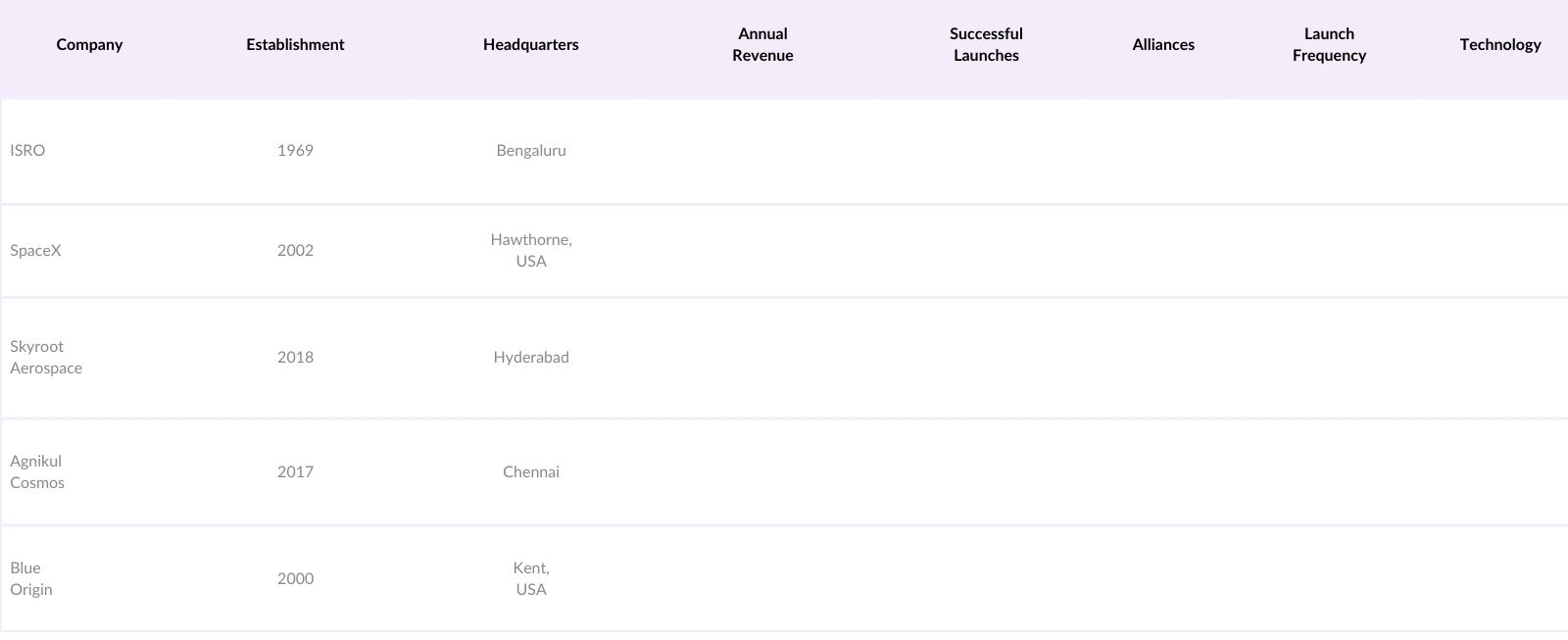
NewSpace India Limited | - | Bengaluru, India | 2019 | Commercial launch services using PSLV, SSLV and LVM3 vehicles |
Antrix Corporation Limited | - | Bengaluru, India | 1992 | Legacy international launch contracts and historical ISRO commercialization |
Skyroot Aerospace Private Limited | - | Hyderabad, India | 2018 | Dedicated and rideshare small-satellite orbital launches using Vikram vehicles |
Agnikul Cosmos Private Limited | - | Chennai, India | 2017 | Configurable small-satellite launch services using Agnibaan vehicles |
Dhruva Space Private Limited | - | Hyderabad, India | 2012 | Launch integration, orbital deployers and mission liaison services |
Bellatrix Aerospace Private Limited | - | Bengaluru, India | - | Orbital transportation, propulsion and post-launch deployment support |
Cosmicport Private Limited | - | Thoothukudi, India | 2023 | Emerging launch systems and spaceport-linked commercial services |
Manastu Space Technologies Private Limited | - | Navi Mumbai, India | - | In-space propulsion and mission-mobility services linked to deployment |
Hindustan Aeronautics Limited | - | Bengaluru, India | 1940 | Industrialized launch-vehicle production and SSLV commercialization capability |
Larsen & Toubro Limited | - | Mumbai, India | 1938 | Launch-vehicle structures, systems integration and industry-led rocket production |
Cross Comparison Parameters
The report provides detailed cross-comparison of key players across 10 performance parameters to identify competitive strengths and weaknesses.
Analysis Covered
Market Share Analysis:
Benchmarks provider positioning across launch execution and integration revenue pools.
Cross Comparison Matrix:
Compares cadence, payload capability, backlog, reliability, pricing and commercial scale.
SWOT Analysis:
Evaluates technical maturity, infrastructure access, capital strength and execution risk.
Pricing Strategy Analysis:
Assesses dedicated, rideshare, reservation and bundled mission pricing economics comparatively.
Company Profiles:
Reviews capabilities, contracts, partnerships, leadership, funding and commercialization readiness levels.
CHAPTER 10 - REPORT TOC
Market Report Structure
Comprehensive coverage across three strategic phases, Market Assessment, Go-To-Market Strategy, and Survey, delivering end-to-end insights from market analysis and execution roadmap to customer demand validation.
Market Assessment Phase
Supply-side and competitive intelligence covering market sizing, segmentation, competitive dynamics, regulatory landscape, and future forecasts.
Go-To-Market Strategy Phase
15 chapters
Entry strategy evaluation, execution roadmap, partner recommendations, and profitability outlook.
Survey Phase
8 chapters
Demand-side primary research conducted through structured interviews and online surveys with end users across priority metros and Tier 2/3 cities to capture consumption behavior, unmet needs, and purchase drivers.
Complete Report Coverage
201+ detailed sections covering every aspect of the market
143
Assessment Sections
58
Strategy Sections
CHAPTER 11 - Our Approach
Research Methodology
Desk Research
- Reviewed national launch mission statistics
- Mapped commercial launch service contracts
- Assessed private launcher flight milestones
- Analyzed spaceport infrastructure development programs
Primary Research
- Interviewed launch service commercial directors
- Engaged satellite mission program directors
- Consulted payload integration engineering managers
- Interviewed institutional space procurement leaders
Validation and Triangulation
- 240 respondent ecosystem cross-check sample
- Reconciled mission cadence with billings
- Validated launch pricing across formats
- Tested capacity against infrastructure pipeline
CHAPTER 12 - FAQ
FAQs
Still have questions?
Our research team is here to help you find the right solution
CHAPTER 13 - Related Research
Explore Related Reports
Expand your market intelligence with complementary research across regions and adjacent markets.
Regional/Country ReportsRelated market analysis across key regions
Related market analysis across key regions
- Oman space launch services market report size, share, growth drivers, trends, opportunities & forecast 2025–2030
- Indonesia Space Launch Services Market
- Vietnam Space Launch Services Market
- Thailand Space Launch Services Market
- Malaysia Space Launch Services Market
Adjacent ReportsRelated markets and complementary research
Related markets and complementary research
- Vietnam Satellite Manufacturing Market Report Size, Share, Growth Drivers, Trends, Opportunities & Forecast 2025–2030
- Bahrain Payload Integration Services Market
- Vietnam Spacecraft Development Market
- Qatar Commercial Rocket Launch Market
- India Ground Support Equipment Market Size, Share & Forecast, By Equipment Type, Power Source & Application, 2026-2032
500+
Market Research Reports
50+
Countries Covered
15+
Industry Verticals