Indonesia CRM Software Market Outlook to 2030

Region:Asia

Author(s):Sanjeev

Product Code:KROD9011

Published On

November 2024

Total pages

80

About the Report

Indonesia CRM Software Market Overview

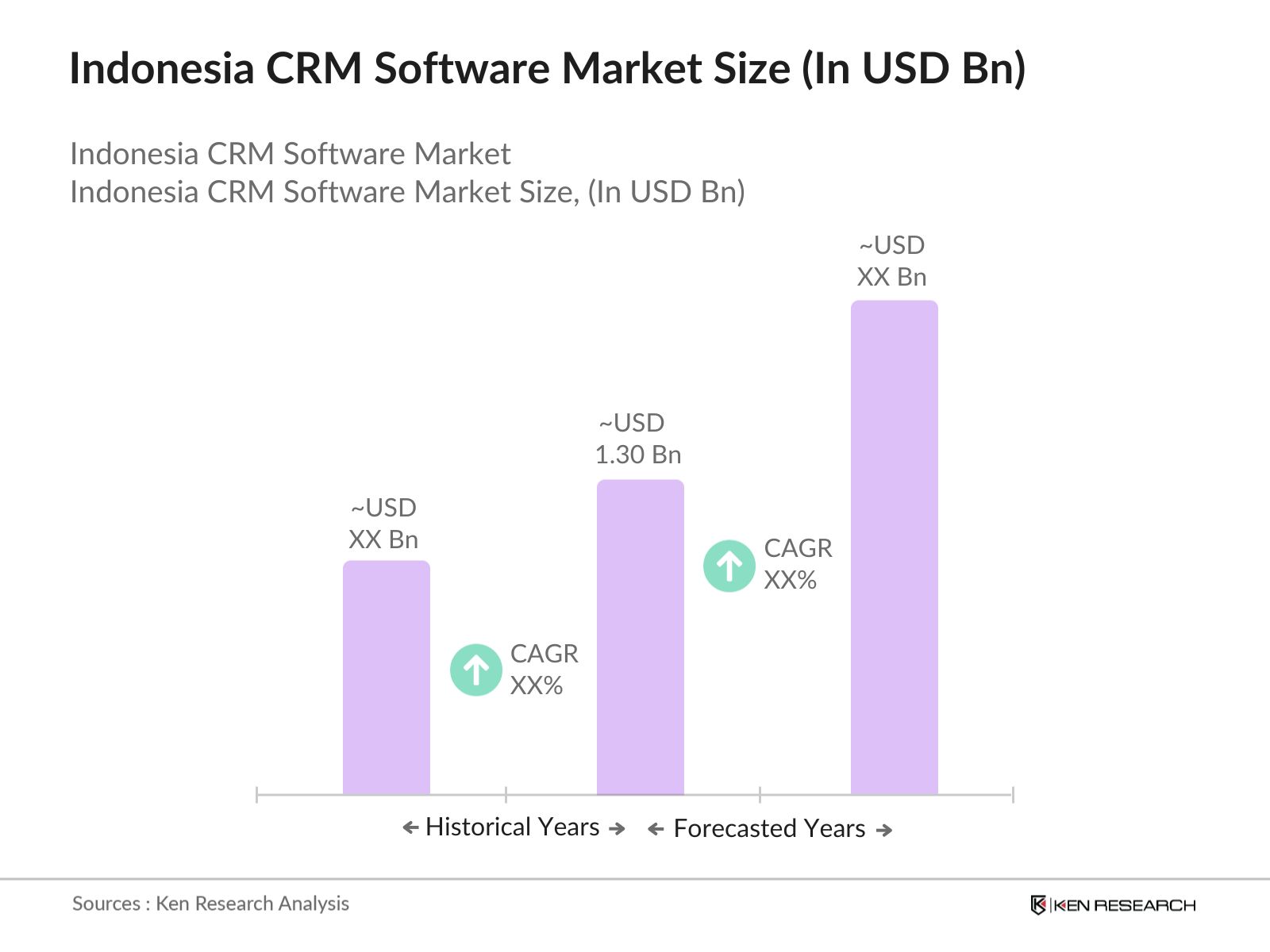
  • The Indonesia CRM software market is valued at USD 1.30 billion, driven by increasing digital transformation initiatives and the rapid growth of e-commerce platforms. The proliferation of customer-centric business models in industries like retail, telecommunications, and banking has further accelerated CRM adoption. Cloud-based CRM solutions have also gained traction due to their scalability and cost-effectiveness, contributing significantly to the markets current value.
  • Cities such as Jakarta, Surabaya, and Bandung dominate the market due to their advanced digital infrastructure, high internet penetration, and a strong presence of SMEs and large enterprises. These urban centers are hubs for tech-driven industries that require sophisticated CRM tools to manage vast amounts of customer data and streamline business operations. The high demand for technology-driven solutions in these regions positions them as key contributors to the CRM market in Indonesia.
  • Indonesias data localization laws, enacted in 2022, require that all electronic system operators store data within the country. This has significant implications for CRM providers, as they must ensure compliance by hosting customer data on local servers. Businesses using cloud-based CRM platforms have to align with these regulations, creating challenges but also opportunities for local data center providers. The policy is part of Indonesias broader push to secure digital sovereignty and protect citizen data.

market overviews

Indonesia CRM Software Market Segmentation

The Indonesia CRM software market is segmented by deployment models and by enterprise size.
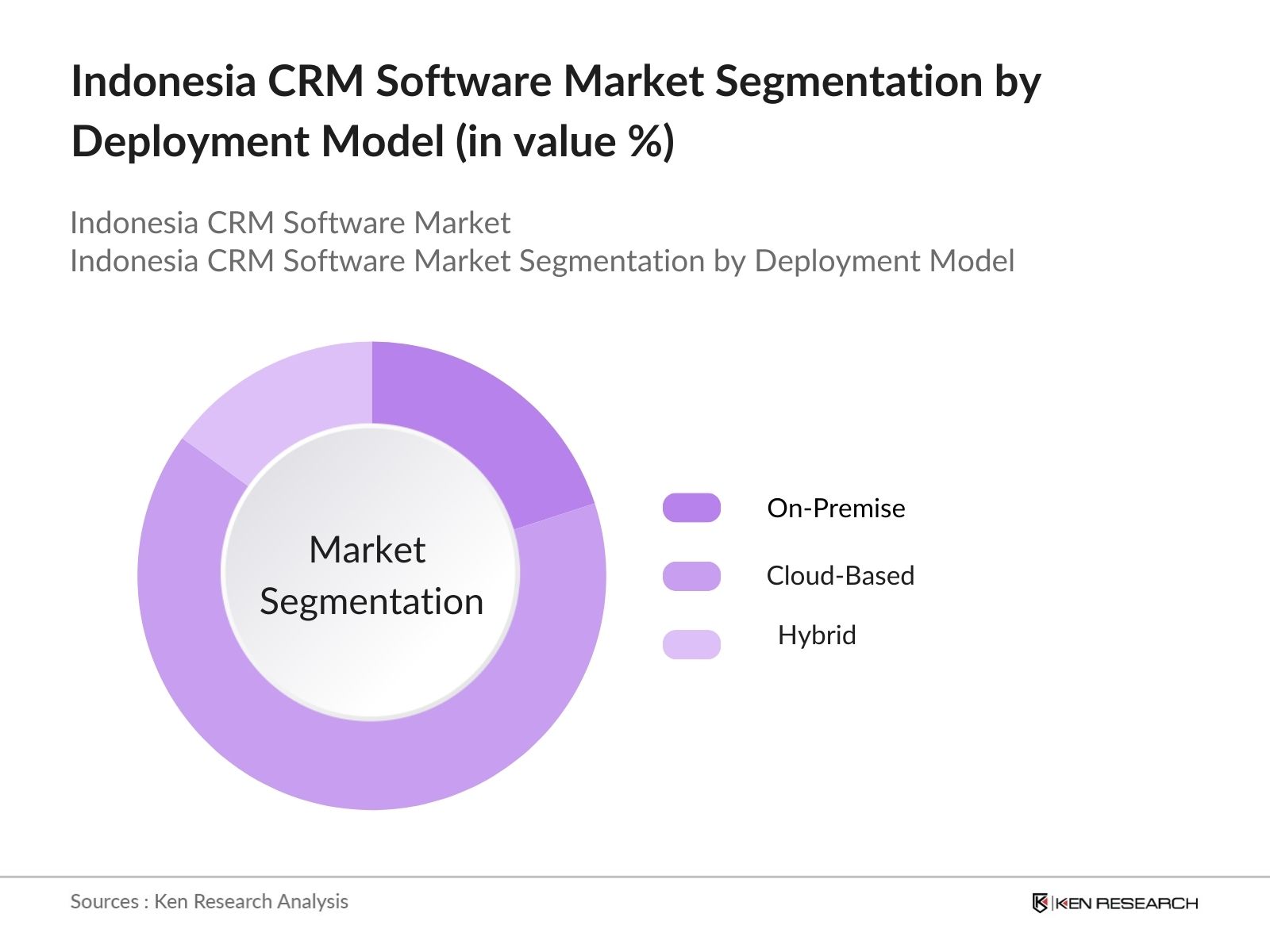
  • By Deployment Model: The market is segmented by deployment models into on-premise, cloud-based, and hybrid solutions. Cloud-based CRM dominates this segment, accounting for 65% of the market share in 2023. The rising preference for cloud solutions is driven by cost savings, ease of integration, and scalability, which are particularly appealing to small and medium enterprises (SMEs). Cloud-based solutions also offer enhanced accessibility, allowing businesses to access CRM tools from anywhere, which is a crucial feature for Indonesia's growing remote workforce.market overviews
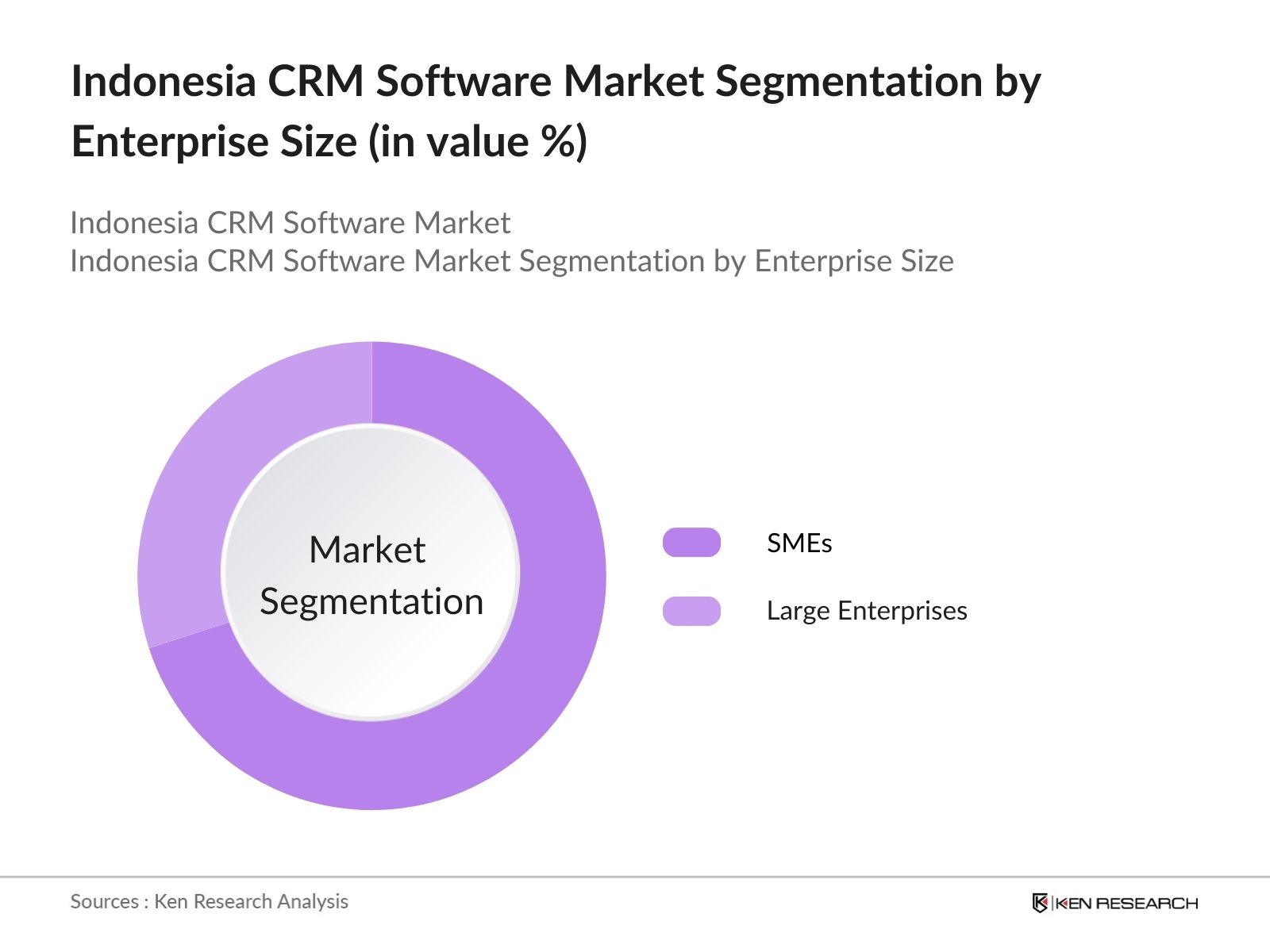
  • By Enterprise Size: The market is further segmented by enterprise size into small and medium enterprises (SMEs) and large enterprises. SMEs dominate the market, holding a 70% share in 2023. This is due to their increasing adoption of CRM tools to improve customer engagement, manage sales pipelines, and enhance overall operational efficiency. The affordability and flexibility of cloud-based CRM solutions have made them highly attractive for SMEs, which constitute a significant portion of the Indonesian business landscape.market overviews

Indonesia CRM Software Market Competitive Landscape

The Indonesia CRM software market is dominated by both local and global players, with significant contributions from cloud solution providers. Companies such as Salesforce, Microsoft Dynamics, and PT Solusi Teknologi Informasi lead the market due to their strong technological capabilities and customer support services. These companies offer comprehensive CRM solutions tailored to Indonesia's diverse business needs, from small enterprises to large corporations.

Company Name

Establishment Year

Headquarters

No. of Employees

Revenue (USD Mn)

Deployment Type

Industry Focus

Geographic Presence

Product Portfolio

Partnerships

Salesforce Inc.

1999

San Francisco, USA

Microsoft Dynamics

2003

Redmond, USA

PT Solusi Teknologi Informasi

2010

Jakarta, Indonesia

Zoho Corporation

1996

Chennai, India

HubSpot Inc.

2006

Cambridge, USA

Indonesia CRM Software Market Analysis

Growth Drivers

  • Digital Transformation of Businesses: The acceleration of digital transformation initiatives in Indonesia, particularly due to COVID-19, has driven significant demand for CRM software. In 2023, Indonesia's Ministry of Communication and Informatics reported that the digital economy contributed around $70 billion to the national GDP, and this is expected to grow rapidly as businesses increasingly adopt digital tools like CRM to enhance operational efficiency. Government initiatives, such as Indonesias Digital Roadmap 2021-2024, are pushing organizations to digitize their operations, further boosting CRM software adoption. Source: Ministry of Communication and Informatics.
  • Increasing SME Adoption: Indonesia is home to over 64 million SMEs, contributing nearly 61% of the countrys GDP, according to the Indonesian Ministry of Cooperatives and SMEs in 2023. SMEs are increasingly adopting CRM solutions to enhance customer relationship management and improve competitiveness. As part of Indonesias drive to boost digital inclusion, the government launched initiatives to digitize 30 million SMEs by 2024, with many of these businesses leveraging CRM platforms to optimize their operations. The growth of SMEs in e-commerce, retail, and other sectors is expected to play a major role in CRM software demand. Source: Indonesian Ministry of Cooperatives and SMEs.
  • Expansion of E-Commerce Industry: Indonesias e-commerce market, valued at approximately $52 billion in 2022, continues to expand due to high internet penetration and increasing smartphone adoption. According to Bank Indonesia, the total volume of e-commerce transactions in 2023 exceeded $470 billion. As businesses shift to digital platforms, CRM solutions are increasingly being utilized to manage customer interactions, sales, and marketing campaigns. This growth in e-commerce is a key driver of CRM adoption, as companies aim to improve customer retention and engagement in a competitive online marketplace.

Market Challenges

  • High Initial Implementation Costs: For many businesses, especially SMEs, the high upfront cost of implementing CRM systems remains a significant barrier. The Indonesian government has identified that over 70% of SMEs in the country face financial constraints when adopting digital technologies, according to the Ministry of Finance. These businesses often find it challenging to invest in advanced CRM platforms, which require both hardware and software expenditures, as well as additional costs for employee training and integration with existing systems. This limits the overall market growth for CRM solutions.
  • Data Security and Privacy Concerns: With the rise of digital technologies, concerns over data privacy and security have grown in Indonesia. In 2022, the National Cyber and Encryption Agency reported over 900 million cyberattacks, making data security a top priority for businesses. The sensitivity of customer data in CRM systems increases the risk of breaches, which can lead to financial and reputational losses. As businesses become more reliant on CRM software, ensuring compliance with data protection regulations, such as Indonesias Personal Data Protection Law (enacted in 2022), is critical.

Indonesia CRM Software Market Future Outlook

Over the next five years, the Indonesia CRM software market is expected to witness robust growth driven by the increasing demand for digital transformation, AI-driven CRM tools, and the adoption of cloud technologies. Companies are anticipated to invest heavily in CRM solutions that incorporate artificial intelligence (AI) and machine learning to enhance customer insights and deliver personalized customer experiences. Moreover, the ongoing expansion of Indonesias e-commerce sector will continue to fuel CRM demand as businesses look to manage customer relationships more effectively.

Future Market Opportunities

  • Cloud-Based CRM Growth: Cloud adoption in Indonesia has been steadily increasing, with the Indonesia Cloud Computing Association reporting a market size of over $1 billion in 2023. Cloud-based CRM solutions are gaining traction due to their cost-efficiency, scalability, and ease of deployment. As businesses look to minimize upfront costs and improve accessibility, the shift from on-premises CRM to cloud-based platforms represents a significant growth opportunity. SMEs, in particular, are adopting cloud CRM solutions to streamline operations without heavy infrastructure investments.
  • Integration of AI and Machine Learning: AI and machine learning are becoming integral to CRM platforms, enabling businesses to automate customer interactions, predict customer behavior, and personalize services. In 2023, Bank Indonesia reported that over 40% of large enterprises are investing in AI-driven CRM solutions to enhance customer engagement. AI-powered CRM tools help businesses improve decision-making, enhance marketing strategies, and streamline customer service, making them a key opportunity for market expansion in Indonesia.

Scope of the Report

By Deployment Model

On-Premise


Cloud-Based


Hybrid

By Enterprise Size


Small and Medium Enterprises (SMEs)


Large Enterprises

By End-User Industry

BFSI


Retail


Healthcare


Manufacturing


Telecommunications

By Functionality

Sales and Marketing Automation


Customer Support and Service Automation


Lead and Contact Management


Workflow and Pipeline Management

By Region

North

East

West

South


Products

Key Target Audience

  • CRM Software Providers

  • Cloud Service Providers

  • Telecommunications Companies

  • E-commerce Businesses

  • Government and Regulatory Bodies (Ministry of Communication and Information Technology)

  • Investors and Venture Capitalist Firms

  • Large Enterprises (Telecommunications, BFSI)

  • SMEs (Retail, Healthcare)

Companies

Players Mention in the Report:

  • Salesforce Inc.

  • Microsoft Dynamics

  • PT Solusi Teknologi Informasi

  • Zoho Corporation

  • SAP SE

  • HubSpot Inc.

  • Oracle Corporation

  • SugarCRM Inc.

  • Freshworks Inc.

  • Nimble Inc.

  • Agile CRM

  • Insightly Inc.

  • Pipedrive

  • PT Mitra Integrasi Informatika

  • Bitrix24

Table of Contents

1. Indonesia CRM Software Market Overview

1.1. Definition and Scope

1.2. Market Taxonomy

1.3. Market Growth Rate

1.4. Market Segmentation Overview

2. Indonesia CRM Software Market Size (In USD Mn)

2.1. Historical Market Size

2.2. Year-On-Year Growth Analysis

2.3. Key Market Developments and Milestones

3. Indonesia CRM Software Market Analysis

3.1. Growth Drivers

3.1.1. Digital Transformation of Businesses

3.1.2. Increasing SME Adoption

3.1.3. Expansion of E-Commerce Industry

3.1.4. Rise in Customer-Centric Business Models

3.2. Market Challenges

3.2.1. High Initial Implementation Costs

3.2.2. Data Security and Privacy Concerns

3.2.3. Lack of Technical Expertise

3.3. Opportunities

3.3.1. Cloud-Based CRM Growth

3.3.2. Integration of AI and Machine Learning

3.3.3. Expansion in Tier II and III Cities

3.3.4. Strategic Partnerships with Telecom and IT Providers

3.4. Trends

3.4.1. Shift to Mobile-First CRM Solutions

3.4.2. Automation in Customer Support and Sales Processes

3.4.3. Focus on Customer Experience Analytics

3.4.4. Integration with Social Media Platforms

3.5. Government Regulation

3.5.1. Data Localization Policies

3.5.2. Customer Data Protection Regulations

3.5.3. Compliance with Financial Reporting Standards

3.6. SWOT Analysis

3.7. Stakeholder Ecosystem

3.8. Porters Five Forces Analysis

3.9. Competition Ecosystem

4. Indonesia CRM Software Market Segmentation

4.1. By Deployment Model (In Value %)

4.1.1. On-Premise

4.1.2. Cloud-Based

4.1.3. Hybrid

4.2. By Enterprise Size (In Value %)

4.2.1. Small and Medium Enterprises (SMEs)

4.2.2. Large Enterprises

4.3. By End-User Industry (In Value %)

4.3.1. BFSI

4.3.2. Retail

4.3.3. Healthcare

4.3.4. Manufacturing

4.3.5. Telecommunications

4.4. By Functionality (In Value %)

4.4.1. Sales and Marketing Automation

4.4.2. Customer Support and Service Automation

4.4.3. Lead and Contact Management

4.4.4. Workflow and Pipeline Management

4.5. By Region (In Value %)

4.5.1. North

4.5.2. West

4.5.3. East

4.5.4. South

5. Indonesia CRM Software Market Competitive Analysis

5.1. Detailed Profiles of Major Companies

5.1.1. PT Solusi Teknologi Informasi

5.1.2. PT System Integrasi Asia

5.1.3. Salesforce Inc.

5.1.4. Microsoft Dynamics

5.1.5. Oracle Corporation

5.1.6. Zoho Corporation

5.1.7. SAP SE

5.1.8. PT Mitra Integrasi Informatika

5.1.9. SugarCRM Inc.

5.1.10. HubSpot Inc.

5.1.11. Pipedrive

5.1.12. Freshworks Inc.

5.1.13. Agile CRM

5.1.14. Nimble Inc.

5.1.15. Insightly Inc.

5.2. Cross Comparison Parameters (Revenue, Market Share, Headquarters, Customer Base, Product Portfolio, Deployment Options, Integrations, Industry Focus)

5.3. Market Share Analysis

5.4. Strategic Initiatives

5.5. Mergers and Acquisitions

5.6. Investment Analysis

5.7. Venture Capital Funding

5.8. Government Grants

5.9. Private Equity Investments

6. Indonesia CRM Software Market Regulatory Framework

6.1. Data Protection and Privacy Laws

6.2. Cybersecurity Guidelines

6.3. International Data Transfer Regulations

6.4. Financial Reporting and Auditing Standards

7. Indonesia CRM Software Future Market Size (In USD Mn)

7.1. Future Market Size Projections

7.2. Key Factors Driving Future Market Growth

8. Indonesia CRM Software Future Market Segmentation

8.1. By Deployment Model (In Value %)

8.2. By Enterprise Size (In Value %)

8.3. By End-User Industry (In Value %)

8.4. By Functionality (In Value %)

8.5. By Region (In Value %)

9. Indonesia CRM Software Market Analysts Recommendations

9.1. TAM/SAM/SOM Analysis

9.2. Customer Cohort Analysis

9.3. Marketing Initiatives

9.4. White Space Opportunity Analysis

Disclaimer Contact Us

Research Methodology

Step 1: Identification of Key Variables

The initial phase involves identifying the critical variables that impact the Indonesia CRM software market, including deployment types, enterprise size, and end-user industries. We employed desk research and utilized secondary databases to map the CRM market ecosystem in Indonesia.

Step 2: Market Analysis and Construction

This step involves analyzing historical market data and key developments, including the adoption of CRM tools across different sectors. We assessed market penetration and analyzed service provider performance across various segments.

Step 3: Hypothesis Validation and Expert Consultation

In this step, we conducted expert interviews with CRM software providers, system integrators, and end-users to validate the market data. These consultations provided insights into adoption trends and customer preferences in Indonesia.

Step 4: Research Synthesis and Final Output

The final step entailed synthesizing all the collected data, combining top-down and bottom-up approaches to estimate market size and segment growth. This process involved cross-referencing data from key industry players to ensure accuracy.

Frequently Asked Questions

1. How big is Indonesia CRM Software Market?

The Indonesia CRM software market is valued at USD 1.30 billion, primarily driven by the growing need for businesses to improve customer engagement and optimize sales and marketing processes.

2. What are the challenges in the Indonesia CRM Software Market?

Challenges include high initial implementation costs, data privacy concerns, and the lack of skilled professionals to manage advanced CRM systems.

3. Who are the major players in the Indonesia CRM Software Market?

Key players include Salesforce, Microsoft Dynamics, PT Solusi Teknologi Informasi, Zoho Corporation, and SAP SE. These companies dominate due to their advanced technology and wide customer base.

4. What are the growth drivers of Indonesia CRM Software Market?

Growth drivers include the increasing digitalization of businesses, expansion of the e-commerce industry, and the growing demand for customer-centric business models.

5. What are the emerging trends in the Indonesia CRM Software Market?

Key trends include the integration of artificial intelligence, mobile-first CRM platforms, and automation in customer service and sales processes.

Why Buy From Us?

RRR
Refine Robust Result (RRR) Framework

What makes us stand out is that our consultants follows Robust, Refine and Result (RRR) methodology. i.e. Robust for clear definitions, approaches and sanity checking, Refine for differentiating respondents facts and opinions and Result for presenting data with story

Our Reach Is Unmatched

We have set a benchmark in the industry by offering our clients with syndicated and customized market research reports featuring coverage of entire market as well as meticulous research and analyst insights.

Research
Shifting the Research Paradigm

While we don't replace traditional research, we flip the method upside down. Our dual approach of Top Bottom & Bottom Top ensures quality deliverable by not just verifying company fundamentals but also looking at the sector and macroeconomic factors.

Insite
More Insights-Better Decisions

With one step in the future, our research team constantly tries to show you the bigger picture. We help with some of the tough questions you may encounter along the way: How is the industry positioned? Best marketing channel? KPI's of competitors? By aligning every element, we help maximize success.

Trust
Transparency and Trust

Our report gives you instant access to the answers and sources that other companies might choose to hide. We elaborate each steps of research methodology we have used and showcase you the sample size to earn your trust.

support
Round the Clock Support

If you need any support, we are here! We pride ourselves on universe strength, data quality, and quick, friendly, and professional service.

Why Client Choose Us?

400000+ Reports in repository
150+ Consulting project a year
100+ Analysts
8000+ Client Queries in 2022