Indonesia Packaged Water Market

Indonesia Packaged Water Market: Growth Drivers, Segmentation & Future Outlook 2024–2030

Region:Asia

Author(s):Shambhavi

Product Code:KROD6727

Published On

December 2024

Total pages

87

About the Report

```html

Indonesia Packaged Water Market Overview

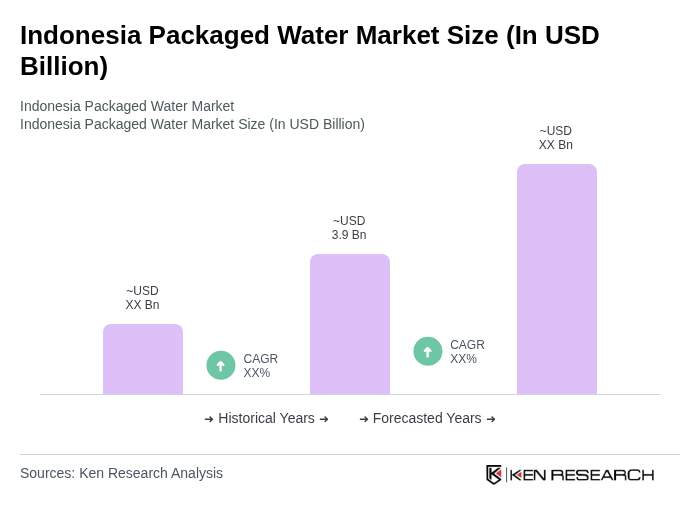
  • The Indonesia Packaged Water Market is valued at USD 3.9 billion, based on a five-year historical analysis. This growth is primarily driven by increasing health consciousness among consumers, urbanization, rising disposable incomes, limited access to safe tap water, and the rising demand for convenient hydration solutions. The market has seen a significant shift towards bottled water as a preferred choice for both daily consumption and on-the-go lifestyles.(source)(source)
  • Key cities such as Jakarta, Surabaya, and Bandung dominate the market due to their high population density and urban lifestyle. These cities have a well-established distribution network and a growing middle class that drives the demand for packaged water products, making them critical hubs for market growth.(source)
  • The Ministry of Environment and Forestry Regulation No. P.75/Menlh/Setjen/Kum.1/7/2022 on Plastic Waste Reduction requires bottled water manufacturers to incorporate recycled content in packaging and meet specific recycling targets, with compliance enforced through mandatory reporting and penalties for non-adherence. This initiative is part of a broader strategy to promote sustainability and environmental responsibility within the packaged water industry.(source)
 
Indonesia Packaged Water Market Size Infographic

Indonesia Packaged Water Market Segmentation

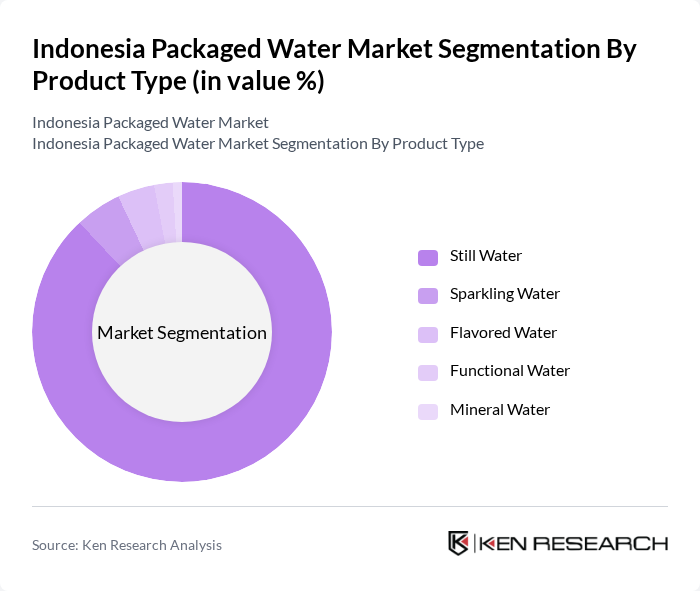
By Product Type: The product type segmentation includes Still Water, Sparkling Water, Flavored Water, Functional Water, and Mineral Water. Among these, Still Water is the most dominant segment, driven by its widespread acceptance and preference among consumers for everyday hydration. The increasing health awareness has also led to a rise in demand for Functional Water, which is gaining traction due to its perceived health benefits.(source)(source)(source)

Indonesia Packaged Water Market segmentation by Product Type.

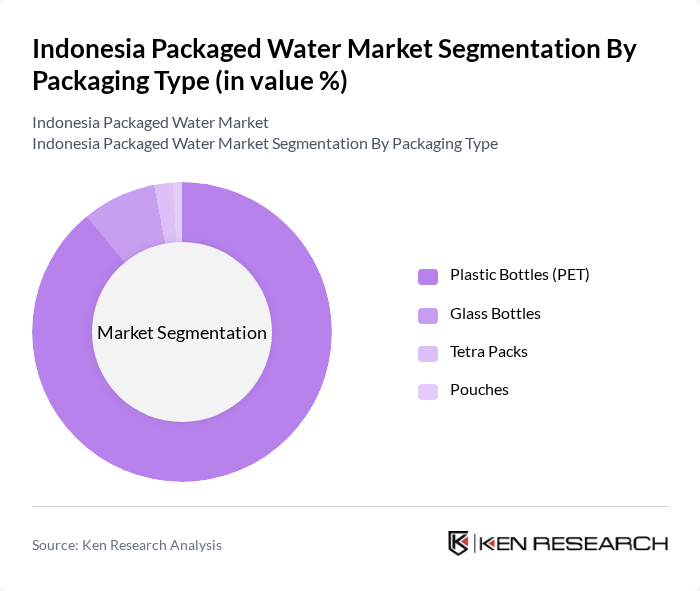
By Packaging Type: The packaging type segmentation includes Plastic Bottles (PET), Glass Bottles, Tetra Packs, and Pouches. Plastic Bottles (PET) dominate the market due to their lightweight, convenience, and cost-effectiveness, making them the preferred choice for consumers. However, there is a growing trend towards Glass Bottles and Tetra Packs as consumers become more environmentally conscious and seek sustainable packaging options.(source)(source)

Indonesia Packaged Water Market segmentation by Packaging Type.

Indonesia Packaged Water Market Competitive Landscape

The Indonesia Packaged Water Market is characterized by a dynamic mix of regional and international players. Leading participants such as Aqua (Danone), Nestlé Pure Life, Ades (Coca-Cola), Le Minerale, VIT, Cleo, Pristine, Aqua Reflections, Sumber Air, San Pellegrino, Evian, Citra, D'Water, Bening, Water+ (PT. Tirta Investama) contribute to innovation, geographic expansion, and service delivery in this space.

Aqua (Danone) 1973 Jakarta, Indonesia
Nestlé Pure Life 2003 Jakarta, Indonesia
Ades (Coca-Cola) 1993 Jakarta, Indonesia
Le Minerale 2016 Jakarta, Indonesia
VIT 1999 Jakarta, Indonesia
Company Establishment Year Headquarters Market Share (%) Revenue Growth Rate (YoY %) Distribution Coverage (Urban/Rural %) Product Portfolio Breadth Brand Awareness Index Average Selling Price (IDR/liter)

``````html

Indonesia Packaged Water Market Industry Analysis

Growth Drivers

  • Increasing Health Awareness: The Indonesian population is becoming increasingly health-conscious, with a reported 60% of consumers prioritizing hydration as part of their wellness routines. This trend is supported by the World Health Organization's recommendation of 2-3 liters of water daily. As a result, the demand for packaged water has surged, with sales reaching approximately 13 billion liters in future, reflecting a growing preference for bottled water over sugary beverages.
  • Urbanization and Population Growth: Indonesia's urban population is projected to reach 56% in future, driving the demand for convenient hydration solutions. The country's population is expected to grow by 1.1% annually, adding approximately 3 million people each year. This urban migration leads to increased consumption of packaged water, as urban dwellers often seek accessible and portable hydration options amidst busy lifestyles, contributing to a market expansion.
  • Rising Disposable Incomes: With Indonesia's GDP per capita projected to rise to $4,600 in future, disposable incomes are increasing, allowing consumers to spend more on premium products. This economic growth is reflected in the packaged water market, where premium brands have seen a 15% increase in sales. As consumers prioritize quality and brand reputation, the demand for higher-priced bottled water options is expected to continue growing, enhancing market dynamics.

Market Challenges

  • Environmental Concerns Over Plastic Waste: The rise in packaged water consumption has led to significant environmental challenges, particularly concerning plastic waste. Indonesia is the second-largest contributor to ocean plastic pollution, with an estimated 3.2 million tons of plastic waste generated annually. This has prompted increased scrutiny from consumers and regulators, pushing brands to adopt sustainable practices and eco-friendly packaging solutions to mitigate environmental impact.
  • Intense Competition Among Brands: The Indonesian packaged water market is characterized by fierce competition, with over 200 brands vying for market share. This saturation has led to aggressive pricing strategies and marketing campaigns, making it challenging for new entrants to establish themselves. In future, the top five brands accounted for only 35% of the market, indicating a fragmented landscape where differentiation and brand loyalty are crucial for success.

Indonesia Packaged Water Market Future Outlook

The future of the Indonesian packaged water market appears promising, driven by evolving consumer preferences and a growing emphasis on health and sustainability. As urbanization continues, the demand for convenient hydration solutions will likely increase, with consumers gravitating towards premium and functional water products. Additionally, the market is expected to witness innovations in eco-friendly packaging and distribution channels, enhancing accessibility and reducing environmental impact, thereby shaping a more sustainable industry landscape.

Market Opportunities

  • Expansion of Distribution Channels: The growth of e-commerce in Indonesia, projected to reach $140 billion in future, presents significant opportunities for packaged water brands. By leveraging online platforms, companies can enhance their reach and accessibility, catering to the increasing demand for home delivery services, particularly in urban areas where convenience is paramount.
  • Introduction of Eco-Friendly Packaging: With rising environmental awareness, there is a growing market for eco-friendly packaging solutions. Brands that adopt biodegradable or recyclable materials can attract environmentally conscious consumers. The global market for sustainable packaging is expected to reach $600 billion in future, indicating a lucrative opportunity for Indonesian companies to innovate and differentiate themselves in a competitive landscape.

```

Scope of the Report

By Product Type

Still Water

Sparkling Water

Flavored Water

Functional Water

Mineral Water

By Packaging Type

Plastic Bottles (PET)

Glass Bottles

Tetra Packs

Pouches

By Distribution Channel

Supermarkets/Hypermarkets

Convenience Stores

Online Retail

HoReCa

Direct Sales

By Region

Java

Sumatra

Kalimantan

Sulawesi

Others

By Price Range

Budget

Economy

Premium

By Pack Size

Single-Serve (200-330 ml)

Standard (500-750 ml)

Large Format (1,000-1,500 ml)

Bulk (4,000-5,000 ml)

Products

Key Target Audience

  • Investors and Venture Capitalist Firms

  • Government and Regulatory Bodies (e.g., Badan Pengawas Obat dan Makanan, Kementerian Perdagangan)

  • Manufacturers and Producers

  • Distributors and Retailers

  • Packaging Suppliers

  • Water Quality Testing Laboratories

  • Industry Associations (e.g., Asosiasi Air Minum Dalam Kemasan Indonesia)

  • Financial Institutions

Companies

Players Mentioned in the Report:

  • Aqua (Danone)

  • Nestle Pure Life

  • Ades (Coca-Cola)

  • Le Minerale

  • VIT

  • Cleo

  • Pristine

  • Aqua Reflections

  • Sumber Air

  • San Pellegrino

  • Evian

  • Citra

  • D'Water

  • Bening

  • Water+ (PT. Tirta Investama)

Table of Contents

Market Assessment Phase

1. Executive Summary and Approach

2. Indonesia Packaged Water Market Overview

2.1 Key Insights and Strategic Recommendations

2.2 Indonesia Packaged Water Market Overview

2.3 Definition and Scope

2.4 Evolution of Market Ecosystem

2.5 Timeline of Key Regulatory Milestones

2.6 Value Chain & Stakeholder Mapping

2.7 Business Cycle Analysis

2.8 Policy & Incentive Landscape

3. Indonesia Packaged Water Market Analysis

3.1 Growth Drivers

3.1.1 Increasing Health Awareness
3.1.2 Urbanization and Population Growth
3.1.3 Rising Disposable Incomes
3.1.4 Demand for Convenient Hydration Solutions

3.2 Market Challenges

3.2.1 Environmental Concerns Over Plastic Waste
3.2.2 Regulatory Compliance Issues
3.2.3 Intense Competition Among Brands
3.2.4 Fluctuating Raw Material Prices

3.3 Market Opportunities

3.3.1 Expansion of Distribution Channels
3.3.2 Introduction of Eco-Friendly Packaging
3.3.3 Growth in E-commerce Sales
3.3.4 Product Diversification (Flavored, Functional Water)

3.4 Market Trends

3.4.1 Shift Towards Sustainable Practices
3.4.2 Increasing Popularity of Premium Water Brands
3.4.3 Rise of Subscription-Based Delivery Services
3.4.4 Health and Wellness Trends Influencing Choices

3.5 Government Regulation

3.5.1 Standards for Water Quality and Safety
3.5.2 Regulations on Plastic Use and Recycling
3.5.3 Labeling and Marketing Guidelines
3.5.4 Import Tariffs on Bottled Water

4. SWOT Analysis

5. Stakeholder Analysis

6. Porter's Five Forces Analysis

7. Indonesia Packaged Water Market Market Size, 2019-2024

7.1 By Value

7.2 By Volume

7.3 By Average Selling Price

8. Indonesia Packaged Water Market Segmentation

8.1 By Product Type

8.1.1 Still Water
8.1.2 Sparkling Water
8.1.3 Flavored Water
8.1.4 Functional Water
8.1.5 Mineral Water

8.2 By Packaging Type

8.2.1 Plastic Bottles (PET)
8.2.2 Glass Bottles
8.2.3 Tetra Packs
8.2.4 Pouches

8.3 By Distribution Channel

8.3.1 Supermarkets/Hypermarkets
8.3.2 Convenience Stores
8.3.3 Online Retail
8.3.4 HoReCa (Hotels, Restaurants, Cafés)
8.3.5 Direct Sales

8.4 By Region

8.4.1 Java
8.4.2 Sumatra
8.4.3 Kalimantan
8.4.4 Sulawesi
8.4.5 Others

8.5 By Price Range

8.5.1 Budget
8.5.2 Economy
8.5.3 Premium

8.6 By Pack Size

8.6.1 Single-Serve (200-330 ml)
8.6.2 Standard (500-750 ml)
8.6.3 Large Format (1,000-1,500 ml)
8.6.4 Bulk (4,000-5,000 ml)

9. Indonesia Packaged Water Market Competitive Analysis

9.1 Market Share of Key Players

9.2 Cross Comparison of Key Players

9.2.1 Company Name
9.2.2 Market Share (%)
9.2.3 Revenue Growth Rate (YoY %)
9.2.4 Distribution Coverage (Urban/Rural %)
9.2.5 Product Portfolio Breadth
9.2.6 Brand Awareness Index
9.2.7 Average Selling Price (IDR/liter)
9.2.8 Market Penetration Rate (%)
9.2.9 Customer Retention Rate (%)
9.2.10 Innovation Index (New Products/Year)

9.3 SWOT Analysis of Top Players

9.4 Pricing Analysis

9.5 Detailed Profile of Major Companies

9.5.1 Aqua (Danone)
9.5.2 Nestlé Pure Life
9.5.3 Ades (Coca-Cola)
9.5.4 Le Minerale
9.5.5 VIT
9.5.6 Cleo
9.5.7 Pristine
9.5.8 Aqua Reflections
9.5.9 Sumber Air
9.5.10 San Pellegrino
9.5.11 Evian
9.5.12 Citra
9.5.13 D'Water
9.5.14 Bening
9.5.15 Water+ (PT. Tirta Investama)

10. Indonesia Packaged Water Market End-User Analysis

10.1 Procurement Behavior of Key Ministries

10.1.1 Government Contracts and Tenders
10.1.2 Budget Allocations for Water Supply
10.1.3 Compliance with Health Standards
10.1.4 Supplier Evaluation Criteria

10.2 Corporate Spend on Infrastructure & Energy

10.2.1 Investment in Water Infrastructure
10.2.2 Budget for Sustainable Practices
10.2.3 Expenditure on Quality Assurance

10.3 Pain Point Analysis by End-User Category

10.3.1 Quality and Safety Concerns
10.3.2 Accessibility Issues in Remote Areas
10.3.3 Price Sensitivity Among Consumers

10.4 User Readiness for Adoption

10.4.1 Awareness of Health Benefits
10.4.2 Availability of Products
10.4.3 Consumer Preferences

10.5 Post-Deployment ROI and Use Case Expansion

10.5.1 Evaluation of Cost Savings
10.5.2 Impact on Health Outcomes
10.5.3 Opportunities for Product Line Expansion

11. Indonesia Packaged Water Market Future Size, 2025-2030

11.1 By Value

11.2 By Volume

11.3 By Average Selling Price

Go-To-Market Strategy Phase

1. Whitespace Analysis + Business Model Canvas

1.1 Market Gaps Identification

1.2 Business Model Framework

2. Marketing and Positioning Recommendations

2.1 Branding Strategies

2.2 Product USPs

3. Distribution Plan

3.1 Urban Retail vs Rural NGO Tie-ups

4. Channel & Pricing Gaps

4.1 Underserved Routes

4.2 Pricing Bands

5. Unmet Demand & Latent Needs

5.1 Category Gaps

5.2 Consumer Segments

6. Customer Relationship

6.1 Loyalty Programs

6.2 After-sales Service

7. Value Proposition

7.1 Sustainability

7.2 Integrated Supply Chains

8. Key Activities

8.1 Regulatory Compliance

8.2 Branding

8.3 Distribution Setup

9. Entry Strategy Evaluation

9.1 Domestic Market Entry Strategy

9.1.1 Product Mix
9.1.2 Pricing Band
9.1.3 Packaging

9.2 Export Entry Strategy

9.2.1 Target Countries
9.2.2 Compliance Roadmap

10. Entry Mode Assessment

10.1 JV

10.2 Greenfield

10.3 M&A

10.4 Distributor Model

11. Capital and Timeline Estimation

11.1 Capital Requirements

11.2 Timelines

12. Control vs Risk Trade-Off

12.1 Ownership vs Partnerships

13. Profitability Outlook

13.1 Breakeven Analysis

13.2 Long-term Sustainability

14. Potential Partner List

14.1 Distributors

14.2 JVs

14.3 Acquisition Targets

15. Execution Roadmap

15.1 Phased Plan for Market Entry

15.1.1 Market Setup
15.1.2 Market Entry
15.1.3 Growth Acceleration
15.1.4 Scale & Stabilize

15.2 Key Activities and Milestones

15.2.1 Milestone Planning
15.2.2 Activity Tracking
Disclaimer Contact Us

Research Methodology

```html

Phase 1: Approach

Desk Research

  • Analysis of industry reports from government agencies and trade associations related to the packaged water sector in Indonesia
  • Review of market trends and consumer behavior studies published by local research firms
  • Examination of import/export data and statistics from the Indonesian Central Bureau of Statistics

Primary Research

  • Interviews with key stakeholders including manufacturers, distributors, and retailers in the packaged water market
  • Surveys conducted with consumers to understand preferences, purchasing habits, and brand loyalty
  • Focus group discussions with health and wellness experts to gauge perceptions of bottled water quality and safety

Validation & Triangulation

  • Cross-validation of findings through comparison with historical sales data and market growth rates
  • Triangulation of insights from primary interviews with secondary data sources to ensure consistency
  • Sanity checks through expert panel reviews involving industry veterans and market analysts

Phase 2: Market Size Estimation

Top-down Assessment

  • Estimation of total market size based on national consumption statistics and per capita water consumption rates
  • Segmentation of the market by product type (e.g., still, sparkling, flavored) and distribution channel (e.g., retail, online)
  • Incorporation of demographic trends and urbanization rates influencing packaged water demand

Bottom-up Modeling

  • Collection of sales volume data from leading bottled water brands operating in Indonesia
  • Analysis of pricing strategies and cost structures of various packaged water products
  • Estimation of market share based on production capacity and distribution reach of key players

Forecasting & Scenario Analysis

  • Development of forecasting models using historical growth rates and projected population growth
  • Scenario analysis based on potential regulatory changes affecting bottled water production and distribution
  • Assessment of market resilience under different economic conditions and consumer trends towards health and sustainability

Phase 3: CATI Sample Composition

Scope Item/Segment Sample Size Target Respondent Profiles
Retail Market Insights 150 Store Managers, Retail Buyers
Consumer Preferences Survey 120 General Consumers, Health-Conscious Shoppers
Distribution Channel Analysis 100 Wholesalers, Distributors
Brand Perception Study 120 Marketing Managers, Brand Strategists
Environmental Impact Assessment 80 Sustainability Experts, Environmental Activists

```

Frequently Asked Questions

What is the current value of the Indonesia Packaged Water Market?

The Indonesia Packaged Water Market is valued at approximately USD 3.9 billion, reflecting significant growth driven by health consciousness, urbanization, and rising disposable incomes among consumers.

What factors are driving the growth of the packaged water market in Indonesia?

Key growth drivers include increasing health awareness, urbanization, rising disposable incomes, limited access to safe tap water, and a growing demand for convenient hydration solutions among consumers.

Which cities are the main hubs for the Indonesia Packaged Water Market?

Jakarta, Surabaya, and Bandung are the primary cities dominating the Indonesia Packaged Water Market due to their high population density, urban lifestyle, and established distribution networks.

What regulations impact the packaged water industry in Indonesia?

The Ministry of Environment and Forestry Regulation No. P.75/Menlh/Setjen/Kum.1/7/2022 mandates bottled water manufacturers to incorporate recycled content in packaging and meet specific recycling targets, promoting sustainability in the industry.

What are the main product types in the Indonesia Packaged Water Market?

The market is segmented into Still Water, Sparkling Water, Flavored Water, Functional Water, and Mineral Water, with Still Water being the most dominant segment due to its widespread acceptance.

How is the packaging type segmented in the Indonesia Packaged Water Market?

Packaging types include Plastic Bottles (PET), Glass Bottles, Tetra Packs, and Pouches. Plastic Bottles dominate due to their convenience and cost-effectiveness, while Glass Bottles and Tetra Packs are gaining popularity for their sustainability.

What challenges does the Indonesia Packaged Water Market face?

Challenges include environmental concerns over plastic waste, intense competition among over 200 brands, and regulatory compliance issues, which complicate market entry for new players.

What opportunities exist for growth in the Indonesia Packaged Water Market?

Opportunities include expanding distribution channels through e-commerce, introducing eco-friendly packaging solutions, and diversifying product offerings to include flavored and functional water options.

How does urbanization affect the demand for packaged water in Indonesia?

Urbanization increases the demand for convenient hydration solutions as more people move to cities, leading to a higher consumption of packaged water due to busy lifestyles and limited access to safe drinking water.

What is the trend regarding health awareness among Indonesian consumers?

Health awareness is rising, with 60% of consumers prioritizing hydration as part of their wellness routines, leading to increased demand for packaged water over sugary beverages.

Which brands are leading the Indonesia Packaged Water Market?

Leading brands include Aqua (Danone), Nestlé Pure Life, Ades (Coca-Cola), Le Minerale, and VIT, which contribute to innovation and market growth through diverse product offerings and strong distribution networks.

What is the expected future outlook for the Indonesia Packaged Water Market?

The future outlook is promising, with anticipated growth driven by evolving consumer preferences towards health and sustainability, alongside innovations in eco-friendly packaging and distribution channels.

How does disposable income influence the packaged water market in Indonesia?

Rising disposable incomes, projected to reach $4,600 per capita, enable consumers to spend more on premium bottled water products, enhancing market dynamics and driving demand for higher-priced options.

What role does e-commerce play in the Indonesia Packaged Water Market?

E-commerce is a significant growth opportunity, projected to reach $140 billion, allowing packaged water brands to enhance accessibility and cater to the increasing demand for home delivery services in urban areas.

What are the environmental concerns associated with the packaged water industry in Indonesia?

Environmental concerns primarily revolve around plastic waste, as Indonesia is a major contributor to ocean plastic pollution, prompting brands to adopt sustainable practices and eco-friendly packaging solutions.

Why Buy From Us?

RRR
Refine Robust Result (RRR) Framework

What makes us stand out is that our consultants follows Robust, Refine and Result (RRR) methodology. i.e. Robust for clear definitions, approaches and sanity checking, Refine for differentiating respondents facts and opinions and Result for presenting data with story

Our Reach Is Unmatched

We have set a benchmark in the industry by offering our clients with syndicated and customized market research reports featuring coverage of entire market as well as meticulous research and analyst insights.

Research
Shifting the Research Paradigm

While we don't replace traditional research, we flip the method upside down. Our dual approach of Top Bottom & Bottom Top ensures quality deliverable by not just verifying company fundamentals but also looking at the sector and macroeconomic factors.

Insite
More Insights-Better Decisions

With one step in the future, our research team constantly tries to show you the bigger picture. We help with some of the tough questions you may encounter along the way: How is the industry positioned? Best marketing channel? KPI's of competitors? By aligning every element, we help maximize success.

Trust
Transparency and Trust

Our report gives you instant access to the answers and sources that other companies might choose to hide. We elaborate each steps of research methodology we have used and showcase you the sample size to earn your trust.

support
Round the Clock Support

If you need any support, we are here! We pride ourselves on universe strength, data quality, and quick, friendly, and professional service.

Why Client Choose Us?

400000+ Reports in repository
150+ Consulting project a year
100+ Analysts
8000+ Client Queries in 2022