
MEA Non-Lethal Weapons Market Outlook to 2030
Region:Global
Author(s):Yogita Sahu
Product Code:KROD4539
December 2024
87
About the Report
MEA Non-Lethal Weapons Market Overview
- The MEA Non-Lethal Weapons Market is valued at USD 680 million, reflecting the growing demand for alternatives to lethal weaponry by military and law enforcement sectors. This market is primarily driven by the need for effective crowd control measures in a region facing civil unrest and high-security concerns. The demand for innovative non-lethal weapons is increasing as governments focus on minimizing casualties while maintaining public order and safety.
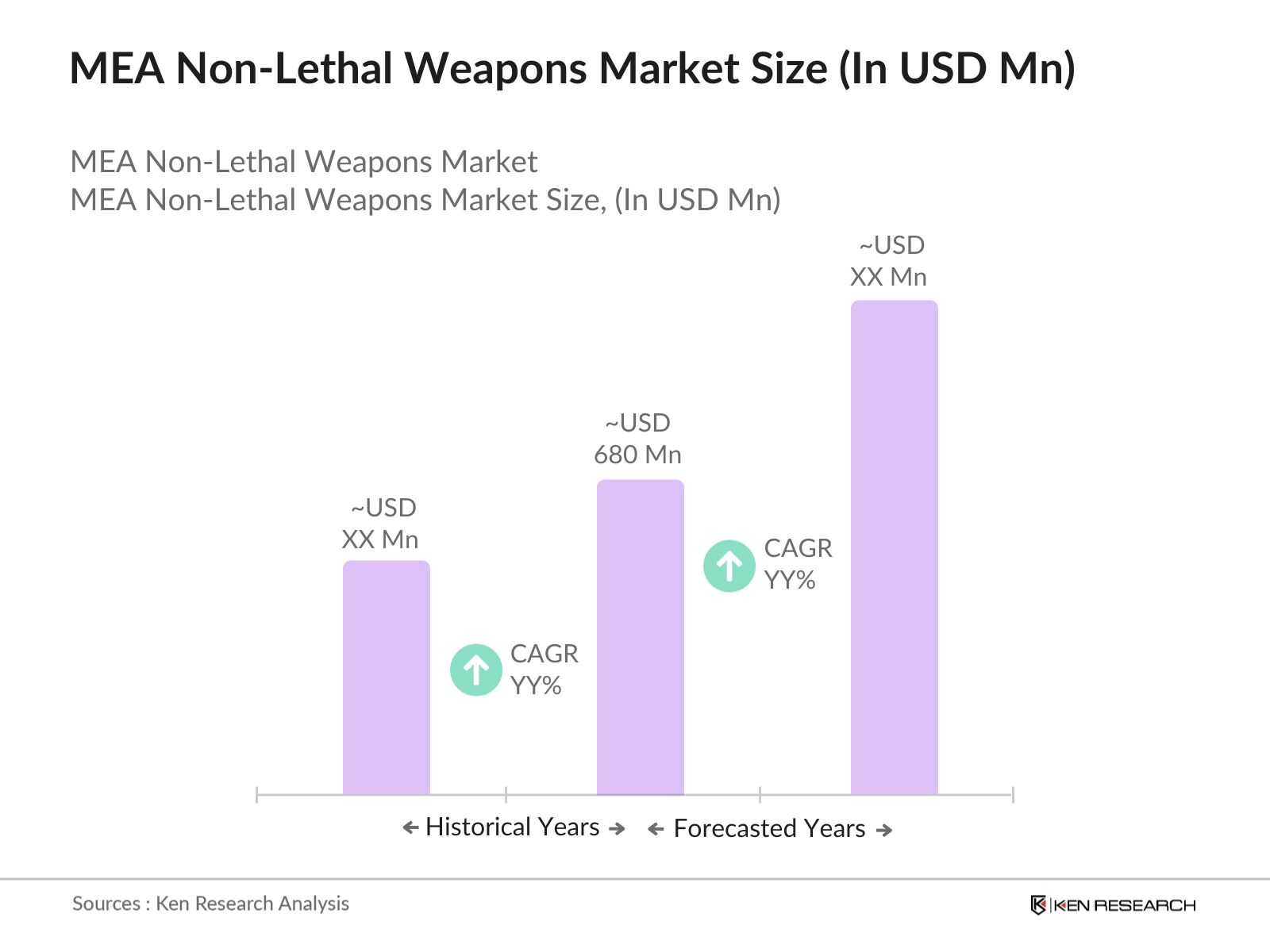
- Countries like Saudi Arabia, UAE, and South Africa are key players in this market due to their robust investments in law enforcement and defense capabilities. Saudi Arabias increased security budget and the UAEs proactive policing initiatives place them at the forefront of market demand, while South Africas active development in non-lethal technologies for civil management further strengthens the dominance of these countries in the MEA region.
- The UAE government allocated AED 500 million in 2024 to support local manufacturing of non-lethal weapons, aimed at reducing reliance on foreign suppliers. This initiative includes partnerships with local firms to produce stun grenades and riot shields, fostering a domestic supply chain to meet internal security demands more efficiently.
MEA Non-Lethal Weapons Market Segmentation
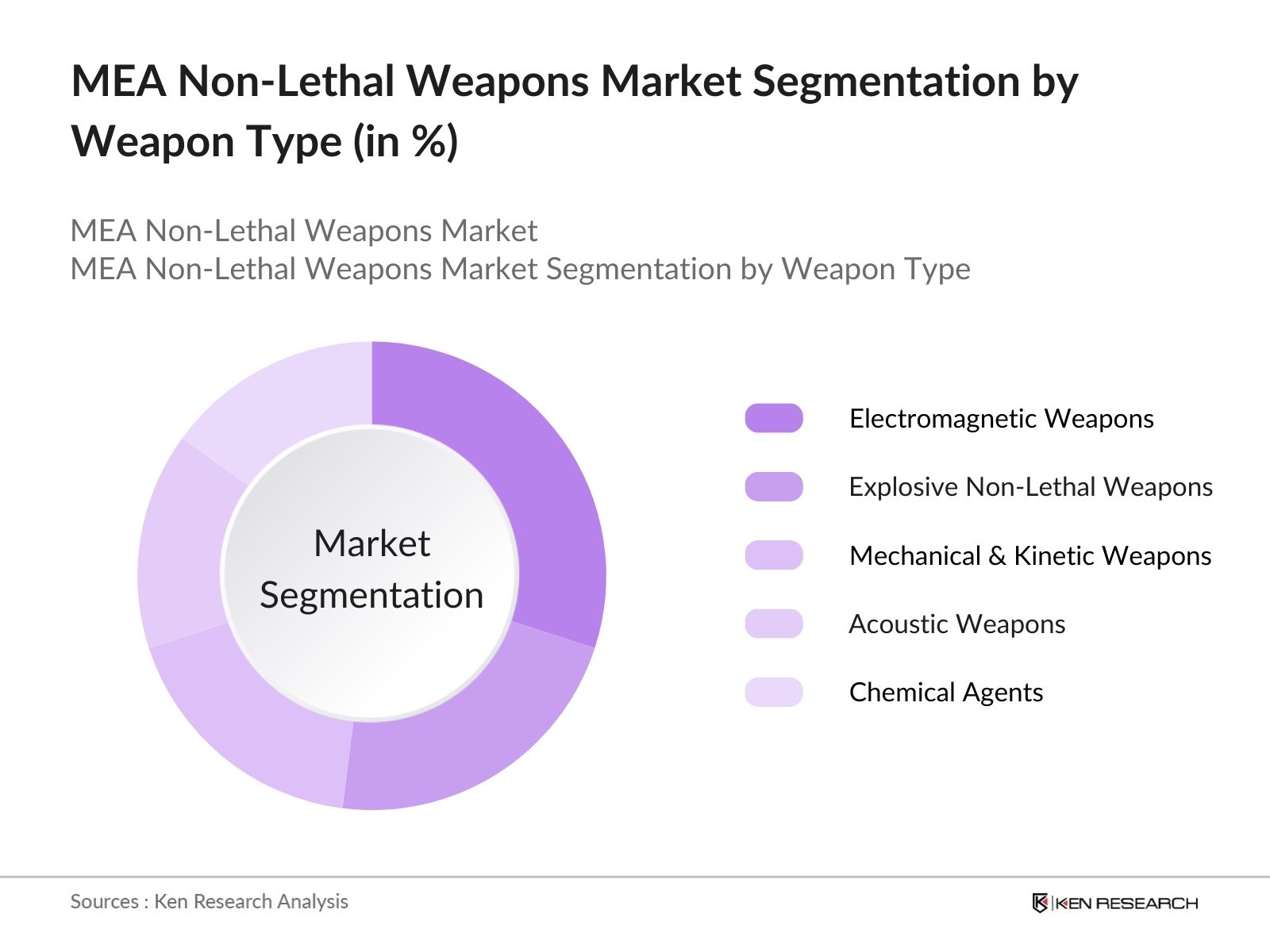
By Weapon Type: The market is segmented by weapon type into electromagnetic weapons, explosive non-lethal weapons, mechanical and kinetic non-lethal weapons, acoustic weapons, and chemical agents. Electromagnetic weapons hold a dominant market share in this segment due to their versatility and capability to disrupt electronics without permanent damage, making them highly effective in various security applications.
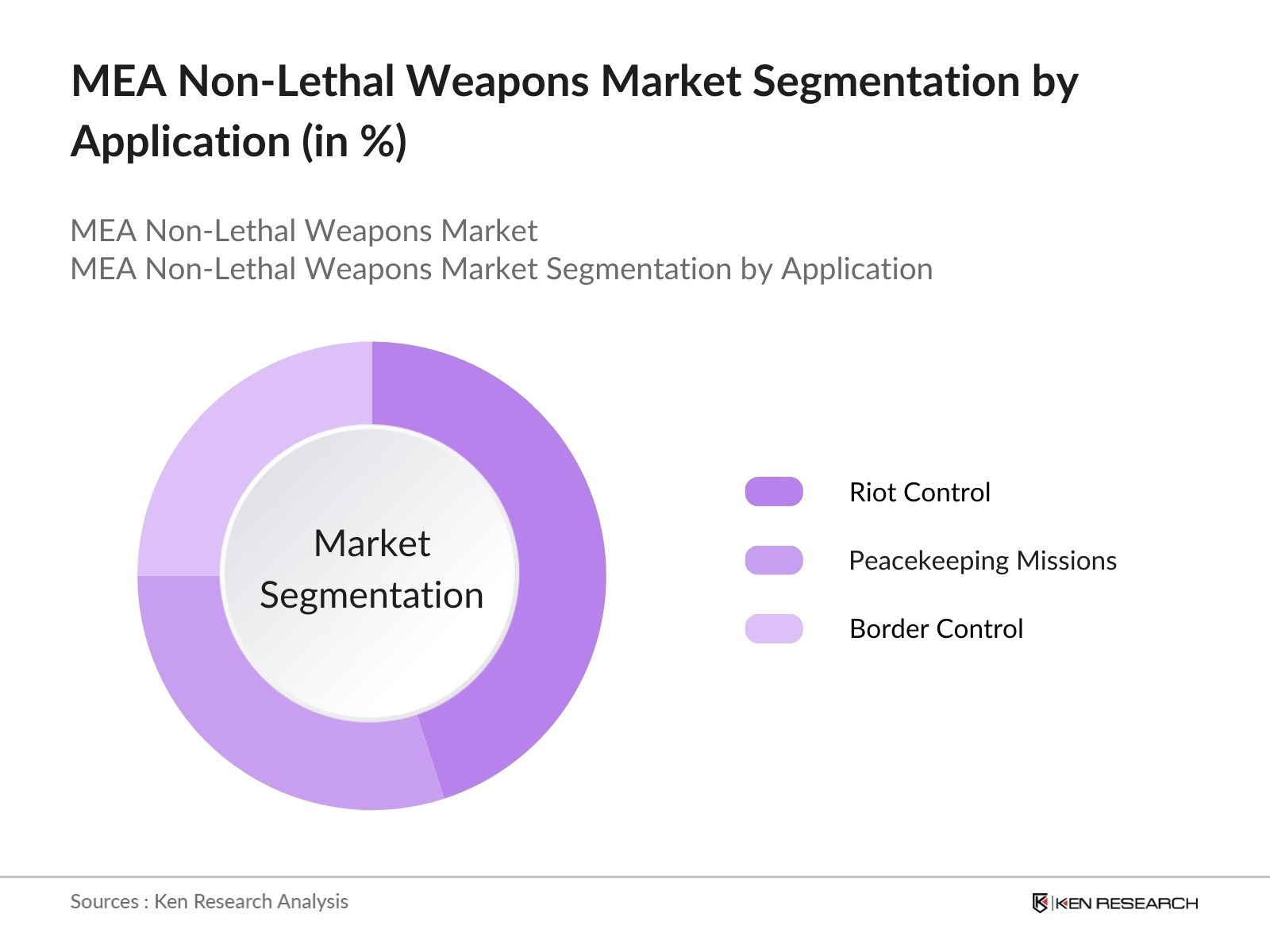
By Application: The market is segmented by application into riot control, peacekeeping missions, and border control. Riot control has the highest market share, attributed to the increasing need for non-lethal methods to manage civil protests and unrest. This applications prominence is due to heightened demands from law enforcement agencies across the MEA region, where protests and demonstrations often require controlled, non-lethal interventions to minimize civilian harm.
MEA Non-Lethal Weapons Market Competitive Landscape
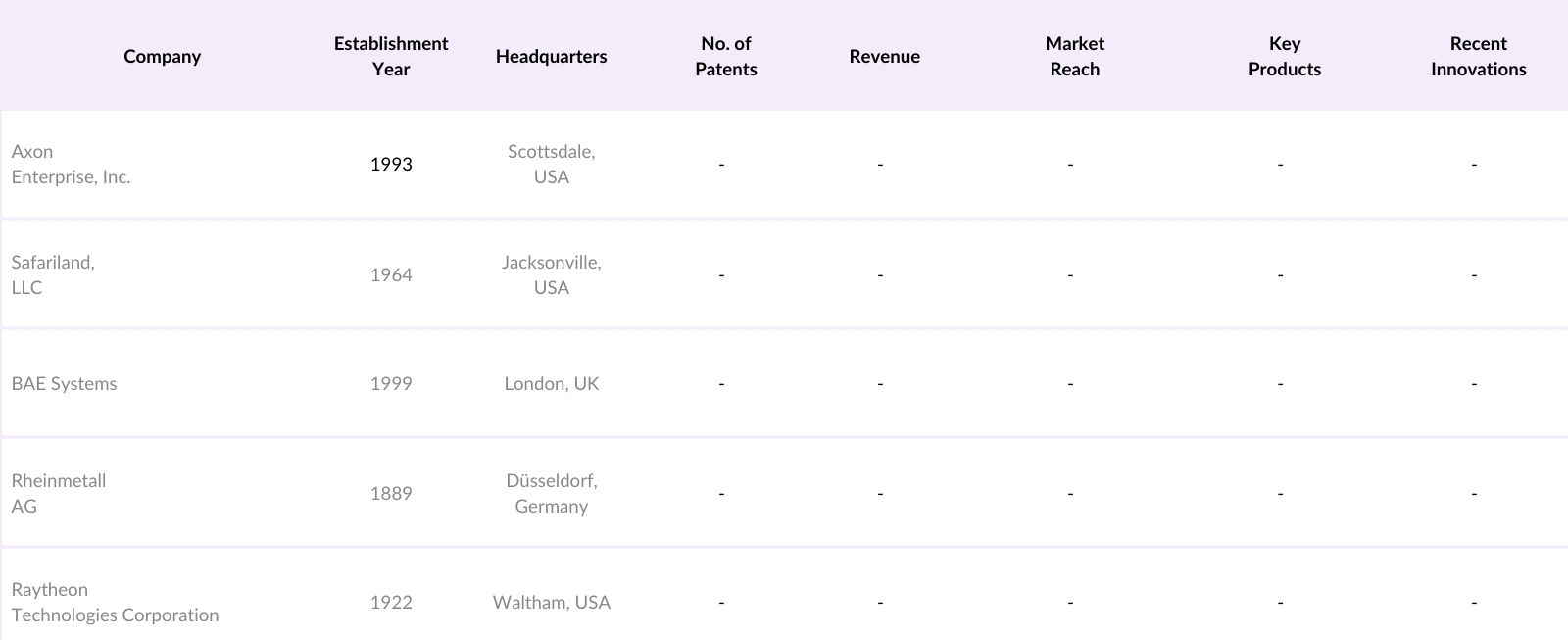
The market is dominated by a combination of regional and global players. These companies benefit from their expertise in weapon technology and longstanding relationships with military and law enforcement agencies, making them influential players in the non-lethal weapons market.
MEA Non-Lethal Weapons Market Analysis
Market Growth Drivers
- Increasing Demand from Law Enforcement Agencies: The growing adoption of non-lethal weapons among law enforcement agencies in countries like Saudi Arabia and the UAE is significant, with recent government data showing that nearly 10,000 new units of non-lethal weapons were allocated for public order management across various agencies in 2024. This increased demand is partly driven by a need for more effective crowd control and riot management solutions, with law enforcement opting for non-lethal options to minimize civilian casualties and reduce legal complications.
- Rising Investment in Security and Defense Sectors: Government expenditures on internal security and defense have surged in response to regional instability, with Saudi Arabia alone earmarking over SAR 100 billion in 2024 for such advancements. A substantial part of this budget is dedicated to non-lethal technology acquisition, demonstrating the emphasis on non-lethal approaches within defense strategies.
- Shift Towards Non-Lethal Measures in Civilian Applications: Civilian applications of non-lethal weapons have been rising, with estimates indicating that over 5,000 units of personal security non-lethal tools, such as stun guns and pepper sprays, were sold in the UAE in 2024 alone. Growing security awareness and incidents involving home invasions and personal assault cases have encouraged civilians to seek self-defense tools that are effective but not deadly, reflecting a broader trend towards personal safety without resorting to firearms.
Market Challenges
- High Cost of Advanced Non-Lethal Technologies: The cost of equipping personnel with non-lethal technologies like tasers and advanced bean bag rounds can reach up to USD 1,200 per unit, placing a financial burden on defense agencies with limited budgets. This high cost often results in restricted access to the latest non-lethal options, especially for smaller agencies within lower-budget regions, which limits broader market penetration and scalability.
- Limited Training and Knowledge in Non-Lethal Weapon Use: Reports indicate that over 60% of law enforcement personnel across the MEA region lack proper training in deploying non-lethal weapons effectively. This lack of training leads to inconsistent outcomes and even accidental misuse, posing a barrier to the widespread adoption of these technologies. As the market expands, the demand for training programs specific to non-lethal methods continues to grow, adding to the operational challenges for agencies.
MEA Non-Lethal Weapons Market Future Outlook
Over the next five years, the MEA Non-Lethal Weapons industry is anticipated to grow substantially, driven by increased adoption of non-lethal technologies for security, public safety, and border control.
Future Market Opportunities
- Increasing Integration of AI and Autonomous Non-Lethal Systems: Over the next five years, AI-based systems for autonomous non-lethal operations are anticipated to rise, enhancing accuracy and response in hostile scenarios. By 2029, estimates suggest that MEA defense agencies may integrate over 2,000 AI-controlled non-lethal units to improve response times and limit human error.
- Growth in Civilian Self-Defense Products: Civilian demand for non-lethal self-defense options is expected to grow considerably by 2029, with projections indicating a potential 40% increase in product availability in major urban centers. Increased access to such products will contribute to greater public safety without escalating risks associated with lethal arms.
Scope of the Report
|
Weapon Type |
Electromagnetic Weapons |
|
End-User |
Law Enforcement |
|
Technology |
Directed Energy |
|
Application |
Riot Control |
|
Region |
Saudi Arabia |
Products
Key Target Audience Organizations and Entities Who Can Benefit by Subscribing This Report:
Law Enforcement Agencies
Defense and Military Bodies
Security Equipment Distributors
Civil Rights Organizations
Investor and Venture Capitalist Firms
Government and Regulatory Bodies (Ministry of Interior, Defense Ministries)
Technology Providers
Public Safety Training Centers
Companies
Players Mentioned in the Report:
Axon Enterprise, Inc.
Safariland, LLC
BAE Systems
Rheinmetall AG
Raytheon Technologies Corporation
AMTEC Less-Lethal Systems, Inc.
Lamperd Less Lethal Inc.
Combined Systems, Inc.
PepperBall Technologies, Inc.
Chemring Group PLC
Table of Contents
1. MEA Non-Lethal Weapons Market Overview
1.1. Definition and Scope
1.2. Market Taxonomy
1.3. Market Growth Rate
1.4. Market Segmentation Overview
2. MEA Non-Lethal Weapons Market Size (In USD Mn)
2.1. Historical Market Size
2.2. Year-On-Year Growth Analysis
2.3. Key Market Developments and Milestones
3. MEA Non-Lethal Weapons Market Analysis
3.1. Growth Drivers
3.1.1. Increased Military and Law Enforcement Demand
3.1.2. Rise in Civil Unrest and Protests
3.1.3. Government Initiatives for Public Safety
3.2. Market Challenges
3.2.1. Stringent Regulatory Standards
3.2.2. Limited Awareness of Non-Lethal Alternatives
3.2.3. High Development and Production Costs
3.3. Opportunities
3.3.1. Growing Adoption in Crowd Control Operations
3.3.2. Technological Advancements in Non-Lethal Weaponry
3.3.3. Collaboration with Military Agencies
3.4. Trends
3.4.1. Increased Use of Directed Energy Weapons
3.4.2. Adoption of Acoustic and Infrared Technologies
3.4.3. Rise in Non-Lethal Weapon R&D
3.5. Government Regulation
3.5.1. National Defense Regulations
3.5.2. Compliance Standards for Public Safety
3.5.3. Certification and Licensing Procedures
3.6. SWOT Analysis
3.7. Stakeholder Ecosystem
3.8. Porters Five Forces Analysis
3.9. Competitive Ecosystem
4. MEA Non-Lethal Weapons Market Segmentation
4.1. By Weapon Type (In Value %)
4.1.1. Electromagnetic Weapons
4.1.2. Explosive Non-Lethal Weapons
4.1.3. Mechanical and Kinetic Non-Lethal Weapons
4.1.4. Acoustic Weapons
4.1.5. Chemical Agents
4.2. By End-User (In Value %)
4.2.1. Law Enforcement
4.2.2. Military Forces
4.2.3. Civilian Use
4.3. By Technology (In Value %)
4.3.1. Directed Energy
4.3.2. Chemical Irritants
4.3.3. Kinetic Impact
4.4. By Application (In Value %)
4.4.1. Riot Control
4.4.2. Peacekeeping Missions
4.4.3. Border Control
4.5. By Region (In Value %)
4.5.1. Saudi Arabia
4.5.2. UAE
4.5.3. South Africa
4.5.4. Egypt
4.5.5. Israel
5. MEA Non-Lethal Weapons Market Competitive Analysis
5.1 Detailed Profiles of Major Competitors
5.1.1. Axon Enterprise, Inc.
5.1.2. Safariland, LLC
5.1.3. BAE Systems
5.1.4. Rheinmetall AG
5.1.5. Raytheon Technologies Corporation
5.1.6. AMTEC Less-Lethal Systems, Inc.
5.1.7. Lamperd Less Lethal Inc.
5.1.8. Combined Systems, Inc.
5.1.9. PepperBall Technologies, Inc.
5.1.10. Chemring Group PLC
5.1.11. Condor Non-Lethal Technologies
5.1.12. Taser International
5.1.13. Mission Less Lethal Technologies
5.1.14. NonLethal Technologies, Inc.
5.1.15. Mace Security International, Inc.
5.2 Cross Comparison Parameters (Revenue, Headquarters, Number of Patents, Market Presence, Technological Advancements, Recent Product Launches, Strategic Partnerships, R&D Expenditure)
5.3. Market Share Analysis
5.4. Strategic Initiatives
5.5. Mergers and Acquisitions
5.6. Investment Analysis
5.7. Venture Capital Funding
5.8. Government Grants
5.9. Private Equity Investments
6. MEA Non-Lethal Weapons Market Regulatory Framework
6.1. Environmental and Safety Standards
6.2. Compliance and Quality Control
6.3. Certification Procedures
7. MEA Non-Lethal Weapons Future Market Segmentation
7.1 By Weapon Type
7.2 By End-User
7.3 By Technology
7.4 By Application
7.5 By Region
8. MEA Non-Lethal Weapons Future Market Size (In USD Mn)
8.1. Future Market Size Projections
8.2. Key Factors Driving Future Growth
9. MEA Non-Lethal Weapons Market Analysts Recommendations
9.1. TAM/SAM/SOM Analysis
9.2. Customer Segmentation Analysis
9.3. Marketing and Outreach Initiatives
9.4. Opportunity Analysis
Research Methodology
Step 1: Identification of Key Variables
This initial phase maps out the non-lethal weapons market, focusing on stakeholders like government defense bodies, manufacturers, and law enforcement agencies. A thorough examination of secondary data sources helps outline key drivers and market dynamics.
Step 2: Market Analysis and Construction
Historical data on market penetration, revenue generation, and product demand patterns are evaluated to establish an accurate market structure and estimate growth trends. This stage includes insights into product adoption and demand by key applications.
Step 3: Hypothesis Validation and Expert Consultation
Market hypotheses are verified through expert interviews with professionals across defense and law enforcement sectors. These insights validate findings and provide on-ground perspectives into emerging trends and challenges in the non-lethal weapons market.
Step 4: Research Synthesis and Final Output
This final stage integrates direct inputs from key manufacturers and security agencies to confirm sales, product efficacy, and consumer preferences, ensuring a detailed and verified analysis of the MEA Non-Lethal Weapons Market.
Frequently Asked Questions
1. How big is the MEA Non-Lethal Weapons Market?
The MEA Non-Lethal Weapons Market is valued at USD 680 million, with demand fueled by rising civil unrest and the need for effective crowd management tools.
2. What are the challenges in the MEA Non-Lethal Weapons Market?
Challenges in the MEA Non-Lethal Weapons Market include stringent regulations, high costs of development, and limited public awareness about non-lethal weapon alternatives.
3. Who are the major players in the MEA Non-Lethal Weapons Market?
Key players in the MEA Non-Lethal Weapons Market include Axon Enterprise, Inc., Safariland, LLC, BAE Systems, Rheinmetall AG, and Raytheon Technologies Corporation, leveraging their technological expertise and established market presence.
4. What are the growth drivers of the MEA Non-Lethal Weapons Market?
Market growth in the MEA Non-Lethal Weapons Market is driven by increased investment in public safety, rising demand for non-lethal weapons among law enforcement, and advancements in technology.
Why Buy From Us?

What makes us stand out is that our consultants follows Robust, Refine and Result (RRR) methodology. i.e. Robust for clear definitions, approaches and sanity checking, Refine for differentiating respondents facts and opinions and Result for presenting data with story

We have set a benchmark in the industry by offering our clients with syndicated and customized market research reports featuring coverage of entire market as well as meticulous research and analyst insights.

While we don't replace traditional research, we flip the method upside down. Our dual approach of Top Bottom & Bottom Top ensures quality deliverable by not just verifying company fundamentals but also looking at the sector and macroeconomic factors.

With one step in the future, our research team constantly tries to show you the bigger picture. We help with some of the tough questions you may encounter along the way: How is the industry positioned? Best marketing channel? KPI's of competitors? By aligning every element, we help maximize success.

Our report gives you instant access to the answers and sources that other companies might choose to hide. We elaborate each steps of research methodology we have used and showcase you the sample size to earn your trust.

If you need any support, we are here! We pride ourselves on universe strength, data quality, and quick, friendly, and professional service.