
Middle East & Africa Molecular Spectroscopy Market Outlook to 2030
Region:Middle East
Author(s):Sanjeev
Product Code:KROD8637
December 2024
84
About the Report
Middle East & Africa Molecular Spectroscopy Market Overview
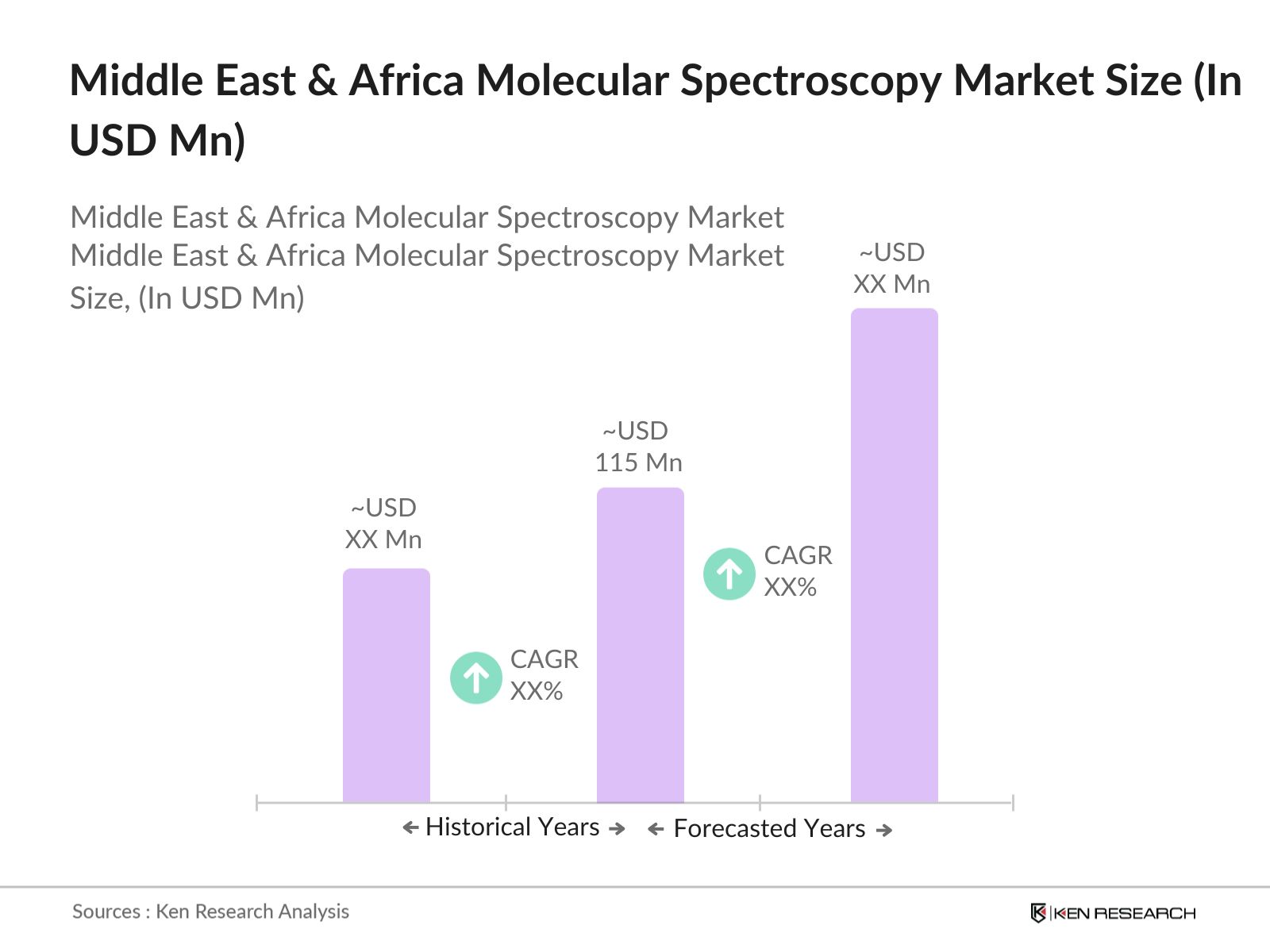
- The Middle East & Africa Molecular Spectroscopy market is valued at USD 115 million, driven by several factors including the rising demand in pharmaceuticals, biotechnology, and environmental testing. A five-year historical analysis shows that the pharmaceutical sector's expansion and the increasing government focus on enhancing research capabilities in universities and public institutions have significantly contributed to the markets growth. Furthermore, increased applications of molecular spectroscopy in food safety and environmental analysis have broadened its scope. Major advancements in portable and user-friendly spectroscopy tools have also propelled adoption in this region.
- Key countries driving the molecular spectroscopy market in the Middle East & Africa include South Africa, the UAE, and Saudi Arabia. These countries have an established presence of pharmaceutical manufacturing facilities, research institutions, and environmental agencies, further promoting the demand for molecular spectroscopy systems. The dominance of these countries is attributed to substantial investments in healthcare infrastructure and government-led initiatives for scientific and technological advancement.
- Governments across the MEA region have implemented stringent compliance standards for pharmaceutical testing, emphasizing molecular-level analysis. Saudi Arabias SFDA, for example, requires comprehensive molecular spectroscopy testing for new drug approvals, a process that involves detailed analysis of molecular interactions. South Africa has similar requirements under its Medicines Control Council, which mandates spectroscopy-based testing for drug imports, ensuring that pharmaceutical products meet quality and safety standards. These regulations create a high demand for molecular spectroscopy technologies in the region.
Middle East & Africa Molecular Spectroscopy Market Segmentation
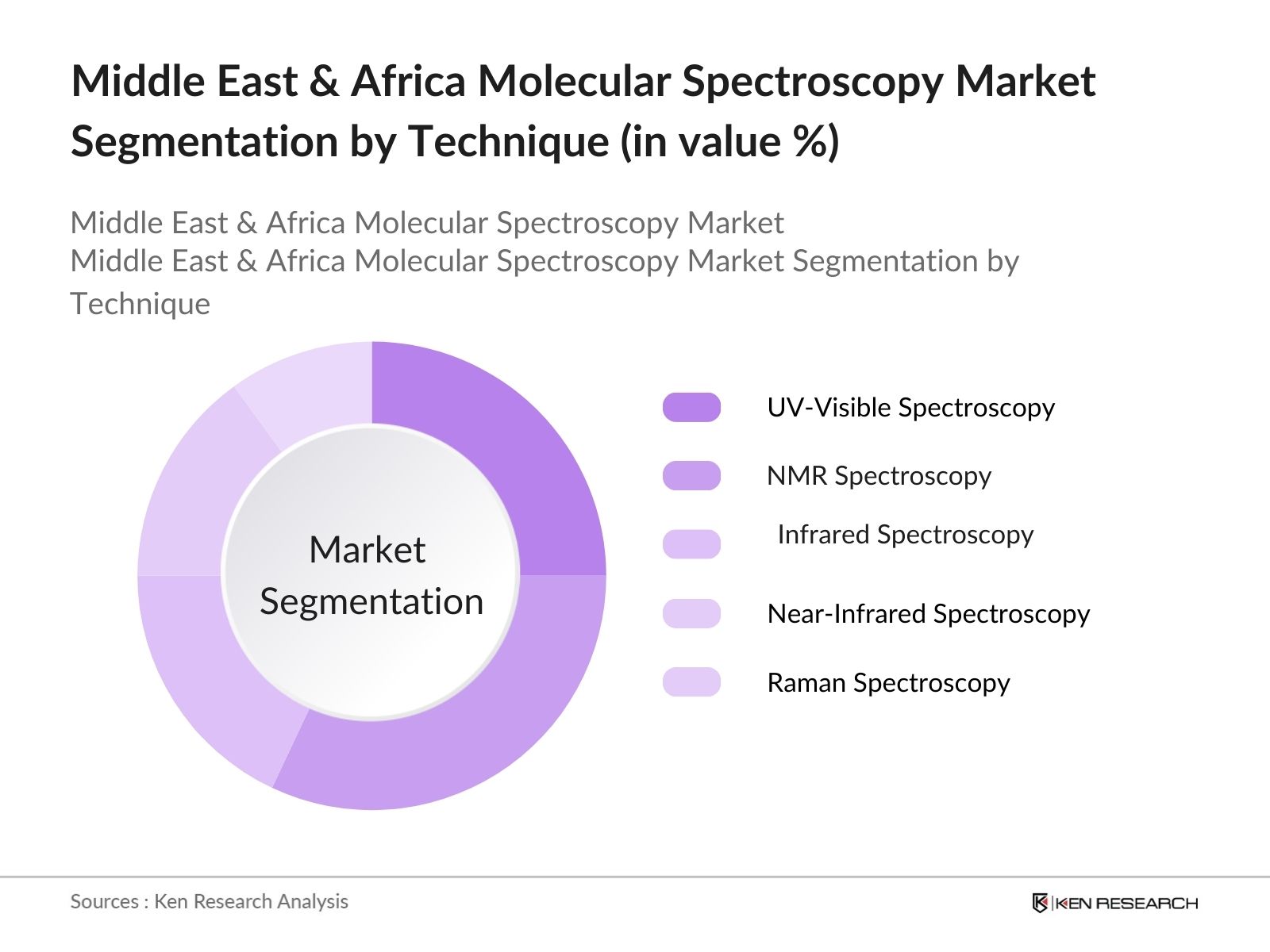
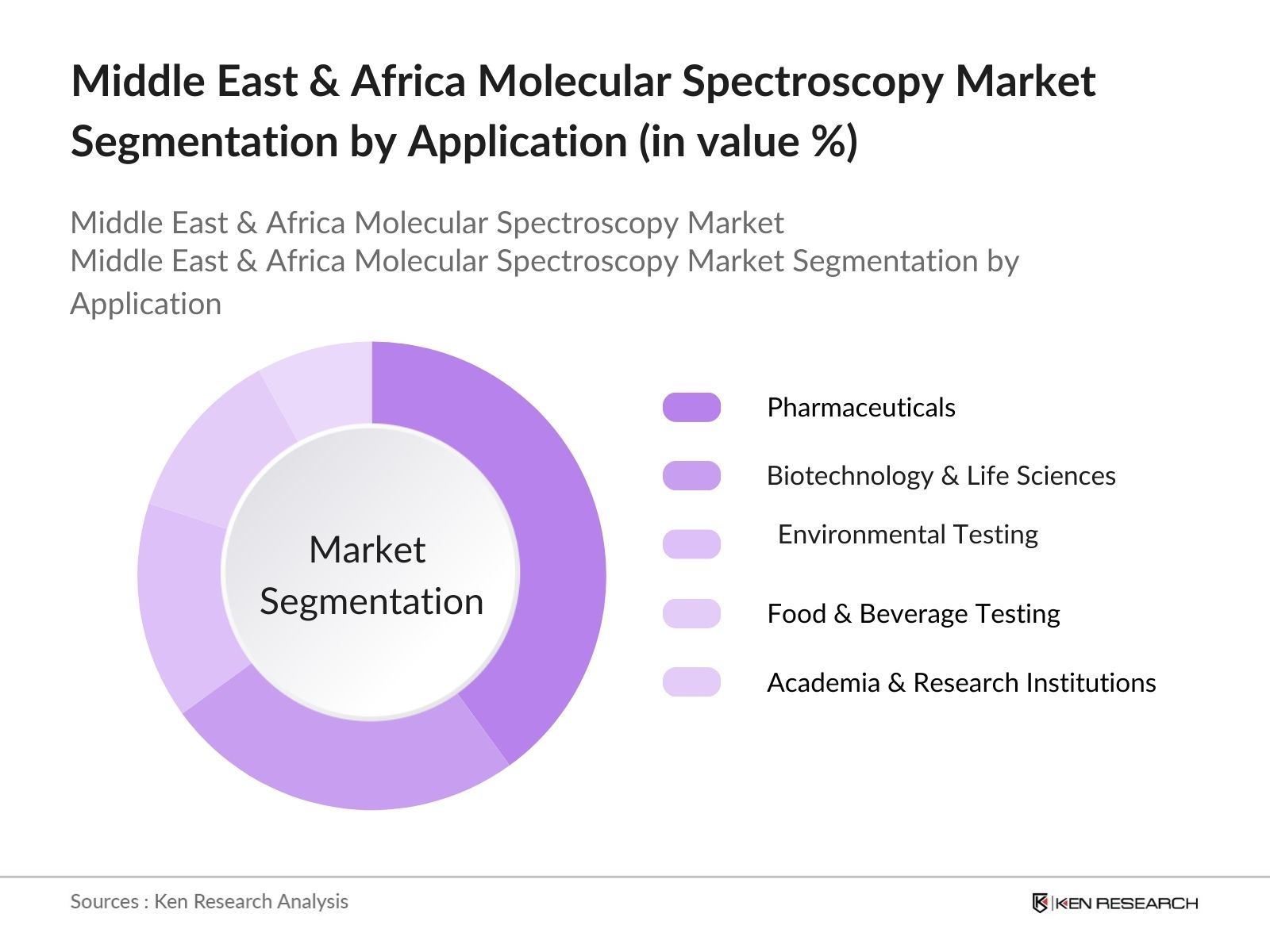
The Middle East & Africa Molecular Spectroscopy market is segmented by technique and by application.
- By Technique: The market is segmented by technique into UV-Visible Spectroscopy, Infrared Spectroscopy, Nuclear Magnetic Resonance (NMR) Spectroscopy, Near-Infrared (NIR) Spectroscopy, and Raman Spectroscopy. Recently, Infrared Spectroscopy has gained a dominant market share due to its extensive use in environmental monitoring and pharmaceutical quality control. Infrared spectroscopy helps in detecting and identifying organic compounds in various samples, making it indispensable in food testing and environmental analysis. In pharmaceuticals, it assists in the analysis of active ingredients, contributing to its significant role in quality assurance protocols.
- By Application: The market is also segmented by application into pharmaceuticals, biotechnology & life sciences, environmental testing, food & beverage testing, and academia & research institutions. Pharmaceuticals dominate the market due to the growing need for high-precision analytical tools for drug development and quality control. Molecular spectroscopy technologies, especially NMR and infrared spectroscopy, are pivotal in analyzing chemical compounds and ensuring that drugs meet stringent safety standards. The push for drug innovation in developing economies like South Africa, along with global pharmaceutical companies expanding operations in the Middle East, has driven demand in this segment.
Competitive Landscape
The molecular spectroscopy market in the Middle East & Africa is led by several major global and regional players. The competitive landscape is characterized by innovation, partnerships with research institutions, and a focus on expanding product portfolios to meet industry-specific demands. International players have increasingly entered into joint ventures with local distributors and agencies to capture the regional market.
|
Company |
Establishment Year |
Headquarters |
Revenue (USD Mn) |
Product Portfolio |
R&D Investment (USD Mn) |
|
Agilent Technologies |
1999 |
Santa Clara, USA |
|||
|
Thermo Fisher Scientific Inc. |
1956 |
Waltham, USA |
|||
|
PerkinElmer Inc. |
1937 |
Waltham, USA |
|||
|
Bruker Corporation |
1960 |
Billerica, USA |
|||
|
Horiba Ltd. |
1945 |
Kyoto, Japan |
Middle East & Africa Molecular Spectroscopy Market Analysis
Growth Drivers
- Expansion in Pharmaceuticals and Biotechnology: The pharmaceuticals and biotechnology sectors in the Middle East & Africa (MEA) region are rapidly expanding, driven by rising demand for advanced therapeutic solutions and vaccines. In Saudi Arabia, pharmaceutical exports reached $1.6 billion in 2023, supported by government investments in biotech innovation. The UAE and Egypt also witnessed increased pharmaceutical production, valued at $2 billion and $1.3 billion respectively, due to new biotech research facilities and manufacturing plants. These expansions directly stimulate demand for molecular spectroscopy systems used for drug development, quality control, and molecular analysis.
- Increasing Government Research Initiatives: Governments across the MEA region are boosting investments in scientific research, driving the demand for molecular spectroscopy technologies. In 2023, the UAE allocated $2.6 billion for health and science research, while South Africas research and development budget stood at $4.7 billion, focusing heavily on medical diagnostics and pharmaceutical advancements. These efforts are aimed at bolstering life sciences, which rely heavily on spectroscopy techniques for molecular characterization and testing. Additionally, these government initiatives improve infrastructure for clinical research and drug testing across the region.
- Advancements in Molecular Spectroscopy Techniques: Technological advancements in molecular spectroscopy techniques, such as Raman, NMR, and UV-Vis spectroscopy, have enhanced sensitivity and accuracy in molecular analysis. These innovations support pharmaceutical, biotech, and academic research applications, including faster drug discovery and development. For example, Saudi Arabia is adopting more advanced spectroscopy systems for rapid COVID-19 vaccine testing, while Nigeria has invested $350 million in upgrading lab equipment for pharmaceutical testing, supporting faster molecular-level analysis. Such innovations are making spectroscopy more efficient and crucial for the evolving scientific landscape in the MEA region.
Market Challenges
High Capital Investment Costs (Molecular Spectroscopy): One of the primary challenges in adopting molecular spectroscopy systems in the MEA region is the high capital investment required for purchasing advanced equipment. In South Africa, setting up a fully equipped molecular spectroscopy lab can cost up to $5 million, making it difficult for smaller research facilities to adopt cutting-edge technology. Additionally, Nigeria has faced challenges in financing laboratory expansions, with some molecular research facilities requiring annual maintenance costs exceeding $1 million. This limits access to high-quality spectroscopy tools, especially in underfunded sectors.
Stringent Regulatory Frameworks: Stringent regulatory frameworks related to pharmaceutical testing and drug approval processes in the MEA region pose another significant challenge. In Saudi Arabia, for instance, the Saudi Food and Drug Authority (SFDA) mandates comprehensive molecular testing for drug approval, which can take months. South Africa's health authorities also have strict molecular analysis requirements for imported pharmaceuticals, further complicating market entry. These regulations increase the operational costs for pharmaceutical companies, reducing their ability to invest in advanced molecular spectroscopy technologies.
Middle East & Africa Molecular Spectroscopy Market Future Outlook
Over the next five years, the Middle East & Africa Molecular Spectroscopy market is expected to experience significant growth, driven by technological advancements, increased funding for scientific research, and rising demand in industries such as pharmaceuticals, environmental safety, and food quality testing. Expansion of laboratory capacities and collaborations with academic institutions are expected to further bolster market growth. Governments across the region are investing heavily in life sciences and environmental protection initiatives, which will fuel the demand for high-precision molecular spectroscopy instruments.
Market Opportunities
- Rising Healthcare Expenditure (Molecular Spectroscopy): The MEA region is witnessing a significant rise in healthcare expenditure, creating substantial opportunities for molecular spectroscopy applications. For example, healthcare spending in Saudi Arabia reached $54.6 billion in 2023, with a significant portion allocated to upgrading diagnostic and research equipment. Similarly, South Africas healthcare budget increased to $22 billion, with a focus on enhancing medical research capabilities. This rising expenditure fuels demand for spectroscopy systems used in disease diagnosis, drug discovery, and personalized medicine.
- Growing R&D Activities (Pharmaceuticals and Life Sciences): The growing R&D activities in the pharmaceutical and life sciences sectors across the MEA region present lucrative opportunities for the molecular spectroscopy market. In 2023, Saudi Arabia invested $1.8 billion in pharmaceutical research, targeting new drug development and vaccine production. Egypt followed with $600 million in research funding for biotechnology innovations, particularly in molecular diagnostics. These investments are driving demand for spectroscopy tools used for drug formulation, protein analysis, and disease biomarker identification, contributing to advancements in healthcare and biopharma research.
Scope of the Report
|
UV-Visible Spectroscopy Infrared Spectroscopy Nuclear Magnetic Resonance (NMR) Spectroscopy Near-Infrared (NIR) Spectroscopy Raman Spectroscopy |
|
|
By Application |
Pharmaceuticals Biotechnology & Life Sciences Environmental Testing Food & Beverage Testing Academia & Research Institutions |
|
By End-User |
Hospitals & Diagnostic Labs Pharmaceutical Companies Research Institutes Environmental Agencies Food Testing Laboratories |
|
By Procurement Mode |
Capital Purchase Leasing Rental |
|
By Region |
North East West South |
Products
Key Target Audience
Pharmaceutical and Biotechnology Companies
Environmental Testing Agencies
Food & Beverage Testing Laboratories
Diagnostic Labs and Hospitals
Government and Regulatory Bodies (such as Saudi FDA, South African National Accreditation System)
R&D Institutes and Universities
Investment and Venture Capitalist Firms
Industrial Laboratories
Companies
Players Mention in the Report:
Agilent Technologies
Thermo Fisher Scientific Inc.
PerkinElmer Inc.
Bruker Corporation
Horiba Ltd.
Shimadzu Corporation
JEOL Ltd.
JASCO Inc.
Hitachi High-Technologies Corporation
Waters Corporation
Danaher Corporation
FOSS Analytical
Edinburgh Instruments Ltd.
B&W Tek
Teledyne Leeman Labs
Table of Contents
1. Middle East & Africa Molecular Spectroscopy Market Overview
1.1. Definition and Scope
1.2. Market Taxonomy
1.3. Market Growth Rate
1.4. Market Segmentation Overview
2. Middle East & Africa Molecular Spectroscopy Market Size (in USD Mn)
2.1. Historical Market Size
2.2. Year-on-Year Growth Analysis
2.3. Key Market Developments and Milestones
3. Middle East & Africa Molecular Spectroscopy Market Analysis
3.1. Growth Drivers
3.1.1. Expansion in Pharmaceuticals and Biotechnology
3.1.2. Increasing Government Research Initiatives
3.1.3. Advancements in Molecular Spectroscopy Techniques
3.2. Market Challenges
3.2.1. High Capital Investment Costs (Molecular Spectroscopy)
3.2.2. Stringent Regulatory Frameworks
3.2.3. Lack of Skilled Professionals
3.3. Opportunities
3.3.1. Rising Healthcare Expenditure (Molecular Spectroscopy)
3.3.2. Growing R&D Activities (Pharmaceuticals and Life Sciences)
3.3.3. Expanding Applications in Environmental Testing and Food Safety
3.4. Trends
3.4.1. Increasing Integration of AI & Machine Learning in Spectroscopy Systems
3.4.2. Adoption of Portable and Handheld Spectroscopy Devices
3.4.3. Growing Interest in NIR (Near Infrared) Spectroscopy Applications
3.5. Government Regulation
3.5.1. Middle East & Africas Compliance Standards for Pharmaceutical Testing
3.5.2. Environmental Safety Guidelines (Spectroscopy Techniques)
3.5.3. Import/Export Regulations for Analytical Equipment
3.6. SWOT Analysis
3.7. Stake Ecosystem (Molecular Spectroscopy Value Chain)
3.8. Porters Five Forces
3.9. Competition Ecosystem
4. Middle East & Africa Molecular Spectroscopy Market Segmentation
4.1. By Technique (In Value %)
4.1.1. UV-Visible Spectroscopy
4.1.2. Infrared Spectroscopy
4.1.3. Nuclear Magnetic Resonance (NMR) Spectroscopy
4.1.4. Near-Infrared (NIR) Spectroscopy
4.1.5. Raman Spectroscopy
4.2. By Application (In Value %)
4.2.1. Pharmaceuticals
4.2.2. Biotechnology & Life Sciences
4.2.3. Environmental Testing
4.2.4. Food & Beverage Testing
4.2.5. Academia & Research Institutions
4.3. By End-User (In Value %)
4.3.1. Hospitals & Diagnostic Labs
4.3.2. Pharmaceutical Companies
4.3.3. Research Institutes
4.3.4. Environmental Agencies
4.3.5. Food Testing Laboratories
4.4. By Region (In Value %)
4.4.1. North
4.4.2. East
4.4.3. West
4.4.4. South
4.5. By Mode of Procurement (In Value %)
4.5.1. Capital Purchase
4.5.2. Leasing
4.5.3. Rental
5. Middle East & Africa Molecular Spectroscopy Market Competitive Analysis
5.1. Detailed Profiles of Major Companies
5.1.1. Agilent Technologies
5.1.2. Thermo Fisher Scientific Inc.
5.1.3. PerkinElmer Inc.
5.1.4. Bruker Corporation
5.1.5. Horiba Ltd.
5.1.6. Shimadzu Corporation
5.1.7. JEOL Ltd.
5.1.8. JASCO Inc.
5.1.9. Hitachi High-Technologies Corporation
5.1.10. Waters Corporation
5.1.11. Danaher Corporation
5.1.12. FOSS Analytical
5.1.13. Edinburgh Instruments Ltd.
5.1.14. B&W Tek
5.1.15. Teledyne Leeman Labs
5.2. Cross Comparison Parameters (Number of Employees, Headquarters, Revenue, Market Presence, Product Portfolio, R&D Expenditure, Partnerships, Customer Base)
5.3. Market Share Analysis
5.4. Strategic Initiatives
5.5. Mergers and Acquisitions
5.6. Investment Analysis
5.7. Venture Capital Funding
5.8. Government Grants
5.9. Private Equity Investments
6. Middle East & Africa Molecular Spectroscopy Market Regulatory Framework
6.1. Quality Compliance Standards for Spectroscopy Equipment
6.2. Environmental and Pharmaceutical Testing Requirements
6.3. Certification Processes
7. Middle East & Africa Molecular Spectroscopy Future Market Size (In USD Mn)
7.1. Future Market Size Projections
7.2. Key Factors Driving Future Market Growth
8. Middle East & Africa Molecular Spectroscopy Future Market Segmentation
8.1. By Technique (In Value %)
8.2. By Application (In Value %)
8.3. By End-User (In Value %)
8.4. By Geography (In Value %)
8.5. By Mode of Procurement (In Value %)
9. Middle East & Africa Molecular Spectroscopy Market Analysts Recommendations
9.1. TAM/SAM/SOM Analysis
9.2. Customer Cohort Analysis
9.3. Marketing Initiatives
9.4. White Space Opportunity Analysis
Research Methodology
Step 1: Identification of Key Variables
The initial phase involved mapping out all the stakeholders within the molecular spectroscopy ecosystem in the Middle East & Africa. Extensive desk research and proprietary databases were utilized to define critical variables such as application areas, regulatory frameworks, and technology trends influencing the market.
Step 2: Market Analysis and Construction
This phase included analyzing historical data on market growth, including penetration rates in various sectors, and evaluating the revenue generated by key market players. A thorough examination of the techniques employed in pharmaceuticals and environmental testing was conducted.
Step 3: Hypothesis Validation and Expert Consultation
Market hypotheses were developed and validated through interviews with experts from leading pharmaceutical, environmental testing, and academic institutions. Insights gained from these consultations were crucial in fine-tuning market forecasts.
Step 4: Research Synthesis and Final Output
In the final stage, data from key industry sources was cross-referenced with inputs from molecular spectroscopy manufacturers. This step ensured that the market analysis was comprehensive, accurate, and validated by real-world data.
Frequently Asked Questions
01. How big is the Middle East & Africa Molecular Spectroscopy market?
The Middle East & Africa Molecular Spectroscopy market is valued at USD 115 million, driven by growing demand in pharmaceuticals, biotechnology, and environmental testing.
02. What are the challenges in the Middle East & Africa Molecular Spectroscopy market?
Challenges in Middle East & Africa Molecular Spectroscopy market include the high cost of advanced molecular spectroscopy instruments and the lack of skilled professionals to operate and interpret the data produced by these instruments.
03. Who are the major players in the Middle East & Africa Molecular Spectroscopy market?
Key players in the Middle East & Africa Molecular Spectroscopy market include Agilent Technologies, Thermo Fisher Scientific Inc., PerkinElmer Inc., Bruker Corporation, and Horiba Ltd.
04. What are the growth drivers of the Middle East & Africa Molecular Spectroscopy market?
The Middle East & Africa Molecular Spectroscopy market is driven by the expansion of pharmaceutical industries, government investments in research and development, and rising demand for food safety and environmental testing.
05. Which countries dominate the Middle East & Africa Molecular Spectroscopy market?
South Africa, the UAE, and Saudi Arabia dominate the market due to their well-established healthcare infrastructure, growing pharmaceutical sector, and government-backed research initiatives.
Why Buy From Us?

What makes us stand out is that our consultants follows Robust, Refine and Result (RRR) methodology. i.e. Robust for clear definitions, approaches and sanity checking, Refine for differentiating respondents facts and opinions and Result for presenting data with story

We have set a benchmark in the industry by offering our clients with syndicated and customized market research reports featuring coverage of entire market as well as meticulous research and analyst insights.

While we don't replace traditional research, we flip the method upside down. Our dual approach of Top Bottom & Bottom Top ensures quality deliverable by not just verifying company fundamentals but also looking at the sector and macroeconomic factors.

With one step in the future, our research team constantly tries to show you the bigger picture. We help with some of the tough questions you may encounter along the way: How is the industry positioned? Best marketing channel? KPI's of competitors? By aligning every element, we help maximize success.

Our report gives you instant access to the answers and sources that other companies might choose to hide. We elaborate each steps of research methodology we have used and showcase you the sample size to earn your trust.

If you need any support, we are here! We pride ourselves on universe strength, data quality, and quick, friendly, and professional service.