
North America Milk Market Outlook to 2030
Region:North America
Author(s):Sanjeev
Product Code:KROD2216
December 2024
84
About the Report
North America Milk Market Overview
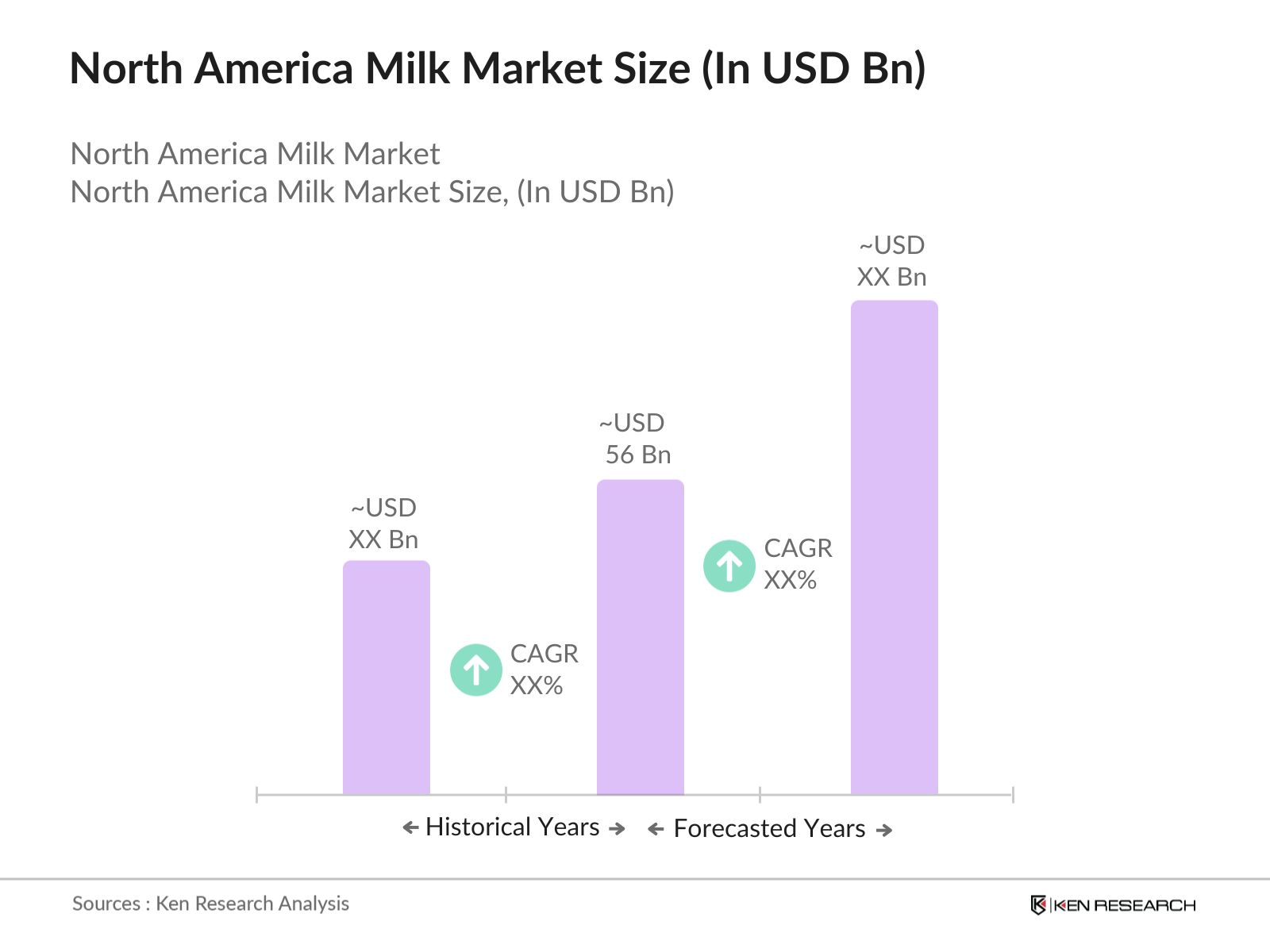
- The North America Milk Market, valued at USD 56 billion, is primarily driven by the rising demand for dairy products in diverse categories like whole milk, lactose-free milk, and organic milk. Increasing health consciousness among consumers and a shift towards fortified milk options have contributed to consistent demand. Additionally, technological advancements in dairy processing have improved production efficiency and expanded the availability of different milk variants. These trends are pivotal in propelling the markets sustained growth across the region.
- The United States and Canada lead the North American milk market due to well-established dairy industries, extensive distribution networks, and a strong consumer base. The U.S., with its advanced dairy farming practices and production capabilities, holds a significant position in milk production and consumption. Canada, with its stringent quality standards and increasing demand for organic and fortified milk, is another major player. Both countries benefit from high per capita consumption, supported by effective governmental policies and infrastructure.
- The North American dairy sector operates under stringent safety regulations to ensure product quality. In 2023, FDA standards mandated testing protocols that cover 99% of all milk production, ensuring compliance with safety and health requirements. These regulations protect consumers by minimizing contamination risks and maintaining high-quality standards, crucial for sustaining consumer trust and demand.
North America Milk Market Segmentation
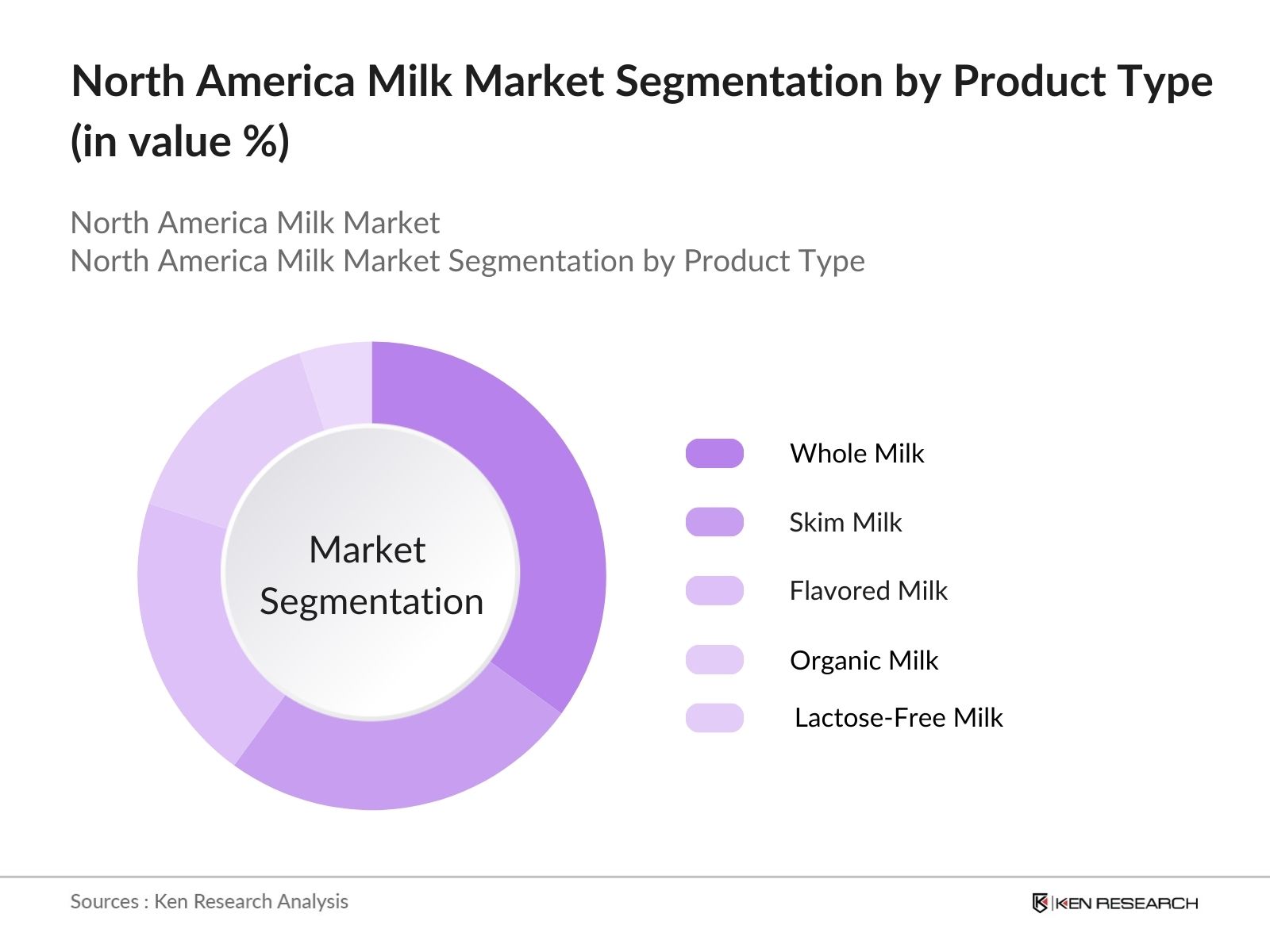
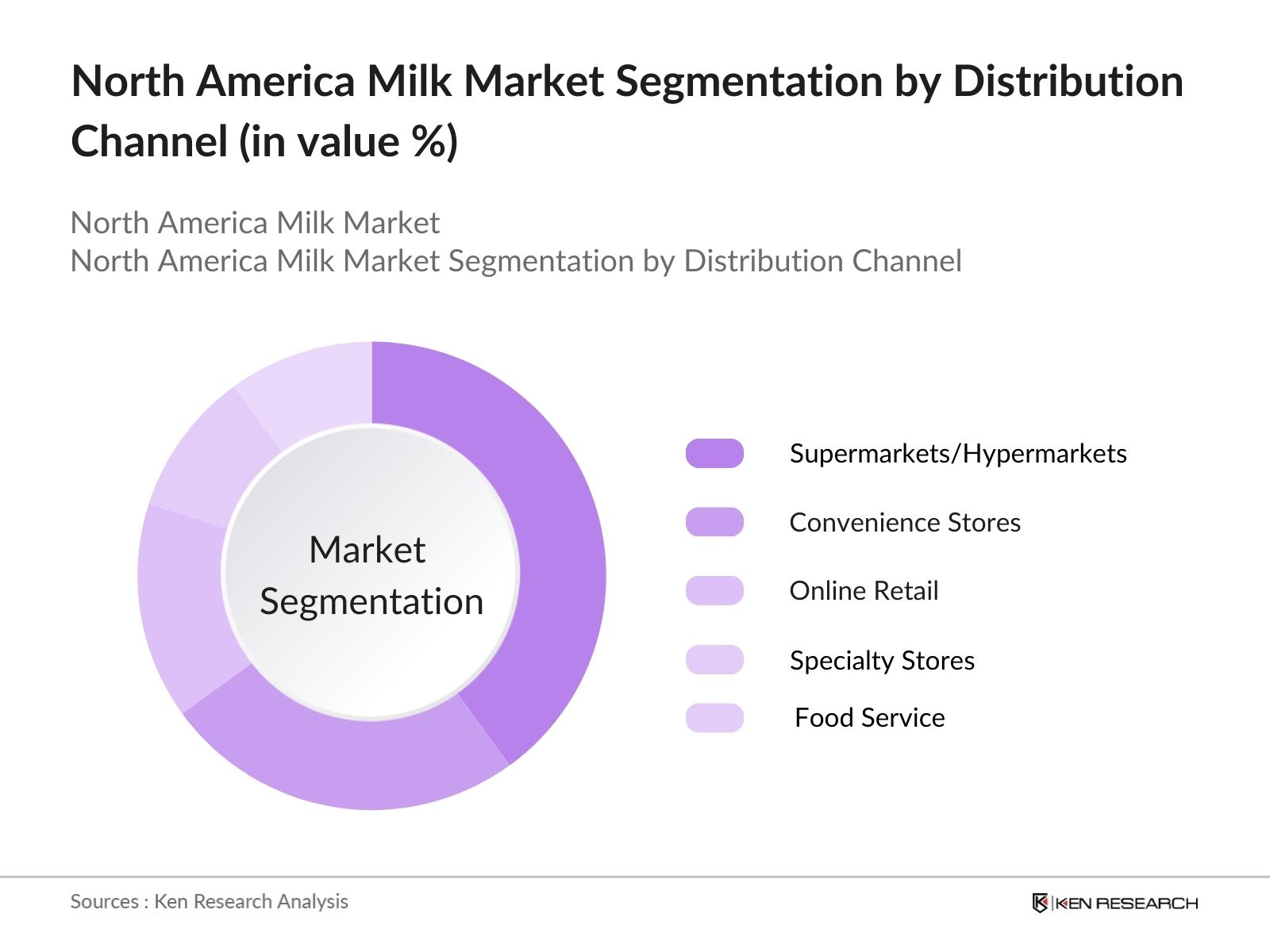
The North America Milk Market is segmented by product type and by distribution channels.
- By Product Type: The North America Milk Market is segmented by product type into whole milk, skim milk, flavored milk, organic milk, and lactose-free milk. Recently, whole milk has maintained a dominant market share due to its nutritional benefits and consumer preference for natural, unaltered milk products. Whole milk, known for its full-bodied taste, has a deep-rooted appeal among consumers who prioritize traditional dairy options, further supported by increased consumption for its perceived health benefits.
- By Distribution Channel: The North America Milk Market is further segmented by distribution channels, including supermarkets/hypermarkets, convenience stores, online retail, specialty stores, and food service. Supermarkets and hypermarkets hold the largest market share in this segment, as they offer a wide selection of milk products and brands. The convenience factor, combined with strategic location across urban and suburban areas, makes supermarkets a preferred choice for consumers, boosting their share in the market.
North America Milk Market Competitive Landscape
The North America Milk Market is dominated by a few key players, including major dairy corporations and regional cooperatives. This industry consolidation reflects the influence of these companies on production, distribution, and pricing strategies, making them pivotal in shaping market trends. Companies leverage extensive distribution networks, diverse product offerings, and innovation in dairy processing to maintain their market positions.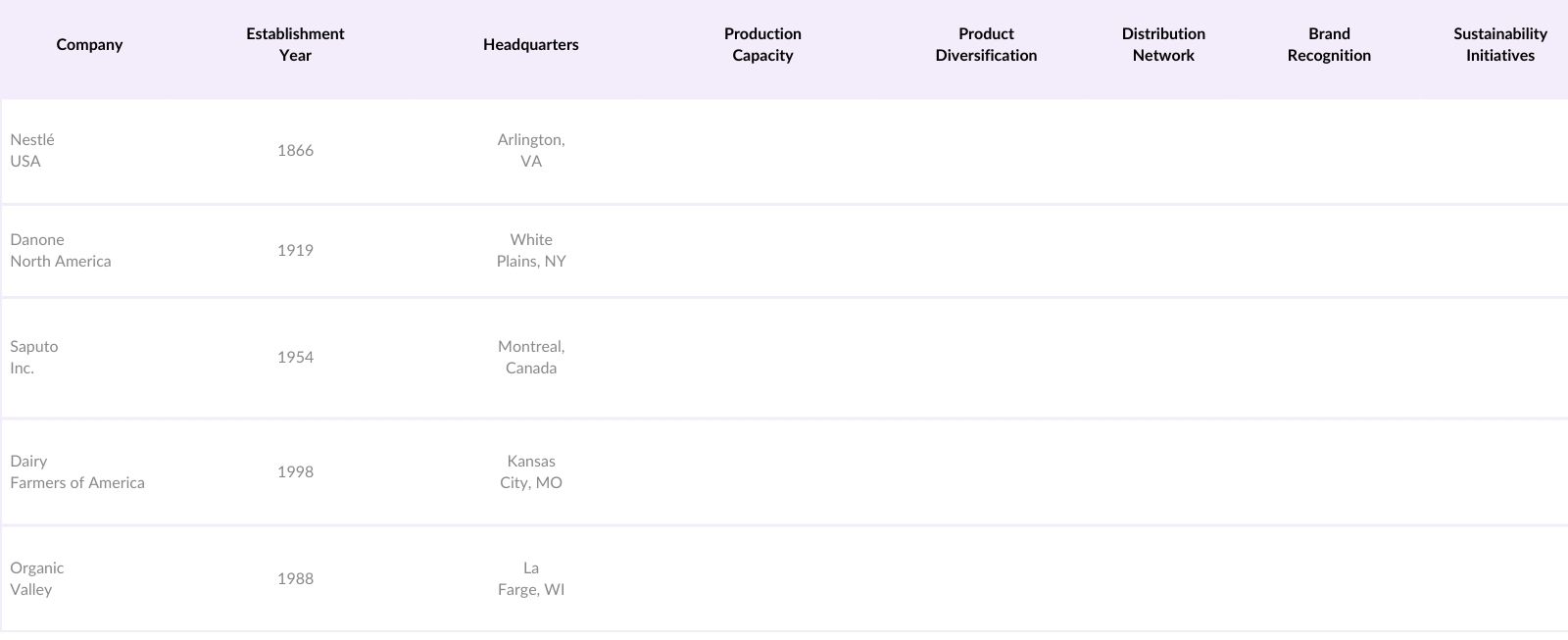
North America Milk Market Analysis
Growth Drivers
- Rising Demand for Dairy Nutrition: The North American milk market is driven by increasing consumer demand for dairy as a source of essential nutrients. As of 2023, USDA reports indicate that milk remains one of the largest sources of calcium, vitamin D, and high-quality protein, with consumption exceeding 80 billion pounds in the U.S. alone. This high demand is further underscored by demographic studies showing a consistent intake across various age groups, as consumers recognize milks nutritional benefits in promoting bone health, especially among older adults and growing children.
- Expansion in Retail and Distribution Channels: The retail landscape for milk in North America is expanding, facilitated by investments in advanced cold-chain logistics and distribution networks. According to 2023 statistics from the USDA, approximately 98% of retail grocery stores in North America are equipped with chilled sections, supporting the availability of milk products. This robust distribution infrastructure ensures that milk is available even in remote areas, driving higher sales volumes across the region. In addition, partnerships with local dairy farmers and large-scale processors enable seamless supply, contributing significantly to market growth.
- Consumer Preference for Organic and Non-GMO Milk: There is a notable shift towards organic and non-GMO milk in North America, with data from the USDA indicating that 35% of households now actively choose organic milk products. Consumers increasingly prioritize health and environmental impacts, with organic milk free from synthetic hormones and GMOs seen as a healthier choice. In 2023, retail sales of organic milk increased by 7%, showing a clear consumer trend favoring natural products. This preference bolsters demand, prompting dairy farms to adopt sustainable, organic farming practices.
Market Challenges
- Supply Chain Disruptions: Supply chain disruptions have posed challenges for the North American milk market, affecting the consistent supply of dairy products. Recent USDA reports highlight a 3-day increase in milk delivery times to retailers in 2023 due to transportation and logistics setbacks. Disruptions are partly attributed to labor shortages and rising fuel costs, affecting the timely distribution of fresh milk. Additionally, weather-related events have impacted local milk production, further exacerbated supply challenges and led to sporadic shortages in some regions.
- Increasing Lactose Intolerance Awareness: A rising awareness of lactose intolerance affects milk consumption patterns, with approximately 36% of the North American population reporting sensitivity to lactose as of 2023, according to data from the National Institutes of Health. This awareness has prompted some consumers to seek lactose-free or alternative dairy products, impacting traditional milk sales. With growing availability and consumer preference for lactose-free options, the traditional milk sector faces pressure to adapt to changing consumer needs and preferences.
North America Milk Market Future Outlook
Over the next five years, the North America Milk Market is anticipated to experience steady growth, driven by increasing demand for health-oriented milk products, particularly lactose-free and organic options. The rising focus on sustainable dairy farming practices and advanced processing technologies is also expected to contribute positively. Consumers shifting preference towards healthier alternatives and fortified milk products will likely influence market dynamics.
Market Opportunities
- Growth of Plant-Based Alternatives and Hybrid Products: The North American milk market sees an expanding opportunity in plant-based and hybrid dairy products, fueled by consumer interest in sustainable and allergen-friendly options. In 2023, USDA data shows a 4% increase in sales of hybrid milk products, which combine plant and animal proteins. This trend aligns with consumer preferences for variety and health-conscious choices, presenting a significant avenue for traditional dairy producers to diversify product offerings and capture new market segments. USDA
- Demand for Value-Added Dairy Products: There is an emerging opportunity in value-added milk products, such as fortified and flavored milk, responding to consumer demand for convenience and health benefits. USDA data from 2023 reveals that fortified milk products now represent 20% of total milk sales, driven by health-focused consumers. Additionally, high-protein and lactose-free milk variants are increasingly popular, presenting dairy producers with new growth channels by catering to specific nutritional needs and preferences.
Scope of the Report
|
Whole Milk Skim Milk Flavored Milk Organic Milk Lactose-Free Milk |
|
|
By Distribution Channel |
Supermarkets/Hypermarkets Convenience Stores Online Retail Specialty Stores Food Service |
|
By Fat Content |
Full-Fat Reduced-Fat Low-Fat Fat-Free |
|
By Packaging |
Cartons Bottles Pouches Glass Jars Cans |
|
By Region |
US Canada Mexico |
Products
Key Target Audience
Dairy Producers and Suppliers
Large-scale Supermarket Chains and Retailers
Health-Conscious Consumers
Food Service Industry (cafes, restaurants, hotels)
Government and Regulatory Bodies (USDA, FDA)
E-commerce and Online Retail Platforms
Investor and Venture Capitalist Firms
Research and Development Organizations
Companies
Players Mention in the Report:
Nestl USA
Danone North America
Saputo Inc.
Dairy Farmers of America
Organic Valley
Dean Foods
Lactalis American Group
Prairie Farms Dairy
Aurora Organic Dairy
The Kroger Co.
Borden Dairy Company
Darigold
Byrne Dairy
Shamrock Farms
Horizon Organic
Table of Contents
1. North America Milk Market Overview
1.1 Definition and Scope
1.2 Market Taxonomy
1.3 Market Growth Rate
1.4 Market Segmentation Overview
2. North America Milk Market Size (In USD Bn)
2.1 Historical Market Size
2.2 Year-On-Year Growth Analysis
2.3 Key Market Developments and Milestones
3. North America Milk Market Analysis
3.1 Growth Drivers
3.1.1 Rising Demand for Dairy Nutrition
3.1.2 Expansion in Retail and Distribution Channels
3.1.3 Consumer Preference for Organic and Non-GMO Milk
3.1.4 Government Initiatives Supporting Dairy Farming
3.2 Market Challenges
3.2.1 Supply Chain Disruptions
3.2.2 Increasing Lactose Intolerance Awareness
3.2.3 Fluctuating Milk Prices
3.3 Opportunities
3.3.1 Growth of Plant-Based Alternatives and Hybrid Products
3.3.2 Demand for Value-Added Dairy Products
3.3.3 Export Opportunities in Emerging Markets
3.4 Trends
3.4.1 Rise of Sustainable Packaging
3.4.2 Technological Advancements in Dairy Processing
3.4.3 Increased Focus on Nutritional Fortification
3.5 Government Regulation
3.5.1 Dairy Standards and Safety Regulations
3.5.2 Labeling and Nutritional Information Requirements
3.5.3 Tariffs and Trade Policies on Dairy Imports/Exports
3.6 SWOT Analysis
3.7 Stakeholder Ecosystem
3.8 Porters Five Forces
3.9 Competition Ecosystem
4. North America Milk Market Segmentation
4.1 By Product Type (In Value %)
4.1.1 Whole Milk
4.1.2 Skim Milk
4.1.3 Flavored Milk
4.1.4 Organic Milk
4.1.5 Lactose-Free Milk
4.2 By Distribution Channel (In Value %)
4.2.1 Supermarkets/Hypermarkets
4.2.2 Convenience Stores
4.2.3 Online Retail
4.2.4 Specialty Stores
4.2.5 Food Service
4.3 By Fat Content (In Value %)
4.3.1 Full-Fat
4.3.2 Reduced-Fat
4.3.3 Low-Fat
4.3.4 Fat-Free
4.4 By Packaging (In Value %)
4.4.1 Cartons
4.4.2 Bottles
4.4.3 Pouches
4.4.4 Glass Jars
4.4.5 Cans
4.5 By Region (In Value %)
4.5.1 United States
4.5.2 Canada
4.5.3 Mexico
5. North America Milk Market Competitive Analysis
5.1 Detailed Profiles of Major Companies
5.1.1 Nestl USA
5.1.2 Danone North America
5.1.3 Saputo Inc.
5.1.4 Dairy Farmers of America
5.1.5 Agropur Cooperative
5.1.6 Dean Foods
5.1.7 Organic Valley
5.1.8 Lactalis American Group
5.1.9 Prairie Farms Dairy
5.1.10 Aurora Organic Dairy
5.1.11 The Kroger Co.
5.1.12 Borden Dairy Company
5.1.13 Darigold
5.1.14 Byrne Dairy
5.1.15 Shamrock Farms
5.2 Cross Comparison Parameters (Product Portfolio, Distribution Network, Market Share, Innovations, Sustainability Initiatives, Brand Presence, Financial Performance, Regional Market Penetration)
5.3 Market Share Analysis
5.4 Strategic Initiatives
5.5 Mergers and Acquisitions
5.6 Investment Analysis
5.7 Joint Ventures and Collaborations
5.8 Government Grants
5.9 Private Equity Investments
6. North America Milk Market Regulatory Framework
6.1 Dairy Production Standards
6.2 Labeling Requirements and Compliance
6.3 Import and Export Tariffs
6.4 Organic Certification Standards
6.5 Animal Welfare Regulations
7. North America Milk Future Market Size (In USD Bn)
7.1 Future Market Size Projections
7.2 Key Factors Driving Future Market Growth
8. North America Milk Market Analysts Recommendations
8.1 Total Addressable Market (TAM) Analysis
8.2 Customer Segmentation Analysis
8.3 Targeted Marketing Strategies
8.4 White Space Opportunity Identification
Research Methodology
Step 1: Identification of Key Variables
The initial phase entails mapping out the North America Milk Markets ecosystem, covering primary stakeholders such as producers, distributors, and consumers. This process incorporates desk research from secondary databases to identify and define the core market variables.
Step 2: Market Analysis and Construction
This step involves analyzing historical data related to the milk market, including evaluating demand fluctuations across the segments. Additionally, an assessment of consumer behavior trends aids in constructing an accurate market model.
Step 3: Hypothesis Validation and Expert Consultation
Market hypotheses are developed based on the initial research and validated through expert interviews. Consultations with key industry players provide insights into operational and financial metrics, further refining the market data.
Step 4: Research Synthesis and Final Output
The final step integrates insights from various stakeholders, including milk producers and retailers, to create a comprehensive, validated market report. This ensures a well-rounded understanding of the market dynamics and key growth drivers in the North America Milk Market.
Frequently Asked Questions
01. How big is the North America Milk Market?
The North America Milk Market is valued at USD 56 billion, supported by robust consumer demand for dairy products and advancements in dairy farming practices.
02. What are the key challenges in the North America Milk Market?
North America Milk Market Key challenges include fluctuating milk prices, supply chain disruptions, and the rising popularity of dairy alternatives, impacting traditional milk consumption.
03. Who are the major players in the North America Milk Market?
North America Milk Market Major players include Nestl USA, Danone North America, Saputo Inc., Dairy Farmers of America, and Organic Valley, each recognized for their extensive distribution and product range.
04. What factors are driving the North America Milk Market?
The North America Milk Market is driven by a steady increase in demand for health-conscious milk options, including organic and lactose-free products, along with strong consumer interest in fortified milk.
05. What trends are shaping the North America Milk Market?
Prominent trends in North America Milk Market include a rise in organic milk consumption, innovation in sustainable packaging, and the use of advanced dairy processing technologies.
Why Buy From Us?

What makes us stand out is that our consultants follows Robust, Refine and Result (RRR) methodology. i.e. Robust for clear definitions, approaches and sanity checking, Refine for differentiating respondents facts and opinions and Result for presenting data with story

We have set a benchmark in the industry by offering our clients with syndicated and customized market research reports featuring coverage of entire market as well as meticulous research and analyst insights.

While we don't replace traditional research, we flip the method upside down. Our dual approach of Top Bottom & Bottom Top ensures quality deliverable by not just verifying company fundamentals but also looking at the sector and macroeconomic factors.

With one step in the future, our research team constantly tries to show you the bigger picture. We help with some of the tough questions you may encounter along the way: How is the industry positioned? Best marketing channel? KPI's of competitors? By aligning every element, we help maximize success.

Our report gives you instant access to the answers and sources that other companies might choose to hide. We elaborate each steps of research methodology we have used and showcase you the sample size to earn your trust.

If you need any support, we are here! We pride ourselves on universe strength, data quality, and quick, friendly, and professional service.