
North America Solar PV Market Outlook to 2030

Region:North America

Author(s):Abhinav kumar

Product Code:KROD9224

Published On

December 2024

Total pages

82

About the Report

North America Solar PV Market Overview

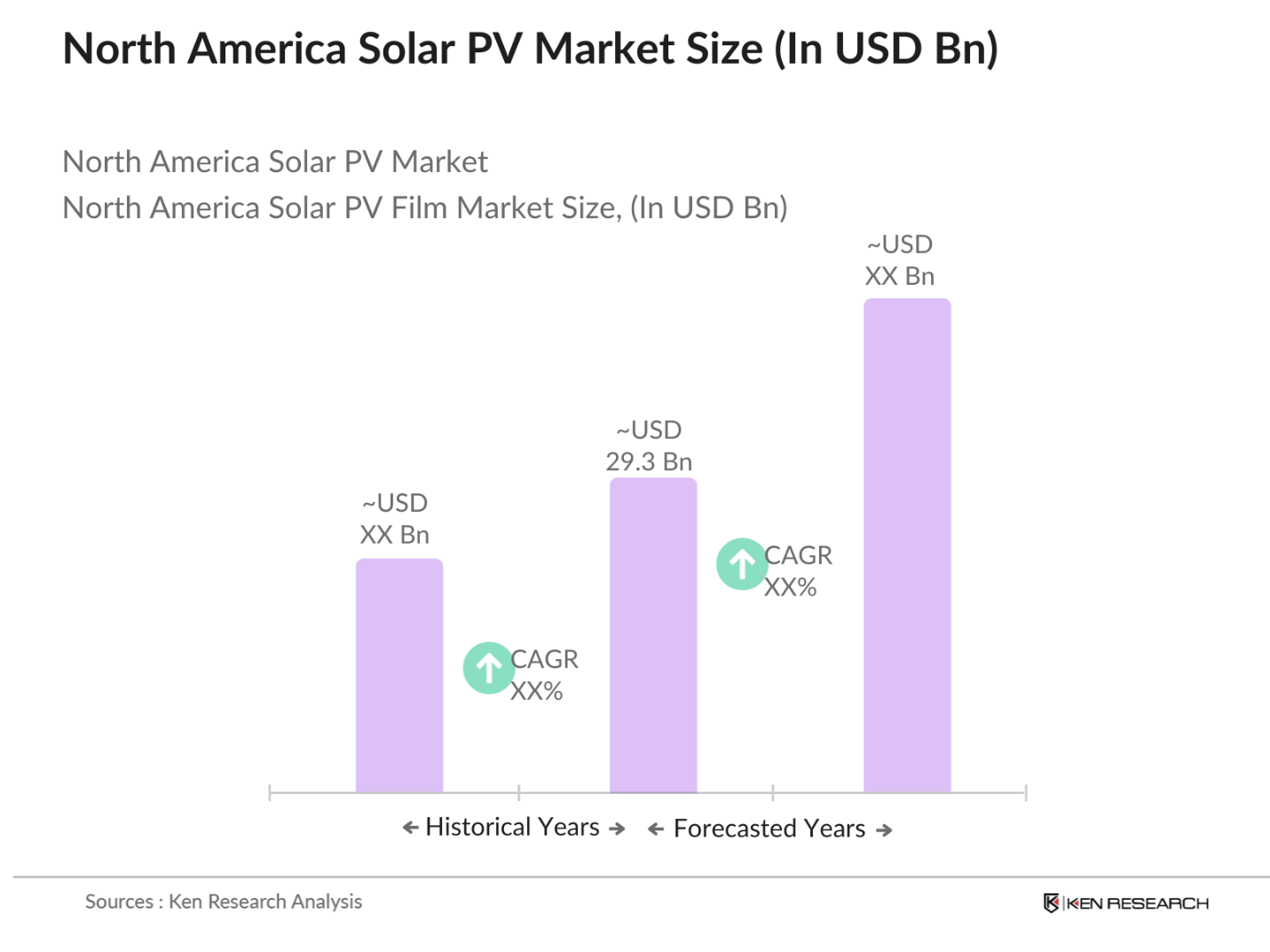
  • The North America Solar PV Market is valued at USD 29.3 billion, based on a five-year historical analysis. This growth is driven by increasing government incentives for renewable energy, technological advancements in PV systems, and declining costs of solar modules, which have significantly reduced installation expenses. The strong demand for clean energy sources to combat climate change has further bolstered the markets expansion, with substantial investments flowing into solar infrastructure projects across the region.

North America Solar PV Market Size

  • In North America, the United States and Canada are dominant players in the Solar PV Market. The U.S. leads due to its large-scale utility projects, supportive federal tax credits, and favorable policies for renewable energy. In Canada, provinces such as Ontario and Alberta have implemented green energy initiatives, driving local PV installations. These factors establish the U.S. and Canada as the principal contributors to market growth, owing to their policies, economic capacity, and energy transition goals.
  • Federal policies in North America are highly supportive of solar PV. In the U.S., the Inflation Reduction Act extends tax credits for solar projects, while the Department of the Interior has expedited approvals for solar installations on public lands. Canadas federal government also promotes solar through programs such as the Clean Energy Incentive, which offers tax credits for solar investments, fostering growth in both residential and utility-scale segments.

North America Solar PV Market Segmentation

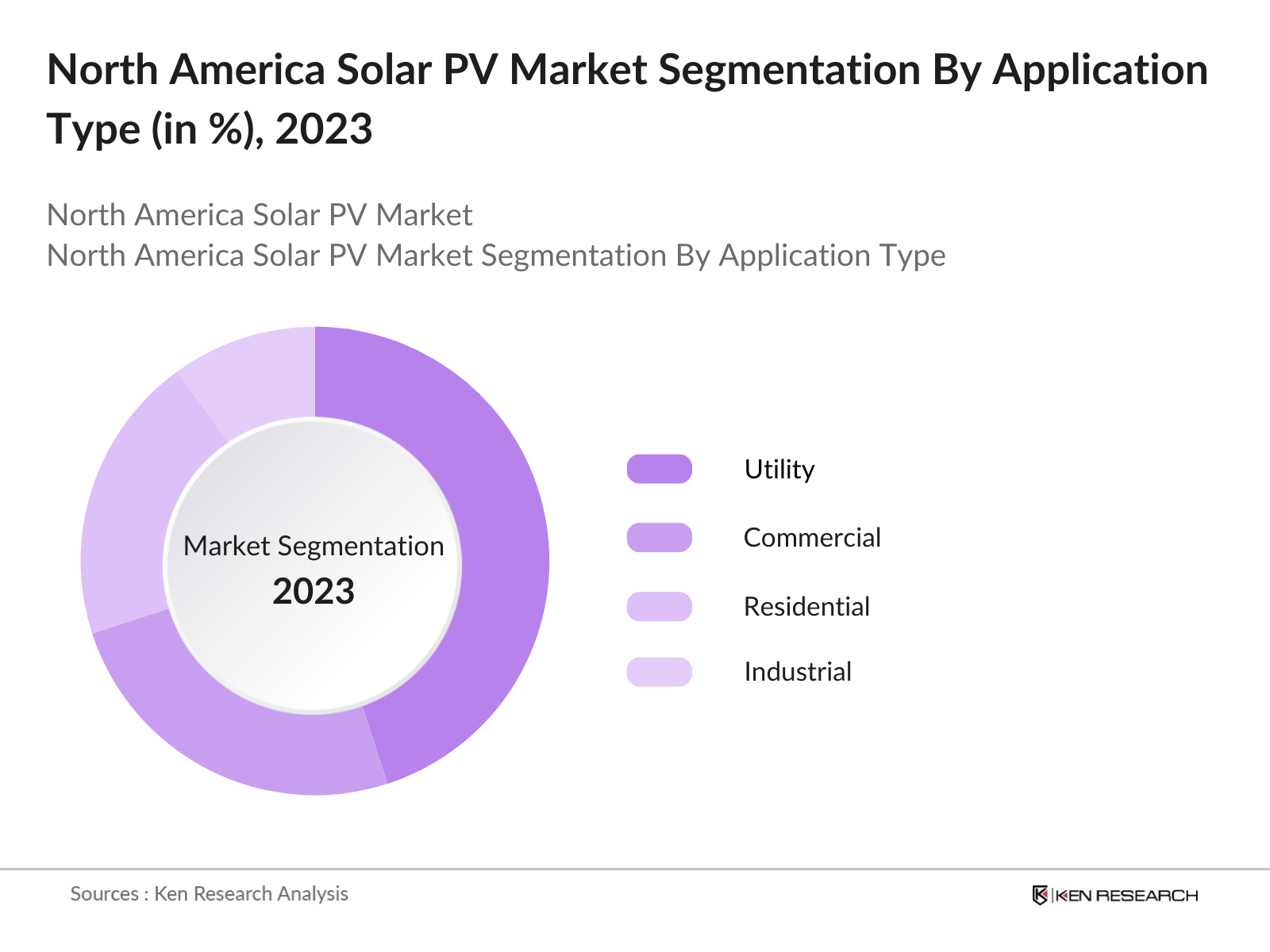
By Application: The North America Solar PV market is segmented by application into residential, commercial, industrial, utility, and off-grid sectors. Among these, the utility segment holds the dominant share due to the increasing number of large-scale solar farms and utility companies initiatives to integrate renewable energy into their grid systems. Utility-scale projects benefit from economies of scale, allowing for significant energy production, which meets the demand of urban centers while contributing to regional sustainability targets.

North America Solar PV Market Segmentation By Application

By Technology: The market is also segmented by technology into crystalline silicon, thin-film, multi-junction, concentrated PV (CPV), and organic PV. Crystalline silicon technology leads due to its high efficiency and extensive usage in both residential and commercial PV applications. Its long-standing presence in the industry and technological advancements in silicon-based modules have made it the preferred choice, especially in urban and suburban regions with significant solar installations.
North America Solar PV Market Segmentation By Technology

North America Solar PV Market Competitive Landscape

The North America Solar PV market is consolidated with a few key players dominating due to their scale of operations, technological advancements, and strong distribution networks. Companies like First Solar and Canadian Solar lead the market with large-scale utility projects and a focus on technology improvements, setting a high competitive benchmark.
North America Solar PV Market Competitive Landscape

North America Solar PV Industry Analysis

Growth Drivers

  • Environmental Regulations: The North American Solar PV market is heavily influenced by stringent environmental regulations aimed at reducing greenhouse gas emissions. The U.S. government, through the Environmental Protection Agency (EPA), mandates emission reduction policies, impacting power generation sectors that still depend on fossil fuels. For instance, the EPAs Clean Power Plan targets a substantial reduction in carbon dioxide emissions from power plants by enforcing limits on pollution levels. This regulatory environment has accelerated the shift towards clean energy sources, including solar. The Canadian Environmental Protection Act also sets similar mandates, with Canada pledging to eliminate coal-fired electricity by 2030.
  • Technological Advancements: Advancements in PV technology are improving the efficiency and durability of solar panels in North America. Current developments in multi-junction cells and perovskite materials have led to higher efficiency rates, with average cell efficiencies now reaching over 22%. This increase in efficiency, supported by research institutions like the National Renewable Energy Laboratory (NREL), boosts energy production per panel, enabling more viable large-scale solar projects. NRELs recent data highlights that these advancements are making solar a more competitive energy source in North Americas renewable energy market.
  • Declining Installation Costs: The average cost per watt for solar PV systems has significantly decreased in recent years, owing to advancements in manufacturing and an increase in local suppliers. Reports from the U.S. Department of Energy show that, as of 2024, the cost per watt for residential installations dropped to around $3, while utility-scale installations average at about $1. The competitive pricing of solar PV systems encourages adoption across residential, commercial, and utility-scale sectors, making solar energy more accessible and affordable for North American consumers.

Market Challenges

  • High Initial Investment: Despite declining costs, solar PV installations still require a high initial investment, especially for larger, utility-scale projects. According to the U.S. Energy Information Administration, the capital expenditure for large-scale solar projects remains substantial, which can deter smaller energy providers and rural areas from fully investing in solar infrastructure. This challenge impacts market penetration, particularly in less populated or economically diverse regions across North America, where financial resources are limited.
  • Energy Storage Limitations: Solar PVs reliance on intermittent sunlight makes effective energy storage crucial, yet North Americas grid-scale storage capacity is still developing. As of 2024, North Americas storage facilities could handle approximately 9.4 gigawatts, according to the U.S. Department of Energy. This limitation affects solar power availability during peak demand periods, thereby influencing the stability and reliability of the energy supply. Without advancements in storage technologies, the regions dependency on traditional energy sources may persist.

North America Solar PV Market Future Outlook

Over the next five years, the North America Solar PV market is expected to experience substantial growth driven by continued government support for renewable energy, advancements in solar panel efficiency, and increasing corporate investments in clean energy. These factors, combined with rising environmental awareness, will likely accelerate the adoption of solar PV across residential, commercial, and utility segments. Initiatives such as tax incentives and renewable energy mandates will further promote large-scale solar projects, enhancing the regions solar capacity.

Opportunities

  • Emerging Markets: North Americas solar PV market finds substantial growth opportunities in emerging markets such as Mexico, where solar projects are expanding due to favorable climate conditions and supportive energy policies. Mexicos Secretariat of Energy projects a steady increase in solar capacity as energy reform policies encourage foreign investment in renewables. The Mexican governments target for renewables to reach 35% of total energy production by 2025 underscores these growth prospects.
  • Innovations in PV Technology: Innovations in solar technology present growth opportunities for North Americas PV market. The development of tandem solar cells, projected to surpass efficiencies of 30%, enables enhanced energy yield. Organizations like Canadas National Research Council are exploring advancements in tandem and thin-film technologies that will enable solar PV systems to generate power efficiently, even in low-light conditions. These innovations enhance the applicability of solar PV in various climates across North America.

Scope of the Report

Application

Residential

Commercial

Industrial

Utility

Off-Grid

Deployment

Ground-Mounted

Rooftop

Floating

BIPV

Carport

Technology

Crystalline Silicon

Thin-Film

Multi-Junction

CPV

Organic PV

Component

Modules

Inverters

Balance of System (BOS)

Mounting Structures

Trackers

Country

United States

Canada

Mexico

Rest of North America

Products


Key Target Audience Organizations and Entities Who Can Benefit by Subscribing to This Report:

  • Solar PV Manufacturing Companies

  • Utility Companies

  • Energy Storage Provider Companies

  • Residential and Commercial Installer Companies

  • Electric Utility Regulators (e.g., FERC, NERC)

  • Investor and Venture Capitalist Firms

  • Government and Regulatory Bodies (e.g., U.S. Department of Energy, Canadian Energy Regulator)

  • Renewable Energy Equipment Supplier Companies

Companies


Players Mentioned in the Report

  • First Solar, Inc.

  • Canadian Solar Inc.

  • Tesla, Inc.

  • Sunrun Inc.

  • NextEra Energy

  • Trina Solar Limited

  • Hanwha Q CELLS Co., Ltd.

  • Enphase Energy, Inc.

  • Vivint Solar, Inc.

  • LG Electronics

Table of Contents

1. North America Solar PV Market Overview

1.1 Definition and Scope

1.2 Market Taxonomy

1.3 Market Growth Rate

1.4 Market Segmentation Overview

2. North America Solar PV Market Size (In USD Mn)

2.1 Historical Market Size

2.2 Year-On-Year Growth Analysis

2.3 Key Market Developments and Milestones

3. North America Solar PV Market Analysis

3.1 Growth Drivers

3.1.1 Environmental Regulations

3.1.2 Technological Advancements

3.1.3 Declining Installation Costs

3.1.4 Government Incentives

3.2 Market Challenges

3.2.1 High Initial Investment

3.2.2 Energy Storage Limitations

3.2.3 Grid Integration Issues

3.3 Opportunities

3.3.1 Emerging Markets

3.3.2 Innovations in PV Technology

3.3.3 Expansion of Utility-Scale Projects

3.4 Trends

3.4.1 Adoption of Bifacial Modules

3.4.2 Integration with Energy Storage Systems

3.4.3 Rise of Community Solar Programs

3.5 Government Regulation

3.5.1 Federal Policies

3.5.2 State-Level Initiatives

3.5.3 International Trade Policies

3.6 SWOT Analysis

3.7 Stakeholder Ecosystem

3.8 Porters Five Forces Analysis

3.9 Competitive Landscape

4. North America Solar PV Market Segmentation

4.1 By Application (In Value %)

4.1.1 Residential

4.1.2 Commercial

4.1.3 Industrial

4.1.4 Utility

4.1.5 Off-Grid

4.2 By Deployment (In Value %)

4.2.1 Ground-Mounted

4.2.2 Rooftop

4.2.3 Floating

4.2.4 Building-Integrated Photovoltaics (BIPV)

4.2.5 Carport

4.3 By Technology (In Value %)

4.3.1 Crystalline Silicon

4.3.2 Thin-Film

4.3.3 Multi-Junction

4.3.4 Concentrated PV (CPV)

4.3.5 Organic PV

4.4 By Component (In Value %)

4.4.1 Modules

4.4.2 Inverters

4.4.3 Balance of System (BOS)

4.4.4 Mounting Structures

4.4.5 Trackers

4.5 By Country (In Value %)

4.5.1 United States

4.5.2 Canada

4.5.3 Mexico

4.5.4 Rest of North America

5. North America Solar PV Market Competitive Analysis

5.1 Detailed Profiles of Major Companies

5.1.1 First Solar, Inc.

5.1.2 Canadian Solar Inc.

5.1.3 JinkoSolar Holding Co., Ltd.

5.1.4 Trina Solar Limited

5.1.5 SunPower Corporation

5.1.6 Hanwha Q CELLS Co., Ltd.

5.1.7 Tesla, Inc.

5.1.8 Sunrun Inc.

5.1.9 Enphase Energy, Inc.

5.1.10 Vivint Solar, Inc.

5.1.11 NextEra Energy

5.1.12 LG Electronics

5.1.13 AES Corporation

5.1.14 Sunova Solar

5.1.15 RGS Energy

5.2 Cross Comparison Parameters (Revenue, Market Position, Technology Focus, Regional Coverage, Product Innovation, Market Reach, Operational Capacity, Research and Development Investments)

5.3 Market Share Analysis

5.4 Strategic Initiatives

5.5 Mergers and Acquisitions

5.6 Investment Analysis

5.7 Venture Capital Funding

5.8 Government Grants

5.9 Private Equity Investments

6. North America Solar PV Market Regulatory Framework

6.1 Environmental Standards

6.2 Compliance Requirements

6.3 Certification Processes

7. North America Solar PV Future Market Size (In USD Mn)

7.1 Future Market Size Projections

7.2 Key Factors Driving Future Market Growth

8. North America Solar PV Future Market Segmentation

8.1 By Application (In Value %)

8.2 By Deployment (In Value %)

8.3 By Technology (In Value %)

8.4 By Component (In Value %)

8.5 By Country (In Value %)

9. North America Solar PV Market Analysts Recommendations

9.1 TAM/SAM/SOM Analysis

9.2 Customer Cohort Analysis

9.3 Marketing Initiatives

9.4 White Space Opportunity Analysis

Disclaimer Contact Us

Research Methodology

Step 1: Identification of Key Variables

The initial phase involves constructing an ecosystem map of the North America Solar PV Markets key stakeholders. Extensive desk research is conducted, gathering data from secondary and proprietary databases to outline the main factors influencing the market.

Step 2: Market Analysis and Construction

In this phase, historical data is compiled to assess the market's evolution, focusing on the growth of PV installations, technology shifts, and revenue dynamics. This data helps in building an accurate representation of the current market scenario.

Step 3: Hypothesis Validation and Expert Consultation

Market hypotheses are validated through CATI interviews with industry experts from leading solar PV companies. These discussions yield insights into emerging trends, competitive strategies, and potential barriers to market expansion.

Step 4: Research Synthesis and Final Output

The final stage involves synthesizing insights gathered from primary and secondary research to produce a comprehensive analysis. This includes a verification process to ensure data reliability, forming a robust output on the North America Solar PV market dynamics.

Frequently Asked Questions

01. How big is the North America Solar PV Market?

The North America Solar PV Market is valued at USD 29.3 billion, driven by increasing government incentives, technological advancements, and demand for clean energy solutions.

02. What are the main challenges in the North America Solar PV Market?

Challenges include high initial costs, limitations in energy storage, and issues with integrating solar energy into the existing grid infrastructure, all of which impact growth.

03. Which companies dominate the North America Solar PV Market?

Key players include First Solar, Canadian Solar, Tesla, and NextEra Energy, each leveraging their technological capabilities and extensive market reach.

04. What drives the growth of the North America Solar PV Market?

Growth is propelled by government support, cost reductions in solar technology, and a rising commitment to renewable energy to mitigate climate change impacts.

Why Buy From Us?

RRR
Refine Robust Result (RRR) Framework

What makes us stand out is that our consultants follows Robust, Refine and Result (RRR) methodology. i.e. Robust for clear definitions, approaches and sanity checking, Refine for differentiating respondents facts and opinions and Result for presenting data with story

Our Reach Is Unmatched

We have set a benchmark in the industry by offering our clients with syndicated and customized market research reports featuring coverage of entire market as well as meticulous research and analyst insights.

Research
Shifting the Research Paradigm

While we don't replace traditional research, we flip the method upside down. Our dual approach of Top Bottom & Bottom Top ensures quality deliverable by not just verifying company fundamentals but also looking at the sector and macroeconomic factors.

Insite
More Insights-Better Decisions

With one step in the future, our research team constantly tries to show you the bigger picture. We help with some of the tough questions you may encounter along the way: How is the industry positioned? Best marketing channel? KPI's of competitors? By aligning every element, we help maximize success.

Trust
Transparency and Trust

Our report gives you instant access to the answers and sources that other companies might choose to hide. We elaborate each steps of research methodology we have used and showcase you the sample size to earn your trust.

support
Round the Clock Support

If you need any support, we are here! We pride ourselves on universe strength, data quality, and quick, friendly, and professional service.

Why Client Choose Us?

400000+ Reports in repository
150+ Consulting project a year
100+ Analysts
8000+ Client Queries in 2022