
North America Solid Oxide Fuel Cells Market Outlook to 2030
Region:North America
Author(s):Sanjeev
Product Code:KROD9219
November 2024
90
About the Report
North America Solid Oxide Fuel Cells Market Overview
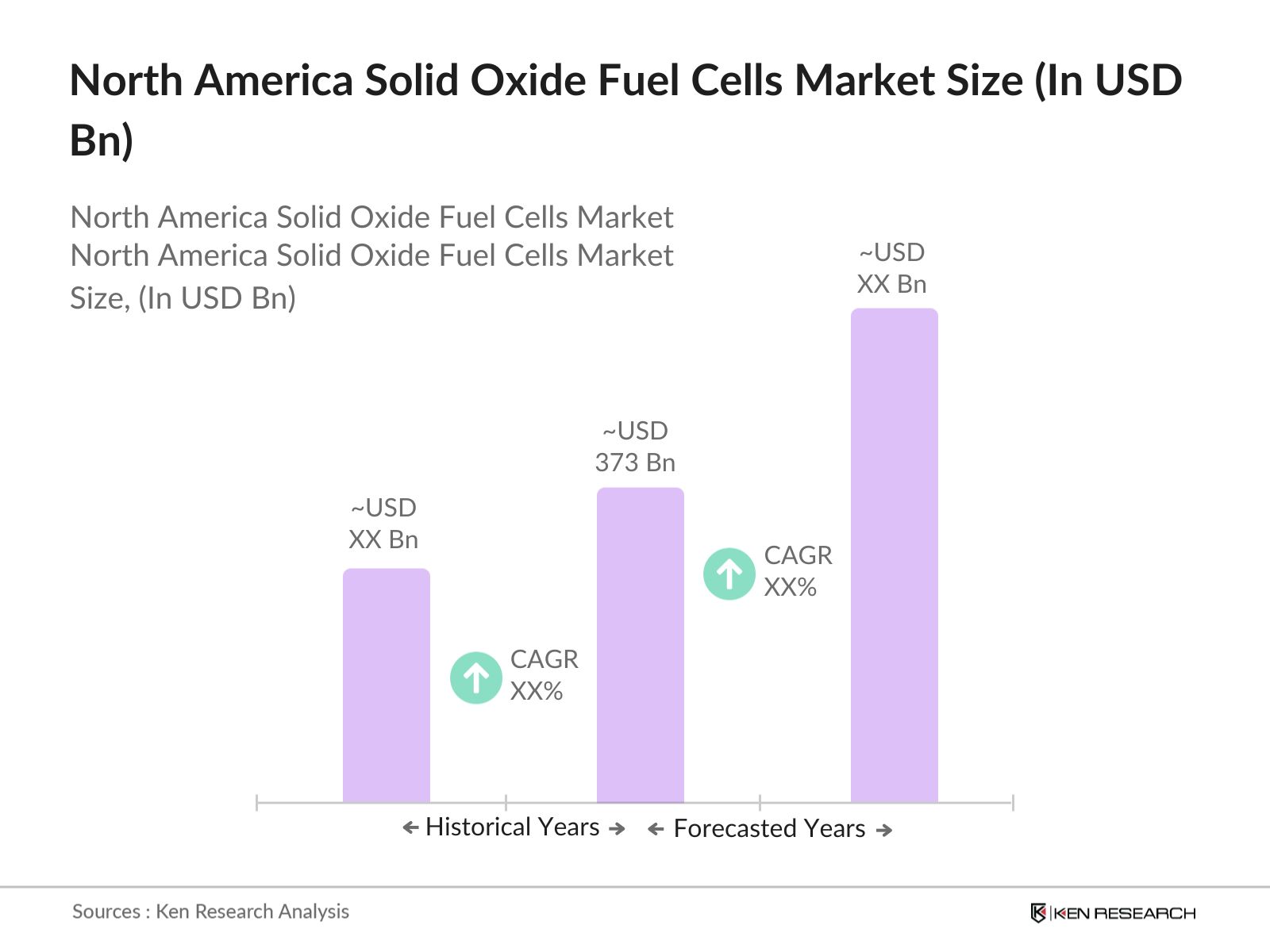
- The North America Solid Oxide Fuel Cells (SOFC) market is valued at USD 373 billion, driven by growing demand for clean energy alternatives and the adoption of distributed energy systems. The increasing emphasis on reducing carbon emissions and improving energy efficiency has resulted in a rise in the deployment of SOFC systems across residential, commercial, and industrial applications. These systems are increasingly being used due to their high efficiency, fuel flexibility, and long-term cost advantages in various power generation and backup power markets, creating significant market momentum.
- The SOFC market is particularly dominated by countries like the United States and Canada. The U.S. has many government incentives supporting clean energy, while Canadas growing investment in hydrogen energy solutions strengthens its position in the market. Both countries benefit from strong R&D in fuel cell technology, regulatory support, and growing adoption of stationary fuel cell systems for distributed power generation and microgrids.
- Government regulations mandating higher energy efficiency standards are driving the adoption of SOFCs across various sectors. In 2024, the U.S. Department of Energy introduced new guidelines aimed at improving energy efficiency by 30% in industrial and commercial buildings by 2025. These regulations encourage the use of energy-efficient technologies like SOFCs, which can achieve electricity generation efficiencies of over 60%, significantly higher than conventional power plants.
North America Solid Oxide Fuel Cells Market Segmentation
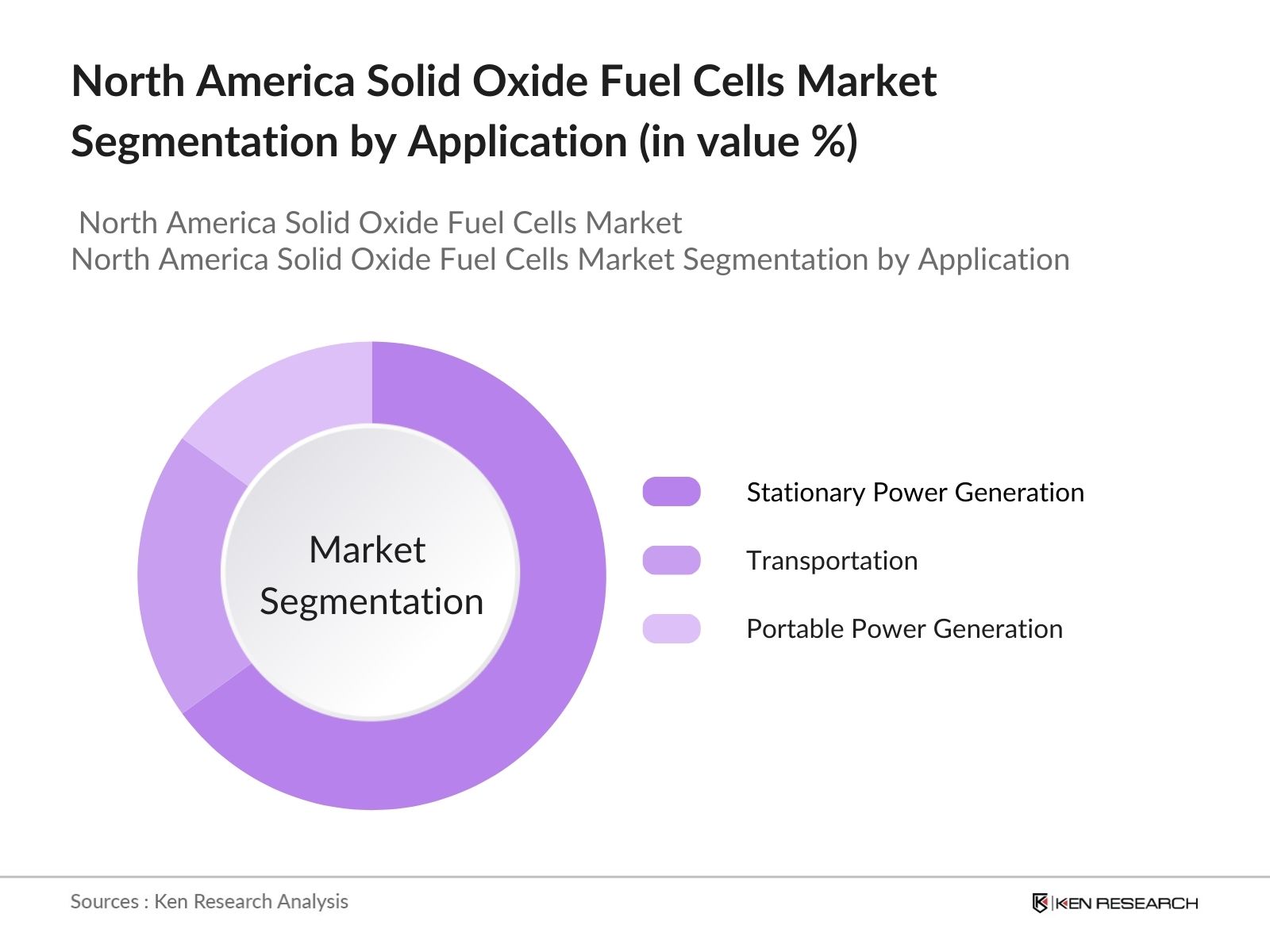
- By Application: The market is segmented by application into stationary power generation, transportation, and portable power generation. Stationary power generation applications dominate the market due to the high demand for distributed energy systems in residential and industrial applications. The ability of SOFC systems to operate continuously for long periods without interruption makes them particularly suited for providing backup power to hospitals, data centers, and remote areas where grid connectivity is limited.
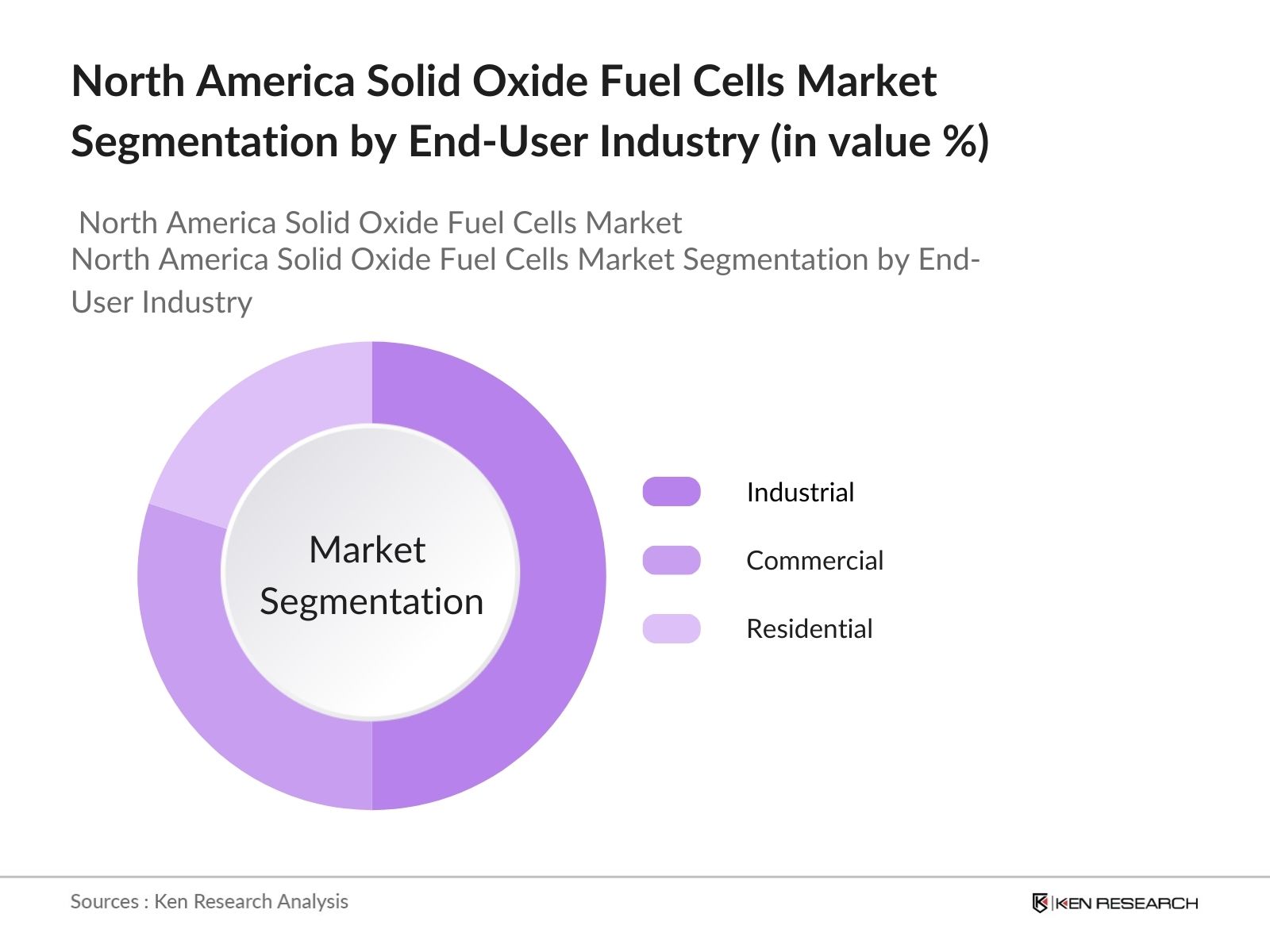
- By End-User Industry: The market is also segmented by end-user industry into residential, commercial, and industrial sectors. The industrial segment holds the largest market share, driven by the need for reliable and cost-efficient power generation solutions in manufacturing and processing plants. SOFC systems are being increasingly adopted in industrial operations due to their ability to deliver high efficiency and support cleaner energy transitions across various sectors, including chemicals, oil & gas, and metal processing.
North America Solid Oxide Fuel Cells Market Competitive Landscape
The North America SOFC market is dominated by a few key players, each with a significant influence due to their strong research and development capabilities and market presence. Companies like Bloom Energy Corporation and FuelCell Energy are driving market consolidation with innovative fuel cell solutions and strategic partnerships with government and private sectors.
|
Company Name |
Established |
Headquarters |
Revenue (USD Mn) |
Number of Employees |
Key Products |
Fuel Type |
Technology |
Customer Base |
R&D Investments |
|
Bloom Energy Corporation |
2001 |
San Jose, CA, USA |
|||||||
|
FuelCell Energy, Inc. |
1969 |
Danbury, CT, USA |
|||||||
|
Cummins Inc. |
1919 |
Columbus, IN, USA |
|||||||
|
Doosan Fuel Cell America |
2014 |
South Windsor, CT, USA |
|||||||
|
General Electric Company |
1892 |
Boston, MA, USA |
North America Solid Oxide Fuel Cells Industry Analysis
Market Growth Drivers
- Increasing Demand for Clean Energy Solutions: The growing demand for cleaner energy alternatives in North America has accelerated the adoption of solid oxide fuel cells (SOFCs) as they offer a highly efficient method of generating electricity with minimal emissions. By 2024, the U.S. Energy Information Administration (EIA) forecasts that approximately 18 quadrillion British thermal units (BTU) of energy consumption in the U.S. will be from renewable sources. SOFCs are gaining traction due to their ability to utilize a variety of fuels, such as hydrogen and natural gas, reducing the dependence on conventional fossil fuels. Data from the U.S. Department of Energy (DOE) highlights the ongoing support for clean energy technologies through grants and R&D funding.
- Government Policies Supporting Renewable Energy: The U.S. and Canada have introduced robust policies aimed at reducing greenhouse gas emissions and increasing the reliance on renewable energy. By 2024, the U.S. government has committed to reducing emissions by at least 50% compared to 2005 levels, as outlined in its Nationally Determined Contributions (NDC). This push towards sustainability includes financial incentives, tax rebates, and subsidies for fuel cell technologies. In Canada, the federal government has allocated over $15 billion towards green energy infrastructure, encouraging the expansion of SOFC installations in commercial, industrial, and residential applications.
Market Challenges
- High Initial Capital Costs: One of the primary challenges hindering the broader deployment of SOFCs is the high initial cost of installation. According to the U.S. Department of Energy, the installation of a commercial-scale SOFC system can range between $3,000 and $5,000 per kilowatt, which remains significantly higher compared to traditional power generation systems like combined cycle gas turbines. This has made large-scale adoption in commercial and residential settings slower, although long-term operational cost benefits are becoming more evident as production volumes increase.
- Challenges in Mass Commercialization: Mass commercialization of SOFC technology is still facing several hurdles, particularly in terms of manufacturing scalability. While recent advancements have lowered production costs, large-scale deployment remains limited to specific industries. According to data from ARPA-E, manufacturing efficiencies have increased by approximately 20% since 2022, yet the infrastructure needed to scale production to meet North America's growing energy demands is still under development. Government support for scaling manufacturing processes, especially in reducing the costs associated with high-temperature materials used in SOFCs, will be crucial in addressing this challenge.
North America Solid Oxide Fuel Cells Market Future Outlook
Over the next five years, the North America Solid Oxide Fuel Cells market is expected to exhibit significant growth, driven by continuous advancements in fuel cell technology and a growing emphasis on reducing carbon emissions. Governments across the region are providing substantial incentives and funding for clean energy projects, further enhancing the adoption of SOFC systems. Additionally, the increasing integration of SOFC systems in distributed power generation for smart grids and microgrids is expected to propel the market forward.
Future Market Opportunities
- Technological Innovations in Manufacturing Processes: Technological advancements in manufacturing processes present a substantial opportunity for the SOFC market. New techniques, such as 3D printing and additive manufacturing, have reduced the costs associated with producing complex fuel cell components. The U.S. National Renewable Energy Laboratory (NREL) has been actively developing methods to reduce the operational temperature of SOFCs through advanced ceramics, thereby increasing efficiency and reducing costs. These innovations have made the production of SOFCs more cost-effective, leading to increased deployment in both commercial and residential sectors.
- Expansion in Remote Power Generation Markets: SOFCs offer significant opportunities in remote and off-grid power generation markets, where reliable and efficient energy sources are critical. With increasing demand for power solutions in isolated areas, such as rural Canada and the U.S., SOFCs are proving to be viable alternatives to traditional diesel generators. According to the U.S. Energy Information Administration, over 12 million Americans live in areas that are either partially or entirely off the grid, providing a significant market for decentralized SOFC systems.
Scope of the Report
Products
Key Target Audience
Government and regulatory bodies (U.S. Department of Energy, Environment and Climate Change Canada)
Utility Companies
Energy Infrastructure Developers
Industrial Energy Users
Residential and Commercial Real Estate Developers
Venture Capital and Investment Firms
Power Generation Equipment Manufacturers
Banks and Financial Institutes
Research and Development Institutes
Companies
Major Players in the North America Solid Oxide Fuel Cells Market
Bloom Energy Corporation
FuelCell Energy, Inc.
Cummins Inc.
Doosan Fuel Cell America, Inc.
General Electric Company
Mitsubishi Power, Ltd.
Aisin Seiki Co., Ltd.
Ceres Power Holdings plc
Elcogen AS
Horizon Fuel Cell Technologies
Versa Power Systems
Hexis AG
SOLIDpower S.p.A.
Proton Power Systems plc
Convion Oy
Table of Contents
1. North America Solid Oxide Fuel Cells Market Overview
1.1. Definition and Scope
1.2. Market Taxonomy
1.3. Market Growth Rate
1.4. Market Segmentation Overview
2. North America Solid Oxide Fuel Cells Market Size (In USD Bn)
2.1. Historical Market Size
2.2. Year-On-Year Growth Analysis
2.3. Key Market Developments and Milestones
3. North America Solid Oxide Fuel Cells Market Analysis
3.1. Growth Drivers
3.1.1. Increasing Demand for Clean Energy Solutions
3.1.2. Government Policies Supporting Renewable Energy
3.1.3. Advancements in Fuel Cell Technology
3.1.4. Adoption in Stationary and Portable Applications
3.2. Market Challenges
3.2.1. High Initial Capital Costs
3.2.2. Challenges in Mass Commercialization
3.2.3. Infrastructure Development for Fuel Distribution
3.3. Opportunities
3.3.1. Technological Innovations in Manufacturing Processes
3.3.2. Expansion in Remote Power Generation Markets
3.3.3. Partnerships between Government and Private Sectors
3.4. Trends
3.4.1. Integration with Hydrogen Economy
3.4.2. Adoption of Distributed Power Generation Systems
3.4.3. Increased Focus on Decentralized Power Systems
3.5. Government Regulation
3.5.1. Energy Efficiency Standards
3.5.2. Incentives and Subsidies for Fuel Cells
3.5.3. Emission Reduction Initiatives
3.5.4. R&D Grants and Funding Programs
3.6. SWOT Analysis
3.7. Stakeholder Ecosystem
3.8. Porters Five Forces Analysis
3.9. Competition Ecosystem
4. North America Solid Oxide Fuel Cells Market Segmentation
4.1. By Application (In Value %)
4.1.1. Stationary Power Generation
4.1.2. Transportation
4.1.3. Portable Power Generation
4.2. By End-User Industry (In Value %)
4.2.1. Residential
4.2.2. Commercial
4.2.3. Industrial
4.3. By Power Rating (In Value %)
4.3.1. <100 kW
4.3.2. 100 kW - 1 MW
4.3.3. >1 MW
4.4. By Fuel Type (In Value %)
4.4.1. Natural Gas
4.4.2. Hydrogen
4.4.3. Biogas
4.5. By Region (In Value %)
4.5.1. North
4.5.2. East
4.5.3. West
4.5.4. South
5. North America Solid Oxide Fuel Cells Market Competitive Analysis
5.1. Detailed Profiles of Major Companies
5.1.1. Bloom Energy Corporation
5.1.2. FuelCell Energy, Inc.
5.1.3. Cummins Inc.
5.1.4. Ceres Power Holdings plc
5.1.5. General Electric Company
5.1.6. Aisin Seiki Co., Ltd.
5.1.7. Elcogen AS
5.1.8. Doosan Fuel Cell America, Inc.
5.1.9. Mitsubishi Power, Ltd.
5.1.10. SOLIDpower S.p.A.
5.1.11. Convion Oy
5.1.12. Versa Power Systems
5.1.13. Hexis AG
5.1.14. Horizon Fuel Cell Technologies
5.1.15. Proton Power Systems plc
5.2. Cross Comparison Parameters
5.2.1. Revenue
5.2.2. Headquarters
5.2.3. Employee Count
5.2.4. Inception Year
5.2.5. Market Share Analysis
5.3. Strategic Initiatives
5.4. Mergers and Acquisitions
5.5. Investment Analysis
5.6. Venture Capital Funding
5.7. Government Grants and Subsidies
5.8. Private Equity Investments
6. North America Solid Oxide Fuel Cells Market Regulatory Framework
6.1. Compliance Standards for Emissions
6.2. Government Incentives and Subsidies
6.3. Industry Certification Processes
7. North America Solid Oxide Fuel Cells Future Market Size (In USD Bn)
7.1. Future Market Size Projections
7.2. Key Factors Driving Future Market Growth
8. North America Solid Oxide Fuel Cells Future Market Segmentation
8.1. By Application (In Value %)
8.2. By End-User Industry (In Value %)
8.3. By Power Rating (In Value %)
8.4. By Fuel Type (In Value %)
8.5. By Region (In Value %)
9. North America Solid Oxide Fuel Cells Market Analysts Recommendations
9.1. TAM/SAM/SOM Analysis
9.2. Customer Segmentation Analysis
9.3. Go-to-Market Strategy
9.4. White Space Opportunity Analysis
Research Methodology
Step 1: Identification of Key Variables
The initial stage involves mapping out the key stakeholders in the North America Solid Oxide Fuel Cells market through desk research and industry reports. This includes identifying critical variables such as fuel type, application, and end-user industries, which shape the market's dynamics.
Step 2: Market Analysis and Construction
Historical data from reputable databases is analyzed to construct a comprehensive view of the market. This step includes evaluating key market trends, penetration rates, and the adoption of SOFC systems in different industries. Data from past projects is cross-referenced to ensure accuracy.
Step 3: Hypothesis Validation and Expert Consultation
Hypotheses regarding future market growth and technological advancements are validated through direct consultation with industry experts, fuel cell manufacturers, and power generation companies. These consultations provide practical insights into market performance and customer needs.
Step 4: Research Synthesis and Final Output
In the final step, data from interviews, case studies, and market reports is synthesized into a detailed analysis of the market. This output is cross verified to ensure accuracy and relevance for stakeholders in the SOFC market, culminating in actionable insights for industry participants.
Frequently Asked Questions
01. How big is the North America Solid Oxide Fuel Cells market?
The North America Solid Oxide Fuel Cells market is valued at USD 373 billion, driven by growing investments in clean energy infrastructure and the increasing adoption of distributed energy systems for power generation and backup.
02. What are the challenges in the North America Solid Oxide Fuel Cells market?
Key challenges in the North America Solid Oxide Fuel Cells market include high initial capital costs for deploying SOFC systems, technical hurdles in mass commercialization, and limited infrastructure for hydrogen distribution. These challenges impact the broader adoption of SOFCs, especially in residential applications.
03. Who are the major players in the North America Solid Oxide Fuel Cells market?
Major players in North America Solid Oxide Fuel Cells market include Bloom Energy Corporation, FuelCell Energy, Inc., Cummins Inc., Doosan Fuel Cell America, Inc., and General Electric Company. These companies dominate the market through continuous innovation, partnerships, and government support.
04. What are the growth drivers of the North America Solid Oxide Fuel Cells market?
The North America Solid Oxide Fuel Cells market is driven by increasing demand for clean energy alternatives, government incentives for renewable energy adoption, advancements in SOFC technology, and the rising need for reliable and efficient power generation systems.
05. What are the future opportunities in the North America Solid Oxide Fuel Cells market?
Future opportunities in North America Solid Oxide Fuel Cells market lie in the integration of SOFC systems with hydrogen fuel networks, expanding their use in microgrids, and the growing adoption of distributed power generation solutions for residential and industrial applications. These areas are expected to experience rapid growth as the clean energy transition accelerates across the region.
Why Buy From Us?

What makes us stand out is that our consultants follows Robust, Refine and Result (RRR) methodology. i.e. Robust for clear definitions, approaches and sanity checking, Refine for differentiating respondents facts and opinions and Result for presenting data with story

We have set a benchmark in the industry by offering our clients with syndicated and customized market research reports featuring coverage of entire market as well as meticulous research and analyst insights.

While we don't replace traditional research, we flip the method upside down. Our dual approach of Top Bottom & Bottom Top ensures quality deliverable by not just verifying company fundamentals but also looking at the sector and macroeconomic factors.

With one step in the future, our research team constantly tries to show you the bigger picture. We help with some of the tough questions you may encounter along the way: How is the industry positioned? Best marketing channel? KPI's of competitors? By aligning every element, we help maximize success.

Our report gives you instant access to the answers and sources that other companies might choose to hide. We elaborate each steps of research methodology we have used and showcase you the sample size to earn your trust.

If you need any support, we are here! We pride ourselves on universe strength, data quality, and quick, friendly, and professional service.