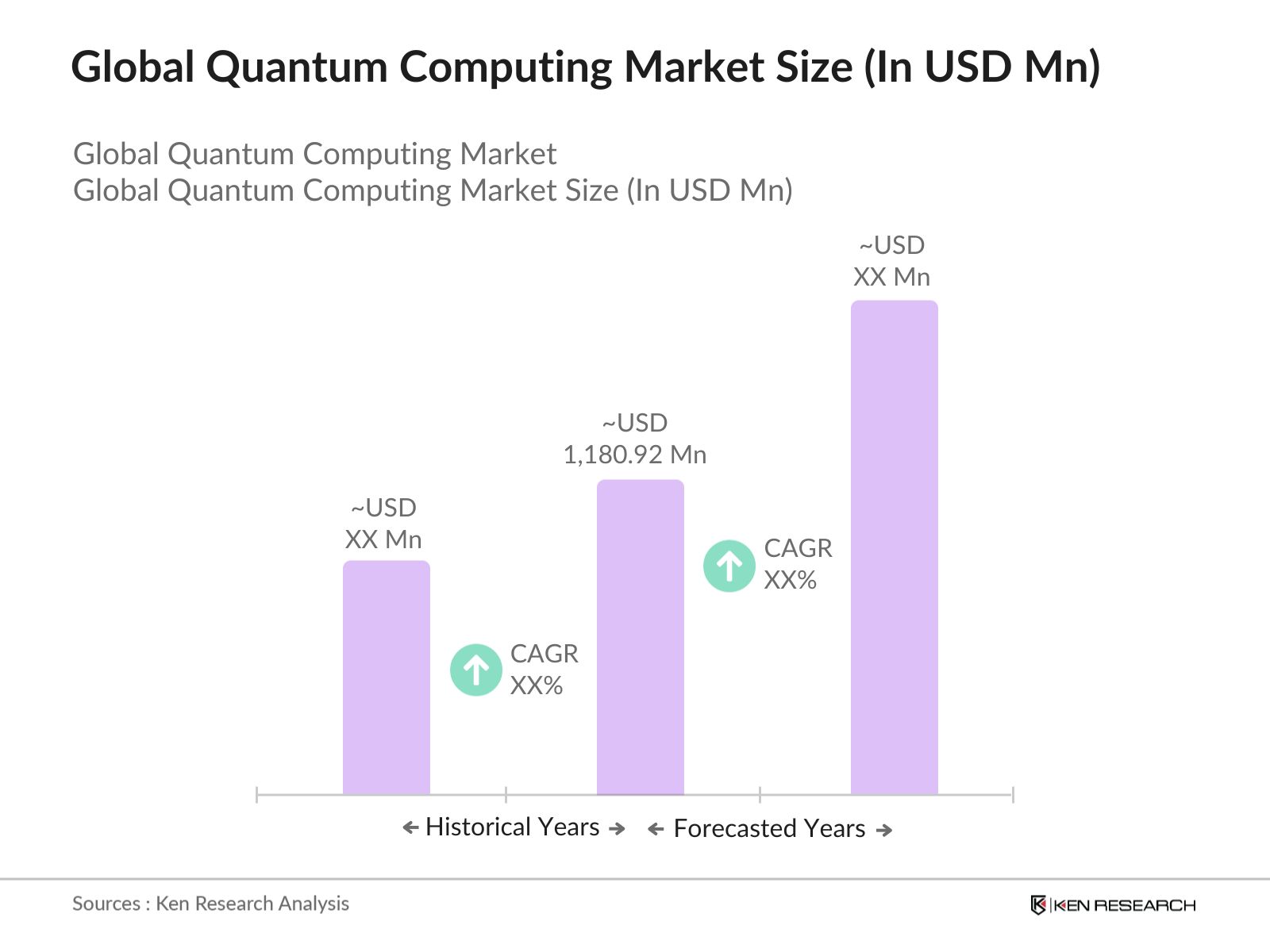
Global Quantum Computing Market Outlook to 2030

Region:Global

Author(s):Meenakshi Bisht

Product Code:KROD1223

Published On

December 2024

Total pages

88

About the Report

Global Quantum Computing Market Overview

  • The Global Quantum Computing Market was valued at USD 1,180.92 million in 2023. The growth is primarily driven by the increasing adoption of quantum computing in sectors like pharmaceuticals, finance, and cybersecurity, which require massive data processing capabilities. The demand for quantum computing is further fueled by technological advancements and the increased focus on research and development in quantum technologies.

market overviews

  • The quantum computing market is highly competitive, with key players including IBM, Google, Microsoft, D-Wave Systems, and Rigetti Computing. These companies are at the forefront of quantum research and development, making significant investments in building quantum processors and quantum cloud services. Their efforts are critical in driving market growth, as they continue to innovate and expand their quantum computing capabilities.
  • In 2021, IBM announced the development of its most powerful quantum computer, the IBM Quantum Eagle, with 127 qubits. This development marks a significant milestone in quantum computing, as it paves the way for tackling complex problems beyond the reach of classical computers. The IBM Quantum Eagle is expected to be a game-changer in industries like pharmaceuticals, where quantum computing can accelerate drug discovery and development processes.
  • In 2023, the United States was dominating the market due to the presence of key players like IBM, Google, and Microsoft. The region's leadership is driven by significant investments in quantum research and a robust ecosystem of quantum startups. The U.S. government and private sector investing heavily in quantum technologies to maintain a competitive edge in this critical field.

Global Quantum Computing Market Segmentation

The Global Quantum Computing Market is segmented into different factors like by product type, by end user industry and region.

By Product Type: The market is segmented by product type into quantum hardware, quantum software, and quantum services. In 2023, quantum services were dominating the market, driven by the increasing demand for quantum cloud services and consulting. Companies like IBM and Google have established strong quantum cloud platforms that allow organizations to access quantum computing resources without the need for expensive hardware investments. The rise of quantum-as-a-service (QaaS) models has further solidified the dominance of this segment.
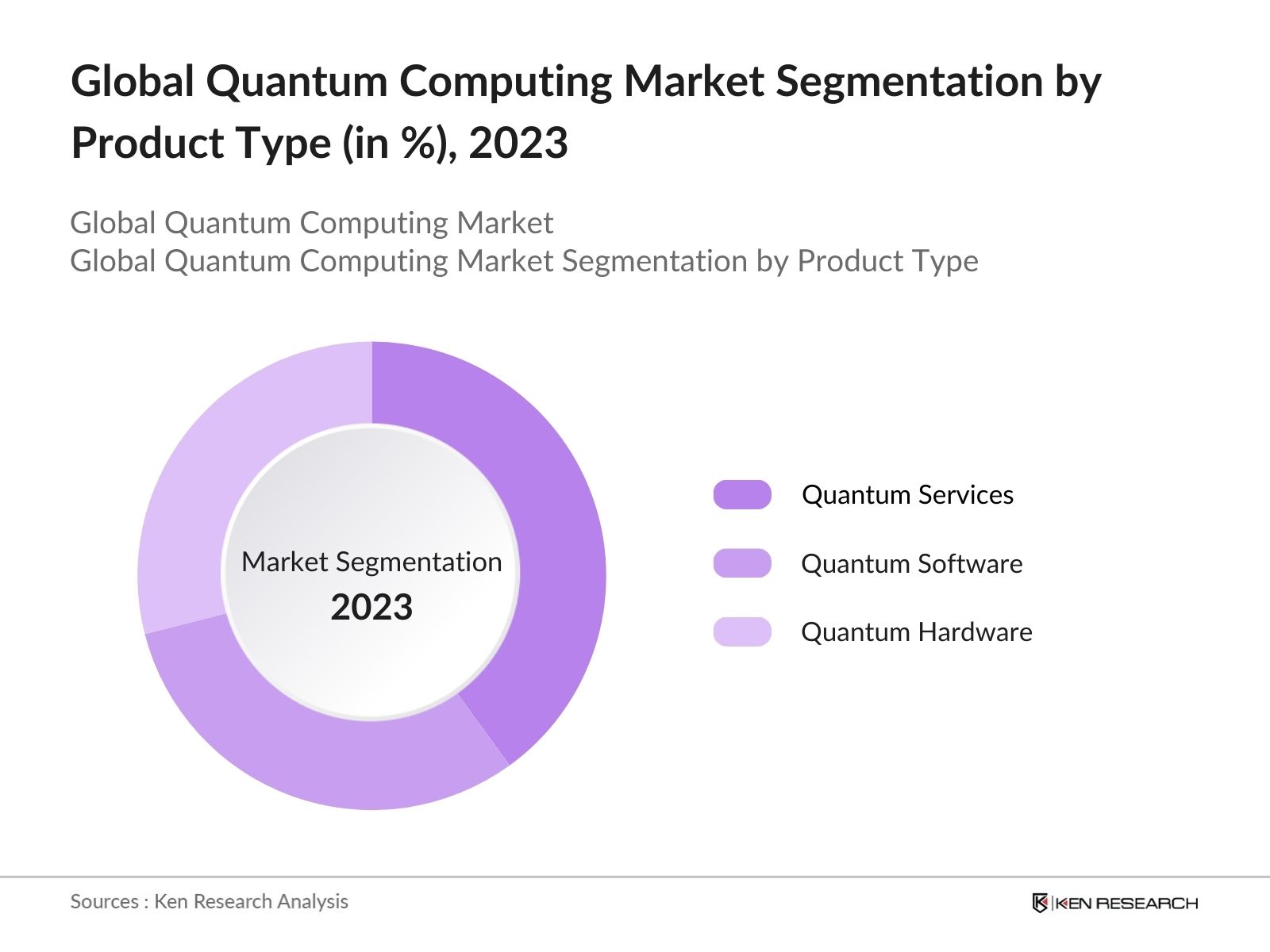
Global Quantum Computing Market Segmentation by Product Type

By Region: The market is segmented by region into North America, Europe, APAC, MEA, and Latin America. In 2023, North America dominated the market due to its advanced R&D infrastructure, significant government funding, and the presence of key players like IBM, Google, and Microsoft. The region's strong ecosystem of quantum startups and extensive investments in quantum technologies also contribute to its leading position.
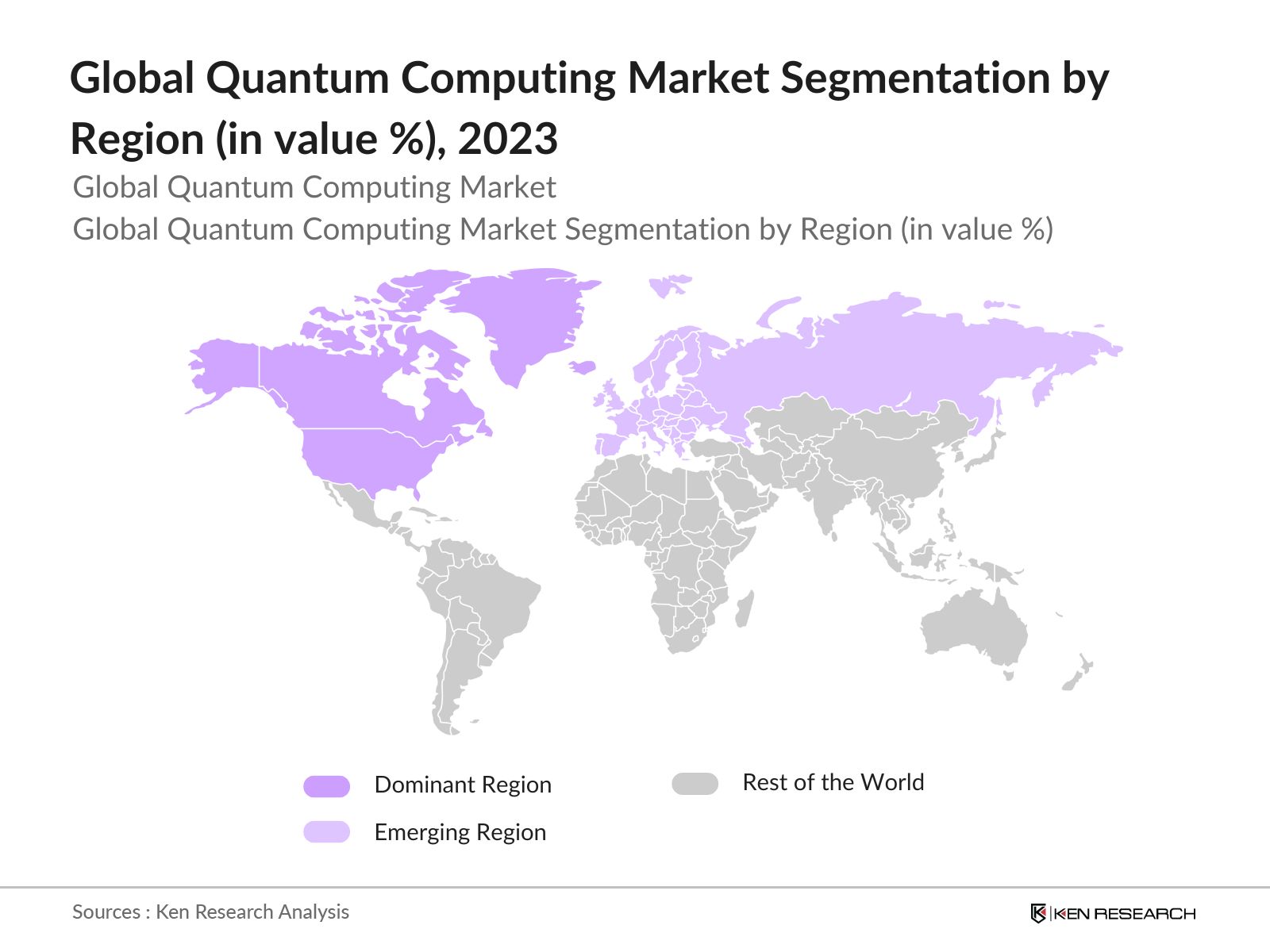
Global Quantum Computing Market Segmentation by Region

By End-User Industry: The market is also segmented by end-user industries, including finance, healthcare, and aerospace & defense. In 2023, the finance sector held the largest market share of the market due to the industry's early adoption of quantum computing for risk analysis, portfolio optimization, and fraud detection. Financial institutions are increasingly leveraging quantum algorithms to gain a competitive edge in the market, driving the demand for quantum computing solutions in this sector.

Global Quantum Computing Market Competitive Landscape

Global Quantum Computing Market Major Players

Company Name

Establishment Year

Headquarters

IBM

1911

Armonk, New York, USA

Google

1998

Mountain View, CA, USA

Microsoft

1975

Redmond, WA, USA

D-Wave Systems

1999

Burnaby, BC, Canada

Rigetti Computing

2013

Berkeley, CA, USA

  • Google: In March 2024, Google Quantum AI, in collaboration with XPRIZE and the Geneva Science and Diplomacy Anticipator (GESDA), launched a three-year, $5 million global competition called XPRIZE Quantum Applications. This initiative aims to encourage the application of quantum computing to solve real-world challenges, showcasing Google's commitment to leveraging quantum technology for practical solutions.
  • Microsoft: PsiQuantum and Microsoft are both involved in DARPA's Underexplored Systems for Utility-Scale Quantum Computing (US2QC) program, which aims to explore unconventional quantum computing methods to achieve utility-scale operation. This program began in February 2023, and both companies have progressed to the second phase, focusing on developing a fault-tolerant prototype of a quantum computer, with evaluations expected by March 2025.

Global Quantum Computing Market Analysis

Global Quantum Computing Market Growth Drivers

  • Increased Government Funding and Investment in Quantum Research: In 2024, governments across the globe have committed substantial funds towards the development of quantum computing technologies. The U.S. government, has allocated $1.2 billion under the National Quantum Initiative, aiming to accelerate quantum research and development. Similarly, China's government has invested over $500 million in its Quantum Internet initiative, which is expected to create a quantum communication network spanning major cities by 2025. These investments are propelling the quantum computing market by providing the necessary financial support for research, development, and deployment of quantum technologies.
  • Growing Demand for Quantum Computing in Pharmaceutical Industry: The pharmaceutical industry is increasingly relying on quantum computing for drug discovery and development. By 2024, major pharmaceutical companies will invest in quantum computing collaborations to accelerate the drug discovery process. Quantum computers' ability to simulate molecular interactions at an unprecedented scale is expected to reduce the time required for drug development significantly. This growing demand from the pharmaceutical sector is driving the adoption of quantum computing, as companies look to gain a competitive edge in the market.
  • Expansion of Quantum Cloud Services: Quantum cloud services are gaining traction as more businesses seek to leverage quantum computing without the need for expensive hardware. By 2024, companies like IBM and Amazon Web Services (AWS) have expanded their quantum cloud offerings, enabling access to quantum computing resources globally. AWS, for instance, has reported an increase in quantum computing-related projects, with over 1,000 companies using its Braket service by mid-2024. The expansion of these services is driving market growth by making quantum computing more accessible to a broader range of industries.

Global Quantum Computing Market Challenges

  • Technical Complexity and Lack of Skilled Workforce: Quantum computing is an extremely complex field that requires specialized knowledge in quantum mechanics, computer science, and engineering. As of 2024, there is a significant shortage of professionals with the necessary expertise to develop and operate quantum systems. The lack of a skilled workforce is a major challenge for the quantum computing market, as it slows down the pace of innovation and limits the scalability of quantum technologies. Companies are investing in training programs and partnerships with academic institutions to address this skills gap, but it remains a long-term challenge for the industry.
  • Quantum Error Correction and Stability Issues: Quantum error correction is one of the most significant technical challenges in quantum computing. As of 2024, achieving stable and reliable quantum computations remains difficult due to the high error rates in quantum systems. These errors arise from the fragile nature of quantum states, which can easily be disturbed by environmental factors. Despite ongoing research, the development of effective error correction methods is still in its early stages, posing a substantial challenge to the practical implementation of quantum computers. This issue continues to hinder the markets growth by limiting the reliability of quantum computing solutions.

Global Quantum Computing Market Government Initiatives

  • European Union's Quantum Flagship Program: The European Union has launched the Quantum Flagship program, a 1 billion initiative aimed at advancing quantum technologies within the EU. As of 2024, the program has funded over 20 projects focused on quantum computing, communication, and simulation. The initiative supports collaboration between research institutions, industry, and government agencies, with the goal of creating a competitive quantum ecosystem in Europe. The Quantum Flagship program is a key driver of quantum innovation in the region, positioning Europe as a major player in the global quantum computing market.
  • India National Quantum Mission: India's National Quantum Mission (NQM), launched in 2023, is a strategic initiative by the Department of Science & Technology to advance quantum technologies. The mission aims to develop quantum computers with 50-1000 qubits, establish secure satellite-based quantum communication networks, and create advanced quantum materials and devices. Additionally, the mission includes the establishment of four thematic hubs focused on quantum computation, communication, sensing, and materials. These efforts are designed to position India as a global leader in quantum technology over the next decade.

Global Quantum Computing Market Future Outlook

The Global Quantum Computing Market is projected to grow exponentially by 2028, driven by advancements in quantum hardware and software, as well as increased adoption across various industries. The expansion of quantum computing applications in fields such as artificial intelligence, cryptography, and optimization will further propel market growth. Additionally, the emergence of quantum cloud services is anticipated to democratize access to quantum computing, enabling broader adoption and innovation.

Market Trends

  • Expansion of Quantum Computing Applications in Artificial Intelligence: Over the next five years, quantum computing will play an increasingly vital role in advancing artificial intelligence (AI) technologies. By 2028, quantum computers are expected to enable significant improvements in machine learning algorithms, particularly in areas such as natural language processing, image recognition, and predictive analytics. These advancements will result in more powerful and efficient AI systems, driving the adoption of quantum computing in industries that rely heavily on AI, such as finance, healthcare, and cybersecurity.
  • Development of Quantum-Secured Communication Networks: The future of quantum computing will see the development and deployment of quantum-secured communication networks. By 2028, several countries are expected to have established quantum communication networks that leverage quantum key distribution (QKD) to provide ultra-secure data transmission. This technology will be particularly important for government agencies, financial institutions, and organizations that handle sensitive information, as it offers protection against cyber threats that cannot be mitigated by classical encryption methods.

Scope of the Report

By Product Type

Quantum Hardware

Quantum Software

Quantum Services

By End-User Industry

Finance

Healthcare

Aerospace & Defense

Others

By Region

North America

Europe

APAC

MEA

Latin America

By Application

Machine Learning

Optimization

Biomedical Simulations

Financial Services

Electronic Material Discovery

Other (Traffic Optimization, Weather Forecasting, and others.)

By Offering Type

Consulting Solutions

Systems

Products

Key Target Audience Organizations and Entities who can benefit by subscribing this report

  • Pharmaceutical Companies

  • Aerospace and Defense Contractors

  • Healthcare Organizations

  • Artificial Intelligence and Machine Learning Companies

  • Data Analytics Firms

  • Cybersecurity Firms

  • High-Performance Computing (HPC) Centers

  • Banks and Financial Institutions

  • Investors and Venture Capital Firms

  • Government Agencies (U.S. Department of Defense (DoD), National Security Agency (NSA))

Time Period Captured in the Report:

  • Historical Period:2018-2023

  • Base Year:2023

  • Forecast Period:2023-2028

Companies

Players Mention in the Report:

  • IBM

  • Google

  • Microsoft

  • D-Wave Systems

  • Rigetti Computing

  • Honeywell

  • IonQ

  • Amazon Web Services (AWS)

  • Intel

  • Alibaba Group

  • Toshiba

  • Fujitsu

  • NTT Data

  • Accenture

  • Cambridge Quantum Computing

Table of Contents

1. Global Quantum Computing Market Overview

1.1. Definition and Scope

1.2. Market Taxonomy

1.3. Market Growth Rate

1.4. Market Segmentation Overview

2. Global Quantum Computing Market Size (in USD Mn), 2018-2023

2.1. Historical Market Size

2.2. Year-on-Year Growth Analysis

2.3. Key Market Developments and Milestones

3. Global Quantum Computing Market Analysis

3.1. Growth Drivers

3.1.1. Increased Government Funding

3.1.2. Growing Demand in Pharmaceuticals

3.1.3. Expansion of Quantum Cloud Services

3.1.4. Strategic Partnerships

3.2. Restraints

3.2.1. High Development Costs

3.2.2. Technical Complexity

3.2.3. Quantum Error Correction Challenges

3.2.4. Limited Commercial Applications

3.3. Opportunities

3.3.1. Expansion into New Industries

3.3.2. Technological Advancements

3.3.3. International Collaborations

3.3.4. Increased Adoption of Quantum-as-a-Service (QaaS)

3.4. Trends

3.4.1. AI and Quantum Computing Integration

3.4.2. Quantum-Secured Communication Networks

3.4.3. Growth of Quantum Cloud Platforms

3.4.4. Advancements in Quantum Error Correction

3.5. Government Regulation

3.5.1. National Quantum Initiatives

3.5.2. Quantum Security Regulations

3.5.3. International Quantum Collaboration Agreements

3.5.4. Public-Private Partnerships

3.6. SWOT Analysis

3.7. Stakeholder Ecosystem

3.8. Competition Ecosystem

4. Global Quantum Computing Market Segmentation, 2023

4.1. By Product Type (in Value %)

4.1.1. Quantum Hardware

4.1.2. Quantum Software

4.1.3. Quantum Services

4.2. By End-User Industry (in Value %)

4.2.1. Finance

4.2.2. Healthcare

4.2.3. Aerospace & Defense

4.2.4. Others

4.3. By Region (in Value %)

4.3.1. North America

4.3.2. Europe

4.3.3. APAC

4.3.4. MEA

4.3.5. Latin America

4.4. By Application (in Value %)

4.4.1. Machine Learning

4.4.1. Optimization

4.4.1. Biomedical Simulations

4.4.1. Financial Services

4.4.1. Electronic Material Discovery

4.4.1. Other (Traffic Optimization, Weather Forecasting, and others.)

4.5. By Offering Type (in Value %)

4.5.1. Consulting Solutions

4.5.2. Systems

5. Global Quantum Computing Market Cross Comparison

5.1 Detailed Profiles of Major Companies

5.1.1. IBM

5.1.2. Google

5.1.3. Microsoft

5.1.4. D-Wave Systems

5.1.5. Rigetti Computing

5.2 Cross Comparison Parameters (No. of Employees, Headquarters, Inception Year, Revenue)

6. Global Quantum Computing Market Competitive Landscape

6.1. Market Share Analysis

6.2. Strategic Initiatives

6.3. Mergers and Acquisitions

6.4. Investment Analysis

6.4.1. Venture Capital Funding

6.4.2. Government Grants

6.4.3. Private Equity Investments

7. Global Quantum Computing Market Regulatory Framework

7.1. Quantum Security Standards

7.2. Compliance Requirements

7.3. Certification Processes

8. Global Quantum Computing Future Market Size (in USD Mn), 2023-2028

8.1. Future Market Size Projections

8.2. Key Factors Driving Future Market Growth

9. Global Quantum Computing Future Market Segmentation, 2028

9.1. By Product Type (in Value %)

9.2. By End-User Industry (in Value %)

9.3. By Region (in Value %)

9.4. By Application (in Value %)
9.5. By Offering Type (in Value %)

10. Global Quantum Computing Market Analysts Recommendations

10.1. TAM/SAM/SOM Analysis

10.2. Customer Cohort Analysis

10.3. Marketing Initiatives

10.4. White Space Opportunity Analysis

Disclaimer Contact Us

Research Methodology

Step 1: Identifying Key Variables

Ecosystem creation for all the major entities and referring to multiple secondary and proprietary databases to perform desk research around the market to collate industry level information.

Step 2: Market Building

Collating statistics on Global Quantum Computing Market over the years, penetration of marketplaces and service providers ratio to compute revenue generated for Global Quantum Computing Industry. We will also review service quality statistics to understand revenue generated which can ensure accuracy behind the data points shared.

Step 3: Validating and Finalizing

Building market hypothesis and conducting CATIs with industry experts belonging to different companies to validate statistics and seek operational and financial information from company representatives.

Step 4: Research output

Our team will approach multiple technologies companies and understand nature of product segments and sales, consumer preference and other parameters, which will support us validate statistics derived through bottom to top approach fromsuch technologies companies.

Frequently Asked Questions

01 How big is the Global Quantum Computing Market?

The Global Quantum Computing Market, valued at USD 1,180.92 million in 2023, is driven by increasing adoption in sectors such as finance, pharmaceuticals, and cybersecurity, along with significant government and private investments.

02 What are the challenges in the Global Quantum Computing Market?

Challenges in Global Quantum Computing Market include high costs of quantum hardware development, technical complexities, quantum error correction issues, and limited commercial applications. These hurdles slow down broader adoption and scalability of quantum technologies.

03 Who are the major players in the Global Quantum Computing Market?

Key players in Global Quantum Computing Market include IBM, Google, Microsoft, D-Wave Systems, and Rigetti Computing. These companies lead the market through continuous innovation, strategic partnerships, and significant investments in quantum research and development.

04 What are the growth drivers of the Global Quantum Computing Market?

Growth drivers in Global Quantum Computing Market include increased government funding, growing demand from the pharmaceutical industry, expansion of quantum cloud services, and strategic partnerships between tech giants and research institutions, all fueling market expansion.

Why Buy From Us?

RRR
Refine Robust Result (RRR) Framework

What makes us stand out is that our consultants follows Robust, Refine and Result (RRR) methodology. i.e. Robust for clear definitions, approaches and sanity checking, Refine for differentiating respondents facts and opinions and Result for presenting data with story

Our Reach Is Unmatched

We have set a benchmark in the industry by offering our clients with syndicated and customized market research reports featuring coverage of entire market as well as meticulous research and analyst insights.

Research
Shifting the Research Paradigm

While we don't replace traditional research, we flip the method upside down. Our dual approach of Top Bottom & Bottom Top ensures quality deliverable by not just verifying company fundamentals but also looking at the sector and macroeconomic factors.

Insite
More Insights-Better Decisions

With one step in the future, our research team constantly tries to show you the bigger picture. We help with some of the tough questions you may encounter along the way: How is the industry positioned? Best marketing channel? KPI's of competitors? By aligning every element, we help maximize success.

Trust
Transparency and Trust

Our report gives you instant access to the answers and sources that other companies might choose to hide. We elaborate each steps of research methodology we have used and showcase you the sample size to earn your trust.

support
Round the Clock Support

If you need any support, we are here! We pride ourselves on universe strength, data quality, and quick, friendly, and professional service.

Why Client Choose Us?

400000+ Reports in repository
150+ Consulting project a year
100+ Analysts
8000+ Client Queries in 2022