
Saudi Arabia Customer Self-Service Software Market Outlook to 2030
Region:Middle East
Author(s):Sanjeev
Product Code:KROD9475
December 2024
81
About the Report
Saudi Arabia Customer Self-Service Software Market Overview
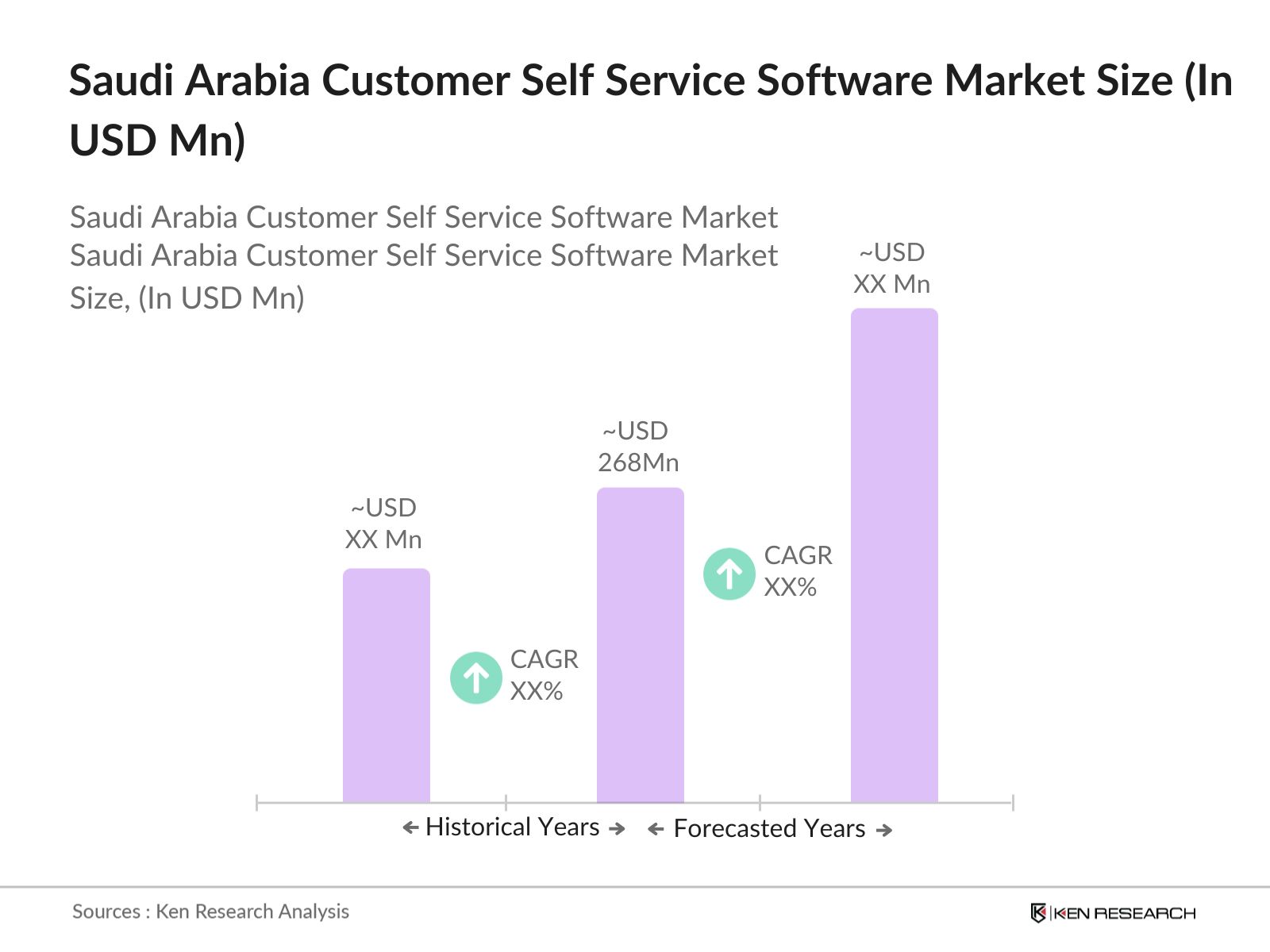
- The Saudi Arabia Customer Self-Service Software market is valued at USD 268 million based on historical data and has shown strong growth due to increasing digital transformation efforts across various sectors. The market is driven by the rapid adoption of digital tools to enhance customer service, with significant contributions from industries such as banking, telecommunications, and retail. The demand for self-service solutions, including interactive voice response (IVR) systems and chatbots, continues to rise, fueled by customer preferences for convenience and 24/7 support.
- Riyadh, Jeddah, and Dammam dominate the market due to their concentration of large enterprises and financial hubs that prioritize customer satisfaction through advanced technologies. Riyadh, as the capital and major economic center, leads in the adoption of customer self-service software, thanks to its robust infrastructure and government support for digital transformation, aligned with Saudi Vision 2030. These cities serve as key growth centers, supported by their strong enterprise base and focus on improving customer experiences.
- Saudi Vision 2030 aims to diversify the economy and improve the digital infrastructure across industries, including customer service. The government has committed SAR 75 billion to the ICT sector by 2025, which is instrumental in enhancing customer service platforms. This comprehensive strategy focuses on advancing digital tools, automation, and customer self-service technologies, creating a favorable environment for the growth of customer self-service software in various sectors.
Saudi Arabia Customer Self-Service Software Market Segmentation
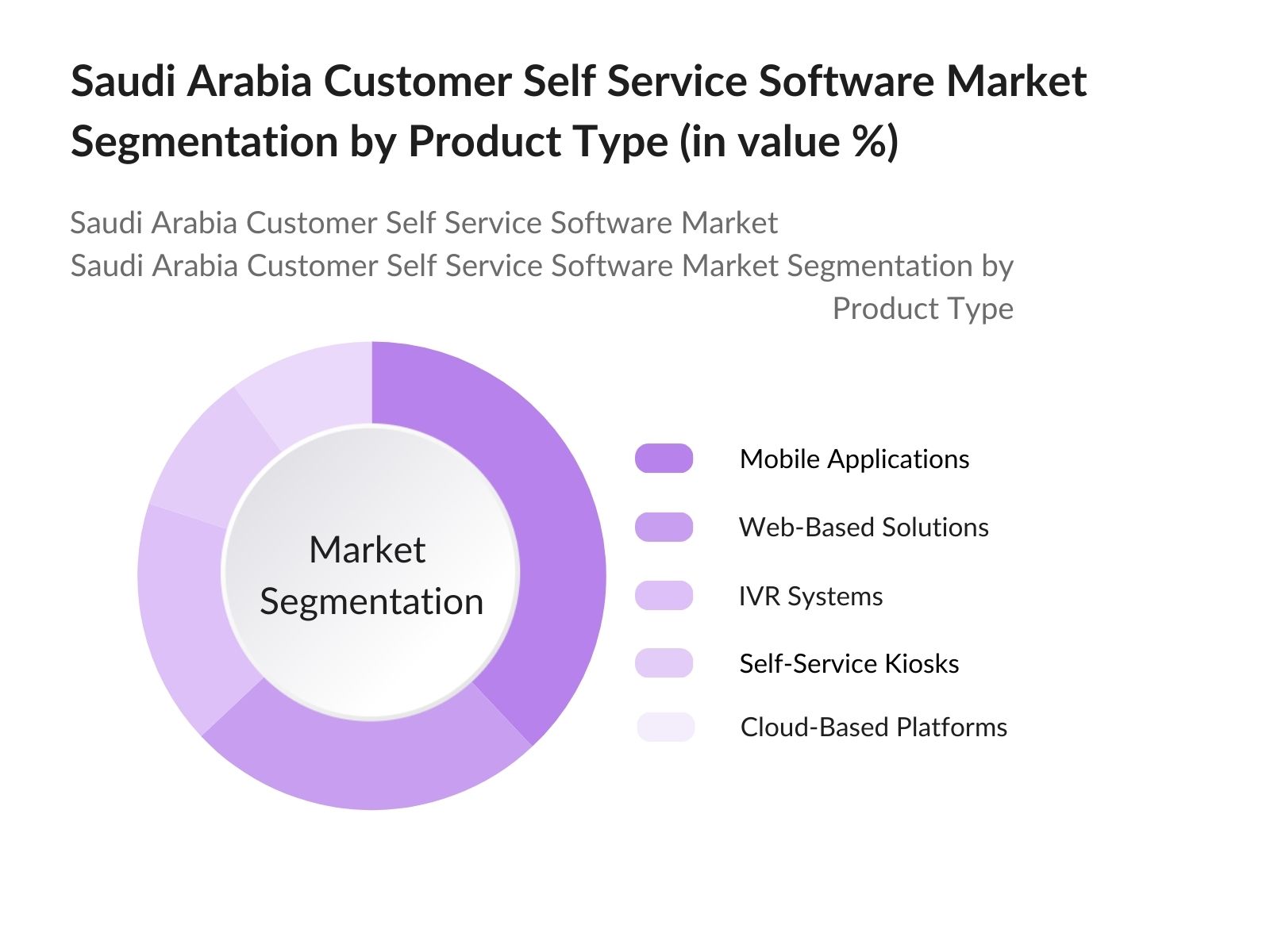
- By Product Type: Saudi Arabias Customer Self-Service Software market is segmented by product type into web-based solutions, mobile applications, IVR systems, self-service kiosks, and cloud-based platforms. Recently, mobile applications hold the dominant market share, driven by the increased penetration of smartphones and the demand for on-the-go customer support solutions. The preference for mobile apps is further bolstered by the convenience and ease they offer, allowing users to manage their accounts, request services, and troubleshoot problems directly from their devices without human intervention.
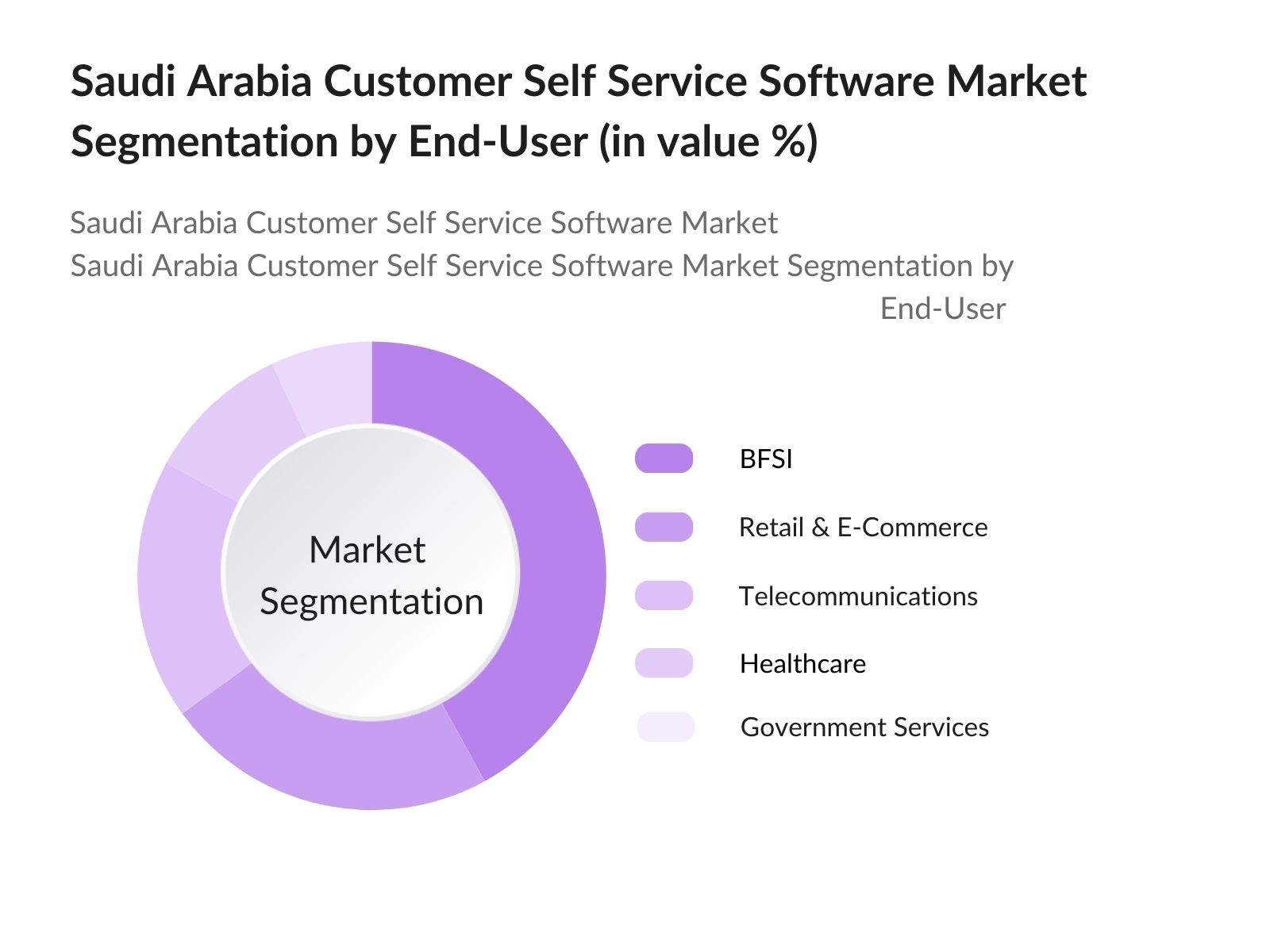
- By End-User Industry: The market is segmented by end-user industries, including banking, financial services, and insurance (BFSI), retail and e-commerce, telecommunications, healthcare, and government services. The BFSI sector dominates this segment due to the sectors inherent need for automation and personalized customer service. As financial institutions embrace digital transformation, customer self-service software helps them reduce operational costs, increase efficiency, and enhance customer engagement through features such as automated customer support, account management, and real-time query resolution.
Saudi Arabia Customer Self-Service Software Market Competitive Landscape
The Saudi Arabia Customer Self-Service Software market is dominated by a mixture of global giants and regional players who have customized their solutions to meet local demands. Companies such as Oracle Corporation, Microsoft Corporation, and SAP SE lead the market by offering scalable and advanced customer interaction tools. This consolidation highlights the significant influence of these key players, as their platforms provide high levels of customization, integration, and security, essential for compliance with local regulatory standards.
|
Company |
Establishment Year |
Headquarters |
Revenue |
Key Customers |
Employee Size |
|
Oracle Corporation |
1977 |
Redwood City, USA |
|||
|
Microsoft Corporation |
1975 |
Redmond, USA |
|||
|
SAP SE |
1972 |
Walldorf, Germany |
|||
|
Salesforce Inc. |
1999 |
San Francisco, USA |
|||
|
Freshworks Inc. |
2010 |
San Mateo, USA |
Saudi Arabia Customer Self-Service Software Industry Analysis
Growth Drivers
- Increasing Adoption of Digital Payment Systems: The rapid expansion of digital payment systems in Saudi Arabia is driven by government-led initiatives to promote cashless transactions. The Saudi Central Bank reported a 20 million increase in digital payment transactions in the first half of 2024. By the same period, the number of point-of-sale (POS) terminals rose to 1.6 million, reflecting the government's push for digital infrastructure. These advancements align with Saudi Vision 2030, which aims for 70% non-cash payments by 2025. This transition boosts the demand for customer self-service software that integrates with digital payments.
- Growing Demand for Automated Customer Support (Chatbots, IVR Systems): The demand for automated customer support tools like chatbots and IVR systems has surged in Saudi Arabia as businesses strive to enhance customer satisfaction and reduce operational costs. According to the Communications and Information Technology Commission (CITC), the number of companies adopting these technologies grew by 12% in 2024. Saudi Arabias robust telecommunications infrastructure, with over 43 million mobile subscribers, creates a strong foundation for automated support systems to reach a wide audience, thereby fueling the market for self-service software.
Market Challenges
- High Implementation and Integration Costs: The implementation of customer self-service software solutions often entails high upfront costs, particularly for integration with legacy systems. In 2024, it was reported by the National Digital Transformation Unit that nearly 40% of small businesses in Saudi Arabia face challenges related to the cost of upgrading their digital infrastructure. This financial barrier limits the ability of some businesses, especially SMEs, to invest in these systems, creating a significant challenge for market expansion. Furthermore, businesses are also burdened by the need for ongoing maintenance and updates, further elevating costs.
- Lack of Skilled IT Workforce for Maintenance: Maintaining customer self-service software solutions requires a skilled IT workforce, but Saudi Arabia faces a shortage in this area. A 2024 report by the Ministry of Human Resources and Social Development highlights that only 36,000 IT professionals are employed in relevant sectors, which is insufficient to meet the growing demand. This skills gap delays the deployment and upkeep of self-service systems, particularly in small and medium enterprises (SMEs), posing a significant challenge for the market.
Saudi Arabia Customer Self-Service Software Market Future Outlook
Over the next five years, the Saudi Arabia Customer Self-Service Software market is expected to witness significant growth, driven by continuous government support, such as the Saudi Vision 2030 initiatives, advancements in AI-powered customer support technologies, and an increasing focus on customer-centric service delivery across multiple industries. Cloud-based and AI-integrated solutions are expected to gain momentum, allowing organizations to provide seamless, 24/7 service while reducing operational costs. The market will continue evolving as companies shift towards greater automation and the integration of analytics for enhanced customer experiences.
Market Opportunities
- Cloud-Based Solutions Adoption: Cloud computing offers a scalable and cost-effective solution for the deployment of customer self-service software. In 2024, the Saudi Cloud Computing Market was valued at SAR 2.3 billion, reflecting an increased shift toward cloud-based services, supported by government initiatives. The adoption of cloud-based customer service platforms has enabled businesses to reduce their capital expenditure on infrastructure while improving scalability and data accessibility. This trend presents a significant growth opportunity for cloud-integrated customer self-service software.
- Integration with Artificial Intelligence and Machine Learning (AI/ML): Artificial Intelligence and Machine Learning technologies are being rapidly integrated into customer self-service software in Saudi Arabia. The Ministry of Communications and Information Technology invested SAR 500 million in AI and ML projects in 2024, emphasizing these technologies' role in enhancing customer service automation. AI-powered chatbots and recommendation engines are increasingly being adopted by retail and banking sectors to provide personalized and efficient customer service, creating new opportunities for software providers to expand their AI/ML-enhanced offerings.
Scope of the Report
|
Web-Based Solutions Mobile Applications IVR Systems Self-Service Kiosks Cloud-Based Platforms |
|
|
By Deployment Model |
On-Premise Cloud-Based |
|
By Enterprise Size |
Small and Medium Enterprises (SMEs) Large Enterprises |
|
By End-User Industry |
BFSI, Retail and E-commerce Telecommunications Healthcare Government and Public Services |
|
By Region |
North East West South |
Products
Key Target Audience
Telecommunications Companies
Retail and E-commerce Enterprises
Banking, Financial Services, and Insurance (BFSI) Providers
Healthcare Organizations
Government and Regulatory Bodies (Ministry of Communications and Information Technology)
Technology and Software Vendors
Investment and Venture Capitalist Firms
Large Enterprises and SMEs Adopting Digital Solutions
Companies
Saudi Arabia Customer Self-Service Software Market Major Players
Oracle Corporation
Microsoft Corporation
Salesforce Inc.
SAP SE
Freshworks Inc.
Zendesk Inc.
Nuance Communications
Verint Systems
Pegasystems Inc.
Aspect Software
Cisco Systems
Avaya Inc.
Genesys Telecommunications
IBM Corporation
ServiceNow
Table of Contents
1. Saudi Arabia Customer Self-Service Software Market Overview
1.1 Definition and Scope
1.2 Market Taxonomy
1.3 Key Market Growth Rate (Customer Interaction Automation Rate, Digital Transformation Efforts)
1.4 Market Segmentation Overview
2. Saudi Arabia Customer Self-Service Software Market Size (In USD Bn)
2.1 Historical Market Size
2.2 Year-On-Year Growth Analysis (Increase in Self-Service Kiosk Installation, Omni-Channel Adoption)
2.3 Key Market Developments and Milestones (Technological Integrations, Government Policy Impact)
3. Saudi Arabia Customer Self-Service Software Market Analysis
3.1 Growth Drivers
3.1.1. Increasing Adoption of Digital Payment Systems
3.1.2. Growing Demand for Automated Customer Support (Chatbots, IVR Systems)
3.1.3. Government Support for Digital Initiatives (Saudi Vision 2030)
3.2 Market Challenges
3.2.1. High Implementation and Integration Costs
3.2.2. Data Privacy and Cybersecurity Concerns
3.2.3. Lack of Skilled IT Workforce for Maintenance
3.3 Opportunities
3.3.1. Cloud-Based Solutions Adoption
3.3.2. Integration with Artificial Intelligence and Machine Learning (AI/ML)
3.3.3. Growing Demand in Small and Medium Enterprises (SMEs)
3.4 Trends
3.4.1. Growing Use of Self-Service Kiosks
3.4.2. Increased Adoption of AI-Powered Chatbots
3.4.3. Personalization in Customer Interactions (Data Analytics, AI)
3.5 Government Regulation
3.5.1. Saudi Vision 2030 and Its Impact
3.5.2. Data Protection and Cybersecurity Laws
3.5.3. Regulations on Digital and Cloud Infrastructure
3.6 SWOT Analysis
3.7 Stakeholder Ecosystem (Vendors, Service Providers, End-Users)
3.8 Porters Five Forces Analysis
3.9 Competition Ecosystem
4. Saudi Arabia Customer Self-Service Software Market Segmentation
4.1 By Product Type (In Value %)
4.1.1. Web-Based Solutions
4.1.2. Mobile Applications
4.1.3. Interactive Voice Response (IVR) Systems
4.1.4. Self-Service Kiosks
4.1.5. Cloud-Based Platforms
4.2 By Deployment Model (In Value %)
4.2.1. On-Premise
4.2.2. Cloud-Based
4.3 By Enterprise Size (In Value %)
4.3.1. Small and Medium Enterprises (SMEs)
4.3.2. Large Enterprises
4.4 By End-User Industry (In Value %)
4.4.1. Banking, Financial Services, and Insurance (BFSI)
4.4.2. Retail and E-commerce
4.4.3. Telecommunications
4.4.4. Healthcare
4.4.5. Government and Public Services
4.5 By Region (In Value %)
4.5.1. Riyadh
4.5.2. Jeddah
4.5.3. Dammam
4.5.4. Makkah
4.5.5. Medina
5. Saudi Arabia Customer Self-Service Software Market Competitive Analysis
5.1 Detailed Profiles of Major Companies
5.1.1. Oracle Corporation
5.1.2. Microsoft Corporation
5.1.3. Salesforce Inc.
5.1.4. Freshworks Inc.
5.1.5. Zendesk Inc.
5.1.6. Nuance Communications
5.1.7. SAP SE
5.1.8. Verint Systems
5.1.9. Pegasystems Inc.
5.1.10. Aspect Software
5.1.11. Cisco Systems
5.1.12. Avaya Inc.
5.1.13. Genesys Telecommunications
5.1.14. IBM Corporation
5.1.15. ServiceNow
5.2 Cross Comparison Parameters (Employee Size, Revenue, Headquarters, Market Presence, Industry Expertise, Solution Portfolio, Local Partnerships, R&D Investment)
5.3 Market Share Analysis
5.4 Strategic Initiatives
5.5 Mergers and Acquisitions
5.6 Investment Analysis
5.7 Venture Capital Funding
5.8 Government Grants
5.9 Private Equity Investments
6. Saudi Arabia Customer Self-Service Software Market Regulatory Framework
6.1 Government Support for Digital Transformation
6.2 Compliance Requirements (Data Privacy, Cybersecurity)
6.3 Certification Processes (ISO Certifications, Local Compliance Certifications)
7. Saudi Arabia Customer Self-Service Software Future Market Size (In USD Bn)
7.1 Future Market Size Projections
7.2 Key Factors Driving Future Market Growth (AI/ML Integration, Cloud Adoption, Personalized Services)
8. Saudi Arabia Customer Self-Service Software Future Market Segmentation
8.1 By Product Type (In Value %)
8.2 By Deployment Model (In Value %)
8.3 By Enterprise Size (In Value %)
8.4 By End-User Industry (In Value %)
8.5 By Region (In Value %)
9. Saudi Arabia Customer Self-Service Software Market Analysts' Recommendations
9.1 TAM/SAM/SOM Analysis
9.2 Marketing Initiatives for Expansion
9.3 White Space Opportunity Analysis
Research Methodology
Step 1: Identification of Key Variables
In the first phase, we construct a comprehensive map of the Saudi Arabia Customer Self-Service Software market, focusing on key stakeholders such as software providers, end-users, and regulatory bodies. This step includes the collection of relevant industry data through extensive desk research and the analysis of secondary databases. The goal is to identify the most influential factors shaping the market.
Step 2: Market Analysis and Construction
During this step, we analyze historical market data, including adoption rates of self-service software and the performance of different deployment models. The analysis is designed to assess market penetration and revenue generation, supported by detailed metrics.
Step 3: Hypothesis Validation and Expert Consultation
We conduct primary research through interviews with industry experts and key decision-makers from major organizations. These consultations validate the data collected and help refine our market forecasts, ensuring that the final output accurately reflects market dynamics.
Step 4: Research Synthesis and Final Output
In the final phase, we engage directly with self-service software vendors and key industry players to verify product segmentation and adoption trends. This bottom-up approach ensures that our analysis is both comprehensive and validated, providing an accurate picture of the market.
Frequently Asked Questions
01. How big is Saudi Arabias Customer Self-Service Software market?
The Saudi Arabia Customer Self-Service Software market is valued at USD 268 million, driven by rising digital transformation efforts and the growing demand for automated customer service tools across industries.
02. What are the challenges in the Saudi Arabia Customer Self-Service Software market?
Challenges in Saudi Arabia Customer Self-Service Software market include high initial implementation costs, cybersecurity concerns, and a shortage of skilled IT personnel. Furthermore, integrating self-service tools with existing enterprise systems can pose technical challenges.
03. Who are the major players in Saudi Arabias Customer Self-Service Software market?
Key players in Saudi Arabia Customer Self-Service Software market include Oracle Corporation, Microsoft Corporation, SAP SE, Salesforce Inc., and Freshworks Inc., all of which dominate due to their comprehensive software offerings and strong partnerships with local enterprises.
04. What are the growth drivers of Saudi Arabias Customer Self-Service Software market?
The Saudi Arabia Customer Self-Service Software market is driven by Saudi Vision 2030s focus on digital transformation, increasing mobile penetration, and the growing adoption of AI-based solutions that enhance customer engagement and reduce operational costs.
05. What opportunities exist in the Saudi Arabia Customer Self-Service Software market?
Opportunities in Saudi Arabia Customer Self-Service Software market lie in the increasing adoption of cloud-based solutions, integration of AI and machine learning, and growing demand for personalized customer service tools, particularly among small and medium enterprises.
Why Buy From Us?

What makes us stand out is that our consultants follows Robust, Refine and Result (RRR) methodology. i.e. Robust for clear definitions, approaches and sanity checking, Refine for differentiating respondents facts and opinions and Result for presenting data with story

We have set a benchmark in the industry by offering our clients with syndicated and customized market research reports featuring coverage of entire market as well as meticulous research and analyst insights.

While we don't replace traditional research, we flip the method upside down. Our dual approach of Top Bottom & Bottom Top ensures quality deliverable by not just verifying company fundamentals but also looking at the sector and macroeconomic factors.

With one step in the future, our research team constantly tries to show you the bigger picture. We help with some of the tough questions you may encounter along the way: How is the industry positioned? Best marketing channel? KPI's of competitors? By aligning every element, we help maximize success.

Our report gives you instant access to the answers and sources that other companies might choose to hide. We elaborate each steps of research methodology we have used and showcase you the sample size to earn your trust.

If you need any support, we are here! We pride ourselves on universe strength, data quality, and quick, friendly, and professional service.