CHAPTER 1 - MARKET SUMMARY
Market Overview
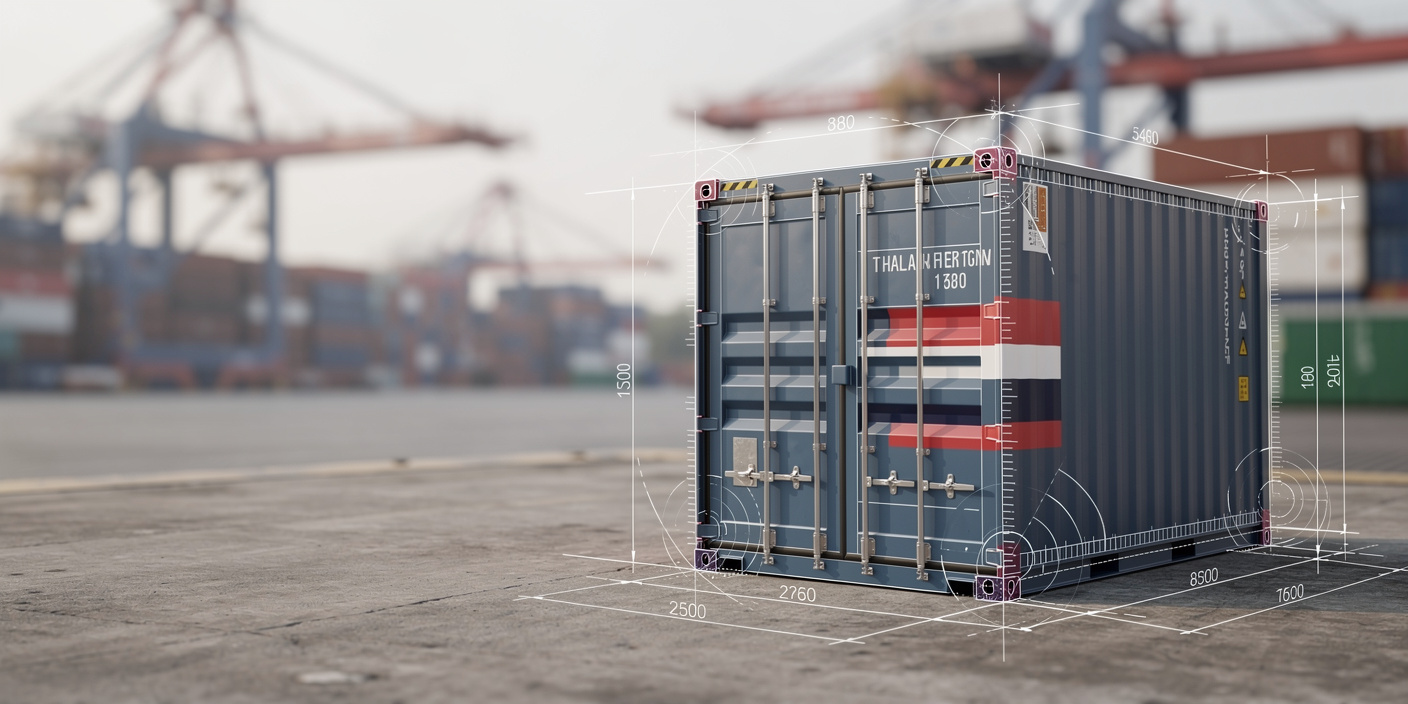
The Thailand Freight Forwarding Market coordinates carrier capacity, cargo consolidation, customs clearance, documentation, insurance, and origin-to-destination execution for manufacturers and traders. Merchandise exports and imports together were estimated at USD 685.7 Bn in 2025, creating a large recurring transaction pool. Commercial value is captured through forwarding fees, consolidation margins, brokerage charges, and specialized handling rather than carrier line-haul pass-through.
Bangkok Metropolitan Region and the Eastern Economic Corridor form the market's principal operating spine. Laem Chabang Port handled approximately 10.15 million TEU in 2025, while Suvarnabhumi Airport processed an estimated 1.52 million tonnes of air cargo. This concentration supports route density, carrier choice, customs expertise, and shorter repositioning cycles, improving economics for forwarders with integrated port, airport, factory, and border networks.
Market Value
USD 3,620 Mn
2025
Dominant Region
Bangkok Metropolitan Region and Eastern Economic Corridor
2025
Dominant Segment
Digital Forwarding
fastest growing, 2026-2031
Total Number of Players
1,400+
Future Outlook
The Thailand Freight Forwarding Market is projected to increase from USD 3,620 Mn in 2025 to USD 5,193 Mn by 2031, representing a forecast CAGR of 6.2%. Growth should be supported by export-oriented manufacturing, higher container throughput, cross-border trade with Cambodia, Laos, Malaysia, and Myanmar, and greater demand for customs, consolidation, visibility, and time-critical services. The historical CAGR of 4.8% between 2020 and 2025 reflects a volatile cycle that included pandemic disruption, freight-rate inflation, normalization in 2023, and renewed trade expansion during 2024 and 2025.
Forecast value growth is expected to combine shipment expansion with modest revenue-per-shipment improvement. Managed shipment volume is modeled to rise by approximately 4.5% to 5.0% annually from 2026 to 2030, while service yield improves by roughly 1.1% to 1.4% through digital documentation, regulated-cargo handling, multimodal coordination, and integrated customs services. Sea freight remains the largest revenue pool, but digital forwarding, cross-border road services, and specialized air cargo should outpace the market average. Operators with scale procurement, dense branch coverage, and reliable data integration are positioned to capture disproportionate value.
6.2%
Forecast CAGR
$5,193 Mn
2030 Projection
Base Year
2025
Historical Period
2020-2025
Forecast Period
2026-2031
Historical CAGR
4.8%
CHAPTER 2 - SCOPE OF REPORT
Scope of the Market
CHAPTER 3 - Key Stakeholders
Key Target Audience
Key stakeholders who can leverage from this market analysis for investment, strategy, and operational planning.
Investors
CAGR, consolidation, margins, digital moat, capital efficiency, risk
Corporates
freight cost, carrier access, customs, visibility, service reliability
Government
trade facilitation, port capacity, modal shift, competitiveness, resilience
Operators
yield, shipment density, capacity procurement, clearance, customer retention
Financial institutions
cash conversion, working capital, covenants, demand stability, capex
CHAPTER 4 - Market Size & Growth
Market Size, Growth Forecast and Trends
This section evaluates the historical market size, analyzes year-over-year growth dynamics, and presents forecast projections supported by market performance indicators and demand-side drivers.
Historical & Projected Market Size ($ Million)
Year-over-Year Growth Rate (%)
Market Value vs Volume Growth (%)
Historical Market Performance (2020-2025)
Historical performance was shaped by three distinct phases. Revenue contracted in 2020 as factory stoppages and international mobility restrictions reduced cargo availability. The market then expanded by 8.9% in 2021 and reached a period-high growth rate of 14.9% in 2022 as freight scarcity, congestion, and elevated rates increased forwarding yields. Revenue declined by 6.6% in 2023 when ocean and air rates normalized, despite shipment activity remaining positive. Growth returned to 3.9% in 2024 and 4.0% in 2025 as trade values and port throughput recovered.
Forecast Market Outlook (2026-2031)
The forecast assumes value growth accelerates from 5.7% in 2026 to approximately 6.5% by 2030 before stabilizing at 6.4% in 2031. The market is projected to add USD 1,573 Mn of annual revenue between 2025 and 2031. Managed shipment volume should increase by 4.5% to 5.0% annually, while revenue per shipment rises by 1.1% to 1.4% through digital tools, specialized cargo, integrated customs services, and multimodal coordination. Sea freight remains the core scale segment, while digital and cross-border offerings drive mix improvement.
CHAPTER 5 - Market Data
Market Breakdown
The Thailand Freight Forwarding Market combines trade-linked transaction volume with service intensity, infrastructure capacity, and carrier access. The KPI trajectory indicates that revenue expansion is supported by merchandise flows, container handling, and air cargo activity, giving investors and operators a practical view of market momentum.
Year | Market Size (USD Mn) | YoY Growth (%) | Merchandise Trade Value (USD Bn) | Laem Chabang Throughput (Mn TEU) | Suvarnabhumi Air Cargo (Mn Tonnes) | Period |
|---|---|---|---|---|---|---|
| 2020 | $2,865 Mn | +- | 438.5 | 7.64 | Forecast | |
| 2021 | $3,120 Mn | +8.9% | 538.8 | 8.42 | Forecast | |
| 2022 | $3,585 Mn | +14.9% | 590.3 | 8.73 | Forecast | |
| 2023 | $3,350 Mn | +-6.6% | 574.3 | 8.68 | Forecast | |
| 2024 | $3,480 Mn | +3.9% | 607.3 | 9.47 | Forecast | |
| 2025 | $3,620 Mn | +4.0% | 685.7 | 10.15 | Forecast | |
| 2026F | $3,826 Mn | +5.7% | 690.0 | 10.55 | Forecast | |
| 2027F | $4,056 Mn | +6.0% | 718.0 | 11.00 | Forecast | |
| 2028F | $4,307 Mn | +6.2% | 748.0 | 11.50 | Forecast | |
| 2029F | $4,583 Mn | +6.4% | 781.0 | 12.00 | Forecast | |
| 2030F | $4,881 Mn | +6.5% | 816.0 | 12.60 | Forecast | |
| 2031F | $5,193 Mn | +6.4% | 853.0 | 13.20 | Forecast |
Merchandise Trade Value
USD 607.3 Bn, 2024, Thailand. The size and diversity of two-way trade support recurring forwarding demand across export manufacturing, imported inputs, consumer goods, and agricultural cargo. Official trade data recorded exports of USD 300.5 Bn and imports of USD 306.8 Bn in 2024.
Laem Chabang Throughput
10.15 million TEU, 2025, Thailand. Rising port throughput improves carrier frequency, consolidation density, and branch economics for sea forwarders. Phase 3 is designed to lift capacity from 11 million to 18 million TEU and increase rail's cargo share from 7% to 30%.
Suvarnabhumi Air Cargo
1.52 million tonnes, 2025, Thailand. Air cargo density supports time-critical electronics, automotive components, perishables, pharmaceuticals, and express shipments. Suvarnabhumi's central role allows forwarders to combine airport handling, bonded trucking, customs brokerage, and regional uplift procurement.
CHAPTER 6 - Segmentation
Market Segmentation Framework
Comprehensive analysis across key dimensions providing insights into market structure, customer demand, service delivery, shipment patterns, operating models, and geographic concentration.
No of Segments
7
Dominant Segment
Mode of Transport
Fastest Growing Segment
Business Model
Service Type
Mode of Transport
Shipment Flow
Customer Type
End-Use Industry
Business Model
Geography
Key Segmentation Takeaways
Comprehensive analysis across all extracted segmentation dimensions provides insights into market structure, customer preferences, route economics, channel configuration, and competitive positioning.
Mode of Transport
Transport mode remains the most commercially important segmentation because carrier procurement, shipment size, transit time, documentation, and margin structure differ materially across sea, road, air, and multimodal flows. Sea Freight is the dominant Level-2 sub-segment because Thailand's export industries depend on containerized trade through Laem Chabang, while road forwarding provides high-frequency domestic and border connectivity.
Business Model
Business Model is the fastest-growing dimension because shippers increasingly expect instant quotations, electronic documents, milestone visibility, exception alerts, and integrated customs workflows. Digital Forwarding is the fastest-growing Level-2 sub-segment, supported by platform-based booking and data integration. Integrated Logistics also expands as manufacturers consolidate forwarding, warehousing, transport management, and customs coordination under fewer accountable providers.
CHAPTER 7 - Regional Analysis
Regional Analysis
Thailand is a major Southeast Asian freight forwarding hub with diversified manufacturing, extensive land borders, deep-sea port capacity, and a large two-way trade base. Its market is more mature than several neighboring economies, while infrastructure upgrades and digital customs create a platform for regional gateway services.
Regional Ranking
3rd among major Southeast Asian forwarding markets
Regional Revenue Share
14.6% of Southeast Asia in 2025
Infrastructure Indicator
10.15 million TEU at Laem Chabang in 2025
Regional Ranking
3rd among major Southeast Asian forwarding markets
Regional Revenue Share
14.6% of Southeast Asia in 2025
Infrastructure Indicator
10.15 million TEU at Laem Chabang in 2025
Regional Analysis (Current Year)
Market Position
Thailand ranks third among major Southeast Asian freight forwarding markets, with a modeled 14.6% regional revenue share and a diversified export base spanning vehicles, electronics, food, chemicals, and machinery.
Growth Advantage
Thailand's 6.2% forecast CAGR is slightly below the 6.7% Southeast Asian average, positioning it as a mature regional challenger with stronger infrastructure but slower catch-up growth than Vietnam.
Competitive Strengths
Thailand combines 10.15 million TEU of Laem Chabang throughput, a 3.5 Logistics Performance Index score, four land-border corridors, and EEC capacity investment supporting multimodal gateway economics.
CHAPTER 8 - INDUSTRY ANALYSIS
Growth Drivers, Market Challenges & Market Opportunities
Comprehensive analysis of key factors shaping the Thailand Freight Forwarding Market, including growth catalysts, operational challenges, and emerging opportunities across service delivery, infrastructure, trade, and customer segments.
Growth Drivers
Export Manufacturing and Two-Way Trade Expansion
- Official 2024 trade reached USD 607.3 Bn (2024, Thailand), including USD 300.5 Bn of exports and USD 306.8 Bn of imports, supporting balanced inbound and outbound carrier procurement for forwarders.
- Shipments to the United States reached USD 72.5 Bn (2025, Thailand), increasing intercontinental ocean and air forwarding demand while raising the value of customs expertise and trade-compliance advisory.
- Thailand's automotive, electronics, machinery, food, and chemical clusters generated an estimated USD 685.7 Bn of merchandise trade (2025, Thailand), creating repeat shipment density for contract forwarders serving industrial accounts.
Port, Airport, and EEC Capacity Development
- Laem Chabang Phase 3 is designed to add 7 million TEU of capacity (project plan, Thailand), enabling larger container flows and creating commercial space for port-centric consolidation, customs, and multimodal services.
- The project targets an increase in rail's port cargo share from 7% to 30% (project plan, Thailand), supporting rail-linked forwarding products and reducing dependence on congested road drayage.
- Suvarnabhumi processed approximately 1.39 million tonnes of air cargo in 2024 (Thailand), sustaining high-yield forwarding opportunities in electronics, automotive parts, perishables, pharmaceuticals, and time-critical shipments.
Cross-Border Commerce and Paperless Trade
- January 2025 border exports rose 3.8% year on year (Thailand), supporting outbound consolidation through Malaysia and CLMV corridors and increasing demand for bilingual customs and permit management.
- Thailand's National Single Window links approximately 37 relevant agencies (Thailand), reducing paper-based duplication and increasing the strategic value of forwarders able to integrate electronic declarations and approvals.
- National Single Window services support 24-hour electronic tracking (Thailand), allowing forwarders to monetize visibility, exception management, document orchestration, and compliance support beyond basic freight booking.
Market Challenges
Freight-Rate and Trade-Cycle Volatility
- Laem Chabang throughput remained near 8.68 million TEU in 2023 (Thailand), showing that revenue can contract even when physical container activity is resilient, because forwarding margins depend on rate spreads and service mix.
- The United States represented 18.3% of Thai exports in 2024 (Thailand), exposing forwarders to tariff changes, sourcing shifts, and trade-policy uncertainty in a commercially important long-haul corridor.
- Revenue per shipment fell an estimated 8.5% in 2023 (Thailand market estimate), pressuring asset-light operators that lacked contracted customers, specialized services, or diversified carrier procurement.
Fragmented Competition and Margin Pressure
- The modeled top ten account for only 28.5% of 2025 revenue (Thailand), leaving a 71.5% fragmented pool where local relationships and price competition can outweigh global scale.
- Standard freight booking and consolidation represents approximately 54% of 2025 service revenue (Thailand market estimate), concentrating competition in the most commoditized service category and limiting differentiation through price alone.
- National logistics costs equaled 13.5% of GDP in 2024 (Thailand), highlighting persistent inefficiencies but also creating shipper pressure for lower rates, tighter service-level agreements, and demonstrable cost savings.
Modal Imbalance and Corridor Bottlenecks
- Rail currently handles about 7% of Laem Chabang cargo transfers (Thailand project baseline), limiting multimodal substitution and increasing dependence on truck drayage between factories, depots, and port terminals.
- Laem Chabang throughput exceeded 10 million TEU in 2025 (Thailand), increasing pressure on gates, container yards, empty repositioning, and surrounding roads before Phase 3 capacity is fully available.
- Border and transit imports rose only 1.5% in January 2025 (Thailand), indicating uneven corridor performance and the need for route diversification rather than reliance on a single border gateway.
Market Opportunities
Digital Forwarding and Shipper Visibility
- Digital forwarding can monetize online booking, control-tower visibility, document management, and exception alerts across an estimated USD 3,620 Mn market in 2025 (Thailand), improving customer stickiness without owning carrier assets.
- E-commerce value was projected to reach USD 23.45 Bn in 2025 (Thailand), benefiting forwarders that can aggregate lower-volume international shipments and connect merchants with customs-compliant cross-border services.
- Capturing the opportunity requires integration with a National Single Window ecosystem spanning approximately 37 agencies (Thailand), plus carrier APIs, electronic proof, cybersecurity, and standardized master data.
Rail-Linked Port and Multimodal Services
- The planned 7 million TEU capacity addition (Thailand) expands monetizable demand for container management, bonded transport, customs brokerage, project logistics, and factory-to-port scheduling.
- Raising rail's port share to 30% (Thailand project target) can benefit forwarders, rail operators, inland depots, and manufacturers through lower road exposure and more predictable high-volume flows.
- Opportunity realization requires synchronized terminal capacity, inland rail slots, container depots, and data exchange, consistent with a project objective to save approximately THB 250 Bn in logistics costs (Thailand).
Specialized Air, Cold Chain, and Regulated Cargo
- Specialized forwarding can capture higher yields across pharmaceuticals, electronics, automotive components, perishables, and dangerous goods, which collectively support an estimated 20% air-freight revenue share in 2025 (Thailand).
- Manufacturers and exporters benefit from validated handling, temperature monitoring, security, and time-definite escalation, particularly as air cargo volume is modeled to exceed 2.1 million tonnes by 2031 (Thailand).
- Operators must invest in certified processes, trained teams, airline block-space relationships, and digital condition monitoring to capture the modeled 8% project and specialized cargo share in 2025 (Thailand).
8. Growth Drivers
9. Market Challenges
10. Market Opportunities
11. Competitive Landscape Overview
CHAPTER 9 - Competitive Landscape
Competitive Landscape Overview
The Thailand Freight Forwarding Market is highly fragmented, with global networks competing against established Thai specialists on carrier procurement, customs capability, branch reach, sector expertise, service reliability, and price.
Market Share Distribution
Top 5 Players
Market Dynamics
8 new entrants in the past 5 years, indicating strong market attractiveness and growth potential.
Company Name | Market Share | Headquarters | Founding Year | Core Market Focus |
|---|---|---|---|---|
DHL Global Forwarding | 4.8% | Bonn, Germany | 1969 | Global air and ocean forwarding, customs, industrial logistics |
Kuehne+Nagel | 4.1% | Schindellegi, Switzerland | 1890 | Sea, air, road, contract, and integrated forwarding solutions |
DSV | 4.6% | Hedehusene, Denmark | 1976 | Air and sea forwarding, road, project, and contract logistics |
CEVA Logistics | 2.8% | Marseille, France | 2007 | Multimodal forwarding, automotive, industrial, and contract logistics |
Nippon Express | 2.6% | Tokyo, Japan | 1937 | Japanese manufacturing accounts, air, ocean, and cross-border logistics |
Yusen Logistics | 2.3% | Tokyo, Japan | 1955 | Automotive, electronics, air, ocean, and supply chain solutions |
Kerry Logistics Network | 2.2% | Hong Kong | 1981 | Asian freight networks, cross-border road, and integrated logistics |
Expeditors International | 2.1% | Seattle, United States | 1979 | Air and ocean forwarding, customs brokerage, and trade compliance |
Triple i Logistics | 1.6% | Bangkok, Thailand | 2008 | Air freight, sea freight, multimodal, and specialized logistics |
WICE Logistics | 1.4% | Bangkok, Thailand | 1993 | International forwarding, cross-border transport, and supply chain services |
Cross Comparison Parameters
The report provides detailed cross-comparison of key players across 10 performance parameters to identify competitive strengths and weaknesses.
Analysis Covered
Market Share Analysis:
Estimates Thailand forwarding revenue concentration and segment leadership by player
Cross Comparison Matrix:
Benchmarks network, capacity, service, growth, and profitability across competitors
SWOT Analysis:
Assesses strategic strengths, weaknesses, opportunities, and operating threats by company
Pricing Strategy Analysis:
Compares contract rates, spot pricing, surcharges, and service premiums
Company Profiles:
Summarizes footprint, capabilities, customer sectors, and strategic positioning in Thailand
CHAPTER 10 - REPORT TOC
Market Report Structure
Comprehensive coverage across three strategic phases — Market Assessment, Go-To-Market Strategy, and Survey — delivering end-to-end insights from market analysis and execution roadmap to customer demand validation.
Phase 1Market Assessment Phase
11
Chapters
Supply-side and competitive intelligence covering market sizing, segmentation, competitive dynamics, regulatory landscape, and future forecasts.
Phase 2Go-To-Market Strategy Phase
15
Chapters
Entry strategy evaluation, execution roadmap, partner recommendations, and profitability outlook.
Complete Report Coverage
201+ detailed sections covering every aspect of the market
143
Assessment Sections
58
Strategy Sections
CHAPTER 11 - Our Approach
Research Methodology
Desk Research
- Reviewed Thailand merchandise trade statistics
- Mapped port and airport throughput
- Assessed customs and NSW rules
- Benchmarked forwarding company service footprints
Primary Research
- Interviewed ocean freight procurement managers
- Consulted customs brokerage operations heads
- Engaged manufacturing supply chain directors
- Surveyed port ecosystem commercial managers
Validation and Triangulation
- Validated estimates across 340 respondents
- Reconciled revenue and shipment volumes
- Cross-checked port and trade trends
- Stress-tested pass-through revenue exclusions
CHAPTER 12 - FAQ
FAQs
Still have questions?
Our research team is here to help you find the right solution
CHAPTER 13 - Related Research
Explore Related Reports
Expand your market intelligence with complementary research across regions and adjacent markets.
Regional/Country ReportsRelated market analysis across key regions
Related market analysis across key regions
No regional reports found.
Adjacent ReportsRelated markets and complementary research
Related markets and complementary research
- Saudi Arabia digital logistics market report size, share, growth drivers, trends, opportunities & forecast 2025–2030
- South Korea Freight Brokerage Market
- KSA Supply Chain Optimization Market
- UAE Container Shipping Market
- Germany Air Cargo Services Market
500+
Market Research Reports
50+
Countries Covered
15+
Industry Verticals