
U.S. Propane Market Outlook to 2030
Region:North America
Author(s):Shivani Mehra
Product Code:KROD11461
November 2024
88
About the Report
U.S. Propane Market Overview
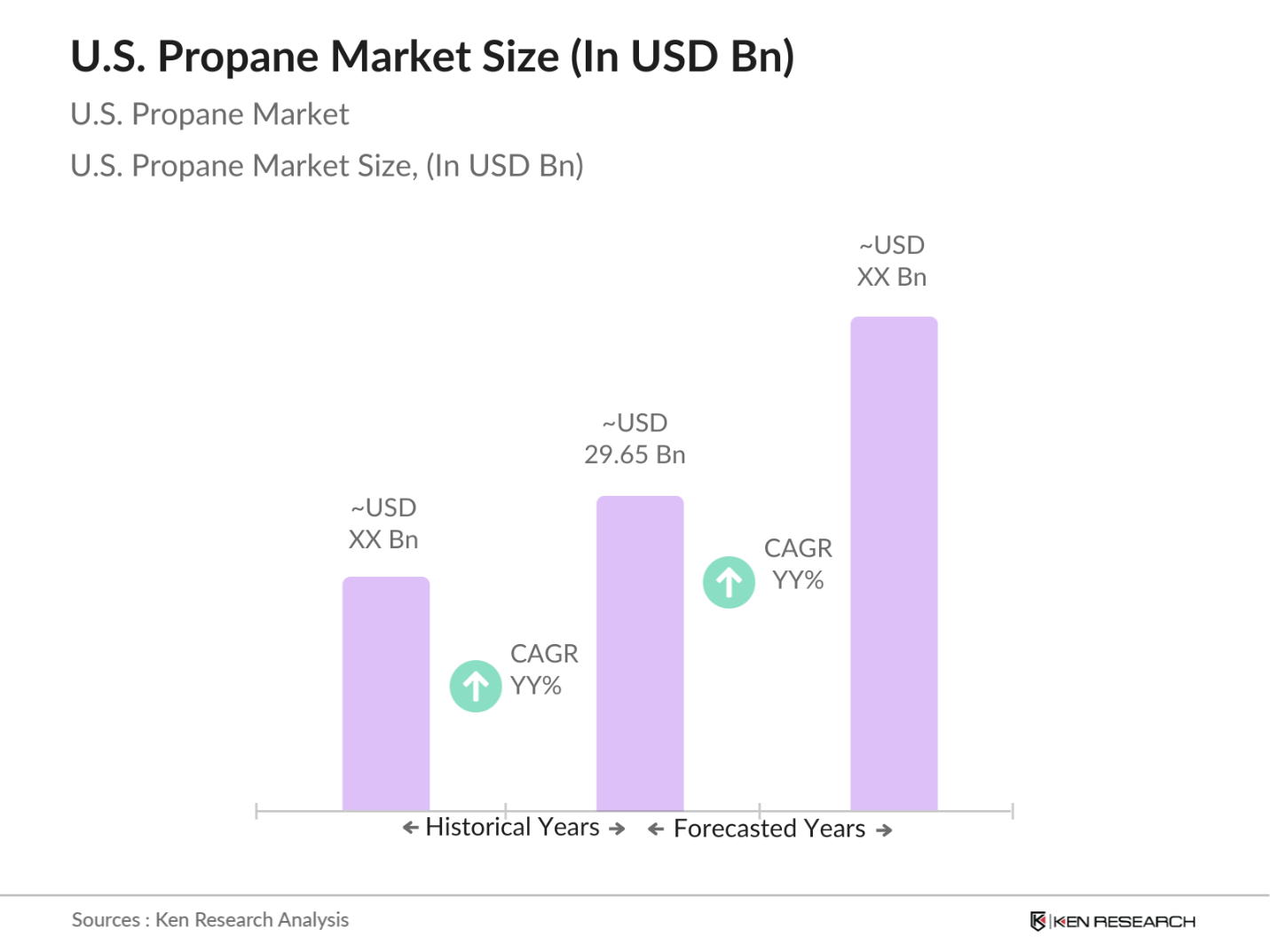
- The U.S. propane market, valued at USD 29.65 billion, is driven by increasing demand across residential, commercial, and industrial applications. Residential heating and industrial processes are significant contributors to the market, fueled by the fuels efficient energy properties and cleaner combustion compared to other fossil fuels. This market has shown resilience due to the extensive infrastructure and supply chains that ensure steady delivery and storage capabilities, enabling widespread accessibility.
- Key cities, including New York, Chicago, and Los Angeles, dominate the propane market in the U.S. due to high population density, colder climates, and significant infrastructure investment in propane storage and distribution. These urban areas rely on propane for heating, cooking, and emergency backup power. Additionally, regions with agricultural and industrial concentrations, like Texas and California, experience elevated propane demand for various operational purposes.
- The U.S. government, under the Clean Air Act, has introduced stricter regulations in 2023 to reduce greenhouse gas emissions across industrial sectors. This policy encourages the adoption of cleaner fuels like propane, which emits only 139 pounds of CO per million British thermal units (MMBtu), compared to 205 pounds for coal. This makes propane a favorable choice for industries seeking compliance with federal environmental guidelines.
U.S. Propane Market Segmentation
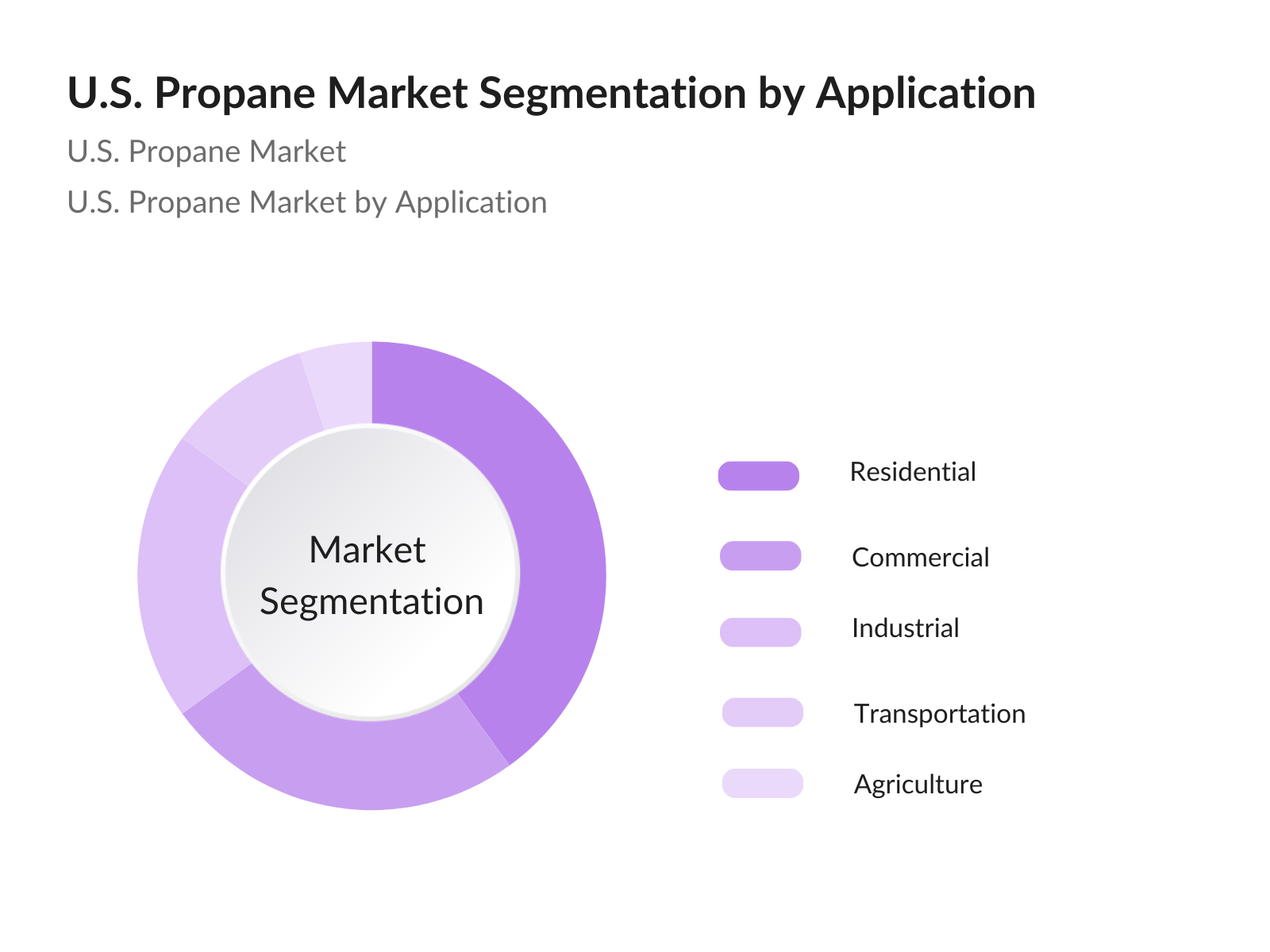
- By Application: The U.S. propane market is segmented by application into residential, commercial, industrial, transportation, and agriculture. Among these, residential applications hold the dominant market share, as propane is widely used for heating, cooking, and water heating in homes, especially in areas without access to natural gas pipelines. This continued reliance on propane in the residential sector is supported by government incentives for clean energy and the development of highly efficient propane-fueled appliances.
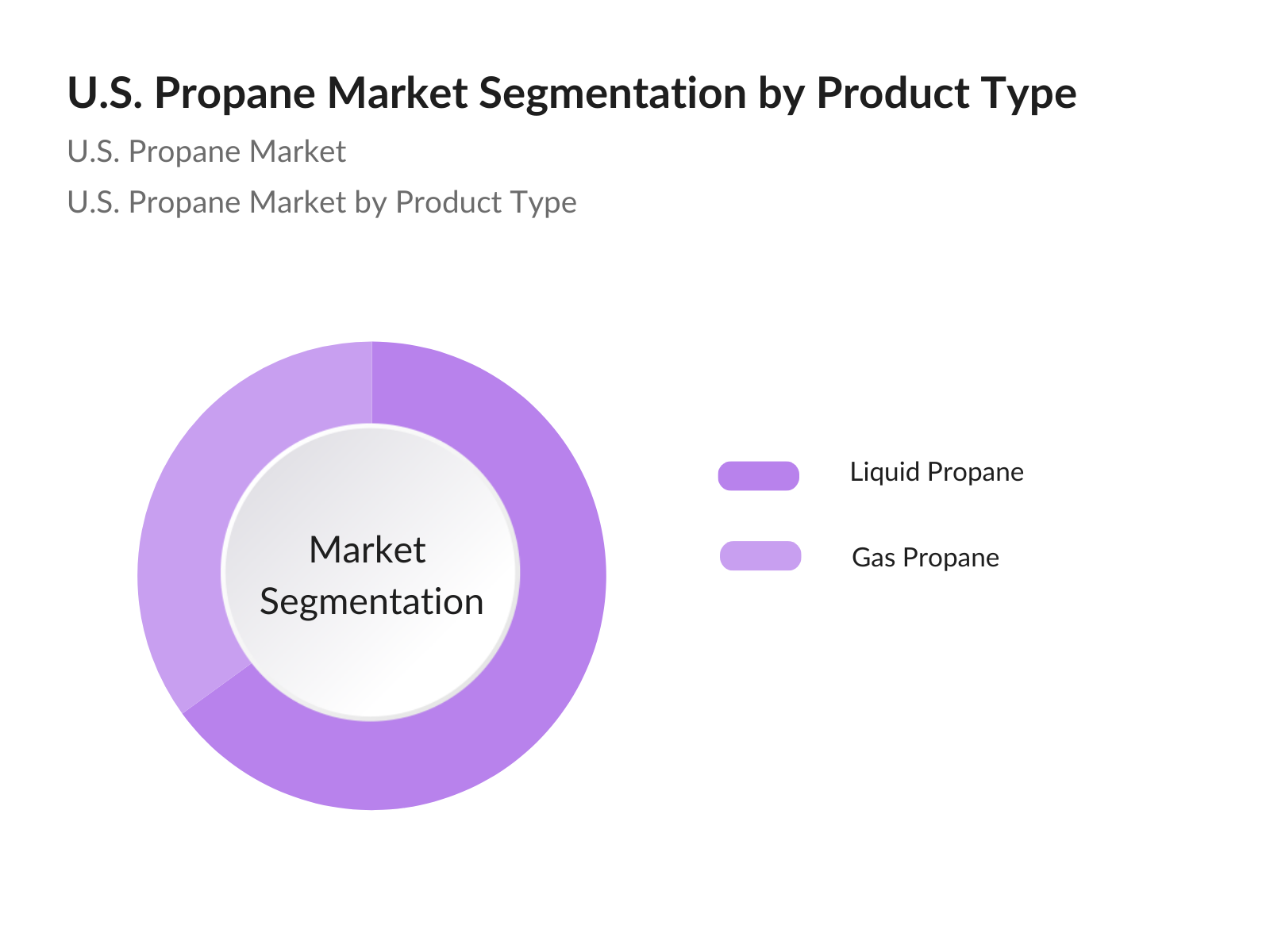
- By Product Type: The U.S. propane market is segmented by product type into liquid propane and gas propane. Liquid propane dominates this segment due to its versatility in storage and transport, which allows for easy distribution across rural and urban areas alike. It is preferred for residential and industrial uses where stability and longer storage durations are critical. Furthermore, advancements in liquid propane technology have enhanced safety, further solidifying its role in the market.
U.S. Propane Market Competitive Landscape
The U.S. propane market is dominated by a few key players with established distribution networks and a significant market presence. This competitive landscape is defined by the ongoing efforts of major companies to invest in infrastructure, enhance propane delivery systems, and maintain reliable supply chains.
|
Company |
Establishment Year |
Headquarters |
Distribution Networks |
Annual Production Volume |
Research & Development Investments |
Technology Integration |
Workforce |
Revenue |
Geographic Presence |
|
AmeriGas Partners |
1959 |
King of Prussia, PA |
- |
- |
- |
- |
- |
- |
- |
|
Ferrellgas Partners |
1939 |
Overland Park, KS |
- |
- |
- |
- |
- |
- |
- |
|
Suburban Propane |
1928 |
Whippany, NJ |
- |
- |
- |
- |
- |
- |
- |
|
UGI Corporation |
1882 |
King of Prussia, PA |
- |
- |
- |
- |
- |
- |
- |
|
Superior Plus Corp |
1922 |
Toronto, Canada |
- |
- |
- |
- |
- |
- |
- |
U.S. Propane Market Analysis
Market Growth Drivers
- Energy Demand Shifts: The U.S. Energy Information Administration (EIA) reports that in 2023, the United States produced approximately 2.7 million barrels per day (b/d) of propane, reflecting a steady increase from previous years. This growth is attributed to the rising demand for propane as a cleaner-burning alternative to traditional fossil fuels, particularly in residential and commercial heating applications. The shift towards propane is driven by its lower carbon emissions compared to coal and oil, aligning with national energy policies aimed at reducing greenhouse gas emissions.
- Government Policies & Regulations: In 2023, the U.S. government implemented stricter emission standards under the Clean Air Act, setting ambitious targets to reduce greenhouse gas emissions significantly from levels. These regulations incentivize industries to adopt propane, which emits approximately 139 pounds of CO per million British thermal units (MMBtu), compared to 205 pounds for coal. Additionally, the Renewable Fuel Standard (RFS) mandates the blending of renewable fuels, including bio-propane, into transportation fuel, further promoting propane usage.
- Rising Residential and Commercial Applications: The EIA's Residential Energy Consumption Survey indicates that as of 2024, about 5 million U.S. households use propane as their primary heating fuel. This number has been increasing due to propane's efficiency and lower environmental impact. In the commercial sector, propane is widely used in cooking, water heating, and space heating, with approximately 1.5 million commercial establishments utilizing propane-based systems.
Market Challenges:
- Volatility in Propane Prices: Propane prices have experienced fluctuations due to factors such as crude oil price changes and seasonal demand variations. In November 2024, the average residential propane price in the U.S. was $2.457 per gallon, reflecting a slight increase from the previous month. These price variations can impact consumer affordability and industrial cost structures, posing challenges for market stability.
- Infrastructure Constraints: The distribution of propane relies heavily on a network of pipelines, rail, and trucking systems. Infrastructure limitations, particularly in rural and remote areas, can lead to supply bottlenecks. The EIA notes that during peak demand periods, such as winter months, logistical challenges can result in regional supply shortages and increased prices.
U.S. Propane Market Future Outlook
The U.S. propane market is expected to grow steadily over the next few years, driven by factors such as the rising demand for clean energy, advancements in propane storage technology, and increased use in industrial and agricultural sectors. Government initiatives aimed at reducing emissions and promoting energy efficiency in residential and commercial buildings are also expected to support this market expansion. Additionally, innovations in propane-fueled equipment for heating, cooking, and industrial applications are likely to contribute to market growth.
Market Opportunities:
- Technological Advancements in Storage and Transportation: Innovations in propane storage and transportation, such as the development of composite cylinders and improved railcar designs, have enhanced safety and efficiency. The EIA highlights that these advancements reduce transportation costs and expand distribution capabilities, enabling propane to reach underserved markets and meet growing demand.
- Growth in Agricultural and Manufacturing Applications: Propane is extensively used in agriculture for crop drying, weed control, and powering equipment. The U.S. Department of Agriculture (USDA) reports that in 2023, approximately 900,000 farms utilized propane-powered equipment. In manufacturing, propane serves as a fuel for forklifts and other machinery, with about 500,000 propane-powered forklifts operating nationwide. These applications present significant growth opportunities for the propane market.
Scope of the Report
|
By Application |
Residential Commercial Industrial Transportation Agriculture |
|
By End-Use Sector |
Residential Heating Industrial Process Heating Agriculture Drying & Heating Commercial Cooking & Heating Transportation Fuel |
|
By Product Type |
Liquid Propane Gas Propane |
|
By Distribution Channel |
Direct Sales Distribution Centers Dealers and Contractors Retail Outlets |
|
By Region |
North-East Midwest West Coast Southern States |
Products
Key Target Audience
Residential Heating Equipment Manufacturers
Industrial Heating Equipment Manufacturers
Agricultural Equipment Suppliers
Government and Regulatory Bodies (U.S. Department of Energy, Environmental Protection Agency)
Investment and Venture Capitalist Firms
Energy and Utility Companies
Transportation Sector Representatives
Retail and Distribution Chains
Companies
Players Mentioned in the report
AmeriGas Partners
Ferrellgas Partners
Suburban Propane
UGI Corporation
Superior Plus Corp
Global Partners
Blossman Gas
ThompsonGas
Cenex
Eastern Propane
MFA Oil Company
MacGas
Pacific Coast Propane
Blue Star Gas
Parkland Fuel Corporation
Table of Contents
1. U.S. Propane Market Overview
1.1. Definition and Scope
1.2. Market Taxonomy
1.3. Supply Chain Analysis (Supply Sources, Distribution Channels, End-Users)
1.4. Market Growth Rate
1.5. Market Segmentation Overview
2. U.S. Propane Market Size (In USD Billion)
2.1. Historical Market Size
2.2. Year-On-Year Growth Analysis
2.3. Key Market Developments and Milestones
3. U.S. Propane Market Analysis
3.1. Growth Drivers
3.1.1. Energy Demand Shifts
3.1.2. Government Policies & Regulations (Emission Standards, Energy Transition Goals)
3.1.3. Rising Residential and Commercial Applications
3.1.4. Industrial Usage Expansion (Fuel, Chemical Feedstock)
3.2. Market Challenges
3.2.1. Volatility in Propane Prices
3.2.2. Environmental Concerns
3.2.3. Infrastructure Constraints
3.2.4. Competition with Alternative Fuels
3.3. Opportunities
3.3.1. Technological Advancements in Storage and Transportation
3.3.2. Growth in Agricultural and Manufacturing Applications
3.3.3. Integration in Renewable Hybrid Systems
3.3.4. Expansion in Remote Power Generation Markets
3.4. Trends
3.4.1. Increased Adoption in Backup Power Solutions
3.4.2. Urbanization and Industrialization Impact
3.4.3. Advances in Distribution Technologies
3.5. Regulatory Framework
3.5.1. Safety Standards and Certification Requirements
3.5.2. National Energy Policy Impacts
3.5.3. Emission Standards and Environmental Compliance
3.6. SWOT Analysis
3.7. Stake Ecosystem
3.8. Porters Five Forces
3.9. Competition Ecosystem
4. U.S. Propane Market Segmentation
4.1. By Application (In Value %)
4.1.1. Residential
4.1.2. Commercial
4.1.3. Industrial
4.1.4. Transportation
4.1.5. Agriculture
4.2. By End-Use Sector (In Value %)
4.2.1. Residential Heating
4.2.2. Industrial Process Heating
4.2.3. Agriculture Drying & Heating
4.2.4. Commercial Cooking & Heating
4.2.5. Transportation Fuel
4.3. By Product Type (In Value %)
4.3.1. Liquid Propane
4.3.2. Gas Propane
4.4. By Distribution Channel (In Value %)
4.4.1. Direct Sales
4.4.2. Distribution Centers
4.4.3. Dealers and Contractors
4.4.4. Retail Outlets
4.5. By Region (In Value %)
4.5.1. Northeast
4.5.2. Midwest
4.5.3. South
4.5.4. West
5. U.S. Propane Market Competitive Analysis
5.1. Detailed Profiles of Major Competitors
5.1.1. AmeriGas Partners
5.1.2. Ferrellgas Partners
5.1.3. Suburban Propane
5.1.4. UGI Corporation
5.1.5. Superior Plus Corp
5.1.6. Global Partners
5.1.7. Blossman Gas
5.1.8. ThompsonGas
5.1.9. Cenex
5.1.10. Eastern Propane
5.1.11. MFA Oil Company
5.1.12. MacGas
5.1.13. Pacific Coast Propane
5.1.14. Blue Star Gas
5.1.15. Parkland Fuel Corporation
5.2. Cross Comparison Parameters (Annual Production Volume, Geographic Presence, Distribution Networks, Inception Year, Workforce Strength, Technology Capabilities, R&D Expenditure, Product Diversity)
5.3. Market Share Analysis
5.4. Strategic Initiatives
5.5. Mergers and Acquisitions
5.6. Investment Analysis
5.7. Venture Capital Funding
5.8. Government Incentives
5.9. Private Equity Investments
6. U.S. Propane Market Regulatory Framework
6.1. Propane Safety and Emission Standards
6.2. Environmental Regulations and Compliance (Air Quality Standards)
6.3. Certification and Licensing Requirements
6.4. Subsidies and Tax Incentives
7. U.S. Propane Future Market Size (In USD Billion)
7.1. Projected Market Growth
7.2. Key Factors Driving Future Market Expansion
8. U.S. Propane Future Market Segmentation
8.1. By Application (In Value %)
8.2. By End-Use Sector (In Value %)
8.3. By Product Type (In Value %)
8.4. By Distribution Channel (In Value %)
8.5. By Region (In Value %)
9. U.S. Propane Market Analysts Recommendations
9.1. TAM/SAM/SOM Analysis
9.2. Target Market Analysis
9.3. Potential Market Entry Strategies
9.4. White Space Opportunity Identification
Disclaimer Contact UsResearch Methodology
Step 1: Identification of Key Variables
In the initial stage, we mapped the ecosystem of the U.S. propane market, identifying all significant players, supply chain structures, and end-user segments. Extensive desk research was conducted using secondary sources and proprietary databases to collect foundational information about industry dynamics and key variables affecting the market.
Step 2: Market Analysis and Construction
We analyzed historical data to understand the market penetration across segments, gauging the supply-demand ratio and market revenue generation. In addition, we conducted a service quality assessment to ensure that the revenue estimates were robust and reflective of actual market trends.
Step 3: Hypothesis Validation and Expert Consultation
Market hypotheses were developed and validated through expert interviews. By conducting consultations with industry experts, we gained operational and financial insights, which allowed us to corroborate market data and refine our understanding of key trends and dynamics.
Step 4: Research Synthesis and Final Output
In the final phase, we engaged directly with propane manufacturers to acquire detailed data on product segments, sales trends, and consumer preferences. This information helped validate our estimates and ensure that the analysis was comprehensive, accurate, and in line with industry developments.
Frequently Asked Questions
01. How big is the U.S. propane market?
The U.S. propane market is valued at approximately USD 29.65 billion, driven by increasing demand across various sectors, particularly residential heating and industrial applications.
02. What are the challenges in the U.S. propane market?
Challenges in the U.S. propane market include price volatility, regulatory pressures related to emissions, and competition from alternative energy sources, impacting both suppliers and consumers.
03. Who are the major players in the U.S. propane market?
Key players include AmeriGas Partners, Ferrellgas Partners, Suburban Propane, UGI Corporation, and Superior Plus Corp, known for their extensive distribution networks and strong market presence.
04. What are the growth drivers of the U.S. propane market?
Growth drivers include rising demand for cleaner fuels, government support for energy-efficient heating solutions, and the use of propane in diverse applications such as agriculture and industry.
Why Buy From Us?

What makes us stand out is that our consultants follows Robust, Refine and Result (RRR) methodology. i.e. Robust for clear definitions, approaches and sanity checking, Refine for differentiating respondents facts and opinions and Result for presenting data with story

We have set a benchmark in the industry by offering our clients with syndicated and customized market research reports featuring coverage of entire market as well as meticulous research and analyst insights.

While we don't replace traditional research, we flip the method upside down. Our dual approach of Top Bottom & Bottom Top ensures quality deliverable by not just verifying company fundamentals but also looking at the sector and macroeconomic factors.

With one step in the future, our research team constantly tries to show you the bigger picture. We help with some of the tough questions you may encounter along the way: How is the industry positioned? Best marketing channel? KPI's of competitors? By aligning every element, we help maximize success.

Our report gives you instant access to the answers and sources that other companies might choose to hide. We elaborate each steps of research methodology we have used and showcase you the sample size to earn your trust.

If you need any support, we are here! We pride ourselves on universe strength, data quality, and quick, friendly, and professional service.