USA Battery Recycling Market Outlook to 2030

Region:North America

Author(s):Shubham

Product Code:KROD5741

Published On

November 2024

Total pages

98

About the Report

USA Battery Recycling Market Overview

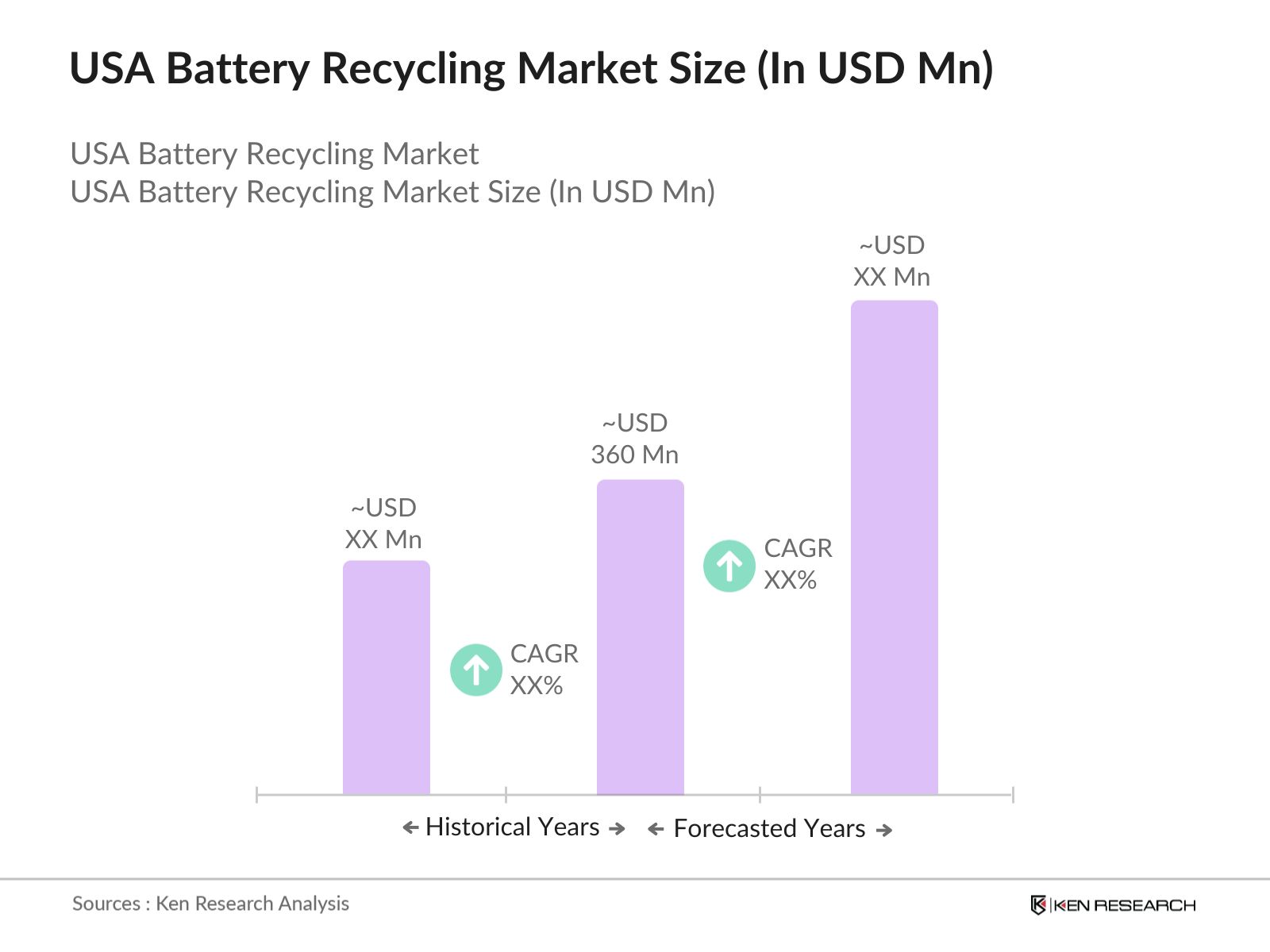
  • The USA Battery Recycling Market is valued at USD 360 million, driven primarily by the increasing volume of end-of-life batteries and rising demand for sustainable waste management solutions. Federal and state regulations, alongside incentives, have amplified efforts to manage and recycle batteries from electric vehicles (EVs), consumer electronics, and industrial applications. As battery technology evolves, recycling processes are becoming more efficient, making the market one of the fastest-growing in the environmental management sector. market overviews
  • Key regions in the USA Battery Recycling Market include California, Texas, and New York. These states are recognized for their strong regulatory frameworks, high EV adoption rates, and dense population centers, which contribute to higher volumes of battery waste. California leads in recycling innovation and environmental policy, while Texas large industrial sector and New Yorks high population density support substantial recycling infrastructure. These factors establish these states as leaders in the USA Battery Recycling Market.
  • Federal standards in 2024 mandate strict guidelines on battery waste management, with penalties for non-compliance to reduce landfill waste. Updated by the EPA, these standards require recycling facilities to meet specific environmental safety benchmarks. Compliance supports reductions in hazardous waste generation, with approximately 40,000 metric tons of battery waste expected to be recycled under these standards, mitigating environmental risks posed by improper disposal.

USA Battery Recycling Market Segmentation

  • By Battery Type: The Market is segmented by battery type into Lithium-Ion, Lead-Acid, Nickel-Cadmium, Nickel-Metal Hydride, and Others (including Zinc-Carbon and Alkaline batteries). Lithium-Ion batteries currently hold the largest market share, supported by the widespread use in electric vehicles and portable electronics. Lithium recovery processes have improved significantly, enabling cost-effective recycling for manufacturers and government entities alike. The substantial resources dedicated to recovering lithium from spent batteries reinforce this segments prominence, with many manufacturers investing in lithium recovery technologies to support sustainable production and meet regulatory requirements. market overviews
  • By Source: The market is further segmented by source into Automotive Batteries, Industrial Batteries, and Consumer Electronics Batteries. Automotive batteries dominate the source segment due to the surge in electric vehicle production, leading to an increase in the volume of end-of-life batteries requiring recycling. Given the environmental impact and regulatory focus on EV battery waste management, automotive batteries are heavily recycled to recover essential materials like lithium, cobalt, and nickel. The market has seen significant investments in facilities dedicated to processing these batteries, making this segment the leader within the battery recycling market. market overviews

USA Battery Recycling Market Competitive Landscape

The USA Battery Recycling Market is highly competitive, with both established players and new entrants focusing on technological advancements and regulatory compliance to secure government contracts and partnerships. The industry is dominated by companies specializing in sustainable solutions for managing battery waste, with strategic partnerships and innovation at the core of their competitive advantage. market overviews

USA Battery Recycling Market Analysis

Growth Drivers

  • Increasing Battery Waste Volume: The annual volume of discarded batteries in the U.S. surged from 90000 units in 2023 to an estimated 652,293 units by 2030, driven by increased use in consumer electronics, electric vehicles, and energy storage systems. These waste levels contribute significantly to hazardous waste generation, impacting the recycling demand and volume. Lithium-ion and lead-acid batteries make up a substantial portion, with 30,000 metric tons reaching end-of-life in 2024. This trend reflects a recycling demand of 40,000 metric tons by 2025, supporting regulatory compliance.
  • Technological Advancements in Recycling Processes: Advanced recycling technologies like hydrometallurgical and direct recycling have transformed battery material recovery, enhancing efficiency and environmental safety. These methods now yield recovery rates close to 95% for metals like lithium and nickel, up from 70% in 2020, decreasing environmental impact. In 2024, over USD 500 million was invested in recycling technologies, with the U.S. Department of Energy supporting development through grants and innovation hubs. This progress aids compliance with U.S. environmental goals and enhances battery recycling efficacy.
  • Government Incentives and Regulatory Mandates: Federal and state-level initiatives promoting sustainable waste management practices play a pivotal role in the growth of the battery recycling market. The U.S. Environmental Protection Agency (EPA) has implemented stringent regulations for hazardous waste disposal, including used batteries, to minimize environmental impacts. These regulations encourage recycling efforts, particularly for lead-acid and lithium-ion batteries, which require specific disposal methods to prevent toxic leaks.

Challenges

  • High Processing Costs: Setting up battery recycling facilities demands substantial capital investment, making it challenging for smaller businesses to enter the market. While larger corporations can leverage federal grants to mitigate these costs, smaller enterprises face limited financial support, making it difficult to manage the high costs of specialized infrastructure and equipment. This economic barrier restricts the growth rate of new recycling facilities and curtails broader market expansion within the U.S.
  • Limited Infrastructure and Collection Challenges: The U.S. recycling sector faces obstacles due to limited battery collection systems across many states, which often lack organized, end-to-end waste management solutions. This inadequate infrastructure contributes to challenges in efficient recycling processes, with only a few states offering well-defined programs for consumer battery waste collection. Consequently, the insufficient collection and disposal methods limit recycling efficiency and increase environmental waste concerns.

USA Battery Recycling Market Future Outlook

The USA Battery Recycling Market is expected to experience significant growth through 2028, driven by the increasing adoption of electric vehicles, regulatory pressure for sustainable waste management, and advancements in recycling technologies. Innovations in battery chemistry and the development of cost-effective recycling processes are likely to reduce costs, enhancing the markets profitability. Additionally, government incentives and public awareness initiatives will play a pivotal role in expanding the collection and recycling infrastructure, ensuring more efficient material recovery and reduced environmental impact.

Future Market Opportunities

  • Expansion of Electric Vehicle (EV) Market: The growth in the U.S. electric vehicle market, expected to register 1.9 million EVs in 2024, directly impacts battery recycling demand. Each EV battery has a lifecycle of 8-10 years, generating substantial end-of-life battery volume annually. With lithium-ion batteries representing over 90% of EV batteries, the increasing number of EVs presents an opportunity to enhance recycling throughput for valuable materials like lithium, cobalt, and nickel, thereby reducing dependence on imports.
  • Government Subsidies and Incentives: Government programs like the Battery Materials Initiative (BMI) offer financial incentives, including tax credits and grants, to support the establishment and scaling of battery recycling facilities. In 2024, federal subsidies provided a noteworthy amount in direct funding for recycling infrastructure development, enabling companies to mitigate capital costs and streamline recycling processes. These incentives enhance U.S. efforts to secure domestic critical materials and drive innovation in battery material recovery.

Scope of the Report

Battery Type

Lithium-Ion

Lead-Acid

Nickel-Cadmium

Nickel-Metal Hydride

Others (Zinc-Carbon, Alkaline)

Source

Automotive Batteries

Industrial Batteries

Consumer Electronics Batteries

Recycling Process

Pyrometallurgical Process

Hydrometallurgical Process

Mechanical Process

End-User Industry

Automotive

Industrial

Consumer Electronics

Region

Northeast

Midwest

South

West

Products


Key Target Audience

  • Investors and Venture Capitalist Firms

  • Banks and Financial Institutions

  • Government and Regulatory Bodies (EPA, Department of Energy)

  • Battery Manufacturers

  • Electric Vehicle Manufacturers

  • Battery Recycling Facility Operators

  • Environmental Agencies (EPA Regional Offices)

  • Industrial Battery Users

Companies


Players Mentioned in the Report

  • Call2Recycle

  • Exide Technologies

  • East Penn Manufacturing

  • Aqua Metals, Inc.

  • Retriev Technologies

  • Battery Solutions

  • Gopher Resource LLC

  • Li-Cycle

  • Interstate Batteries Recycling

  • Umicore

  • Redwood Materials

  • American Manganese Inc.

  • Teck Resources Limited

  • Glencore

  • Gravita India Limited

Table of Contents

1. USA Battery Recycling Market Overview

1.1. Definition and Scope

1.2. Market Taxonomy

1.3. Market Growth Rate

1.4. Market Segmentation Overview

2. USA Battery Recycling Market Size (In USD Mn)

2.1. Historical Market Size

2.2. Year-On-Year Growth Analysis

2.3. Key Market Developments and Milestones

3. USA Battery Recycling Market Analysis

3.1. Growth Drivers

3.1.1. Environmental Regulations (EPA, Local Regulations)

3.1.2. Increasing Battery Waste Volume

3.1.3. Demand for Recycled Battery Materials

3.1.4. Technological Advancements in Recycling Processes

3.2. Market Challenges

3.2.1. High Initial Investment (Capital Expenditure)

3.2.2. Limited Collection Infrastructure

3.2.3. Regulatory Compliance (Hazardous Waste Management)

3.3. Opportunities

3.3.1. Expansion of Electric Vehicle (EV) Market

3.3.2. Government Subsidies and Incentives

3.3.3. Innovation in Battery Composition

3.4. Trends

3.4.1. Shift Towards Lithium-Ion Battery Recycling

3.4.2. Automation in Sorting and Separation Processes

3.4.3. Integration with Circular Economy Models

3.5. Government Regulations

3.5.1. Federal Recycling Standards

3.5.2. Battery Recycling Incentive Programs

3.5.3. Extended Producer Responsibility (EPR)

3.6. SWOT Analysis

3.7. Stake Ecosystem

3.8. Porters Five Forces

3.9. Competition Ecosystem

4. USA Battery Recycling Market Segmentation

4.1. By Battery Type (In Value %)

4.1.1. Lithium-Ion

4.1.2. Lead-Acid

4.1.3. Nickel-Cadmium

4.1.4. Nickel-Metal Hydride

4.1.5. Others (Zinc-Carbon, Alkaline)

4.2. By Source (In Value %)

4.2.1. Automotive Batteries

4.2.2. Industrial Batteries

4.2.3. Consumer Electronics Batteries

4.3. By Recycling Process (In Value %)

4.3.1. Pyrometallurgical Process

4.3.2. Hydrometallurgical Process

4.3.3. Mechanical Process

4.4. By End-User Industry (In Value %)

4.4.1. Automotive

4.4.2. Industrial

4.4.3. Consumer Electronics

4.5. By Region (In Value %)

4.5.1. Northeast

4.5.2. Midwest

4.5.3. South

4.5.4. West

5. USA Battery Recycling Market Competitive Analysis

5.1 Detailed Profiles of Major Companies

5.1.1. Call2Recycle

5.1.2. Exide Technologies

5.1.3. East Penn Manufacturing

5.1.4. Aqua Metals, Inc.

5.1.5. Retriev Technologies

5.1.6. Battery Solutions

5.1.7. Gopher Resource LLC

5.1.8. Li-Cycle

5.1.9. Interstate Batteries Recycling

5.1.10. Umicore

5.1.11. Redwood Materials

5.1.12. American Manganese Inc.

5.1.13. Teck Resources Limited

5.1.14. Glencore

5.1.15. Gravita India Limited

5.2 Cross Comparison Parameters (Recycling Capacity, No. of Recycling Facilities, Technology Used, Raw Material Sourcing, Revenue, Market Reach, Partnerships, Product Portfolio)

5.3. Market Share Analysis

5.4. Strategic Initiatives

5.5. Mergers and Acquisitions

5.6. Investment Analysis

5.7. Venture Capital Funding

5.8. Government Grants

5.9. Private Equity Investments

6. USA Battery Recycling Market Regulatory Framework

6.1. Recycling Certification Standards

6.2. Hazardous Waste Management Regulations

6.3. Compliance Requirements for Battery Disposal

7. USA Battery Recycling Future Market Size (In USD Mn)

7.1. Future Market Size Projections

7.2. Key Factors Driving Future Market Growth

8. USA Battery Recycling Future Market Segmentation

8.1. By Battery Type (In Value %)

8.2. By Source (In Value %)

8.3. By Recycling Process (In Value %)

8.4. By End-User Industry (In Value %)

8.5. By Region (In Value %)

9. USA Battery Recycling Market Analysts Recommendations

9.1. TAM/SAM/SOM Analysis

9.2. Customer Cohort Analysis

9.3. Marketing Initiatives

9.4. White Space Opportunity Analysis

Disclaimer Contact Us

Research Methodology

Step 1: Identification of Key Variables

The first stage involves mapping the USA Battery Recycling Market ecosystem, identifying key stakeholders such as recycling facilities, battery manufacturers, and regulatory bodies. This mapping is based on in-depth desk research and proprietary databases to gather market-level insights and identify primary variables affecting the industry.

Step 2: Market Analysis and Construction

In this phase, historical data on recycling volumes and facility capacity is compiled to analyze market growth patterns. This includes evaluating battery disposal ratios and materials recovery rates, providing accurate estimates of market value and capacity utilization.

Step 3: Hypothesis Validation and Expert Consultation

Hypotheses around key growth drivers and barriers are validated through interviews with industry experts, including battery recycling facility managers and policy analysts. These discussions provide insights into operational challenges, financial pressures, and future opportunities within the recycling industry.

Step 4: Research Synthesis and Final Output

The final step integrates data from industry stakeholders to refine the analysis. Insights from battery manufacturers and recycling technology developers ensure comprehensive coverage of market dynamics, enhancing the accuracy and reliability of the market projections and identifying future growth opportunities.

Frequently Asked Questions

How big is the USA Battery Recycling Market?

The USA Battery Recycling Market, valued at USD 360 million, is bolstered by increased battery waste, stringent environmental regulations, and growing demand for recycled battery materials.

What are the challenges in the USA Battery Recycling Market?

The USA Battery Recycling Market, faces challenges such as high initial investment for recycling facilities, complex regulatory compliance, and limited collection infrastructure, which impact operational efficiency.

Who are the major players in the USA Battery Recycling Market?

Key players in the USA Battery Recycling Market include Call2Recycle, Exide Technologies, Li-Cycle, Retriev Technologies, and Aqua Metals, who dominate due to advanced recycling technologies and strong regulatory compliance.

What are the growth drivers of the USA Battery Recycling Market?

USA Battery Recycling Market growth is driven by increasing battery waste from EVs, regulatory incentives, and technological advancements in recycling methods, making recycling more cost-effective and environmentally friendly.

Why Buy From Us?

RRR
Refine Robust Result (RRR) Framework

What makes us stand out is that our consultants follows Robust, Refine and Result (RRR) methodology. i.e. Robust for clear definitions, approaches and sanity checking, Refine for differentiating respondents facts and opinions and Result for presenting data with story

Our Reach Is Unmatched

We have set a benchmark in the industry by offering our clients with syndicated and customized market research reports featuring coverage of entire market as well as meticulous research and analyst insights.

Research
Shifting the Research Paradigm

While we don't replace traditional research, we flip the method upside down. Our dual approach of Top Bottom & Bottom Top ensures quality deliverable by not just verifying company fundamentals but also looking at the sector and macroeconomic factors.

Insite
More Insights-Better Decisions

With one step in the future, our research team constantly tries to show you the bigger picture. We help with some of the tough questions you may encounter along the way: How is the industry positioned? Best marketing channel? KPI's of competitors? By aligning every element, we help maximize success.

Trust
Transparency and Trust

Our report gives you instant access to the answers and sources that other companies might choose to hide. We elaborate each steps of research methodology we have used and showcase you the sample size to earn your trust.

support
Round the Clock Support

If you need any support, we are here! We pride ourselves on universe strength, data quality, and quick, friendly, and professional service.

Why Client Choose Us?

400000+ Reports in repository
150+ Consulting project a year
100+ Analysts
8000+ Client Queries in 2022