
USA Graphic Processing Unit (GPU) Market Outlook to 2030
Region:North America
Author(s):Vijay Kumar
Product Code:KROD8258
November 2024
82
About the Report
USA GPU Market Overview
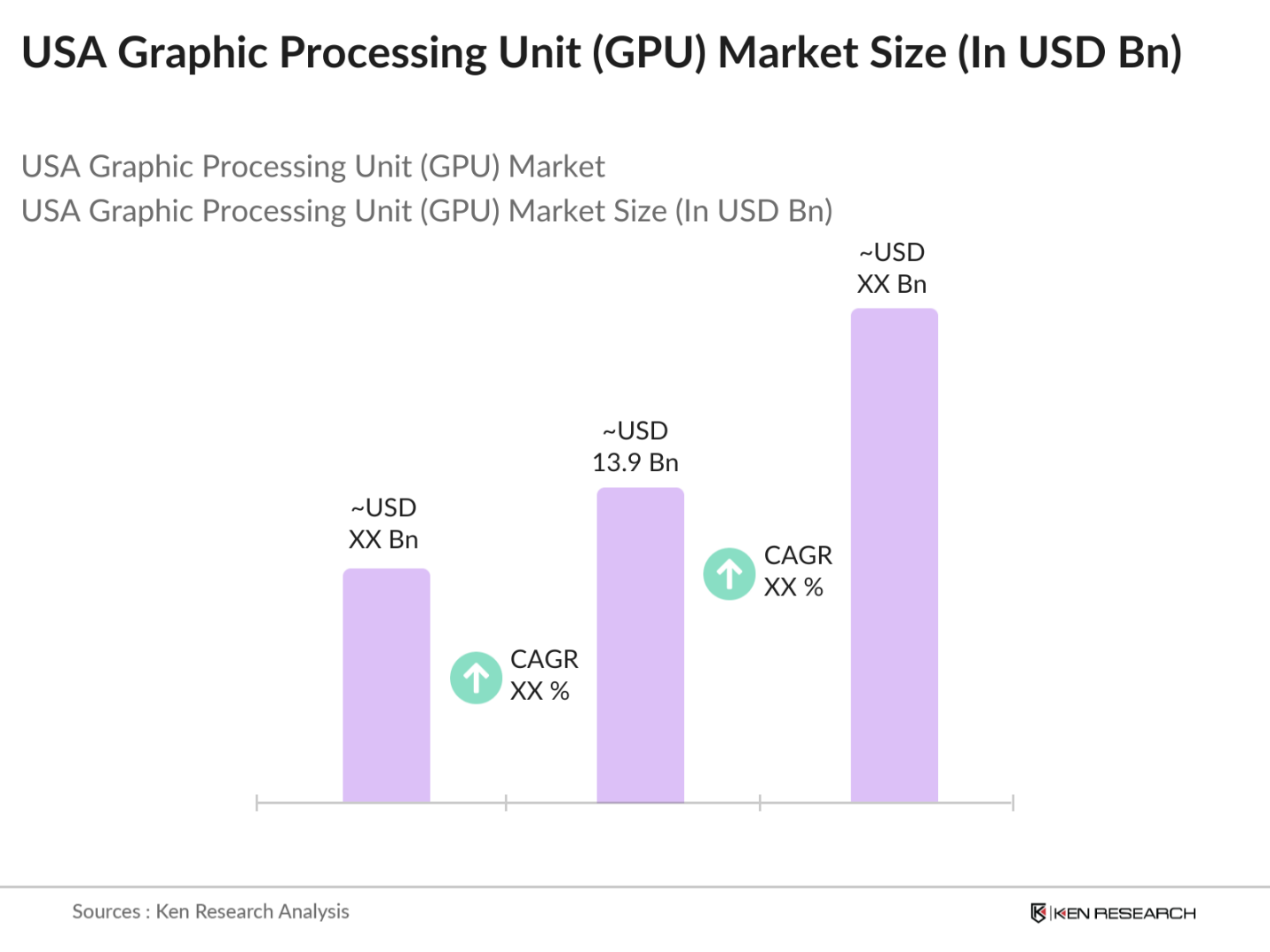
- The USA GPU market is valued at USD 13.9 billion based on a five-year historical analysis, driven largely by demand across gaming, AI applications, and data-intensive tasks in data centers. Rising investments in AI and machine learning by corporations and government agencies, as well as high-performance computing needs in various sectors, continue to propel the market. Additionally, the expanding gaming sector further sustains growth due to enhanced visual demands in PC and console gaming.
- The USA GPU market sees considerable dominance in Silicon Valley, California, due to the concentration of major technology companies, research institutions, and AI-focused startups. New York, as a financial hub, also leads due to increasing demand for data-driven insights powered by GPUs. Texas emerges as a center of data center expansions, driven by affordable energy resources and favorable government policies, further enhancing GPU adoption in data processing applications.
- Export control measures on semiconductor technology to specific regions have impacted GPU exports. U.S. government restrictions on China have resulted in a 20% reduction in GPU export volumes in 2023. Such regulations aim to protect U.S. technology but pose a challenge for companies relying on foreign markets.
USA GPU Market Segmentation
By Product Type: The market is segmented by product type into Dedicated GPUs, Integrated GPUs, and Hybrid GPUs. Dedicated GPUs hold a dominant market share in the USA within this segmentation due to their widespread use in high-performance gaming and computationally intense applications such as artificial intelligence and scientific modeling. These GPUs are preferred for their powerful processing capabilities, which meet the demands of industries like gaming, healthcare, and automotive for advanced graphics and data processing.

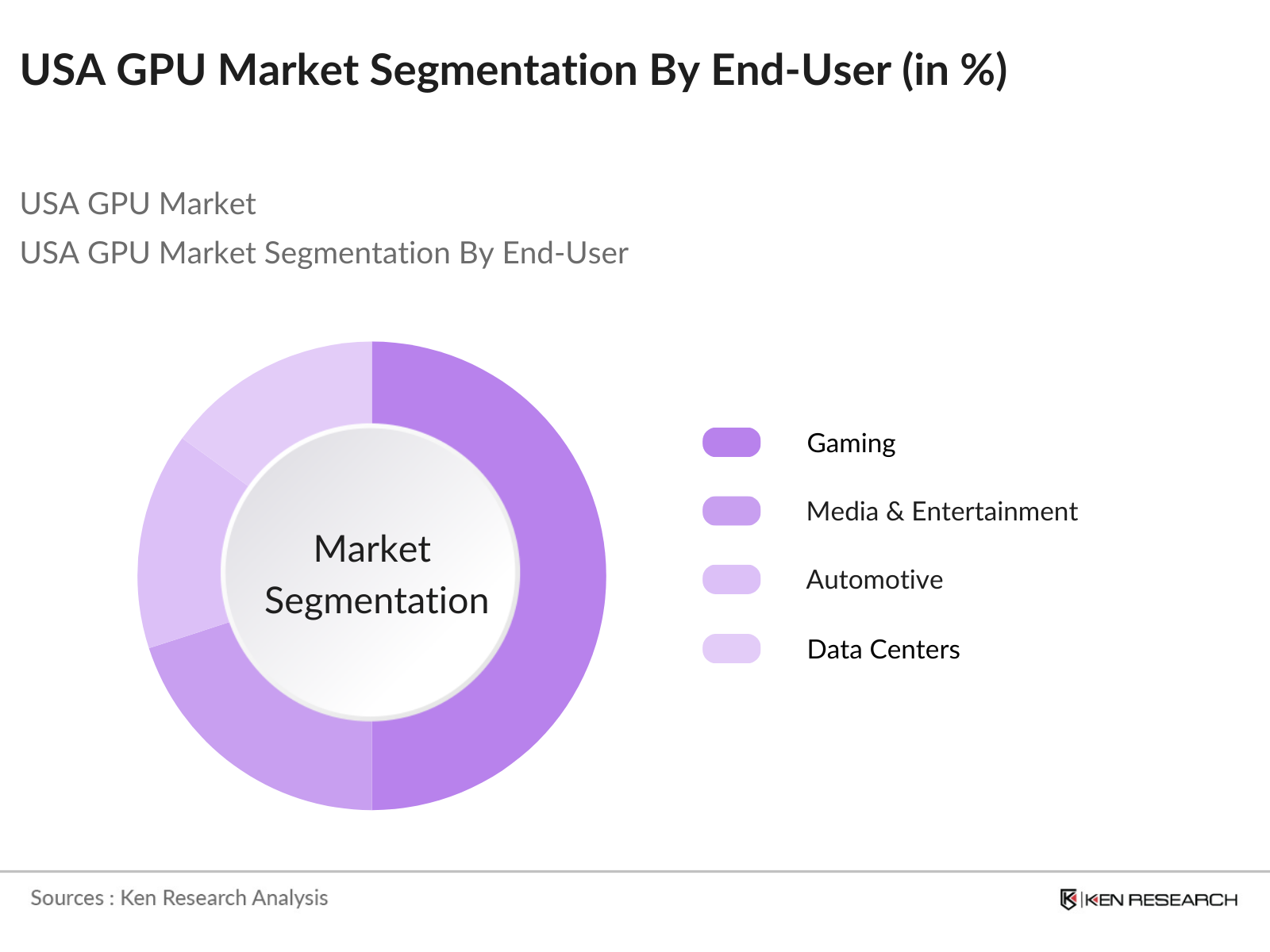
By End-Use Industry: The market is further segmented by end-use industry into Gaming, Media and Entertainment, Automotive, Data Centers, and Healthcare. The Gaming segment leads this market due to the high-performance needs of modern games and consumer demand for ultra-realistic graphics. Major brands continue innovating within this segment to enhance user experience, positioning gaming GPUs as a top choice among enthusiasts and professionals.
USA GPU Market Competitive Landscape
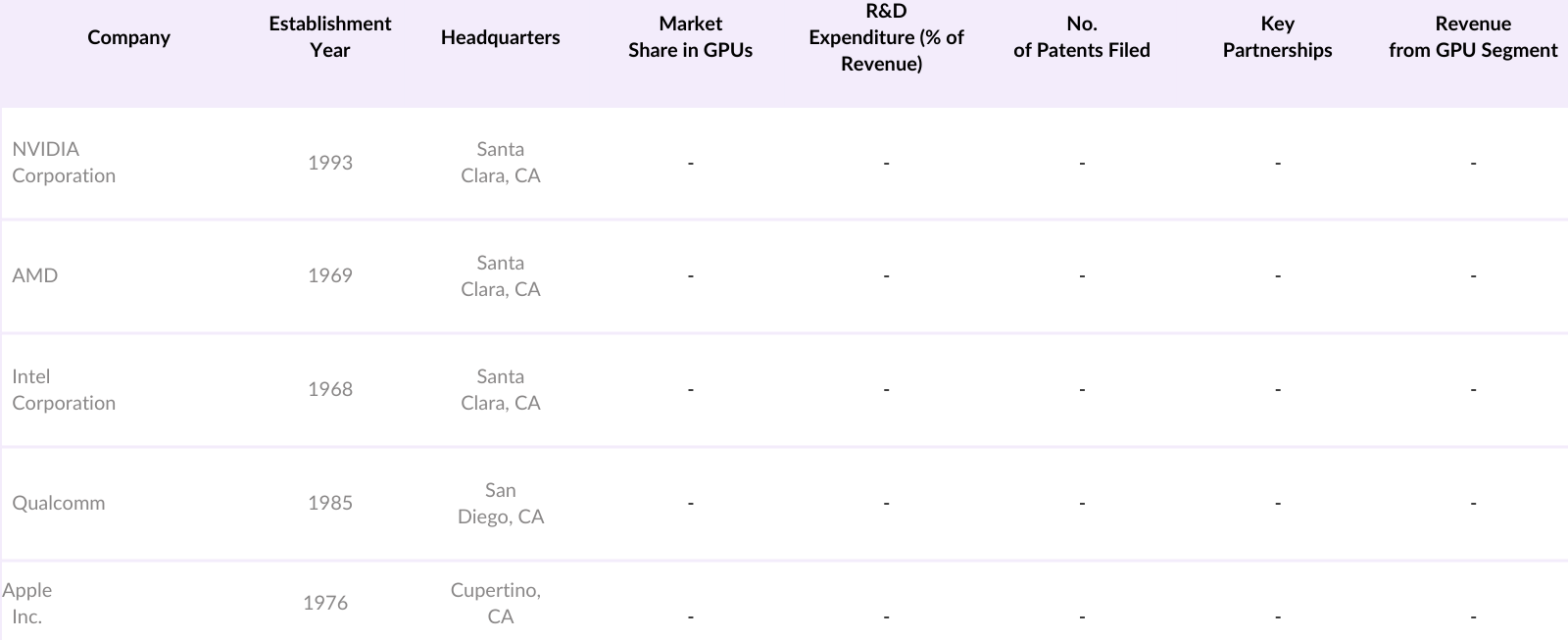
The USA GPU market is dominated by several major players, including global tech giants and specialized chip manufacturers. This consolidation underscores the influence of key players in shaping the technology landscape and market trends.
USA GPU Industry Analysis
Growth Drivers
- Gaming Industry Expansion: The U.S. gaming sector has seen substantial growth, driven by a rise in gaming devices requiring high-performance GPUs. With nearly 180 million gamers in the U.S. by 2024, demand for immersive, high-graphics games continues to climb, fostering GPU demand. Further, the U.S. gaming industry generated $54 billion in 2023, reflecting a push for advanced graphics capabilities in GPUs.
- AI and Machine Learning Applications: The U.S. remains a leader in AI, with federal investments in AI technology exceeding $4.2 billion in 2023, accelerating the need for GPUs to handle complex computations. Government support, including initiatives from the National AI Initiative Act, has strengthened GPU demand for machine learning tasks across industries like healthcare and finance. AI R&D expenditures in the U.S. were estimated at $93.5 billion in 2023.
- Cryptocurrency Mining: Cryptocurrency mining, especially in states like Texas, remains a prominent use case for high-performance GPUs. Despite regulatory challenges, the U.S. accounted for 37% of global Bitcoin mining as of early 2023. Mining operators demand energy-efficient GPUs, with operational costs reaching $5 billion annually across the U.S., underscoring the need for advanced GPUs.
Market Challenges
- High Manufacturing Costs (Cost Per Transistor): Manufacturing high-performance GPUs in the U.S. involves steep costs, with each transistor's cost rising by 35% in advanced nodes. The U.S. semiconductor sector reported an average manufacturing cost increase of 8% in 2023, owing to cutting-edge materials and processes. The high capital expenditure impacts profit margins, particularly in smaller companies.
- Supply Chain Disruptions: Post-pandemic supply chain complexities remain a concern, with semiconductor manufacturing lead times peaking at 27 weeks in 2023. The U.S. relies on imported components for GPUs, with imports of such items valued at $68 billion in 2022. Current tariffs on essential semiconductor components exacerbate delays and costs.
USA GPU Market Future Outlook
Over the next five years, the USA GPU market is expected to experience steady growth, driven by ongoing advancements in AI, rising demand for gaming and VR applications, and the expansion of data center infrastructure. This market will also benefit from government-backed technology initiatives and private investments in research and development. Enhanced processing capabilities and energy-efficient GPU models are anticipated to further boost market expansion.
Market Opportunities
- Demand for Energy-Efficient GPUs: Energy consumption in GPUs is under scrutiny, with data centers alone consuming 70 billion kWh annually in the U.S. The push for energy-efficient GPUs is an opportunity, supported by the governments Energy Star program for efficient computing. Lowering GPU power consumption by 20% could save approximately $1.5 billion annually in energy costs across the U.S.
- Integration with Edge Computing: Edge computing is rapidly growing, with U.S. companies investing over $50 billion in edge networks by 2024. GPU integration at the edge enables real-time data processing in sectors like healthcare and manufacturing. The U.S. government has announced grants for edge computing innovations, encouraging GPU deployment for local data processing applications.
Scope of the Report
|
Product Type |
Dedicated GPUs Integrated GPUs Hybrid GPUs |
|
End-Use Industry |
Gaming Media and Entertainment Automotive Data Centers Healthcare |
|
Technology |
Ray Tracing Rasterization AI Accelerated GPUs |
|
Deployment Model |
Cloud-based On-premises Hybrid |
|
Architecture |
GPU Clusters Unified Memory Access (UMA) Discrete Memory Access (DMA) |
Products
Key Target Audience
Investors and Venture Capital Firms
GPU Manufacturers and Suppliers
Gaming Industry Stakeholders
Data Center Operators
Automotive Manufacturers
Healthcare Tech Firms
Media and Entertainment Companies
Government and Regulatory Bodies (U.S. Department of Commerce, Federal Trade Commission)
Companies
Players Mentioned in the Report
NVIDIA Corporation
AMD (Advanced Micro Devices, Inc.)
Intel Corporation
Qualcomm Technologies, Inc.
Apple Inc.
Samsung Electronics Co., Ltd.
ARM Holdings
IBM Corporation
Google Inc.
Microsoft Corporation
Table of Contents
1. USA GPU Market Overview
1.1. Definition and Scope
1.2. Market Taxonomy
1.3. Market Growth Rate
1.4. Market Segmentation Overview
2. USA GPU Market Size (In USD Bn)
2.1. Historical Market Size
2.2. Year-On-Year Growth Analysis
2.3. Key Market Developments and Milestones
3. USA GPU Market Analysis
3.1. Growth Drivers
3.1.1. Gaming Industry Expansion
3.1.2. AI and Machine Learning Applications
3.1.3. Cryptocurrency Mining
3.1.4. Increased Demand for Data Centers
3.1.5. Government Digital Transformation Initiatives
3.2. Market Challenges
3.2.1. High Manufacturing Costs (Cost Per Transistor)
3.2.2. Supply Chain Disruptions
3.2.3. Regulatory Restrictions on Exports
3.3. Opportunities
3.3.1. Demand for Energy-Efficient GPUs
3.3.2. Integration with Edge Computing
3.3.3. Collaboration with Cloud Providers
3.4. Trends
3.4.1. Shift to GPU-as-a-Service
3.4.2. Demand for High-Performance Computing (HPC)
3.4.3. Hybrid Cloud GPU Utilization
3.5. Government Regulations
3.5.1. Export Control Measures
3.5.2. Data Localization Laws
3.5.3. Semiconductor Manufacturing Incentives
3.6. SWOT Analysis
3.7. Value Chain Analysis
3.8. Porters Five Forces
3.9. Competition Ecosystem
4. USA GPU Market Segmentation
4.1. By Product Type (In Value %)
4.1.1. Dedicated GPUs
4.1.2. Integrated GPUs
4.1.3. Hybrid GPUs
4.2. By End-Use Industry (In Value %)
4.2.1. Gaming
4.2.2. Media and Entertainment
4.2.3. Automotive
4.2.4. Data Centers
4.2.5. Healthcare
4.3. By Technology (In Value %)
4.3.1. Ray Tracing
4.3.2. Rasterization
4.3.3. Artificial Intelligence (AI) Accelerated GPUs
4.4. By Deployment Model (In Value %)
4.4.1. Cloud-based
4.4.2. On-premises
4.4.3. Hybrid
4.5. By Architecture (In Value %)
4.5.1. GPU Clusters
4.5.2. Unified Memory Access (UMA)
4.5.3. Discrete Memory Access (DMA)
5. USA GPU Market Competitive Analysis
5.1. Detailed Profiles of Major Companies
5.1.1. NVIDIA Corporation
5.1.2. AMD (Advanced Micro Devices, Inc.)
5.1.3. Intel Corporation
5.1.4. Qualcomm Technologies, Inc.
5.1.5. Samsung Electronics Co., Ltd.
5.1.6. ARM Holdings
5.1.7. Apple Inc.
5.1.8. IBM Corporation
5.1.9. Google Inc.
5.1.10. Microsoft Corporation
5.1.11. ASUS
5.1.12. EVGA Corporation
5.1.13. Gigabyte Technology Co., Ltd.
5.1.14. Hewlett Packard Enterprise (HPE)
5.1.15. Tesla, Inc. (For AI Acceleration)
5.2. Cross Comparison Parameters
5.2.1. No. of Patents Filed
5.2.2. Headquarters Location
5.2.3. Manufacturing Facilities
5.2.4. Revenue from GPU Segment
5.2.5. Employee Count in R&D
5.2.6. Technology Partnerships
5.2.7. Customer Segmentation
5.2.8. Product Launch Frequency
5.3. Market Share Analysis
5.4. Strategic Initiatives
5.5. Mergers and Acquisitions
5.6. Investment Analysis
5.7. Venture Capital Funding
5.8. Government Grants
5.9. Private Equity Investments
6. USA GPU Market Regulatory Framework
6.1. Environmental Standards for Manufacturing
6.2. Compliance with Export Regulations
6.3. Certification Processes
7. USA GPU Future Market Size (In USD Bn)
7.1. Future Market Size Projections
7.2. Key Factors Driving Future Market Growth
8. USA GPU Future Market Segmentation
8.1. By Product Type (In Value %)
8.2. By End-Use Industry (In Value %)
8.3. By Technology (In Value %)
8.4. By Deployment Model (In Value %)
8.5. By Architecture (In Value %)
9. USA GPU Market Analyst Recommendations
9.1. TAM/SAM/SOM Analysis
9.2. Customer Cohort Analysis
9.3. Marketing Initiatives
9.4. White Space Opportunity Analysis
Disclaimer Contact UsResearch Methodology
Step 1: Identification of Key Variables
This initial phase involves developing an ecosystem map to identify and define all major stakeholders in the USA GPU Market. Extensive desk research, incorporating secondary and proprietary databases, helps outline critical variables impacting the market.
Step 2: Market Analysis and Construction
Historical data for the USA GPU Market is compiled and analyzed. This involves examining market penetration, end-use distribution, and financial data, ensuring accuracy and reliability in revenue estimates.
Step 3: Hypothesis Validation and Expert Consultation
Market hypotheses are validated through expert interviews, gathering insights from representatives across various companies. These consultations ensure practical and financial accuracy in the data.
Step 4: Research Synthesis and Final Output
Direct engagement with GPU manufacturers provides detailed information on product segments, sales performance, and consumer preferences. This data is then verified against bottom-up analysis for accuracy and market relevance.
Frequently Asked Questions
01. How big is the USA GPU Market?
The USA GPU market is valued at USD 13.9 billion based on a five-year historical analysis, driven largely by demand across gaming, AI applications, and data-intensive tasks in data centers.
02. What are the challenges in the USA GPU Market?
Challenges include high manufacturing costs, reliance on advanced semiconductor technologies, and regulatory hurdles in export controls, affecting market expansion.
03. Who are the major players in the USA GPU Market?
Key players include NVIDIA Corporation, AMD, Intel Corporation, Qualcomm, and Apple Inc., each leading with strong R&D and diversified product portfolios.
04. What drives growth in the USA GPU Market?
The market is propelled by AI applications, increased gaming demand, and the need for advanced data processing in data centers, spurred by technological advancements.
Why Buy From Us?

What makes us stand out is that our consultants follows Robust, Refine and Result (RRR) methodology. i.e. Robust for clear definitions, approaches and sanity checking, Refine for differentiating respondents facts and opinions and Result for presenting data with story

We have set a benchmark in the industry by offering our clients with syndicated and customized market research reports featuring coverage of entire market as well as meticulous research and analyst insights.

While we don't replace traditional research, we flip the method upside down. Our dual approach of Top Bottom & Bottom Top ensures quality deliverable by not just verifying company fundamentals but also looking at the sector and macroeconomic factors.

With one step in the future, our research team constantly tries to show you the bigger picture. We help with some of the tough questions you may encounter along the way: How is the industry positioned? Best marketing channel? KPI's of competitors? By aligning every element, we help maximize success.

Our report gives you instant access to the answers and sources that other companies might choose to hide. We elaborate each steps of research methodology we have used and showcase you the sample size to earn your trust.

If you need any support, we are here! We pride ourselves on universe strength, data quality, and quick, friendly, and professional service.